Rectifiers and Filter Circuits
Rakesh Kumar Sheoran
Assistant Professor in Physics
Prarambh IASE, Jhajjar (Haryana)
13/04/2020
Rectifier
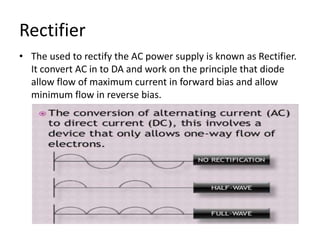
• The used to rectify the AC power supply is known as Rectifier.
It convert AC in to DA and work on the principle that diode
allow flow of maximum current in forward bias and allow
minimum flow in reverse bias.
Types of rectifiers
• Half Wave Rectifier (HWR)
• Full Wave Rectifier (FWR)
- Centre Tapped Rectifier
- Bridge Rectifier
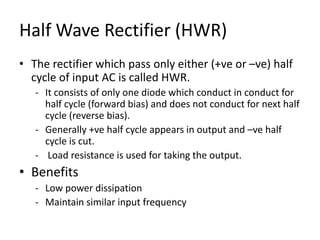
Half Wave Rectifier (HWR)
• The rectifier which pass only either (+ve or –ve) half
cycle of input AC is called HWR.
- It consists of only one diode which conduct in conduct for
half cycle (forward bias) and does not conduct for next half
cycle (reverse bias).
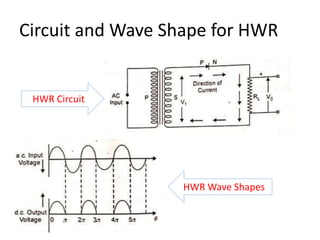
- Generally +ve half cycle appears in output and –ve half
cycle is cut.
- Load resistance is used for taking the output.
• Benefits
- Low power dissipation
- Maintain similar input frequency
Circuit and Wave Shape for HWR
HWR Circuit
HWR Wave Shapes
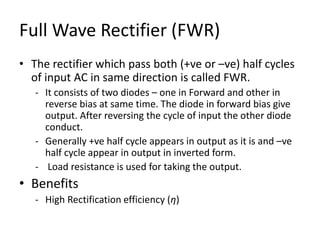
Full Wave Rectifier (FWR)
• The rectifier which pass both (+ve or –ve) half cycles
of input AC in same direction is called FWR.
- It consists of two diodes – one in Forward and other in
reverse bias at same time. The diode in forward bias give
output. After reversing the cycle of input the other diode
conduct.
- Generally +ve half cycle appears in output as it is and –ve
half cycle appear in output in inverted form.
- Load resistance is used for taking the output.
• Benefits
- High Rectification efficiency (η)
FWR (contd…)
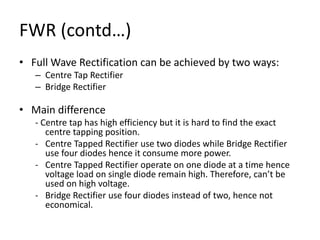
• Full Wave Rectification can be achieved by two ways:
– Centre Tap Rectifier
– Bridge Rectifier
• Main difference
- Centre tap has high efficiency but it is hard to find the exact
centre tapping position.
- Centre Tapped Rectifier use two diodes while Bridge Rectifier
use four diodes hence it consume more power.
- Centre Tapped Rectifier operate on one diode at a time hence
voltage load on single diode remain high. Therefore, can’t be
used on high voltage.
- Bridge Rectifier use four diodes instead of two, hence not
economical.
Centre Tapped FWR (contd…)
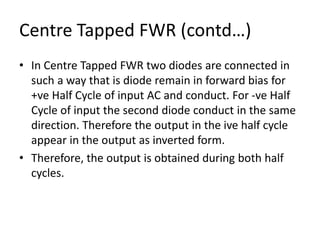
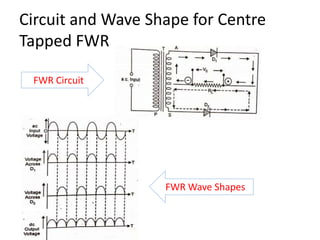
• In Centre Tapped FWR two diodes are connected in
such a way that is diode remain in forward bias for
+ve Half Cycle of input AC and conduct. For -ve Half
Cycle of input the second diode conduct in the same
direction. Therefore the output in the ive half cycle
appear in the output as inverted form.
• Therefore, the output is obtained during both half
cycles.
Circuit and Wave Shape for Centre
Tapped FWR
FWR Circuit
FWR Wave Shapes
Bridge Rectifier
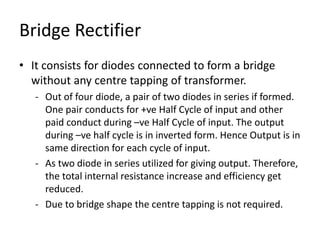
• It consists for diodes connected to form a bridge
without any centre tapping of transformer.
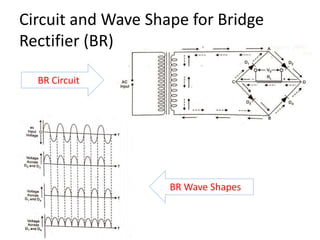
- Out of four diode, a pair of two diodes in series if formed.
One pair conducts for +ve Half Cycle of input and other
paid conduct during –ve Half Cycle of input. The output
during –ve half cycle is in inverted form. Hence Output is in
same direction for each cycle of input.
- As two diode in series utilized for giving output. Therefore,
the total internal resistance increase and efficiency get
reduced.
- Due to bridge shape the centre tapping is not required.
Circuit and Wave Shape for Bridge
Rectifier (BR)
BR Circuit
BR Wave Shapes
Rectification Efficiency & Ripple Factor
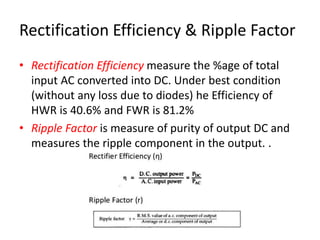
• Rectification Efficiency measure the %age of total
input AC converted into DC. Under best condition
(without any loss due to diodes) he Efficiency of
HWR is 40.6% and FWR is 81.2%
• Ripple Factor is measure of purity of output DC and
measures the ripple component in the output. .
Rectification Efficiency & Ripple Factor
• Rectification Efficiency measure the %age of total
input AC converted into DC. Under best condition
(without any loss due to diodes) he Efficiency of
HWR is 40.6% and FWR is 81.2%
• Ripple Factor is measure of purity of output DC and
measures the ripple component in the output. .
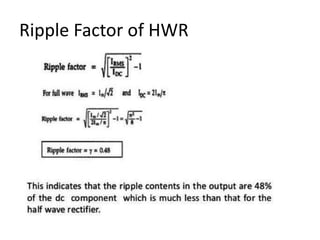
Ripple Factor of HWR
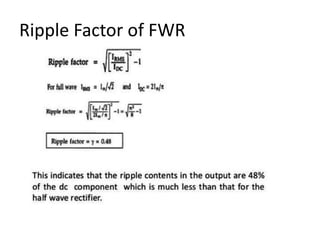
Ripple Factor of FWR
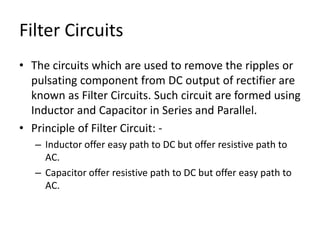
Filter Circuits
• The circuits which are used to remove the ripples or
pulsating component from DC output of rectifier are
known as Filter Circuits. Such circuit are formed using
Inductor and Capacitor in Series and Parallel.
• Principle of Filter Circuit: -
– Inductor offer easy path to DC but offer resistive path to
AC.
– Capacitor offer resistive path to DC but offer easy path to
AC.
Types of Filter Circuit
• Series Inductor Filter / L-Filter)
• Shunt Capacitor filter
• Choke Inductor Filter (L– Section Filter)
• Capacitor Input Filter (π -section Filter)
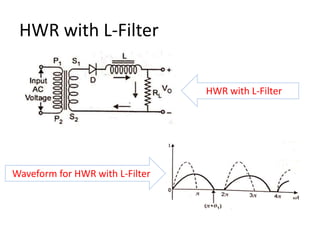
HWR with L-Filter
HWR with L-Filter
Waveform for HWR with L-Filter
HWR with L-Filter (contd…)
• When current through Inductor (L) tends to increase, it oppose the
growth of current and store the excess energy in the form of
Magnetic Field.
• When current through Inductor (L) tends to decrease, it oppose the
decay of current and provide stored energy stored form the
Magnetic Field.
• Due to this the span of current flow through Load Resistance (RL)
increase.
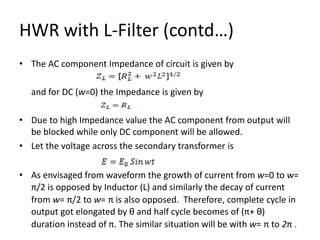
HWR with L-Filter (contd…)
• The AC component Impedance of circuit is given by
and for DC (w=0) the Impedance is given by
• Due to high Impedance value the AC component from output will
be blocked while only DC component will be allowed.
• Let the voltage across the secondary transformer is
• As envisaged from waveform the growth of current from w=0 to w=
π/2 is opposed by Inductor (L) and similarly the decay of current
from w= π/2 to w= π is also opposed. Therefore, complete cycle in
output got elongated by θ and half cycle becomes of (π+ θ)
duration instead of π. The similar situation will be with w= π to 2π .
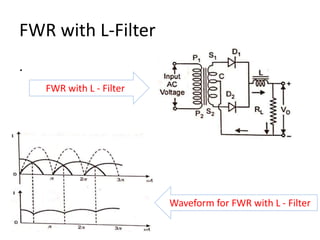
FWR with L-Filter
.
FWR with L - Filter
Waveform for FWR with L - Filter
Ripple Factor for FWR with L-Filter
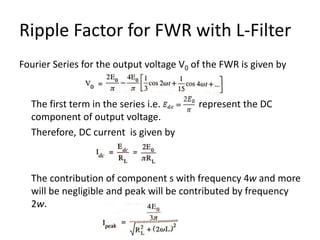
Fourier Series for the output voltage V0 of the FWR is given by
The first term in the series i.e. represent the DC
component of output voltage.
Therefore, DC current is given by
The contribution of component s with frequency 4w and more
will be negligible and peak will be contributed by frequency
2w.
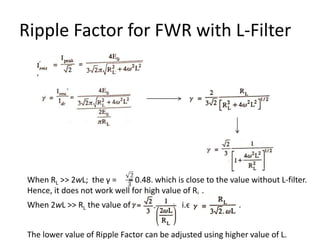
Ripple Factor for FWR with L-Filter
When RL >> 2wL; the γ = = 0.48. which is close to the value without L-filter.
Hence, it does not work well for high value of RL .
When 2wL >> RL the value of i.e. .
The lower value of Ripple Factor can be adjusted using higher value of L.
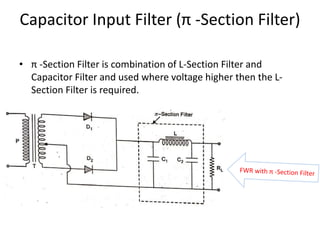
Capacitor Input Filter (π -Section Filter)
• π -Section Filter is combination of L-Section Filter and
Capacitor Filter and used where voltage higher then the L-
Section Filter is required.
Capacitor Input Filter (π -Section Filter)
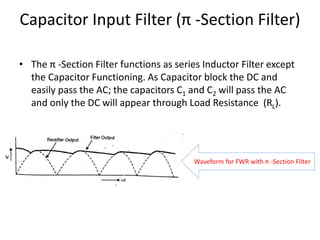
• The π -Section Filter functions as series Inductor Filter except
the Capacitor Functioning. As Capacitor block the DC and
easily pass the AC; the capacitors C1 and C2 will pass the AC
and only the DC will appear through Load Resistance (RL).
Waveform for FWR with π -Section Filter
Capacitor Input Filter (π -Section Filter)
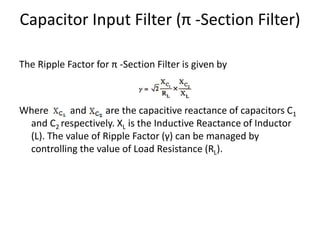
The Ripple Factor for π -Section Filter is given by
Where and are the capacitive reactance of capacitors C1
and C2 respectively. XL is the Inductive Reactance of Inductor
(L). The value of Ripple Factor (γ) can be managed by
controlling the value of Load Resistance (RL).
Assignment
1. What is rectifier? Explain, how p-n junction diode can be used as Half
Wave Rectifier. Also draw the output waveform.
2. Explain the functioning of Central Tap Full Wave Rectifier and calculate
its Ripple Factor.
3. Explain functioning of Bridge Rectifier with neat and clean diagram.
4. What is Filter Circuit? Explain following Filter Circuits and calculate
Ripple Factor for them:
(i) L-Filter
(ii) π -Section Filter
5. Explain the following terms:
(i) Ripple Factor
(ii) Rectification Efficiency
Thank You

Rectifiers and Filter Circuits

  • 1.
    Rectifiers and FilterCircuits Rakesh Kumar Sheoran Assistant Professor in Physics Prarambh IASE, Jhajjar (Haryana) 13/04/2020
  • 2.
    Rectifier • The usedto rectify the AC power supply is known as Rectifier. It convert AC in to DA and work on the principle that diode allow flow of maximum current in forward bias and allow minimum flow in reverse bias.
  • 3.
    Types of rectifiers •Half Wave Rectifier (HWR) • Full Wave Rectifier (FWR) - Centre Tapped Rectifier - Bridge Rectifier
  • 4.
    Half Wave Rectifier(HWR) • The rectifier which pass only either (+ve or –ve) half cycle of input AC is called HWR. - It consists of only one diode which conduct in conduct for half cycle (forward bias) and does not conduct for next half cycle (reverse bias). - Generally +ve half cycle appears in output and –ve half cycle is cut. - Load resistance is used for taking the output. • Benefits - Low power dissipation - Maintain similar input frequency
  • 5.
    Circuit and WaveShape for HWR HWR Circuit HWR Wave Shapes
  • 6.
    Full Wave Rectifier(FWR) • The rectifier which pass both (+ve or –ve) half cycles of input AC in same direction is called FWR. - It consists of two diodes – one in Forward and other in reverse bias at same time. The diode in forward bias give output. After reversing the cycle of input the other diode conduct. - Generally +ve half cycle appears in output as it is and –ve half cycle appear in output in inverted form. - Load resistance is used for taking the output. • Benefits - High Rectification efficiency (η)
  • 7.
    FWR (contd…) • FullWave Rectification can be achieved by two ways: – Centre Tap Rectifier – Bridge Rectifier • Main difference - Centre tap has high efficiency but it is hard to find the exact centre tapping position. - Centre Tapped Rectifier use two diodes while Bridge Rectifier use four diodes hence it consume more power. - Centre Tapped Rectifier operate on one diode at a time hence voltage load on single diode remain high. Therefore, can’t be used on high voltage. - Bridge Rectifier use four diodes instead of two, hence not economical.
  • 8.
    Centre Tapped FWR(contd…) • In Centre Tapped FWR two diodes are connected in such a way that is diode remain in forward bias for +ve Half Cycle of input AC and conduct. For -ve Half Cycle of input the second diode conduct in the same direction. Therefore the output in the ive half cycle appear in the output as inverted form. • Therefore, the output is obtained during both half cycles.
  • 9.
    Circuit and WaveShape for Centre Tapped FWR FWR Circuit FWR Wave Shapes
  • 10.
    Bridge Rectifier • Itconsists for diodes connected to form a bridge without any centre tapping of transformer. - Out of four diode, a pair of two diodes in series if formed. One pair conducts for +ve Half Cycle of input and other paid conduct during –ve Half Cycle of input. The output during –ve half cycle is in inverted form. Hence Output is in same direction for each cycle of input. - As two diode in series utilized for giving output. Therefore, the total internal resistance increase and efficiency get reduced. - Due to bridge shape the centre tapping is not required.
  • 11.
    Circuit and WaveShape for Bridge Rectifier (BR) BR Circuit BR Wave Shapes
  • 12.
    Rectification Efficiency &Ripple Factor • Rectification Efficiency measure the %age of total input AC converted into DC. Under best condition (without any loss due to diodes) he Efficiency of HWR is 40.6% and FWR is 81.2% • Ripple Factor is measure of purity of output DC and measures the ripple component in the output. .
  • 13.
    Rectification Efficiency &Ripple Factor • Rectification Efficiency measure the %age of total input AC converted into DC. Under best condition (without any loss due to diodes) he Efficiency of HWR is 40.6% and FWR is 81.2% • Ripple Factor is measure of purity of output DC and measures the ripple component in the output. .
  • 14.
  • 15.
  • 16.
    Filter Circuits • Thecircuits which are used to remove the ripples or pulsating component from DC output of rectifier are known as Filter Circuits. Such circuit are formed using Inductor and Capacitor in Series and Parallel. • Principle of Filter Circuit: - – Inductor offer easy path to DC but offer resistive path to AC. – Capacitor offer resistive path to DC but offer easy path to AC.
  • 17.
    Types of FilterCircuit • Series Inductor Filter / L-Filter) • Shunt Capacitor filter • Choke Inductor Filter (L– Section Filter) • Capacitor Input Filter (π -section Filter)
  • 18.
    HWR with L-Filter HWRwith L-Filter Waveform for HWR with L-Filter
  • 19.
    HWR with L-Filter(contd…) • When current through Inductor (L) tends to increase, it oppose the growth of current and store the excess energy in the form of Magnetic Field. • When current through Inductor (L) tends to decrease, it oppose the decay of current and provide stored energy stored form the Magnetic Field. • Due to this the span of current flow through Load Resistance (RL) increase.
  • 20.
    HWR with L-Filter(contd…) • The AC component Impedance of circuit is given by and for DC (w=0) the Impedance is given by • Due to high Impedance value the AC component from output will be blocked while only DC component will be allowed. • Let the voltage across the secondary transformer is • As envisaged from waveform the growth of current from w=0 to w= π/2 is opposed by Inductor (L) and similarly the decay of current from w= π/2 to w= π is also opposed. Therefore, complete cycle in output got elongated by θ and half cycle becomes of (π+ θ) duration instead of π. The similar situation will be with w= π to 2π .
  • 21.
    FWR with L-Filter . FWRwith L - Filter Waveform for FWR with L - Filter
  • 22.
    Ripple Factor forFWR with L-Filter Fourier Series for the output voltage V0 of the FWR is given by The first term in the series i.e. represent the DC component of output voltage. Therefore, DC current is given by The contribution of component s with frequency 4w and more will be negligible and peak will be contributed by frequency 2w.
  • 23.
    Ripple Factor forFWR with L-Filter When RL >> 2wL; the γ = = 0.48. which is close to the value without L-filter. Hence, it does not work well for high value of RL . When 2wL >> RL the value of i.e. . The lower value of Ripple Factor can be adjusted using higher value of L.
  • 24.
    Capacitor Input Filter(π -Section Filter) • π -Section Filter is combination of L-Section Filter and Capacitor Filter and used where voltage higher then the L- Section Filter is required.
  • 25.
    Capacitor Input Filter(π -Section Filter) • The π -Section Filter functions as series Inductor Filter except the Capacitor Functioning. As Capacitor block the DC and easily pass the AC; the capacitors C1 and C2 will pass the AC and only the DC will appear through Load Resistance (RL). Waveform for FWR with π -Section Filter
  • 26.
    Capacitor Input Filter(π -Section Filter) The Ripple Factor for π -Section Filter is given by Where and are the capacitive reactance of capacitors C1 and C2 respectively. XL is the Inductive Reactance of Inductor (L). The value of Ripple Factor (γ) can be managed by controlling the value of Load Resistance (RL).
  • 27.
    Assignment 1. What isrectifier? Explain, how p-n junction diode can be used as Half Wave Rectifier. Also draw the output waveform. 2. Explain the functioning of Central Tap Full Wave Rectifier and calculate its Ripple Factor. 3. Explain functioning of Bridge Rectifier with neat and clean diagram. 4. What is Filter Circuit? Explain following Filter Circuits and calculate Ripple Factor for them: (i) L-Filter (ii) π -Section Filter 5. Explain the following terms: (i) Ripple Factor (ii) Rectification Efficiency
  • 28.