JNN INSTITUTE OF
ENGINEERING
BE8255 – BASIC ELECTRICAL ELECTRONICS AND
MEASUREMENT ENGINEERING
MALATHY N, ASSISTANT PROFESSOR
Department of EEE
 To explain the basic theorems used in Electrical circuits and
the different components and function of electrical
machines.
 To explain the fundamentals of semiconductor and
applications.
 To explain the principles of digital electronics
 To impart knowledge of communication.
OBJECTIVES
At the end of the course, the students will able to
 Define the fundamental laws, theorems of electrical circuits
and principles and operation of measuring instruments.
 Summarize the basic principles of electrical machines and
their performance
 Utilize the different energy sources, protective devices and
their field applications
 Design the fundamentals of electronic circuit constructions.
 Explain the fundamentals of communication engineering.
COURSE OUTCOMES
TEXT BOOKS:
1. D P Kothari and I.J Nagarath, ”Electrical Machines “Basic Electrical and
Electronics Engineering”, McGraw Hill Education(India) Private Limited,
Third Reprint ,2016
2. S.K.Bhattacharya “Basic Electrical and Electronics Engineering”, Pearson
India, 2011
3. Sedha R.S., “Applied Electronics”, S. Chand & Co., 2006
REFERENCES
1. A.E.Fitzgerald, David E Higginbotham and Arvin Grabel, “Basic Electrical
Engineering”, McGraw Hill Education(India) Private Limited, 2009
2. Del Toro, “Electrical Engineering Fundamentals”, Pearson Education, New
Delhi, 2007
3. Leonard S Bobrow, “ Foundations of Electrical Engineering”, Oxford
University Press, 2013
4. Mahmood Nahvi and Joseph A. Edminister, “Electric Circuits”, Schaum’
Outline Series, McGraw Hill, 2002.
5. Mehta V K, “Principles of Electronics”, S.Chand & Company Ltd, 1994.
6. Nagsarkar T K and Sukhija M S, “Basics of Electrical Engineering”, Oxford
press 2005.
 DC and AC ROTATING MACHINES: Types, Construction,
principle, Emf and torque equation, application Speed
Control- Basics of Stepper Motor – Brushless DC motors-
Transformers-Introduction- types and construction, working
principle of Ideal transformer-Emf equation- All day
efficiency calculation.
 https://www.youtube.com/watch?v=IC-PWxtcirI
 https://www.youtube.com/watch?v=CWulQ1ZSE3c
UNIT II ELECTRICAL MACHINES
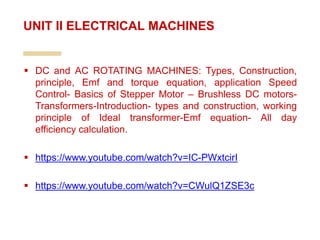
 A dc generator is a machine that converts mechanical
energy into electrical energy (dc voltage and current) by
using the principle of magnetic induction.
DC GENERATOR
1.Yoke or Magnetic frame
2. Pole core and pole
shoes
3. Field winding
4.Armature-Armature
core, Armature winding.
5. Commutator
6. Brushes
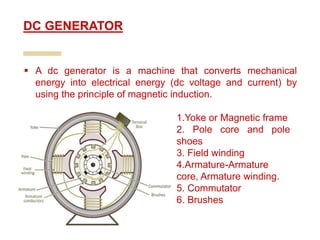
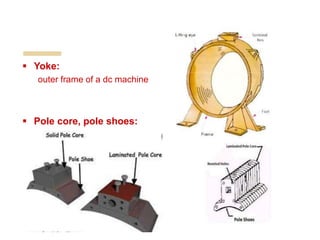
 Yoke:
outer frame of a dc machine
 Pole core, pole shoes:
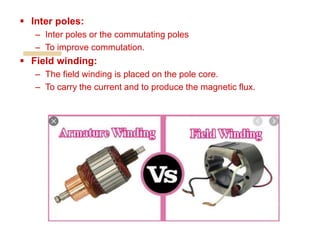
 Inter poles:
– Inter poles or the commutating poles
– To improve commutation.
 Field winding:
– The field winding is placed on the pole core.
– To carry the current and to produce the magnetic flux.
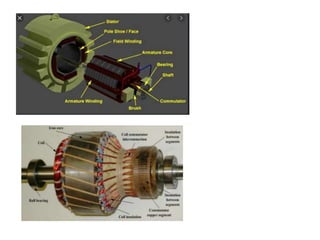
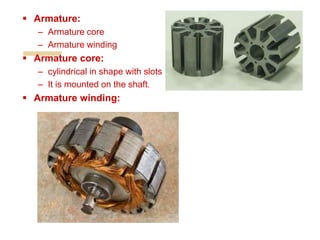
 Armature:
– Armature core
– Armature winding
 Armature core:
– cylindrical in shape with slots
– It is mounted on the shaft.
 Armature winding:
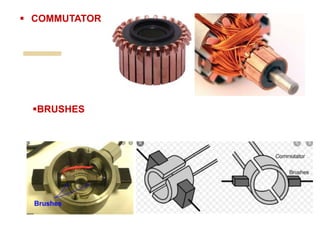
 COMMUTATOR
BRUSHES
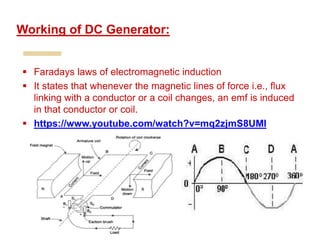
 Faradays laws of electromagnetic induction
 It states that whenever the magnetic lines of force i.e., flux
linking with a conductor or a coil changes, an emf is induced
in that conductor or coil.
 https://www.youtube.com/watch?v=mq2zjmS8UMI
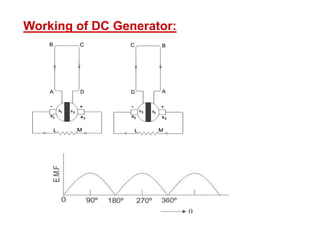
Working of DC Generator:
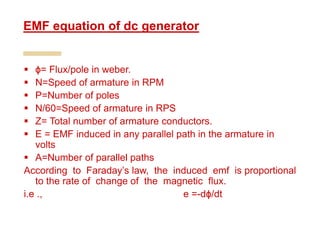
 ϕ= Flux/pole in weber.
 N=Speed of armature in RPM
 P=Number of poles
 N/60=Speed of armature in RPS
 Z= Total number of armature conductors.
 E = EMF induced in any parallel path in the armature in
volts
 A=Number of parallel paths
According to Faraday’s law, the induced emf is proportional
to the rate of change of the magnetic flux.
i.e ., e =-dϕ/dt
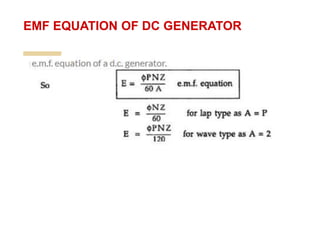
EMF equation of dc generator
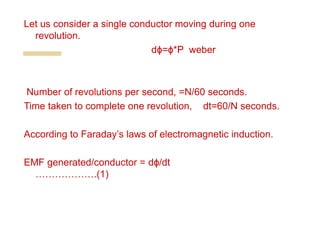
Let us consider a single conductor moving during one
revolution.
dϕ=ϕ*P weber
Number of revolutions per second, =N/60 seconds.
Time taken to complete one revolution, dt=60/N seconds.
According to Faraday’s laws of electromagnetic induction.
EMF generated/conductor = dϕ/dt
……………….(1)
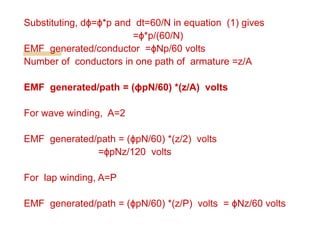
Substituting, dϕ=ϕ*p and dt=60/N in equation (1) gives
=ϕ*p/(60/N)
EMF generated/conductor =ϕNp/60 volts
Number of conductors in one path of armature =z/A
EMF generated/path = (ϕpN/60) *(z/A) volts
For wave winding, A=2
EMF generated/path = (ϕpN/60) *(z/2) volts
=ϕpNz/120 volts
For lap winding, A=P
EMF generated/path = (ϕpN/60) *(z/P) volts = ϕNz/60 volts
 Separately excited DC generator.
 Self excited DC generator
- DC shunt generator
- DC series generator
- DC compound generator
Types of DC generators
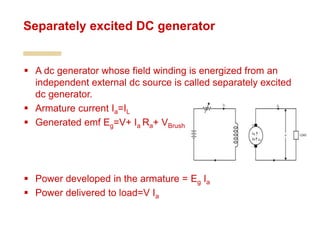
 A dc generator whose field winding is energized from an
independent external dc source is called separately excited
dc generator.
 Armature current Ia=IL
 Generated emf Eg=V+ Ia Ra+ VBrush
 Power developed in the armature = Eg Ia
 Power delivered to load=V Ia
Separately excited DC generator
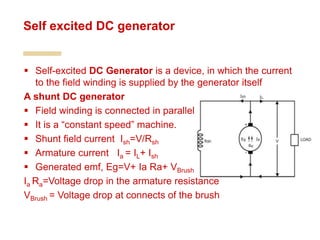
 Self-excited DC Generator is a device, in which the current
to the field winding is supplied by the generator itself
A shunt DC generator
 Field winding is connected in parallel with armature.
 It is a “constant speed” machine.
 Shunt field current Ish=V/Rsh
 Armature current Ia = IL+ Ish
 Generated emf, Eg=V+ Ia Ra+ VBrush
Ia Ra=Voltage drop in the armature resistance
VBrush = Voltage drop at connects of the brush
Self excited DC generator
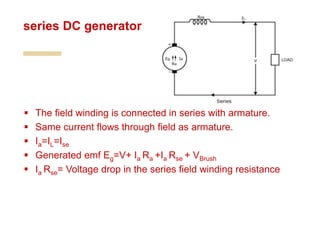
 The field winding is connected in series with armature.
 Same current flows through field as armature.
 Ia=IL=Ise
 Generated emf Eg=V+ Ia Ra +Ia Rse + VBrush
 Ia Rse= Voltage drop in the series field winding resistance
series DC generator
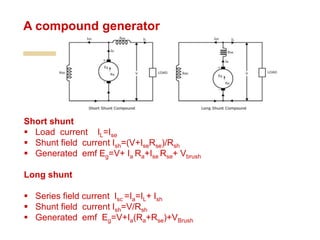
Short shunt
 Load current IL=Ise
 Shunt field current Ish=(V+IseRse)/Rsh
 Generated emf Eg=V+ Ia Ra+Ise Rse+ Vbrush
Long shunt
 Series field current Isc =Ia=IL+ Ish
 Shunt field current Ish=V/Rsh
 Generated emf Eg=V+Ia(Ra+Rse)+VBrush
A compound generator
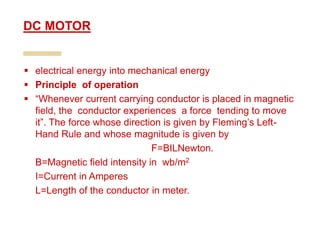
 electrical energy into mechanical energy
 Principle of operation
 “Whenever current carrying conductor is placed in magnetic
field, the conductor experiences a force tending to move
it”. The force whose direction is given by Fleming’s Left-
Hand Rule and whose magnitude is given by
F=BILNewton.
B=Magnetic field intensity in wb/m2
I=Current in Amperes
L=Length of the conductor in meter.
DC MOTOR
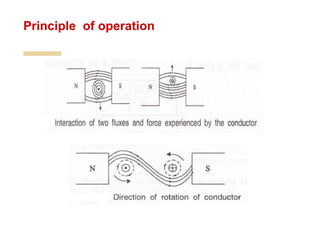
Principle of operation
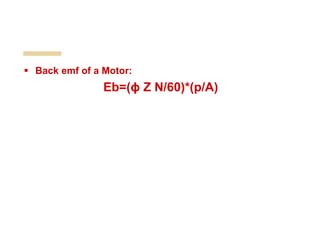
 Back emf of a Motor:
Eb=(ϕ Z N/60)*(p/A)
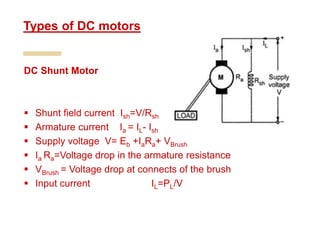
DC Shunt Motor
 Shunt field current Ish=V/Rsh
 Armature current Ia = IL- Ish
 Supply voltage V= Eb +IaRa+ VBrush
 Ia Ra=Voltage drop in the armature resistance
 VBrush = Voltage drop at connects of the brush
 Input current IL=PL/V
Types of DC motors
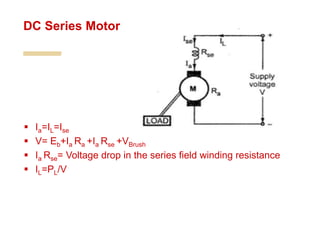
 Ia=IL=Ise
 V= Eb+Ia Ra +Ia Rse +VBrush
 Ia Rse= Voltage drop in the series field winding resistance
 IL=PL/V
DC Series Motor
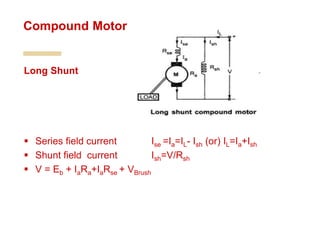
Long Shunt
 Series field current Ise =Ia=IL- Ish (or) IL=Ia+Ish
 Shunt field current Ish=V/Rsh
 V = Eb + IaRa+IaRse + VBrush
Compound Motor
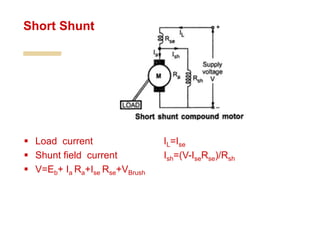
 Load current IL=Ise
 Shunt field current Ish=(V-IseRse)/Rsh
 V=Eb+ Ia Ra+Ise Rse+VBrush
Short Shunt
EMF EQUATION OF DC GENERATOR
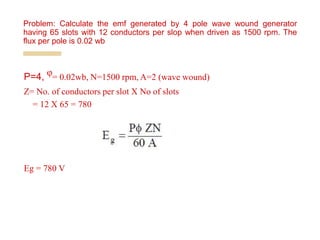
P=4, ᵠ= 0.02wb, N=1500 rpm, A=2 (wave wound)
Z= No. of conductors per slot X No of slots
= 12 X 65 = 780
Eg = 780 V
Problem: Calculate the emf generated by 4 pole wave wound generator
having 65 slots with 12 conductors per slop when driven as 1500 rpm. The
flux per pole is 0.02 wb
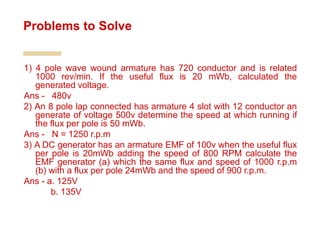
1) 4 pole wave wound armature has 720 conductor and is related
1000 rev/min. If the useful flux is 20 mWb, calculated the
generated voltage.
Ans - 480v
2) An 8 pole lap connected has armature 4 slot with 12 conductor an
generate of voltage 500v determine the speed at which running if
the flux per pole is 50 mWb.
Ans - N = 1250 r.p.m
3) A DC generator has an armature EMF of 100v when the useful flux
per pole is 20mWb adding the speed of 800 RPM calculate the
EMF generator (a) which the same flux and speed of 1000 r.p.m
(b) with a flux per pole 24mWb and the speed of 900 r.p.m.
Ans - a. 125V
b. 135V
Problems to Solve
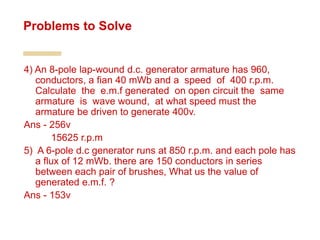
4) An 8-pole lap-wound d.c. generator armature has 960,
conductors, a fian 40 mWb and a speed of 400 r.p.m.
Calculate the e.m.f generated on open circuit the same
armature is wave wound, at what speed must the
armature be driven to generate 400v.
Ans - 256v
15625 r.p.m
5) A 6-pole d.c generator runs at 850 r.p.m. and each pole has
a flux of 12 mWb. there are 150 conductors in series
between each pair of brushes, What us the value of
generated e.m.f. ?
Ans - 153v
Problems to Solve
 two-pole or four-pole, 2 hp or less
 domestic appliances
 resembles, three-phase, squirrel-cage motor
 no starting torque & special arrangement
Types of Single-Phase Motors
 (i) split-phase type
 (ii) capacitor start type
 (iii) capacitor run type
 (iv) capacitor start capacitor run type
 (v) shaded-pole type
 Three phase IM
 https://www.youtube.com/watch?v=AQqyGNOP_3o
SINGLE PHASE INDUCTION MOTOR
 https://www.youtube.com/watch?v=awrUxv7B-a8
 https://www.youtube.com/watch?v=mQ-gPMDv-tI
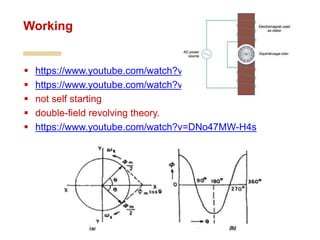
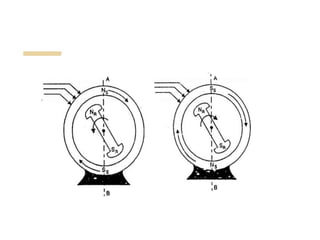
 not self starting
 double-field revolving theory.
 https://www.youtube.com/watch?v=DNo47MW-H4s
Working
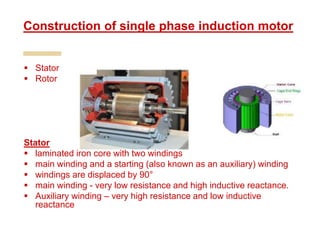
 Stator
 Rotor
Stator
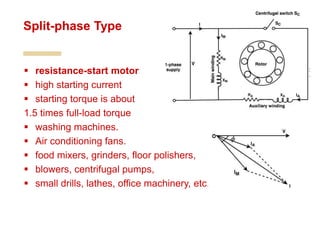
 laminated iron core with two windings
 main winding and a starting (also known as an auxiliary) winding
 windings are displaced by 90°
 main winding - very low resistance and high inductive reactance.
 Auxiliary winding – very high resistance and low inductive
reactance
Construction of single phase induction motor
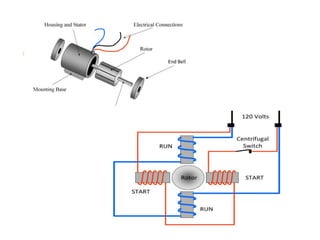
 resistance-start motor
 high starting current
 starting torque is about
1.5 times full-load torque
 washing machines.
 Air conditioning fans.
 food mixers, grinders, floor polishers,
 blowers, centrifugal pumps,
 small drills, lathes, office machinery, etc.
Split-phase Type
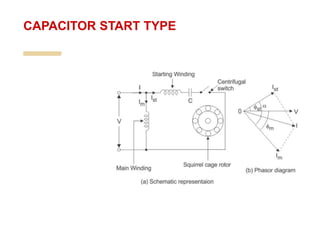
CAPACITOR START TYPE
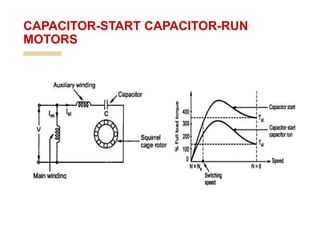
CAPACITOR-START CAPACITOR-RUN
MOTORS
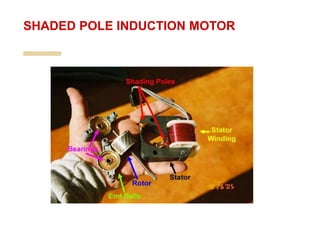
SHADED POLE INDUCTION MOTOR
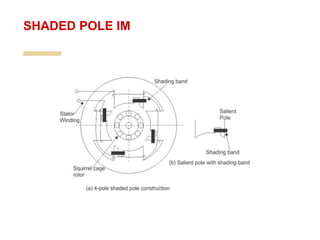
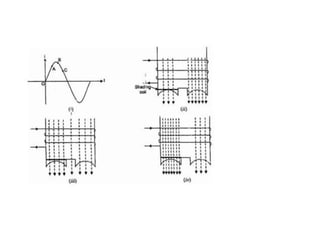
SHADED POLE IM
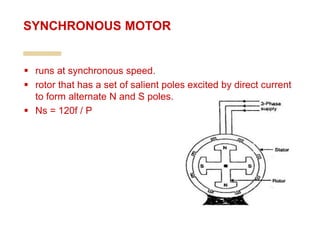
 runs at synchronous speed.
 rotor that has a set of salient poles excited by direct current
to form alternate N and S poles.
 Ns = 120f / P
SYNCHRONOUS MOTOR
 electromechanical device
 The motor’s position can be controlled accurately without
any feedback mechanism, as long as the motor is carefully
sized to the application
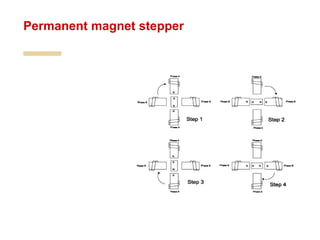
 Permanent magnet stepper
 Hybrid synchronous stepper
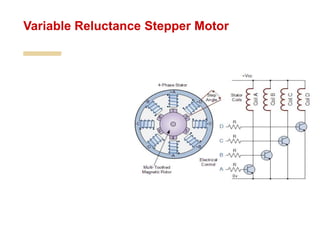
 Variable reluctance stepper
 https://www.youtube.com/watch?v=eyqwLiowZiU
STEPPER MOTOR
Variable Reluctance Stepper Motor
Permanent magnet stepper
 Similarities to AC induction motors and brushed DC motors.
 Hall sensor provides the information to synchronize stator
armature excitation with rotor position
 The electronic controller circuit energizes appropriate motor
winding by turning transistor or other solid state switches to
rotate the motor continuously.
 no mechanical commutator
 High speed of operation
 Computer hard drives and DVD/CD players
 Electric vehicles, hybrid vehicles, and electric bicycles
 https://www.youtube.com/watch?v=bCEiOnuODac
BRUSHLESS DC MOTOR
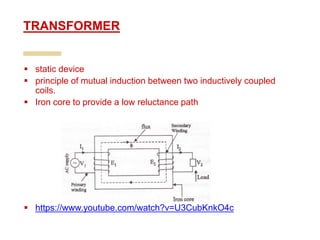
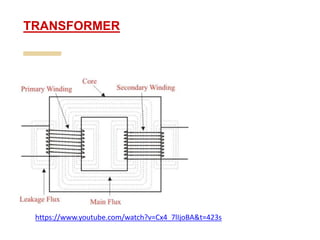
 static device
 principle of mutual induction between two inductively coupled
coils.
 Iron core to provide a low reluctance path
 https://www.youtube.com/watch?v=U3CubKnkO4c
TRANSFORMER
TRANSFORMER
https://www.youtube.com/watch?v=Cx4_7lIjoBA&t=423s
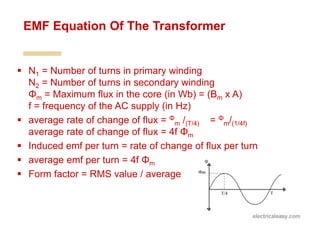
 N1 = Number of turns in primary winding
N2 = Number of turns in secondary winding
Φm = Maximum flux in the core (in Wb) = (Bm x A)
f = frequency of the AC supply (in Hz)
 average rate of change of flux = Φ
m /(T/4) = Φ
m/(1/4f)
average rate of change of flux = 4f Φm
 Induced emf per turn = rate of change of flux per turn
 average emf per turn = 4f Φm
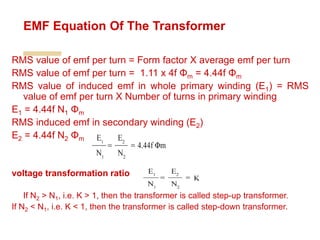
 Form factor = RMS value / average
EMF Equation Of The Transformer
RMS value of emf per turn = Form factor X average emf per turn
RMS value of emf per turn = 1.11 x 4f Φm = 4.44f Φm
RMS value of induced emf in whole primary winding (E1) = RMS
value of emf per turn X Number of turns in primary winding
E1 = 4.44f N1 Φm
RMS induced emf in secondary winding (E2)
E2 = 4.44f N2 Φm
voltage transformation ratio
If N2 > N1, i.e. K > 1, then the transformer is called step-up transformer.
If N2 < N1, i.e. K < 1, then the transformer is called step-down transformer.
EMF Equation Of The Transformer
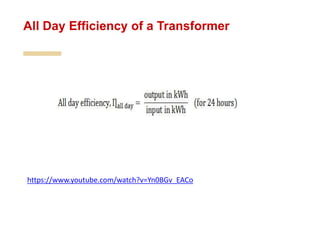
All Day Efficiency of a Transformer
https://www.youtube.com/watch?v=Yn0BGv_EACo

BEEM UII.pptx

  • 1.
    JNN INSTITUTE OF ENGINEERING BE8255– BASIC ELECTRICAL ELECTRONICS AND MEASUREMENT ENGINEERING MALATHY N, ASSISTANT PROFESSOR Department of EEE
  • 2.
     To explainthe basic theorems used in Electrical circuits and the different components and function of electrical machines.  To explain the fundamentals of semiconductor and applications.  To explain the principles of digital electronics  To impart knowledge of communication. OBJECTIVES
  • 3.
    At the endof the course, the students will able to  Define the fundamental laws, theorems of electrical circuits and principles and operation of measuring instruments.  Summarize the basic principles of electrical machines and their performance  Utilize the different energy sources, protective devices and their field applications  Design the fundamentals of electronic circuit constructions.  Explain the fundamentals of communication engineering. COURSE OUTCOMES
  • 4.
    TEXT BOOKS: 1. DP Kothari and I.J Nagarath, ”Electrical Machines “Basic Electrical and Electronics Engineering”, McGraw Hill Education(India) Private Limited, Third Reprint ,2016 2. S.K.Bhattacharya “Basic Electrical and Electronics Engineering”, Pearson India, 2011 3. Sedha R.S., “Applied Electronics”, S. Chand & Co., 2006 REFERENCES 1. A.E.Fitzgerald, David E Higginbotham and Arvin Grabel, “Basic Electrical Engineering”, McGraw Hill Education(India) Private Limited, 2009 2. Del Toro, “Electrical Engineering Fundamentals”, Pearson Education, New Delhi, 2007 3. Leonard S Bobrow, “ Foundations of Electrical Engineering”, Oxford University Press, 2013 4. Mahmood Nahvi and Joseph A. Edminister, “Electric Circuits”, Schaum’ Outline Series, McGraw Hill, 2002. 5. Mehta V K, “Principles of Electronics”, S.Chand & Company Ltd, 1994. 6. Nagsarkar T K and Sukhija M S, “Basics of Electrical Engineering”, Oxford press 2005.
  • 5.
     DC andAC ROTATING MACHINES: Types, Construction, principle, Emf and torque equation, application Speed Control- Basics of Stepper Motor – Brushless DC motors- Transformers-Introduction- types and construction, working principle of Ideal transformer-Emf equation- All day efficiency calculation.  https://www.youtube.com/watch?v=IC-PWxtcirI  https://www.youtube.com/watch?v=CWulQ1ZSE3c UNIT II ELECTRICAL MACHINES
  • 6.
     A dcgenerator is a machine that converts mechanical energy into electrical energy (dc voltage and current) by using the principle of magnetic induction. DC GENERATOR 1.Yoke or Magnetic frame 2. Pole core and pole shoes 3. Field winding 4.Armature-Armature core, Armature winding. 5. Commutator 6. Brushes
  • 8.
     Yoke: outer frameof a dc machine  Pole core, pole shoes:
  • 9.
     Inter poles: –Inter poles or the commutating poles – To improve commutation.  Field winding: – The field winding is placed on the pole core. – To carry the current and to produce the magnetic flux.
  • 10.
     Armature: – Armaturecore – Armature winding  Armature core: – cylindrical in shape with slots – It is mounted on the shaft.  Armature winding:
  • 11.
  • 12.
     Faradays lawsof electromagnetic induction  It states that whenever the magnetic lines of force i.e., flux linking with a conductor or a coil changes, an emf is induced in that conductor or coil.  https://www.youtube.com/watch?v=mq2zjmS8UMI Working of DC Generator:
  • 13.
    Working of DCGenerator:
  • 14.
     ϕ= Flux/polein weber.  N=Speed of armature in RPM  P=Number of poles  N/60=Speed of armature in RPS  Z= Total number of armature conductors.  E = EMF induced in any parallel path in the armature in volts  A=Number of parallel paths According to Faraday’s law, the induced emf is proportional to the rate of change of the magnetic flux. i.e ., e =-dϕ/dt EMF equation of dc generator
  • 15.
    Let us considera single conductor moving during one revolution. dϕ=ϕ*P weber Number of revolutions per second, =N/60 seconds. Time taken to complete one revolution, dt=60/N seconds. According to Faraday’s laws of electromagnetic induction. EMF generated/conductor = dϕ/dt ……………….(1)
  • 16.
    Substituting, dϕ=ϕ*p anddt=60/N in equation (1) gives =ϕ*p/(60/N) EMF generated/conductor =ϕNp/60 volts Number of conductors in one path of armature =z/A EMF generated/path = (ϕpN/60) *(z/A) volts For wave winding, A=2 EMF generated/path = (ϕpN/60) *(z/2) volts =ϕpNz/120 volts For lap winding, A=P EMF generated/path = (ϕpN/60) *(z/P) volts = ϕNz/60 volts
  • 17.
     Separately excitedDC generator.  Self excited DC generator - DC shunt generator - DC series generator - DC compound generator Types of DC generators
  • 18.
     A dcgenerator whose field winding is energized from an independent external dc source is called separately excited dc generator.  Armature current Ia=IL  Generated emf Eg=V+ Ia Ra+ VBrush  Power developed in the armature = Eg Ia  Power delivered to load=V Ia Separately excited DC generator
  • 19.
     Self-excited DCGenerator is a device, in which the current to the field winding is supplied by the generator itself A shunt DC generator  Field winding is connected in parallel with armature.  It is a “constant speed” machine.  Shunt field current Ish=V/Rsh  Armature current Ia = IL+ Ish  Generated emf, Eg=V+ Ia Ra+ VBrush Ia Ra=Voltage drop in the armature resistance VBrush = Voltage drop at connects of the brush Self excited DC generator
  • 20.
     The fieldwinding is connected in series with armature.  Same current flows through field as armature.  Ia=IL=Ise  Generated emf Eg=V+ Ia Ra +Ia Rse + VBrush  Ia Rse= Voltage drop in the series field winding resistance series DC generator
  • 21.
    Short shunt  Loadcurrent IL=Ise  Shunt field current Ish=(V+IseRse)/Rsh  Generated emf Eg=V+ Ia Ra+Ise Rse+ Vbrush Long shunt  Series field current Isc =Ia=IL+ Ish  Shunt field current Ish=V/Rsh  Generated emf Eg=V+Ia(Ra+Rse)+VBrush A compound generator
  • 22.
     electrical energyinto mechanical energy  Principle of operation  “Whenever current carrying conductor is placed in magnetic field, the conductor experiences a force tending to move it”. The force whose direction is given by Fleming’s Left- Hand Rule and whose magnitude is given by F=BILNewton. B=Magnetic field intensity in wb/m2 I=Current in Amperes L=Length of the conductor in meter. DC MOTOR
  • 23.
  • 24.
     Back emfof a Motor: Eb=(ϕ Z N/60)*(p/A)
  • 25.
    DC Shunt Motor Shunt field current Ish=V/Rsh  Armature current Ia = IL- Ish  Supply voltage V= Eb +IaRa+ VBrush  Ia Ra=Voltage drop in the armature resistance  VBrush = Voltage drop at connects of the brush  Input current IL=PL/V Types of DC motors
  • 26.
     Ia=IL=Ise  V=Eb+Ia Ra +Ia Rse +VBrush  Ia Rse= Voltage drop in the series field winding resistance  IL=PL/V DC Series Motor
  • 27.
    Long Shunt  Seriesfield current Ise =Ia=IL- Ish (or) IL=Ia+Ish  Shunt field current Ish=V/Rsh  V = Eb + IaRa+IaRse + VBrush Compound Motor
  • 28.
     Load currentIL=Ise  Shunt field current Ish=(V-IseRse)/Rsh  V=Eb+ Ia Ra+Ise Rse+VBrush Short Shunt
  • 29.
    EMF EQUATION OFDC GENERATOR
  • 30.
    P=4, ᵠ= 0.02wb,N=1500 rpm, A=2 (wave wound) Z= No. of conductors per slot X No of slots = 12 X 65 = 780 Eg = 780 V Problem: Calculate the emf generated by 4 pole wave wound generator having 65 slots with 12 conductors per slop when driven as 1500 rpm. The flux per pole is 0.02 wb
  • 31.
    1) 4 polewave wound armature has 720 conductor and is related 1000 rev/min. If the useful flux is 20 mWb, calculated the generated voltage. Ans - 480v 2) An 8 pole lap connected has armature 4 slot with 12 conductor an generate of voltage 500v determine the speed at which running if the flux per pole is 50 mWb. Ans - N = 1250 r.p.m 3) A DC generator has an armature EMF of 100v when the useful flux per pole is 20mWb adding the speed of 800 RPM calculate the EMF generator (a) which the same flux and speed of 1000 r.p.m (b) with a flux per pole 24mWb and the speed of 900 r.p.m. Ans - a. 125V b. 135V Problems to Solve
  • 32.
    4) An 8-polelap-wound d.c. generator armature has 960, conductors, a fian 40 mWb and a speed of 400 r.p.m. Calculate the e.m.f generated on open circuit the same armature is wave wound, at what speed must the armature be driven to generate 400v. Ans - 256v 15625 r.p.m 5) A 6-pole d.c generator runs at 850 r.p.m. and each pole has a flux of 12 mWb. there are 150 conductors in series between each pair of brushes, What us the value of generated e.m.f. ? Ans - 153v Problems to Solve
  • 33.
     two-pole orfour-pole, 2 hp or less  domestic appliances  resembles, three-phase, squirrel-cage motor  no starting torque & special arrangement Types of Single-Phase Motors  (i) split-phase type  (ii) capacitor start type  (iii) capacitor run type  (iv) capacitor start capacitor run type  (v) shaded-pole type  Three phase IM  https://www.youtube.com/watch?v=AQqyGNOP_3o SINGLE PHASE INDUCTION MOTOR
  • 34.
     https://www.youtube.com/watch?v=awrUxv7B-a8  https://www.youtube.com/watch?v=mQ-gPMDv-tI not self starting  double-field revolving theory.  https://www.youtube.com/watch?v=DNo47MW-H4s Working
  • 35.
     Stator  Rotor Stator laminated iron core with two windings  main winding and a starting (also known as an auxiliary) winding  windings are displaced by 90°  main winding - very low resistance and high inductive reactance.  Auxiliary winding – very high resistance and low inductive reactance Construction of single phase induction motor
  • 37.
     resistance-start motor high starting current  starting torque is about 1.5 times full-load torque  washing machines.  Air conditioning fans.  food mixers, grinders, floor polishers,  blowers, centrifugal pumps,  small drills, lathes, office machinery, etc. Split-phase Type
  • 38.
  • 39.
  • 40.
  • 41.
  • 43.
     runs atsynchronous speed.  rotor that has a set of salient poles excited by direct current to form alternate N and S poles.  Ns = 120f / P SYNCHRONOUS MOTOR
  • 45.
     electromechanical device The motor’s position can be controlled accurately without any feedback mechanism, as long as the motor is carefully sized to the application  Permanent magnet stepper  Hybrid synchronous stepper  Variable reluctance stepper  https://www.youtube.com/watch?v=eyqwLiowZiU STEPPER MOTOR
  • 46.
  • 47.
  • 48.
     Similarities toAC induction motors and brushed DC motors.  Hall sensor provides the information to synchronize stator armature excitation with rotor position  The electronic controller circuit energizes appropriate motor winding by turning transistor or other solid state switches to rotate the motor continuously.  no mechanical commutator  High speed of operation  Computer hard drives and DVD/CD players  Electric vehicles, hybrid vehicles, and electric bicycles  https://www.youtube.com/watch?v=bCEiOnuODac BRUSHLESS DC MOTOR
  • 49.
     static device principle of mutual induction between two inductively coupled coils.  Iron core to provide a low reluctance path  https://www.youtube.com/watch?v=U3CubKnkO4c TRANSFORMER
  • 50.
  • 51.
     N1 =Number of turns in primary winding N2 = Number of turns in secondary winding Φm = Maximum flux in the core (in Wb) = (Bm x A) f = frequency of the AC supply (in Hz)  average rate of change of flux = Φ m /(T/4) = Φ m/(1/4f) average rate of change of flux = 4f Φm  Induced emf per turn = rate of change of flux per turn  average emf per turn = 4f Φm  Form factor = RMS value / average EMF Equation Of The Transformer
  • 52.
    RMS value ofemf per turn = Form factor X average emf per turn RMS value of emf per turn = 1.11 x 4f Φm = 4.44f Φm RMS value of induced emf in whole primary winding (E1) = RMS value of emf per turn X Number of turns in primary winding E1 = 4.44f N1 Φm RMS induced emf in secondary winding (E2) E2 = 4.44f N2 Φm voltage transformation ratio If N2 > N1, i.e. K > 1, then the transformer is called step-up transformer. If N2 < N1, i.e. K < 1, then the transformer is called step-down transformer. EMF Equation Of The Transformer
  • 53.
    All Day Efficiencyof a Transformer https://www.youtube.com/watch?v=Yn0BGv_EACo