BASIC ELECTRICAL AND
ELECTRONICS ENGINEERING-
ELECTRICAL MACHINES
Ms. J. Glory Priyadharshini,
Assistant Professor/EEE,
Sri Ramakrishna Institute of Technology
BEEE NOTES MODULE 2
Syllabus Content:
• Construction, Principle of operation and
characteristics of DC generator and motor
• Construction, Principle of operation and
characteristics of Transformer
• Construction, Principle of operation and
characteristics of Synchronous machines
• Construction, Principle of operation and
characteristics of Induction machines
• Basic ideas about Energy audit and importance
of energy saving
1
DC GENERATOR
AND
DC MOTOR
2
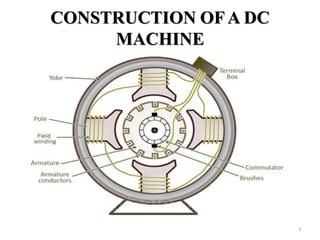
CONSTRUCTION OF A DC
MACHINE
3
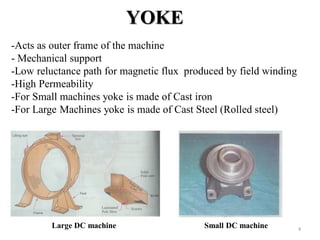
YOKE
-Acts as outer frame of the machine
- Mechanical support
-Low reluctance path for magnetic flux produced by field winding
-High Permeability
-For Small machines yoke is made of Cast iron
-For Large Machines yoke is made of Cast Steel (Rolled steel)
Large DC machine Small DC machine 4
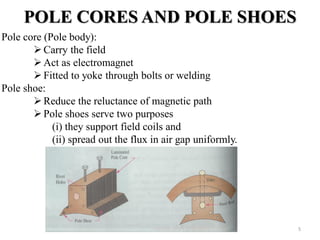
POLE CORES AND POLE SHOES
Pole core (Pole body):
Carry the field
Act as electromagnet
Fitted to yoke through bolts or welding
Pole shoe:
Reduce the reluctance of magnetic path
Pole shoes serve two purposes
(i) they support field coils and
(ii) spread out the flux in air gap uniformly.
5
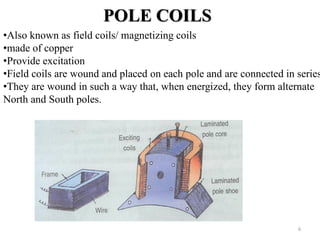
POLE COILS
•Also known as field coils/ magnetizing coils
•made of copper
•Provide excitation
•Field coils are wound and placed on each pole and are connected in series
•They are wound in such a way that, when energized, they form alternate
North and South poles.
6
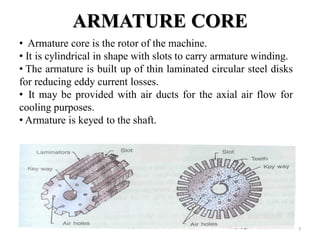
ARMATURE CORE
• Armature core is the rotor of the machine.
• It is cylindrical in shape with slots to carry armature winding.
• The armature is built up of thin laminated circular steel disks
for reducing eddy current losses.
• It may be provided with air ducts for the axial air flow for
cooling purposes.
• Armature is keyed to the shaft.
7
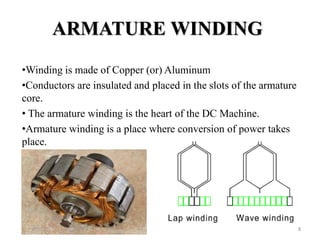
ARMATURE WINDING
•Winding is made of Copper (or) Aluminum
•Conductors are insulated and placed in the slots of the armature
core.
• The armature winding is the heart of the DC Machine.
•Armature winding is a place where conversion of power takes
place.
8
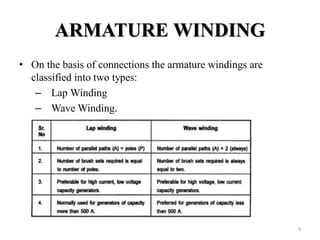
ARMATURE WINDING
• On the basis of connections the armature windings are
classified into two types:
– Lap Winding
– Wave Winding.
9
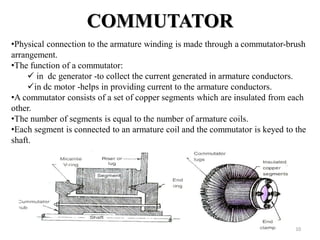
COMMUTATOR
•Physical connection to the armature winding is made through a commutator-brush
arrangement.
•The function of a commutator:
 in dc generator -to collect the current generated in armature conductors.
in dc motor -helps in providing current to the armature conductors.
•A commutator consists of a set of copper segments which are insulated from each
other.
•The number of segments is equal to the number of armature coils.
•Each segment is connected to an armature coil and the commutator is keyed to the
shaft.
10
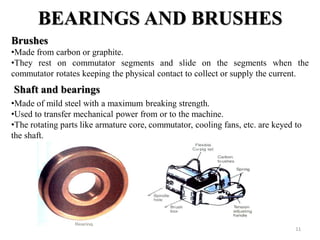
BEARINGS AND BRUSHES
Brushes
•Made from carbon or graphite.
•They rest on commutator segments and slide on the segments when the
commutator rotates keeping the physical contact to collect or supply the current.
Shaft and bearings
•Made of mild steel with a maximum breaking strength.
•Used to transfer mechanical power from or to the machine.
•The rotating parts like armature core, commutator, cooling fans, etc. are keyed to
the shaft.
11
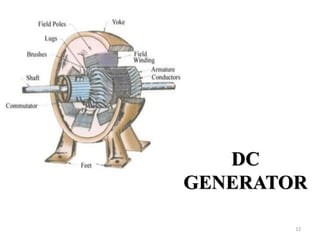
DC
GENERATOR
12
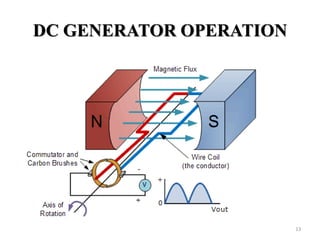
DC GENERATOR OPERATION
13
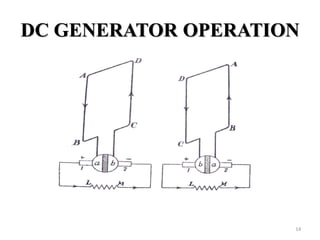
DC GENERATOR OPERATION
14
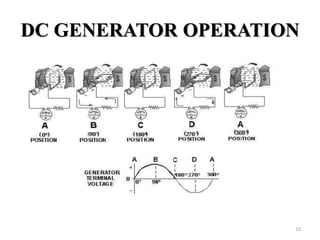
DC GENERATOR OPERATION
15
EMF EQUATION OF A
GENERATOR
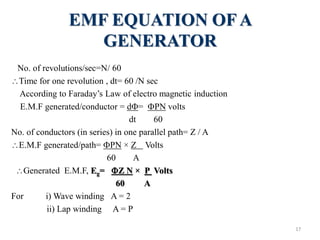
Let  = flux/pole in Weber
Z =Total number of armature conductors
Z=No. of slot × No. of conductors/slot
P= No. of generator poles
A =No. of parallel paths in armature
N= Armature rotation in revolutions per minute (r. p. m)
E= e.m.f induced in any parallel path in armature
Eg= e.m.f generated in any one of the parallel paths
Average e.m.f generated/conductor = d volt
dt
Now, flux cut/conductor in one revolution d = P wb
16
EMF EQUATION OF A
GENERATOR
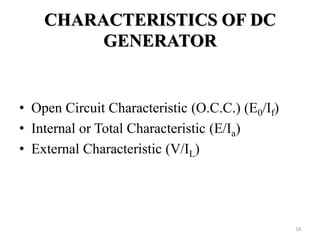
No. of revolutions/sec=N/ 60
Time for one revolution , dt= 60 /N sec
According to Faraday’s Law of electro magnetic induction
E.M.F generated/conductor = d= PN volts
dt 60
No. of conductors (in series) in one parallel path= Z / A
E.M.F generated/path= PN × Z Volts
60 A
Generated E.M.F, Eg= Z N × P Volts
60 A
For i) Wave winding A = 2
ii) Lap winding A = P
17
CHARACTERISTICS OF DC
GENERATOR
• Open Circuit Characteristic (O.C.C.) (E0/If)
• Internal or Total Characteristic (E/Ia)
• External Characteristic (V/IL)
18
OPEN CIRCUIT
CHARACTERISTICS
Open circuit characteristic is also known as magnetic characteristic or no-
load saturation characteristic.
This characteristic shows the relation between generated emf at no load
(E0) and the field current (If) at a given fixed speed.
Same for both the DC generators.
19
INTERNAL
CHARACTERISTIC
• This characteristic shows the relation between the on-load generated emf
(Eg) and the armature current (Ia).
• The on-load generated emf Eg is always less than E0 due to the armature
reaction.
• Therefore, internal characteristic curve lies below the O.C.C.
20
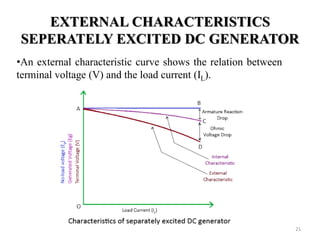
EXTERNAL CHARACTERISTICS
SEPERATELY EXCITED DC GENERATOR
•An external characteristic curve shows the relation between
terminal voltage (V) and the load current (IL).
21
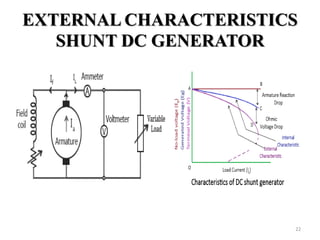
EXTERNAL CHARACTERISTICS
SHUNT DC GENERATOR
22
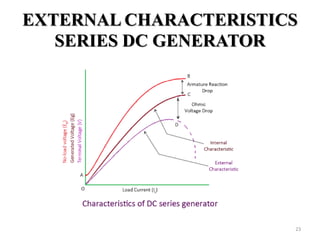
EXTERNAL CHARACTERISTICS
SERIES DC GENERATOR
23
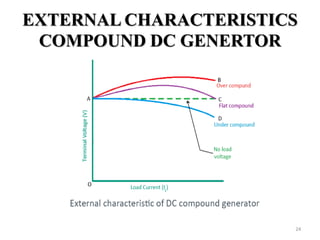
EXTERNAL CHARACTERISTICS
COMPOUND DC GENERTOR
24
APPLICATIONS OF DC
GENERATORS
SEPARATELY EXCITED DC GENERATORS
• Used in laboratories for testing as they have a wide range of voltage output.
• Used as a supply source of DC motors.
SHUNT WOUND GENERATORS
• Used for lighting purposes.
• Used to charge the battery.
• Providing excitation to the alternators.
SERIES WOUND GENERATORS
• Used in DC locomotives for regenerative braking for providing field
excitation current.
• Used as a booster in distribution networks.
COMPOUND WOUND GENERATOR
• Over compounded cumulative generators are used in lighting and heavy
power supply.
• Flat compounded generators are used in offices, hotels, homes, schools, etc.
• Differentially compounded generators are mainly used for arc welding
purpose.
25
DC MOTOR
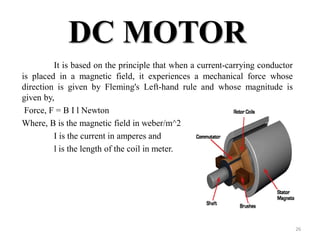
It is based on the principle that when a current-carrying conductor
is placed in a magnetic field, it experiences a mechanical force whose
direction is given by Fleming's Left-hand rule and whose magnitude is
given by,
Force, F = B I l Newton
Where, B is the magnetic field in weber/m^2
I is the current in amperes and
l is the length of the coil in meter.
26
WORKING OF DC MOTOR
• When armature windings are connected to a DC
supply, an electric current sets up in the winding.
• Magnetic field is provided by field winding
(electromagnetism) or by using permanent magnets.
• In this case, current carrying armature conductors
experience a force due to the magnetic field,
according to Faraday’s Law.
• Commutator is made segmented to achieve
unidirectional torque to obtain the required
mechanical output.
27
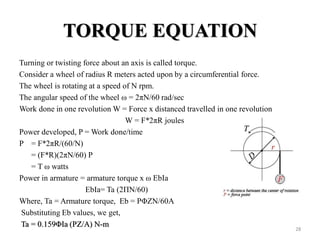
TORQUE EQUATION
Turning or twisting force about an axis is called torque.
Consider a wheel of radius R meters acted upon by a circumferential force.
The wheel is rotating at a speed of N rpm.
The angular speed of the wheel ω = 2πN/60 rad/sec
Work done in one revolution W = Force x distanced travelled in one revolution
W = F*2πR joules
Power developed, P = Work done/time
P = F*2πR/(60/N)
= (F*R)(2πN/60) P
= T ω watts
Power in armature = armature torque x ω EbIa
EbIa= Ta (2ΠN/60)
Where, Ta = Armature torque, Eb = PΦZN/60A
Substituting Eb values, we get,
Ta = 0.159ΦIa (PZ/A) N-m
28
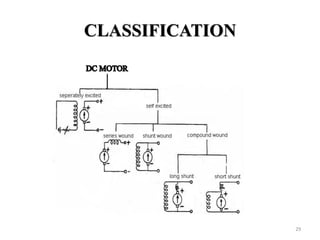
CLASSIFICATION
29
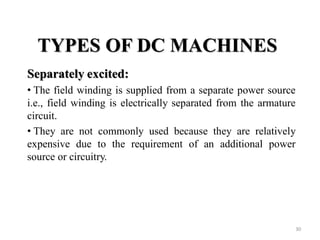
TYPES OF DC MACHINES
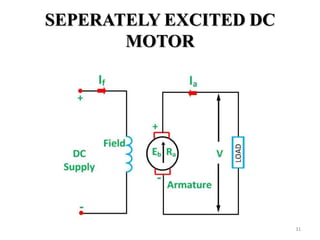
Separately excited:
• The field winding is supplied from a separate power source
i.e., field winding is electrically separated from the armature
circuit.
• They are not commonly used because they are relatively
expensive due to the requirement of an additional power
source or circuitry.
30
SEPERATELY EXCITED DC
MOTOR
31
TYPES OF DC MACHINES
Self-excited:
• The field winding and armature winding are interconnected in
various ways(series /parallel) to achieve a wide range of
performance characteristics.
• The field winding is energized by the current produced by
themselves.
• The field flux gradually increases as induced current due to the
residual magnetism starts flowing through the field winding .
32
TYPES OF DC MACHINES
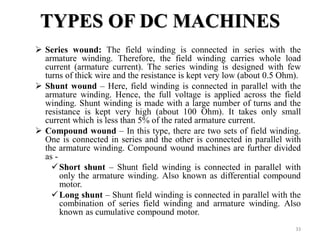
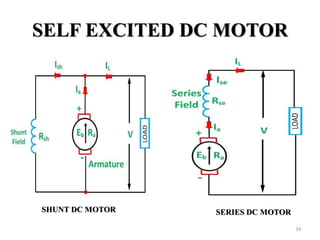
 Series wound: The field winding is connected in series with the
armature winding. Therefore, the field winding carries whole load
current (armature current). The series winding is designed with few
turns of thick wire and the resistance is kept very low (about 0.5 Ohm).
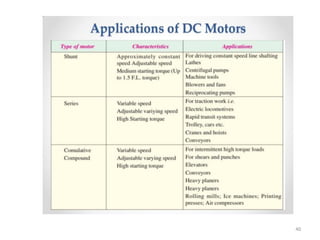
 Shunt wound – Here, field winding is connected in parallel with the
armature winding. Hence, the full voltage is applied across the field
winding. Shunt winding is made with a large number of turns and the
resistance is kept very high (about 100 Ohm). It takes only small
current which is less than 5% of the rated armature current.
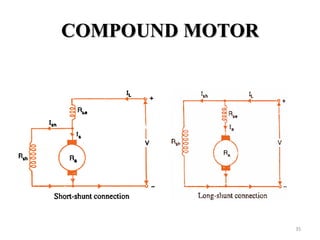
 Compound wound – In this type, there are two sets of field winding.
One is connected in series and the other is connected in parallel with
the armature winding. Compound wound machines are further divided
as -
Short shunt – Shunt field winding is connected in parallel with
only the armature winding. Also known as differential compound
motor.
Long shunt – Shunt field winding is connected in parallel with the
combination of series field winding and armature winding. Also
known as cumulative compound motor.
33
SELF EXCITED DC MOTOR
SHUNT DC MOTOR SERIES DC MOTOR
34
COMPOUND MOTOR
35
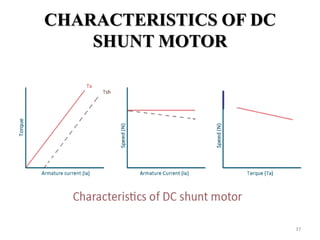
CHARACTERISTICS OF DC
MOTOR
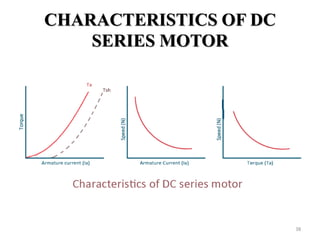
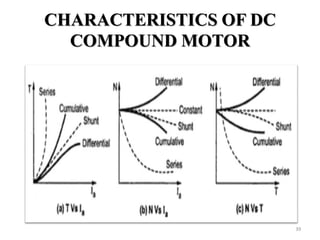
• Torque vs. armature current (Ta-Ia)
• Speed vs. armature current (N-Ia)
• Speed vs. torque (N-Ta)
36
CHARACTERISTICS OF DC
SHUNT MOTOR
37
CHARACTERISTICS OF DC
SERIES MOTOR
38
CHARACTERISTICS OF DC
COMPOUND MOTOR
39
40
TRANSFORMER
41
Transformer
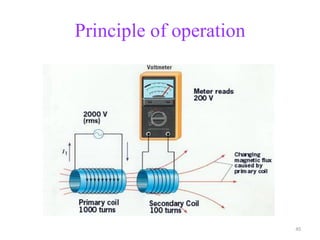
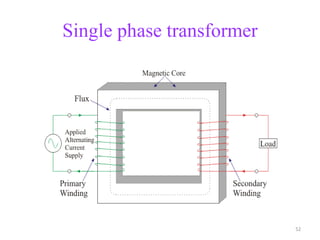
• A Transformer is a static device which works on the
principle of mutual Induction.
• The transformer transfers AC power from one circuit
to the other circuit.
• There are two types of windings in the transformer.
• The winding to which AC supply is given is termed
as Primary winding and in the secondary winding, the
load is connected.
42
Transformer
Transformer is a device that,
• transfers electric power from one circuit to another
• does so without a change of frequency
• accomplishes this by electromagnetic induction
• where the two electric circuits are in mutual inductive
influence of each other.
43
Necessity of a Transformer
• In India, electrical power is generated at 11Kv.
• For economical reasons AC power is transmitted at very high
voltages say 220 kV or 440 kV over long distances.
• Therefore a step up transformer is applied at the generating
stations.
• Now for safety reasons the voltage is stepped down to
different levels by step down transformer at various
substations to feed the power to the different locations and
thus the utilisation of power is done at 400/230 V.
• If (V2 > V1) the voltage is raised on the output side and is
known as Step-up transformer
• If (V2 < V1) the voltage level is lowered on the output side and
is known as Step down transformer
44
Principle of operation
45
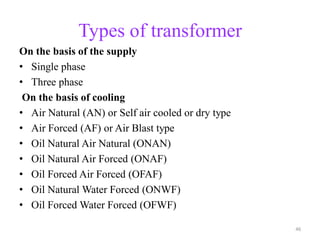
Types of transformer
On the basis of the supply
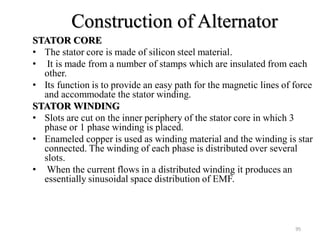
• Single phase
• Three phase
On the basis of cooling
• Air Natural (AN) or Self air cooled or dry type
• Air Forced (AF) or Air Blast type
• Oil Natural Air Natural (ONAN)
• Oil Natural Air Forced (ONAF)
• Oil Forced Air Forced (OFAF)
• Oil Natural Water Forced (ONWF)
• Oil Forced Water Forced (OFWF)
46
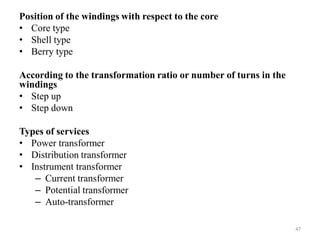
Position of the windings with respect to the core
• Core type
• Shell type
• Berry type
According to the transformation ratio or number of turns in the
windings
• Step up
• Step down
Types of services
• Power transformer
• Distribution transformer
• Instrument transformer
– Current transformer
– Potential transformer
– Auto-transformer
47
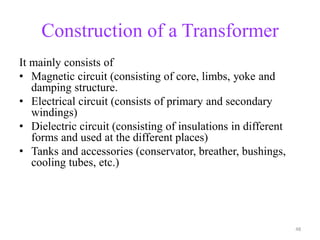
Construction of a Transformer
It mainly consists of
• Magnetic circuit (consisting of core, limbs, yoke and
damping structure.
• Electrical circuit (consists of primary and secondary
windings)
• Dielectric circuit (consisting of insulations in different
forms and used at the different places)
• Tanks and accessories (conservator, breather, bushings,
cooling tubes, etc.)
48
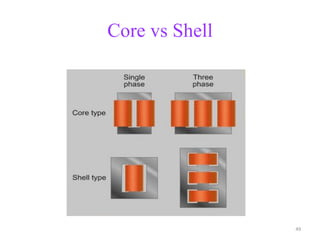
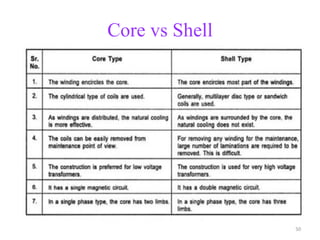
Core vs Shell
49
Core vs Shell
50
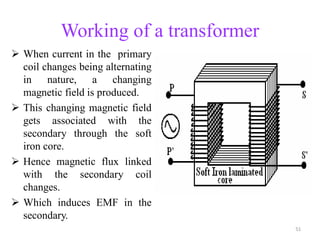
Working of a transformer
 When current in the primary
coil changes being alternating
in nature, a changing
magnetic field is produced.
 This changing magnetic field
gets associated with the
secondary through the soft
iron core.
 Hence magnetic flux linked
with the secondary coil
changes.
 Which induces EMF in the
secondary.
51
Single phase transformer
52
Ideal Transformers
• Zero leakage flux:
-Fluxes produced by the primary and secondary currents
are confined within the core.
• The windings have no resistance:
- Induced voltages equal applied voltages
• The core has infinite permeability
- Reluctance of the core is zero
- Negligible current is required to establish magnetic
flux
• Loss-less magnetic core
- No hysteresis or eddy currents
53
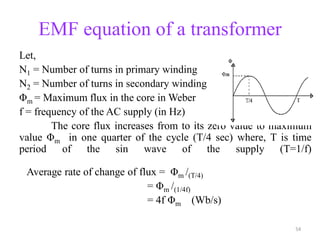
EMF equation of a transformer
Let,
N1 = Number of turns in primary winding
N2 = Number of turns in secondary winding
Φm = Maximum flux in the core in Weber
f = frequency of the AC supply (in Hz)
The core flux increases from to its zero value to maximum
value Φm in one quarter of the cycle (T/4 sec) where, T is time
period of the sin wave of the supply (T=1/f)
Average rate of change of flux = Φm /(T/4)
= Φm /(1/4f)
= 4f Φm (Wb/s)
54
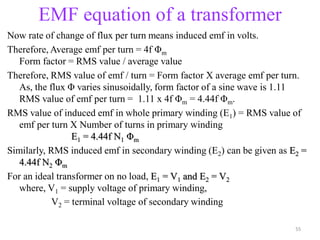
EMF equation of a transformer
Now rate of change of flux per turn means induced emf in volts.
Therefore, Average emf per turn = 4f Φm
Form factor = RMS value / average value
Therefore, RMS value of emf / turn = Form factor X average emf per turn.
As, the flux Φ varies sinusoidally, form factor of a sine wave is 1.11
RMS value of emf per turn = 1.11 x 4f Φm = 4.44f Φm.
RMS value of induced emf in whole primary winding (E1) = RMS value of
emf per turn X Number of turns in primary winding
E1 = 4.44f N1 Φm
Similarly, RMS induced emf in secondary winding (E2) can be given as E2 =
4.44f N2 Φm
For an ideal transformer on no load, E1 = V1 and E2 = V2
where, V1 = supply voltage of primary winding,
V2 = terminal voltage of secondary winding
55
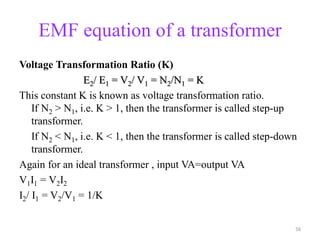
EMF equation of a transformer
Voltage Transformation Ratio (K)
E2/ E1 = V2/ V1 = N2/N1 = K
This constant K is known as voltage transformation ratio.
If N2 > N1, i.e. K > 1, then the transformer is called step-up
transformer.
If N2 < N1, i.e. K < 1, then the transformer is called step-down
transformer.
Again for an ideal transformer , input VA=output VA
V1I1 = V2I2
I2/ I1 = V2/V1 = 1/K
56
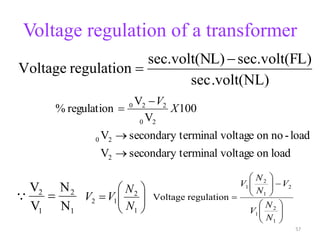
Voltage regulation of a transformer
volt(NL)
.
sec
L)
sec.volt(F
L)
sec.volt(N
regulation
Voltage











1
2
1
2
N
N
V
V
1
2
1
2
N
N
V
V




















1
2
1
2
1
2
1
regulation
Voltage
N
N
V
V
N
N
V
load
on
voltage
terminal
secondary
V
load
-
no
on
voltage
terminal
secondary
V
100
V
V
regulation
%
2
2
0
2
0
2
2
0



 X
V
57
Transformer Efficiency
Transformer efficiency at particular load and power
factor is defined as the output divided by the input the two
being measured in same unit(either watts or kilo watt).
Transformer being a highly efficient equipment, has very
small losses. Hence it’s impractical to calculate efficiency by
measuring its input and output. So first we have to determine the
losses.
58
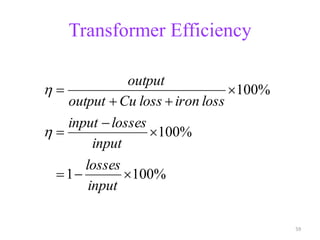
Transformer Efficiency
%
100
1
%
100
%
100










input
losses
input
losses
input
loss
iron
loss
Cu
output
output


59
INDUCTION
MACHINE
60
AC Machines
• AC machines are classified into two types:
 Synchronous machines
 Asynchronous machines
• There are basically two types of induction motor that
depend upon the input supply – a) single phase
induction motor and b) three phase induction motor.
• Single phase induction motor is not a self starting
motor and three phase induction motor is a self-
starting motor
61
Three Phase Induction Motor
• An electrical motor is an electromechanical device which
converts electrical energy into a mechanical energy.
• The most widely used motor is Three phase induction motor
as this type of motor does not require any starting
device(self starting induction motor).
• Asynchronous motor never run at synchronous speed.
• They work on the principle of induction. So, it is called
induction motor.
• They run constant speed from no load to full load.
62
Construction of Three Phase IM
• 3 phase induction motor consists of a stator and a rotor.
• The construction of stator for both the kind of three phase induction motor
remains the same.
• The stator of the three phase induction motor consists of three main parts:
a) Stator frame
b) Stator core
c) Stator winding or field winding
• Stator Frame:
 It is the outer most part of the three phase induction motor.
 Its main function is to support the stator core and the field winding.
 It acts as a covering and provide protection and mechanical strength to all
the inner parts of the machine.
 The frame is either made up of die cast or fabricated steel.
 The frame of three phase induction motor should be very strong and rigid
as the air gap length of three phase induction motor is very small, otherwise
rotor will not remain concentric with stator which will give rise to
unbalanced magnetic pull.
63
Construction of Three Phase IM
• Stator Core :
 The main function of the stator core is to carry alternating flux.
 In order to reduce the eddy current losses the stator core is laminated.
 This laminated type of structure is made up of stamping which is about 0.4
to 0.5 mm thick.
 All the stamping are stamped together to form stator core, which is then
housed in stator frame.
 The stampings are generally made up of silicon steel, which reduces
the hysteresis loss.
64
Construction of Three Phase IM
• Stator Winding or Field Winding :
 The slots on the periphery of stator core of the three phase induction motor
carries three phase windings.
 This three phase winding is supplied by three phase ac supply.
 The three phases of the winding are connected either in star or delta depending
upon which type of starting method is used.
 The squirrel cage motor is mostly started by star-delta starter and hence the
stator of squirrel cage motor are delta connected.
 The slip ring three phase induction motor are started by
inserting resistances so, the stator winding can be connected either in star or
delta.
 The winding wound on the stator of three phase induction motor is also called
field winding and when this winding is excited by three phase ac supply it
produces rotating magnetic field.
65
Construction of Three Phase IM
• The ROTOR is a rotating part of induction motor.
• The rotor is connected to the mechanical load through the
shaft.
• The rotor of the three phase induction motor are further
classified as a) Squirrel cage rotor,
b) Slip ring or wound or phase wound rotor.
• Depending upon the type of rotor used the three phase
induction motor are classified as a) Squirrel cage induction
motor and b) Slip ring induction motor or wound induction
motor or phase wound induction motor
66
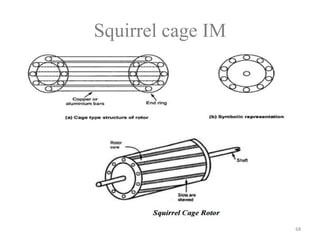
Squirrel cage IM
• Most of the induction motors are of squirrel cage type.
• Squirrel cage rotor consist of a cylindrical laminated core with parallel
slots.
• These parallel slots carry rotor conductors.
• Heavy bars of copper, aluminum or alloys are used as rotor conductors
instead of wires.
• Rotor slots are slightly skewed to achieve following advantages -
 it reduces locking tendency of the rotor, i.e. the tendency of
rotor teeth to remain under stator teeth due to magnetic
attraction.
 increases the effective transformation ratio between stator and
rotor
 increases rotor resistance due to increased length of the rotor
conductor
• The rotor bars are brazed or electrically welded to short circuiting end
rings at both ends.
• The rotor bars are permanently short circuited, hence it is not possible
to add any external resistance to armature circuit.
67
Squirrel cage IM
68
Slip ring IM
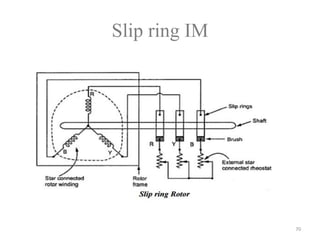
• Phase wound rotor is wound with 3 phase, double layer, distributed winding.
• The number of poles of rotor are kept same to the number of poles of the
stator.
• The three phase rotor winding is internally star connected.
• The other three terminals of the winding are taken out through three insulated
slip rings mounted on the shaft and the brushes resting on them.
• These three brushes are connected to an external star connected rheostat.
• This arrangement is done to introduce an external resistance in rotor circuit for
starting purposes and for changing the speed / torque characteristics.
• When motor is running at its rated speed, slip rings are automatically short
circuited by means of a metal collar and brushes are lifted above the slip rings
to minimize the frictional losses.
69
Slip ring IM
70
Working
• In an induction motor only the stator winding is fed with an
AC supply.
• Alternating flux is produced around the stator winding due to
AC supply.
• This alternating flux revolves with synchronous speed. The
revolving flux is called as "Rotating Magnetic Field" (RMF).
• The relative speed between stator RMF and rotor conductors
causes an induced emf in the rotor conductors, according to the
Faraday's law of electromagnetic induction.
• The rotor conductors are short circuited, and hence rotor
current is produced due to induced emf.
• Now, induced current in rotor will also produce alternating
flux around it. This rotor flux lags behind the stator flux.
71
Working
• The direction of induced rotor current is such that it will
tend to oppose the cause of its production(Lenz's law).
• The cause of production of rotor current is the relative
velocity between rotating stator flux and the rotor.
• The rotor will try to catch up with the stator RMF.
• Thus the rotor rotates in the same direction as that of
stator flux to minimize the relative velocity.
• However, the rotor never succeeds in catching up the
synchronous speed.
• This is the basic working principle of induction motor.
72
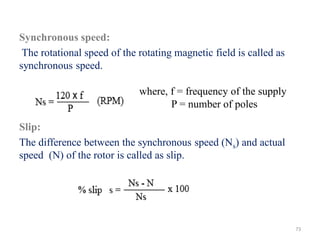
Synchronous speed:
The rotational speed of the rotating magnetic field is called as
synchronous speed.
Slip:
The difference between the synchronous speed (Ns) and actual
speed (N) of the rotor is called as slip.
where, f = frequency of the supply
P = number of poles
73
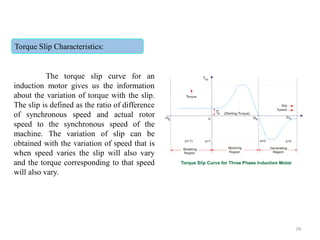
Torque Slip Characteristics:
The torque slip curve for an
induction motor gives us the information
about the variation of torque with the slip.
The slip is defined as the ratio of difference
of synchronous speed and actual rotor
speed to the synchronous speed of the
machine. The variation of slip can be
obtained with the variation of speed that is
when speed varies the slip will also vary
and the torque corresponding to that speed
will also vary.
74
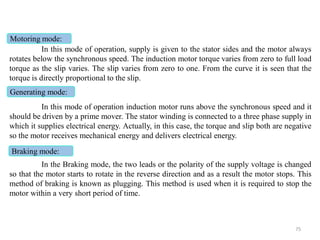
In this mode of operation, supply is given to the stator sides and the motor always
rotates below the synchronous speed. The induction motor torque varies from zero to full load
torque as the slip varies. The slip varies from zero to one. From the curve it is seen that the
torque is directly proportional to the slip.
In this mode of operation induction motor runs above the synchronous speed and it
should be driven by a prime mover. The stator winding is connected to a three phase supply in
which it supplies electrical energy. Actually, in this case, the torque and slip both are negative
so the motor receives mechanical energy and delivers electrical energy.
In the Braking mode, the two leads or the polarity of the supply voltage is changed
so that the motor starts to rotate in the reverse direction and as a result the motor stops. This
method of braking is known as plugging. This method is used when it is required to stop the
motor within a very short period of time.
Motoring mode:
Generating mode:
Braking mode:
75
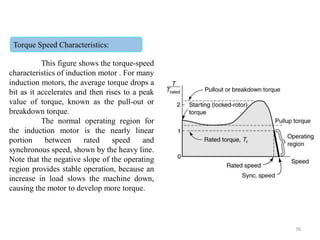
Torque Speed Characteristics:
This figure shows the torque-speed
characteristics of induction motor . For many
induction motors, the average torque drops a
bit as it accelerates and then rises to a peak
value of torque, known as the pull-out or
breakdown torque.
The normal operating region for
the induction motor is the nearly linear
portion between rated speed and
synchronous speed, shown by the heavy line.
Note that the negative slope of the operating
region provides stable operation, because an
increase in load slows the machine down,
causing the motor to develop more torque.
76
Applications
• Lifts
• Cranes
• Hoists
• Large capacity exhaust fans
• Driving lathe machines
• Crushers
• Oil extracting mills
• Textile and etc.
77
Advantages of Induction Motor
• Low cost: Induction machines are very cheap when compared to
synchronous and DC motors. This is due to the modest design of induction
motor. Therefore, these motors are preferred for fixed speed applications in
industrial, commercial and domestic applications where AC line power can
be easily attached.
• Low maintenance cost: Induction motors are maintenance free motors
unlike dc motors and synchronous motors. The construction of induction
motor is very simple and hence maintenance is also easy, resulting in low
maintenance cost.
• Ease of operation: Operation of induction motor is very simple because
there is no electrical connector to the rotor that supply power. Induction
motors are self start motors. This can result in reducing the effort needed
for maintenance.
78
Advantages of Induction Motor
• Speed Variation: The speed variation of induction motor is nearly
constant. The speed typically varies only by a few percent going from no
load to rated load.
• High starting torque: The staring torque of induction motor is very high
which makes motor useful for operations where load is applied before the
starting of the motor. 3 phase induction motors will have self starting
torque unlike synchronous motors. However, single-phase induction motors
does not have self starting torque and are made to rotate using some
auxiliaries.
• Durability: Another major advantage an induction motor is its durability.
This makes it the ideal machine for many uses. This results the motor to
run for many years with no cost and maintenance.
79
Why is Three Phase Induction Motor Self
Starting?
In three phase system, there are three single phase
line with 120o phase difference. So the rotating
magnetic field is having the same phase difference
which will make the rotor to move. If we consider three
phases a, b and c, when phase a is magnetized, the rotor
will move towards the phase a winding a, in the next
moment phase b will get magnetized and it will attract
the rotor and then phase c. So the rotor will continue to
rotate.
80
Construction of Single Phase Induction Motor
• Like any other electrical motor asynchronous motor also have
two main parts namely rotor and stator.
• Stator:
As its name indicates stator is a stationary part of induction
motor. A single phase AC supply is given to the stator of single
phase induction motor.
• Rotor:
The rotor is a rotating part of induction motor. The rotor is
connected to the mechanical load through the shaft. The rotor
in single phase induction motor is of squirrel cage rotor type.
81
Stator of Single Phase Induction Motor
• The stator of the single phase induction motor has laminated stamping to
reduce eddy current losses on its periphery.
• The slots are provided on its stamping to carry stator or main winding.
• In order to reduce the hysteresis losses, stamping are made up of silicon
steel.
• When the stator winding is given a single phase AC supply, the magnetic
field is produced and the motor rotates at a speed slightly less than the
synchronous speed Ns which is given by Ns =120f/ P
• The construction of the stator of asynchronous motor is similar to that of
three phase induction motor except there are two dissimilarity in the
winding part of the single phase induction motor.
• Firstly the single phase induction motors are mostly provided with
concentric coils. As the number of turns per coil can be easily adjusted with
the help of concentric coils, the mmf distribution is almost sinusoidal.
• Except for shaded pole motor, the asynchronous motor has two stator
windings namely the main winding and the auxiliary winding. These two
windings are placed in space quadrature with respect to each other.
82
Rotor of Single Phase Induction Motor
• The construction of the rotor of the single phase induction motor
is similar to the squirrel cage three phase induction motor.
• The rotor is cylindrical in shape and has slots all over its periphery.
• The slots are not made parallel to each other but are bit skewed as the skewing
prevents magnetic locking of stator and rotor teeth and makes the working of
induction motor more smooth and quieter i.e less noise.
• The squirrel cage rotor consists of aluminum, brass or copper bars. These
aluminum or copper bars are called rotor conductors and are placed in the slots
on the periphery of the rotor.
• The rotor conductors are permanently shorted by the copper or aluminum rings
called the end rings.
• In order to provide mechanical strength these rotor conductor are braced to the
end ring and hence form a complete closed circuit resembling like a cage and
hence got its name as squirrel cage induction motor.
• As the bars are permanently shorted by end rings, the rotor electrical
resistance is very small and it is not possible to add external resistance as the
bars are permanently shorted. The absence of slip ring and brushes make
the construction of single phase induction motor very simple and robust.
83
Why Single Phase Induction Motor is not Self
Starting?
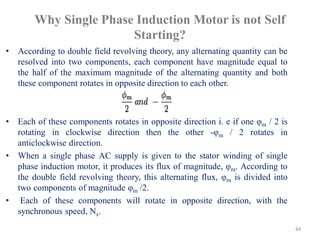
• According to double field revolving theory, any alternating quantity can be
resolved into two components, each component have magnitude equal to
the half of the maximum magnitude of the alternating quantity and both
these component rotates in opposite direction to each other.
• Each of these components rotates in opposite direction i. e if one φm / 2 is
rotating in clockwise direction then the other -φm / 2 rotates in
anticlockwise direction.
• When a single phase AC supply is given to the stator winding of single
phase induction motor, it produces its flux of magnitude, φm. According to
the double field revolving theory, this alternating flux, φm is divided into
two components of magnitude φm /2.
• Each of these components will rotate in opposite direction, with the
synchronous speed, Ns.
84
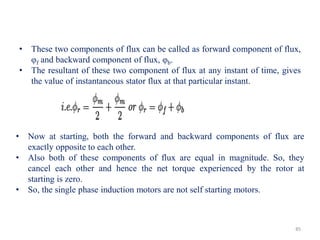
• Now at starting, both the forward and backward components of flux are
exactly opposite to each other.
• Also both of these components of flux are equal in magnitude. So, they
cancel each other and hence the net torque experienced by the rotor at
starting is zero.
• So, the single phase induction motors are not self starting motors.
• These two components of flux can be called as forward component of flux,
φf and backward component of flux, φb.
• The resultant of these two component of flux at any instant of time, gives
the value of instantaneous stator flux at that particular instant.
85
Methods for Making Single Phase Induction as Self
Starting Motor
• The single phase induction motors are not self starting because the
produced stator flux is alternating in nature and at the starting the
two components of this flux cancel each other and hence there is no
net torque.
• The solution to this problem is that if the stator flux is made rotating
type, rather than alternating type, which rotates in one particular
direction only. Then the induction motor will become self starting.
• Now for producing this rotating magnetic field we require two
alternating flux, having some phase difference angle between them.
• When these two fluxes interact with each other they will produce a
resultant flux.
• This resultant flux is rotating in nature and rotates in space in one
particular direction only.
• Once the motor starts running, the additional flux can be removed.
The motor will continue to run under the influence of the main flux
only.
86
Types of Single Phase Induction Motor
• Depending upon the methods for making asynchronous motor
as Self Starting Motor, there are mainly four types of single
phase induction motor namely,
– Split phase induction motor,
– Capacitor start induction motor,
– Capacitor start capacitor run induction motor,
– Shaded pole induction motor.
– Permanent split capacitor motor or single value capacitor
motor.
87
Comparison between Single Phase and Three
Phase Induction Motors
 Single phase induction motors are simple in construction, reliable and
economical for small power rating as compared to three phase
induction motors.
 The electrical power factor of single phase induction motors is low as
compared to three phase induction motors.
 For same size, the single phase induction motors develop about 50% of
the output as that of three phase induction motors.
 The starting torque is also low for asynchronous motors / single phase
induction motor.
 The efficiency of single phase induction motors is less as compare it to
the three phase induction motors.
• Single phase induction motors are simple, robust, reliable and cheaper for
small ratings. They are generally available up to 1 KW rating.
88
Applications of Single Phase Induction Motor
• Pumps
• Compressors
• Small fans
• Mixers
• Toys
• High speed vacuum cleaners
• Electric shavers
• Drilling machines
89
90
An alternator is a machine which converts
mechanical energy from a prime mover to AC electric
power at specific voltage and current. It is also known
as synchronous generator.
91
Classification
• Alternators or synchronous generators can be classified in may
ways depending upon their application and design.
• According to application these machines are classified as-
 Automotive type - used in modern automobile.
 Diesel electric locomotive type - used in diesel electric
multiple unit.
 Marine type - used in marine.
 Brush less type - used in electrical power generation plant
as main source of power.
 Radio alternators - used for low brand radio frequency
transmission.
• According to design of Rotor these machines are classified as-
 Salient pole
 Non salient pole
92
Construction of Alternator
93
Construction of Alternator
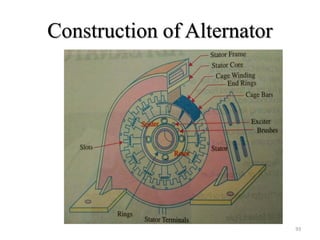
• The stationary part of the machine is called Stator.
• It includes various parts like stator frame, stator core, stator
windings and cooling arrangement.
• Based on the type of rotor alternator is classified as salient
pole and non- salient pole.
STATOR FRAME
• It is the outer body of the machine made of special magnetic
iron or steel alloy, and it protects the inner parts of the
machine.
94
Construction of Alternator
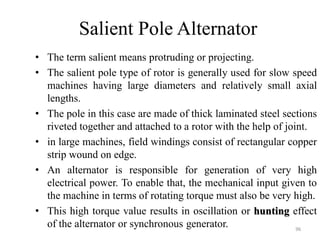
STATOR CORE
• The stator core is made of silicon steel material.
• It is made from a number of stamps which are insulated from each
other.
• Its function is to provide an easy path for the magnetic lines of force
and accommodate the stator winding.
STATOR WINDING
• Slots are cut on the inner periphery of the stator core in which 3
phase or 1 phase winding is placed.
• Enameled copper is used as winding material and the winding is star
connected. The winding of each phase is distributed over several
slots.
• When the current flows in a distributed winding it produces an
essentially sinusoidal space distribution of EMF.
95
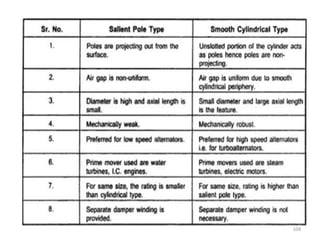
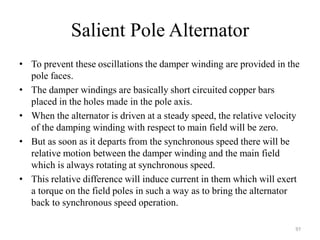
Salient Pole Alternator
• The term salient means protruding or projecting.
• The salient pole type of rotor is generally used for slow speed
machines having large diameters and relatively small axial
lengths.
• The pole in this case are made of thick laminated steel sections
riveted together and attached to a rotor with the help of joint.
• in large machines, field windings consist of rectangular copper
strip wound on edge.
• An alternator is responsible for generation of very high
electrical power. To enable that, the mechanical input given to
the machine in terms of rotating torque must also be very high.
• This high torque value results in oscillation or hunting effect
of the alternator or synchronous generator. 96
Salient Pole Alternator
• To prevent these oscillations the damper winding are provided in the
pole faces.
• The damper windings are basically short circuited copper bars
placed in the holes made in the pole axis.
• When the alternator is driven at a steady speed, the relative velocity
of the damping winding with respect to main field will be zero.
• But as soon as it departs from the synchronous speed there will be
relative motion between the damper winding and the main field
which is always rotating at synchronous speed.
• This relative difference will induce current in them which will exert
a torque on the field poles in such a way as to bring the alternator
back to synchronous speed operation.
97
Salient Pole Alternator
98
Special feature- Salient Pole Alternator
• They have a large horizontal diameter compared to a shorter
axial length.
• The pole shoes covers only about 2/3rd of pole pitch.
• Poles are laminated to reduce eddy current loss.
• The salient pole type motor is generally used for low speed
operations of around 100 to 400 rpm, and they are used in
power stations with hydraulic turbines or diesel engines.
• Salient pole alternators driven by water turbines are called
hydro-alternators or hydro generators.
• These generator looks like a big wheel and are mainly used for
low/ medium speed turbine such as in hydel power plant.
99
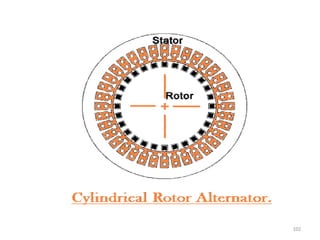
Smooth cylindrical type
• It is used for steam turbine driven alternator.
• The rotor of this generator rotates in very high speed.
• The rotor consists of a smooth solid forged steel cylinder
having a number of slots milled out at intervals along the outer
periphery for accommodation of field coils.
• These rotors are designed mostly for 2 pole or 4 pole turbo
generator running at 36000 rpm or 1800 rpm respectively.
• the central polar areas are surrounded by the field winding
placed in slots.
• the feild coils are so arranged around these polar areas that
flux density is maximum on the polar central line and
gradually falls away on either side.
100
Smooth cylindrical type
• The poles here are non salient i.e., they do not project out from
the surface of the rotor.
• to avoid excessive peripheral velocity, such rotors hav very
small diameters and very long axial length.
• The cylindrical construction of the rotor gives better balance,
quieter operaion and also have less windage losses.
101
102
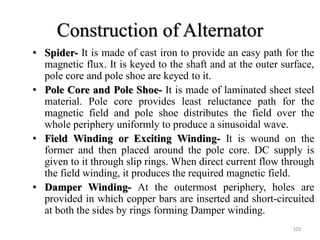
Construction of Alternator
• Spider- It is made of cast iron to provide an easy path for the
magnetic flux. It is keyed to the shaft and at the outer surface,
pole core and pole shoe are keyed to it.
• Pole Core and Pole Shoe- It is made of laminated sheet steel
material. Pole core provides least reluctance path for the
magnetic field and pole shoe distributes the field over the
whole periphery uniformly to produce a sinusoidal wave.
• Field Winding or Exciting Winding- It is wound on the
former and then placed around the pole core. DC supply is
given to it through slip rings. When direct current flow through
the field winding, it produces the required magnetic field.
• Damper Winding- At the outermost periphery, holes are
provided in which copper bars are inserted and short-circuited
at both the sides by rings forming Damper winding.
103
104
Working of Alternator
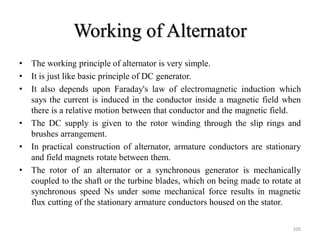
• The working principle of alternator is very simple.
• It is just like basic principle of DC generator.
• It also depends upon Faraday's law of electromagnetic induction which
says the current is induced in the conductor inside a magnetic field when
there is a relative motion between that conductor and the magnetic field.
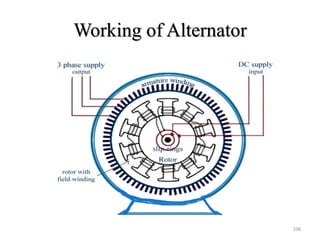
• The DC supply is given to the rotor winding through the slip rings and
brushes arrangement.
• In practical construction of alternator, armature conductors are stationary
and field magnets rotate between them.
• The rotor of an alternator or a synchronous generator is mechanically
coupled to the shaft or the turbine blades, which on being made to rotate at
synchronous speed Ns under some mechanical force results in magnetic
flux cutting of the stationary armature conductors housed on the stator.
105
Working of Alternator
106
Working of Alternator
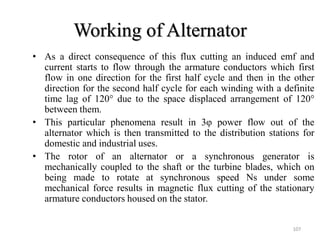
• As a direct consequence of this flux cutting an induced emf and
current starts to flow through the armature conductors which first
flow in one direction for the first half cycle and then in the other
direction for the second half cycle for each winding with a definite
time lag of 120° due to the space displaced arrangement of 120°
between them.
• This particular phenomena result in 3φ power flow out of the
alternator which is then transmitted to the distribution stations for
domestic and industrial uses.
• The rotor of an alternator or a synchronous generator is
mechanically coupled to the shaft or the turbine blades, which on
being made to rotate at synchronous speed Ns under some
mechanical force results in magnetic flux cutting of the stationary
armature conductors housed on the stator.
107

BEEE machines

  • 1.
    BASIC ELECTRICAL AND ELECTRONICSENGINEERING- ELECTRICAL MACHINES Ms. J. Glory Priyadharshini, Assistant Professor/EEE, Sri Ramakrishna Institute of Technology
  • 2.
    BEEE NOTES MODULE2 Syllabus Content: • Construction, Principle of operation and characteristics of DC generator and motor • Construction, Principle of operation and characteristics of Transformer • Construction, Principle of operation and characteristics of Synchronous machines • Construction, Principle of operation and characteristics of Induction machines • Basic ideas about Energy audit and importance of energy saving 1
  • 3.
  • 4.
    CONSTRUCTION OF ADC MACHINE 3
  • 5.
    YOKE -Acts as outerframe of the machine - Mechanical support -Low reluctance path for magnetic flux produced by field winding -High Permeability -For Small machines yoke is made of Cast iron -For Large Machines yoke is made of Cast Steel (Rolled steel) Large DC machine Small DC machine 4
  • 6.
    POLE CORES ANDPOLE SHOES Pole core (Pole body): Carry the field Act as electromagnet Fitted to yoke through bolts or welding Pole shoe: Reduce the reluctance of magnetic path Pole shoes serve two purposes (i) they support field coils and (ii) spread out the flux in air gap uniformly. 5
  • 7.
    POLE COILS •Also knownas field coils/ magnetizing coils •made of copper •Provide excitation •Field coils are wound and placed on each pole and are connected in series •They are wound in such a way that, when energized, they form alternate North and South poles. 6
  • 8.
    ARMATURE CORE • Armaturecore is the rotor of the machine. • It is cylindrical in shape with slots to carry armature winding. • The armature is built up of thin laminated circular steel disks for reducing eddy current losses. • It may be provided with air ducts for the axial air flow for cooling purposes. • Armature is keyed to the shaft. 7
  • 9.
    ARMATURE WINDING •Winding ismade of Copper (or) Aluminum •Conductors are insulated and placed in the slots of the armature core. • The armature winding is the heart of the DC Machine. •Armature winding is a place where conversion of power takes place. 8
  • 10.
    ARMATURE WINDING • Onthe basis of connections the armature windings are classified into two types: – Lap Winding – Wave Winding. 9
  • 11.
    COMMUTATOR •Physical connection tothe armature winding is made through a commutator-brush arrangement. •The function of a commutator:  in dc generator -to collect the current generated in armature conductors. in dc motor -helps in providing current to the armature conductors. •A commutator consists of a set of copper segments which are insulated from each other. •The number of segments is equal to the number of armature coils. •Each segment is connected to an armature coil and the commutator is keyed to the shaft. 10
  • 12.
    BEARINGS AND BRUSHES Brushes •Madefrom carbon or graphite. •They rest on commutator segments and slide on the segments when the commutator rotates keeping the physical contact to collect or supply the current. Shaft and bearings •Made of mild steel with a maximum breaking strength. •Used to transfer mechanical power from or to the machine. •The rotating parts like armature core, commutator, cooling fans, etc. are keyed to the shaft. 11
  • 13.
  • 14.
  • 15.
  • 16.
  • 17.
    EMF EQUATION OFA GENERATOR Let  = flux/pole in Weber Z =Total number of armature conductors Z=No. of slot × No. of conductors/slot P= No. of generator poles A =No. of parallel paths in armature N= Armature rotation in revolutions per minute (r. p. m) E= e.m.f induced in any parallel path in armature Eg= e.m.f generated in any one of the parallel paths Average e.m.f generated/conductor = d volt dt Now, flux cut/conductor in one revolution d = P wb 16
  • 18.
    EMF EQUATION OFA GENERATOR No. of revolutions/sec=N/ 60 Time for one revolution , dt= 60 /N sec According to Faraday’s Law of electro magnetic induction E.M.F generated/conductor = d= PN volts dt 60 No. of conductors (in series) in one parallel path= Z / A E.M.F generated/path= PN × Z Volts 60 A Generated E.M.F, Eg= Z N × P Volts 60 A For i) Wave winding A = 2 ii) Lap winding A = P 17
  • 19.
    CHARACTERISTICS OF DC GENERATOR •Open Circuit Characteristic (O.C.C.) (E0/If) • Internal or Total Characteristic (E/Ia) • External Characteristic (V/IL) 18
  • 20.
    OPEN CIRCUIT CHARACTERISTICS Open circuitcharacteristic is also known as magnetic characteristic or no- load saturation characteristic. This characteristic shows the relation between generated emf at no load (E0) and the field current (If) at a given fixed speed. Same for both the DC generators. 19
  • 21.
    INTERNAL CHARACTERISTIC • This characteristicshows the relation between the on-load generated emf (Eg) and the armature current (Ia). • The on-load generated emf Eg is always less than E0 due to the armature reaction. • Therefore, internal characteristic curve lies below the O.C.C. 20
  • 22.
    EXTERNAL CHARACTERISTICS SEPERATELY EXCITEDDC GENERATOR •An external characteristic curve shows the relation between terminal voltage (V) and the load current (IL). 21
  • 23.
  • 24.
  • 25.
  • 26.
    APPLICATIONS OF DC GENERATORS SEPARATELYEXCITED DC GENERATORS • Used in laboratories for testing as they have a wide range of voltage output. • Used as a supply source of DC motors. SHUNT WOUND GENERATORS • Used for lighting purposes. • Used to charge the battery. • Providing excitation to the alternators. SERIES WOUND GENERATORS • Used in DC locomotives for regenerative braking for providing field excitation current. • Used as a booster in distribution networks. COMPOUND WOUND GENERATOR • Over compounded cumulative generators are used in lighting and heavy power supply. • Flat compounded generators are used in offices, hotels, homes, schools, etc. • Differentially compounded generators are mainly used for arc welding purpose. 25
  • 27.
    DC MOTOR It isbased on the principle that when a current-carrying conductor is placed in a magnetic field, it experiences a mechanical force whose direction is given by Fleming's Left-hand rule and whose magnitude is given by, Force, F = B I l Newton Where, B is the magnetic field in weber/m^2 I is the current in amperes and l is the length of the coil in meter. 26
  • 28.
    WORKING OF DCMOTOR • When armature windings are connected to a DC supply, an electric current sets up in the winding. • Magnetic field is provided by field winding (electromagnetism) or by using permanent magnets. • In this case, current carrying armature conductors experience a force due to the magnetic field, according to Faraday’s Law. • Commutator is made segmented to achieve unidirectional torque to obtain the required mechanical output. 27
  • 29.
    TORQUE EQUATION Turning ortwisting force about an axis is called torque. Consider a wheel of radius R meters acted upon by a circumferential force. The wheel is rotating at a speed of N rpm. The angular speed of the wheel ω = 2πN/60 rad/sec Work done in one revolution W = Force x distanced travelled in one revolution W = F*2πR joules Power developed, P = Work done/time P = F*2πR/(60/N) = (F*R)(2πN/60) P = T ω watts Power in armature = armature torque x ω EbIa EbIa= Ta (2ΠN/60) Where, Ta = Armature torque, Eb = PΦZN/60A Substituting Eb values, we get, Ta = 0.159ΦIa (PZ/A) N-m 28
  • 30.
  • 31.
    TYPES OF DCMACHINES Separately excited: • The field winding is supplied from a separate power source i.e., field winding is electrically separated from the armature circuit. • They are not commonly used because they are relatively expensive due to the requirement of an additional power source or circuitry. 30
  • 32.
  • 33.
    TYPES OF DCMACHINES Self-excited: • The field winding and armature winding are interconnected in various ways(series /parallel) to achieve a wide range of performance characteristics. • The field winding is energized by the current produced by themselves. • The field flux gradually increases as induced current due to the residual magnetism starts flowing through the field winding . 32
  • 34.
    TYPES OF DCMACHINES  Series wound: The field winding is connected in series with the armature winding. Therefore, the field winding carries whole load current (armature current). The series winding is designed with few turns of thick wire and the resistance is kept very low (about 0.5 Ohm).  Shunt wound – Here, field winding is connected in parallel with the armature winding. Hence, the full voltage is applied across the field winding. Shunt winding is made with a large number of turns and the resistance is kept very high (about 100 Ohm). It takes only small current which is less than 5% of the rated armature current.  Compound wound – In this type, there are two sets of field winding. One is connected in series and the other is connected in parallel with the armature winding. Compound wound machines are further divided as - Short shunt – Shunt field winding is connected in parallel with only the armature winding. Also known as differential compound motor. Long shunt – Shunt field winding is connected in parallel with the combination of series field winding and armature winding. Also known as cumulative compound motor. 33
  • 35.
    SELF EXCITED DCMOTOR SHUNT DC MOTOR SERIES DC MOTOR 34
  • 36.
  • 37.
    CHARACTERISTICS OF DC MOTOR •Torque vs. armature current (Ta-Ia) • Speed vs. armature current (N-Ia) • Speed vs. torque (N-Ta) 36
  • 38.
  • 39.
  • 40.
  • 41.
  • 42.
  • 43.
    Transformer • A Transformeris a static device which works on the principle of mutual Induction. • The transformer transfers AC power from one circuit to the other circuit. • There are two types of windings in the transformer. • The winding to which AC supply is given is termed as Primary winding and in the secondary winding, the load is connected. 42
  • 44.
    Transformer Transformer is adevice that, • transfers electric power from one circuit to another • does so without a change of frequency • accomplishes this by electromagnetic induction • where the two electric circuits are in mutual inductive influence of each other. 43
  • 45.
    Necessity of aTransformer • In India, electrical power is generated at 11Kv. • For economical reasons AC power is transmitted at very high voltages say 220 kV or 440 kV over long distances. • Therefore a step up transformer is applied at the generating stations. • Now for safety reasons the voltage is stepped down to different levels by step down transformer at various substations to feed the power to the different locations and thus the utilisation of power is done at 400/230 V. • If (V2 > V1) the voltage is raised on the output side and is known as Step-up transformer • If (V2 < V1) the voltage level is lowered on the output side and is known as Step down transformer 44
  • 46.
  • 47.
    Types of transformer Onthe basis of the supply • Single phase • Three phase On the basis of cooling • Air Natural (AN) or Self air cooled or dry type • Air Forced (AF) or Air Blast type • Oil Natural Air Natural (ONAN) • Oil Natural Air Forced (ONAF) • Oil Forced Air Forced (OFAF) • Oil Natural Water Forced (ONWF) • Oil Forced Water Forced (OFWF) 46
  • 48.
    Position of thewindings with respect to the core • Core type • Shell type • Berry type According to the transformation ratio or number of turns in the windings • Step up • Step down Types of services • Power transformer • Distribution transformer • Instrument transformer – Current transformer – Potential transformer – Auto-transformer 47
  • 49.
    Construction of aTransformer It mainly consists of • Magnetic circuit (consisting of core, limbs, yoke and damping structure. • Electrical circuit (consists of primary and secondary windings) • Dielectric circuit (consisting of insulations in different forms and used at the different places) • Tanks and accessories (conservator, breather, bushings, cooling tubes, etc.) 48
  • 50.
  • 51.
  • 52.
    Working of atransformer  When current in the primary coil changes being alternating in nature, a changing magnetic field is produced.  This changing magnetic field gets associated with the secondary through the soft iron core.  Hence magnetic flux linked with the secondary coil changes.  Which induces EMF in the secondary. 51
  • 53.
  • 54.
    Ideal Transformers • Zeroleakage flux: -Fluxes produced by the primary and secondary currents are confined within the core. • The windings have no resistance: - Induced voltages equal applied voltages • The core has infinite permeability - Reluctance of the core is zero - Negligible current is required to establish magnetic flux • Loss-less magnetic core - No hysteresis or eddy currents 53
  • 55.
    EMF equation ofa transformer Let, N1 = Number of turns in primary winding N2 = Number of turns in secondary winding Φm = Maximum flux in the core in Weber f = frequency of the AC supply (in Hz) The core flux increases from to its zero value to maximum value Φm in one quarter of the cycle (T/4 sec) where, T is time period of the sin wave of the supply (T=1/f) Average rate of change of flux = Φm /(T/4) = Φm /(1/4f) = 4f Φm (Wb/s) 54
  • 56.
    EMF equation ofa transformer Now rate of change of flux per turn means induced emf in volts. Therefore, Average emf per turn = 4f Φm Form factor = RMS value / average value Therefore, RMS value of emf / turn = Form factor X average emf per turn. As, the flux Φ varies sinusoidally, form factor of a sine wave is 1.11 RMS value of emf per turn = 1.11 x 4f Φm = 4.44f Φm. RMS value of induced emf in whole primary winding (E1) = RMS value of emf per turn X Number of turns in primary winding E1 = 4.44f N1 Φm Similarly, RMS induced emf in secondary winding (E2) can be given as E2 = 4.44f N2 Φm For an ideal transformer on no load, E1 = V1 and E2 = V2 where, V1 = supply voltage of primary winding, V2 = terminal voltage of secondary winding 55
  • 57.
    EMF equation ofa transformer Voltage Transformation Ratio (K) E2/ E1 = V2/ V1 = N2/N1 = K This constant K is known as voltage transformation ratio. If N2 > N1, i.e. K > 1, then the transformer is called step-up transformer. If N2 < N1, i.e. K < 1, then the transformer is called step-down transformer. Again for an ideal transformer , input VA=output VA V1I1 = V2I2 I2/ I1 = V2/V1 = 1/K 56
  • 58.
    Voltage regulation ofa transformer volt(NL) . sec L) sec.volt(F L) sec.volt(N regulation Voltage            1 2 1 2 N N V V 1 2 1 2 N N V V                     1 2 1 2 1 2 1 regulation Voltage N N V V N N V load on voltage terminal secondary V load - no on voltage terminal secondary V 100 V V regulation % 2 2 0 2 0 2 2 0     X V 57
  • 59.
    Transformer Efficiency Transformer efficiencyat particular load and power factor is defined as the output divided by the input the two being measured in same unit(either watts or kilo watt). Transformer being a highly efficient equipment, has very small losses. Hence it’s impractical to calculate efficiency by measuring its input and output. So first we have to determine the losses. 58
  • 60.
  • 61.
  • 62.
    AC Machines • ACmachines are classified into two types:  Synchronous machines  Asynchronous machines • There are basically two types of induction motor that depend upon the input supply – a) single phase induction motor and b) three phase induction motor. • Single phase induction motor is not a self starting motor and three phase induction motor is a self- starting motor 61
  • 63.
    Three Phase InductionMotor • An electrical motor is an electromechanical device which converts electrical energy into a mechanical energy. • The most widely used motor is Three phase induction motor as this type of motor does not require any starting device(self starting induction motor). • Asynchronous motor never run at synchronous speed. • They work on the principle of induction. So, it is called induction motor. • They run constant speed from no load to full load. 62
  • 64.
    Construction of ThreePhase IM • 3 phase induction motor consists of a stator and a rotor. • The construction of stator for both the kind of three phase induction motor remains the same. • The stator of the three phase induction motor consists of three main parts: a) Stator frame b) Stator core c) Stator winding or field winding • Stator Frame:  It is the outer most part of the three phase induction motor.  Its main function is to support the stator core and the field winding.  It acts as a covering and provide protection and mechanical strength to all the inner parts of the machine.  The frame is either made up of die cast or fabricated steel.  The frame of three phase induction motor should be very strong and rigid as the air gap length of three phase induction motor is very small, otherwise rotor will not remain concentric with stator which will give rise to unbalanced magnetic pull. 63
  • 65.
    Construction of ThreePhase IM • Stator Core :  The main function of the stator core is to carry alternating flux.  In order to reduce the eddy current losses the stator core is laminated.  This laminated type of structure is made up of stamping which is about 0.4 to 0.5 mm thick.  All the stamping are stamped together to form stator core, which is then housed in stator frame.  The stampings are generally made up of silicon steel, which reduces the hysteresis loss. 64
  • 66.
    Construction of ThreePhase IM • Stator Winding or Field Winding :  The slots on the periphery of stator core of the three phase induction motor carries three phase windings.  This three phase winding is supplied by three phase ac supply.  The three phases of the winding are connected either in star or delta depending upon which type of starting method is used.  The squirrel cage motor is mostly started by star-delta starter and hence the stator of squirrel cage motor are delta connected.  The slip ring three phase induction motor are started by inserting resistances so, the stator winding can be connected either in star or delta.  The winding wound on the stator of three phase induction motor is also called field winding and when this winding is excited by three phase ac supply it produces rotating magnetic field. 65
  • 67.
    Construction of ThreePhase IM • The ROTOR is a rotating part of induction motor. • The rotor is connected to the mechanical load through the shaft. • The rotor of the three phase induction motor are further classified as a) Squirrel cage rotor, b) Slip ring or wound or phase wound rotor. • Depending upon the type of rotor used the three phase induction motor are classified as a) Squirrel cage induction motor and b) Slip ring induction motor or wound induction motor or phase wound induction motor 66
  • 68.
    Squirrel cage IM •Most of the induction motors are of squirrel cage type. • Squirrel cage rotor consist of a cylindrical laminated core with parallel slots. • These parallel slots carry rotor conductors. • Heavy bars of copper, aluminum or alloys are used as rotor conductors instead of wires. • Rotor slots are slightly skewed to achieve following advantages -  it reduces locking tendency of the rotor, i.e. the tendency of rotor teeth to remain under stator teeth due to magnetic attraction.  increases the effective transformation ratio between stator and rotor  increases rotor resistance due to increased length of the rotor conductor • The rotor bars are brazed or electrically welded to short circuiting end rings at both ends. • The rotor bars are permanently short circuited, hence it is not possible to add any external resistance to armature circuit. 67
  • 69.
  • 70.
    Slip ring IM •Phase wound rotor is wound with 3 phase, double layer, distributed winding. • The number of poles of rotor are kept same to the number of poles of the stator. • The three phase rotor winding is internally star connected. • The other three terminals of the winding are taken out through three insulated slip rings mounted on the shaft and the brushes resting on them. • These three brushes are connected to an external star connected rheostat. • This arrangement is done to introduce an external resistance in rotor circuit for starting purposes and for changing the speed / torque characteristics. • When motor is running at its rated speed, slip rings are automatically short circuited by means of a metal collar and brushes are lifted above the slip rings to minimize the frictional losses. 69
  • 71.
  • 72.
    Working • In aninduction motor only the stator winding is fed with an AC supply. • Alternating flux is produced around the stator winding due to AC supply. • This alternating flux revolves with synchronous speed. The revolving flux is called as "Rotating Magnetic Field" (RMF). • The relative speed between stator RMF and rotor conductors causes an induced emf in the rotor conductors, according to the Faraday's law of electromagnetic induction. • The rotor conductors are short circuited, and hence rotor current is produced due to induced emf. • Now, induced current in rotor will also produce alternating flux around it. This rotor flux lags behind the stator flux. 71
  • 73.
    Working • The directionof induced rotor current is such that it will tend to oppose the cause of its production(Lenz's law). • The cause of production of rotor current is the relative velocity between rotating stator flux and the rotor. • The rotor will try to catch up with the stator RMF. • Thus the rotor rotates in the same direction as that of stator flux to minimize the relative velocity. • However, the rotor never succeeds in catching up the synchronous speed. • This is the basic working principle of induction motor. 72
  • 74.
    Synchronous speed: The rotationalspeed of the rotating magnetic field is called as synchronous speed. Slip: The difference between the synchronous speed (Ns) and actual speed (N) of the rotor is called as slip. where, f = frequency of the supply P = number of poles 73
  • 75.
    Torque Slip Characteristics: Thetorque slip curve for an induction motor gives us the information about the variation of torque with the slip. The slip is defined as the ratio of difference of synchronous speed and actual rotor speed to the synchronous speed of the machine. The variation of slip can be obtained with the variation of speed that is when speed varies the slip will also vary and the torque corresponding to that speed will also vary. 74
  • 76.
    In this modeof operation, supply is given to the stator sides and the motor always rotates below the synchronous speed. The induction motor torque varies from zero to full load torque as the slip varies. The slip varies from zero to one. From the curve it is seen that the torque is directly proportional to the slip. In this mode of operation induction motor runs above the synchronous speed and it should be driven by a prime mover. The stator winding is connected to a three phase supply in which it supplies electrical energy. Actually, in this case, the torque and slip both are negative so the motor receives mechanical energy and delivers electrical energy. In the Braking mode, the two leads or the polarity of the supply voltage is changed so that the motor starts to rotate in the reverse direction and as a result the motor stops. This method of braking is known as plugging. This method is used when it is required to stop the motor within a very short period of time. Motoring mode: Generating mode: Braking mode: 75
  • 77.
    Torque Speed Characteristics: Thisfigure shows the torque-speed characteristics of induction motor . For many induction motors, the average torque drops a bit as it accelerates and then rises to a peak value of torque, known as the pull-out or breakdown torque. The normal operating region for the induction motor is the nearly linear portion between rated speed and synchronous speed, shown by the heavy line. Note that the negative slope of the operating region provides stable operation, because an increase in load slows the machine down, causing the motor to develop more torque. 76
  • 78.
    Applications • Lifts • Cranes •Hoists • Large capacity exhaust fans • Driving lathe machines • Crushers • Oil extracting mills • Textile and etc. 77
  • 79.
    Advantages of InductionMotor • Low cost: Induction machines are very cheap when compared to synchronous and DC motors. This is due to the modest design of induction motor. Therefore, these motors are preferred for fixed speed applications in industrial, commercial and domestic applications where AC line power can be easily attached. • Low maintenance cost: Induction motors are maintenance free motors unlike dc motors and synchronous motors. The construction of induction motor is very simple and hence maintenance is also easy, resulting in low maintenance cost. • Ease of operation: Operation of induction motor is very simple because there is no electrical connector to the rotor that supply power. Induction motors are self start motors. This can result in reducing the effort needed for maintenance. 78
  • 80.
    Advantages of InductionMotor • Speed Variation: The speed variation of induction motor is nearly constant. The speed typically varies only by a few percent going from no load to rated load. • High starting torque: The staring torque of induction motor is very high which makes motor useful for operations where load is applied before the starting of the motor. 3 phase induction motors will have self starting torque unlike synchronous motors. However, single-phase induction motors does not have self starting torque and are made to rotate using some auxiliaries. • Durability: Another major advantage an induction motor is its durability. This makes it the ideal machine for many uses. This results the motor to run for many years with no cost and maintenance. 79
  • 81.
    Why is ThreePhase Induction Motor Self Starting? In three phase system, there are three single phase line with 120o phase difference. So the rotating magnetic field is having the same phase difference which will make the rotor to move. If we consider three phases a, b and c, when phase a is magnetized, the rotor will move towards the phase a winding a, in the next moment phase b will get magnetized and it will attract the rotor and then phase c. So the rotor will continue to rotate. 80
  • 82.
    Construction of SinglePhase Induction Motor • Like any other electrical motor asynchronous motor also have two main parts namely rotor and stator. • Stator: As its name indicates stator is a stationary part of induction motor. A single phase AC supply is given to the stator of single phase induction motor. • Rotor: The rotor is a rotating part of induction motor. The rotor is connected to the mechanical load through the shaft. The rotor in single phase induction motor is of squirrel cage rotor type. 81
  • 83.
    Stator of SinglePhase Induction Motor • The stator of the single phase induction motor has laminated stamping to reduce eddy current losses on its periphery. • The slots are provided on its stamping to carry stator or main winding. • In order to reduce the hysteresis losses, stamping are made up of silicon steel. • When the stator winding is given a single phase AC supply, the magnetic field is produced and the motor rotates at a speed slightly less than the synchronous speed Ns which is given by Ns =120f/ P • The construction of the stator of asynchronous motor is similar to that of three phase induction motor except there are two dissimilarity in the winding part of the single phase induction motor. • Firstly the single phase induction motors are mostly provided with concentric coils. As the number of turns per coil can be easily adjusted with the help of concentric coils, the mmf distribution is almost sinusoidal. • Except for shaded pole motor, the asynchronous motor has two stator windings namely the main winding and the auxiliary winding. These two windings are placed in space quadrature with respect to each other. 82
  • 84.
    Rotor of SinglePhase Induction Motor • The construction of the rotor of the single phase induction motor is similar to the squirrel cage three phase induction motor. • The rotor is cylindrical in shape and has slots all over its periphery. • The slots are not made parallel to each other but are bit skewed as the skewing prevents magnetic locking of stator and rotor teeth and makes the working of induction motor more smooth and quieter i.e less noise. • The squirrel cage rotor consists of aluminum, brass or copper bars. These aluminum or copper bars are called rotor conductors and are placed in the slots on the periphery of the rotor. • The rotor conductors are permanently shorted by the copper or aluminum rings called the end rings. • In order to provide mechanical strength these rotor conductor are braced to the end ring and hence form a complete closed circuit resembling like a cage and hence got its name as squirrel cage induction motor. • As the bars are permanently shorted by end rings, the rotor electrical resistance is very small and it is not possible to add external resistance as the bars are permanently shorted. The absence of slip ring and brushes make the construction of single phase induction motor very simple and robust. 83
  • 85.
    Why Single PhaseInduction Motor is not Self Starting? • According to double field revolving theory, any alternating quantity can be resolved into two components, each component have magnitude equal to the half of the maximum magnitude of the alternating quantity and both these component rotates in opposite direction to each other. • Each of these components rotates in opposite direction i. e if one φm / 2 is rotating in clockwise direction then the other -φm / 2 rotates in anticlockwise direction. • When a single phase AC supply is given to the stator winding of single phase induction motor, it produces its flux of magnitude, φm. According to the double field revolving theory, this alternating flux, φm is divided into two components of magnitude φm /2. • Each of these components will rotate in opposite direction, with the synchronous speed, Ns. 84
  • 86.
    • Now atstarting, both the forward and backward components of flux are exactly opposite to each other. • Also both of these components of flux are equal in magnitude. So, they cancel each other and hence the net torque experienced by the rotor at starting is zero. • So, the single phase induction motors are not self starting motors. • These two components of flux can be called as forward component of flux, φf and backward component of flux, φb. • The resultant of these two component of flux at any instant of time, gives the value of instantaneous stator flux at that particular instant. 85
  • 87.
    Methods for MakingSingle Phase Induction as Self Starting Motor • The single phase induction motors are not self starting because the produced stator flux is alternating in nature and at the starting the two components of this flux cancel each other and hence there is no net torque. • The solution to this problem is that if the stator flux is made rotating type, rather than alternating type, which rotates in one particular direction only. Then the induction motor will become self starting. • Now for producing this rotating magnetic field we require two alternating flux, having some phase difference angle between them. • When these two fluxes interact with each other they will produce a resultant flux. • This resultant flux is rotating in nature and rotates in space in one particular direction only. • Once the motor starts running, the additional flux can be removed. The motor will continue to run under the influence of the main flux only. 86
  • 88.
    Types of SinglePhase Induction Motor • Depending upon the methods for making asynchronous motor as Self Starting Motor, there are mainly four types of single phase induction motor namely, – Split phase induction motor, – Capacitor start induction motor, – Capacitor start capacitor run induction motor, – Shaded pole induction motor. – Permanent split capacitor motor or single value capacitor motor. 87
  • 89.
    Comparison between SinglePhase and Three Phase Induction Motors  Single phase induction motors are simple in construction, reliable and economical for small power rating as compared to three phase induction motors.  The electrical power factor of single phase induction motors is low as compared to three phase induction motors.  For same size, the single phase induction motors develop about 50% of the output as that of three phase induction motors.  The starting torque is also low for asynchronous motors / single phase induction motor.  The efficiency of single phase induction motors is less as compare it to the three phase induction motors. • Single phase induction motors are simple, robust, reliable and cheaper for small ratings. They are generally available up to 1 KW rating. 88
  • 90.
    Applications of SinglePhase Induction Motor • Pumps • Compressors • Small fans • Mixers • Toys • High speed vacuum cleaners • Electric shavers • Drilling machines 89
  • 91.
  • 92.
    An alternator isa machine which converts mechanical energy from a prime mover to AC electric power at specific voltage and current. It is also known as synchronous generator. 91
  • 93.
    Classification • Alternators orsynchronous generators can be classified in may ways depending upon their application and design. • According to application these machines are classified as-  Automotive type - used in modern automobile.  Diesel electric locomotive type - used in diesel electric multiple unit.  Marine type - used in marine.  Brush less type - used in electrical power generation plant as main source of power.  Radio alternators - used for low brand radio frequency transmission. • According to design of Rotor these machines are classified as-  Salient pole  Non salient pole 92
  • 94.
  • 95.
    Construction of Alternator •The stationary part of the machine is called Stator. • It includes various parts like stator frame, stator core, stator windings and cooling arrangement. • Based on the type of rotor alternator is classified as salient pole and non- salient pole. STATOR FRAME • It is the outer body of the machine made of special magnetic iron or steel alloy, and it protects the inner parts of the machine. 94
  • 96.
    Construction of Alternator STATORCORE • The stator core is made of silicon steel material. • It is made from a number of stamps which are insulated from each other. • Its function is to provide an easy path for the magnetic lines of force and accommodate the stator winding. STATOR WINDING • Slots are cut on the inner periphery of the stator core in which 3 phase or 1 phase winding is placed. • Enameled copper is used as winding material and the winding is star connected. The winding of each phase is distributed over several slots. • When the current flows in a distributed winding it produces an essentially sinusoidal space distribution of EMF. 95
  • 97.
    Salient Pole Alternator •The term salient means protruding or projecting. • The salient pole type of rotor is generally used for slow speed machines having large diameters and relatively small axial lengths. • The pole in this case are made of thick laminated steel sections riveted together and attached to a rotor with the help of joint. • in large machines, field windings consist of rectangular copper strip wound on edge. • An alternator is responsible for generation of very high electrical power. To enable that, the mechanical input given to the machine in terms of rotating torque must also be very high. • This high torque value results in oscillation or hunting effect of the alternator or synchronous generator. 96
  • 98.
    Salient Pole Alternator •To prevent these oscillations the damper winding are provided in the pole faces. • The damper windings are basically short circuited copper bars placed in the holes made in the pole axis. • When the alternator is driven at a steady speed, the relative velocity of the damping winding with respect to main field will be zero. • But as soon as it departs from the synchronous speed there will be relative motion between the damper winding and the main field which is always rotating at synchronous speed. • This relative difference will induce current in them which will exert a torque on the field poles in such a way as to bring the alternator back to synchronous speed operation. 97
  • 99.
  • 100.
    Special feature- SalientPole Alternator • They have a large horizontal diameter compared to a shorter axial length. • The pole shoes covers only about 2/3rd of pole pitch. • Poles are laminated to reduce eddy current loss. • The salient pole type motor is generally used for low speed operations of around 100 to 400 rpm, and they are used in power stations with hydraulic turbines or diesel engines. • Salient pole alternators driven by water turbines are called hydro-alternators or hydro generators. • These generator looks like a big wheel and are mainly used for low/ medium speed turbine such as in hydel power plant. 99
  • 101.
    Smooth cylindrical type •It is used for steam turbine driven alternator. • The rotor of this generator rotates in very high speed. • The rotor consists of a smooth solid forged steel cylinder having a number of slots milled out at intervals along the outer periphery for accommodation of field coils. • These rotors are designed mostly for 2 pole or 4 pole turbo generator running at 36000 rpm or 1800 rpm respectively. • the central polar areas are surrounded by the field winding placed in slots. • the feild coils are so arranged around these polar areas that flux density is maximum on the polar central line and gradually falls away on either side. 100
  • 102.
    Smooth cylindrical type •The poles here are non salient i.e., they do not project out from the surface of the rotor. • to avoid excessive peripheral velocity, such rotors hav very small diameters and very long axial length. • The cylindrical construction of the rotor gives better balance, quieter operaion and also have less windage losses. 101
  • 103.
  • 104.
    Construction of Alternator •Spider- It is made of cast iron to provide an easy path for the magnetic flux. It is keyed to the shaft and at the outer surface, pole core and pole shoe are keyed to it. • Pole Core and Pole Shoe- It is made of laminated sheet steel material. Pole core provides least reluctance path for the magnetic field and pole shoe distributes the field over the whole periphery uniformly to produce a sinusoidal wave. • Field Winding or Exciting Winding- It is wound on the former and then placed around the pole core. DC supply is given to it through slip rings. When direct current flow through the field winding, it produces the required magnetic field. • Damper Winding- At the outermost periphery, holes are provided in which copper bars are inserted and short-circuited at both the sides by rings forming Damper winding. 103
  • 105.
  • 106.
    Working of Alternator •The working principle of alternator is very simple. • It is just like basic principle of DC generator. • It also depends upon Faraday's law of electromagnetic induction which says the current is induced in the conductor inside a magnetic field when there is a relative motion between that conductor and the magnetic field. • The DC supply is given to the rotor winding through the slip rings and brushes arrangement. • In practical construction of alternator, armature conductors are stationary and field magnets rotate between them. • The rotor of an alternator or a synchronous generator is mechanically coupled to the shaft or the turbine blades, which on being made to rotate at synchronous speed Ns under some mechanical force results in magnetic flux cutting of the stationary armature conductors housed on the stator. 105
  • 107.
  • 108.
    Working of Alternator •As a direct consequence of this flux cutting an induced emf and current starts to flow through the armature conductors which first flow in one direction for the first half cycle and then in the other direction for the second half cycle for each winding with a definite time lag of 120° due to the space displaced arrangement of 120° between them. • This particular phenomena result in 3φ power flow out of the alternator which is then transmitted to the distribution stations for domestic and industrial uses. • The rotor of an alternator or a synchronous generator is mechanically coupled to the shaft or the turbine blades, which on being made to rotate at synchronous speed Ns under some mechanical force results in magnetic flux cutting of the stationary armature conductors housed on the stator. 107