Tachogenerator
Tachogenerator
• The word Tachogenerator comes from Greek
word ‘TACHO’.
• In Greek, Tacho means speed. Generator
means an instrument which generate power.
• Tachogenerator, is a device which is used for
measuring the speed of a shaft and converting
into a voltage so that it can be measured.
• In other words, it converts angular velocity into
voltage.
Uses
• They are used to measure the
speeds of electric motors,
engines, and the equipment they
power: conveyor belts, machine
tools, mixers, fans, etc.
Types of Tachogenerator
• DC Tachogenerator - A DC Tachogenerator is a
small DC generator, which generate electrical
voltage corresponding to the speed of rotating
machine.
• AC Tachogenerator - The AC tachogenerator is a
small brushless alternator with a rotating multi-pole
permanent magnet. The output voltage is again
measured by a voltmeter although the varying
frequency will affect the accuracy of this instrument.
DC Tachogenerator
• A DC Tachogenerator is a small DC generator, which
has to generate electrical voltage corresponding to
the speed of rotating machine.
• The produced voltage is dynamically-induced EMF.
• When the conductor is in motion and the field is in
stationary an EMF is induced in the conductor and
this type of EMF is called Dynamically-induced EMF.
Continued
• The requirement of dynamically-induced EMF
is to establish necessary flux in field system.
• A system of conductors is required so that a
relative motion between the flux and
conductor create rate of change of flux linkage
and generate the DC voltage.
• The field system may be in the form of
electromagnet or permanent magnet, and it is
the stationary part of the DC Tachogenerator.
Operating Principle
• The operating principle of DC tachogenerator is
same as that of DC generator and is based on the
principle of Faraday’s Law of Electromagnetic
Induction.
• According to the law, when an conductor move in
a magnetic field it cuts the magnetic lines of
force, due to which an EMF is induced in the
conductor.
• The magnitude of induced EMF depends upon
the rate of change of magnetic flux linkage with
the conductor.
Schematic Diagram
Working Principle
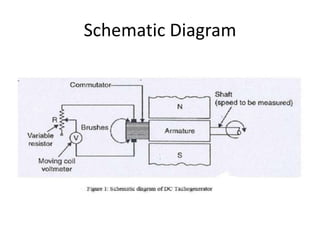
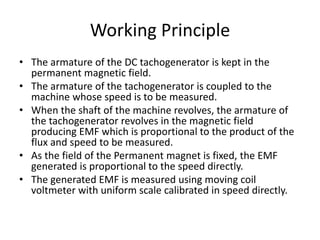
• The armature of the DC tachogenerator is kept in the
permanent magnetic field.
• The armature of the tachogenerator is coupled to the
machine whose speed is to be measured.
• When the shaft of the machine revolves, the armature of
the tachogenerator revolves in the magnetic field
producing EMF which is proportional to the product of the
flux and speed to be measured.
• As the field of the Permanent magnet is fixed, the EMF
generated is proportional to the speed directly.
• The generated EMF is measured using moving coil
voltmeter with uniform scale calibrated in speed directly.
Continued
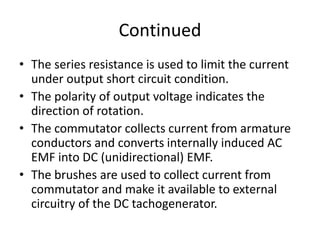
• The series resistance is used to limit the current
under output short circuit condition.
• The polarity of output voltage indicates the
direction of rotation.
• The commutator collects current from armature
conductors and converts internally induced AC
EMF into DC (unidirectional) EMF.
• The brushes are used to collect current from
commutator and make it available to external
circuitry of the DC tachogenerator.
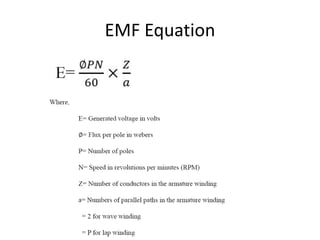
EMF Equation
Advantages
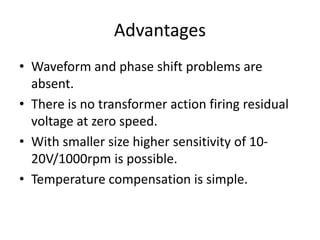
• Waveform and phase shift problems are
absent.
• There is no transformer action firing residual
voltage at zero speed.
• With smaller size higher sensitivity of 10-
20V/1000rpm is possible.
• Temperature compensation is simple.
Disadvantages
• At higher speed brush vibration problem is
troublesome.
• Arcing at brush commutator contact due to
brush wear make it unsuitable for explosive
condition.
AC Tachometers
• The AC tachogenerator is a small
brushless alternator with a rotating
multi-pole permanent magnet. The
output voltage is again measured by a
voltmeter although the varying
frequency will affect the accuracy of this
instrument.
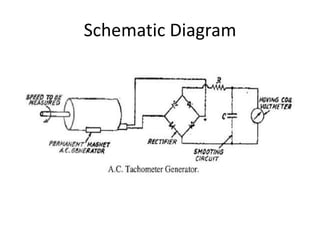
Construction
It consists of:
• Permanent Magnet
• Coil (Stator)
• Rectifier Bridge
• Moving Coil (MC) Voltmeter
Schematic Diagram
Working
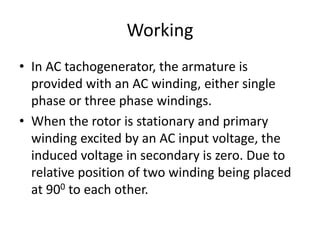
• In AC tachogenerator, the armature is
provided with an AC winding, either single
phase or three phase windings.
• When the rotor is stationary and primary
winding excited by an AC input voltage, the
induced voltage in secondary is zero. Due to
relative position of two winding being placed
at 900 to each other.
Continued
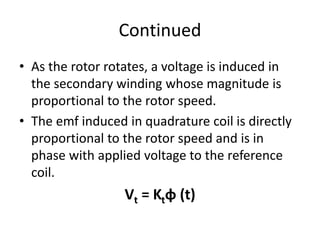
• As the rotor rotates, a voltage is induced in
the secondary winding whose magnitude is
proportional to the rotor speed.
• The emf induced in quadrature coil is directly
proportional to the rotor speed and is in
phase with applied voltage to the reference
coil.
Vt = Ktɸ (t)
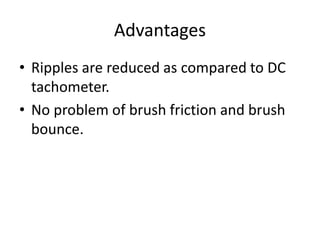
Advantages
• Ripples are reduced as compared to DC
tachometer.
• No problem of brush friction and brush
bounce.
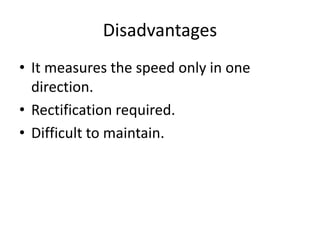
Disadvantages
• It measures the speed only in one
direction.
• Rectification required.
• Difficult to maintain.
Differences
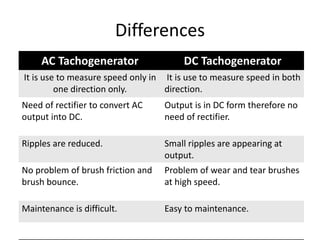
AC Tachogenerator DC Tachogenerator
It is use to measure speed only in
one direction only.
It is use to measure speed in both
direction.
Need of rectifier to convert AC
output into DC.
Output is in DC form therefore no
need of rectifier.
Ripples are reduced. Small ripples are appearing at
output.
No problem of brush friction and
brush bounce.
Problem of wear and tear brushes
at high speed.
Maintenance is difficult. Easy to maintenance.
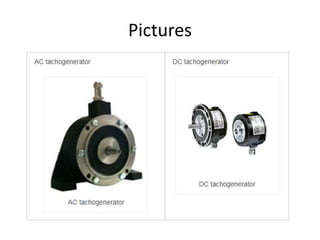
Pictures
Thank you

Tachogenerator

  • 1.
  • 2.
    Tachogenerator • The wordTachogenerator comes from Greek word ‘TACHO’. • In Greek, Tacho means speed. Generator means an instrument which generate power. • Tachogenerator, is a device which is used for measuring the speed of a shaft and converting into a voltage so that it can be measured. • In other words, it converts angular velocity into voltage.
  • 3.
    Uses • They areused to measure the speeds of electric motors, engines, and the equipment they power: conveyor belts, machine tools, mixers, fans, etc.
  • 4.
    Types of Tachogenerator •DC Tachogenerator - A DC Tachogenerator is a small DC generator, which generate electrical voltage corresponding to the speed of rotating machine. • AC Tachogenerator - The AC tachogenerator is a small brushless alternator with a rotating multi-pole permanent magnet. The output voltage is again measured by a voltmeter although the varying frequency will affect the accuracy of this instrument.
  • 5.
    DC Tachogenerator • ADC Tachogenerator is a small DC generator, which has to generate electrical voltage corresponding to the speed of rotating machine. • The produced voltage is dynamically-induced EMF. • When the conductor is in motion and the field is in stationary an EMF is induced in the conductor and this type of EMF is called Dynamically-induced EMF.
  • 6.
    Continued • The requirementof dynamically-induced EMF is to establish necessary flux in field system. • A system of conductors is required so that a relative motion between the flux and conductor create rate of change of flux linkage and generate the DC voltage. • The field system may be in the form of electromagnet or permanent magnet, and it is the stationary part of the DC Tachogenerator.
  • 7.
    Operating Principle • Theoperating principle of DC tachogenerator is same as that of DC generator and is based on the principle of Faraday’s Law of Electromagnetic Induction. • According to the law, when an conductor move in a magnetic field it cuts the magnetic lines of force, due to which an EMF is induced in the conductor. • The magnitude of induced EMF depends upon the rate of change of magnetic flux linkage with the conductor.
  • 8.
  • 9.
    Working Principle • Thearmature of the DC tachogenerator is kept in the permanent magnetic field. • The armature of the tachogenerator is coupled to the machine whose speed is to be measured. • When the shaft of the machine revolves, the armature of the tachogenerator revolves in the magnetic field producing EMF which is proportional to the product of the flux and speed to be measured. • As the field of the Permanent magnet is fixed, the EMF generated is proportional to the speed directly. • The generated EMF is measured using moving coil voltmeter with uniform scale calibrated in speed directly.
  • 10.
    Continued • The seriesresistance is used to limit the current under output short circuit condition. • The polarity of output voltage indicates the direction of rotation. • The commutator collects current from armature conductors and converts internally induced AC EMF into DC (unidirectional) EMF. • The brushes are used to collect current from commutator and make it available to external circuitry of the DC tachogenerator.
  • 11.
  • 12.
    Advantages • Waveform andphase shift problems are absent. • There is no transformer action firing residual voltage at zero speed. • With smaller size higher sensitivity of 10- 20V/1000rpm is possible. • Temperature compensation is simple.
  • 13.
    Disadvantages • At higherspeed brush vibration problem is troublesome. • Arcing at brush commutator contact due to brush wear make it unsuitable for explosive condition.
  • 14.
    AC Tachometers • TheAC tachogenerator is a small brushless alternator with a rotating multi-pole permanent magnet. The output voltage is again measured by a voltmeter although the varying frequency will affect the accuracy of this instrument.
  • 15.
    Construction It consists of: •Permanent Magnet • Coil (Stator) • Rectifier Bridge • Moving Coil (MC) Voltmeter
  • 16.
  • 17.
    Working • In ACtachogenerator, the armature is provided with an AC winding, either single phase or three phase windings. • When the rotor is stationary and primary winding excited by an AC input voltage, the induced voltage in secondary is zero. Due to relative position of two winding being placed at 900 to each other.
  • 18.
    Continued • As therotor rotates, a voltage is induced in the secondary winding whose magnitude is proportional to the rotor speed. • The emf induced in quadrature coil is directly proportional to the rotor speed and is in phase with applied voltage to the reference coil. Vt = Ktɸ (t)
  • 19.
    Advantages • Ripples arereduced as compared to DC tachometer. • No problem of brush friction and brush bounce.
  • 20.
    Disadvantages • It measuresthe speed only in one direction. • Rectification required. • Difficult to maintain.
  • 21.
    Differences AC Tachogenerator DCTachogenerator It is use to measure speed only in one direction only. It is use to measure speed in both direction. Need of rectifier to convert AC output into DC. Output is in DC form therefore no need of rectifier. Ripples are reduced. Small ripples are appearing at output. No problem of brush friction and brush bounce. Problem of wear and tear brushes at high speed. Maintenance is difficult. Easy to maintenance.
  • 22.
  • 23.