Unit -2
DATABASE DESIGN (ENTITY (OBJECT), ENTITY SET, ENTITY TYPE -
PART 3
9/4/2019 DATABASE DEVELOPMENT LIFE CYCLE -UNIT 2 PART 1- BY RAM K PALIWAL 1
Database Design – Entity (Object)
An entity is an object in the real world with an independent
existence that can be differentiated from other objects. An
entity might be
◦ An object with physical existence (e.g., a lecturer, a student, a car)
◦ An object with conceptual existence (e.g., a course, a job, a
position)
Entities can be classified based on their strength. An entity
is considered weak if its tables are existence dependent.
◦ That is, it cannot exist without a relationship with another entity
9/4/2019 DATABASE DEVELOPMENT LIFE CYCLE -UNIT 2 PART 1- BY RAM K PALIWAL 2
Database Design – Entity (Object)
◦ Its primary key is derived from the primary key of the parent entity
◦ The Spouse table, in the COMPANY database, is a weak entity because its primary key is dependent on
the Employee table. Without a corresponding employee record, the spouse record would not exist.
An entity is considered strong if it can exist apart from all of its
related entities.
◦ Kernels are strong entities.
◦ A table without a foreign key or a table that contains a foreign key that can
contain nulls is a strong entity
Another term to know is entity type which defines a collection of
similar entities
9/4/2019 DATABASE DEVELOPMENT LIFE CYCLE -UNIT 2 PART 1- BY RAM K PALIWAL 3
Database Design – Entity (Object)
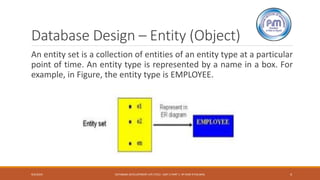
An entity set is a collection of entities of an entity type at a particular
point of time. An entity type is represented by a name in a box. For
example, in Figure, the entity type is EMPLOYEE.
9/4/2019 DATABASE DEVELOPMENT LIFE CYCLE -UNIT 2 PART 1- BY RAM K PALIWAL 4
Database Design – Entity (Object)
Kinds of Entities
You should also be familiar with different kinds of entities including
independent entities, dependent entities and characteristic entities.
These are described below.
◦ Independent entities
◦ Dependent entities
◦ Characteristics entities
9/4/2019 DATABASE DEVELOPMENT LIFE CYCLE -UNIT 2 PART 1- BY RAM K PALIWAL 5
Database Design – Entity (Object)
Independent entities
Independent entities, also referred to as kernels, are the backbone
of the database. They are what other tables are based on. Kernels
have the following characteristics:
◦ They are the building blocks of a database.
◦ The primary key may be simple or composite.
◦ The primary key is not a foreign key.
◦ They do not depend on another entity for their existence.
If we refer back to our COMPANY database, examples of an
independent entity include the Customer table, Employee table or
Product table.
9/4/2019 DATABASE DEVELOPMENT LIFE CYCLE -UNIT 2 PART 1- BY RAM K PALIWAL 6
Database Design – Entity (Object)
Dependent Entities
Dependent entities, also referred to as derived entities, depend on
other tables for their meaning. These entities have the following
characteristics:
◦ Dependent entities are used to connect two kernels together.
◦ They are said to be existence dependent on two or more tables.
◦ Many to many relationships become associative tables with at least two
foreign keys.
◦ They may contain other attributes.
◦ The foreign key identifies each associated table.
9/4/2019 DATABASE DEVELOPMENT LIFE CYCLE -UNIT 2 PART 1- BY RAM K PALIWAL 7
Characteristic entities
Characteristic entities provide more information about
another table. These entities have the following
characteristics:
◦ They represent multivalued attributes.
◦ They describe other entities.
◦ They typically have a one to many relationship.
◦ The foreign key is used to further identify the characterized table.
9/4/2019 DATABASE DEVELOPMENT LIFE CYCLE -UNIT 2 PART 1- BY RAM K PALIWAL 8
◦Options for primary key are as follows:
◦ Use a composite of foreign key plus a qualifying column
◦ Create a new simple primary key. In the COMPANY database,
these might include:
◦ Employee (EID, Name, Address, Age, Salary) – EID is the simple
primary key.
◦ EmployeePhone (EID, Phone) – EID is part of a composite
primary key. Here, EID is also a foreign key.
9/4/2019 DATABASE DEVELOPMENT LIFE CYCLE -UNIT 2 PART 1- BY RAM K PALIWAL 9
References
1. https://resources.saylor.org/wwwresources/archived/site/wp-
content/uploads/2014/12/CS403-1.10-Database-Design-2nd-Edition-CCBY.pdf
2. Database System Concepts 6th edition by korth and Sudarshan
9/4/2019 DATABASE DEVELOPMENT LIFE CYCLE -UNIT 2 PART 1- BY RAM K PALIWAL 10

Database design (entity, entity set and entity type) unit 2 part 3

  • 1.
    Unit -2 DATABASE DESIGN(ENTITY (OBJECT), ENTITY SET, ENTITY TYPE - PART 3 9/4/2019 DATABASE DEVELOPMENT LIFE CYCLE -UNIT 2 PART 1- BY RAM K PALIWAL 1
  • 2.
    Database Design –Entity (Object) An entity is an object in the real world with an independent existence that can be differentiated from other objects. An entity might be ◦ An object with physical existence (e.g., a lecturer, a student, a car) ◦ An object with conceptual existence (e.g., a course, a job, a position) Entities can be classified based on their strength. An entity is considered weak if its tables are existence dependent. ◦ That is, it cannot exist without a relationship with another entity 9/4/2019 DATABASE DEVELOPMENT LIFE CYCLE -UNIT 2 PART 1- BY RAM K PALIWAL 2
  • 3.
    Database Design –Entity (Object) ◦ Its primary key is derived from the primary key of the parent entity ◦ The Spouse table, in the COMPANY database, is a weak entity because its primary key is dependent on the Employee table. Without a corresponding employee record, the spouse record would not exist. An entity is considered strong if it can exist apart from all of its related entities. ◦ Kernels are strong entities. ◦ A table without a foreign key or a table that contains a foreign key that can contain nulls is a strong entity Another term to know is entity type which defines a collection of similar entities 9/4/2019 DATABASE DEVELOPMENT LIFE CYCLE -UNIT 2 PART 1- BY RAM K PALIWAL 3
  • 4.
    Database Design –Entity (Object) An entity set is a collection of entities of an entity type at a particular point of time. An entity type is represented by a name in a box. For example, in Figure, the entity type is EMPLOYEE. 9/4/2019 DATABASE DEVELOPMENT LIFE CYCLE -UNIT 2 PART 1- BY RAM K PALIWAL 4
  • 5.
    Database Design –Entity (Object) Kinds of Entities You should also be familiar with different kinds of entities including independent entities, dependent entities and characteristic entities. These are described below. ◦ Independent entities ◦ Dependent entities ◦ Characteristics entities 9/4/2019 DATABASE DEVELOPMENT LIFE CYCLE -UNIT 2 PART 1- BY RAM K PALIWAL 5
  • 6.
    Database Design –Entity (Object) Independent entities Independent entities, also referred to as kernels, are the backbone of the database. They are what other tables are based on. Kernels have the following characteristics: ◦ They are the building blocks of a database. ◦ The primary key may be simple or composite. ◦ The primary key is not a foreign key. ◦ They do not depend on another entity for their existence. If we refer back to our COMPANY database, examples of an independent entity include the Customer table, Employee table or Product table. 9/4/2019 DATABASE DEVELOPMENT LIFE CYCLE -UNIT 2 PART 1- BY RAM K PALIWAL 6
  • 7.
    Database Design –Entity (Object) Dependent Entities Dependent entities, also referred to as derived entities, depend on other tables for their meaning. These entities have the following characteristics: ◦ Dependent entities are used to connect two kernels together. ◦ They are said to be existence dependent on two or more tables. ◦ Many to many relationships become associative tables with at least two foreign keys. ◦ They may contain other attributes. ◦ The foreign key identifies each associated table. 9/4/2019 DATABASE DEVELOPMENT LIFE CYCLE -UNIT 2 PART 1- BY RAM K PALIWAL 7
  • 8.
    Characteristic entities Characteristic entitiesprovide more information about another table. These entities have the following characteristics: ◦ They represent multivalued attributes. ◦ They describe other entities. ◦ They typically have a one to many relationship. ◦ The foreign key is used to further identify the characterized table. 9/4/2019 DATABASE DEVELOPMENT LIFE CYCLE -UNIT 2 PART 1- BY RAM K PALIWAL 8
  • 9.
    ◦Options for primarykey are as follows: ◦ Use a composite of foreign key plus a qualifying column ◦ Create a new simple primary key. In the COMPANY database, these might include: ◦ Employee (EID, Name, Address, Age, Salary) – EID is the simple primary key. ◦ EmployeePhone (EID, Phone) – EID is part of a composite primary key. Here, EID is also a foreign key. 9/4/2019 DATABASE DEVELOPMENT LIFE CYCLE -UNIT 2 PART 1- BY RAM K PALIWAL 9
  • 10.
    References 1. https://resources.saylor.org/wwwresources/archived/site/wp- content/uploads/2014/12/CS403-1.10-Database-Design-2nd-Edition-CCBY.pdf 2. DatabaseSystem Concepts 6th edition by korth and Sudarshan 9/4/2019 DATABASE DEVELOPMENT LIFE CYCLE -UNIT 2 PART 1- BY RAM K PALIWAL 10