UNIT II DATABASE DESIGN
Entity-Relationship model – E-R Diagrams – Enhanced-ER Model – ER-to-Relational Mapping –
Functional Dependencies – Non-loss Decomposition – First, Second, Third Normal Forms, Dependency
Preservation – Boyce/Codd Normal Form
2.1. ENTITY-RELATIONSHIP MODEL and E-R DIAGRAMS:
 The term database application refers to a particular database and the associated programs that
implement the database queries and updates.
 For example, a BANK database application that keeps track of customer accounts would include
programs that implement database updates corresponding to customer deposits and withdrawals.
These programs provide user-friendly graphical user interfaces (GUIs) utilizing forms and menus
for the end users of the application— the bank tellers, in this example. Hence, a major part of the
database application will require the design, implementation, and testing of these application
programs.
 Traditionally, the design and testing of application programs has been considered to be part of
software engineering rather than database design. In many software design tools, the database
design methodologies and software engineering methodologies are intertwined since these
activities are strongly related.
 Entity-Relationship (ER) model is a popular high-level conceptual data model. This model and
its variations are frequently used for the conceptual design of database applications, and many
database design tools employ its concepts.
 The diagrammatic notation associated with the ER model is known as ER diagrams.
Using High-Level Conceptual Data Models for Database Design:
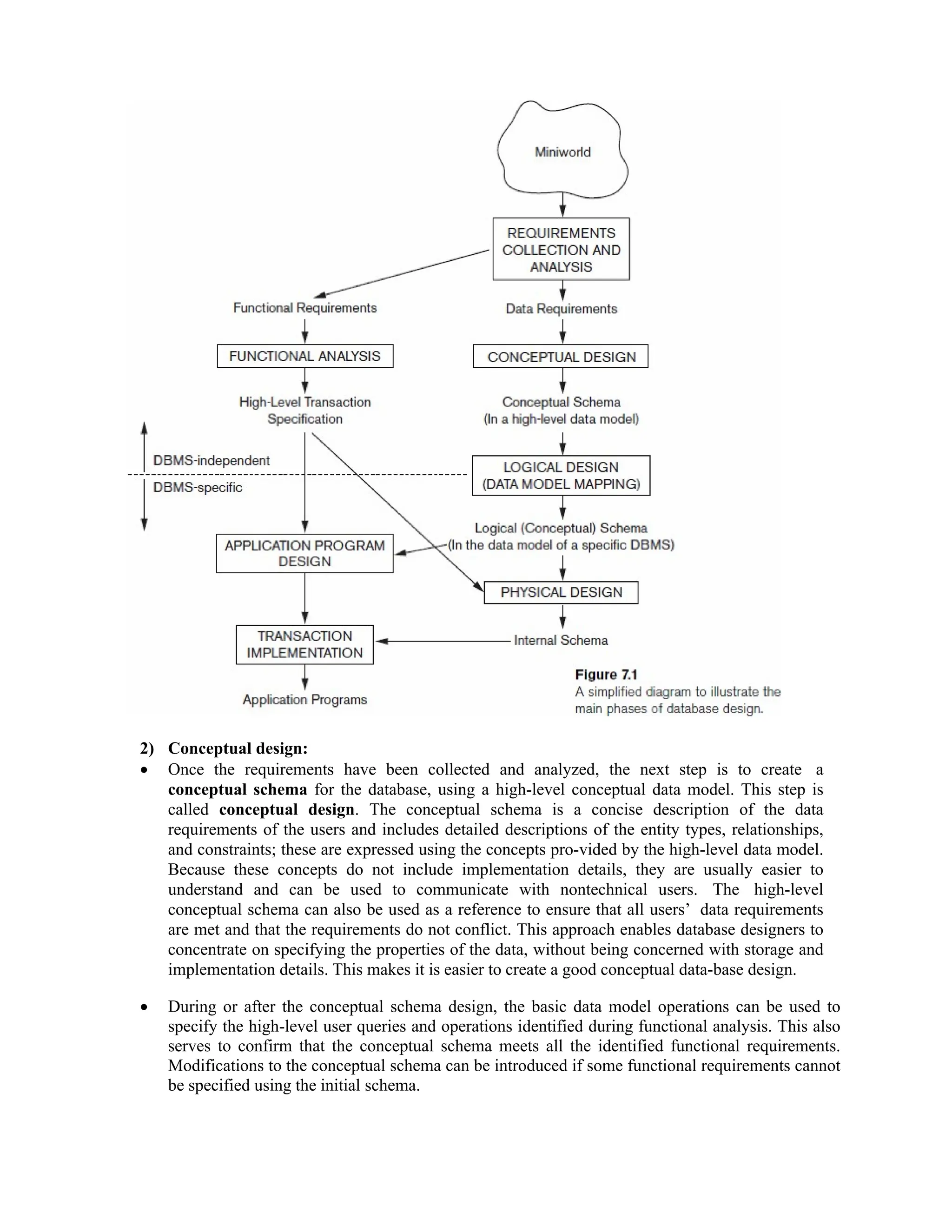
1) Requirements collection and analysis :
 During this step, the database designers interview prospective database users to understand and
document their data requirements. The result of this step is a concisely written set of users’
requirements. These requirements should be specified in as detailed and complete a form as
possible. In parallel with specifying the data requirements, it is useful to specify the known
functional requirements of the application. These consist of the user-defined operations (or
transactions) that will be applied to the database, including both retrievals and updates. In
software design, it is common to use data flow diagrams, sequence diagrams, scenarios, and
other techniques to specify functional requirements.
2) Conceptual design:
 Once the requirements have been collected and analyzed, the next step is to create a
conceptual schema for the database, using a high-level conceptual data model. This step is
called conceptual design. The conceptual schema is a concise description of the data
requirements of the users and includes detailed descriptions of the entity types, relationships,
and constraints; these are expressed using the concepts pro-vided by the high-level data model.
Because these concepts do not include implementation details, they are usually easier to
understand and can be used to communicate with nontechnical users. The high-level
conceptual schema can also be used as a reference to ensure that all users’ data requirements
are met and that the requirements do not conflict. This approach enables database designers to
concentrate on specifying the properties of the data, without being concerned with storage and
implementation details. This makes it is easier to create a good conceptual data-base design.
 During or after the conceptual schema design, the basic data model operations can be used to
specify the high-level user queries and operations identified during functional analysis. This also
serves to confirm that the conceptual schema meets all the identified functional requirements.
Modifications to the conceptual schema can be introduced if some functional requirements cannot
be specified using the initial schema.
3) Logical design:
 The next step in database design is the actual implementation of the database, using a commercial
DBMS. Most current commercial DBMSs use an implementation data model—such as the
relational or the object-relational database model—so the conceptual schema is transformed from
the high-level data model into the implementation data model. This step is called logical design
or data model mapping; its result is a database schema in the implementation data model of the
DBMS. Data model mapping is often automated or semiautomated within the database design
tools.
4) Physical design:
 The last step is the physical design phase, during which the internal storage structures, file
organizations, indexes, access paths, and physical design parameters for the database files are
specified. In parallel with these activities, application programs are designed and implemented as
database transactions corresponding to the high-level transaction specifications.
A Sample Database Application
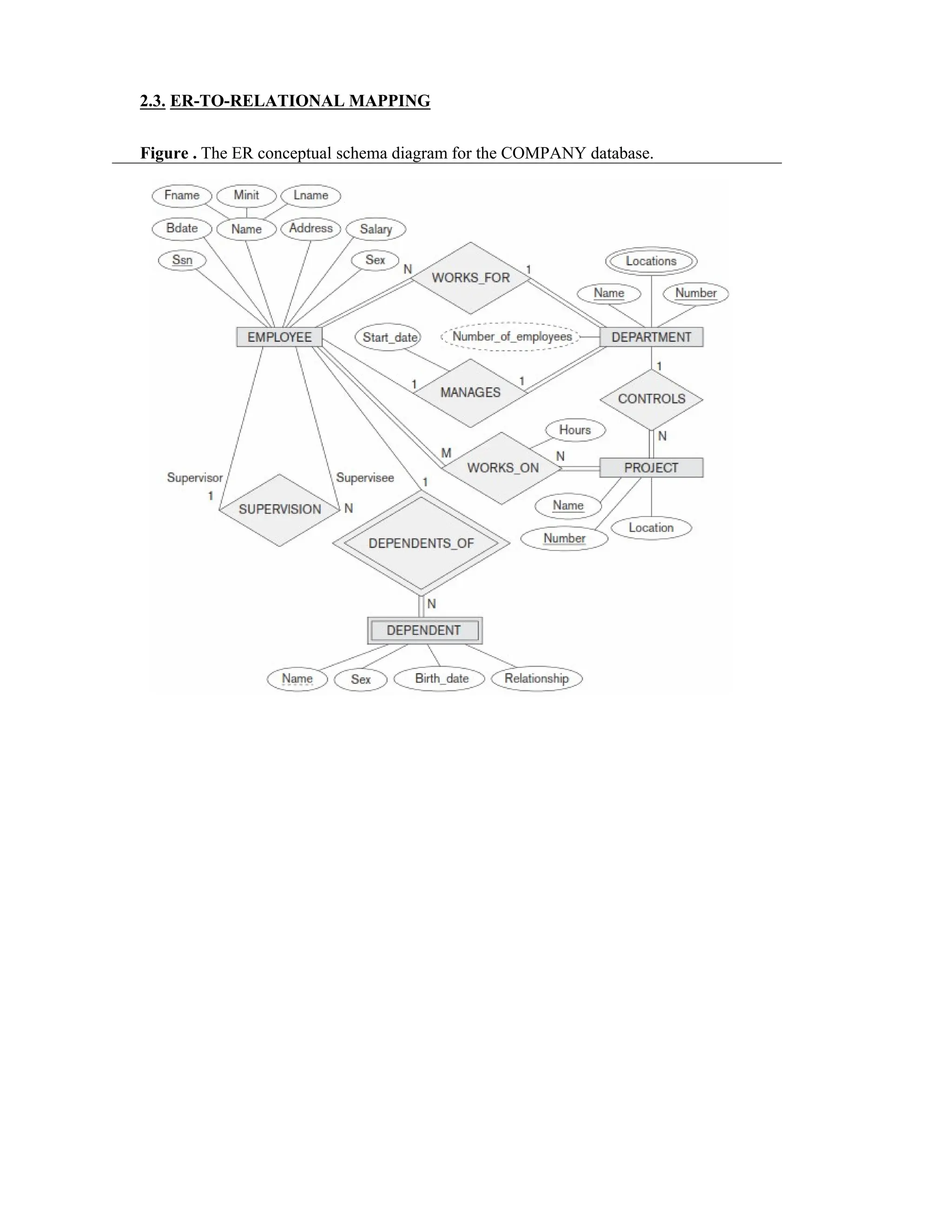
 Consider a sample database application, called COMPANY, which serves to illustrate the basic
ER model concepts and their use in schema design.
 The company is organized into departments. Each department has a unique name, a unique
number, and a particular employee who manages the department. We keep track of the start date
when that employee began managing the department. A department may have several locations.
 A department controls a number of projects, each of which has a unique name, a unique number,
and a single location.
 We store each employee’s name, Social Security number,address, salary, sex (gender), and birth
date. An employee is assigned to one department, but may work on several projects, which are
not necessarily controlled by the same department. We keep track of the current number of hours
per week that an employee works on each project. We also keep track of the direct supervisor of
each employee (who is another employee).
 We want to keep track of the dependents of each employee for insurance purposes. We keep each
dependent’s first name, sex, birth date, and relation-ship to the employee.
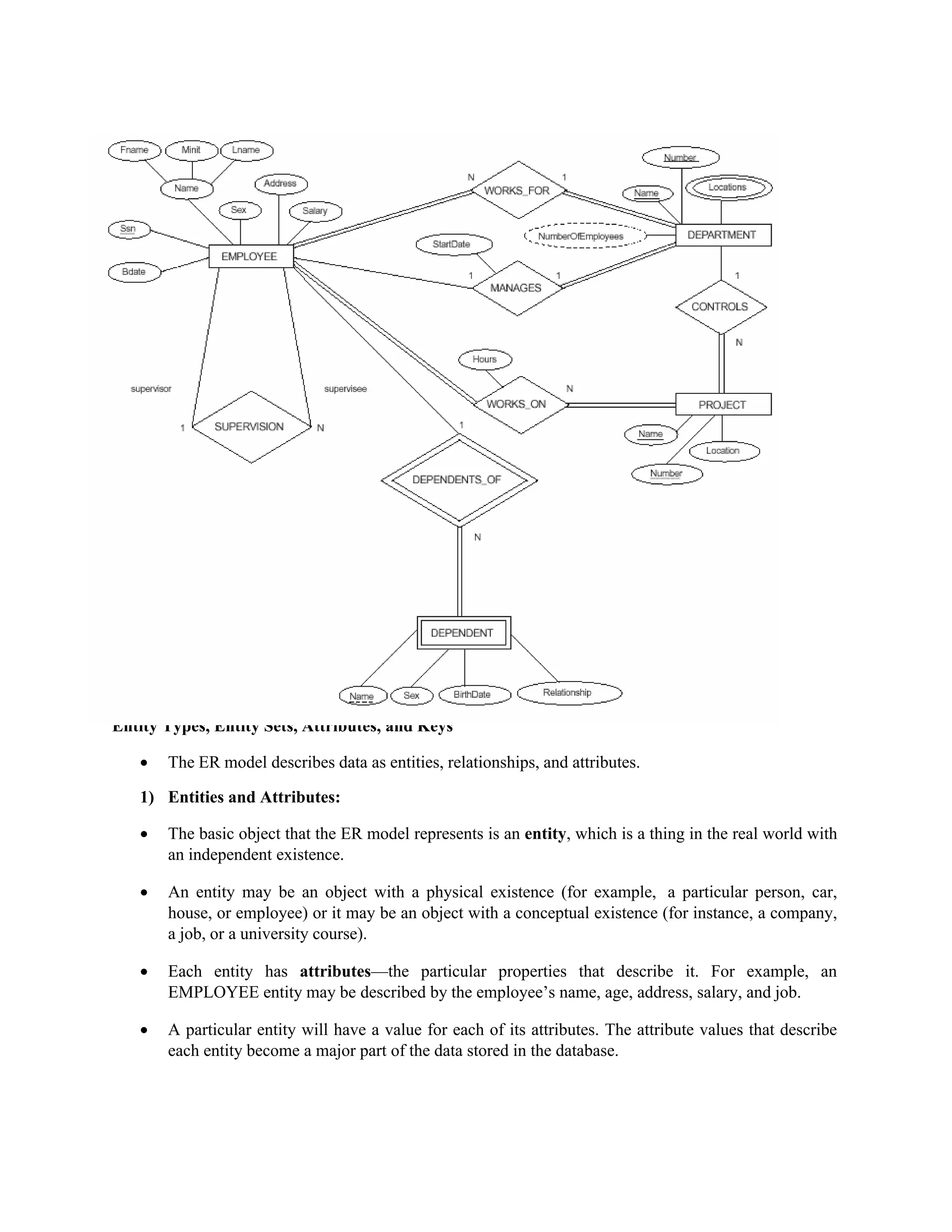
 Figure shows how the schema for this database application can be displayed by means of the
graphical notation known as ER diagrams. This figure will be explained gradually as the ER
model concepts are presented. We describe the step-by-step process of deriving this schema from
the stated requirements—and explain the ER diagrammatic notation—as we introduce the ER
model concepts.
Entity Types, Entity Sets, Attributes, and Keys
 The ER model describes data as entities, relationships, and attributes.
1) Entities and Attributes:
 The basic object that the ER model represents is an entity, which is a thing in the real world with
an independent existence.
 An entity may be an object with a physical existence (for example, a particular person, car,
house, or employee) or it may be an object with a conceptual existence (for instance, a company,
a job, or a university course).
 Each entity has attributes—the particular properties that describe it. For example, an
EMPLOYEE entity may be described by the employee’s name, age, address, salary, and job.
 A particular entity will have a value for each of its attributes. The attribute values that describe
each entity become a major part of the data stored in the database.
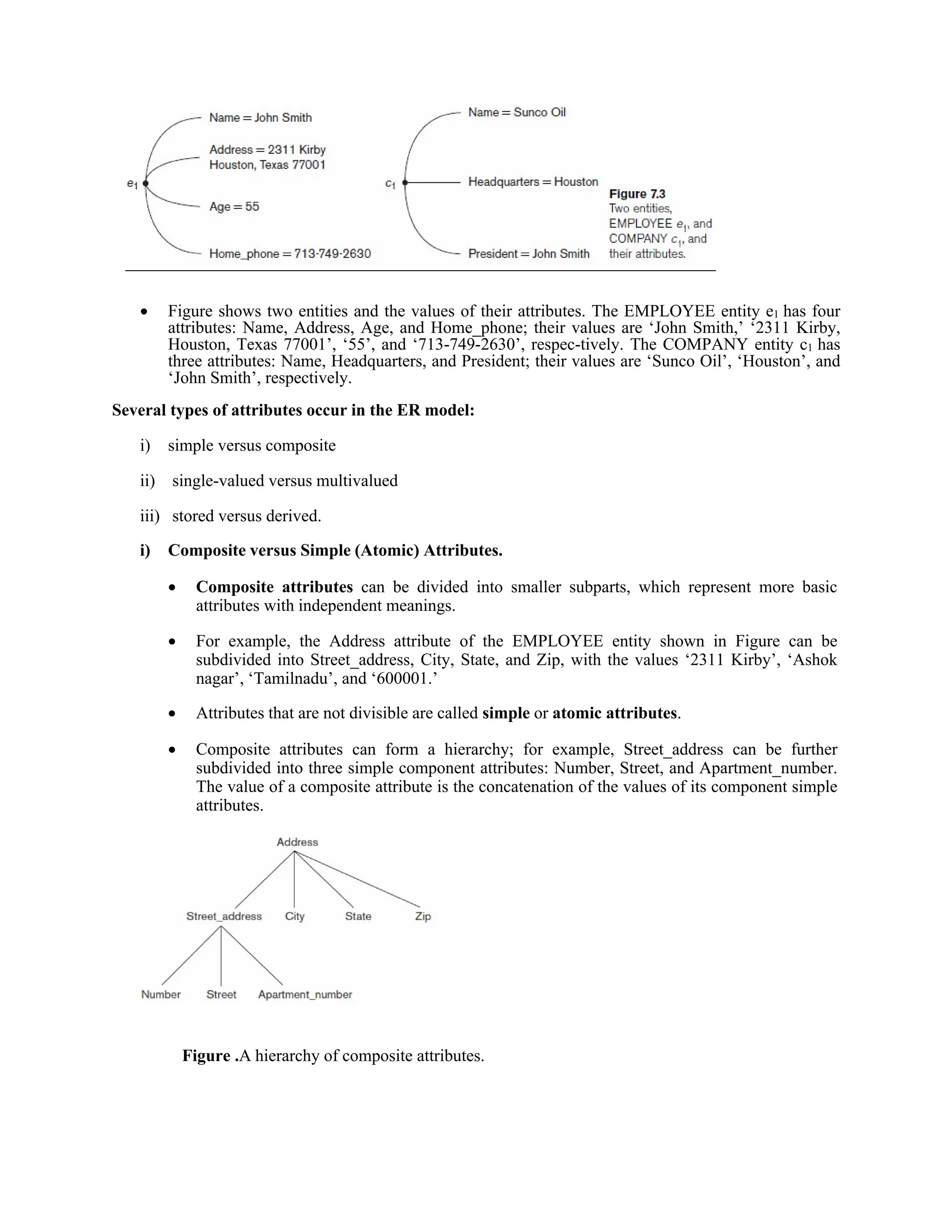
 Figure shows two entities and the values of their attributes. The EMPLOYEE entity e1 has four
attributes: Name, Address, Age, and Home_phone; their values are ‘John Smith,’ ‘2311 Kirby,
Houston, Texas 77001’, ‘55’, and ‘713-749-2630’, respec-tively. The COMPANY entity c1 has
three attributes: Name, Headquarters, and President; their values are ‘Sunco Oil’, ‘Houston’, and
‘John Smith’, respectively.
Several types of attributes occur in the ER model:
i) simple versus composite
ii) single-valued versus multivalued
iii) stored versus derived.
i) Composite versus Simple (Atomic) Attributes.
 Composite attributes can be divided into smaller subparts, which represent more basic
attributes with independent meanings.
 For example, the Address attribute of the EMPLOYEE entity shown in Figure can be
subdivided into Street_address, City, State, and Zip, with the values ‘2311 Kirby’, ‘Ashok
nagar’, ‘Tamilnadu’, and ‘600001.’
 Attributes that are not divisible are called simple or atomic attributes.
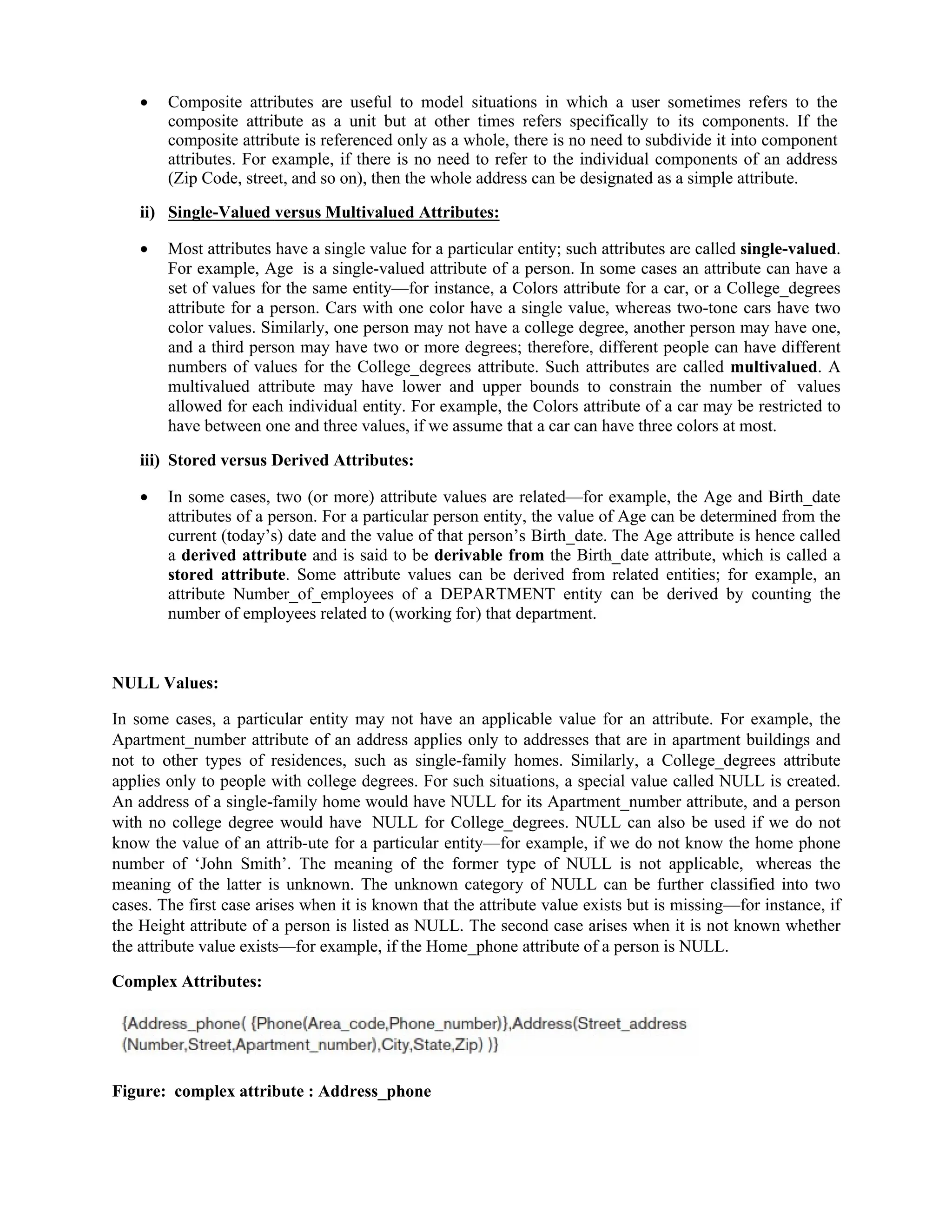
 Composite attributes can form a hierarchy; for example, Street_address can be further
subdivided into three simple component attributes: Number, Street, and Apartment_number.
The value of a composite attribute is the concatenation of the values of its component simple
attributes.
Figure .A hierarchy of composite attributes.
 Composite attributes are useful to model situations in which a user sometimes refers to the
composite attribute as a unit but at other times refers specifically to its components. If the
composite attribute is referenced only as a whole, there is no need to subdivide it into component
attributes. For example, if there is no need to refer to the individual components of an address
(Zip Code, street, and so on), then the whole address can be designated as a simple attribute.
ii) Single-Valued versus Multivalued Attributes:
 Most attributes have a single value for a particular entity; such attributes are called single-valued.
For example, Age is a single-valued attribute of a person. In some cases an attribute can have a
set of values for the same entity—for instance, a Colors attribute for a car, or a College_degrees
attribute for a person. Cars with one color have a single value, whereas two-tone cars have two
color values. Similarly, one person may not have a college degree, another person may have one,
and a third person may have two or more degrees; therefore, different people can have different
numbers of values for the College_degrees attribute. Such attributes are called multivalued. A
multivalued attribute may have lower and upper bounds to constrain the number of values
allowed for each individual entity. For example, the Colors attribute of a car may be restricted to
have between one and three values, if we assume that a car can have three colors at most.
iii) Stored versus Derived Attributes:
 In some cases, two (or more) attribute values are related—for example, the Age and Birth_date
attributes of a person. For a particular person entity, the value of Age can be determined from the
current (today’s) date and the value of that person’s Birth_date. The Age attribute is hence called
a derived attribute and is said to be derivable from the Birth_date attribute, which is called a
stored attribute. Some attribute values can be derived from related entities; for example, an
attribute Number_of_employees of a DEPARTMENT entity can be derived by counting the
number of employees related to (working for) that department.
NULL Values:
In some cases, a particular entity may not have an applicable value for an attribute. For example, the
Apartment_number attribute of an address applies only to addresses that are in apartment buildings and
not to other types of residences, such as single-family homes. Similarly, a College_degrees attribute
applies only to people with college degrees. For such situations, a special value called NULL is created.
An address of a single-family home would have NULL for its Apartment_number attribute, and a person
with no college degree would have NULL for College_degrees. NULL can also be used if we do not
know the value of an attrib-ute for a particular entity—for example, if we do not know the home phone
number of ‘John Smith’. The meaning of the former type of NULL is not applicable, whereas the
meaning of the latter is unknown. The unknown category of NULL can be further classified into two
cases. The first case arises when it is known that the attribute value exists but is missing—for instance, if
the Height attribute of a person is listed as NULL. The second case arises when it is not known whether
the attribute value exists—for example, if the Home_phone attribute of a person is NULL.
Complex Attributes:
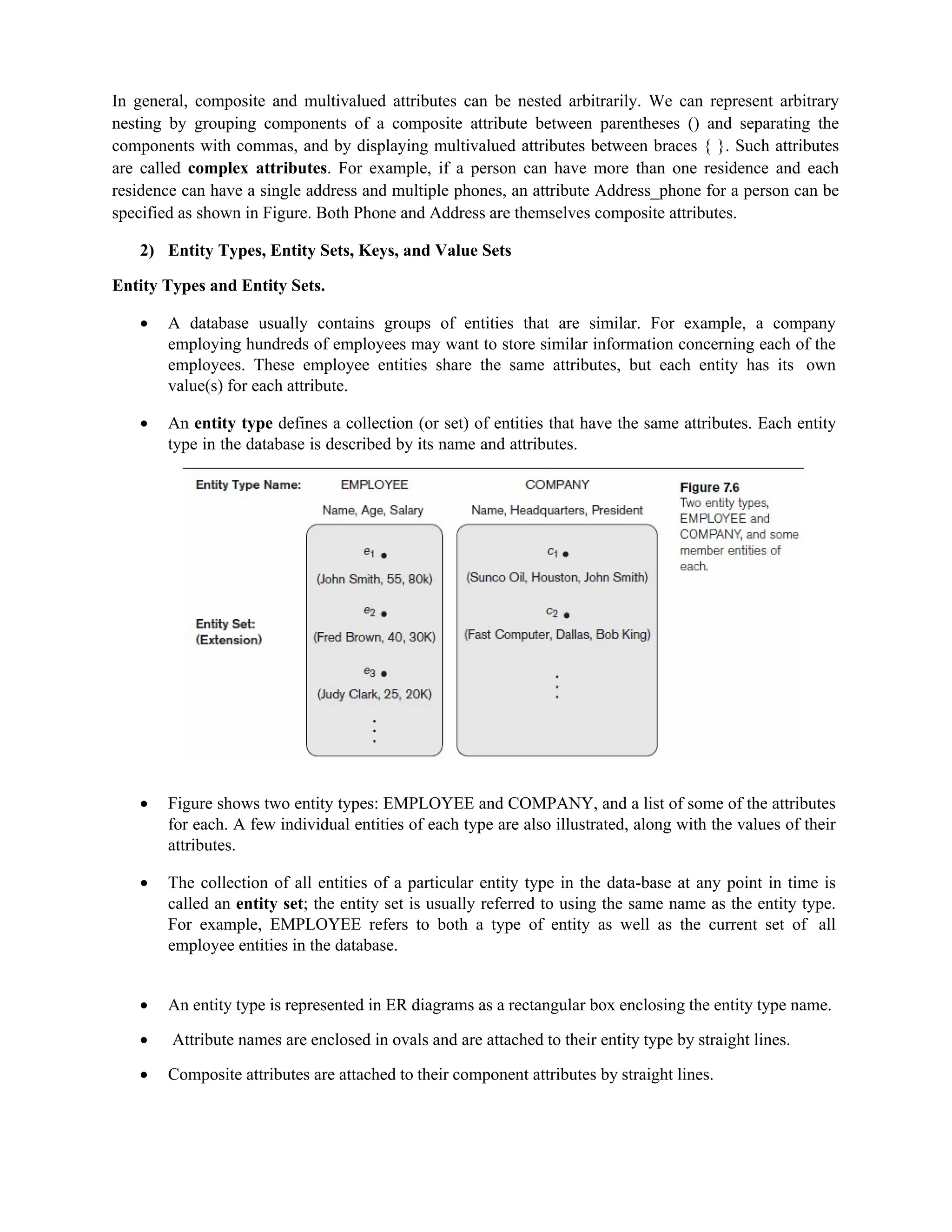
Figure: complex attribute : Address_phone
In general, composite and multivalued attributes can be nested arbitrarily. We can represent arbitrary
nesting by grouping components of a composite attribute between parentheses () and separating the
components with commas, and by displaying multivalued attributes between braces { }. Such attributes
are called complex attributes. For example, if a person can have more than one residence and each
residence can have a single address and multiple phones, an attribute Address_phone for a person can be
specified as shown in Figure. Both Phone and Address are themselves composite attributes.
2) Entity Types, Entity Sets, Keys, and Value Sets
Entity Types and Entity Sets.
 A database usually contains groups of entities that are similar. For example, a company
employing hundreds of employees may want to store similar information concerning each of the
employees. These employee entities share the same attributes, but each entity has its own
value(s) for each attribute.
 An entity type defines a collection (or set) of entities that have the same attributes. Each entity
type in the database is described by its name and attributes.
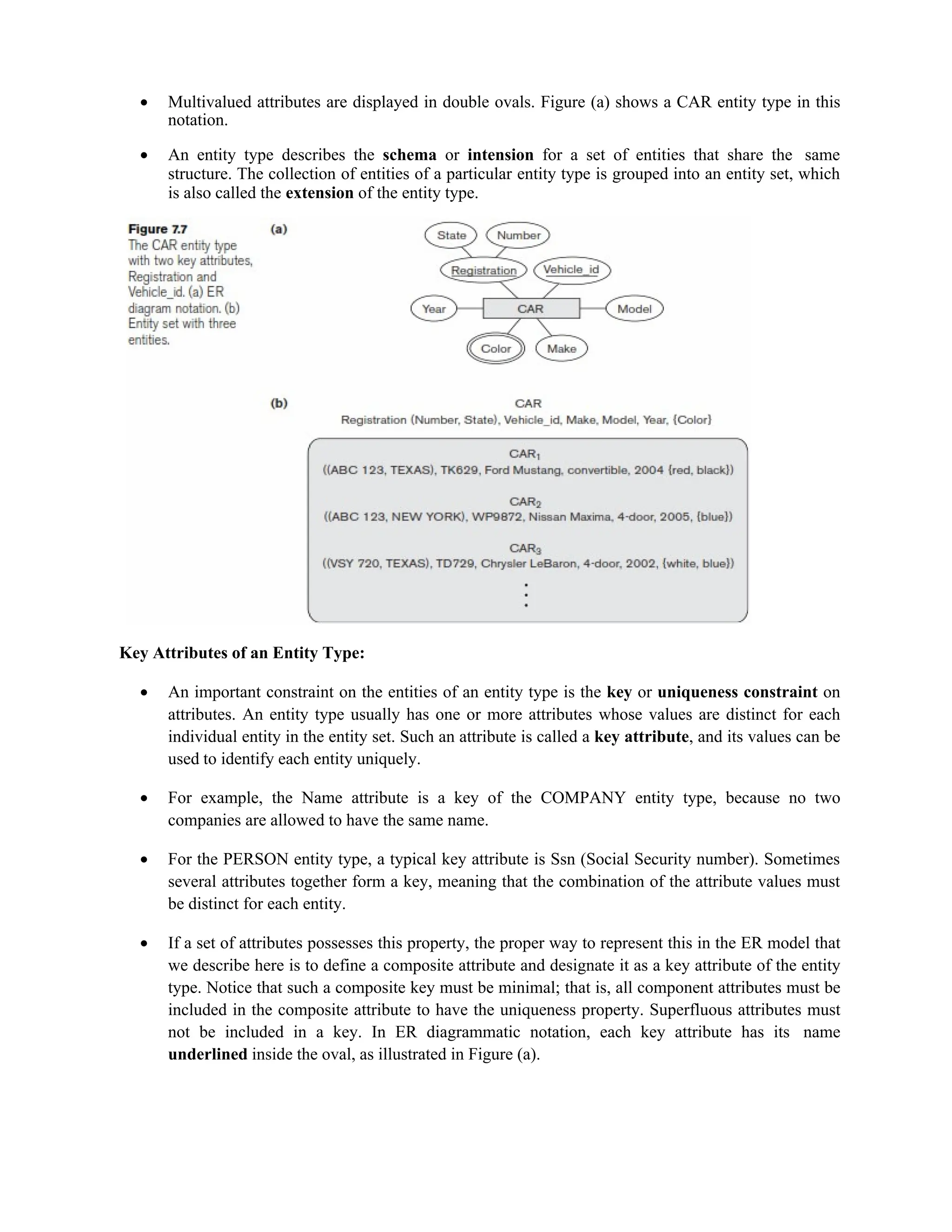
 Figure shows two entity types: EMPLOYEE and COMPANY, and a list of some of the attributes
for each. A few individual entities of each type are also illustrated, along with the values of their
attributes.
 The collection of all entities of a particular entity type in the data-base at any point in time is
called an entity set; the entity set is usually referred to using the same name as the entity type.
For example, EMPLOYEE refers to both a type of entity as well as the current set of all
employee entities in the database.
 An entity type is represented in ER diagrams as a rectangular box enclosing the entity type name.
 Attribute names are enclosed in ovals and are attached to their entity type by straight lines.
 Composite attributes are attached to their component attributes by straight lines.
 Multivalued attributes are displayed in double ovals. Figure (a) shows a CAR entity type in this
notation.
 An entity type describes the schema or intension for a set of entities that share the same
structure. The collection of entities of a particular entity type is grouped into an entity set, which
is also called the extension of the entity type.
Key Attributes of an Entity Type:
 An important constraint on the entities of an entity type is the key or uniqueness constraint on
attributes. An entity type usually has one or more attributes whose values are distinct for each
individual entity in the entity set. Such an attribute is called a key attribute, and its values can be
used to identify each entity uniquely.
 For example, the Name attribute is a key of the COMPANY entity type, because no two
companies are allowed to have the same name.
 For the PERSON entity type, a typical key attribute is Ssn (Social Security number). Sometimes
several attributes together form a key, meaning that the combination of the attribute values must
be distinct for each entity.
 If a set of attributes possesses this property, the proper way to represent this in the ER model that
we describe here is to define a composite attribute and designate it as a key attribute of the entity
type. Notice that such a composite key must be minimal; that is, all component attributes must be
included in the composite attribute to have the uniqueness property. Superfluous attributes must
not be included in a key. In ER diagrammatic notation, each key attribute has its name
underlined inside the oval, as illustrated in Figure (a).
 Specifying that an attribute is a key of an entity type means that the preceding uniqueness
property must hold for every entity set of the entity type. Hence, it is a constraint that prohibits
any two entities from having the same value for the key attribute at the same time. It is not the
property of a particular entity set; rather, it is a constraint on any entity set of the entity type at
any point in time. This key con-straint (and other constraints we discuss later) is derived from the
constraints of the miniworld that the database represents.
 Some entity types have more than one key attribute. For example, each of the Vehicle_id and
Registration attributes of the entity type CAR (Figure 7.7) is a key in its own right. The
Registration attribute is an example of a composite key formed from two simple component
attributes, State and Number, neither of which is a key on its own. An entity type may also have
no key, in which case it is called a weak entity type..
 In our diagrammatic notation, if two attributes are underlined separately, then each is a key on its
own. Unlike the relational model, there is no concept of primary key in the ER modele; the
primary key will be chosen during mapping to a relational schema.
Value Sets (Domains) of Attributes.
 Each simple attribute of an entity type is associated with a value set (or domain of values),
which specifies the set of values that may be assigned to that attribute for each individual entity.
 In Figure, if the range of ages allowed for employees is between 16 and 70, we can specify the
value set of the Age attribute of EMPLOYEE to be the set of integer numbers between 16 and
70. Similarly, we can specify the value set for the Name attribute to be the set of strings of
alphabetic characters separated by blank characters, and so on.
 Value sets are not displayed in ER diagrams, and are typically specified using the basic data
types available in most programming languages, such as integer, string, Boolean, float,
enumerated type, subrange, and so on. Additional data types to represent common database
types such as date, time, and other concepts are also employed.
 Mathematically, an attribute A of entity set E whose value set is V can be defined as a function
from E to the power set6
P(V ) of V:
A : E → P(V )
 We refer to the value of attribute A for entity e as A(e). The previous definition cov-ers both
single-valued and multivalued attributes, as well as NULLs. A NULL value is represented by the
empty set. For single-valued attributes, A(e) is restricted to being a singleton set for each entity e
in E, whereas there is no restriction on multivalued attributes.7
For a composite attribute A, the
value set V is the power set of the Cartesian product of P(V1), P(V2), ..., P(Vn), where V1, V2, ...,
Vn are the value sets of the simple component attributes that form A:
V = P (P(V1) × P(V2) × ... × P(Vn))
 The value set provides all possible values. Usually only a small number of these val-ues exist in
the database at a particular time. Those values represent the data from the current state of the
miniworld. They correspond to the data as it actually exists in the miniworld.
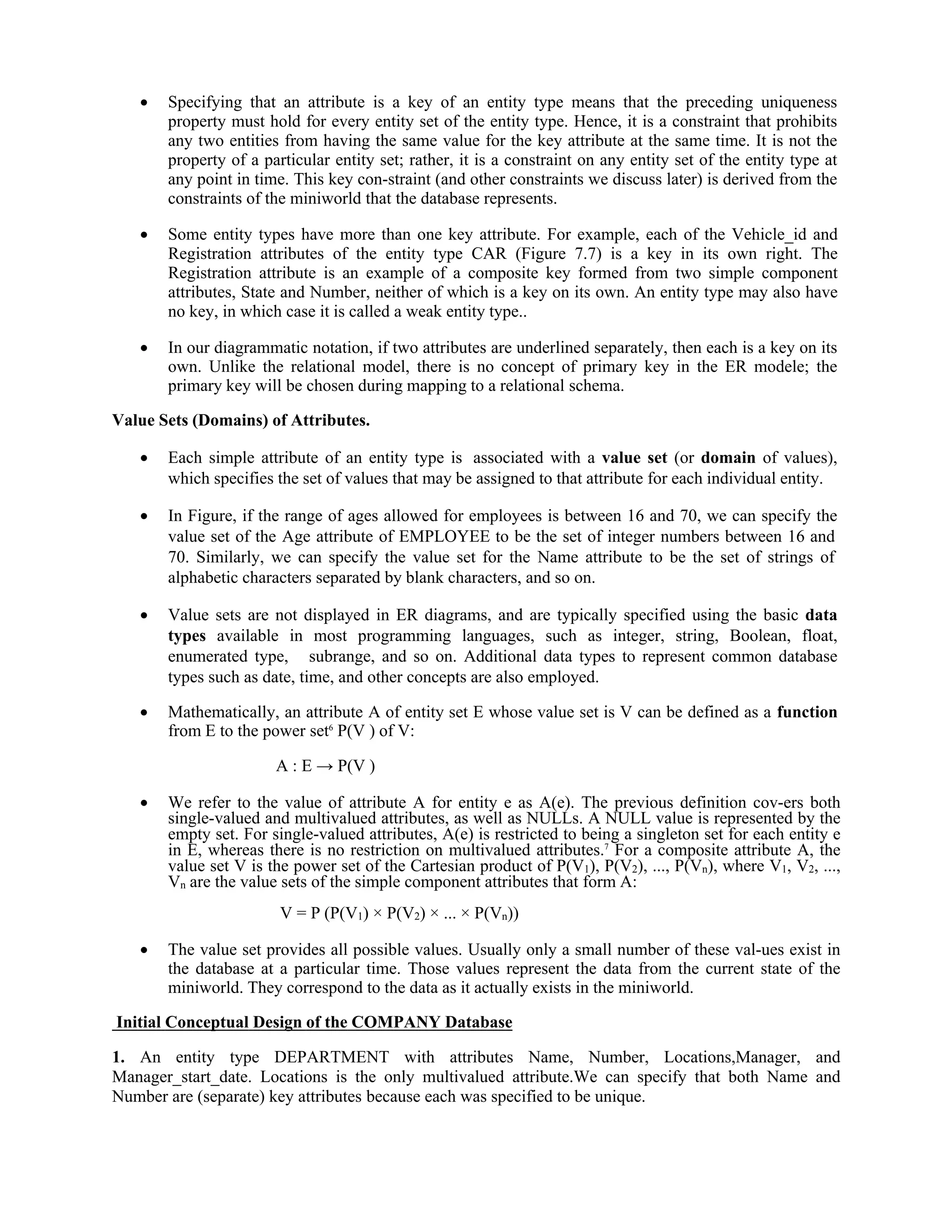
Initial Conceptual Design of the COMPANY Database
1. An entity type DEPARTMENT with attributes Name, Number, Locations,Manager, and
Manager_start_date. Locations is the only multivalued attribute.We can specify that both Name and
Number are (separate) key attributes because each was specified to be unique.
2. An entity type PROJECT with attributes Name, Number, Location, and Controlling_department. Both
Name and Number are (separate) key attributes.
3. An entity type EMPLOYEE with attributes Name, Ssn, Sex, Address, Salary, Birth_date, Department,
and Supervisor. Both Name and Address may be composite attributes; however, this was not specified in
the requirements. We must go back to the users to see if any of them will refer to the individual
components of Name—First_name, Middle_initial, Last_name—or of Address.
4. An entity type DEPENDENT with attributes Employee, Dependent_name, Sex, Birth_date, and
Relationship (to the employee).
Figure. Preliminary design of entity types for the COMPANY database. Some of the shown attributes
will be refined into relationships.
Relationship types, Roles, Structural Constraints:
Relationship type: R among n Entity types E1, ..., En defines a set of associations among entities
from these types. Each association will be denoted as:
(e1, ..., en) where ei belongs to Ei, 1 <= i <= n.
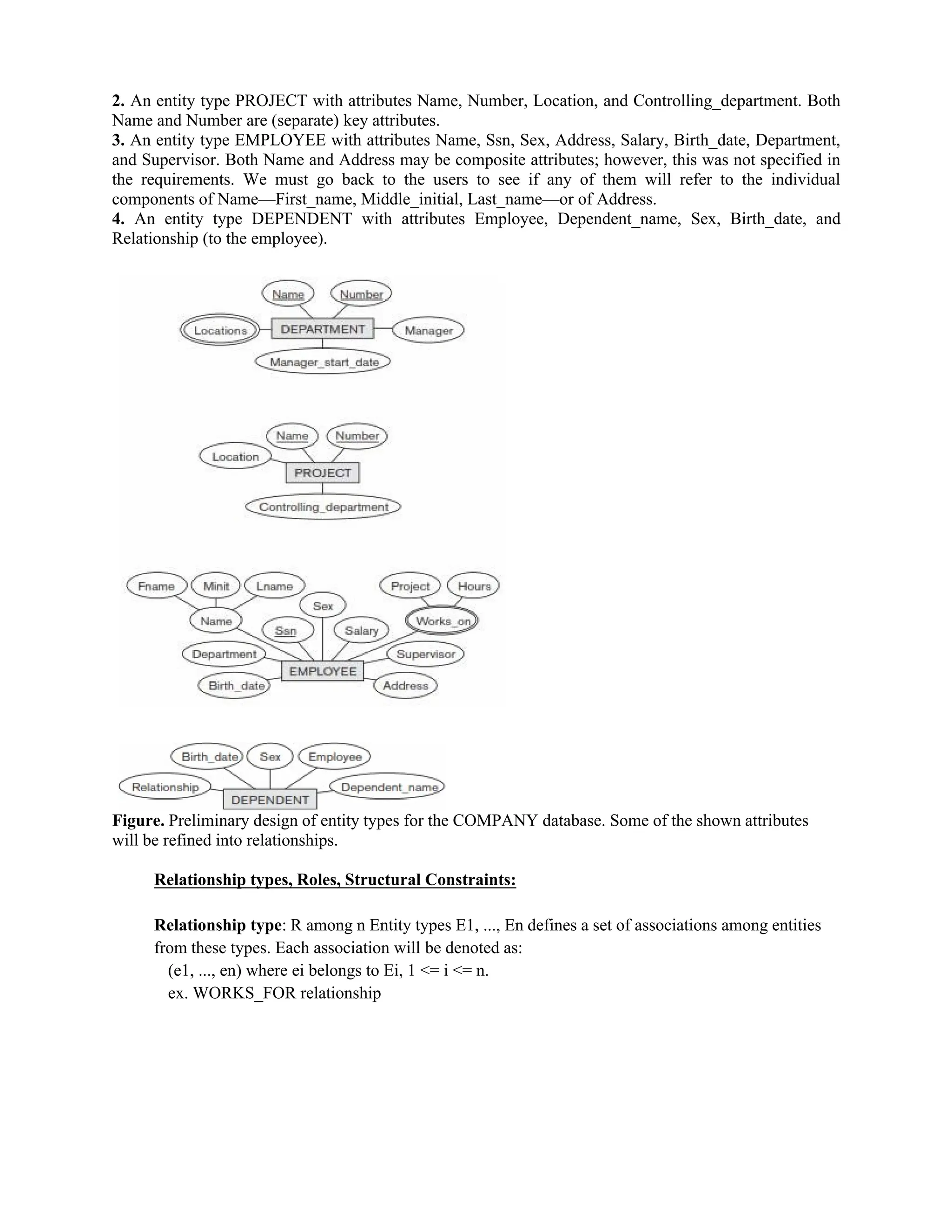
ex. WORKS_FOR relationship
Figure. Some instances of the WORKS_FOR relationship between EMPLOYEE and
DEPARTMENT.
Degree of a relationship:
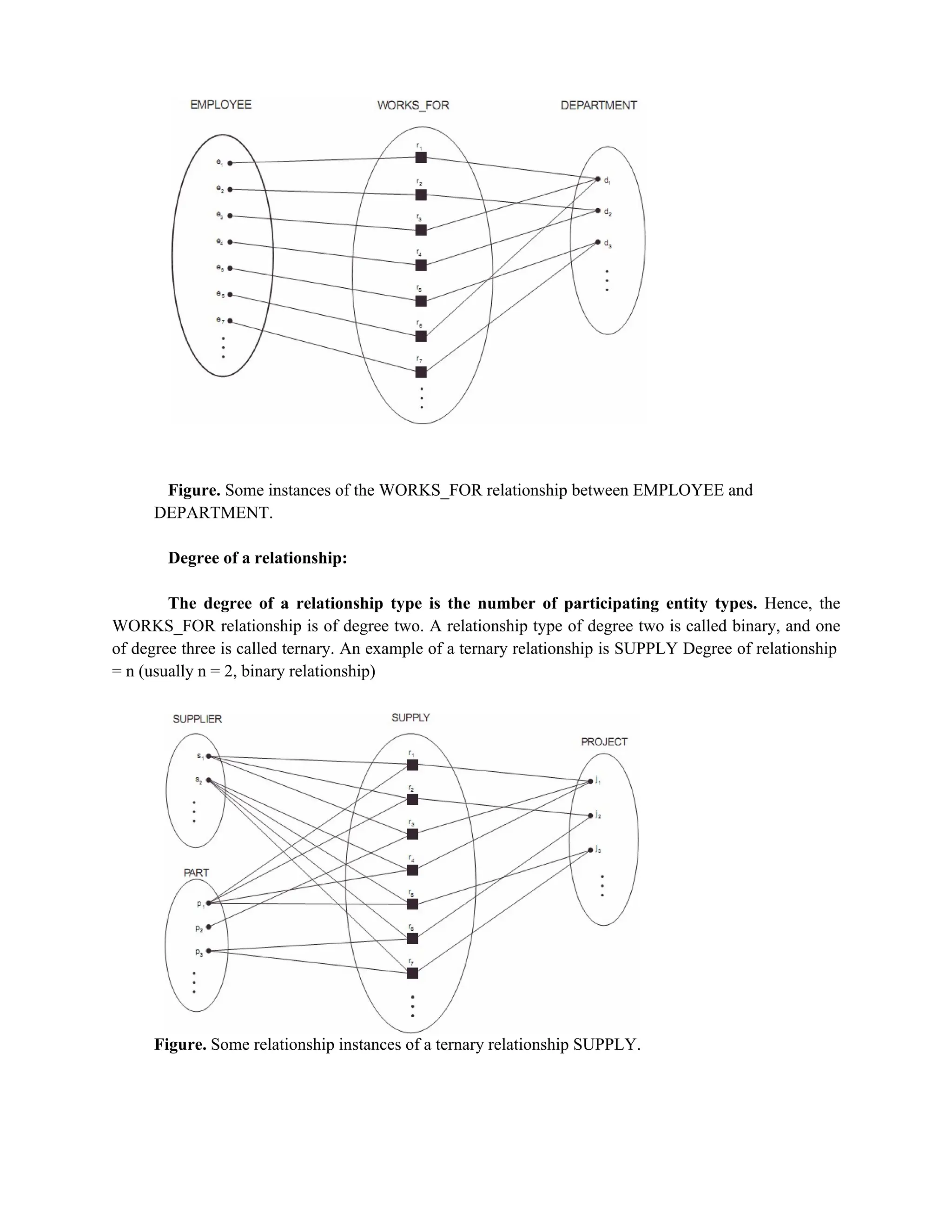
The degree of a relationship type is the number of participating entity types. Hence, the
WORKS_FOR relationship is of degree two. A relationship type of degree two is called binary, and one
of degree three is called ternary. An example of a ternary relationship is SUPPLY Degree of relationship
= n (usually n = 2, binary relationship)
Figure. Some relationship instances of a ternary relationship SUPPLY.
Relationships as Attributes: It is sometimes convenient to think of a relationship type in terms of
attributes,
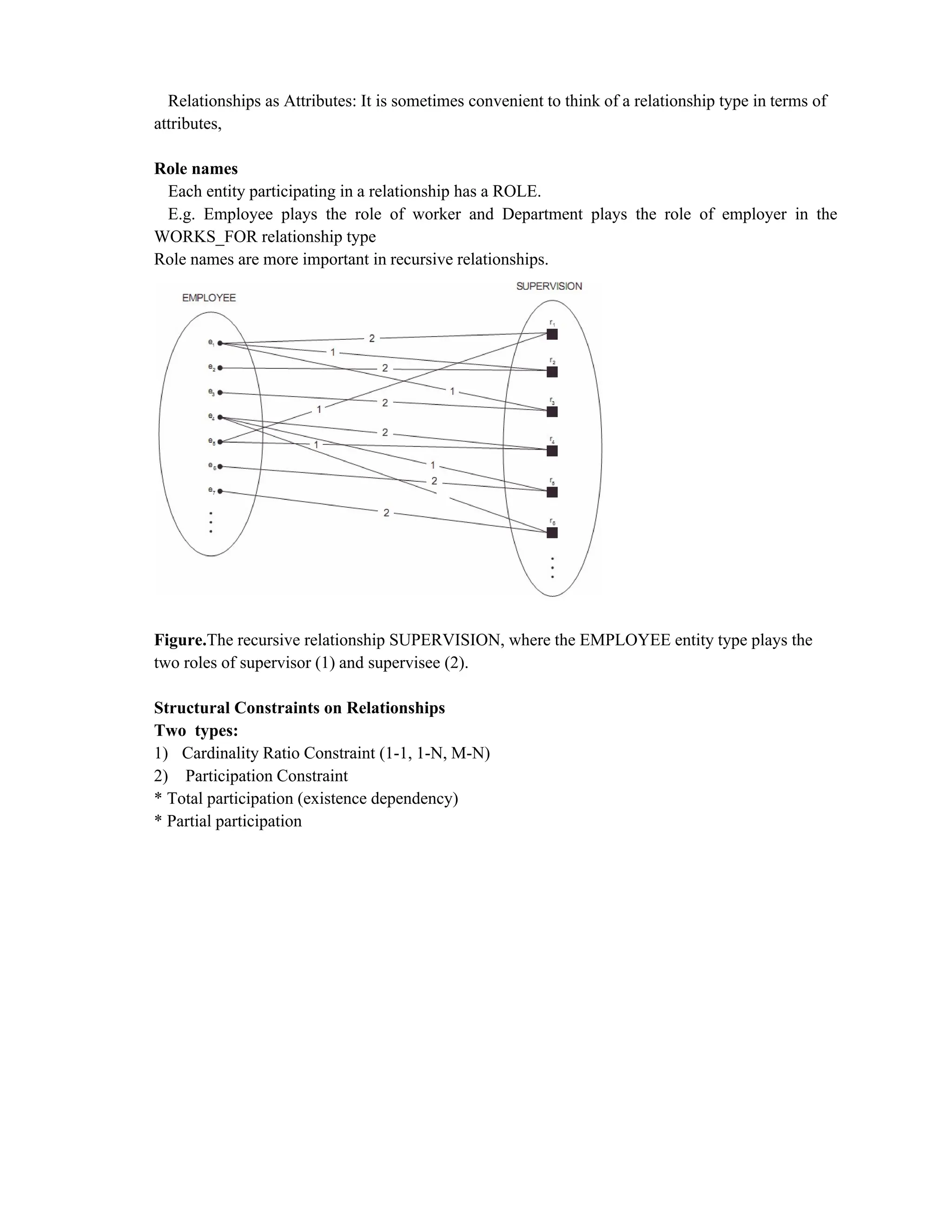
Role names
Each entity participating in a relationship has a ROLE.
E.g. Employee plays the role of worker and Department plays the role of employer in the
WORKS_FOR relationship type
Role names are more important in recursive relationships.
Figure.The recursive relationship SUPERVISION, where the EMPLOYEE entity type plays the
two roles of supervisor (1) and supervisee (2).
Structural Constraints on Relationships
Two types:
1) Cardinality Ratio Constraint (1-1, 1-N, M-N)
2) Participation Constraint
* Total participation (existence dependency)
* Partial participation
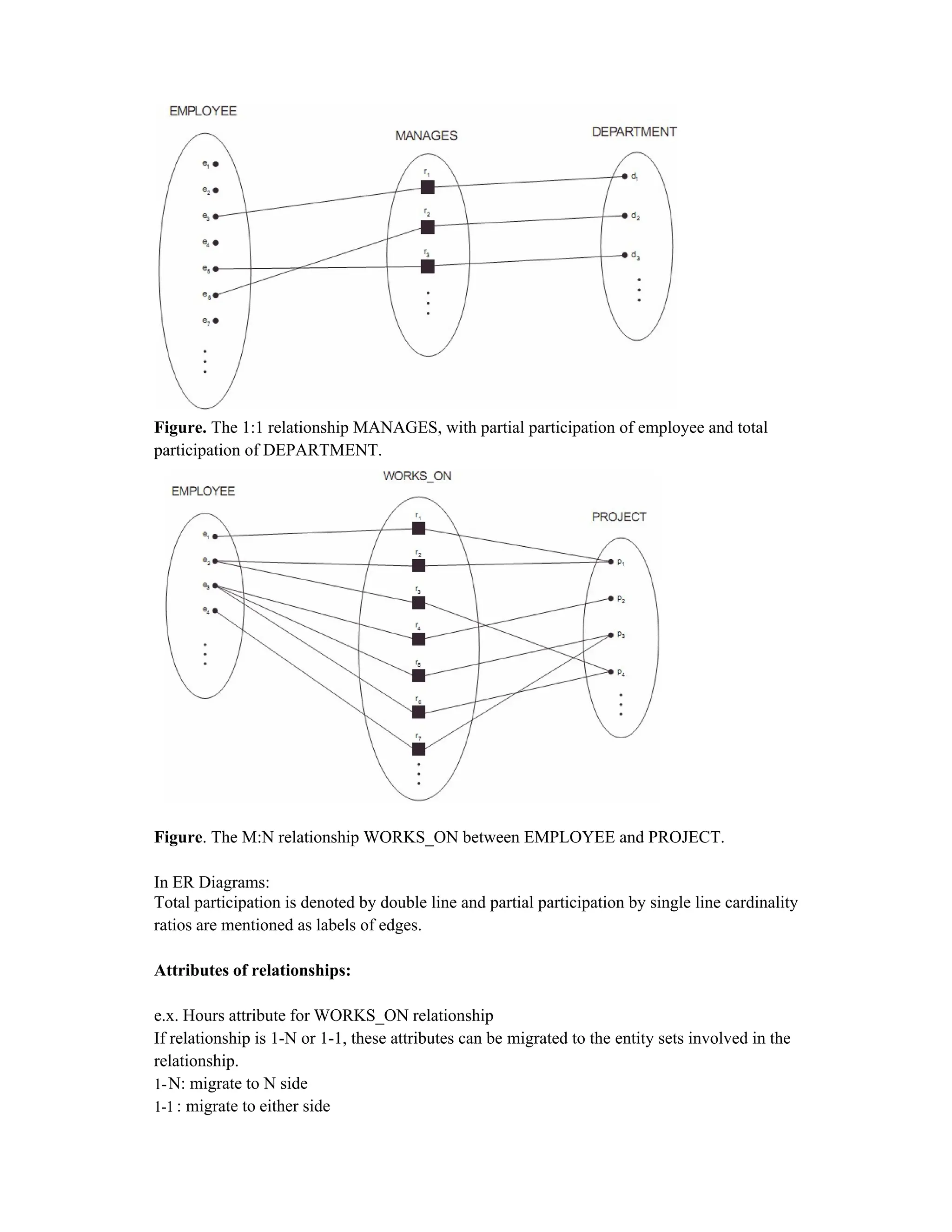
Figure. The 1:1 relationship MANAGES, with partial participation of employee and total
participation of DEPARTMENT.
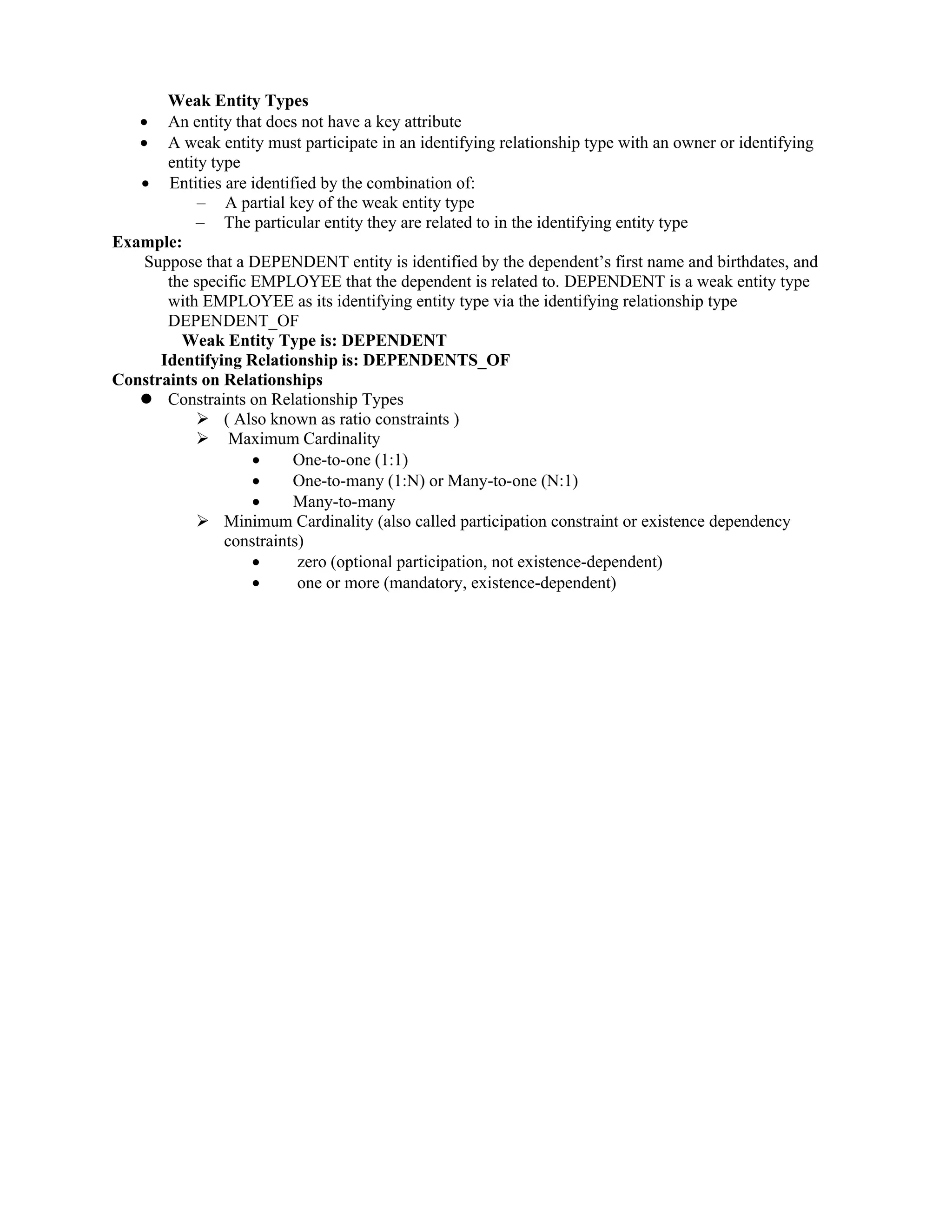
Figure. The M:N relationship WORKS_ON between EMPLOYEE and PROJECT.
In ER Diagrams:
Total participation is denoted by double line and partial participation by single line cardinality
ratios are mentioned as labels of edges.
Attributes of relationships:
e.x. Hours attribute for WORKS_ON relationship
If relationship is 1-N or 1-1, these attributes can be migrated to the entity sets involved in the
relationship.
1-N: migrate to N side
1-1 : migrate to either side
Weak Entity Types
 An entity that does not have a key attribute
 A weak entity must participate in an identifying relationship type with an owner or identifying
entity type
 Entities are identified by the combination of:
– A partial key of the weak entity type
– The particular entity they are related to in the identifying entity type
Example:
Suppose that a DEPENDENT entity is identified by the dependent’s first name and birthdates, and
the specific EMPLOYEE that the dependent is related to. DEPENDENT is a weak entity type
with EMPLOYEE as its identifying entity type via the identifying relationship type
DEPENDENT_OF
Weak Entity Type is: DEPENDENT
Identifying Relationship is: DEPENDENTS_OF
Constraints on Relationships
 Constraints on Relationship Types
 ( Also known as ratio constraints )
 Maximum Cardinality
 One-to-one (1:1)
 One-to-many (1:N) or Many-to-one (N:1)
 Many-to-many
 Minimum Cardinality (also called participation constraint or existence dependency
constraints)
 zero (optional participation, not existence-dependent)
 one or more (mandatory, existence-dependent)
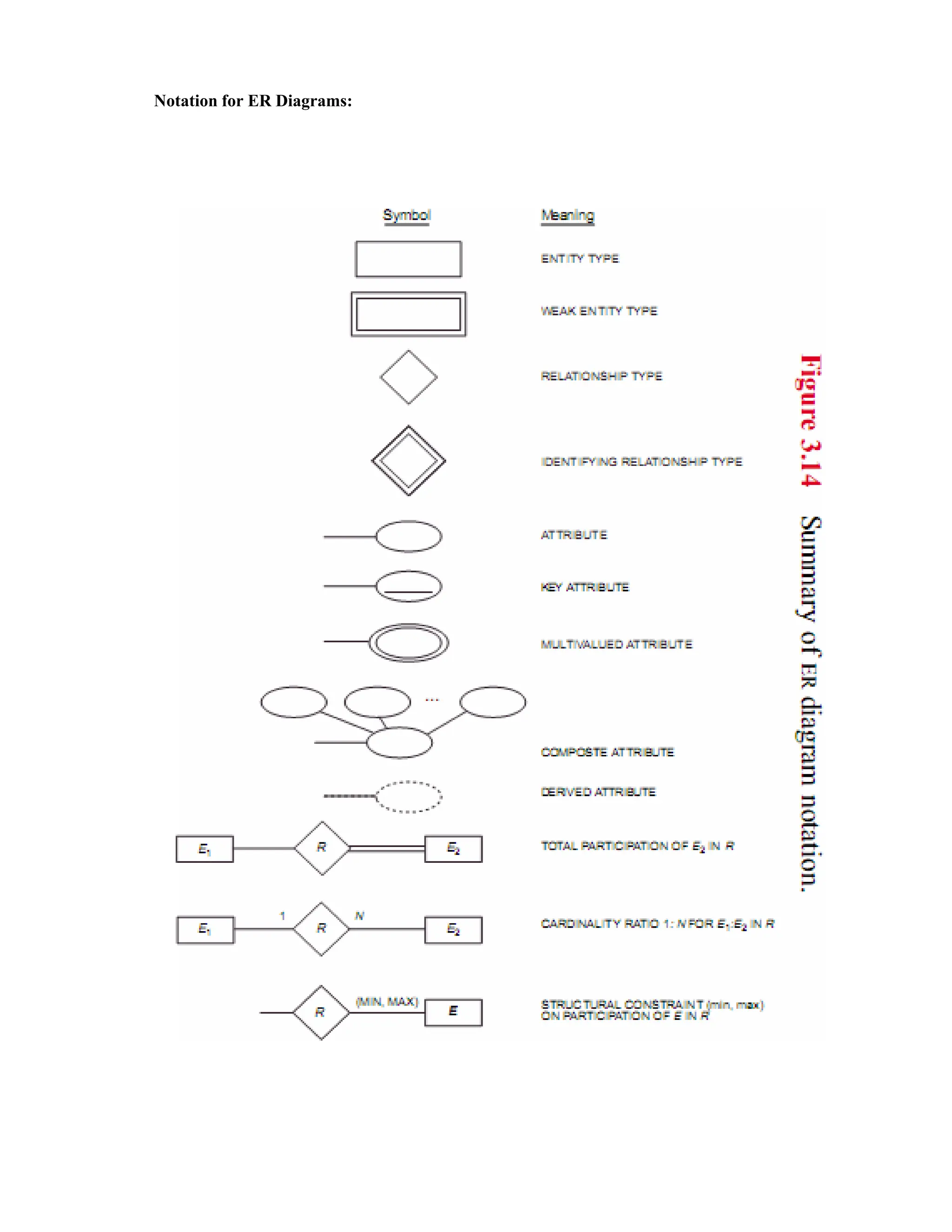
Notation for ER Diagrams:
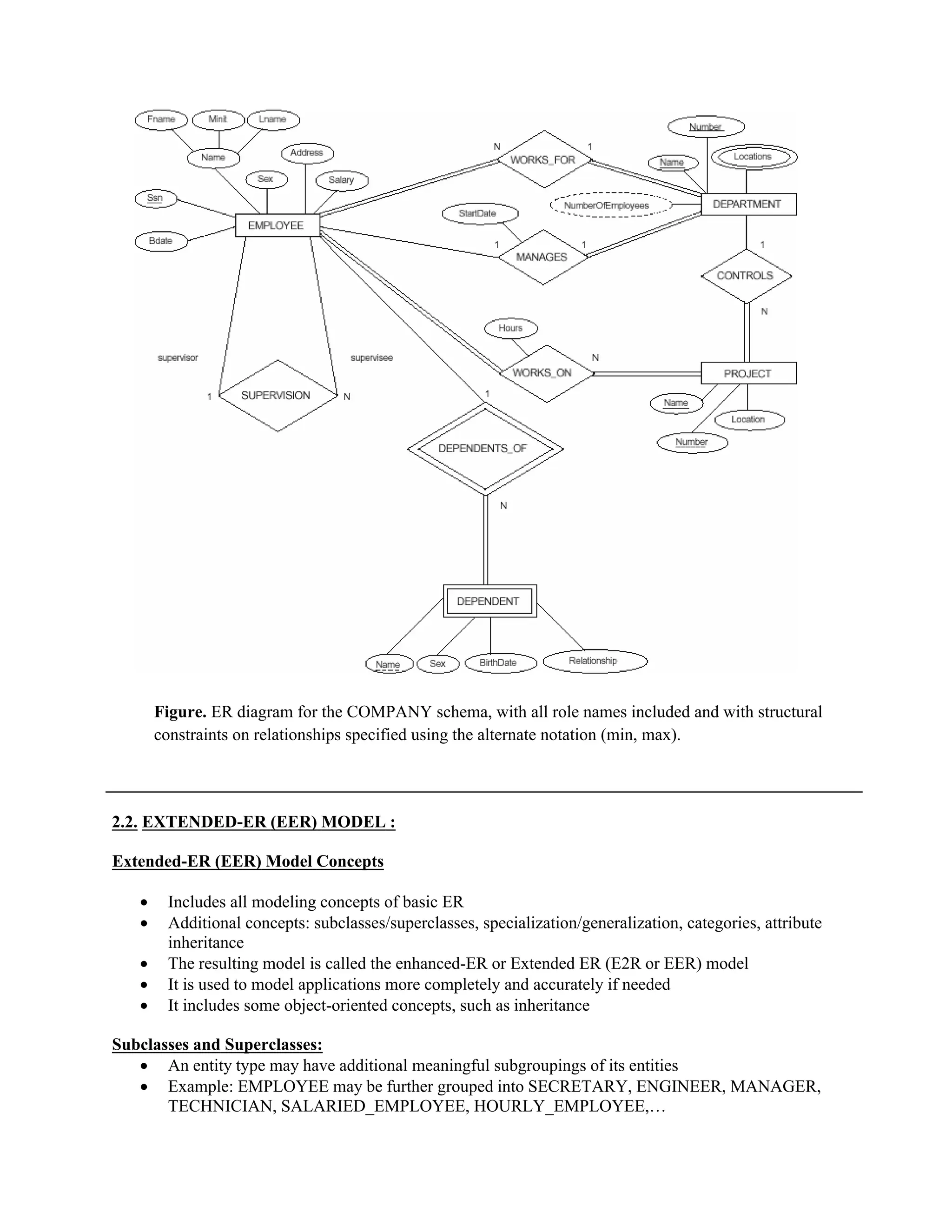
Figure. ER diagram for the COMPANY schema, with all role names included and with structural
constraints on relationships specified using the alternate notation (min, max).
2.2. EXTENDED-ER (EER) MODEL :
Extended-ER (EER) Model Concepts
 Includes all modeling concepts of basic ER
 Additional concepts: subclasses/superclasses, specialization/generalization, categories, attribute
inheritance
 The resulting model is called the enhanced-ER or Extended ER (E2R or EER) model
 It is used to model applications more completely and accurately if needed
 It includes some object-oriented concepts, such as inheritance
Subclasses and Superclasses:
 An entity type may have additional meaningful subgroupings of its entities
 Example: EMPLOYEE may be further grouped into SECRETARY, ENGINEER, MANAGER,
TECHNICIAN, SALARIED_EMPLOYEE, HOURLY_EMPLOYEE,…
– Each of these groupings is a subset of EMPLOYEE entities
– Each is called a subclass of EMPLOYEE
– EMPLOYEE is the superclass for each of these subclasses
 These are called superclass/subclass relationships.
 Example: EMPLOYEE/SECRETARY, EMPLOYEE/TECHNICIAN
 These are also called IS-A relationships (SECRETARY IS-A EMPLOYEE, TECHNICIAN IS-A
EMPLOYEE, …).
 Note: An entity that is member of a subclass represents the same real-world entity as some
member of the superclass
– The Subclass member is the same entity in a distinct specific role
– An entity cannot exist in the database merely by being a member of a subclass; it must
also be a member of the superclass
– A member of the superclass can be optionally included as a member of any number of its
subclasses
 Example: A salaried employee who is also an engineer belongs to the two subclasses ENGINEER
and SALARIED_EMPLOYEE
– It is not necessary that every entity in a superclass be a member of some subclass
Attribute Inheritance in Superclass / Subclass Relationships
 An entity that is member of a subclass inherits all attributes of the entity as a member of the
superclass .
It also inherits all relationships
Specialization and Generalization:
1)Specialization
 Is the process of defining a set of subclasses of a superclass
 The set of subclasses is based upon some distinguishing characteristics of the entities in the
superclass
 Example: {SECRETARY, ENGINEER, TECHNICIAN} is a specialization of EMPLOYEE
based upon job type.
– May have several specializations of the same superclass
 Example: Another specialization of EMPLOYEE based in method of pay is
{SALARIED_EMPLOYEE, HOURLY_EMPLOYEE}.
– Superclass/subclass relationships and specialization can be diagrammatically represented
in EER diagrams
– Attributes of a subclass are called specific attributes. For example, TypingSpeed of
SECRETARY
– The subclass can participate in specific relationship types. For example, BELONGS_TO
of HOURLY_EMPLOYEE
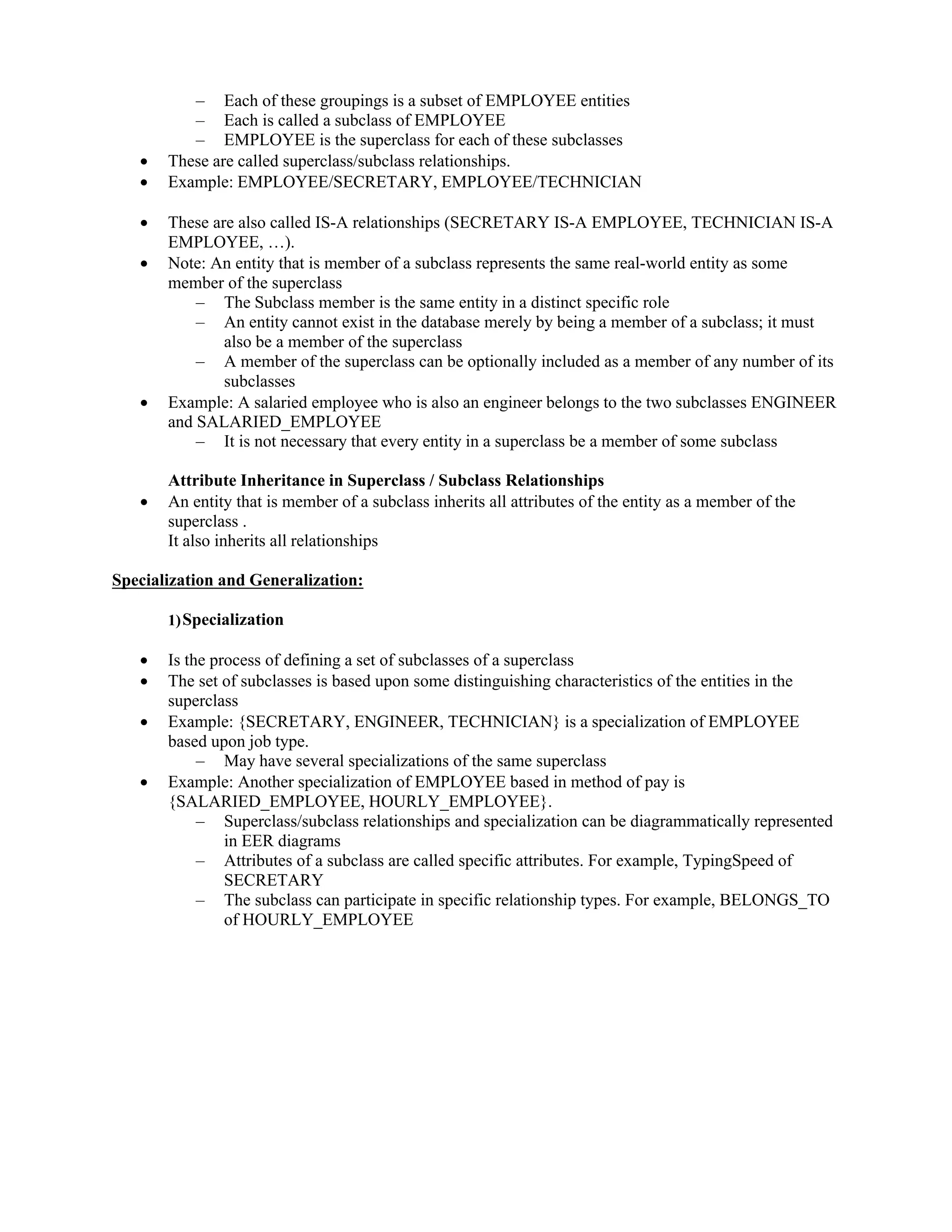
Example of a Specialization
Figure.Specialization
2)Generalization
 The reverse of the specialization process
 Several classes with common features are generalized into a superclass; original classes become
its subclasses
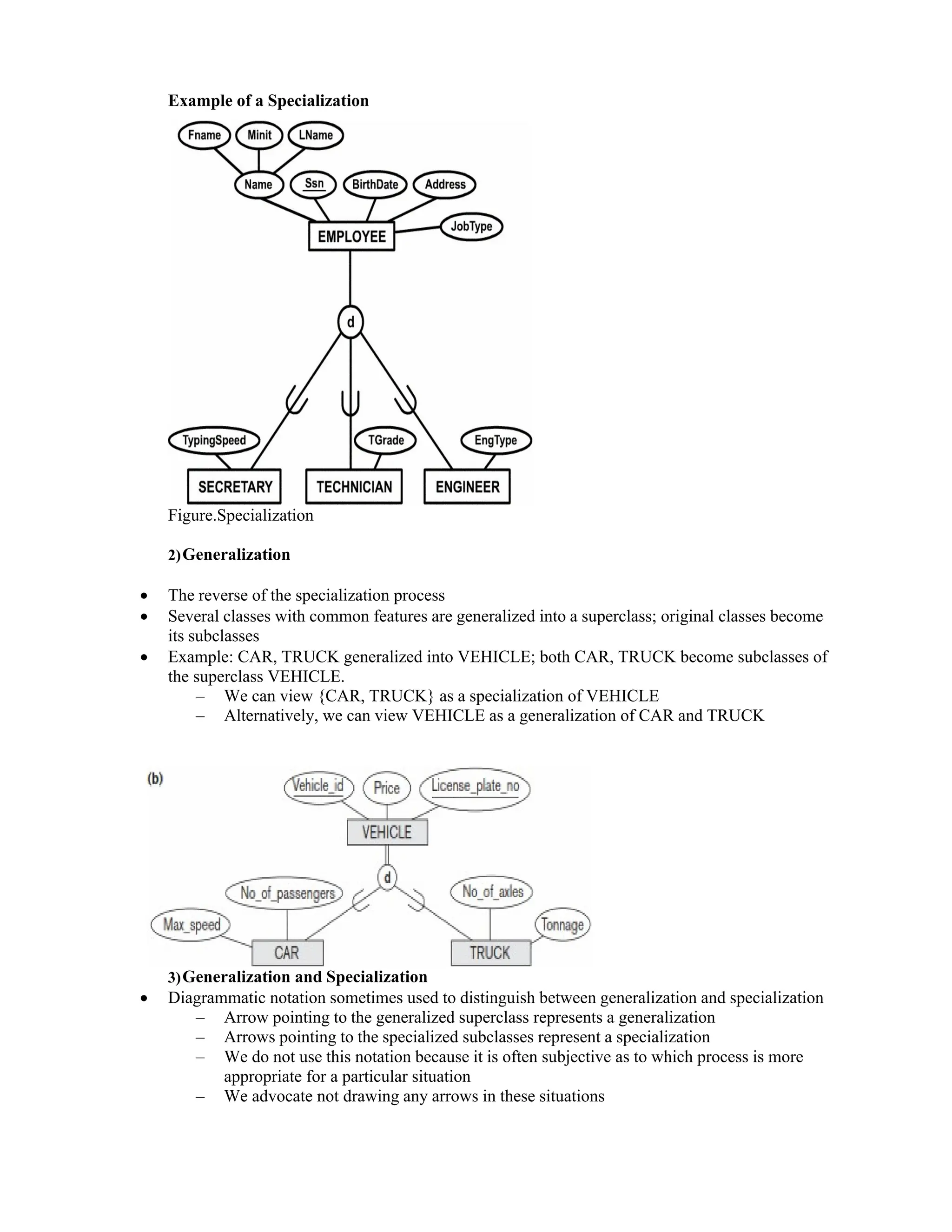
 Example: CAR, TRUCK generalized into VEHICLE; both CAR, TRUCK become subclasses of
the superclass VEHICLE.
– We can view {CAR, TRUCK} as a specialization of VEHICLE
– Alternatively, we can view VEHICLE as a generalization of CAR and TRUCK
3)Generalization and Specialization
 Diagrammatic notation sometimes used to distinguish between generalization and specialization
– Arrow pointing to the generalized superclass represents a generalization
– Arrows pointing to the specialized subclasses represent a specialization
– We do not use this notation because it is often subjective as to which process is more
appropriate for a particular situation
– We advocate not drawing any arrows in these situations
 Data Modeling with Specialization and Generalization
– A superclass or subclass represents a set of entities
– Shown in rectangles in EER diagrams (as are entity types)
– Sometimes, all entity sets are simply called classes, whether they are entity types,
superclasses, or subclasses
Constraints on Specialization and Generalization
 If we can determine exactly those entities that will become members of each subclass by a
condition, the subclasses are called predicate-defined (or condition-defined) subclasses
 Condition is a constraint that determines subclass members
 Display a predicate-defined subclass by writing the predicate condition next to the line
attaching the subclass to its superclass
 If all subclasses in a specialization have membership condition on same attribute of the
superclass, specialization is called an attribute defined-specialization
 Attribute is called the defining attribute of the specialization
 Example: JobType is the defining attribute of the specialization {SECRETARY,
TECHNICIAN, ENGINEER} of EMPLOYEE
 If no condition determines membership, the subclass is called user-defined
 Membership in a subclass is determined by the database users by applying an operation to
add an entity to the subclass
 Membership in the subclass is specified individually for each entity in the superclass by
the user
 Two other conditions apply to a specialization/generalization:
 Disjointness Constraint:
 Specifies that the subclasses of the specialization must be disjointed (an entity can be a
member of at most one of the subclasses of the specialization)
 Specified by d in EER diagram
 If not disjointed, overlap; that is the same entity may be a member of more than one
subclass of the specialization
 Specified by o in EER diagram
 Completeness Constraint:
 Total specifies that every entity in the superclass must be a member of some subclass in
the specialization/ generalization
 Shown in EER diagrams by a double line
 Partial allows an entity not to belong to any of the subclasses
 Shown in EER diagrams by a single line
 Hence, we have four types of specialization/generalization:
 Disjoint, total
 Disjoint, partial
 Overlapping, total
 Overlapping, partial
 Note: Generalization usually is total because the superclass is derived from the subclasses.
Example of disjoint partial Specialization
Figure. Disjoint partial Specialization
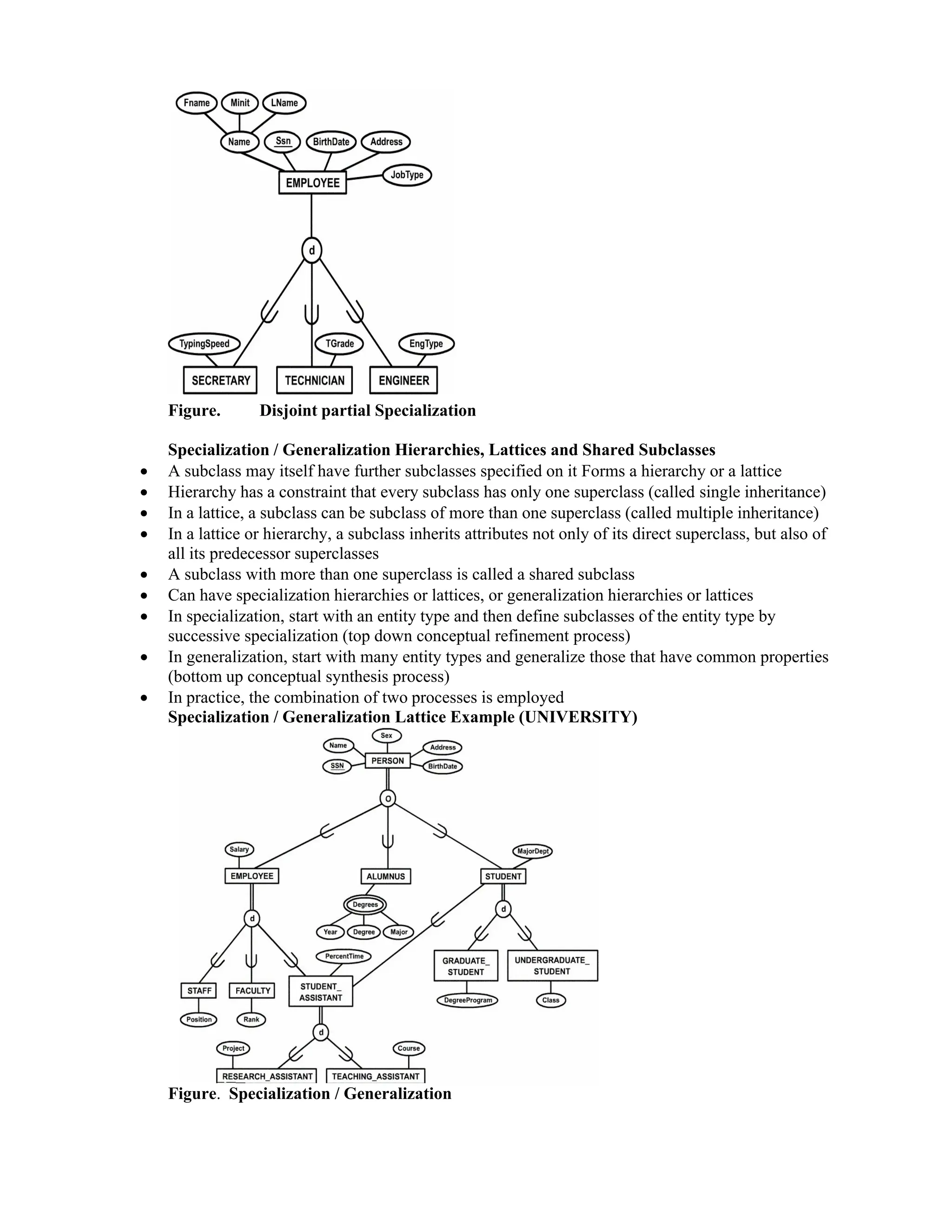
Specialization / Generalization Hierarchies, Lattices and Shared Subclasses
 A subclass may itself have further subclasses specified on it Forms a hierarchy or a lattice
 Hierarchy has a constraint that every subclass has only one superclass (called single inheritance)
 In a lattice, a subclass can be subclass of more than one superclass (called multiple inheritance)
 In a lattice or hierarchy, a subclass inherits attributes not only of its direct superclass, but also of
all its predecessor superclasses
 A subclass with more than one superclass is called a shared subclass
 Can have specialization hierarchies or lattices, or generalization hierarchies or lattices
 In specialization, start with an entity type and then define subclasses of the entity type by
successive specialization (top down conceptual refinement process)
 In generalization, start with many entity types and generalize those that have common properties
(bottom up conceptual synthesis process)
 In practice, the combination of two processes is employed
Specialization / Generalization Lattice Example (UNIVERSITY)
Figure. Specialization / Generalization
Modeling of UNION types using categories:
 All of the superclass/subclass relationships we have seen thus far have a single superclass
 A shared subclass is subclass in more than one distinct superclass/subclass relationships, where
each relationships has a single superclass (multiple inheritance)
 In some cases, need to model a single superclass/subclass relationship with more than one
superclass
 Superclasses represent different entity types
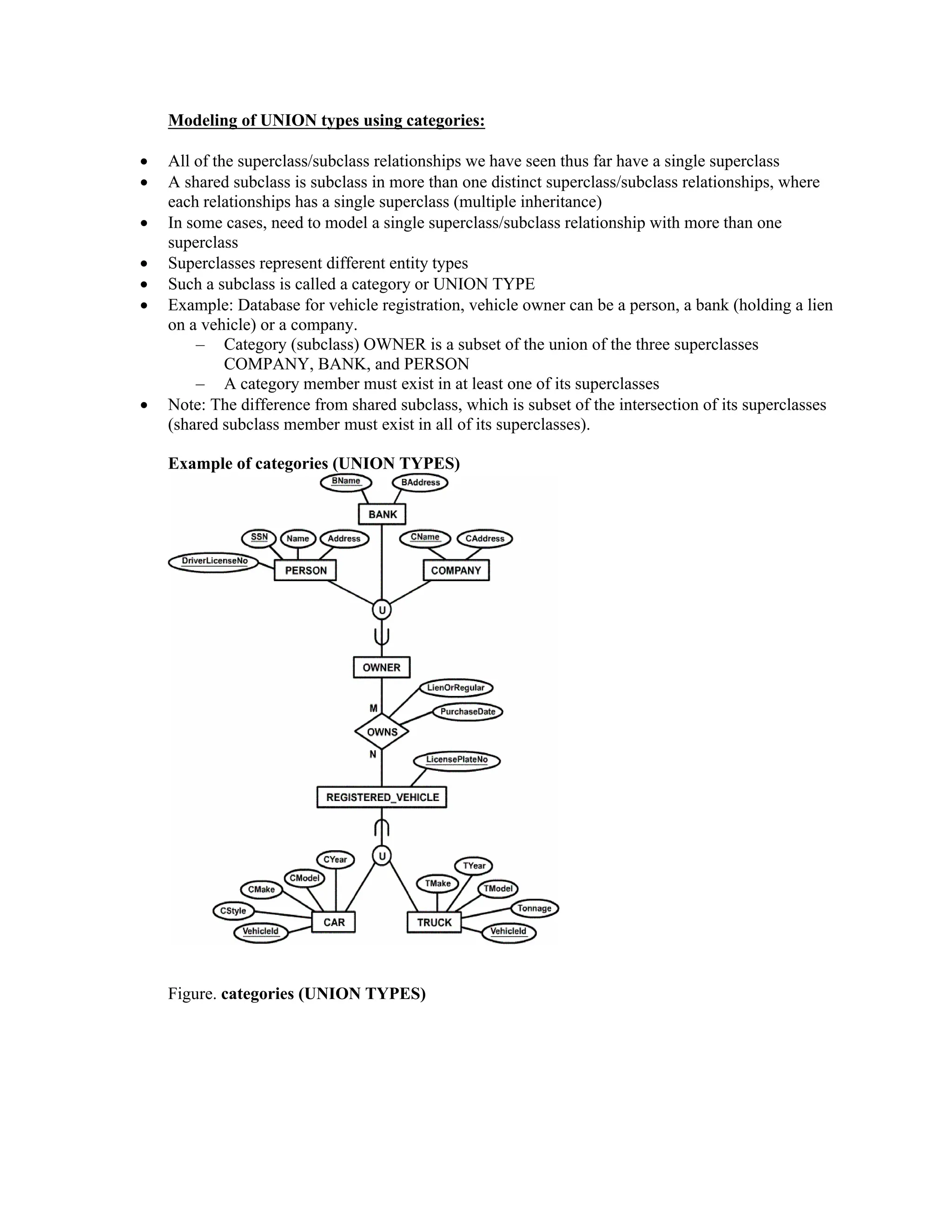
 Such a subclass is called a category or UNION TYPE
 Example: Database for vehicle registration, vehicle owner can be a person, a bank (holding a lien
on a vehicle) or a company.
– Category (subclass) OWNER is a subset of the union of the three superclasses
COMPANY, BANK, and PERSON
– A category member must exist in at least one of its superclasses
 Note: The difference from shared subclass, which is subset of the intersection of its superclasses
(shared subclass member must exist in all of its superclasses).
Example of categories (UNION TYPES)
Figure. categories (UNION TYPES)
2.3. ER-TO-RELATIONAL MAPPING
Figure . The ER conceptual schema diagram for the COMPANY database.
Seven-step algorithm to convert the basic ER model constructs into relations :
Step 1: Mapping of Regular Entity Types:
 For each regular (strong) entity type E in the ER schema, create a relation R that includes all the
simple attributes of E. Include only the simple component attributes of a composite attribute.
Choose one of the key attributes of E as the primary key for R. If the chosen key of E is a
composite, then the set of simple attributes that form it will together form the primary key of R.
 If multiple keys were identified for E during the conceptual design, the information describing the
attributes that form each additional key is kept in order to specify secondary (unique) keys of
relation R. Knowledge about keys is also kept for index-ing purposes and other types of analyses.
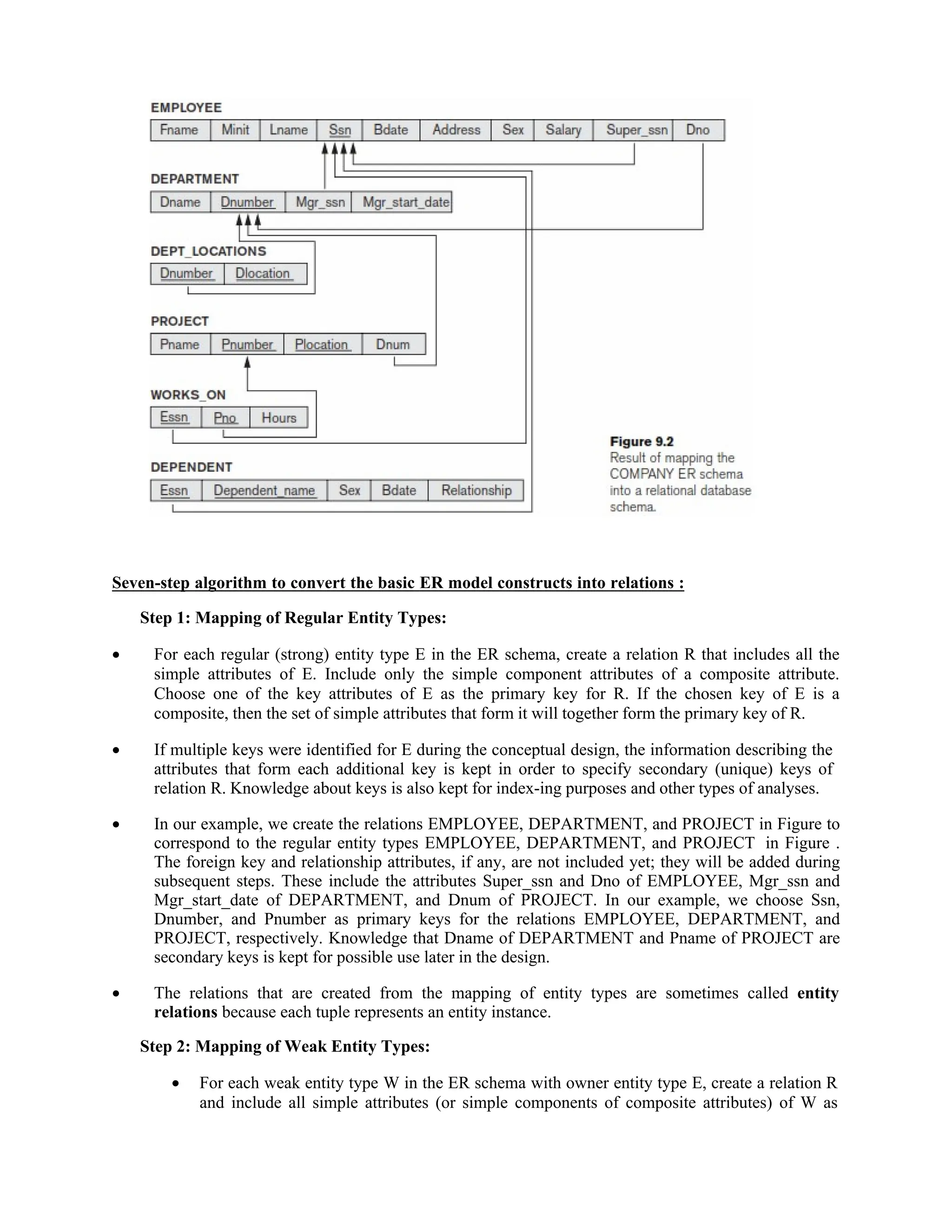
 In our example, we create the relations EMPLOYEE, DEPARTMENT, and PROJECT in Figure to
correspond to the regular entity types EMPLOYEE, DEPARTMENT, and PROJECT in Figure .
The foreign key and relationship attributes, if any, are not included yet; they will be added during
subsequent steps. These include the attributes Super_ssn and Dno of EMPLOYEE, Mgr_ssn and
Mgr_start_date of DEPARTMENT, and Dnum of PROJECT. In our example, we choose Ssn,
Dnumber, and Pnumber as primary keys for the relations EMPLOYEE, DEPARTMENT, and
PROJECT, respectively. Knowledge that Dname of DEPARTMENT and Pname of PROJECT are
secondary keys is kept for possible use later in the design.
 The relations that are created from the mapping of entity types are sometimes called entity
relations because each tuple represents an entity instance.
Step 2: Mapping of Weak Entity Types:
 For each weak entity type W in the ER schema with owner entity type E, create a relation R
and include all simple attributes (or simple components of composite attributes) of W as
attributes of R. In addition, include as foreign key attributes of R, the primary key attribute(s)
of the relation(s) that correspond to the owner entity type(s); this takes care of mapping the
identifying relationship type of W. The primary key of R is the combination of the primary
key(s) of the owner(s) and the partial key of the weak entity type W, if any.
 If there is a weak entity type E2 whose owner is also a weak entity type E1, then E1 should be
mapped before E2 to determine its primary key first.
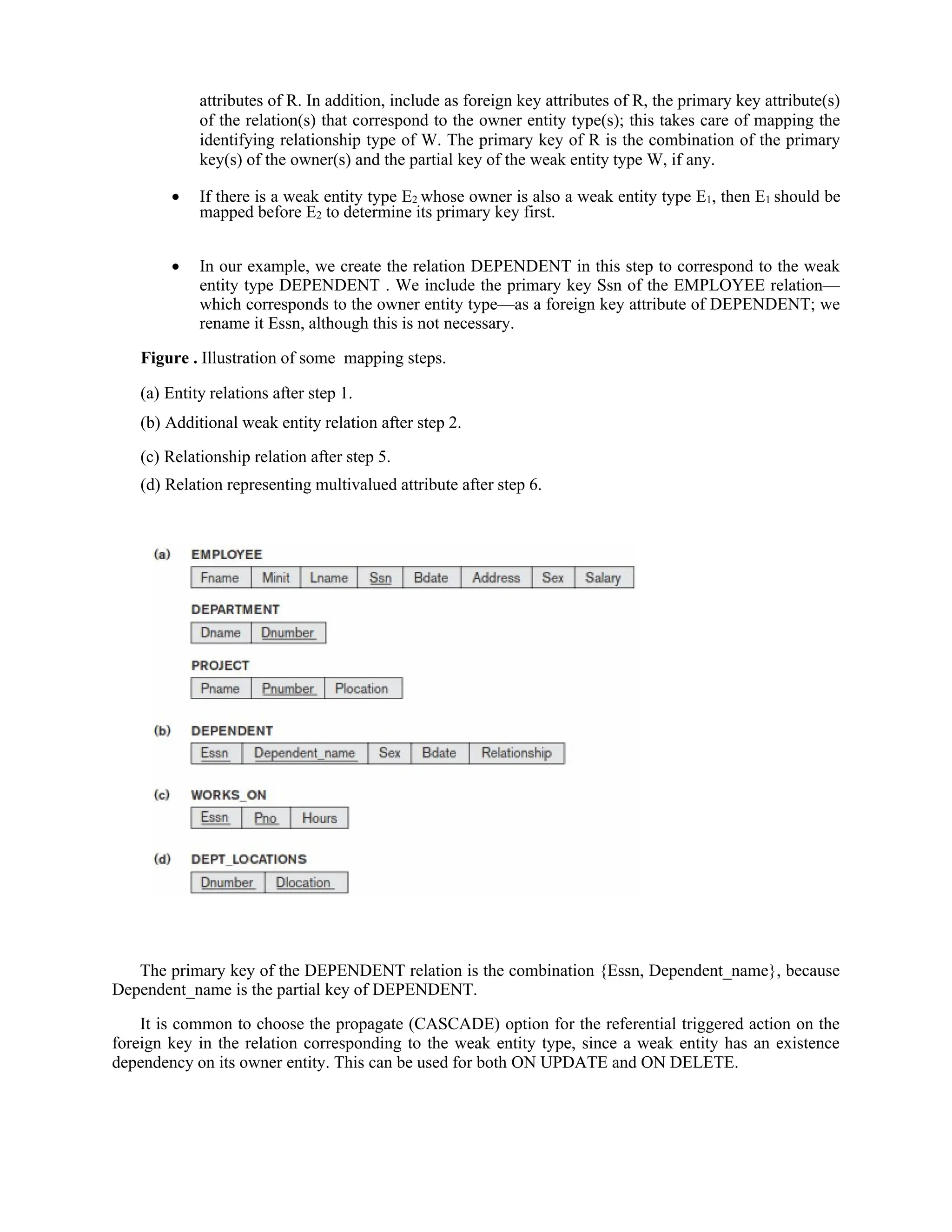
 In our example, we create the relation DEPENDENT in this step to correspond to the weak
entity type DEPENDENT . We include the primary key Ssn of the EMPLOYEE relation—
which corresponds to the owner entity type—as a foreign key attribute of DEPENDENT; we
rename it Essn, although this is not necessary.
Figure . Illustration of some mapping steps.
(a) Entity relations after step 1.
(b) Additional weak entity relation after step 2.
(c) Relationship relation after step 5.
(d) Relation representing multivalued attribute after step 6.
The primary key of the DEPENDENT relation is the combination {Essn, Dependent_name}, because
Dependent_name is the partial key of DEPENDENT.
It is common to choose the propagate (CASCADE) option for the referential triggered action on the
foreign key in the relation corresponding to the weak entity type, since a weak entity has an existence
dependency on its owner entity. This can be used for both ON UPDATE and ON DELETE.
Step 3: Mapping of Binary 1:1 Relationship Types:
For each binary 1:1 relationship type R in the ER schema, identify the relations S and T that
correspond to the entity types participating in R. There are three possible approaches:
(1) Foreign key approach
(2) Merged relationship approach
(3) Cross-reference or relationship relation approach.
The first approach is the most useful and should be followed unless special conditions exist.
(1) Foreign key approach:
Choose one of the relations—S, say—and include as a foreign key in S the primary key of T. It is
better to choose an entity type with total participation in R in the role of S. Include all the simple
attributes (or simple components of composite attributes) of the 1:1 relationship type R as attributes of S.
In our example, we map the 1:1 relationship type MANAGES from Figure by choosing the
participating entity type DEPARTMENT to serve in the role of S because its participation in the
MANAGES relationship type is total (every department has a manager). We include the primary key of
the EMPLOYEE relation as foreign key in the DEPARTMENT relation and rename it Mgr_ssn. We also
include the simple attribute Start_date of the MANAGES relationship type in the DEPARTMENT
relation and rename it Mgr_start_date.
Note that it is possible to include the primary key of S as a foreign key in T instead. In our example,
this amounts to having a foreign key attribute, say Department_managed in the EMPLOYEE relation, but
it will have a NULL value for employee tuples who do not manage a department. If only 2 percent of
employees manage a department, then 98 percent of the foreign keys would be NULL in this case.
Another possibility is to have foreign keys in both relations S and T redundantly, but this creates
redundancy and incurs a penalty for consistency maintenance.
(2)Merged relation approach:
An alternative mapping of a 1:1 relationship type is to merge the two entity types and the relationship
into a single rela-tion. This is possible when both participations are total, as this would indicate that the
two tables will have the exact same number of tuples at all times.
(3)Cross-reference or relationship relation approach:
The third option is to set up a third relation R for the purpose of cross-referencing the primary keys
of the two relations S and T representing the entity types. As we will see, this approach is required for
binary M:N relationships. The relation R is called a relationship relation (or sometimes a lookup table),
because eachtuple in R represents a relationship instance that relates one tuple from S with one tuple from
T. The relation R will include the primary key attributes of S and T as foreign keys to S and T. The
primary key of R will be one of the two foreign keys, and the other foreign key will be a unique key of R.
The drawback is having an extra relation, and requiring an extra join operation when combining related
tuples from the tables.
Step 4: Mapping of Binary 1:N Relationship Types:
For each regular binary 1:N relationship type R, identify the relation S that represents the
participating entity type at the N-side of the relationship type. Include as foreign key in S the primary key
of the relation T that represents the other entity type participating in R; we do this because each entity
instance on the N-side is related to at most one entity instance on the 1-side of the relationship type.
Include any simple attributes (or simple components of composite attributes) of the 1:N relationship type
as attributes of S.
In our example, we now map the 1:N relationship types WORKS_FOR, CONTROLS, and
SUPERVISION from Figure 9.1. For WORKS_FOR we include the primary key Dnumber of the
DEPARTMENT relation as foreign key in the EMPLOYEE relation and call it Dno. For SUPERVISION
we include the primary key of the EMPLOYEE relation as foreign key in the EMPLOYEE relation
itself—because the relationship is recursive—and call it Super_ssn. The CONTROLS relationship is
mapped to the foreign key attribute Dnum of PROJECT, which references the primary key Dnumber of
the DEPARTMENT relation. .
An alternative approach is to use the relationship relation (cross-reference) option as in the third
option for binary 1:1 relationships. We create a separate relation R whose attributes are the primary keys
of S and T, which will also be foreign keys to S and T. The primary key of R is the same as the primary
key of S. This option can be used if few tuples in S participate in the relationship to avoid excessive
NULL val-ues in the foreign key.
Step 5: Mapping of Binary M:N Relationship Types.
For each binary M:N relationship type R, create a new relation S to represent R. Include as foreign
key attributes in S the primary keys of the relations that represent the participating entity types; their
combination will form the primary key of S. Also include any sim-ple attributes of the M:N relationship
type (or simple components of composite attributes) as attributes of S. Notice that we cannot represent an
M:N relationship type by a single foreign key attribute in one of the participating relations (as we did for
1:1 or 1:N relationship types) because of the M:N cardinality ratio; we must cre-ate a separate relationship
relation S.
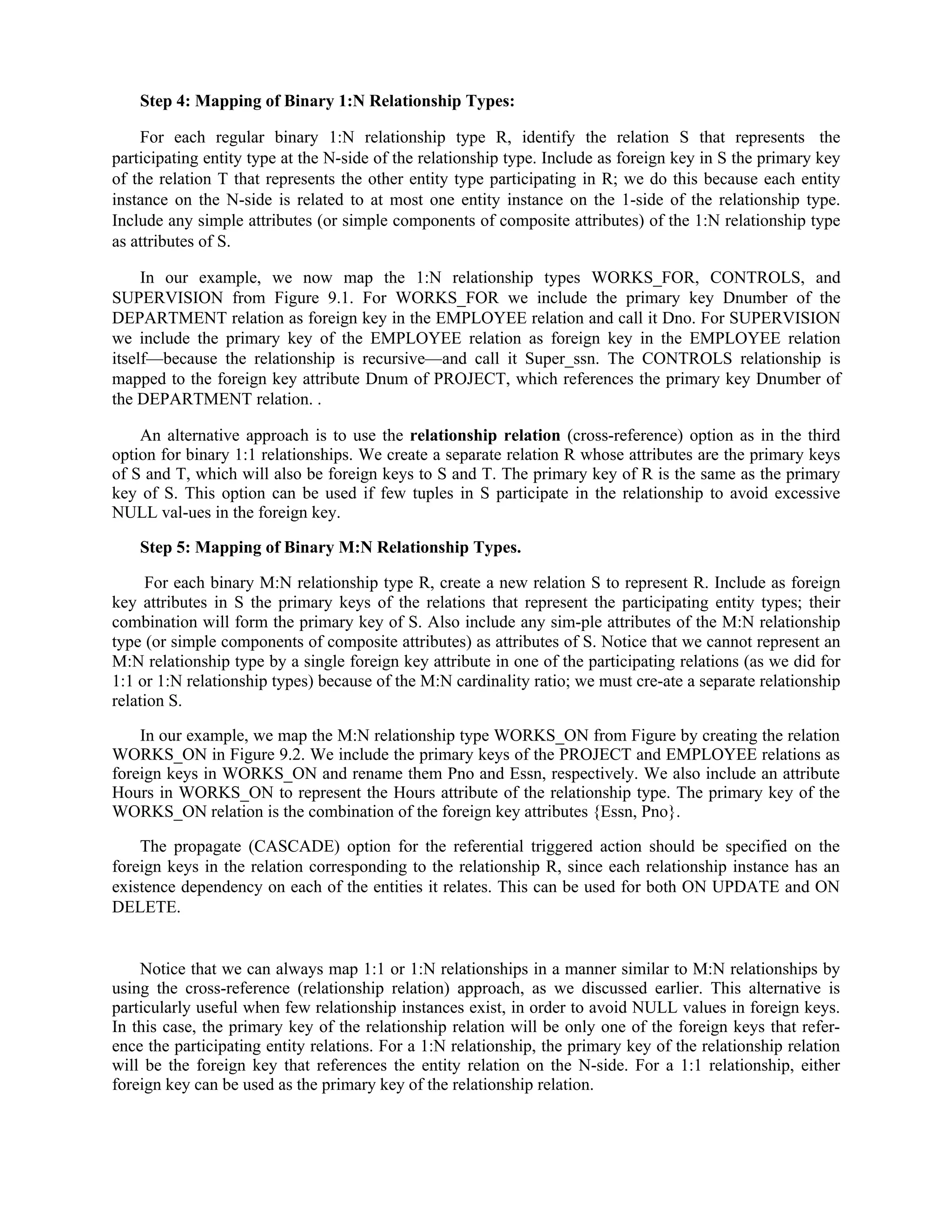
In our example, we map the M:N relationship type WORKS_ON from Figure by creating the relation
WORKS_ON in Figure 9.2. We include the primary keys of the PROJECT and EMPLOYEE relations as
foreign keys in WORKS_ON and rename them Pno and Essn, respectively. We also include an attribute
Hours in WORKS_ON to represent the Hours attribute of the relationship type. The primary key of the
WORKS_ON relation is the combination of the foreign key attributes {Essn, Pno}.
The propagate (CASCADE) option for the referential triggered action should be specified on the
foreign keys in the relation corresponding to the relationship R, since each relationship instance has an
existence dependency on each of the entities it relates. This can be used for both ON UPDATE and ON
DELETE.
Notice that we can always map 1:1 or 1:N relationships in a manner similar to M:N relationships by
using the cross-reference (relationship relation) approach, as we discussed earlier. This alternative is
particularly useful when few relationship instances exist, in order to avoid NULL values in foreign keys.
In this case, the primary key of the relationship relation will be only one of the foreign keys that refer-
ence the participating entity relations. For a 1:N relationship, the primary key of the relationship relation
will be the foreign key that references the entity relation on the N-side. For a 1:1 relationship, either
foreign key can be used as the primary key of the relationship relation.
Step 6: Mapping of Multivalued Attributes:
For each multivalued attribute A, create a new relation R. This relation R will include an attribute
corresponding to A, plus the primary key attribute K—as a foreign key in R—of the relation that repre-
sents the entity type or relationship type that has A as a multivalued attribute. The primary key of R is the
combination of A and K. If the multivalued attribute is com-posite, we include its simple components.
In our example, we create a relation DEPT_LOCATIONS (see Figure 9.3(d)). The attribute Dlocation
represents the multivalued attribute LOCATIONS of DEPARTMENT, while Dnumber—as foreign
key—represents the primary key of the DEPARTMENT relation. The primary key of
DEPT_LOCATIONS is the combination of {Dnumber, Dlocation}. A separate tuple will exist in
DEPT_LOCATIONS for each loca-tion that a department has.
The propagate (CASCADE) option for the referential triggered action should be specified on the
foreign key in the relation R corresponding to the multivalued attribute for both ON UPDATE and ON
DELETE. We should also note that the key of R when mapping a composite, multivalued attribute
requires some analysis of the meaning of the component attributes. In some cases, when a multi-valued
attribute is composite, only some of the component attributes are required to be part of the key of R; these
attributes are similar to a partial key of a weak entity type that corresponds to the multivalued attribute .
Step 7: Mapping of N-ary Relationship Types:
For each n-ary relationship type R, where n > 2, create a new relation S to represent R. Include as
foreign key attributes in S the primary keys of the relations that represent the participating entity types.
Also include any simple attributes of the n-ary relationship type (or simple components of composite
attributes) as attributes of S. The primary key of S is usually a combination of all the foreign keys that
reference the relations representing the participating entity types. However, if the cardinality constraints
on any of the entity types E participating in R is 1, then the primary key of S should not include the
foreign key attribute that references the relation E corresponding to E.
Table . Correspondence between ER and Relational Models
2.4. FUNCTIONAL DEPENDENCIES:
 A functional dependency is a constraint between two sets of attributes from the database.
 A functional dependency, denoted by X → Y, between two sets of attributes X and Y that are
subsets of R specifies a constraint on the possible tuples that can form a relation state r of R. The
constraint is that, for any two tuples t1 and t2 in r that have t1[X] = t2[X], they must also have t1[Y]
= t2[Y].
 This means that the values of the Y component of a tuple in r depend on, or are determined by,
the values of the X component; alternatively, the values of the X com-ponent of a tuple uniquely
(or functionally) determine the values of the Y component. We also say that there is a functional
dependency from X to Y, or that Y is functionally dependent on X. The abbreviation for
functional dependency is FD or f.d. The set of attributes X is called the left-hand side of the FD,
and Y is called the right-hand side.
 Thus, X functionally determines Y in a relation schema R if, and only if, whenever two tuples of
r(R) agree on their X-value, they must necessarily agree on their Y-value. Note the following:
 If a constraint on R states that there cannot be more than one tuple with a given X-value in any
relation instance r(R)—that is, X is a candidate key of R—this implies that X → Y for any
subset of attributes Y of R (because the key constraint implies that no two tuples in any legal state
r(R) will have the same value of X). If X is a candidate key of R, then X → R.
If X → Y in R, this does not say whether or not Y → X in R.
 A functional dependency is a property of the semantics or meaning of the attributes. The
database designers will use their understanding of the semantics of the attributes of R—that is,
how they relate to one another—to specify the functional dependencies that should hold on all
relation states (extensions) r of R. Whenever the semantics of two sets of attributes in R indicate
that a functional dependency should hold, we specify the dependency as a constraint. Relation
extensions r(R) that satisfy the functional dependency constraints are called legal relation states
(or legal extensions) of R.
 Hence, the main use of functional dependencies is to describe further a relation schema R by
specifying constraints on its attributes that must hold at all times. Certain FDs can be specified
without referring to a specific relation, but as a property of those attributes given their commonly
understood meaning. For example, {State, Driver_license_number} → Ssn should hold for any
adult in the United States and hence should hold whenever these attributes appear in a relation. It
is also possible that certain functional dependencies may cease to exist in the real world if the
relationship changes. For example, the FD Zip_code → Area_code used to exist as a relationship
between postal codes and telephone num-ber codes in the United States, but with the proliferation
of telephone area codes it is no longer true.
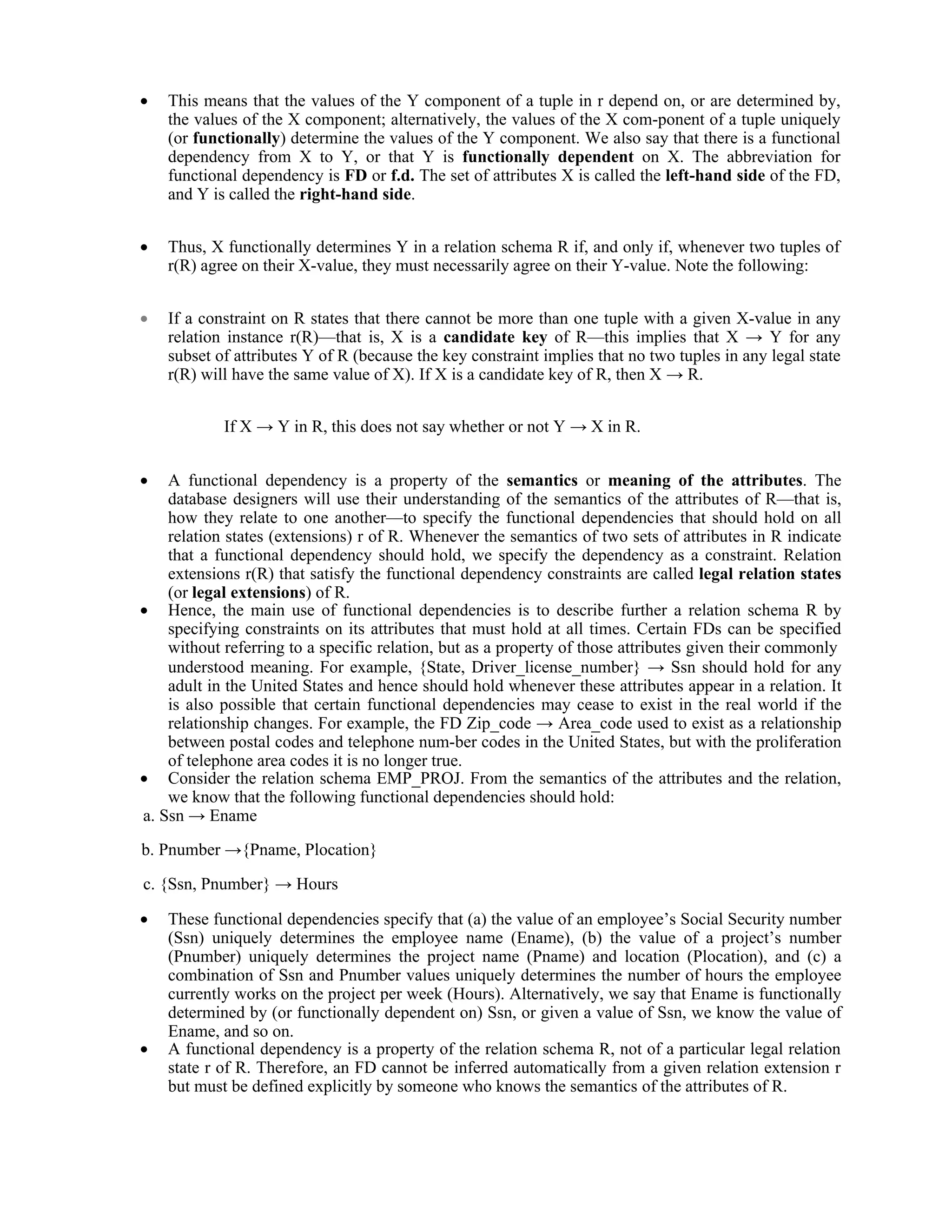
 Consider the relation schema EMP_PROJ. From the semantics of the attributes and the relation,
we know that the following functional dependencies should hold:
a. Ssn → Ename
b. Pnumber →{Pname, Plocation}
c. {Ssn, Pnumber} → Hours
 These functional dependencies specify that (a) the value of an employee’s Social Security number
(Ssn) uniquely determines the employee name (Ename), (b) the value of a project’s number
(Pnumber) uniquely determines the project name (Pname) and location (Plocation), and (c) a
combination of Ssn and Pnumber values uniquely determines the number of hours the employee
currently works on the project per week (Hours). Alternatively, we say that Ename is functionally
determined by (or functionally dependent on) Ssn, or given a value of Ssn, we know the value of
Ename, and so on.
 A functional dependency is a property of the relation schema R, not of a particular legal relation
state r of R. Therefore, an FD cannot be inferred automatically from a given relation extension r
but must be defined explicitly by someone who knows the semantics of the attributes of R.
 Given a populated relation, one cannot determine which FDs hold and which do not unless the
meaning of and the relationships among the attributes are known. All one can say is that a certain
FD may exist if it holds in that particular extension. One cannot guarantee its existence until the
meaning of the corresponding attributes is clearly understood. One can, however, emphatically
state that a certain FD does not hold if there are tuples that show the violation of such an FD.
 Figure introduces a diagrammatic notation for displaying FDs: Each FD is displayed as a
horizontal line. The left-hand-side attributes of the FD are connected by vertical lines to the line
representing the FD, while the right-hand-side attributes are connected by the lines with arrows
pointing toward the attributes. We denote by F the set of functional dependencies that are
specified on relation schema R.
2.5. NON LOSS DECOMPOSITION (OR) LOSSLESS DECOMPOSITION :
 The decompositio of relation R into R1 and R2 is lossless when the join of R1 and R2 yield the
same relation as in R.
 A relational table is decomposed (or factored) into two or more smaller tables, in such a way that
the designer can capture the precise content of the original table by joining the decomposed
parts. This is called lossless-join (or non-additive join) decomposition.
 This is also referred as non-additive decomposition.
 The lossless-join decomposition is always defined with respect to a specific set F of
dependencies.
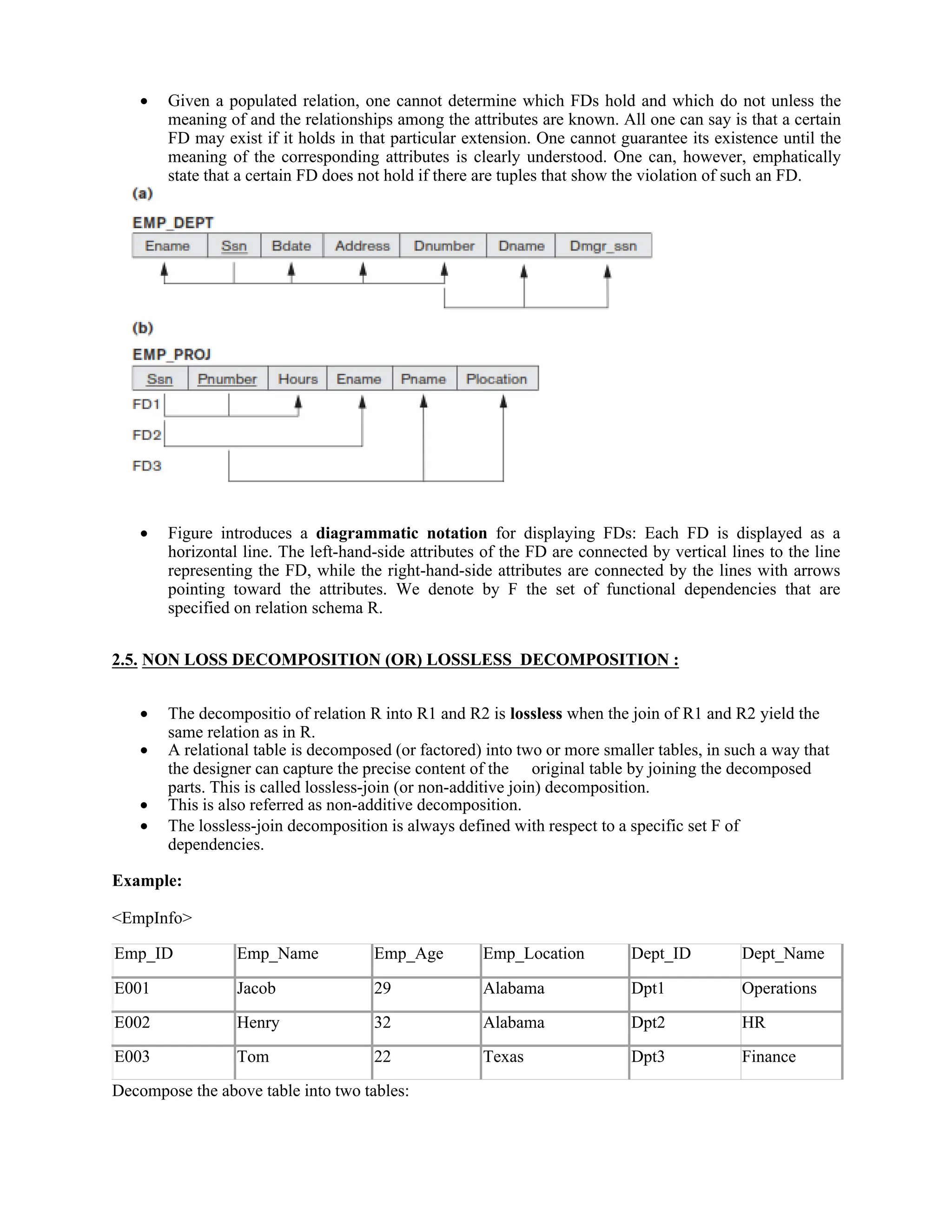
Example:
<EmpInfo>
Emp_ID Emp_Name Emp_Age Emp_Location Dept_ID Dept_Name
E001 Jacob 29 Alabama Dpt1 Operations
E002 Henry 32 Alabama Dpt2 HR
E003 Tom 22 Texas Dpt3 Finance
Decompose the above table into two tables:
<EmpDetails>
Emp_ID Emp_Name Emp_Age Emp_Location
E001 Jacob 29 Alabama
E002 Henry 32 Alabama
E003 Tom 22 Texas
<DeptDetails>
Dept_ID Emp_ID Dept_Name
Dpt1 E001 Operations
Dpt2 E002 HR
Dpt3 E003 Finance
Now, Natural Join is applied on the above two tables:
The result will be:
Emp_ID Emp_Name Emp_Age Emp_Location Dept_ID Dept_Name
E001 Jacob 29 Alabama Dpt1 Operations
E002 Henry 32 Alabama Dpt2 HR
E003 Tom 22 Texas Dpt3 Finance
Therefore, the above relation had lossless decomposition i.e. no loss of information.
Lossy Decomposition:
 When a relation is decomposed into two or more relational schemas, the loss of information is
unavoidable when the original relation is retrieved.
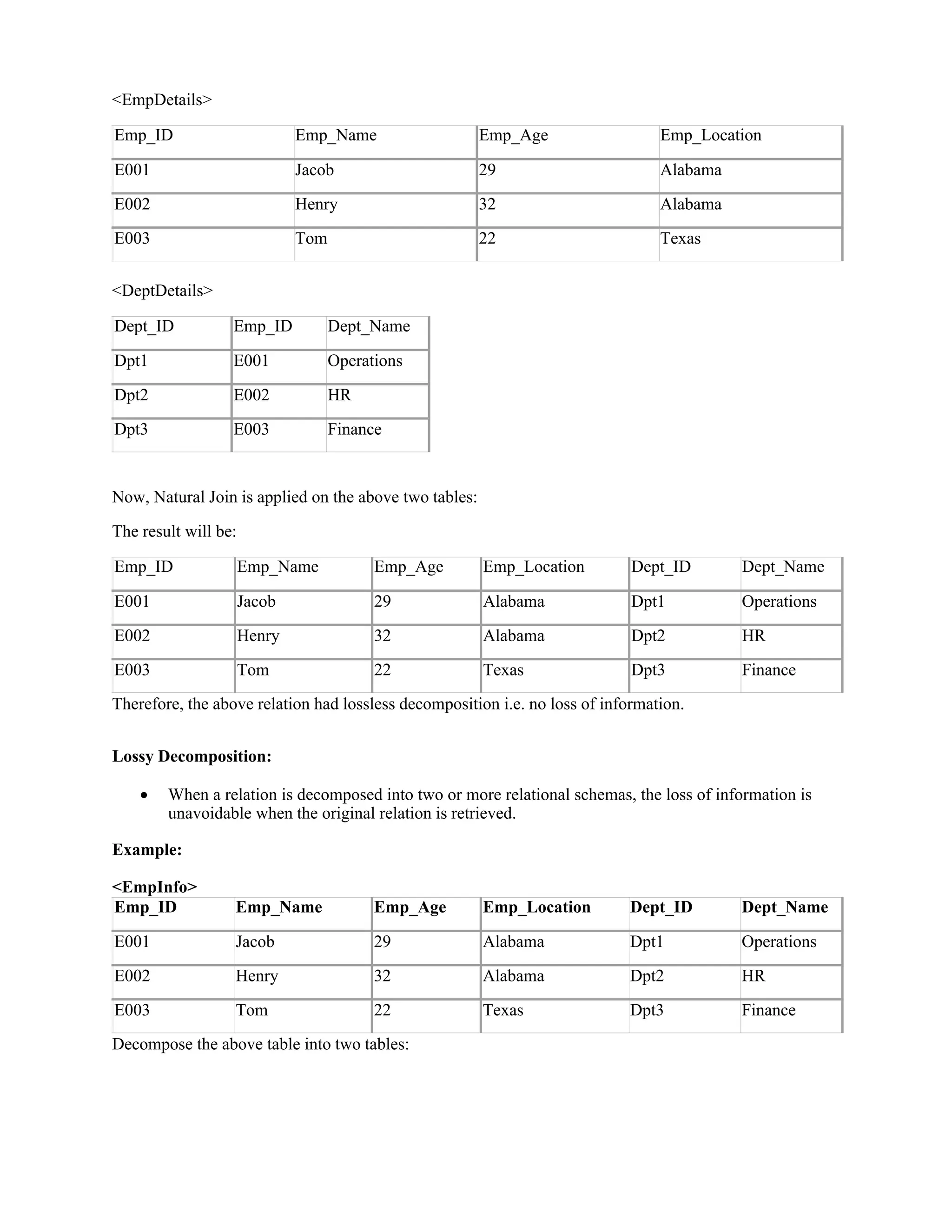
Example:
<EmpInfo>
Emp_ID Emp_Name Emp_Age Emp_Location Dept_ID Dept_Name
E001 Jacob 29 Alabama Dpt1 Operations
E002 Henry 32 Alabama Dpt2 HR
E003 Tom 22 Texas Dpt3 Finance
Decompose the above table into two tables:
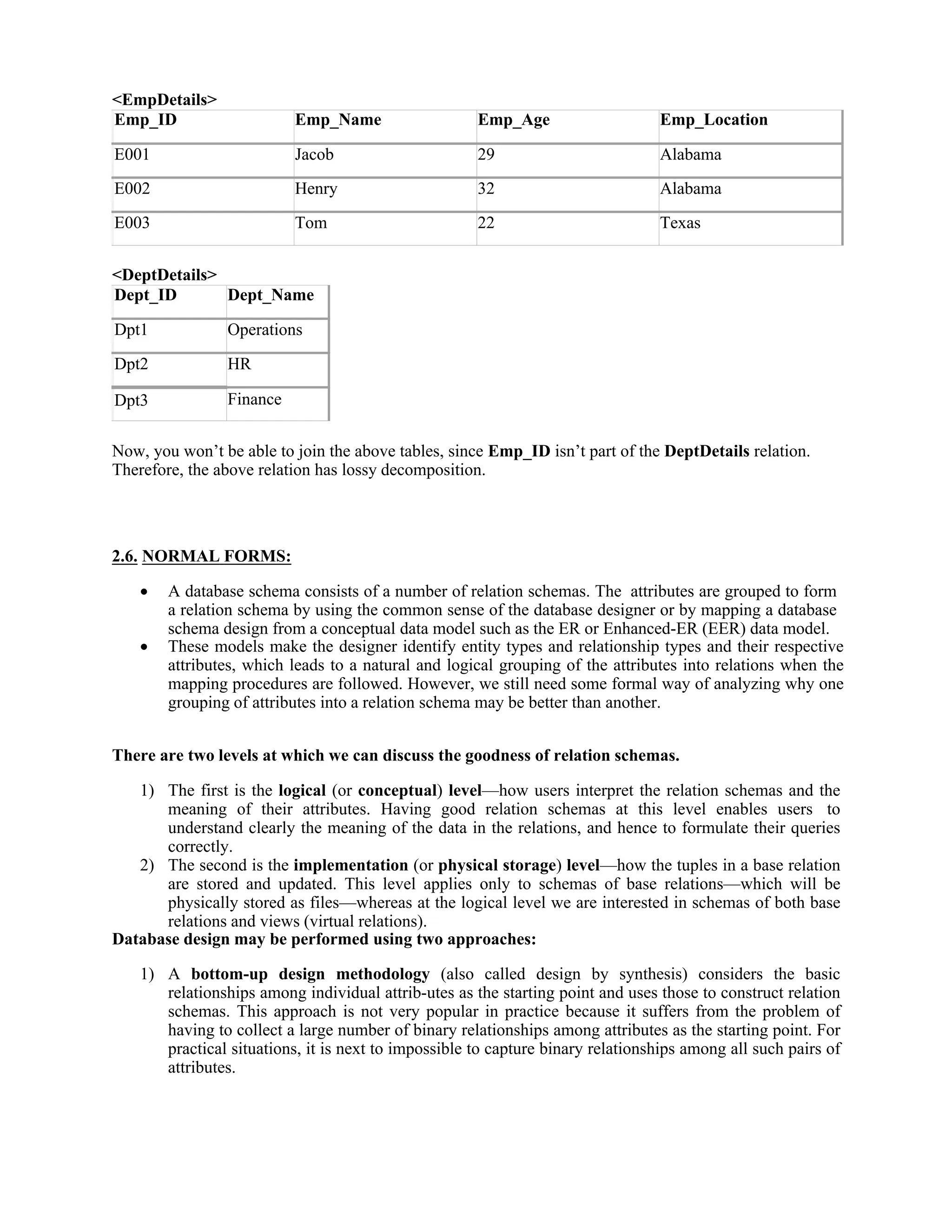
<EmpDetails>
Emp_ID Emp_Name Emp_Age Emp_Location
E001 Jacob 29 Alabama
E002 Henry 32 Alabama
E003 Tom 22 Texas
<DeptDetails>
Dept_ID Dept_Name
Dpt1 Operations
Dpt2 HR
Dpt3 Finance
Now, you won’t be able to join the above tables, since Emp_ID isn’t part of the DeptDetails relation.
Therefore, the above relation has lossy decomposition.
2.6. NORMAL FORMS:
 A database schema consists of a number of relation schemas. The attributes are grouped to form
a relation schema by using the common sense of the database designer or by mapping a database
schema design from a conceptual data model such as the ER or Enhanced-ER (EER) data model.
 These models make the designer identify entity types and relationship types and their respective
attributes, which leads to a natural and logical grouping of the attributes into relations when the
mapping procedures are followed. However, we still need some formal way of analyzing why one
grouping of attributes into a relation schema may be better than another.
There are two levels at which we can discuss the goodness of relation schemas.
1) The first is the logical (or conceptual) level—how users interpret the relation schemas and the
meaning of their attributes. Having good relation schemas at this level enables users to
understand clearly the meaning of the data in the relations, and hence to formulate their queries
correctly.
2) The second is the implementation (or physical storage) level—how the tuples in a base relation
are stored and updated. This level applies only to schemas of base relations—which will be
physically stored as files—whereas at the logical level we are interested in schemas of both base
relations and views (virtual relations).
Database design may be performed using two approaches:
1) A bottom-up design methodology (also called design by synthesis) considers the basic
relationships among individual attrib-utes as the starting point and uses those to construct relation
schemas. This approach is not very popular in practice because it suffers from the problem of
having to collect a large number of binary relationships among attributes as the starting point. For
practical situations, it is next to impossible to capture binary relationships among all such pairs of
attributes.
2) In contrast, a top-down design methodology (also called design by analysis) starts with a
number of groupings of attributes into relations that exist together naturally, for example, on an
invoice, a form, or a report. The relations are then analyzed individually and collectively, lead-ing
to further decomposition until all desirable properties are met. The theory described in this
chapter is applicable to both the top-down and bottom-up design approaches, but is more
appropriate when used with the top-down approach.
 Relational database design ultimately produces a set of relations. The implicit goals of the design
activity are information preservation and minimum redundancy. Information is very hard to
quantify—hence we consider information preservation in terms of maintaining all concepts,
including attribute types, entity types, and relationship types as well as
generalization/specialization relationships.
 Thus, the relational design must preserve all of these concepts, which are originally captured in
the conceptual design after the conceptual to logical design mapping. Minimizing redundancy
implies minimizing redundant storage of the same information and reducing the need for multiple
updates to maintain consistency across multiple copies of the same information in response to
real-world events that require making an update.
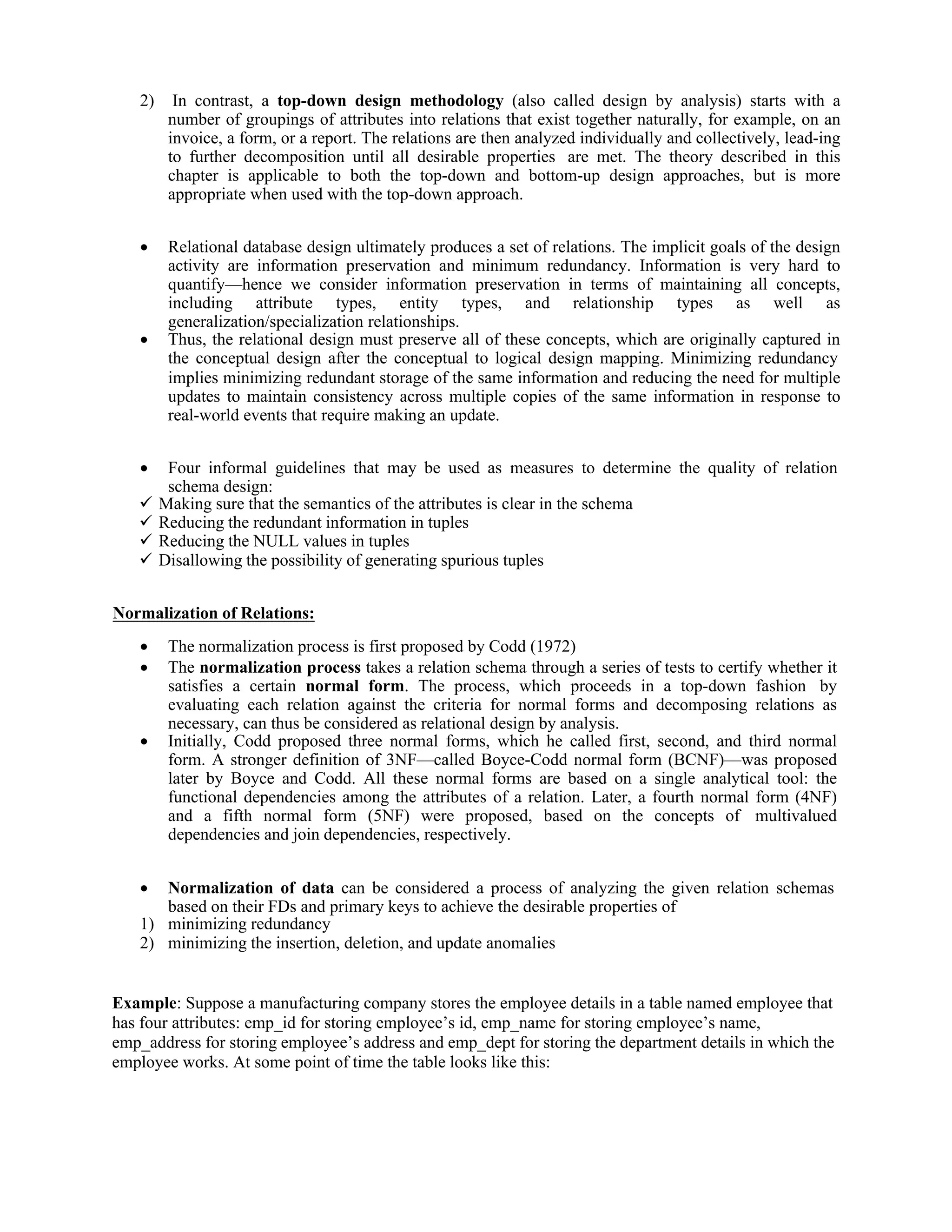
 Four informal guidelines that may be used as measures to determine the quality of relation
schema design:
 Making sure that the semantics of the attributes is clear in the schema
 Reducing the redundant information in tuples
 Reducing the NULL values in tuples
 Disallowing the possibility of generating spurious tuples
Normalization of Relations:
 The normalization process is first proposed by Codd (1972)
 The normalization process takes a relation schema through a series of tests to certify whether it
satisfies a certain normal form. The process, which proceeds in a top-down fashion by
evaluating each relation against the criteria for normal forms and decomposing relations as
necessary, can thus be considered as relational design by analysis.
 Initially, Codd proposed three normal forms, which he called first, second, and third normal
form. A stronger definition of 3NF—called Boyce-Codd normal form (BCNF)—was proposed
later by Boyce and Codd. All these normal forms are based on a single analytical tool: the
functional dependencies among the attributes of a relation. Later, a fourth normal form (4NF)
and a fifth normal form (5NF) were proposed, based on the concepts of multivalued
dependencies and join dependencies, respectively.
 Normalization of data can be considered a process of analyzing the given relation schemas
based on their FDs and primary keys to achieve the desirable properties of
1) minimizing redundancy
2) minimizing the insertion, deletion, and update anomalies
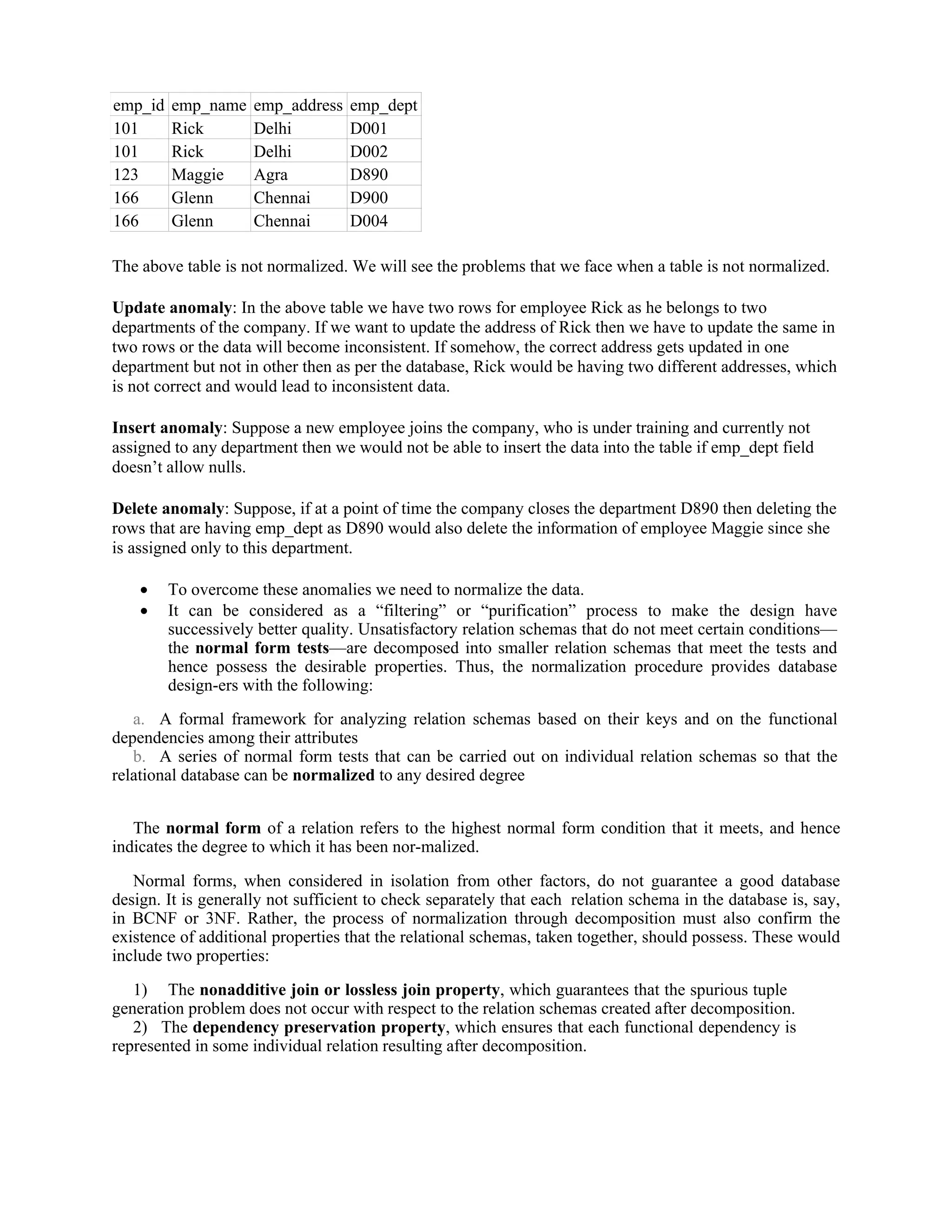
Example: Suppose a manufacturing company stores the employee details in a table named employee that
has four attributes: emp_id for storing employee’s id, emp_name for storing employee’s name,
emp_address for storing employee’s address and emp_dept for storing the department details in which the
employee works. At some point of time the table looks like this:
emp_id emp_name emp_address emp_dept
101 Rick Delhi D001
101 Rick Delhi D002
123 Maggie Agra D890
166 Glenn Chennai D900
166 Glenn Chennai D004
The above table is not normalized. We will see the problems that we face when a table is not normalized.
Update anomaly: In the above table we have two rows for employee Rick as he belongs to two
departments of the company. If we want to update the address of Rick then we have to update the same in
two rows or the data will become inconsistent. If somehow, the correct address gets updated in one
department but not in other then as per the database, Rick would be having two different addresses, which
is not correct and would lead to inconsistent data.
Insert anomaly: Suppose a new employee joins the company, who is under training and currently not
assigned to any department then we would not be able to insert the data into the table if emp_dept field
doesn’t allow nulls.
Delete anomaly: Suppose, if at a point of time the company closes the department D890 then deleting the
rows that are having emp_dept as D890 would also delete the information of employee Maggie since she
is assigned only to this department.
 To overcome these anomalies we need to normalize the data.
 It can be considered as a “filtering” or “purification” process to make the design have
successively better quality. Unsatisfactory relation schemas that do not meet certain conditions—
the normal form tests—are decomposed into smaller relation schemas that meet the tests and
hence possess the desirable properties. Thus, the normalization procedure provides database
design-ers with the following:
a. A formal framework for analyzing relation schemas based on their keys and on the functional
dependencies among their attributes
b. A series of normal form tests that can be carried out on individual relation schemas so that the
relational database can be normalized to any desired degree
The normal form of a relation refers to the highest normal form condition that it meets, and hence
indicates the degree to which it has been nor-malized.
Normal forms, when considered in isolation from other factors, do not guarantee a good database
design. It is generally not sufficient to check separately that each relation schema in the database is, say,
in BCNF or 3NF. Rather, the process of normalization through decomposition must also confirm the
existence of additional properties that the relational schemas, taken together, should possess. These would
include two properties:
1) The nonadditive join or lossless join property, which guarantees that the spurious tuple
generation problem does not occur with respect to the relation schemas created after decomposition.
2) The dependency preservation property, which ensures that each functional dependency is
represented in some individual relation resulting after decomposition.
Dname Dnumber Dmgr_ssn Dlocations
 The nonadditive join property is extremely critical and must be achieved at any cost,
whereas the dependency preservation property, although desirable, is some-times sacrificed.
 Denormalization is the process of storing the join of higher nor-mal form relations as a base
relation, which is in a lower normal form.
 A superkey of a relation schema R = {A1, A2, ... , An} is a set of attributes S ⊆ R with the
property that no two tuples t1 and t2 in any legal relation state r of R will have t1[S] = t2[S]. A
key K is a superkey with the additional property that removal of any attribute from K will
cause K not to be a superkey any more.
 The difference between a key and a superkey is that a key has to be minimal;
 If a relation schema has more than one key, each is called a candidate key. One of the
candidate keys is arbitrarily designated to be the primary key, and the others are called
secondary keys.
 An attribute of relation schema R is called a prime attribute of R if it is a member of some
candidate key of R. An attribute is called nonprime if it is not a prime attribute—that is, if it is
not a member of any candidate key.
2.7. FIRST NORMAL FORM (1NF)
 First normal form states that the domain of an attribute must include only atomic (simple,
indivisible) values and that the value of any attribute in a tuple must be a single value from the
domain of that attribute.
 The only attribute values permitted by 1NF are single atomic (or indivisible) values.
 Consider the DEPARTMENT relation schema shown in Figure We assume that each
department can have a number of locations. This is not in 1NF because Dlocations is not an
atomic attribute. There are two ways we can look at the Dlocations attribute:
1) The domain of Dlocations contains atomic values, but some tuples can have a set of these values.
In this case, Dlocations is not functionally dependent on the primary key Dnumber.
2) The domain of Dlocations contains sets of values and hence is nonatomic. In this case, Dnumber
→ Dlocations because each set is considered a single member of the attribute domain.
a)
DEPARTMENT
(b)
DEPARTMENT
Dname Dnumber Dmgr_ssn Dlocations
Research 5 333445555 {Bangalore, Chennai, Delhi}
Administratio
n
4 987654321 { Chennai }
Headquarters 1 888665555 { Delhi }
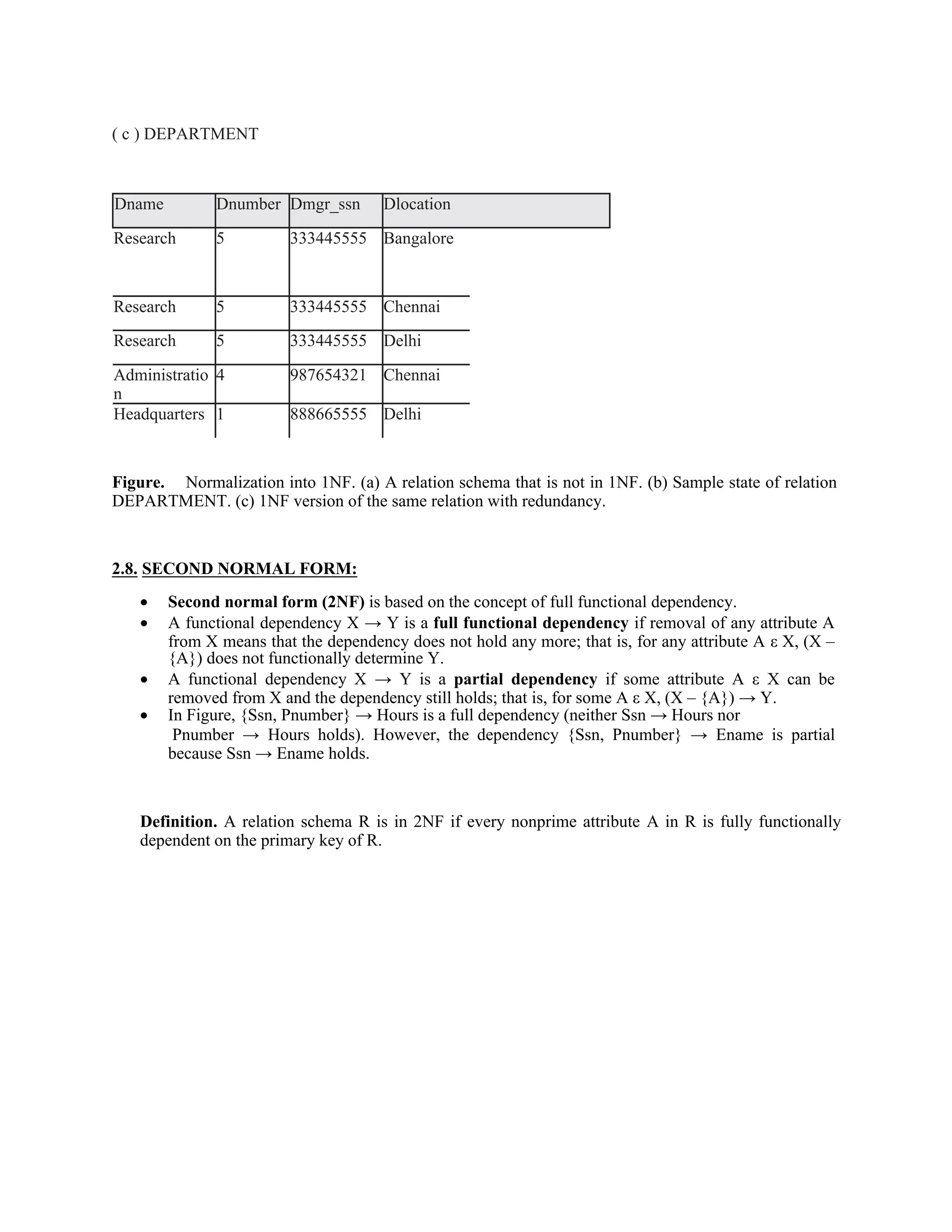
( c ) DEPARTMENT
Dname Dnumber Dmgr_ssn Dlocation
Research 5 333445555 Bangalore
Research 5 333445555 Chennai
Research 5 333445555 Delhi
Administratio
n
4 987654321 Chennai
Headquarters 1 888665555 Delhi
Figure. Normalization into 1NF. (a) A relation schema that is not in 1NF. (b) Sample state of relation
DEPARTMENT. (c) 1NF version of the same relation with redundancy.
2.8. SECOND NORMAL FORM:
 Second normal form (2NF) is based on the concept of full functional dependency.
 A functional dependency X → Y is a full functional dependency if removal of any attribute A
from X means that the dependency does not hold any more; that is, for any attribute A ε X, (X –
{A}) does not functionally determine Y.
 A functional dependency X → Y is a partial dependency if some attribute A ε X can be
removed from X and the dependency still holds; that is, for some A ε X, (X – {A}) → Y.
 In Figure, {Ssn, Pnumber} → Hours is a full dependency (neither Ssn → Hours nor
Pnumber → Hours holds). However, the dependency {Ssn, Pnumber} → Ename is partial
because Ssn → Ename holds.
Definition. A relation schema R is in 2NF if every nonprime attribute A in R is fully functionally
dependent on the primary key of R.
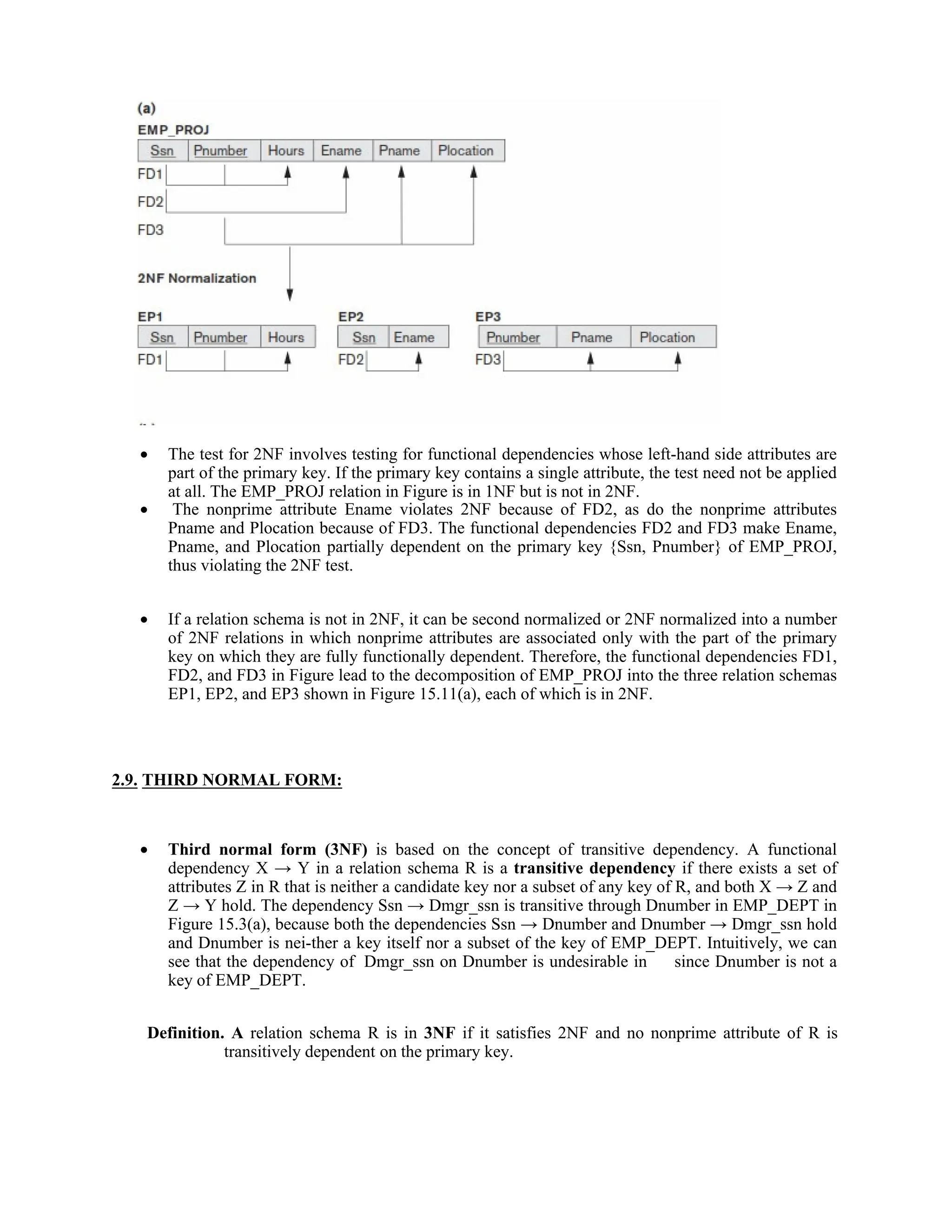
 The test for 2NF involves testing for functional dependencies whose left-hand side attributes are
part of the primary key. If the primary key contains a single attribute, the test need not be applied
at all. The EMP_PROJ relation in Figure is in 1NF but is not in 2NF.
 The nonprime attribute Ename violates 2NF because of FD2, as do the nonprime attributes
Pname and Plocation because of FD3. The functional dependencies FD2 and FD3 make Ename,
Pname, and Plocation partially dependent on the primary key {Ssn, Pnumber} of EMP_PROJ,
thus violating the 2NF test.
 If a relation schema is not in 2NF, it can be second normalized or 2NF normalized into a number
of 2NF relations in which nonprime attributes are associated only with the part of the primary
key on which they are fully functionally dependent. Therefore, the functional dependencies FD1,
FD2, and FD3 in Figure lead to the decomposition of EMP_PROJ into the three relation schemas
EP1, EP2, and EP3 shown in Figure 15.11(a), each of which is in 2NF.
2.9. THIRD NORMAL FORM:
 Third normal form (3NF) is based on the concept of transitive dependency. A functional
dependency X → Y in a relation schema R is a transitive dependency if there exists a set of
attributes Z in R that is neither a candidate key nor a subset of any key of R, and both X → Z and
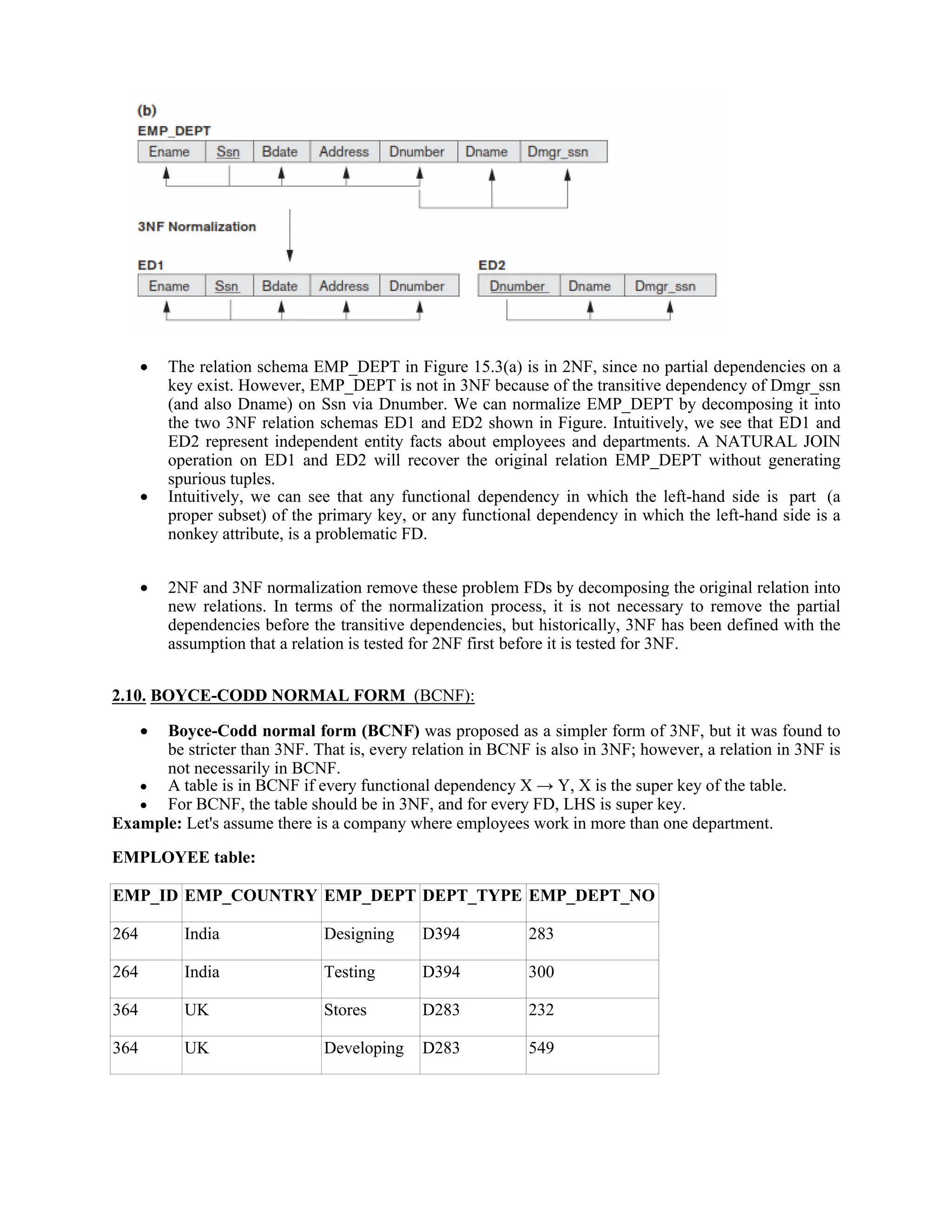
Z → Y hold. The dependency Ssn → Dmgr_ssn is transitive through Dnumber in EMP_DEPT in
Figure 15.3(a), because both the dependencies Ssn → Dnumber and Dnumber → Dmgr_ssn hold
and Dnumber is nei-ther a key itself nor a subset of the key of EMP_DEPT. Intuitively, we can
see that the dependency of Dmgr_ssn on Dnumber is undesirable in since Dnumber is not a
key of EMP_DEPT.
Definition. A relation schema R is in 3NF if it satisfies 2NF and no nonprime attribute of R is
transitively dependent on the primary key.
 The relation schema EMP_DEPT in Figure 15.3(a) is in 2NF, since no partial dependencies on a
key exist. However, EMP_DEPT is not in 3NF because of the transitive dependency of Dmgr_ssn
(and also Dname) on Ssn via Dnumber. We can normalize EMP_DEPT by decomposing it into
the two 3NF relation schemas ED1 and ED2 shown in Figure. Intuitively, we see that ED1 and
ED2 represent independent entity facts about employees and departments. A NATURAL JOIN
operation on ED1 and ED2 will recover the original relation EMP_DEPT without generating
spurious tuples.
 Intuitively, we can see that any functional dependency in which the left-hand side is part (a
proper subset) of the primary key, or any functional dependency in which the left-hand side is a
nonkey attribute, is a problematic FD.
 2NF and 3NF normalization remove these problem FDs by decomposing the original relation into
new relations. In terms of the normalization process, it is not necessary to remove the partial
dependencies before the transitive dependencies, but historically, 3NF has been defined with the
assumption that a relation is tested for 2NF first before it is tested for 3NF.
2.10. BOYCE-CODD NORMAL FORM (BCNF):
 Boyce-Codd normal form (BCNF) was proposed as a simpler form of 3NF, but it was found to
be stricter than 3NF. That is, every relation in BCNF is also in 3NF; however, a relation in 3NF is
not necessarily in BCNF.
 A table is in BCNF if every functional dependency X → Y, X is the super key of the table.
 For BCNF, the table should be in 3NF, and for every FD, LHS is super key.
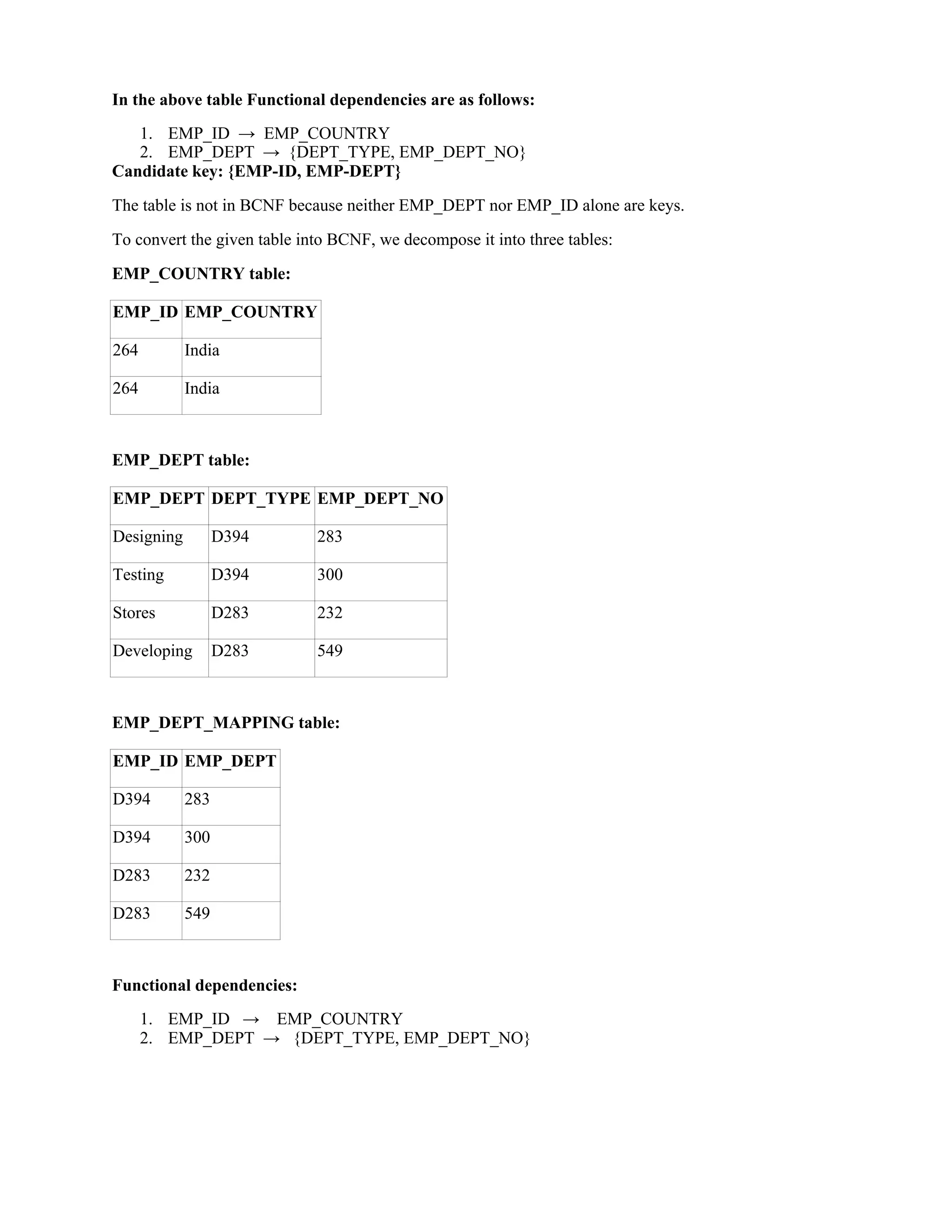
Example: Let's assume there is a company where employees work in more than one department.
EMPLOYEE table:
EMP_ID EMP_COUNTRY EMP_DEPT DEPT_TYPE EMP_DEPT_NO
264 India Designing D394 283
264 India Testing D394 300
364 UK Stores D283 232
364 UK Developing D283 549
In the above table Functional dependencies are as follows:
1. EMP_ID → EMP_COUNTRY
2. EMP_DEPT → {DEPT_TYPE, EMP_DEPT_NO}
Candidate key: {EMP-ID, EMP-DEPT}
The table is not in BCNF because neither EMP_DEPT nor EMP_ID alone are keys.
To convert the given table into BCNF, we decompose it into three tables:
EMP_COUNTRY table:
EMP_ID EMP_COUNTRY
264 India
264 India
EMP_DEPT table:
EMP_DEPT DEPT_TYPE EMP_DEPT_NO
Designing D394 283
Testing D394 300
Stores D283 232
Developing D283 549
EMP_DEPT_MAPPING table:
EMP_ID EMP_DEPT
D394 283
D394 300
D283 232
D283 549
Functional dependencies:
1. EMP_ID → EMP_COUNTRY
2. EMP_DEPT → {DEPT_TYPE, EMP_DEPT_NO}
Candidate keys:
For the first table: EMP_ID
For the second table: EMP_DEPT
For the third table: {EMP_ID, EMP_DEPT}
Now, this is in BCNF because left side part of both the functional dependencies is a key.

Relational data base and Er diagema Normalization

  • 1.
    UNIT II DATABASEDESIGN Entity-Relationship model – E-R Diagrams – Enhanced-ER Model – ER-to-Relational Mapping – Functional Dependencies – Non-loss Decomposition – First, Second, Third Normal Forms, Dependency Preservation – Boyce/Codd Normal Form 2.1. ENTITY-RELATIONSHIP MODEL and E-R DIAGRAMS:  The term database application refers to a particular database and the associated programs that implement the database queries and updates.  For example, a BANK database application that keeps track of customer accounts would include programs that implement database updates corresponding to customer deposits and withdrawals. These programs provide user-friendly graphical user interfaces (GUIs) utilizing forms and menus for the end users of the application— the bank tellers, in this example. Hence, a major part of the database application will require the design, implementation, and testing of these application programs.  Traditionally, the design and testing of application programs has been considered to be part of software engineering rather than database design. In many software design tools, the database design methodologies and software engineering methodologies are intertwined since these activities are strongly related.  Entity-Relationship (ER) model is a popular high-level conceptual data model. This model and its variations are frequently used for the conceptual design of database applications, and many database design tools employ its concepts.  The diagrammatic notation associated with the ER model is known as ER diagrams. Using High-Level Conceptual Data Models for Database Design: 1) Requirements collection and analysis :  During this step, the database designers interview prospective database users to understand and document their data requirements. The result of this step is a concisely written set of users’ requirements. These requirements should be specified in as detailed and complete a form as possible. In parallel with specifying the data requirements, it is useful to specify the known functional requirements of the application. These consist of the user-defined operations (or transactions) that will be applied to the database, including both retrievals and updates. In software design, it is common to use data flow diagrams, sequence diagrams, scenarios, and other techniques to specify functional requirements.
  • 2.
    2) Conceptual design: Once the requirements have been collected and analyzed, the next step is to create a conceptual schema for the database, using a high-level conceptual data model. This step is called conceptual design. The conceptual schema is a concise description of the data requirements of the users and includes detailed descriptions of the entity types, relationships, and constraints; these are expressed using the concepts pro-vided by the high-level data model. Because these concepts do not include implementation details, they are usually easier to understand and can be used to communicate with nontechnical users. The high-level conceptual schema can also be used as a reference to ensure that all users’ data requirements are met and that the requirements do not conflict. This approach enables database designers to concentrate on specifying the properties of the data, without being concerned with storage and implementation details. This makes it is easier to create a good conceptual data-base design.  During or after the conceptual schema design, the basic data model operations can be used to specify the high-level user queries and operations identified during functional analysis. This also serves to confirm that the conceptual schema meets all the identified functional requirements. Modifications to the conceptual schema can be introduced if some functional requirements cannot be specified using the initial schema.
  • 3.
    3) Logical design: The next step in database design is the actual implementation of the database, using a commercial DBMS. Most current commercial DBMSs use an implementation data model—such as the relational or the object-relational database model—so the conceptual schema is transformed from the high-level data model into the implementation data model. This step is called logical design or data model mapping; its result is a database schema in the implementation data model of the DBMS. Data model mapping is often automated or semiautomated within the database design tools. 4) Physical design:  The last step is the physical design phase, during which the internal storage structures, file organizations, indexes, access paths, and physical design parameters for the database files are specified. In parallel with these activities, application programs are designed and implemented as database transactions corresponding to the high-level transaction specifications. A Sample Database Application  Consider a sample database application, called COMPANY, which serves to illustrate the basic ER model concepts and their use in schema design.  The company is organized into departments. Each department has a unique name, a unique number, and a particular employee who manages the department. We keep track of the start date when that employee began managing the department. A department may have several locations.  A department controls a number of projects, each of which has a unique name, a unique number, and a single location.  We store each employee’s name, Social Security number,address, salary, sex (gender), and birth date. An employee is assigned to one department, but may work on several projects, which are not necessarily controlled by the same department. We keep track of the current number of hours per week that an employee works on each project. We also keep track of the direct supervisor of each employee (who is another employee).  We want to keep track of the dependents of each employee for insurance purposes. We keep each dependent’s first name, sex, birth date, and relation-ship to the employee.  Figure shows how the schema for this database application can be displayed by means of the graphical notation known as ER diagrams. This figure will be explained gradually as the ER model concepts are presented. We describe the step-by-step process of deriving this schema from the stated requirements—and explain the ER diagrammatic notation—as we introduce the ER model concepts.
  • 4.
    Entity Types, EntitySets, Attributes, and Keys  The ER model describes data as entities, relationships, and attributes. 1) Entities and Attributes:  The basic object that the ER model represents is an entity, which is a thing in the real world with an independent existence.  An entity may be an object with a physical existence (for example, a particular person, car, house, or employee) or it may be an object with a conceptual existence (for instance, a company, a job, or a university course).  Each entity has attributes—the particular properties that describe it. For example, an EMPLOYEE entity may be described by the employee’s name, age, address, salary, and job.  A particular entity will have a value for each of its attributes. The attribute values that describe each entity become a major part of the data stored in the database.
  • 5.
     Figure showstwo entities and the values of their attributes. The EMPLOYEE entity e1 has four attributes: Name, Address, Age, and Home_phone; their values are ‘John Smith,’ ‘2311 Kirby, Houston, Texas 77001’, ‘55’, and ‘713-749-2630’, respec-tively. The COMPANY entity c1 has three attributes: Name, Headquarters, and President; their values are ‘Sunco Oil’, ‘Houston’, and ‘John Smith’, respectively. Several types of attributes occur in the ER model: i) simple versus composite ii) single-valued versus multivalued iii) stored versus derived. i) Composite versus Simple (Atomic) Attributes.  Composite attributes can be divided into smaller subparts, which represent more basic attributes with independent meanings.  For example, the Address attribute of the EMPLOYEE entity shown in Figure can be subdivided into Street_address, City, State, and Zip, with the values ‘2311 Kirby’, ‘Ashok nagar’, ‘Tamilnadu’, and ‘600001.’  Attributes that are not divisible are called simple or atomic attributes.  Composite attributes can form a hierarchy; for example, Street_address can be further subdivided into three simple component attributes: Number, Street, and Apartment_number. The value of a composite attribute is the concatenation of the values of its component simple attributes. Figure .A hierarchy of composite attributes.
  • 6.
     Composite attributesare useful to model situations in which a user sometimes refers to the composite attribute as a unit but at other times refers specifically to its components. If the composite attribute is referenced only as a whole, there is no need to subdivide it into component attributes. For example, if there is no need to refer to the individual components of an address (Zip Code, street, and so on), then the whole address can be designated as a simple attribute. ii) Single-Valued versus Multivalued Attributes:  Most attributes have a single value for a particular entity; such attributes are called single-valued. For example, Age is a single-valued attribute of a person. In some cases an attribute can have a set of values for the same entity—for instance, a Colors attribute for a car, or a College_degrees attribute for a person. Cars with one color have a single value, whereas two-tone cars have two color values. Similarly, one person may not have a college degree, another person may have one, and a third person may have two or more degrees; therefore, different people can have different numbers of values for the College_degrees attribute. Such attributes are called multivalued. A multivalued attribute may have lower and upper bounds to constrain the number of values allowed for each individual entity. For example, the Colors attribute of a car may be restricted to have between one and three values, if we assume that a car can have three colors at most. iii) Stored versus Derived Attributes:  In some cases, two (or more) attribute values are related—for example, the Age and Birth_date attributes of a person. For a particular person entity, the value of Age can be determined from the current (today’s) date and the value of that person’s Birth_date. The Age attribute is hence called a derived attribute and is said to be derivable from the Birth_date attribute, which is called a stored attribute. Some attribute values can be derived from related entities; for example, an attribute Number_of_employees of a DEPARTMENT entity can be derived by counting the number of employees related to (working for) that department. NULL Values: In some cases, a particular entity may not have an applicable value for an attribute. For example, the Apartment_number attribute of an address applies only to addresses that are in apartment buildings and not to other types of residences, such as single-family homes. Similarly, a College_degrees attribute applies only to people with college degrees. For such situations, a special value called NULL is created. An address of a single-family home would have NULL for its Apartment_number attribute, and a person with no college degree would have NULL for College_degrees. NULL can also be used if we do not know the value of an attrib-ute for a particular entity—for example, if we do not know the home phone number of ‘John Smith’. The meaning of the former type of NULL is not applicable, whereas the meaning of the latter is unknown. The unknown category of NULL can be further classified into two cases. The first case arises when it is known that the attribute value exists but is missing—for instance, if the Height attribute of a person is listed as NULL. The second case arises when it is not known whether the attribute value exists—for example, if the Home_phone attribute of a person is NULL. Complex Attributes: Figure: complex attribute : Address_phone
  • 7.
    In general, compositeand multivalued attributes can be nested arbitrarily. We can represent arbitrary nesting by grouping components of a composite attribute between parentheses () and separating the components with commas, and by displaying multivalued attributes between braces { }. Such attributes are called complex attributes. For example, if a person can have more than one residence and each residence can have a single address and multiple phones, an attribute Address_phone for a person can be specified as shown in Figure. Both Phone and Address are themselves composite attributes. 2) Entity Types, Entity Sets, Keys, and Value Sets Entity Types and Entity Sets.  A database usually contains groups of entities that are similar. For example, a company employing hundreds of employees may want to store similar information concerning each of the employees. These employee entities share the same attributes, but each entity has its own value(s) for each attribute.  An entity type defines a collection (or set) of entities that have the same attributes. Each entity type in the database is described by its name and attributes.  Figure shows two entity types: EMPLOYEE and COMPANY, and a list of some of the attributes for each. A few individual entities of each type are also illustrated, along with the values of their attributes.  The collection of all entities of a particular entity type in the data-base at any point in time is called an entity set; the entity set is usually referred to using the same name as the entity type. For example, EMPLOYEE refers to both a type of entity as well as the current set of all employee entities in the database.  An entity type is represented in ER diagrams as a rectangular box enclosing the entity type name.  Attribute names are enclosed in ovals and are attached to their entity type by straight lines.  Composite attributes are attached to their component attributes by straight lines.
  • 8.
     Multivalued attributesare displayed in double ovals. Figure (a) shows a CAR entity type in this notation.  An entity type describes the schema or intension for a set of entities that share the same structure. The collection of entities of a particular entity type is grouped into an entity set, which is also called the extension of the entity type. Key Attributes of an Entity Type:  An important constraint on the entities of an entity type is the key or uniqueness constraint on attributes. An entity type usually has one or more attributes whose values are distinct for each individual entity in the entity set. Such an attribute is called a key attribute, and its values can be used to identify each entity uniquely.  For example, the Name attribute is a key of the COMPANY entity type, because no two companies are allowed to have the same name.  For the PERSON entity type, a typical key attribute is Ssn (Social Security number). Sometimes several attributes together form a key, meaning that the combination of the attribute values must be distinct for each entity.  If a set of attributes possesses this property, the proper way to represent this in the ER model that we describe here is to define a composite attribute and designate it as a key attribute of the entity type. Notice that such a composite key must be minimal; that is, all component attributes must be included in the composite attribute to have the uniqueness property. Superfluous attributes must not be included in a key. In ER diagrammatic notation, each key attribute has its name underlined inside the oval, as illustrated in Figure (a).
  • 9.
     Specifying thatan attribute is a key of an entity type means that the preceding uniqueness property must hold for every entity set of the entity type. Hence, it is a constraint that prohibits any two entities from having the same value for the key attribute at the same time. It is not the property of a particular entity set; rather, it is a constraint on any entity set of the entity type at any point in time. This key con-straint (and other constraints we discuss later) is derived from the constraints of the miniworld that the database represents.  Some entity types have more than one key attribute. For example, each of the Vehicle_id and Registration attributes of the entity type CAR (Figure 7.7) is a key in its own right. The Registration attribute is an example of a composite key formed from two simple component attributes, State and Number, neither of which is a key on its own. An entity type may also have no key, in which case it is called a weak entity type..  In our diagrammatic notation, if two attributes are underlined separately, then each is a key on its own. Unlike the relational model, there is no concept of primary key in the ER modele; the primary key will be chosen during mapping to a relational schema. Value Sets (Domains) of Attributes.  Each simple attribute of an entity type is associated with a value set (or domain of values), which specifies the set of values that may be assigned to that attribute for each individual entity.  In Figure, if the range of ages allowed for employees is between 16 and 70, we can specify the value set of the Age attribute of EMPLOYEE to be the set of integer numbers between 16 and 70. Similarly, we can specify the value set for the Name attribute to be the set of strings of alphabetic characters separated by blank characters, and so on.  Value sets are not displayed in ER diagrams, and are typically specified using the basic data types available in most programming languages, such as integer, string, Boolean, float, enumerated type, subrange, and so on. Additional data types to represent common database types such as date, time, and other concepts are also employed.  Mathematically, an attribute A of entity set E whose value set is V can be defined as a function from E to the power set6 P(V ) of V: A : E → P(V )  We refer to the value of attribute A for entity e as A(e). The previous definition cov-ers both single-valued and multivalued attributes, as well as NULLs. A NULL value is represented by the empty set. For single-valued attributes, A(e) is restricted to being a singleton set for each entity e in E, whereas there is no restriction on multivalued attributes.7 For a composite attribute A, the value set V is the power set of the Cartesian product of P(V1), P(V2), ..., P(Vn), where V1, V2, ..., Vn are the value sets of the simple component attributes that form A: V = P (P(V1) × P(V2) × ... × P(Vn))  The value set provides all possible values. Usually only a small number of these val-ues exist in the database at a particular time. Those values represent the data from the current state of the miniworld. They correspond to the data as it actually exists in the miniworld. Initial Conceptual Design of the COMPANY Database 1. An entity type DEPARTMENT with attributes Name, Number, Locations,Manager, and Manager_start_date. Locations is the only multivalued attribute.We can specify that both Name and Number are (separate) key attributes because each was specified to be unique.
  • 10.
    2. An entitytype PROJECT with attributes Name, Number, Location, and Controlling_department. Both Name and Number are (separate) key attributes. 3. An entity type EMPLOYEE with attributes Name, Ssn, Sex, Address, Salary, Birth_date, Department, and Supervisor. Both Name and Address may be composite attributes; however, this was not specified in the requirements. We must go back to the users to see if any of them will refer to the individual components of Name—First_name, Middle_initial, Last_name—or of Address. 4. An entity type DEPENDENT with attributes Employee, Dependent_name, Sex, Birth_date, and Relationship (to the employee). Figure. Preliminary design of entity types for the COMPANY database. Some of the shown attributes will be refined into relationships. Relationship types, Roles, Structural Constraints: Relationship type: R among n Entity types E1, ..., En defines a set of associations among entities from these types. Each association will be denoted as: (e1, ..., en) where ei belongs to Ei, 1 <= i <= n. ex. WORKS_FOR relationship
  • 11.
    Figure. Some instancesof the WORKS_FOR relationship between EMPLOYEE and DEPARTMENT. Degree of a relationship: The degree of a relationship type is the number of participating entity types. Hence, the WORKS_FOR relationship is of degree two. A relationship type of degree two is called binary, and one of degree three is called ternary. An example of a ternary relationship is SUPPLY Degree of relationship = n (usually n = 2, binary relationship) Figure. Some relationship instances of a ternary relationship SUPPLY.
  • 12.
    Relationships as Attributes:It is sometimes convenient to think of a relationship type in terms of attributes, Role names Each entity participating in a relationship has a ROLE. E.g. Employee plays the role of worker and Department plays the role of employer in the WORKS_FOR relationship type Role names are more important in recursive relationships. Figure.The recursive relationship SUPERVISION, where the EMPLOYEE entity type plays the two roles of supervisor (1) and supervisee (2). Structural Constraints on Relationships Two types: 1) Cardinality Ratio Constraint (1-1, 1-N, M-N) 2) Participation Constraint * Total participation (existence dependency) * Partial participation
  • 13.
    Figure. The 1:1relationship MANAGES, with partial participation of employee and total participation of DEPARTMENT. Figure. The M:N relationship WORKS_ON between EMPLOYEE and PROJECT. In ER Diagrams: Total participation is denoted by double line and partial participation by single line cardinality ratios are mentioned as labels of edges. Attributes of relationships: e.x. Hours attribute for WORKS_ON relationship If relationship is 1-N or 1-1, these attributes can be migrated to the entity sets involved in the relationship. 1-N: migrate to N side 1-1 : migrate to either side
  • 14.
    Weak Entity Types An entity that does not have a key attribute  A weak entity must participate in an identifying relationship type with an owner or identifying entity type  Entities are identified by the combination of: – A partial key of the weak entity type – The particular entity they are related to in the identifying entity type Example: Suppose that a DEPENDENT entity is identified by the dependent’s first name and birthdates, and the specific EMPLOYEE that the dependent is related to. DEPENDENT is a weak entity type with EMPLOYEE as its identifying entity type via the identifying relationship type DEPENDENT_OF Weak Entity Type is: DEPENDENT Identifying Relationship is: DEPENDENTS_OF Constraints on Relationships  Constraints on Relationship Types  ( Also known as ratio constraints )  Maximum Cardinality  One-to-one (1:1)  One-to-many (1:N) or Many-to-one (N:1)  Many-to-many  Minimum Cardinality (also called participation constraint or existence dependency constraints)  zero (optional participation, not existence-dependent)  one or more (mandatory, existence-dependent)
  • 15.
    Notation for ERDiagrams:
  • 16.
    Figure. ER diagramfor the COMPANY schema, with all role names included and with structural constraints on relationships specified using the alternate notation (min, max). 2.2. EXTENDED-ER (EER) MODEL : Extended-ER (EER) Model Concepts  Includes all modeling concepts of basic ER  Additional concepts: subclasses/superclasses, specialization/generalization, categories, attribute inheritance  The resulting model is called the enhanced-ER or Extended ER (E2R or EER) model  It is used to model applications more completely and accurately if needed  It includes some object-oriented concepts, such as inheritance Subclasses and Superclasses:  An entity type may have additional meaningful subgroupings of its entities  Example: EMPLOYEE may be further grouped into SECRETARY, ENGINEER, MANAGER, TECHNICIAN, SALARIED_EMPLOYEE, HOURLY_EMPLOYEE,…
  • 17.
    – Each ofthese groupings is a subset of EMPLOYEE entities – Each is called a subclass of EMPLOYEE – EMPLOYEE is the superclass for each of these subclasses  These are called superclass/subclass relationships.  Example: EMPLOYEE/SECRETARY, EMPLOYEE/TECHNICIAN  These are also called IS-A relationships (SECRETARY IS-A EMPLOYEE, TECHNICIAN IS-A EMPLOYEE, …).  Note: An entity that is member of a subclass represents the same real-world entity as some member of the superclass – The Subclass member is the same entity in a distinct specific role – An entity cannot exist in the database merely by being a member of a subclass; it must also be a member of the superclass – A member of the superclass can be optionally included as a member of any number of its subclasses  Example: A salaried employee who is also an engineer belongs to the two subclasses ENGINEER and SALARIED_EMPLOYEE – It is not necessary that every entity in a superclass be a member of some subclass Attribute Inheritance in Superclass / Subclass Relationships  An entity that is member of a subclass inherits all attributes of the entity as a member of the superclass . It also inherits all relationships Specialization and Generalization: 1)Specialization  Is the process of defining a set of subclasses of a superclass  The set of subclasses is based upon some distinguishing characteristics of the entities in the superclass  Example: {SECRETARY, ENGINEER, TECHNICIAN} is a specialization of EMPLOYEE based upon job type. – May have several specializations of the same superclass  Example: Another specialization of EMPLOYEE based in method of pay is {SALARIED_EMPLOYEE, HOURLY_EMPLOYEE}. – Superclass/subclass relationships and specialization can be diagrammatically represented in EER diagrams – Attributes of a subclass are called specific attributes. For example, TypingSpeed of SECRETARY – The subclass can participate in specific relationship types. For example, BELONGS_TO of HOURLY_EMPLOYEE
  • 18.
    Example of aSpecialization Figure.Specialization 2)Generalization  The reverse of the specialization process  Several classes with common features are generalized into a superclass; original classes become its subclasses  Example: CAR, TRUCK generalized into VEHICLE; both CAR, TRUCK become subclasses of the superclass VEHICLE. – We can view {CAR, TRUCK} as a specialization of VEHICLE – Alternatively, we can view VEHICLE as a generalization of CAR and TRUCK 3)Generalization and Specialization  Diagrammatic notation sometimes used to distinguish between generalization and specialization – Arrow pointing to the generalized superclass represents a generalization – Arrows pointing to the specialized subclasses represent a specialization – We do not use this notation because it is often subjective as to which process is more appropriate for a particular situation – We advocate not drawing any arrows in these situations
  • 19.
     Data Modelingwith Specialization and Generalization – A superclass or subclass represents a set of entities – Shown in rectangles in EER diagrams (as are entity types) – Sometimes, all entity sets are simply called classes, whether they are entity types, superclasses, or subclasses Constraints on Specialization and Generalization  If we can determine exactly those entities that will become members of each subclass by a condition, the subclasses are called predicate-defined (or condition-defined) subclasses  Condition is a constraint that determines subclass members  Display a predicate-defined subclass by writing the predicate condition next to the line attaching the subclass to its superclass  If all subclasses in a specialization have membership condition on same attribute of the superclass, specialization is called an attribute defined-specialization  Attribute is called the defining attribute of the specialization  Example: JobType is the defining attribute of the specialization {SECRETARY, TECHNICIAN, ENGINEER} of EMPLOYEE  If no condition determines membership, the subclass is called user-defined  Membership in a subclass is determined by the database users by applying an operation to add an entity to the subclass  Membership in the subclass is specified individually for each entity in the superclass by the user  Two other conditions apply to a specialization/generalization:  Disjointness Constraint:  Specifies that the subclasses of the specialization must be disjointed (an entity can be a member of at most one of the subclasses of the specialization)  Specified by d in EER diagram  If not disjointed, overlap; that is the same entity may be a member of more than one subclass of the specialization  Specified by o in EER diagram  Completeness Constraint:  Total specifies that every entity in the superclass must be a member of some subclass in the specialization/ generalization  Shown in EER diagrams by a double line  Partial allows an entity not to belong to any of the subclasses  Shown in EER diagrams by a single line  Hence, we have four types of specialization/generalization:  Disjoint, total  Disjoint, partial  Overlapping, total  Overlapping, partial  Note: Generalization usually is total because the superclass is derived from the subclasses. Example of disjoint partial Specialization
  • 20.
    Figure. Disjoint partialSpecialization Specialization / Generalization Hierarchies, Lattices and Shared Subclasses  A subclass may itself have further subclasses specified on it Forms a hierarchy or a lattice  Hierarchy has a constraint that every subclass has only one superclass (called single inheritance)  In a lattice, a subclass can be subclass of more than one superclass (called multiple inheritance)  In a lattice or hierarchy, a subclass inherits attributes not only of its direct superclass, but also of all its predecessor superclasses  A subclass with more than one superclass is called a shared subclass  Can have specialization hierarchies or lattices, or generalization hierarchies or lattices  In specialization, start with an entity type and then define subclasses of the entity type by successive specialization (top down conceptual refinement process)  In generalization, start with many entity types and generalize those that have common properties (bottom up conceptual synthesis process)  In practice, the combination of two processes is employed Specialization / Generalization Lattice Example (UNIVERSITY) Figure. Specialization / Generalization
  • 21.
    Modeling of UNIONtypes using categories:  All of the superclass/subclass relationships we have seen thus far have a single superclass  A shared subclass is subclass in more than one distinct superclass/subclass relationships, where each relationships has a single superclass (multiple inheritance)  In some cases, need to model a single superclass/subclass relationship with more than one superclass  Superclasses represent different entity types  Such a subclass is called a category or UNION TYPE  Example: Database for vehicle registration, vehicle owner can be a person, a bank (holding a lien on a vehicle) or a company. – Category (subclass) OWNER is a subset of the union of the three superclasses COMPANY, BANK, and PERSON – A category member must exist in at least one of its superclasses  Note: The difference from shared subclass, which is subset of the intersection of its superclasses (shared subclass member must exist in all of its superclasses). Example of categories (UNION TYPES) Figure. categories (UNION TYPES)
  • 22.
    2.3. ER-TO-RELATIONAL MAPPING Figure. The ER conceptual schema diagram for the COMPANY database.
  • 23.
    Seven-step algorithm toconvert the basic ER model constructs into relations : Step 1: Mapping of Regular Entity Types:  For each regular (strong) entity type E in the ER schema, create a relation R that includes all the simple attributes of E. Include only the simple component attributes of a composite attribute. Choose one of the key attributes of E as the primary key for R. If the chosen key of E is a composite, then the set of simple attributes that form it will together form the primary key of R.  If multiple keys were identified for E during the conceptual design, the information describing the attributes that form each additional key is kept in order to specify secondary (unique) keys of relation R. Knowledge about keys is also kept for index-ing purposes and other types of analyses.  In our example, we create the relations EMPLOYEE, DEPARTMENT, and PROJECT in Figure to correspond to the regular entity types EMPLOYEE, DEPARTMENT, and PROJECT in Figure . The foreign key and relationship attributes, if any, are not included yet; they will be added during subsequent steps. These include the attributes Super_ssn and Dno of EMPLOYEE, Mgr_ssn and Mgr_start_date of DEPARTMENT, and Dnum of PROJECT. In our example, we choose Ssn, Dnumber, and Pnumber as primary keys for the relations EMPLOYEE, DEPARTMENT, and PROJECT, respectively. Knowledge that Dname of DEPARTMENT and Pname of PROJECT are secondary keys is kept for possible use later in the design.  The relations that are created from the mapping of entity types are sometimes called entity relations because each tuple represents an entity instance. Step 2: Mapping of Weak Entity Types:  For each weak entity type W in the ER schema with owner entity type E, create a relation R and include all simple attributes (or simple components of composite attributes) of W as
  • 24.
    attributes of R.In addition, include as foreign key attributes of R, the primary key attribute(s) of the relation(s) that correspond to the owner entity type(s); this takes care of mapping the identifying relationship type of W. The primary key of R is the combination of the primary key(s) of the owner(s) and the partial key of the weak entity type W, if any.  If there is a weak entity type E2 whose owner is also a weak entity type E1, then E1 should be mapped before E2 to determine its primary key first.  In our example, we create the relation DEPENDENT in this step to correspond to the weak entity type DEPENDENT . We include the primary key Ssn of the EMPLOYEE relation— which corresponds to the owner entity type—as a foreign key attribute of DEPENDENT; we rename it Essn, although this is not necessary. Figure . Illustration of some mapping steps. (a) Entity relations after step 1. (b) Additional weak entity relation after step 2. (c) Relationship relation after step 5. (d) Relation representing multivalued attribute after step 6. The primary key of the DEPENDENT relation is the combination {Essn, Dependent_name}, because Dependent_name is the partial key of DEPENDENT. It is common to choose the propagate (CASCADE) option for the referential triggered action on the foreign key in the relation corresponding to the weak entity type, since a weak entity has an existence dependency on its owner entity. This can be used for both ON UPDATE and ON DELETE.
  • 25.
    Step 3: Mappingof Binary 1:1 Relationship Types: For each binary 1:1 relationship type R in the ER schema, identify the relations S and T that correspond to the entity types participating in R. There are three possible approaches: (1) Foreign key approach (2) Merged relationship approach (3) Cross-reference or relationship relation approach. The first approach is the most useful and should be followed unless special conditions exist. (1) Foreign key approach: Choose one of the relations—S, say—and include as a foreign key in S the primary key of T. It is better to choose an entity type with total participation in R in the role of S. Include all the simple attributes (or simple components of composite attributes) of the 1:1 relationship type R as attributes of S. In our example, we map the 1:1 relationship type MANAGES from Figure by choosing the participating entity type DEPARTMENT to serve in the role of S because its participation in the MANAGES relationship type is total (every department has a manager). We include the primary key of the EMPLOYEE relation as foreign key in the DEPARTMENT relation and rename it Mgr_ssn. We also include the simple attribute Start_date of the MANAGES relationship type in the DEPARTMENT relation and rename it Mgr_start_date. Note that it is possible to include the primary key of S as a foreign key in T instead. In our example, this amounts to having a foreign key attribute, say Department_managed in the EMPLOYEE relation, but it will have a NULL value for employee tuples who do not manage a department. If only 2 percent of employees manage a department, then 98 percent of the foreign keys would be NULL in this case. Another possibility is to have foreign keys in both relations S and T redundantly, but this creates redundancy and incurs a penalty for consistency maintenance. (2)Merged relation approach: An alternative mapping of a 1:1 relationship type is to merge the two entity types and the relationship into a single rela-tion. This is possible when both participations are total, as this would indicate that the two tables will have the exact same number of tuples at all times. (3)Cross-reference or relationship relation approach: The third option is to set up a third relation R for the purpose of cross-referencing the primary keys of the two relations S and T representing the entity types. As we will see, this approach is required for binary M:N relationships. The relation R is called a relationship relation (or sometimes a lookup table), because eachtuple in R represents a relationship instance that relates one tuple from S with one tuple from T. The relation R will include the primary key attributes of S and T as foreign keys to S and T. The primary key of R will be one of the two foreign keys, and the other foreign key will be a unique key of R. The drawback is having an extra relation, and requiring an extra join operation when combining related tuples from the tables.
  • 26.
    Step 4: Mappingof Binary 1:N Relationship Types: For each regular binary 1:N relationship type R, identify the relation S that represents the participating entity type at the N-side of the relationship type. Include as foreign key in S the primary key of the relation T that represents the other entity type participating in R; we do this because each entity instance on the N-side is related to at most one entity instance on the 1-side of the relationship type. Include any simple attributes (or simple components of composite attributes) of the 1:N relationship type as attributes of S. In our example, we now map the 1:N relationship types WORKS_FOR, CONTROLS, and SUPERVISION from Figure 9.1. For WORKS_FOR we include the primary key Dnumber of the DEPARTMENT relation as foreign key in the EMPLOYEE relation and call it Dno. For SUPERVISION we include the primary key of the EMPLOYEE relation as foreign key in the EMPLOYEE relation itself—because the relationship is recursive—and call it Super_ssn. The CONTROLS relationship is mapped to the foreign key attribute Dnum of PROJECT, which references the primary key Dnumber of the DEPARTMENT relation. . An alternative approach is to use the relationship relation (cross-reference) option as in the third option for binary 1:1 relationships. We create a separate relation R whose attributes are the primary keys of S and T, which will also be foreign keys to S and T. The primary key of R is the same as the primary key of S. This option can be used if few tuples in S participate in the relationship to avoid excessive NULL val-ues in the foreign key. Step 5: Mapping of Binary M:N Relationship Types. For each binary M:N relationship type R, create a new relation S to represent R. Include as foreign key attributes in S the primary keys of the relations that represent the participating entity types; their combination will form the primary key of S. Also include any sim-ple attributes of the M:N relationship type (or simple components of composite attributes) as attributes of S. Notice that we cannot represent an M:N relationship type by a single foreign key attribute in one of the participating relations (as we did for 1:1 or 1:N relationship types) because of the M:N cardinality ratio; we must cre-ate a separate relationship relation S. In our example, we map the M:N relationship type WORKS_ON from Figure by creating the relation WORKS_ON in Figure 9.2. We include the primary keys of the PROJECT and EMPLOYEE relations as foreign keys in WORKS_ON and rename them Pno and Essn, respectively. We also include an attribute Hours in WORKS_ON to represent the Hours attribute of the relationship type. The primary key of the WORKS_ON relation is the combination of the foreign key attributes {Essn, Pno}. The propagate (CASCADE) option for the referential triggered action should be specified on the foreign keys in the relation corresponding to the relationship R, since each relationship instance has an existence dependency on each of the entities it relates. This can be used for both ON UPDATE and ON DELETE. Notice that we can always map 1:1 or 1:N relationships in a manner similar to M:N relationships by using the cross-reference (relationship relation) approach, as we discussed earlier. This alternative is particularly useful when few relationship instances exist, in order to avoid NULL values in foreign keys. In this case, the primary key of the relationship relation will be only one of the foreign keys that refer- ence the participating entity relations. For a 1:N relationship, the primary key of the relationship relation will be the foreign key that references the entity relation on the N-side. For a 1:1 relationship, either foreign key can be used as the primary key of the relationship relation.
  • 27.
    Step 6: Mappingof Multivalued Attributes: For each multivalued attribute A, create a new relation R. This relation R will include an attribute corresponding to A, plus the primary key attribute K—as a foreign key in R—of the relation that repre- sents the entity type or relationship type that has A as a multivalued attribute. The primary key of R is the combination of A and K. If the multivalued attribute is com-posite, we include its simple components. In our example, we create a relation DEPT_LOCATIONS (see Figure 9.3(d)). The attribute Dlocation represents the multivalued attribute LOCATIONS of DEPARTMENT, while Dnumber—as foreign key—represents the primary key of the DEPARTMENT relation. The primary key of DEPT_LOCATIONS is the combination of {Dnumber, Dlocation}. A separate tuple will exist in DEPT_LOCATIONS for each loca-tion that a department has. The propagate (CASCADE) option for the referential triggered action should be specified on the foreign key in the relation R corresponding to the multivalued attribute for both ON UPDATE and ON DELETE. We should also note that the key of R when mapping a composite, multivalued attribute requires some analysis of the meaning of the component attributes. In some cases, when a multi-valued attribute is composite, only some of the component attributes are required to be part of the key of R; these attributes are similar to a partial key of a weak entity type that corresponds to the multivalued attribute . Step 7: Mapping of N-ary Relationship Types: For each n-ary relationship type R, where n > 2, create a new relation S to represent R. Include as foreign key attributes in S the primary keys of the relations that represent the participating entity types. Also include any simple attributes of the n-ary relationship type (or simple components of composite attributes) as attributes of S. The primary key of S is usually a combination of all the foreign keys that reference the relations representing the participating entity types. However, if the cardinality constraints on any of the entity types E participating in R is 1, then the primary key of S should not include the foreign key attribute that references the relation E corresponding to E. Table . Correspondence between ER and Relational Models 2.4. FUNCTIONAL DEPENDENCIES:  A functional dependency is a constraint between two sets of attributes from the database.  A functional dependency, denoted by X → Y, between two sets of attributes X and Y that are subsets of R specifies a constraint on the possible tuples that can form a relation state r of R. The constraint is that, for any two tuples t1 and t2 in r that have t1[X] = t2[X], they must also have t1[Y] = t2[Y].
  • 28.
     This meansthat the values of the Y component of a tuple in r depend on, or are determined by, the values of the X component; alternatively, the values of the X com-ponent of a tuple uniquely (or functionally) determine the values of the Y component. We also say that there is a functional dependency from X to Y, or that Y is functionally dependent on X. The abbreviation for functional dependency is FD or f.d. The set of attributes X is called the left-hand side of the FD, and Y is called the right-hand side.  Thus, X functionally determines Y in a relation schema R if, and only if, whenever two tuples of r(R) agree on their X-value, they must necessarily agree on their Y-value. Note the following:  If a constraint on R states that there cannot be more than one tuple with a given X-value in any relation instance r(R)—that is, X is a candidate key of R—this implies that X → Y for any subset of attributes Y of R (because the key constraint implies that no two tuples in any legal state r(R) will have the same value of X). If X is a candidate key of R, then X → R. If X → Y in R, this does not say whether or not Y → X in R.  A functional dependency is a property of the semantics or meaning of the attributes. The database designers will use their understanding of the semantics of the attributes of R—that is, how they relate to one another—to specify the functional dependencies that should hold on all relation states (extensions) r of R. Whenever the semantics of two sets of attributes in R indicate that a functional dependency should hold, we specify the dependency as a constraint. Relation extensions r(R) that satisfy the functional dependency constraints are called legal relation states (or legal extensions) of R.  Hence, the main use of functional dependencies is to describe further a relation schema R by specifying constraints on its attributes that must hold at all times. Certain FDs can be specified without referring to a specific relation, but as a property of those attributes given their commonly understood meaning. For example, {State, Driver_license_number} → Ssn should hold for any adult in the United States and hence should hold whenever these attributes appear in a relation. It is also possible that certain functional dependencies may cease to exist in the real world if the relationship changes. For example, the FD Zip_code → Area_code used to exist as a relationship between postal codes and telephone num-ber codes in the United States, but with the proliferation of telephone area codes it is no longer true.  Consider the relation schema EMP_PROJ. From the semantics of the attributes and the relation, we know that the following functional dependencies should hold: a. Ssn → Ename b. Pnumber →{Pname, Plocation} c. {Ssn, Pnumber} → Hours  These functional dependencies specify that (a) the value of an employee’s Social Security number (Ssn) uniquely determines the employee name (Ename), (b) the value of a project’s number (Pnumber) uniquely determines the project name (Pname) and location (Plocation), and (c) a combination of Ssn and Pnumber values uniquely determines the number of hours the employee currently works on the project per week (Hours). Alternatively, we say that Ename is functionally determined by (or functionally dependent on) Ssn, or given a value of Ssn, we know the value of Ename, and so on.  A functional dependency is a property of the relation schema R, not of a particular legal relation state r of R. Therefore, an FD cannot be inferred automatically from a given relation extension r but must be defined explicitly by someone who knows the semantics of the attributes of R.
  • 29.
     Given apopulated relation, one cannot determine which FDs hold and which do not unless the meaning of and the relationships among the attributes are known. All one can say is that a certain FD may exist if it holds in that particular extension. One cannot guarantee its existence until the meaning of the corresponding attributes is clearly understood. One can, however, emphatically state that a certain FD does not hold if there are tuples that show the violation of such an FD.  Figure introduces a diagrammatic notation for displaying FDs: Each FD is displayed as a horizontal line. The left-hand-side attributes of the FD are connected by vertical lines to the line representing the FD, while the right-hand-side attributes are connected by the lines with arrows pointing toward the attributes. We denote by F the set of functional dependencies that are specified on relation schema R. 2.5. NON LOSS DECOMPOSITION (OR) LOSSLESS DECOMPOSITION :  The decompositio of relation R into R1 and R2 is lossless when the join of R1 and R2 yield the same relation as in R.  A relational table is decomposed (or factored) into two or more smaller tables, in such a way that the designer can capture the precise content of the original table by joining the decomposed parts. This is called lossless-join (or non-additive join) decomposition.  This is also referred as non-additive decomposition.  The lossless-join decomposition is always defined with respect to a specific set F of dependencies. Example: <EmpInfo> Emp_ID Emp_Name Emp_Age Emp_Location Dept_ID Dept_Name E001 Jacob 29 Alabama Dpt1 Operations E002 Henry 32 Alabama Dpt2 HR E003 Tom 22 Texas Dpt3 Finance Decompose the above table into two tables:
  • 30.
    <EmpDetails> Emp_ID Emp_Name Emp_AgeEmp_Location E001 Jacob 29 Alabama E002 Henry 32 Alabama E003 Tom 22 Texas <DeptDetails> Dept_ID Emp_ID Dept_Name Dpt1 E001 Operations Dpt2 E002 HR Dpt3 E003 Finance Now, Natural Join is applied on the above two tables: The result will be: Emp_ID Emp_Name Emp_Age Emp_Location Dept_ID Dept_Name E001 Jacob 29 Alabama Dpt1 Operations E002 Henry 32 Alabama Dpt2 HR E003 Tom 22 Texas Dpt3 Finance Therefore, the above relation had lossless decomposition i.e. no loss of information. Lossy Decomposition:  When a relation is decomposed into two or more relational schemas, the loss of information is unavoidable when the original relation is retrieved. Example: <EmpInfo> Emp_ID Emp_Name Emp_Age Emp_Location Dept_ID Dept_Name E001 Jacob 29 Alabama Dpt1 Operations E002 Henry 32 Alabama Dpt2 HR E003 Tom 22 Texas Dpt3 Finance Decompose the above table into two tables:
  • 31.
    <EmpDetails> Emp_ID Emp_Name Emp_AgeEmp_Location E001 Jacob 29 Alabama E002 Henry 32 Alabama E003 Tom 22 Texas <DeptDetails> Dept_ID Dept_Name Dpt1 Operations Dpt2 HR Dpt3 Finance Now, you won’t be able to join the above tables, since Emp_ID isn’t part of the DeptDetails relation. Therefore, the above relation has lossy decomposition. 2.6. NORMAL FORMS:  A database schema consists of a number of relation schemas. The attributes are grouped to form a relation schema by using the common sense of the database designer or by mapping a database schema design from a conceptual data model such as the ER or Enhanced-ER (EER) data model.  These models make the designer identify entity types and relationship types and their respective attributes, which leads to a natural and logical grouping of the attributes into relations when the mapping procedures are followed. However, we still need some formal way of analyzing why one grouping of attributes into a relation schema may be better than another. There are two levels at which we can discuss the goodness of relation schemas. 1) The first is the logical (or conceptual) level—how users interpret the relation schemas and the meaning of their attributes. Having good relation schemas at this level enables users to understand clearly the meaning of the data in the relations, and hence to formulate their queries correctly. 2) The second is the implementation (or physical storage) level—how the tuples in a base relation are stored and updated. This level applies only to schemas of base relations—which will be physically stored as files—whereas at the logical level we are interested in schemas of both base relations and views (virtual relations). Database design may be performed using two approaches: 1) A bottom-up design methodology (also called design by synthesis) considers the basic relationships among individual attrib-utes as the starting point and uses those to construct relation schemas. This approach is not very popular in practice because it suffers from the problem of having to collect a large number of binary relationships among attributes as the starting point. For practical situations, it is next to impossible to capture binary relationships among all such pairs of attributes.
  • 32.
    2) In contrast,a top-down design methodology (also called design by analysis) starts with a number of groupings of attributes into relations that exist together naturally, for example, on an invoice, a form, or a report. The relations are then analyzed individually and collectively, lead-ing to further decomposition until all desirable properties are met. The theory described in this chapter is applicable to both the top-down and bottom-up design approaches, but is more appropriate when used with the top-down approach.  Relational database design ultimately produces a set of relations. The implicit goals of the design activity are information preservation and minimum redundancy. Information is very hard to quantify—hence we consider information preservation in terms of maintaining all concepts, including attribute types, entity types, and relationship types as well as generalization/specialization relationships.  Thus, the relational design must preserve all of these concepts, which are originally captured in the conceptual design after the conceptual to logical design mapping. Minimizing redundancy implies minimizing redundant storage of the same information and reducing the need for multiple updates to maintain consistency across multiple copies of the same information in response to real-world events that require making an update.  Four informal guidelines that may be used as measures to determine the quality of relation schema design:  Making sure that the semantics of the attributes is clear in the schema  Reducing the redundant information in tuples  Reducing the NULL values in tuples  Disallowing the possibility of generating spurious tuples Normalization of Relations:  The normalization process is first proposed by Codd (1972)  The normalization process takes a relation schema through a series of tests to certify whether it satisfies a certain normal form. The process, which proceeds in a top-down fashion by evaluating each relation against the criteria for normal forms and decomposing relations as necessary, can thus be considered as relational design by analysis.  Initially, Codd proposed three normal forms, which he called first, second, and third normal form. A stronger definition of 3NF—called Boyce-Codd normal form (BCNF)—was proposed later by Boyce and Codd. All these normal forms are based on a single analytical tool: the functional dependencies among the attributes of a relation. Later, a fourth normal form (4NF) and a fifth normal form (5NF) were proposed, based on the concepts of multivalued dependencies and join dependencies, respectively.  Normalization of data can be considered a process of analyzing the given relation schemas based on their FDs and primary keys to achieve the desirable properties of 1) minimizing redundancy 2) minimizing the insertion, deletion, and update anomalies Example: Suppose a manufacturing company stores the employee details in a table named employee that has four attributes: emp_id for storing employee’s id, emp_name for storing employee’s name, emp_address for storing employee’s address and emp_dept for storing the department details in which the employee works. At some point of time the table looks like this:
  • 33.
    emp_id emp_name emp_addressemp_dept 101 Rick Delhi D001 101 Rick Delhi D002 123 Maggie Agra D890 166 Glenn Chennai D900 166 Glenn Chennai D004 The above table is not normalized. We will see the problems that we face when a table is not normalized. Update anomaly: In the above table we have two rows for employee Rick as he belongs to two departments of the company. If we want to update the address of Rick then we have to update the same in two rows or the data will become inconsistent. If somehow, the correct address gets updated in one department but not in other then as per the database, Rick would be having two different addresses, which is not correct and would lead to inconsistent data. Insert anomaly: Suppose a new employee joins the company, who is under training and currently not assigned to any department then we would not be able to insert the data into the table if emp_dept field doesn’t allow nulls. Delete anomaly: Suppose, if at a point of time the company closes the department D890 then deleting the rows that are having emp_dept as D890 would also delete the information of employee Maggie since she is assigned only to this department.  To overcome these anomalies we need to normalize the data.  It can be considered as a “filtering” or “purification” process to make the design have successively better quality. Unsatisfactory relation schemas that do not meet certain conditions— the normal form tests—are decomposed into smaller relation schemas that meet the tests and hence possess the desirable properties. Thus, the normalization procedure provides database design-ers with the following: a. A formal framework for analyzing relation schemas based on their keys and on the functional dependencies among their attributes b. A series of normal form tests that can be carried out on individual relation schemas so that the relational database can be normalized to any desired degree The normal form of a relation refers to the highest normal form condition that it meets, and hence indicates the degree to which it has been nor-malized. Normal forms, when considered in isolation from other factors, do not guarantee a good database design. It is generally not sufficient to check separately that each relation schema in the database is, say, in BCNF or 3NF. Rather, the process of normalization through decomposition must also confirm the existence of additional properties that the relational schemas, taken together, should possess. These would include two properties: 1) The nonadditive join or lossless join property, which guarantees that the spurious tuple generation problem does not occur with respect to the relation schemas created after decomposition. 2) The dependency preservation property, which ensures that each functional dependency is represented in some individual relation resulting after decomposition.
  • 34.
    Dname Dnumber Dmgr_ssnDlocations  The nonadditive join property is extremely critical and must be achieved at any cost, whereas the dependency preservation property, although desirable, is some-times sacrificed.  Denormalization is the process of storing the join of higher nor-mal form relations as a base relation, which is in a lower normal form.  A superkey of a relation schema R = {A1, A2, ... , An} is a set of attributes S ⊆ R with the property that no two tuples t1 and t2 in any legal relation state r of R will have t1[S] = t2[S]. A key K is a superkey with the additional property that removal of any attribute from K will cause K not to be a superkey any more.  The difference between a key and a superkey is that a key has to be minimal;  If a relation schema has more than one key, each is called a candidate key. One of the candidate keys is arbitrarily designated to be the primary key, and the others are called secondary keys.  An attribute of relation schema R is called a prime attribute of R if it is a member of some candidate key of R. An attribute is called nonprime if it is not a prime attribute—that is, if it is not a member of any candidate key. 2.7. FIRST NORMAL FORM (1NF)  First normal form states that the domain of an attribute must include only atomic (simple, indivisible) values and that the value of any attribute in a tuple must be a single value from the domain of that attribute.  The only attribute values permitted by 1NF are single atomic (or indivisible) values.  Consider the DEPARTMENT relation schema shown in Figure We assume that each department can have a number of locations. This is not in 1NF because Dlocations is not an atomic attribute. There are two ways we can look at the Dlocations attribute: 1) The domain of Dlocations contains atomic values, but some tuples can have a set of these values. In this case, Dlocations is not functionally dependent on the primary key Dnumber. 2) The domain of Dlocations contains sets of values and hence is nonatomic. In this case, Dnumber → Dlocations because each set is considered a single member of the attribute domain. a) DEPARTMENT (b) DEPARTMENT Dname Dnumber Dmgr_ssn Dlocations Research 5 333445555 {Bangalore, Chennai, Delhi} Administratio n 4 987654321 { Chennai } Headquarters 1 888665555 { Delhi }
  • 35.
    ( c )DEPARTMENT Dname Dnumber Dmgr_ssn Dlocation Research 5 333445555 Bangalore Research 5 333445555 Chennai Research 5 333445555 Delhi Administratio n 4 987654321 Chennai Headquarters 1 888665555 Delhi Figure. Normalization into 1NF. (a) A relation schema that is not in 1NF. (b) Sample state of relation DEPARTMENT. (c) 1NF version of the same relation with redundancy. 2.8. SECOND NORMAL FORM:  Second normal form (2NF) is based on the concept of full functional dependency.  A functional dependency X → Y is a full functional dependency if removal of any attribute A from X means that the dependency does not hold any more; that is, for any attribute A ε X, (X – {A}) does not functionally determine Y.  A functional dependency X → Y is a partial dependency if some attribute A ε X can be removed from X and the dependency still holds; that is, for some A ε X, (X – {A}) → Y.  In Figure, {Ssn, Pnumber} → Hours is a full dependency (neither Ssn → Hours nor Pnumber → Hours holds). However, the dependency {Ssn, Pnumber} → Ename is partial because Ssn → Ename holds. Definition. A relation schema R is in 2NF if every nonprime attribute A in R is fully functionally dependent on the primary key of R.
  • 36.
     The testfor 2NF involves testing for functional dependencies whose left-hand side attributes are part of the primary key. If the primary key contains a single attribute, the test need not be applied at all. The EMP_PROJ relation in Figure is in 1NF but is not in 2NF.  The nonprime attribute Ename violates 2NF because of FD2, as do the nonprime attributes Pname and Plocation because of FD3. The functional dependencies FD2 and FD3 make Ename, Pname, and Plocation partially dependent on the primary key {Ssn, Pnumber} of EMP_PROJ, thus violating the 2NF test.  If a relation schema is not in 2NF, it can be second normalized or 2NF normalized into a number of 2NF relations in which nonprime attributes are associated only with the part of the primary key on which they are fully functionally dependent. Therefore, the functional dependencies FD1, FD2, and FD3 in Figure lead to the decomposition of EMP_PROJ into the three relation schemas EP1, EP2, and EP3 shown in Figure 15.11(a), each of which is in 2NF. 2.9. THIRD NORMAL FORM:  Third normal form (3NF) is based on the concept of transitive dependency. A functional dependency X → Y in a relation schema R is a transitive dependency if there exists a set of attributes Z in R that is neither a candidate key nor a subset of any key of R, and both X → Z and Z → Y hold. The dependency Ssn → Dmgr_ssn is transitive through Dnumber in EMP_DEPT in Figure 15.3(a), because both the dependencies Ssn → Dnumber and Dnumber → Dmgr_ssn hold and Dnumber is nei-ther a key itself nor a subset of the key of EMP_DEPT. Intuitively, we can see that the dependency of Dmgr_ssn on Dnumber is undesirable in since Dnumber is not a key of EMP_DEPT. Definition. A relation schema R is in 3NF if it satisfies 2NF and no nonprime attribute of R is transitively dependent on the primary key.
  • 37.
     The relationschema EMP_DEPT in Figure 15.3(a) is in 2NF, since no partial dependencies on a key exist. However, EMP_DEPT is not in 3NF because of the transitive dependency of Dmgr_ssn (and also Dname) on Ssn via Dnumber. We can normalize EMP_DEPT by decomposing it into the two 3NF relation schemas ED1 and ED2 shown in Figure. Intuitively, we see that ED1 and ED2 represent independent entity facts about employees and departments. A NATURAL JOIN operation on ED1 and ED2 will recover the original relation EMP_DEPT without generating spurious tuples.  Intuitively, we can see that any functional dependency in which the left-hand side is part (a proper subset) of the primary key, or any functional dependency in which the left-hand side is a nonkey attribute, is a problematic FD.  2NF and 3NF normalization remove these problem FDs by decomposing the original relation into new relations. In terms of the normalization process, it is not necessary to remove the partial dependencies before the transitive dependencies, but historically, 3NF has been defined with the assumption that a relation is tested for 2NF first before it is tested for 3NF. 2.10. BOYCE-CODD NORMAL FORM (BCNF):  Boyce-Codd normal form (BCNF) was proposed as a simpler form of 3NF, but it was found to be stricter than 3NF. That is, every relation in BCNF is also in 3NF; however, a relation in 3NF is not necessarily in BCNF.  A table is in BCNF if every functional dependency X → Y, X is the super key of the table.  For BCNF, the table should be in 3NF, and for every FD, LHS is super key. Example: Let's assume there is a company where employees work in more than one department. EMPLOYEE table: EMP_ID EMP_COUNTRY EMP_DEPT DEPT_TYPE EMP_DEPT_NO 264 India Designing D394 283 264 India Testing D394 300 364 UK Stores D283 232 364 UK Developing D283 549
  • 38.
    In the abovetable Functional dependencies are as follows: 1. EMP_ID → EMP_COUNTRY 2. EMP_DEPT → {DEPT_TYPE, EMP_DEPT_NO} Candidate key: {EMP-ID, EMP-DEPT} The table is not in BCNF because neither EMP_DEPT nor EMP_ID alone are keys. To convert the given table into BCNF, we decompose it into three tables: EMP_COUNTRY table: EMP_ID EMP_COUNTRY 264 India 264 India EMP_DEPT table: EMP_DEPT DEPT_TYPE EMP_DEPT_NO Designing D394 283 Testing D394 300 Stores D283 232 Developing D283 549 EMP_DEPT_MAPPING table: EMP_ID EMP_DEPT D394 283 D394 300 D283 232 D283 549 Functional dependencies: 1. EMP_ID → EMP_COUNTRY 2. EMP_DEPT → {DEPT_TYPE, EMP_DEPT_NO}
  • 39.
    Candidate keys: For thefirst table: EMP_ID For the second table: EMP_DEPT For the third table: {EMP_ID, EMP_DEPT} Now, this is in BCNF because left side part of both the functional dependencies is a key.