Copyright © 2007 Ramez Elmasri and Shamkant B. Navathe Slide 2- 1
Chapter 2
Database System Concepts andDatabase System Concepts and
Architecture
Copyright © 2007 Ramez Elmasri and Shamkant B. Navathe
OutlineOutline
Data Models and Their CategoriesData Models and Their Categories
Schemas, Instances, and States
Three-Schema ArchitectureThree-Schema Architecture
Data Independence
DBMS Languages and InterfacesDBMS Languages and Interfaces
Database System Utilities and Tools
Classification of DBMSsClassification of DBMSs
History of Data Models
Copyright © 2007 Ramez Elmasri and Shamkant B. Navathe Slide 2- 3
Data ModelsData Models
Data Abstraction:Data Abstraction:
The suppression of details of data organization
and storage and the highlighting of essentialg g g g
features for better understanding
Data Model:
A set of concepts to describe the structure of a
database, and certain constraints that the
database should obeydatabase should obey.
Data model helps to achieve data abstraction.
Copyright © 2007 Ramez Elmasri and Shamkant B. Navathe Slide 2- 4
Categories of Data ModelsCategories of Data Models
Conceptual (high-level, semantic) data models:
P id h l h iProvide concepts that are close to the way many users perceive
data.
Also called entity-based or object-based data models.
Physical (low-level, internal) data models:Physical (low level, internal) data models:
Provide concepts that describe details of how data is stored in the
computer.
Representational (Implementation) data models:
Provide concepts that may be understood by end users but that
are not too different from the way data is organized within the
computer
Hide some details of data storage but can be implemented on aHide some details of data storage but can be implemented on a
computer system in a direct way
Used by many commercial DBMS implementations (e.g. relational
data models used in many commercial systems).
Copyright © 2007 Ramez Elmasri and Shamkant B. Navathe Slide 2- 5
Schemas versus InstancesSchemas versus Instances
Database Schema:
The description of a database.
Includes descriptions of the database structure, data types,
and the constraints on the database.
Schema Diagram:
An illustrative display of a database schema.
Schema Construct:
A component of the schema or an object within the
schema, e.g., STUDENT, COURSE.
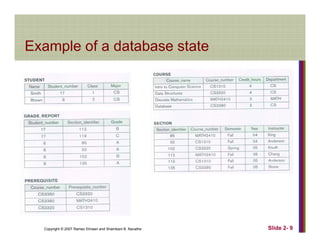
Database State:
The actual data stored in a database at a particular
moment in time. This includes the collection of all the data
in the database.
Al ll d d t b i t ( h t)
Copyright © 2007 Ramez Elmasri and Shamkant B. Navathe Slide 2- 6
Also called database instance (or occurrence or snapshot).
Database Schema vs Database StateDatabase Schema vs. Database State
Database State:
Refers to the content of a database at a moment in time.
Initial Database State:
Refers to the database state when it is initially loaded intoy
the system.
Valid State:
A state that satisfies the structure and constraints of the
database.
Schema and State Distinction
The database schema changes very infrequently. Theg y q y
database state changes every time the database is
updated.
Schema is also called intension whereas State is also
called extension
Copyright © 2007 Ramez Elmasri and Shamkant B. Navathe Slide 2- 7
called extension.
Example of a Database SchemaExample of a Database Schema
Copyright © 2007 Ramez Elmasri and Shamkant B. Navathe Slide 2- 8
Example of a database stateExample of a database state
Copyright © 2007 Ramez Elmasri and Shamkant B. Navathe Slide 2- 9
Three Schema ArchitectureThree-Schema Architecture
Proposed to help achieve the DB characteristics
S i ll li i d h h i l d bSpecially to separate user applications and the physical database
It defines DBMS schemas at three levels:
Internal schema at the internal level to describe physical storage
structures and access paths (e g indexes)structures and access paths (e.g indexes).
Typically uses a physical data model.
Conceptual schema at the conceptual level to describe the
structure for the whole database for a community of users. It hides
th d t il f th h i l t t t d t tthe details of the physical storage structures and concentrates on
describing entities, data types, relationships, and constraints.
Uses a conceptual or an implementation data model.
External schemas at the external level to describes the part ofp
the database that a particular user group is interested in and hides
the rest of the database from that user group.
Usually uses the same data model as the conceptual schema.
Copyright © 2007 Ramez Elmasri and Shamkant B. Navathe Slide 2- 10
The three schema architectureThe three-schema architecture
Copyright © 2007 Ramez Elmasri and Shamkant B. Navathe Slide 2- 11
Data IndependenceData Independence
The ability to change the schema at one level of they g
database system without having to change the
schema at the next higher level.
Logical Data Independence:Logical Data Independence:
The capacity to change the conceptual schema without having
to change the external schemas and their associated
li tiapplication programs.
Physical Data Independence:
The capacity to change the internal schema without having to
change the conceptual schema.
Copyright © 2007 Ramez Elmasri and Shamkant B. Navathe Slide 2- 12
DBMS LanguagesDBMS Languages
Data Definition Language (DDL): a language that is used to define
database schemas. The DDL statement is used to identify description
of the schema construct and store the schema description in the
DBMS catalog.
Data Manipulation Language (DML): a language that is used to
manipulate (retrieve, insert, delete, and modify) data.
A high-level or non-procedural DML can be used on its own to
specify complex database operations in a concise manner, such
as SQL.
A low-level or procedural DML typically retrieves individual
records or objects from the database and processes each
separately, such as PL/SQL.
Copyright © 2007 Ramez Elmasri and Shamkant B. Navathe Slide 2- 13
Embedded Languages: DML with Java, VB, C++, etc.
DBMS InterfacesDBMS Interfaces
Stand-alone query language interfacesq y g g
Example: Entering SQL queries at the DBMS interactive
SQL interface (such as, SQL*Plus in ORACLE)
Programmer interfaces for embedding DML inProgrammer interfaces for embedding DML in
programming languages
User-friendly interfaces
M b d l f b i th bMenu-based, popular for browsing on the web
Forms-based, designed for naïve users
Graphics-based
Natural language: requests in written English
Parametric interfaces, e.g., bank tellers using function keys.
Interfaces for the DBA
Copyright © 2007 Ramez Elmasri and Shamkant B. Navathe Slide 2- 14
Interfaces for the DBA
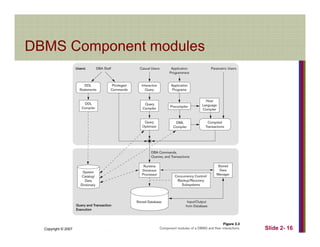
DBMS Component ModulesDBMS Component Modules
A typical DBMS consists of the following components:yp g p
DDL compiler: process schema definitions, specified in the
DDL statements, and stores descriptions of the schemas in
the system catalog.y g
DML compiler: compiles the DML commands into object
code for database access.
Run-time database processor: handles database access atRun time database processor: handles database access at
run time. It receives retrieval and update operations and
carries them out on the database.
Query compiler: handles high-level queries that are enteredQue y co p e a d es g e e que es t at a e e te ed
interactively.
Data manager: controls access to DBMS information that is
stored on disk through interaction with operating system.
Copyright © 2007 Ramez Elmasri and Shamkant B. Navathe Slide 2- 15
g p g y
DBMS Component modulesDBMS Component modules
Copyright © 2007 Ramez Elmasri and Shamkant B. Navathe Slide 2- 16
Database System UtilitiesDatabase System Utilities
There are some functions that are not provided throughp g
the normal DBMS components rather they are provided
through additional programs called utilities. Some of these
are:
Loading or import utility: used to load or import existing data
files into the database.
Backup utility: used to create backup copies of theBackup utility: used to create backup copies of the
database, usually by dumping the entire database onto
tape.
File reorganization utility: is used to reorganize a databaseFile reorganization utility: is used to reorganize a database
file into a different file organization to improve performance.
Performance monitoring utility: is used to monitor database
usage and provides statistics to the DBA.
Copyright © 2007 Ramez Elmasri and Shamkant B. Navathe Slide 2- 17
usage and provides statistics to the DBA.
Other ToolsOther Tools
Data dictionary / repository:
Used to store schema descriptions and other information such as
design decisions, application program descriptions, user
information, etc.
CASE tools:
Used in the design phase of database
E l R ti l R TOADExamples: Rational Rose, TOAD
Application Development Environments:
P id f iliti f d l i d t b li ti i l diProvides facilities for developing database applications including
database design, graphical user interface development, querying
and updating, and application program development.
PowerBuilder (Sybase) JBuilder (Borland) JDeveloper 10G (Oracle)
Copyright © 2007 Ramez Elmasri and Shamkant B. Navathe Slide 2- 18
PowerBuilder (Sybase), JBuilder (Borland), JDeveloper 10G (Oracle)
Classification of DBMSsClassification of DBMSs
Several criteria are normally used to classify DBMSs
Data Model:
Relational, Object, Object-Relational, Hierarchical, Network
Number of Users:
Single-user system
Multi-user system
Number of Sites
Distributed
Centralized
Cost:
PPurpose:
General
special
Copyright © 2007 Ramez Elmasri and Shamkant B. Navathe Slide 2- 19
History of Data ModelsHistory of Data Models
Network Model:
The first network DBMS was implemented by Honeywell in
1964-65 (IDS System). Later implemented in a large variety
of systems
Hi hi l D t M d lHierarchical Data Model:
Used in IBM’s IMS (and some other products) which still
have a large customer base worldwide.
Dominated the DBMS market during 1965 1985Dominated the DBMS market during 1965-1985
Relational Model:
Proposed in 1970 by E.F. Codd (IBM), first commercial
system in 1981 82 Currently most dominantsystem in 1981-82. Currently most dominant.
In several commercial and free open source products:
DB2, ORACLE, MS SQL Server, SYBASE, INFORMIX.
MySQL PostgreSQL
Copyright © 2007 Ramez Elmasri and Shamkant B. Navathe Slide 2- 20
MySQL, PostgreSQL
History of Data ModelsHistory of Data Models
Object-oriented Data Models:j
Comprises models of persistent O-O Programming
Languages such as C++ (e.g., in OBJECTSTORE), Java
and Smalltalk (e g in GEMSTONE)and Smalltalk (e.g., in GEMSTONE).
Object-Relational Models:
Most Recent Trend. Started with Informix Universal Server.
Relational systems incorporate concepts from object
databases leading to object-relational.
Exemplified in the latest versions of Oracle 10i DB2 andExemplified in the latest versions of Oracle-10i, DB2, and
SQL Server and other DBMSs.
Copyright © 2007 Ramez Elmasri and Shamkant B. Navathe Slide 2- 21

Database System Concepts and Architecture

  • 1.
    Copyright © 2007Ramez Elmasri and Shamkant B. Navathe Slide 2- 1
  • 2.
    Chapter 2 Database SystemConcepts andDatabase System Concepts and Architecture Copyright © 2007 Ramez Elmasri and Shamkant B. Navathe
  • 3.
    OutlineOutline Data Models andTheir CategoriesData Models and Their Categories Schemas, Instances, and States Three-Schema ArchitectureThree-Schema Architecture Data Independence DBMS Languages and InterfacesDBMS Languages and Interfaces Database System Utilities and Tools Classification of DBMSsClassification of DBMSs History of Data Models Copyright © 2007 Ramez Elmasri and Shamkant B. Navathe Slide 2- 3
  • 4.
    Data ModelsData Models DataAbstraction:Data Abstraction: The suppression of details of data organization and storage and the highlighting of essentialg g g g features for better understanding Data Model: A set of concepts to describe the structure of a database, and certain constraints that the database should obeydatabase should obey. Data model helps to achieve data abstraction. Copyright © 2007 Ramez Elmasri and Shamkant B. Navathe Slide 2- 4
  • 5.
    Categories of DataModelsCategories of Data Models Conceptual (high-level, semantic) data models: P id h l h iProvide concepts that are close to the way many users perceive data. Also called entity-based or object-based data models. Physical (low-level, internal) data models:Physical (low level, internal) data models: Provide concepts that describe details of how data is stored in the computer. Representational (Implementation) data models: Provide concepts that may be understood by end users but that are not too different from the way data is organized within the computer Hide some details of data storage but can be implemented on aHide some details of data storage but can be implemented on a computer system in a direct way Used by many commercial DBMS implementations (e.g. relational data models used in many commercial systems). Copyright © 2007 Ramez Elmasri and Shamkant B. Navathe Slide 2- 5
  • 6.
    Schemas versus InstancesSchemasversus Instances Database Schema: The description of a database. Includes descriptions of the database structure, data types, and the constraints on the database. Schema Diagram: An illustrative display of a database schema. Schema Construct: A component of the schema or an object within the schema, e.g., STUDENT, COURSE. Database State: The actual data stored in a database at a particular moment in time. This includes the collection of all the data in the database. Al ll d d t b i t ( h t) Copyright © 2007 Ramez Elmasri and Shamkant B. Navathe Slide 2- 6 Also called database instance (or occurrence or snapshot).
  • 7.
    Database Schema vsDatabase StateDatabase Schema vs. Database State Database State: Refers to the content of a database at a moment in time. Initial Database State: Refers to the database state when it is initially loaded intoy the system. Valid State: A state that satisfies the structure and constraints of the database. Schema and State Distinction The database schema changes very infrequently. Theg y q y database state changes every time the database is updated. Schema is also called intension whereas State is also called extension Copyright © 2007 Ramez Elmasri and Shamkant B. Navathe Slide 2- 7 called extension.
  • 8.
    Example of aDatabase SchemaExample of a Database Schema Copyright © 2007 Ramez Elmasri and Shamkant B. Navathe Slide 2- 8
  • 9.
    Example of adatabase stateExample of a database state Copyright © 2007 Ramez Elmasri and Shamkant B. Navathe Slide 2- 9
  • 10.
    Three Schema ArchitectureThree-SchemaArchitecture Proposed to help achieve the DB characteristics S i ll li i d h h i l d bSpecially to separate user applications and the physical database It defines DBMS schemas at three levels: Internal schema at the internal level to describe physical storage structures and access paths (e g indexes)structures and access paths (e.g indexes). Typically uses a physical data model. Conceptual schema at the conceptual level to describe the structure for the whole database for a community of users. It hides th d t il f th h i l t t t d t tthe details of the physical storage structures and concentrates on describing entities, data types, relationships, and constraints. Uses a conceptual or an implementation data model. External schemas at the external level to describes the part ofp the database that a particular user group is interested in and hides the rest of the database from that user group. Usually uses the same data model as the conceptual schema. Copyright © 2007 Ramez Elmasri and Shamkant B. Navathe Slide 2- 10
  • 11.
    The three schemaarchitectureThe three-schema architecture Copyright © 2007 Ramez Elmasri and Shamkant B. Navathe Slide 2- 11
  • 12.
    Data IndependenceData Independence Theability to change the schema at one level of they g database system without having to change the schema at the next higher level. Logical Data Independence:Logical Data Independence: The capacity to change the conceptual schema without having to change the external schemas and their associated li tiapplication programs. Physical Data Independence: The capacity to change the internal schema without having to change the conceptual schema. Copyright © 2007 Ramez Elmasri and Shamkant B. Navathe Slide 2- 12
  • 13.
    DBMS LanguagesDBMS Languages DataDefinition Language (DDL): a language that is used to define database schemas. The DDL statement is used to identify description of the schema construct and store the schema description in the DBMS catalog. Data Manipulation Language (DML): a language that is used to manipulate (retrieve, insert, delete, and modify) data. A high-level or non-procedural DML can be used on its own to specify complex database operations in a concise manner, such as SQL. A low-level or procedural DML typically retrieves individual records or objects from the database and processes each separately, such as PL/SQL. Copyright © 2007 Ramez Elmasri and Shamkant B. Navathe Slide 2- 13 Embedded Languages: DML with Java, VB, C++, etc.
  • 14.
    DBMS InterfacesDBMS Interfaces Stand-alonequery language interfacesq y g g Example: Entering SQL queries at the DBMS interactive SQL interface (such as, SQL*Plus in ORACLE) Programmer interfaces for embedding DML inProgrammer interfaces for embedding DML in programming languages User-friendly interfaces M b d l f b i th bMenu-based, popular for browsing on the web Forms-based, designed for naïve users Graphics-based Natural language: requests in written English Parametric interfaces, e.g., bank tellers using function keys. Interfaces for the DBA Copyright © 2007 Ramez Elmasri and Shamkant B. Navathe Slide 2- 14 Interfaces for the DBA
  • 15.
    DBMS Component ModulesDBMSComponent Modules A typical DBMS consists of the following components:yp g p DDL compiler: process schema definitions, specified in the DDL statements, and stores descriptions of the schemas in the system catalog.y g DML compiler: compiles the DML commands into object code for database access. Run-time database processor: handles database access atRun time database processor: handles database access at run time. It receives retrieval and update operations and carries them out on the database. Query compiler: handles high-level queries that are enteredQue y co p e a d es g e e que es t at a e e te ed interactively. Data manager: controls access to DBMS information that is stored on disk through interaction with operating system. Copyright © 2007 Ramez Elmasri and Shamkant B. Navathe Slide 2- 15 g p g y
  • 16.
    DBMS Component modulesDBMSComponent modules Copyright © 2007 Ramez Elmasri and Shamkant B. Navathe Slide 2- 16
  • 17.
    Database System UtilitiesDatabaseSystem Utilities There are some functions that are not provided throughp g the normal DBMS components rather they are provided through additional programs called utilities. Some of these are: Loading or import utility: used to load or import existing data files into the database. Backup utility: used to create backup copies of theBackup utility: used to create backup copies of the database, usually by dumping the entire database onto tape. File reorganization utility: is used to reorganize a databaseFile reorganization utility: is used to reorganize a database file into a different file organization to improve performance. Performance monitoring utility: is used to monitor database usage and provides statistics to the DBA. Copyright © 2007 Ramez Elmasri and Shamkant B. Navathe Slide 2- 17 usage and provides statistics to the DBA.
  • 18.
    Other ToolsOther Tools Datadictionary / repository: Used to store schema descriptions and other information such as design decisions, application program descriptions, user information, etc. CASE tools: Used in the design phase of database E l R ti l R TOADExamples: Rational Rose, TOAD Application Development Environments: P id f iliti f d l i d t b li ti i l diProvides facilities for developing database applications including database design, graphical user interface development, querying and updating, and application program development. PowerBuilder (Sybase) JBuilder (Borland) JDeveloper 10G (Oracle) Copyright © 2007 Ramez Elmasri and Shamkant B. Navathe Slide 2- 18 PowerBuilder (Sybase), JBuilder (Borland), JDeveloper 10G (Oracle)
  • 19.
    Classification of DBMSsClassificationof DBMSs Several criteria are normally used to classify DBMSs Data Model: Relational, Object, Object-Relational, Hierarchical, Network Number of Users: Single-user system Multi-user system Number of Sites Distributed Centralized Cost: PPurpose: General special Copyright © 2007 Ramez Elmasri and Shamkant B. Navathe Slide 2- 19
  • 20.
    History of DataModelsHistory of Data Models Network Model: The first network DBMS was implemented by Honeywell in 1964-65 (IDS System). Later implemented in a large variety of systems Hi hi l D t M d lHierarchical Data Model: Used in IBM’s IMS (and some other products) which still have a large customer base worldwide. Dominated the DBMS market during 1965 1985Dominated the DBMS market during 1965-1985 Relational Model: Proposed in 1970 by E.F. Codd (IBM), first commercial system in 1981 82 Currently most dominantsystem in 1981-82. Currently most dominant. In several commercial and free open source products: DB2, ORACLE, MS SQL Server, SYBASE, INFORMIX. MySQL PostgreSQL Copyright © 2007 Ramez Elmasri and Shamkant B. Navathe Slide 2- 20 MySQL, PostgreSQL
  • 21.
    History of DataModelsHistory of Data Models Object-oriented Data Models:j Comprises models of persistent O-O Programming Languages such as C++ (e.g., in OBJECTSTORE), Java and Smalltalk (e g in GEMSTONE)and Smalltalk (e.g., in GEMSTONE). Object-Relational Models: Most Recent Trend. Started with Informix Universal Server. Relational systems incorporate concepts from object databases leading to object-relational. Exemplified in the latest versions of Oracle 10i DB2 andExemplified in the latest versions of Oracle-10i, DB2, and SQL Server and other DBMSs. Copyright © 2007 Ramez Elmasri and Shamkant B. Navathe Slide 2- 21