Software Engineering-
Unit 1
SOFTWARE DEVELOPMENT LIFE CYCLE PROCESS MODEL AND
CHARACTERISTICS IN SOFTWARE ENGINEERING
9/3/2019 RAM K PALIWAL - SOFTWARE PROCESS IN SOFTWARE ENGINEERING - UNIT 1 1
Process Models
Prescriptive process models were originally proposed to bring order
to the chaos of software development. History has indicated that
these traditional models have brought a certain amount of useful
structure to software engineering work and have provided a
reasonably effective road map for software teams. However,
software engineering work and the product that it produces remain
on “the edge of chaos.”
All software process models can accommodate the generic
framework activities, but each applies a different emphasis to these
activities and defines a process flow that invokes each framework
activity (as well as software engineering actions and tasks) in a
different manner
9/3/2019 RAM K PALIWAL - SOFTWARE PROCESS IN SOFTWARE ENGINEERING - UNIT 1 2
Spiral Model
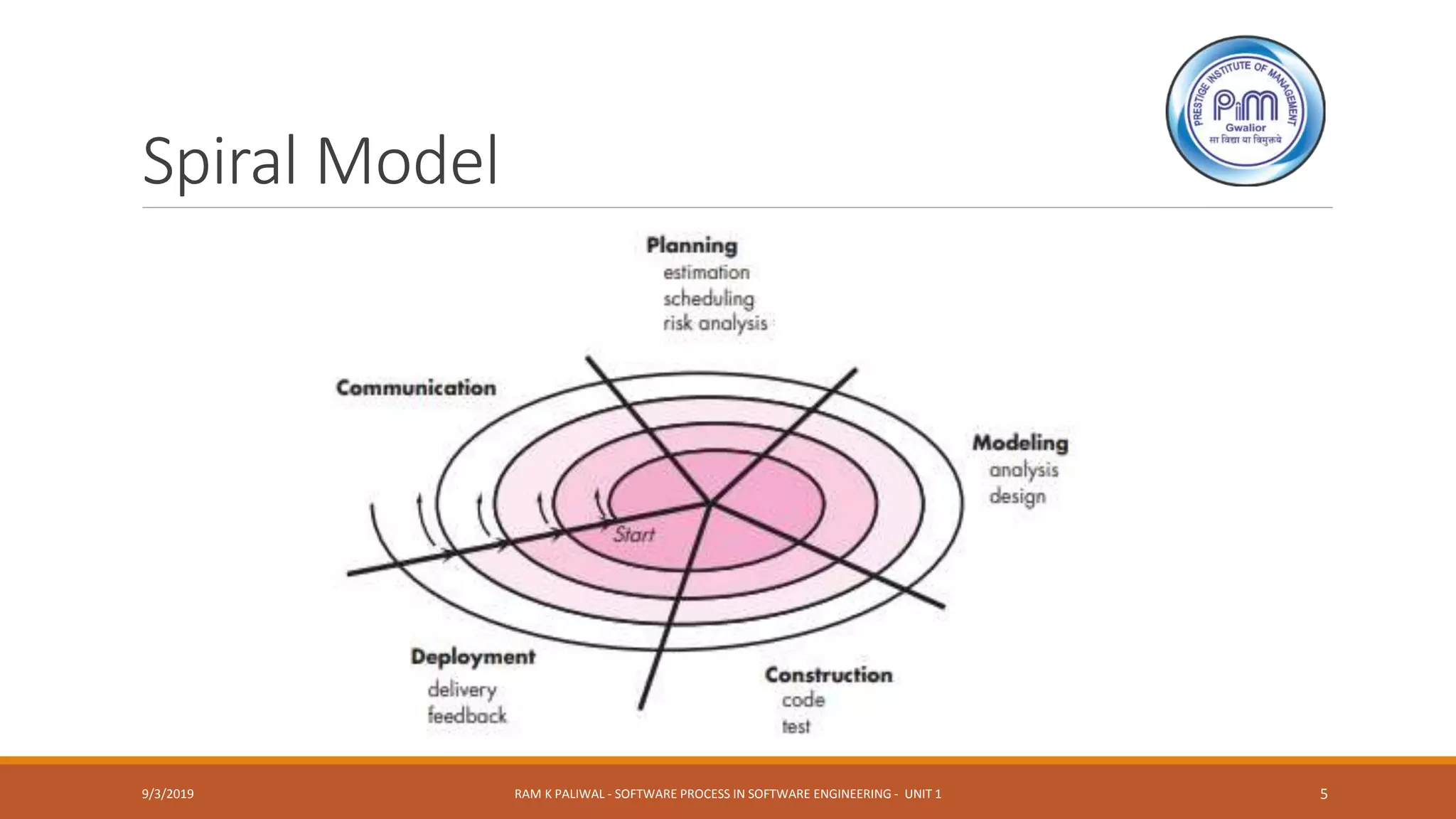
The Spiral Model, Originally proposed by Barry Boehm.
the spiral model is an evolutionary software process model that
couples the iterative nature of prototyping with the controlled
and systematic aspects of the waterfall model. It provides the
potential for rapid development of increasingly more complete
versions of the software. Boehm describes the model in the
following manner:
◦ The spiral development model is a risk-driven process model
generator that is used to guide multi-stakeholder concurrent
engineering of software intensive systems.
9/3/2019 RAM K PALIWAL - SOFTWARE PROCESS IN SOFTWARE ENGINEERING - UNIT 1 3
Spiral Model
◦ . It has two main distinguishing features.
◦ One is a cyclic approach for incrementally growing a system’s degree
of definition and implementation while decreasing its degree of risk.
◦ The other is a set of anchor point milestones for ensuring stakeholder
commitment to feasible and mutually satisfactory system solutions
Using the spiral model, software is developed in a series of
evolutionary releases. During early iterations, the release might be a
model or prototype. During later iterations, increasingly more
complete versions of the engineered system are produced.
9/3/2019 RAM K PALIWAL - SOFTWARE PROCESS IN SOFTWARE ENGINEERING - UNIT 1 4
Spiral Model
9/3/2019 RAM K PALIWAL - SOFTWARE PROCESS IN SOFTWARE ENGINEERING - UNIT 1 5
Spiral Model
The first circuit around the spiral might result in the development of
a product specification; subsequent passes around the spiral might
be used to develop a prototype and then progressively more
sophisticated versions of the software. Each pass through the
planning region results in adjustments to the project plan. Cost and
schedule are adjusted based on feedback derived from the customer
after delivery. In addition, the project manager adjusts the planned
number of iterations required to complete the software.
9/3/2019 RAM K PALIWAL - SOFTWARE PROCESS IN SOFTWARE ENGINEERING - UNIT 1 6
Spiral Model
Advantages:
◦ Risk Handling: The projects with many unknown risks that occur as the
development proceeds, in that case, Spiral Model is the best development
model to follow due to the risk analysis and risk handling at every phase.
◦ Good for large projects: It is recommended to use the Spiral Model in large
and complex projects.
◦ Flexibility in Requirements: Change requests in the Requirements at later
phase can be incorporated accurately by using this model.
◦ Customer Satisfaction: Customer can see the development of the product at
the early phase of the software development and thus, they habituated with
the system by using it before completion of the total product.
9/3/2019 RAM K PALIWAL - SOFTWARE PROCESS IN SOFTWARE ENGINEERING - UNIT 1 7
References:
https://www.geeksforgeeks.org/software-engineering-software-crisis/
7th edition Software Engineering A Practitioners Approach by Roger S. Pressman
9/3/2019 RAM K PALIWAL - SOFTWARE PROCESS IN SOFTWARE ENGINEERING - UNIT 1 8

Sdlc spiral model in software engineering basics by ram k paliwal

  • 1.
    Software Engineering- Unit 1 SOFTWAREDEVELOPMENT LIFE CYCLE PROCESS MODEL AND CHARACTERISTICS IN SOFTWARE ENGINEERING 9/3/2019 RAM K PALIWAL - SOFTWARE PROCESS IN SOFTWARE ENGINEERING - UNIT 1 1
  • 2.
    Process Models Prescriptive processmodels were originally proposed to bring order to the chaos of software development. History has indicated that these traditional models have brought a certain amount of useful structure to software engineering work and have provided a reasonably effective road map for software teams. However, software engineering work and the product that it produces remain on “the edge of chaos.” All software process models can accommodate the generic framework activities, but each applies a different emphasis to these activities and defines a process flow that invokes each framework activity (as well as software engineering actions and tasks) in a different manner 9/3/2019 RAM K PALIWAL - SOFTWARE PROCESS IN SOFTWARE ENGINEERING - UNIT 1 2
  • 3.
    Spiral Model The SpiralModel, Originally proposed by Barry Boehm. the spiral model is an evolutionary software process model that couples the iterative nature of prototyping with the controlled and systematic aspects of the waterfall model. It provides the potential for rapid development of increasingly more complete versions of the software. Boehm describes the model in the following manner: ◦ The spiral development model is a risk-driven process model generator that is used to guide multi-stakeholder concurrent engineering of software intensive systems. 9/3/2019 RAM K PALIWAL - SOFTWARE PROCESS IN SOFTWARE ENGINEERING - UNIT 1 3
  • 4.
    Spiral Model ◦ .It has two main distinguishing features. ◦ One is a cyclic approach for incrementally growing a system’s degree of definition and implementation while decreasing its degree of risk. ◦ The other is a set of anchor point milestones for ensuring stakeholder commitment to feasible and mutually satisfactory system solutions Using the spiral model, software is developed in a series of evolutionary releases. During early iterations, the release might be a model or prototype. During later iterations, increasingly more complete versions of the engineered system are produced. 9/3/2019 RAM K PALIWAL - SOFTWARE PROCESS IN SOFTWARE ENGINEERING - UNIT 1 4
  • 5.
    Spiral Model 9/3/2019 RAMK PALIWAL - SOFTWARE PROCESS IN SOFTWARE ENGINEERING - UNIT 1 5
  • 6.
    Spiral Model The firstcircuit around the spiral might result in the development of a product specification; subsequent passes around the spiral might be used to develop a prototype and then progressively more sophisticated versions of the software. Each pass through the planning region results in adjustments to the project plan. Cost and schedule are adjusted based on feedback derived from the customer after delivery. In addition, the project manager adjusts the planned number of iterations required to complete the software. 9/3/2019 RAM K PALIWAL - SOFTWARE PROCESS IN SOFTWARE ENGINEERING - UNIT 1 6
  • 7.
    Spiral Model Advantages: ◦ RiskHandling: The projects with many unknown risks that occur as the development proceeds, in that case, Spiral Model is the best development model to follow due to the risk analysis and risk handling at every phase. ◦ Good for large projects: It is recommended to use the Spiral Model in large and complex projects. ◦ Flexibility in Requirements: Change requests in the Requirements at later phase can be incorporated accurately by using this model. ◦ Customer Satisfaction: Customer can see the development of the product at the early phase of the software development and thus, they habituated with the system by using it before completion of the total product. 9/3/2019 RAM K PALIWAL - SOFTWARE PROCESS IN SOFTWARE ENGINEERING - UNIT 1 7
  • 8.
    References: https://www.geeksforgeeks.org/software-engineering-software-crisis/ 7th edition SoftwareEngineering A Practitioners Approach by Roger S. Pressman 9/3/2019 RAM K PALIWAL - SOFTWARE PROCESS IN SOFTWARE ENGINEERING - UNIT 1 8

Editor's Notes

  • #5 A risk is any adverse situation that might affect the successful completion of a software project. The most important feature of the spiral model is handling these unknown risks after the project has started. Such risk resolutions are easier done by developing a prototype. The spiral model supports coping up with risks by providing the scope to build a prototype at every phase of the software development.