Unit -2
DATABASE DEVELOPMENT LIFE CYCLE - PART 1
9/4/2019 DATABASE DEVELOPMENT LIFE CYCLE -UNIT 2 PART 1- BY RAM K PALIWAL 1
Database development Life Cycle
A database system is a fundamental component of the larger
enterprise information system. The database development life cycle
(DDLC) is a process of designing, implementing and maintaining a
database system to meet strategic or operational information needs
of an organisation or enterprise.
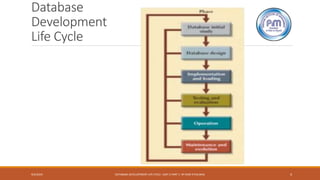
The Database Life Cycle (DBLC) contains six phases:
9/4/2019 DATABASE DEVELOPMENT LIFE CYCLE -UNIT 2 PART 1- BY RAM K PALIWAL 2
Database Development Life Cycle
1. Database initial study
2. Database design
3. Implementation and loading
4. Testing and evaluation
5. Operation
6. Maintenance and evolution.
9/4/2019 DATABASE DEVELOPMENT LIFE CYCLE -UNIT 2 PART 1- BY RAM K PALIWAL 3
Database
Development
Life Cycle
9/4/2019 DATABASE DEVELOPMENT LIFE CYCLE -UNIT 2 PART 1- BY RAM K PALIWAL 4
Database Development Life Cycle
1. The Database Initial Study:
In the Database initial study, the designer must examine the current
system’s operation within the company and determine how and why
the current system fails. The overall purpose of the database initial
study is to:
◦ Analyze the company situation.
◦ Define problems and constraints.
◦ Define objectives.
◦ Define scope and boundaries.
9/4/2019 DATABASE DEVELOPMENT LIFE CYCLE -UNIT 2 PART 1- BY RAM K PALIWAL 5
Database Development Life Cycle
2. Database Design:
The second phase focuses on the design of the database model that
will support company operations and objectives. This is arguably the
most critical DBLC phase: making sure that the final product meets
user and system requirements. As you examine the procedures
required to complete the design phase in the DBLC, remember these
points:
◦ The process of database design is loosely related to the analysis and design of
a larger system. The data component is only one element of a larger
information system.
◦ The systems analysts or systems programmers are in charge of designing the
other system components. Their activities create the procedures that will help
transform the data within the database into useful information.
9/4/2019 DATABASE DEVELOPMENT LIFE CYCLE -UNIT 2 PART 1- BY RAM K PALIWAL 6
Database Development Life Cycle
3. Implementation and Loading:
The output of the database design phase is a series of instructions
detailing the creation of tables, attributes, domains, views, indexes,
security constraints, and storage and performance guidelines. In this
phase, you actually implement all these design specifications.
◦ Install the DBMS:
◦ Create the Database(s)
◦ Load or Convert the Data
9/4/2019 DATABASE DEVELOPMENT LIFE CYCLE -UNIT 2 PART 1- BY RAM K PALIWAL 7
Database Development Life Cycle
Testing and Evaluation:
In the design phase, decisions were made to ensure integrity, security, performance, and
recoverability of the database. During implementation and loading, these plans were put into
place. In testing and evaluation, the DBA tests and fine-tunes the database to ensure that it
performs as expected. This phase occurs in conjunction with applications programming.
◦ Test the Database
◦ Fine-Tune the Database
◦ Evaluate the Database and Its Application Programs
9/4/2019 DATABASE DEVELOPMENT LIFE CYCLE -UNIT 2 PART 1- BY RAM K PALIWAL 8
Database Development Life Cycle
5. Operation
Once the database has passed the evaluation stage, it is
considered to be operational. At that point, the database,
its management, its users, and its application programs
constitute a complete information system. The beginning of
the operational phase invariably starts the process of
system evolution.
9/4/2019 DATABASE DEVELOPMENT LIFE CYCLE -UNIT 2 PART 1- BY RAM K PALIWAL 9
Database Development Life Cycle
6. Maintenance and Evolution
The database administrator must be prepared to perform routine
maintenance activities within the database. Some of the required
periodic maintenance activities include:
◦ Preventive maintenance (backup).
◦ Corrective maintenance (recovery).
◦ Adaptive maintenance (enhancing performance, adding entities and
attributes, and so on).
◦ Assignment of access permissions and their maintenance for new and old
users.
9/4/2019 DATABASE DEVELOPMENT LIFE CYCLE -UNIT 2 PART 1- BY RAM K PALIWAL 10
References
1. https://www.oreilly.com/library/view/database-systems-
concepts/9788177585674/9788177585674_ch08lev1sec3.html
2. http://www.myreadingroom.co.in/notes-and-studymaterial/65-dbms/506-database-
development-life-cycle.html
9/4/2019 DATABASE DEVELOPMENT LIFE CYCLE -UNIT 2 PART 1- BY RAM K PALIWAL 11

Database development life cycle unit 2 part 1

  • 1.
    Unit -2 DATABASE DEVELOPMENTLIFE CYCLE - PART 1 9/4/2019 DATABASE DEVELOPMENT LIFE CYCLE -UNIT 2 PART 1- BY RAM K PALIWAL 1
  • 2.
    Database development LifeCycle A database system is a fundamental component of the larger enterprise information system. The database development life cycle (DDLC) is a process of designing, implementing and maintaining a database system to meet strategic or operational information needs of an organisation or enterprise. The Database Life Cycle (DBLC) contains six phases: 9/4/2019 DATABASE DEVELOPMENT LIFE CYCLE -UNIT 2 PART 1- BY RAM K PALIWAL 2
  • 3.
    Database Development LifeCycle 1. Database initial study 2. Database design 3. Implementation and loading 4. Testing and evaluation 5. Operation 6. Maintenance and evolution. 9/4/2019 DATABASE DEVELOPMENT LIFE CYCLE -UNIT 2 PART 1- BY RAM K PALIWAL 3
  • 4.
    Database Development Life Cycle 9/4/2019 DATABASEDEVELOPMENT LIFE CYCLE -UNIT 2 PART 1- BY RAM K PALIWAL 4
  • 5.
    Database Development LifeCycle 1. The Database Initial Study: In the Database initial study, the designer must examine the current system’s operation within the company and determine how and why the current system fails. The overall purpose of the database initial study is to: ◦ Analyze the company situation. ◦ Define problems and constraints. ◦ Define objectives. ◦ Define scope and boundaries. 9/4/2019 DATABASE DEVELOPMENT LIFE CYCLE -UNIT 2 PART 1- BY RAM K PALIWAL 5
  • 6.
    Database Development LifeCycle 2. Database Design: The second phase focuses on the design of the database model that will support company operations and objectives. This is arguably the most critical DBLC phase: making sure that the final product meets user and system requirements. As you examine the procedures required to complete the design phase in the DBLC, remember these points: ◦ The process of database design is loosely related to the analysis and design of a larger system. The data component is only one element of a larger information system. ◦ The systems analysts or systems programmers are in charge of designing the other system components. Their activities create the procedures that will help transform the data within the database into useful information. 9/4/2019 DATABASE DEVELOPMENT LIFE CYCLE -UNIT 2 PART 1- BY RAM K PALIWAL 6
  • 7.
    Database Development LifeCycle 3. Implementation and Loading: The output of the database design phase is a series of instructions detailing the creation of tables, attributes, domains, views, indexes, security constraints, and storage and performance guidelines. In this phase, you actually implement all these design specifications. ◦ Install the DBMS: ◦ Create the Database(s) ◦ Load or Convert the Data 9/4/2019 DATABASE DEVELOPMENT LIFE CYCLE -UNIT 2 PART 1- BY RAM K PALIWAL 7
  • 8.
    Database Development LifeCycle Testing and Evaluation: In the design phase, decisions were made to ensure integrity, security, performance, and recoverability of the database. During implementation and loading, these plans were put into place. In testing and evaluation, the DBA tests and fine-tunes the database to ensure that it performs as expected. This phase occurs in conjunction with applications programming. ◦ Test the Database ◦ Fine-Tune the Database ◦ Evaluate the Database and Its Application Programs 9/4/2019 DATABASE DEVELOPMENT LIFE CYCLE -UNIT 2 PART 1- BY RAM K PALIWAL 8
  • 9.
    Database Development LifeCycle 5. Operation Once the database has passed the evaluation stage, it is considered to be operational. At that point, the database, its management, its users, and its application programs constitute a complete information system. The beginning of the operational phase invariably starts the process of system evolution. 9/4/2019 DATABASE DEVELOPMENT LIFE CYCLE -UNIT 2 PART 1- BY RAM K PALIWAL 9
  • 10.
    Database Development LifeCycle 6. Maintenance and Evolution The database administrator must be prepared to perform routine maintenance activities within the database. Some of the required periodic maintenance activities include: ◦ Preventive maintenance (backup). ◦ Corrective maintenance (recovery). ◦ Adaptive maintenance (enhancing performance, adding entities and attributes, and so on). ◦ Assignment of access permissions and their maintenance for new and old users. 9/4/2019 DATABASE DEVELOPMENT LIFE CYCLE -UNIT 2 PART 1- BY RAM K PALIWAL 10
  • 11.