eTMF in Clinical Trials
Ms. Chintan Wakade
04-Oct-2015
OVERVIEW
 What is an eTMF?
 Brief History
 Current relevant Software
 eTMF Benefits
 Current Scene
 eTMF Challenges
 eTMF Scope
WHAT IS AN eTMF?
 An electronic trial master file (eTMF) is a formalized
means of organizing and storing documents, images and
other digital content for pharmaceutical clinical trials that
may be required for compliance with government regulatory
agencies. The term eTMF encompasses strategies, methods
and tools used throughout the lifecycle of the clinical trial
regulated content.
 It comprises-
-Software
-Hardware
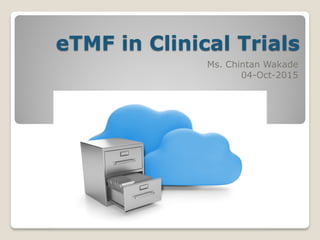
Documents and content are stored electronically on a
computer server “Cloud” eliminating the need for
Regulatory Binders.
eTMF Features
 TMF Taxonomy:
 Includes Document Naming, Categories,
Description
 TMF Meta-data
 Part of document Record
 Basically a Standard-based data/data-set
 It has provision to send notification to
Stakeholder.
 Efficient Search Engine
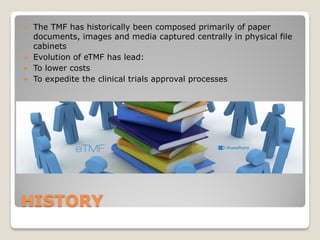
HISTORY
 The TMF has historically been composed primarily of paper
documents, images and media captured centrally in physical file
cabinets
 Evolution of eTMF has lead:
 To lower costs
 To expedite the clinical trials approval processes
History Contd..TMF Ref Model
http://www.appliedclinicaltrialsonline.com/tmf-reference-model-case-standards
DIA REFERENCE MODEL:
 In 2009; the TMF Reference Model team was initially
created within the Document and Records Management
Community of the Drug Information Association to develop
a standardized taxonomy that outlines the clear definition
and organization of TMF content using standard
nomenclature.
 As of early 2013, the TMF Reference Model team is
composed of over 330 representatives from more than 180
life science companies, CROs, consultancies, technical
vendors, industry groups, healthcare, academia, not-for-
profit / NGO and regulatory agencies spread globally from
the USA to Australia. The Asia-Pacific subgroup was an
exciting addition in 2012, and to date there are already 25
members in the group.
History Contd..TMF Ref Model
http://www.appliedclinicaltrialsonline.com/tmf-reference-model-case-standards
 Version 1.0 of the Model, first released in June of 2010, was updated in
February of 2011 (V1.1) and again in December of 2011 (V1.2), based on
broad feedback provided from end users and reviewers, including the UK and
US regulatory agencies MHRA and FDA.
 Version 2.0 of the Model, released in June 2012, included numerous new
aspects:
o The ISF is the part of the TMF found at the investigator site. The Model
provides clarity on which content is common to every trial site (e.g. protocol),
which is site specific (e.g. 1572), and details a few which are only included in
the Investigator Site Files in a small number of countries.
o Device trial content was also included in the Model, both at the Sponsor and
Investigator Site.
o Investigator Initiated Studies (IIS) are trials where an investigator also takes
on the role and responsibilities of a trial Sponsor. The set of documents is as
lean as possible while meeting ICH Guidelines and targeted regulatory
requirements. The challenge was the variation of IIS trials and the acceptance
and use of the Model by Investigator-Sponsors.
o Process related details for all content in the TMF were included and provide an
alternate perspective on the organization of the content.
Upcoming TMF Ref Model
http://www.appliedclinicaltrialsonline.com/tmf-reference-model-case-standards
 Building on the most widely leveraged standardized reference in TMF
management today – with version 2.0 used by more than a hundred life
science sponsors, CROs and technology vendors version 3.0 of the TMF
Reference Model
 Highlights of V3.0 include:
o Updated artifacts – Additions, deletions, consolidations
o Updated zones – Zones have been reassessed for logical
artifact inclusion – E.g. local labs
o Updated definitions – That more accurately describe the TMF
RM components
o Sub-artifact examples – assists with mapping to and
understanding purpose of artifacts
o TMF Reference Model User Guide – Provides step-by-step
process for mapping the organization’s TMF to the TMF RM
Current Softwares
eTMF Type Company Clients
Vault eTMF Veena
[Abbott, Alkermes,
Bayer, inVentiv,
Abbvie]
—Trial Interactive TransPerfect
—[Novartis, INC
Research, Infinity,
Sanofi-Aventis, Pfizer,
others]
—
eNNOV eTMF eNNOV -
—
Freyr eTMF Freyr -
SureClinical eTMF SureClinical -
eTMF Benefits
 Increased Compliance (21 CFR Part 11 and regulatory
compliance)
 Secure System and secure eback-up (User access are secure
password protected)
 Operational Efficiency (More productivity and more people work
efficiency be used in best possible manner)
 Transparency (Between Stakeholders and effective
communication between them and reducing errors due to
correction of errors)
 Data Tracking made easy (Exporting files)
 Cost-effective
 Quality of data (TMF QC Reports)
 Help options and Search options of eTMF
 Time-Saving (Just few clicks away)
 Saves Trees
eTMF Scenario
Ref: Survey: Electronic Processes Increasingly Replacing Paper In Clinical Trials
 Veeva Systems Survey 2014 survey, 43
percent of TMF owners reported most or all
their TMF documents were managed on
paper. In the 2015 report, that figure fell to
just 31 percent
 In citing benefits to inspection readiness of
an eTMF system, 66 percent noted benefits
around missing documents, 60 percent
mentioned benefits around duplicate
documents, and 55 percent cited benefits
around incomplete documents
eTMF Challenges
Scope and Volume:
 Although there is a huge scope of eTMF; it
has large user-base and thousands to
millions of documents. Henceforth
affecting Speed performance of eTMF
software.
 Affecting to an extent to CDQ
Content Quality
Document
eTMF Challenges Contd…
 Training
• Providing training on the use of eTMF.
• Lots of users do not have English as their
primary or secondary language.
 Change Management
• Developing and conducting Web-Based,
Audio, Audio-video Training timely and as
requisite
• Web-Ex and Video-Conference training
modules and its implementation
eTMF SCOPE
Ref: PharmaVoice June 2015 article
 More Sponsors and CROs are moving from
paper-based to eTMF versions
 Inspection-ready and ease of access to files
during inspections/audits
 Comprehensive trial documentation, with no
incomplete or missing documents
 Ease of Navigation an aid for auditors
eTMF ppt

eTMF ppt

  • 1.
    eTMF in ClinicalTrials Ms. Chintan Wakade 04-Oct-2015
  • 2.
    OVERVIEW  What isan eTMF?  Brief History  Current relevant Software  eTMF Benefits  Current Scene  eTMF Challenges  eTMF Scope
  • 3.
    WHAT IS ANeTMF?  An electronic trial master file (eTMF) is a formalized means of organizing and storing documents, images and other digital content for pharmaceutical clinical trials that may be required for compliance with government regulatory agencies. The term eTMF encompasses strategies, methods and tools used throughout the lifecycle of the clinical trial regulated content.  It comprises- -Software -Hardware Documents and content are stored electronically on a computer server “Cloud” eliminating the need for Regulatory Binders.
  • 4.
    eTMF Features  TMFTaxonomy:  Includes Document Naming, Categories, Description  TMF Meta-data  Part of document Record  Basically a Standard-based data/data-set  It has provision to send notification to Stakeholder.  Efficient Search Engine
  • 5.
    HISTORY  The TMFhas historically been composed primarily of paper documents, images and media captured centrally in physical file cabinets  Evolution of eTMF has lead:  To lower costs  To expedite the clinical trials approval processes
  • 6.
    History Contd..TMF RefModel http://www.appliedclinicaltrialsonline.com/tmf-reference-model-case-standards DIA REFERENCE MODEL:  In 2009; the TMF Reference Model team was initially created within the Document and Records Management Community of the Drug Information Association to develop a standardized taxonomy that outlines the clear definition and organization of TMF content using standard nomenclature.  As of early 2013, the TMF Reference Model team is composed of over 330 representatives from more than 180 life science companies, CROs, consultancies, technical vendors, industry groups, healthcare, academia, not-for- profit / NGO and regulatory agencies spread globally from the USA to Australia. The Asia-Pacific subgroup was an exciting addition in 2012, and to date there are already 25 members in the group.
  • 7.
    History Contd..TMF RefModel http://www.appliedclinicaltrialsonline.com/tmf-reference-model-case-standards  Version 1.0 of the Model, first released in June of 2010, was updated in February of 2011 (V1.1) and again in December of 2011 (V1.2), based on broad feedback provided from end users and reviewers, including the UK and US regulatory agencies MHRA and FDA.  Version 2.0 of the Model, released in June 2012, included numerous new aspects: o The ISF is the part of the TMF found at the investigator site. The Model provides clarity on which content is common to every trial site (e.g. protocol), which is site specific (e.g. 1572), and details a few which are only included in the Investigator Site Files in a small number of countries. o Device trial content was also included in the Model, both at the Sponsor and Investigator Site. o Investigator Initiated Studies (IIS) are trials where an investigator also takes on the role and responsibilities of a trial Sponsor. The set of documents is as lean as possible while meeting ICH Guidelines and targeted regulatory requirements. The challenge was the variation of IIS trials and the acceptance and use of the Model by Investigator-Sponsors. o Process related details for all content in the TMF were included and provide an alternate perspective on the organization of the content.
  • 8.
    Upcoming TMF RefModel http://www.appliedclinicaltrialsonline.com/tmf-reference-model-case-standards  Building on the most widely leveraged standardized reference in TMF management today – with version 2.0 used by more than a hundred life science sponsors, CROs and technology vendors version 3.0 of the TMF Reference Model  Highlights of V3.0 include: o Updated artifacts – Additions, deletions, consolidations o Updated zones – Zones have been reassessed for logical artifact inclusion – E.g. local labs o Updated definitions – That more accurately describe the TMF RM components o Sub-artifact examples – assists with mapping to and understanding purpose of artifacts o TMF Reference Model User Guide – Provides step-by-step process for mapping the organization’s TMF to the TMF RM
  • 10.
    Current Softwares eTMF TypeCompany Clients Vault eTMF Veena [Abbott, Alkermes, Bayer, inVentiv, Abbvie] —Trial Interactive TransPerfect —[Novartis, INC Research, Infinity, Sanofi-Aventis, Pfizer, others] — eNNOV eTMF eNNOV - — Freyr eTMF Freyr - SureClinical eTMF SureClinical -
  • 11.
    eTMF Benefits  IncreasedCompliance (21 CFR Part 11 and regulatory compliance)  Secure System and secure eback-up (User access are secure password protected)  Operational Efficiency (More productivity and more people work efficiency be used in best possible manner)  Transparency (Between Stakeholders and effective communication between them and reducing errors due to correction of errors)  Data Tracking made easy (Exporting files)  Cost-effective  Quality of data (TMF QC Reports)  Help options and Search options of eTMF  Time-Saving (Just few clicks away)  Saves Trees
  • 12.
    eTMF Scenario Ref: Survey:Electronic Processes Increasingly Replacing Paper In Clinical Trials  Veeva Systems Survey 2014 survey, 43 percent of TMF owners reported most or all their TMF documents were managed on paper. In the 2015 report, that figure fell to just 31 percent  In citing benefits to inspection readiness of an eTMF system, 66 percent noted benefits around missing documents, 60 percent mentioned benefits around duplicate documents, and 55 percent cited benefits around incomplete documents
  • 13.
    eTMF Challenges Scope andVolume:  Although there is a huge scope of eTMF; it has large user-base and thousands to millions of documents. Henceforth affecting Speed performance of eTMF software.  Affecting to an extent to CDQ Content Quality Document
  • 14.
    eTMF Challenges Contd… Training • Providing training on the use of eTMF. • Lots of users do not have English as their primary or secondary language.  Change Management • Developing and conducting Web-Based, Audio, Audio-video Training timely and as requisite • Web-Ex and Video-Conference training modules and its implementation
  • 15.
    eTMF SCOPE Ref: PharmaVoiceJune 2015 article  More Sponsors and CROs are moving from paper-based to eTMF versions  Inspection-ready and ease of access to files during inspections/audits  Comprehensive trial documentation, with no incomplete or missing documents  Ease of Navigation an aid for auditors