Explaining the Importance
of a Database Lock in Clinical
Research
Introduction
One of the most crucial aspects of research is clinical data management
or CDM. Proper CDM will generate results with excellent quality,
integrity, and reliability. Quality data is essential in order to support
the final conclusions of a certain study.
The person responsible for this area of research is called a clinical data
manager. This job position can be filled by a PI, a study coordinator, or a
CRA. No matter who fills this position at your site, data management has
to be done promptly and correctly in order to generate the best results.
Aside from all the other reasons why data management is so important,
it’s also what determines the future IP (investigational product)
development.
On the subject of clinical data, the most important term is ‘’database
lock’’. Here, we’ll explain what a database lock is and explain you the
purpose of this practice.
How efficient is database lock and what are the benefits from it? 2
What is a ‘’database lock’’?
www.trialjoin.com
3
Locking or closing a
database is nowadays a
crucial practice that is
necessary in order to
prevent unauthorized or
unintentional changes
after the final data
entry, check-up, and
analysis.
4
Prevents unauthorized/
unintentional changes;
3
2
1
PI signs all data, from the
beginning until the end, which is
then entered in eCRFs;
Important in randomized blinded
trials, to prove the integrity after
breaking the blind;
All trials are required to have a
structured and well-defined
process of closing their database
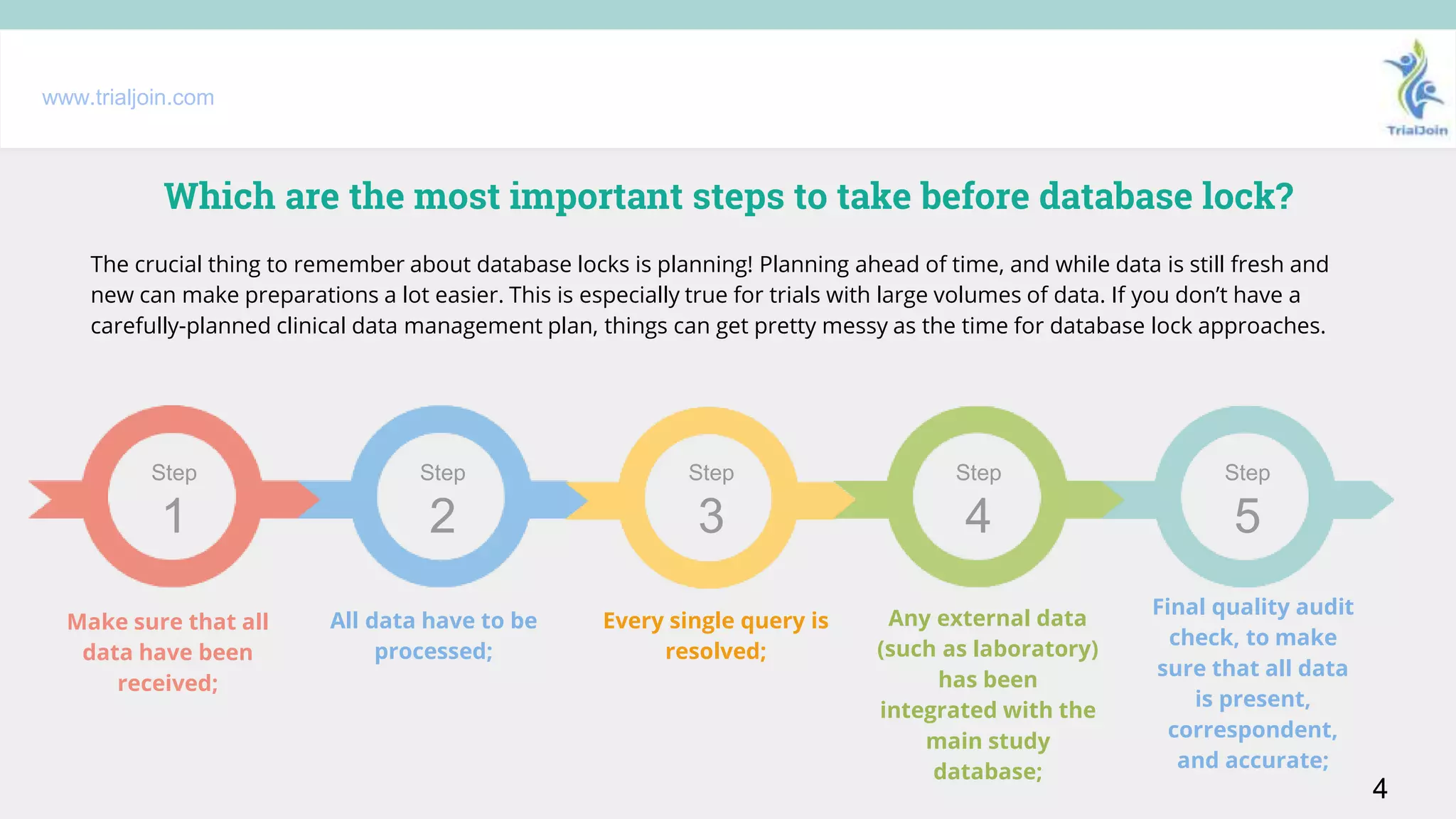
Which are the most important steps to take before database lock?
www.trialjoin.com
4
Make sure that all
data have been
received;
All data have to be
processed;
Every single query is
resolved;
Any external data
(such as laboratory)
has been
integrated with the
main study
database;
Final quality audit
check, to make
sure that all data
is present,
correspondent,
and accurate;
Step
1
The crucial thing to remember about database locks is planning! Planning ahead of time, and while data is still fresh and
new can make preparations a lot easier. This is especially true for trials with large volumes of data. If you don’t have a
carefully-planned clinical data management plan, things can get pretty messy as the time for database lock approaches.
Step
2
Step
3
Step
4
Step
5
Which are the most important steps to take before
database lock?
www.trialjoin.com
5
And FINALLY:
After the final check from the authorized person,
the edit access of the study database will be
removed and this removal date will be
documented.
This is the definitive point of the database lock!
www.trialjoin.com
Frequency of Database Locks
6
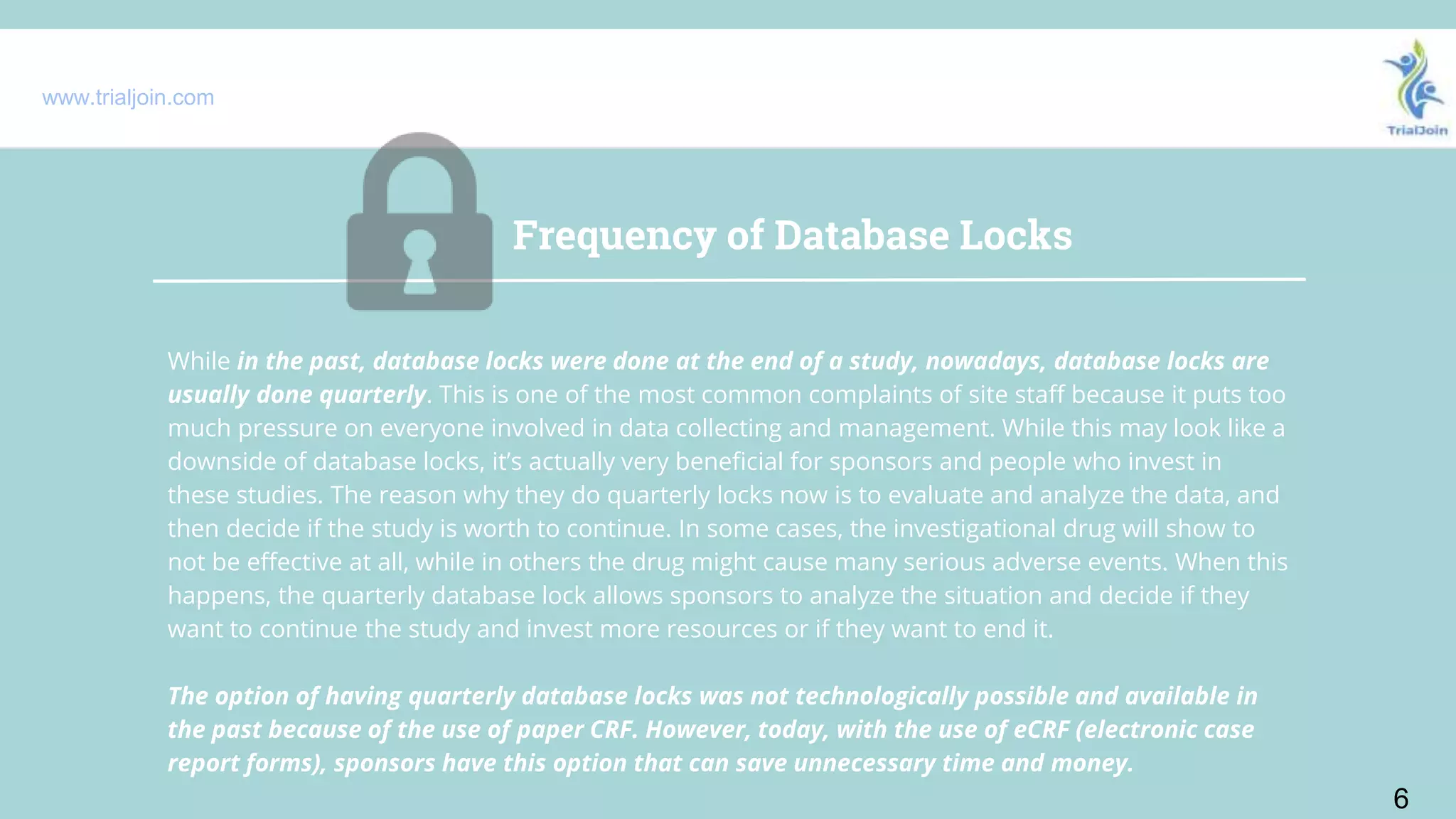
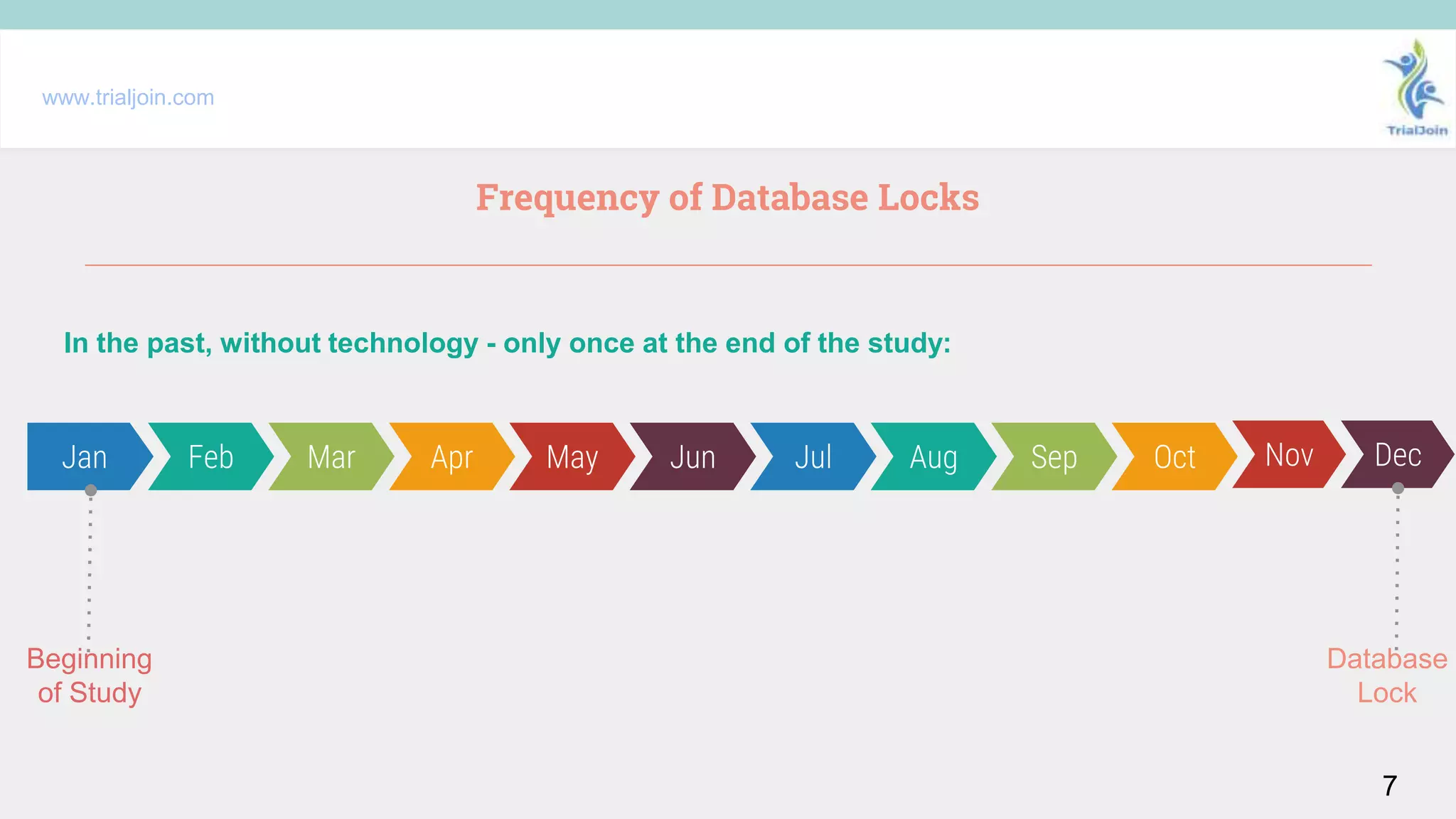
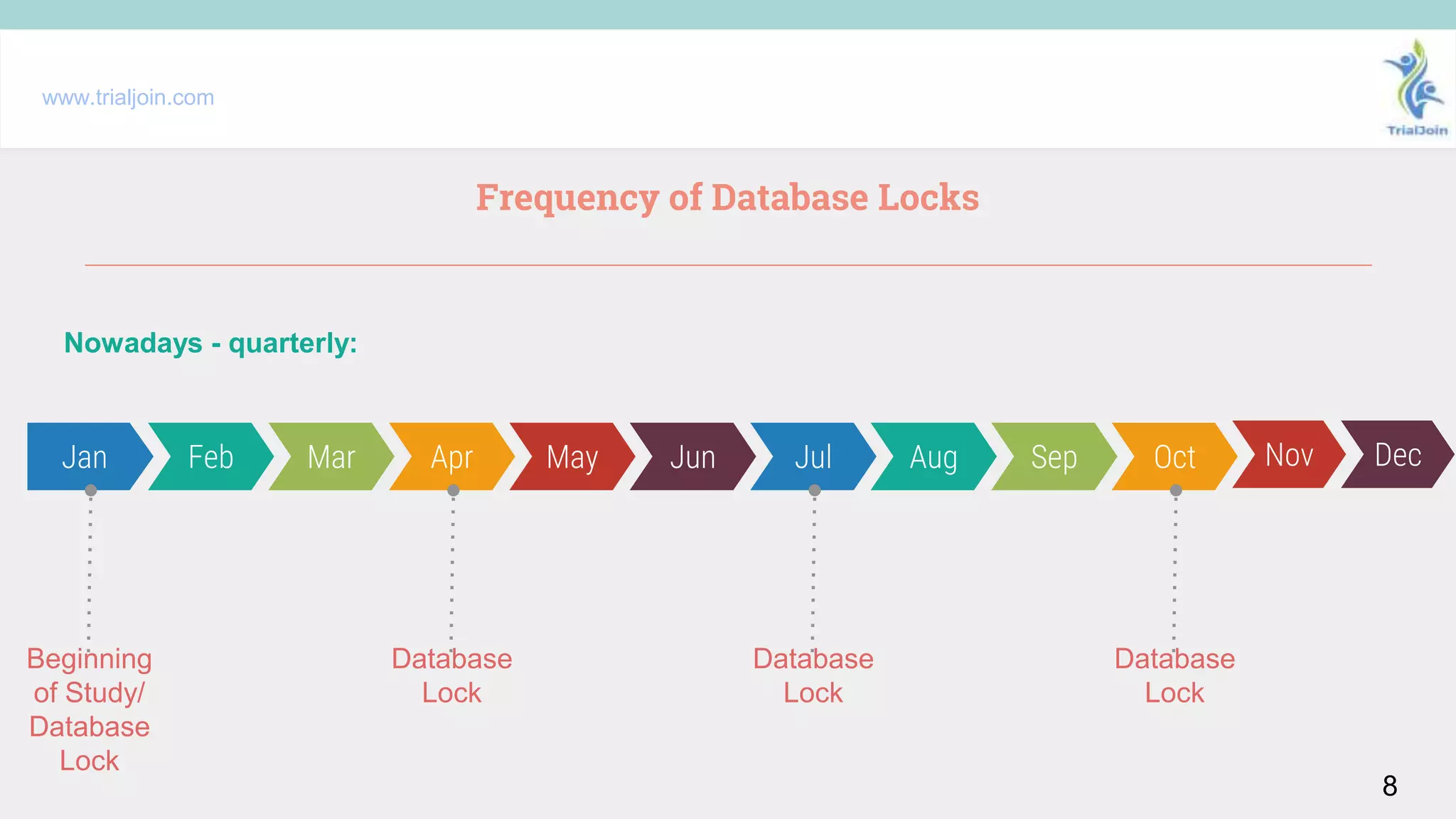
While in the past, database locks were done at the end of a study, nowadays, database locks are
usually done quarterly. This is one of the most common complaints of site staff because it puts too
much pressure on everyone involved in data collecting and management. While this may look like a
downside of database locks, it’s actually very beneficial for sponsors and people who invest in
these studies. The reason why they do quarterly locks now is to evaluate and analyze the data, and
then decide if the study is worth to continue. In some cases, the investigational drug will show to
not be effective at all, while in others the drug might cause many serious adverse events. When this
happens, the quarterly database lock allows sponsors to analyze the situation and decide if they
want to continue the study and invest more resources or if they want to end it.
The option of having quarterly database locks was not technologically possible and available in
the past because of the use of paper CRF. However, today, with the use of eCRF (electronic case
report forms), sponsors have this option that can save unnecessary time and money.
Frequency of Database Locks
www.trialjoin.com
7
Jan Feb Mar Apr May Jun Jul Aug Sep Oct Nov Dec
In the past, without technology - only once at the end of the study:
Beginning
of Study
Database
Lock
Frequency of Database Locks
www.trialjoin.com
8
Jan Feb Mar Apr May Jun Jul Aug Sep Oct Nov Dec
Nowadays - quarterly:
Beginning
of Study/
Database
Lock
Database
Lock
Database
Lock
Database
Lock
www.trialjoin.com
How Beneficial are Database Locks?
9
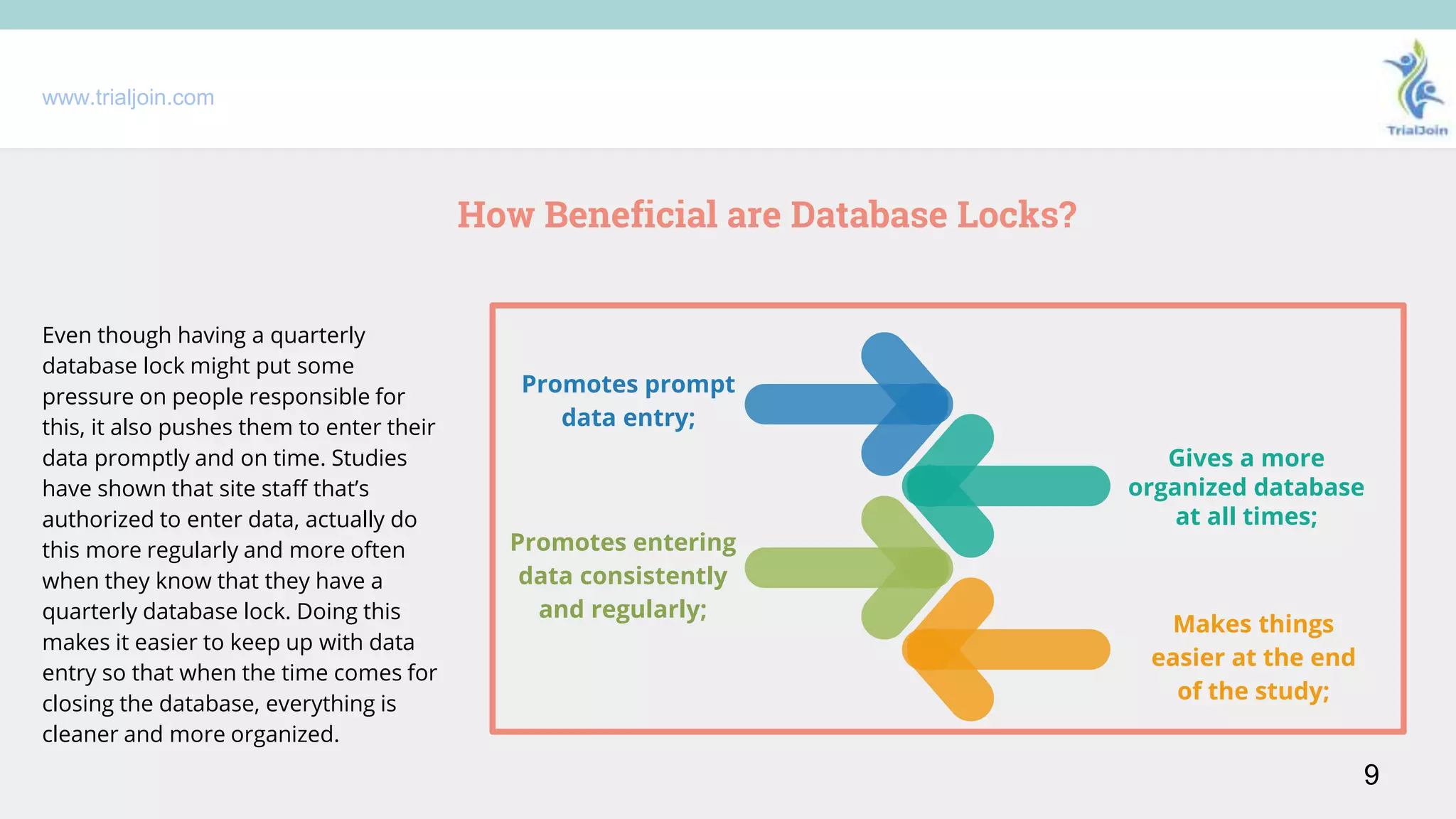
Gives a more
organized database
at all times;
Promotes prompt
data entry;
Makes things
easier at the end
of the study;
Promotes entering
data consistently
and regularly;
Even though having a quarterly
database lock might put some
pressure on people responsible for
this, it also pushes them to enter their
data promptly and on time. Studies
have shown that site staff that’s
authorized to enter data, actually do
this more regularly and more often
when they know that they have a
quarterly database lock. Doing this
makes it easier to keep up with data
entry so that when the time comes for
closing the database, everything is
cleaner and more organized.
www.trialjoin.com
Downsides of Database Locks
10
As we’ve mentioned before, the
frequency of database locks
(quarterly) can put pressure on
site staff. Knowing that
everything is supposed to be
clear and clean before the PI
signs and the database is locked
can be pretty hectic if it’s not
done on time.
Since everything in the database is
interconnected, answering one
query might rise 10 more, and then
answering those 10 will result with
20 more. This can be frustrating,
especially when it comes to
computer-generated queries.
Knowing that all queries have to be
answered before a database lock,
with both the sponsor and monitor
controlling your database, can be
pretty challenging.
More Pressure Answering Queries
www.trialjoin.com
CONCLUSION
Even though there are some small downsides of database locks, we can all agree that this is an important practice
that can keep in line many site activities. Database locks promote prompt and regular data entry at the site, and it
also gives sponsors the chance to assess the study sooner rather than later and decide if they think it’s worth it. In
any case, good preparation for data lockdown is crucial for an easier finalization. Not preparing well will cause a
last-minute chaos and confusion because it will be much harder to enter, sort out, and organize everything at
once.
11

Explaining the importance of a database lock in clinical research

  • 1.
    Explaining the Importance ofa Database Lock in Clinical Research
  • 2.
    Introduction One of themost crucial aspects of research is clinical data management or CDM. Proper CDM will generate results with excellent quality, integrity, and reliability. Quality data is essential in order to support the final conclusions of a certain study. The person responsible for this area of research is called a clinical data manager. This job position can be filled by a PI, a study coordinator, or a CRA. No matter who fills this position at your site, data management has to be done promptly and correctly in order to generate the best results. Aside from all the other reasons why data management is so important, it’s also what determines the future IP (investigational product) development. On the subject of clinical data, the most important term is ‘’database lock’’. Here, we’ll explain what a database lock is and explain you the purpose of this practice. How efficient is database lock and what are the benefits from it? 2
  • 3.
    What is a‘’database lock’’? www.trialjoin.com 3 Locking or closing a database is nowadays a crucial practice that is necessary in order to prevent unauthorized or unintentional changes after the final data entry, check-up, and analysis. 4 Prevents unauthorized/ unintentional changes; 3 2 1 PI signs all data, from the beginning until the end, which is then entered in eCRFs; Important in randomized blinded trials, to prove the integrity after breaking the blind; All trials are required to have a structured and well-defined process of closing their database
  • 4.
    Which are themost important steps to take before database lock? www.trialjoin.com 4 Make sure that all data have been received; All data have to be processed; Every single query is resolved; Any external data (such as laboratory) has been integrated with the main study database; Final quality audit check, to make sure that all data is present, correspondent, and accurate; Step 1 The crucial thing to remember about database locks is planning! Planning ahead of time, and while data is still fresh and new can make preparations a lot easier. This is especially true for trials with large volumes of data. If you don’t have a carefully-planned clinical data management plan, things can get pretty messy as the time for database lock approaches. Step 2 Step 3 Step 4 Step 5
  • 5.
    Which are themost important steps to take before database lock? www.trialjoin.com 5 And FINALLY: After the final check from the authorized person, the edit access of the study database will be removed and this removal date will be documented. This is the definitive point of the database lock!
  • 6.
    www.trialjoin.com Frequency of DatabaseLocks 6 While in the past, database locks were done at the end of a study, nowadays, database locks are usually done quarterly. This is one of the most common complaints of site staff because it puts too much pressure on everyone involved in data collecting and management. While this may look like a downside of database locks, it’s actually very beneficial for sponsors and people who invest in these studies. The reason why they do quarterly locks now is to evaluate and analyze the data, and then decide if the study is worth to continue. In some cases, the investigational drug will show to not be effective at all, while in others the drug might cause many serious adverse events. When this happens, the quarterly database lock allows sponsors to analyze the situation and decide if they want to continue the study and invest more resources or if they want to end it. The option of having quarterly database locks was not technologically possible and available in the past because of the use of paper CRF. However, today, with the use of eCRF (electronic case report forms), sponsors have this option that can save unnecessary time and money.
  • 7.
    Frequency of DatabaseLocks www.trialjoin.com 7 Jan Feb Mar Apr May Jun Jul Aug Sep Oct Nov Dec In the past, without technology - only once at the end of the study: Beginning of Study Database Lock
  • 8.
    Frequency of DatabaseLocks www.trialjoin.com 8 Jan Feb Mar Apr May Jun Jul Aug Sep Oct Nov Dec Nowadays - quarterly: Beginning of Study/ Database Lock Database Lock Database Lock Database Lock
  • 9.
    www.trialjoin.com How Beneficial areDatabase Locks? 9 Gives a more organized database at all times; Promotes prompt data entry; Makes things easier at the end of the study; Promotes entering data consistently and regularly; Even though having a quarterly database lock might put some pressure on people responsible for this, it also pushes them to enter their data promptly and on time. Studies have shown that site staff that’s authorized to enter data, actually do this more regularly and more often when they know that they have a quarterly database lock. Doing this makes it easier to keep up with data entry so that when the time comes for closing the database, everything is cleaner and more organized.
  • 10.
    www.trialjoin.com Downsides of DatabaseLocks 10 As we’ve mentioned before, the frequency of database locks (quarterly) can put pressure on site staff. Knowing that everything is supposed to be clear and clean before the PI signs and the database is locked can be pretty hectic if it’s not done on time. Since everything in the database is interconnected, answering one query might rise 10 more, and then answering those 10 will result with 20 more. This can be frustrating, especially when it comes to computer-generated queries. Knowing that all queries have to be answered before a database lock, with both the sponsor and monitor controlling your database, can be pretty challenging. More Pressure Answering Queries
  • 11.
    www.trialjoin.com CONCLUSION Even though thereare some small downsides of database locks, we can all agree that this is an important practice that can keep in line many site activities. Database locks promote prompt and regular data entry at the site, and it also gives sponsors the chance to assess the study sooner rather than later and decide if they think it’s worth it. In any case, good preparation for data lockdown is crucial for an easier finalization. Not preparing well will cause a last-minute chaos and confusion because it will be much harder to enter, sort out, and organize everything at once. 11