Introduction To Data Communication
Data Communications
 Data communications are the exchange of data
between two devices via some form of
transmission medium such as a wire cable.
 Characteristics:
 The effectiveness of a data communications system
depends on four fundamental characteristics:
 Delivery:
 Accuracy:
 Timeliness
 Jitter:
Data Communications - Characteristics
 Delivery:
 The system must deliver data to the correct destination. Data must be
received by the intended device or user and only by that device or user.
 Accuracy:
 The system must deliver data accurately.
 Timeliness
 The system must deliver data in a timely manner. In the case of video and
audio, timely delivery means delivering the data as they are produced. In
the same order, that they are produced, and without significant delay. This
kind of delivery is called real-time transmission.
 Jitter:
 Jitter refers to the variation in the packet arrival time. It is the uneven
delay in the delivery of audio or video packet.
Components: A data communication system has five components
 Message:
 The message is the information to be communicated. Popular
forms of information include text, numbers, pictures audio and
video.
 Sender:
 The sender is the device that sends the data message. It can be a
computer, workstation, telephone handset, video camera, and so
on.
 Receiver:
 The receiver is the device that receives the message. It can be a
computer, workstation, telephone handset, television and so on.
Components: A data communication system has five components
 Transmission medium:
 The transmission medium is the physical path by which a message
travels from sender to receiver. Ex. Twisted pair wire, coaxial
cable, fiber optic cable and radio waves.
 Protocol:
 A protocol is the set of rules that governs data
communications. It represents an agreement between the
communicating devices.
Data Representation:
 Information today comes in different forms such as text,
numbers, images, audio, and Video.
 Text:
 Text is represented as a bit pattern, a sequence of bits (Os or 1s).
Different sets of bit patterns have been designed to represent text
symbols. Each set is called a code, and the process of representing
symbols is called coding.
 Numbers:
 Numbers are also represented by bit patterns. The number is
directly converted to a binary number to simplify mathematical
operations.
Data Representation:
 Images:
 Images are also represented by bit patterns. An image is composed
of a matrix of pixels (picture elements), where each pixel is a
small dot. The size of the pixel depends on the resolution.
 Audio:
 Audio refers to the recording or broadcasting of sound or music. It
is continuous, not discrete.
 Video:
 Video refers to the recording or broadcasting of a picture or
movie. Video can either be produced as a continuous entity (e.g.,
by a TV camera), or it can be a combination of images, each a
discrete entity, arranged to convey the idea of motion.
Data Flow:
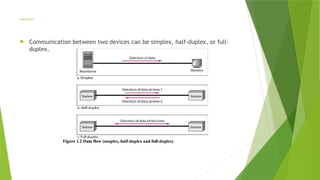
 Communication between two devices can be simplex, half-duplex, or full-
duplex.
Transmission Modes in Computer Networks
 Transmission mode refers to the mechanism of transferring
of data between two devices connected over a network.
 It is also called Communication Mode.
 These modes direct the direction of flow of information.
There are three types of transmission modes.
 They are:
 Simplex Mode
 Half duplex Mode
 Full duplex Mode
Simplex Mode
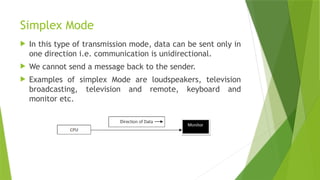
 In this type of transmission mode, data can be sent only in
one direction i.e. communication is unidirectional.
 We cannot send a message back to the sender.
 Examples of simplex Mode are loudspeakers, television
broadcasting, television and remote, keyboard and
monitor etc.
Half duplex Mode
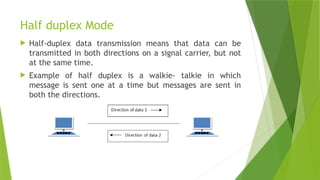
 Half-duplex data transmission means that data can be
transmitted in both directions on a signal carrier, but not
at the same time.
 Example of half duplex is a walkie- talkie in which
message is sent one at a time but messages are sent in
both the directions.
Full duplex Mode
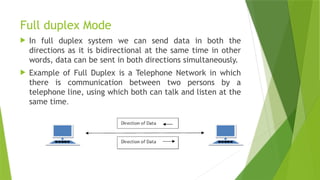
 In full duplex system we can send data in both the
directions as it is bidirectional at the same time in other
words, data can be sent in both directions simultaneously.
 Example of Full Duplex is a Telephone Network in which
there is communication between two persons by a
telephone line, using which both can talk and listen at the
same time.
Network Criteria
 A network must be able to meet a certain number of criteria. The
most important of these are
 Performance
 Reliability
 Security
 Performance: Performance can be measured in many ways, including
transit time and response time.
 Transit time is the amount of time required for a message to travel from
one device to another.
 Response time is the elapsed time between an inquiry and a response.
Network Criteria
 The performance of a network depends on a number of
factors, including the number of users, the type of
transmission medium, the capabilities of the connected
hardware, and the efficiency of the software.
 Reliability: In addition to accuracy of delivery, network
reliability is measured by the frequency of failure, the time
it takes a link to recover from a failure, and the network's
robustness in a disaster.
 Security: Network security issues include protecting data
from unauthorized access, protecting data from damage and
development, and implementing policies and procedures for
recovery from breaches and data losses.

Computer+Networks+-+Data+Communation.pptx

  • 1.
    Introduction To DataCommunication
  • 2.
    Data Communications  Datacommunications are the exchange of data between two devices via some form of transmission medium such as a wire cable.  Characteristics:  The effectiveness of a data communications system depends on four fundamental characteristics:  Delivery:  Accuracy:  Timeliness  Jitter:
  • 3.
    Data Communications -Characteristics  Delivery:  The system must deliver data to the correct destination. Data must be received by the intended device or user and only by that device or user.  Accuracy:  The system must deliver data accurately.  Timeliness  The system must deliver data in a timely manner. In the case of video and audio, timely delivery means delivering the data as they are produced. In the same order, that they are produced, and without significant delay. This kind of delivery is called real-time transmission.  Jitter:  Jitter refers to the variation in the packet arrival time. It is the uneven delay in the delivery of audio or video packet.
  • 4.
    Components: A datacommunication system has five components  Message:  The message is the information to be communicated. Popular forms of information include text, numbers, pictures audio and video.  Sender:  The sender is the device that sends the data message. It can be a computer, workstation, telephone handset, video camera, and so on.  Receiver:  The receiver is the device that receives the message. It can be a computer, workstation, telephone handset, television and so on.
  • 5.
    Components: A datacommunication system has five components  Transmission medium:  The transmission medium is the physical path by which a message travels from sender to receiver. Ex. Twisted pair wire, coaxial cable, fiber optic cable and radio waves.  Protocol:  A protocol is the set of rules that governs data communications. It represents an agreement between the communicating devices.
  • 6.
    Data Representation:  Informationtoday comes in different forms such as text, numbers, images, audio, and Video.  Text:  Text is represented as a bit pattern, a sequence of bits (Os or 1s). Different sets of bit patterns have been designed to represent text symbols. Each set is called a code, and the process of representing symbols is called coding.  Numbers:  Numbers are also represented by bit patterns. The number is directly converted to a binary number to simplify mathematical operations.
  • 7.
    Data Representation:  Images: Images are also represented by bit patterns. An image is composed of a matrix of pixels (picture elements), where each pixel is a small dot. The size of the pixel depends on the resolution.  Audio:  Audio refers to the recording or broadcasting of sound or music. It is continuous, not discrete.  Video:  Video refers to the recording or broadcasting of a picture or movie. Video can either be produced as a continuous entity (e.g., by a TV camera), or it can be a combination of images, each a discrete entity, arranged to convey the idea of motion.
  • 8.
    Data Flow:  Communicationbetween two devices can be simplex, half-duplex, or full- duplex.
  • 9.
    Transmission Modes inComputer Networks  Transmission mode refers to the mechanism of transferring of data between two devices connected over a network.  It is also called Communication Mode.  These modes direct the direction of flow of information. There are three types of transmission modes.  They are:  Simplex Mode  Half duplex Mode  Full duplex Mode
  • 10.
    Simplex Mode  Inthis type of transmission mode, data can be sent only in one direction i.e. communication is unidirectional.  We cannot send a message back to the sender.  Examples of simplex Mode are loudspeakers, television broadcasting, television and remote, keyboard and monitor etc.
  • 11.
    Half duplex Mode Half-duplex data transmission means that data can be transmitted in both directions on a signal carrier, but not at the same time.  Example of half duplex is a walkie- talkie in which message is sent one at a time but messages are sent in both the directions.
  • 12.
    Full duplex Mode In full duplex system we can send data in both the directions as it is bidirectional at the same time in other words, data can be sent in both directions simultaneously.  Example of Full Duplex is a Telephone Network in which there is communication between two persons by a telephone line, using which both can talk and listen at the same time.
  • 13.
    Network Criteria  Anetwork must be able to meet a certain number of criteria. The most important of these are  Performance  Reliability  Security  Performance: Performance can be measured in many ways, including transit time and response time.  Transit time is the amount of time required for a message to travel from one device to another.  Response time is the elapsed time between an inquiry and a response.
  • 14.
    Network Criteria  Theperformance of a network depends on a number of factors, including the number of users, the type of transmission medium, the capabilities of the connected hardware, and the efficiency of the software.  Reliability: In addition to accuracy of delivery, network reliability is measured by the frequency of failure, the time it takes a link to recover from a failure, and the network's robustness in a disaster.  Security: Network security issues include protecting data from unauthorized access, protecting data from damage and development, and implementing policies and procedures for recovery from breaches and data losses.