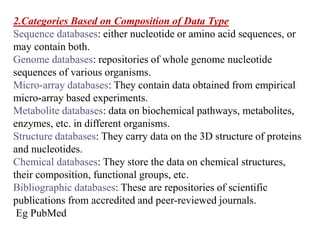
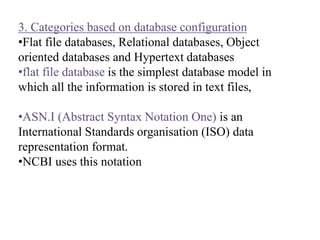
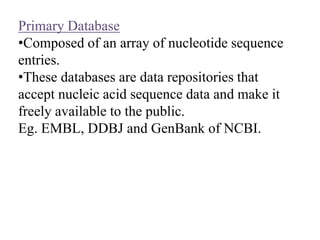
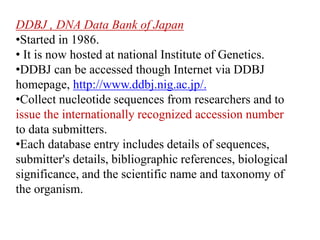
This document discusses biological databases. It notes that biological databases store vast amounts of biological data generated every day, including nucleotide sequences, protein sequences, pathways, and bibliographic information. It describes different types of biological databases, including primary databases that store original data, secondary databases that derive patterns from primary data, and composite databases that amalgamate multiple sources. It provides examples like GenBank, UniProt, KEGG, and PubMed. It also discusses how databases are organized, searched, and tools used like BLAST and FASTA.