
LOGO
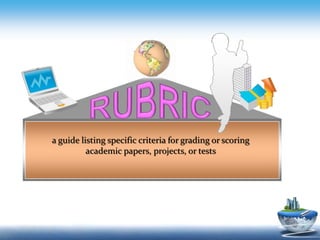
a guide listing specific criteria for grading or scoring
academic papers, projects, or tests
Type of Rubrics
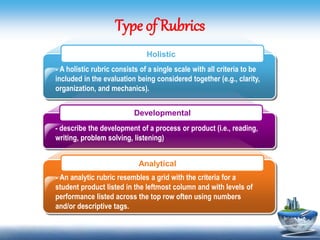
- A holistic rubric consists of a single scale with all criteria to be
included in the evaluation being considered together (e.g., clarity,
organization, and mechanics).
- describe the development of a process or product (i.e., reading,
writing, problem solving, listening)
- An analytic rubric resembles a grid with the criteria for a
student product listed in the leftmost column and with levels of
performance listed across the top row often using numbers
and/or descriptive tags.
Holistic
Developmental
Analytical
Type of Rubrics
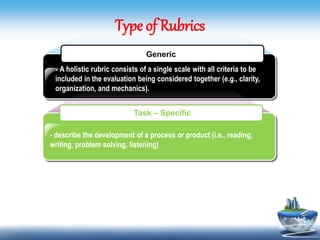
- A holistic rubric consists of a single scale with all criteria to be
included in the evaluation being considered together (e.g., clarity,
organization, and mechanics).
- describe the development of a process or product (i.e., reading,
writing, problem solving, listening)
Generic
Task – Specific
HolisticRubrics Sample
• Describe a product or performance as a whole
• Rely on multiple descriptors
• Are limited in value in terms of providing precise diagnostic information
• May cause more scoring dilemmas
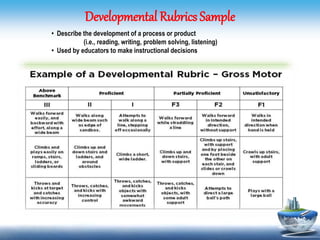
Developmental Rubrics Sample
• Describe the development of a process or product
(i.e., reading, writing, problem solving, listening)
• Used by educators to make instructional decisions
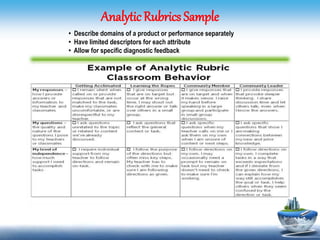
Analytic Rubrics Sample
• Describe domains of a product or performance separately
• Have limited descriptors for each attribute
• Allow for specific diagnostic feedback
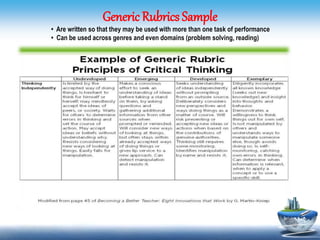
Generic Rubrics Sample
• Are written so that they may be used with more than one task of performance
• Can be used across genres and even domains (problem solving, reading)
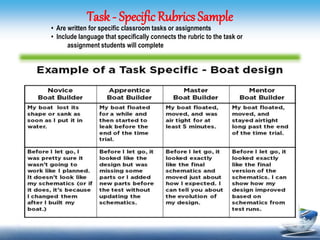
Task - Specific Rubrics Sample
• Are written for specific classroom tasks or assignments
• Include language that specifically connects the rubric to the task or
assignment students will complete
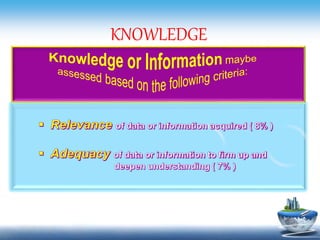
KNOWLEDGE
KNOWLEDGE
Relevance of data/information acquired
Data/information acquired are completely relevant to
the development of understanding.
8 %
8 %
Data/information acquired are to a great extent
relevant to the development of
understanding.
6 - 7 %
Data/information acquired are
to the development of
understanding.
4 - 5 %
Data/information are
to the development of understanding.
2 - 3 %
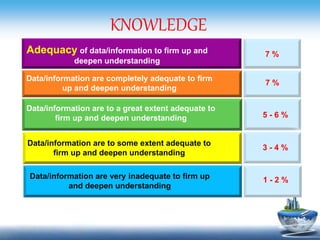
KNOWLEDGE
Adequacy of data/information to firm up and
deepen understanding
Data/information are completely adequate to firm
up and deepen understanding
7 %
7 %
5 - 6 %
3 - 4 %
1 - 2 %
Data/information are to a great extent adequate to
firm up and deepen understanding
Data/information are to some extent adequate to
firm up and deepen understanding
Data/information are very inadequate to firm up
and deepen understanding
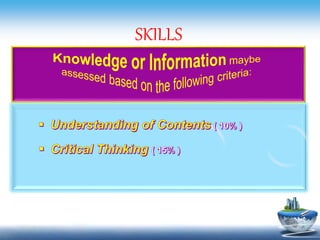
SKILLS
SKILLS
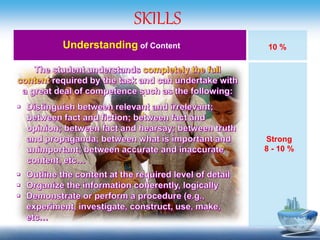
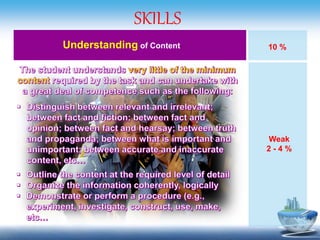
Understanding of Content 10 %
Strong
8 - 10 %
SKILLS
Understanding of Content 10 %
Developing
5 - 7 %
SKILLS
Understanding of Content 10 %
Weak
2 - 4 %
SKILLS
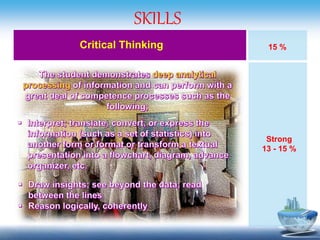
Critical Thinking 15 %
Strong
13 - 15 %
SKILLS
Critical Thinking 15 %
Moderately
Strong
10 - 12 %
SKILLS
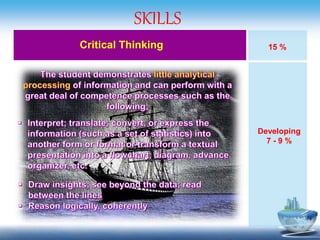
Critical Thinking 15 %
Developing
7 - 9 %
SKILLS
Critical Thinking 15 %
Weak
4 - 6 %
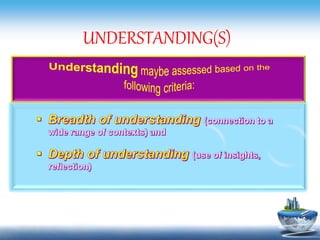
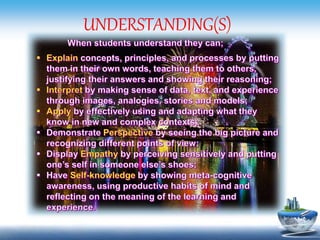
UNDERSTANDING(S)
UNDERSTANDING(S)
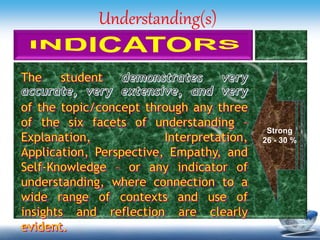
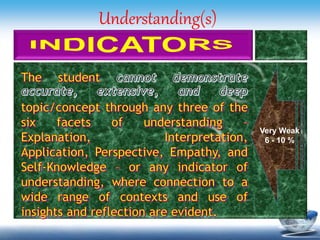
Understanding(s)
Strong
26 - 30 %
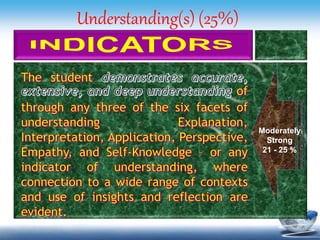
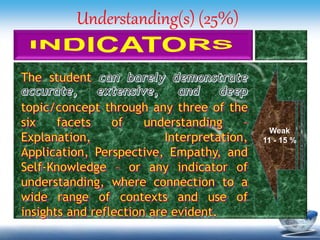
Understanding(s) (25%)
Moderately
Strong
21 - 25 %
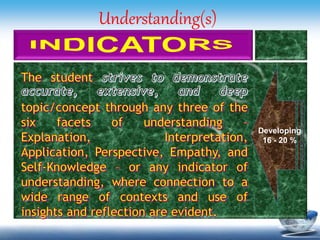
Understanding(s)
Developing
16 - 20 %
Understanding(s) (25%)
Weak
11 - 15 %
Understanding(s)
Very Weak
6 - 10 %
Transfer of Understanding
Strong
26 - 30 %
Transfer of Understanding (30%)
Moderately
Strong
21 - 25 %
Transfer of Understanding
Developing
16 - 20 %
Transfer of Understanding (30%)
Weak
11 - 15 %
Transfer of Understanding
Weak
11 - 15 %
LOGO

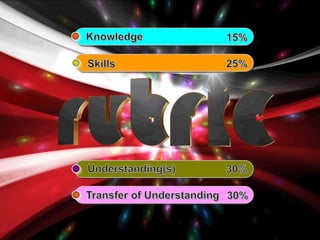
Rubrics