DR SHARMISTHA CHAKRAVARTY
DEPT OF ZOOLOGY
BARNAGAR COLLEGE,SORBHOG
ASSAM
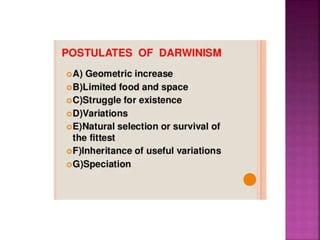
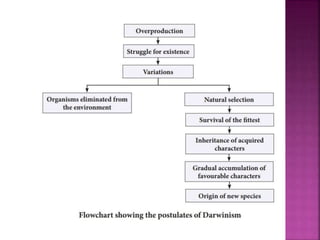
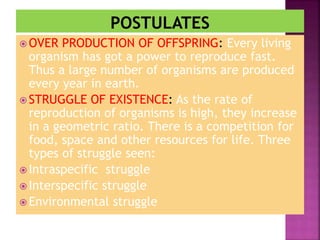
 OVER PRODUCTION OF OFFSPRING: Every living
organism has got a power to reproduce fast.
Thus a large number of organisms are produced
every year in earth.
 STRUGGLE OF EXISTENCE: As the rate of
reproduction of organisms is high, they increase
in a geometric ratio. There is a competition for
food, space and other resources for life. Three
types of struggle seen:
 Intraspecific struggle
 Interspecific struggle
 Environmental struggle
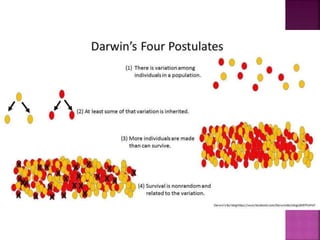
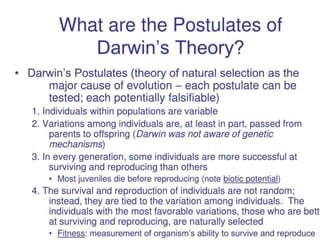
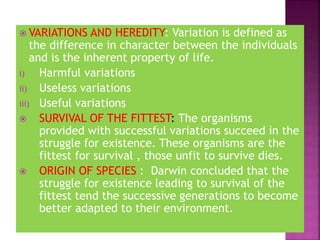
 VARIATIONS AND HEREDITY: Variation is defined as
the difference in character between the individuals
and is the inherent property of life.
i) Harmful variations
ii) Useless variations
iii) Useful variations
 SURVIVAL OF THE FITTEST: The organisms
provided with successful variations succeed in the
struggle for existence. These organisms are the
fittest for survival , those unfit to survive dies.
 ORIGIN OF SPECIES : Darwin concluded that the
struggle for existence leading to survival of the
fittest tend the successive generations to become
better adapted to their environment.
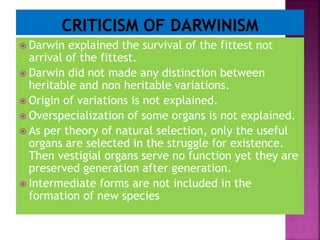
 Darwin explained the survival of the fittest not
arrival of the fittest.
 Darwin did not made any distinction between
heritable and non heritable variations.
 Origin of variations is not explained.
 Overspecialization of some organs is not explained.
 As per theory of natural selection, only the useful
organs are selected in the struggle for existence.
Then vestigial organs serve no function yet they are
preserved generation after generation.
 Intermediate forms are not included in the
formation of new species
 Origin of variations: As it was the main objection of
Darwinism that it could not explain the origin of
variation. Variations are formed due to following
processes:
i) Mutation
ii) Recombination
iii) Migration
iv) Non random mating
v) Hybridization
vi) Genetic drift
 Inheritance of variations: This was explained
by Germplasm theory proposed by August
Weismann in 1904
 Natural selection: It is responsible for maintaining
constancy of a species, as well as changing it. It
maintains constancy as long as environment remains
stable but promotes formation of new species when
environment changes.
 Isolation: Speciation occurs due to isolation of sub
groups of a population having different genotypes.
 Industrial melanism in peppered moth:
industrial melanism is a phenomenon where
the moths living in industrial areas develop
black color to match the body to soot
covered background on the bark of trees
 Weldon expt with shore crabs
 Antibiotic resistance in bacteria
 Pesticide resistance
 Survival of Galapagos finches
 Decline of male peacock with less impressive
tails
 Malaria resistance in human

Darwinism and Neo Darwinism

  • 1.
    DR SHARMISTHA CHAKRAVARTY DEPTOF ZOOLOGY BARNAGAR COLLEGE,SORBHOG ASSAM
  • 7.
     OVER PRODUCTIONOF OFFSPRING: Every living organism has got a power to reproduce fast. Thus a large number of organisms are produced every year in earth.  STRUGGLE OF EXISTENCE: As the rate of reproduction of organisms is high, they increase in a geometric ratio. There is a competition for food, space and other resources for life. Three types of struggle seen:  Intraspecific struggle  Interspecific struggle  Environmental struggle
  • 8.
     VARIATIONS ANDHEREDITY: Variation is defined as the difference in character between the individuals and is the inherent property of life. i) Harmful variations ii) Useless variations iii) Useful variations  SURVIVAL OF THE FITTEST: The organisms provided with successful variations succeed in the struggle for existence. These organisms are the fittest for survival , those unfit to survive dies.  ORIGIN OF SPECIES : Darwin concluded that the struggle for existence leading to survival of the fittest tend the successive generations to become better adapted to their environment.
  • 9.
     Darwin explainedthe survival of the fittest not arrival of the fittest.  Darwin did not made any distinction between heritable and non heritable variations.  Origin of variations is not explained.  Overspecialization of some organs is not explained.  As per theory of natural selection, only the useful organs are selected in the struggle for existence. Then vestigial organs serve no function yet they are preserved generation after generation.  Intermediate forms are not included in the formation of new species
  • 12.
     Origin ofvariations: As it was the main objection of Darwinism that it could not explain the origin of variation. Variations are formed due to following processes: i) Mutation ii) Recombination iii) Migration iv) Non random mating v) Hybridization vi) Genetic drift  Inheritance of variations: This was explained by Germplasm theory proposed by August Weismann in 1904
  • 13.
     Natural selection:It is responsible for maintaining constancy of a species, as well as changing it. It maintains constancy as long as environment remains stable but promotes formation of new species when environment changes.  Isolation: Speciation occurs due to isolation of sub groups of a population having different genotypes.
  • 14.
     Industrial melanismin peppered moth: industrial melanism is a phenomenon where the moths living in industrial areas develop black color to match the body to soot covered background on the bark of trees  Weldon expt with shore crabs  Antibiotic resistance in bacteria  Pesticide resistance  Survival of Galapagos finches  Decline of male peacock with less impressive tails  Malaria resistance in human