Virendra Kumar
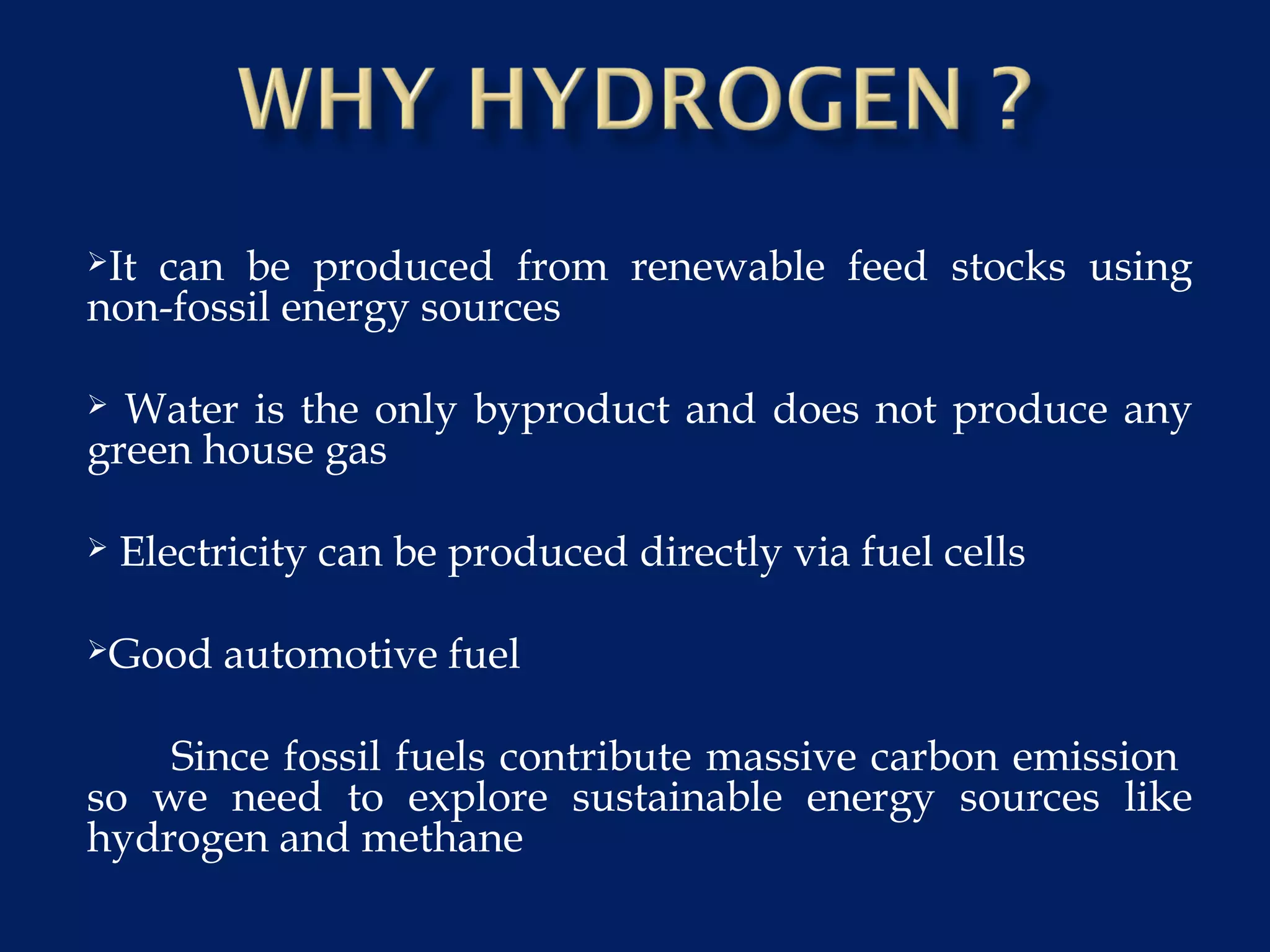
It can be produced from renewable feed stocks using
non-fossil energy sources
 Water is the only byproduct and does not produce any
green house gas
 Electricity can be produced directly via fuel cells
Good automotive fuel
Since fossil fuels contribute massive carbon emission
so we need to explore sustainable energy sources like
hydrogen and methane
Fuel type Energy/unit
mass, MJ/Kg
Energy /Vol
MJ/l
Carbon
emission
Kg C/Kg fuel
Hydrogen gas 120 2 0
Hydrogen liquid 120 8.5 0
Coal(anthracite) 15-19 - 0.5
Natural gas 33-50 9 0.46
Diesel 42.8 35 0.9
Biodiesel 37 33 0.5
Ethanol 21 23 0.5
Bossel et al. 2003
Hydrogen Production Processes
Physico chemical Process
Steam reforming of light HCs
Partial oxidation/Gasification
of heavier HCs/Coal
Thermal Cracking of Natural gas
Electrolysis of water
Biological Process
Bio photolysis
of water
(Direct/Indirect)
Photo fermentation
Dark fermentation
Integration of dark
fermentation with
photo fermentation
Most of the hydrogen is produced from hydrocarbon about 95%,
followed by electrolysis of water 4%, and only 1% is produced from
biomass through biological processes
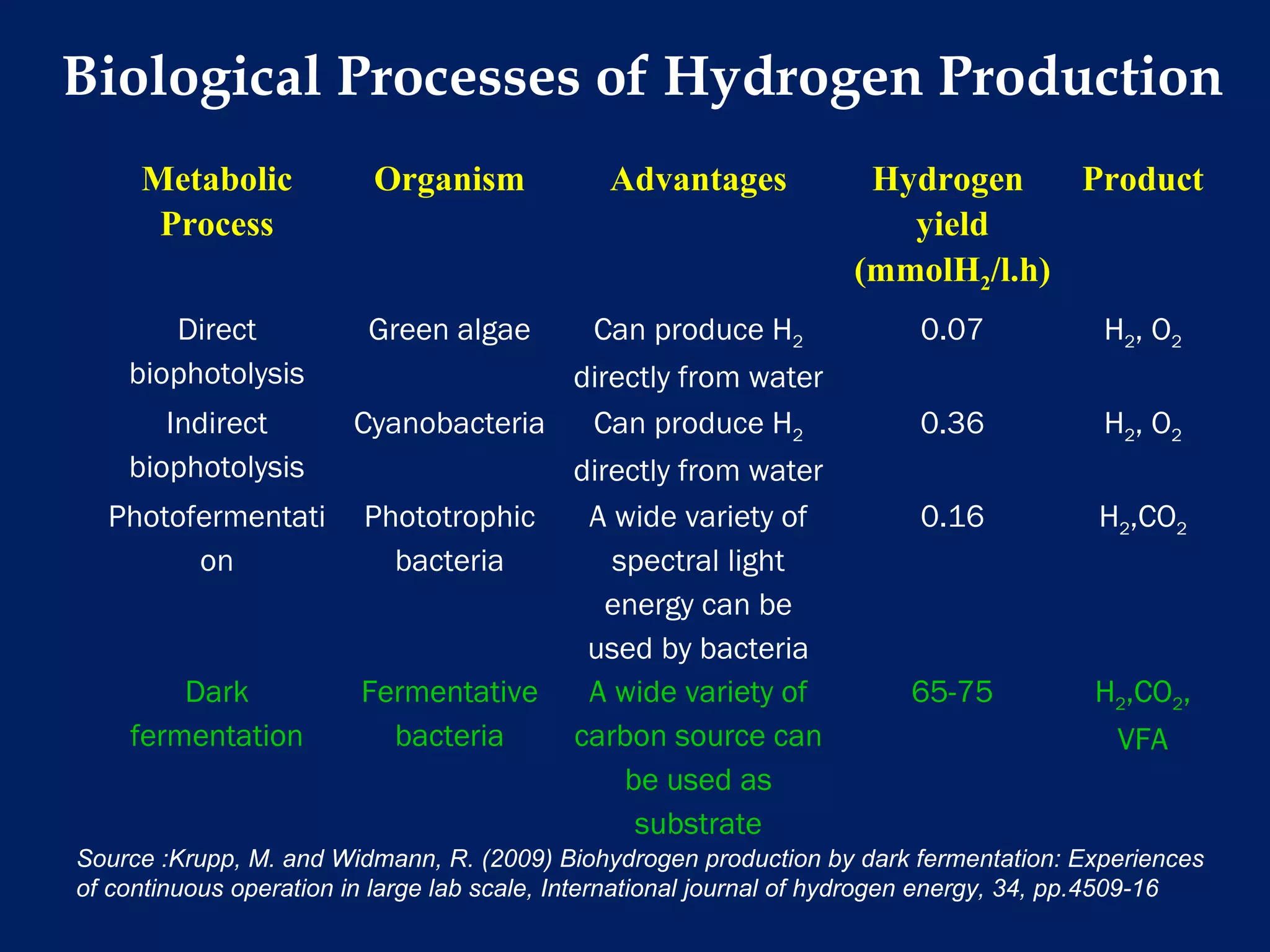
Metabolic
Process
Organism Advantages Hydrogen
yield
(mmolH2/l.h)
Product
Direct
biophotolysis
Green algae Can produce H2
directly from water
0.07 H2, O2
Indirect
biophotolysis
Cyanobacteria Can produce H2
directly from water
0.36 H2, O2
Photofermentati
on
Phototrophic
bacteria
A wide variety of
spectral light
energy can be
used by bacteria
0.16 H2,CO2
Dark
fermentation
Fermentative
bacteria
A wide variety of
carbon source can
be used as
substrate
65-75 H2,CO2,
VFA
Biological Processes of Hydrogen Production
Source :Krupp, M. and Widmann, R. (2009) Biohydrogen production by dark fermentation: Experiences
of continuous operation in large lab scale, International journal of hydrogen energy, 34, pp.4509-16
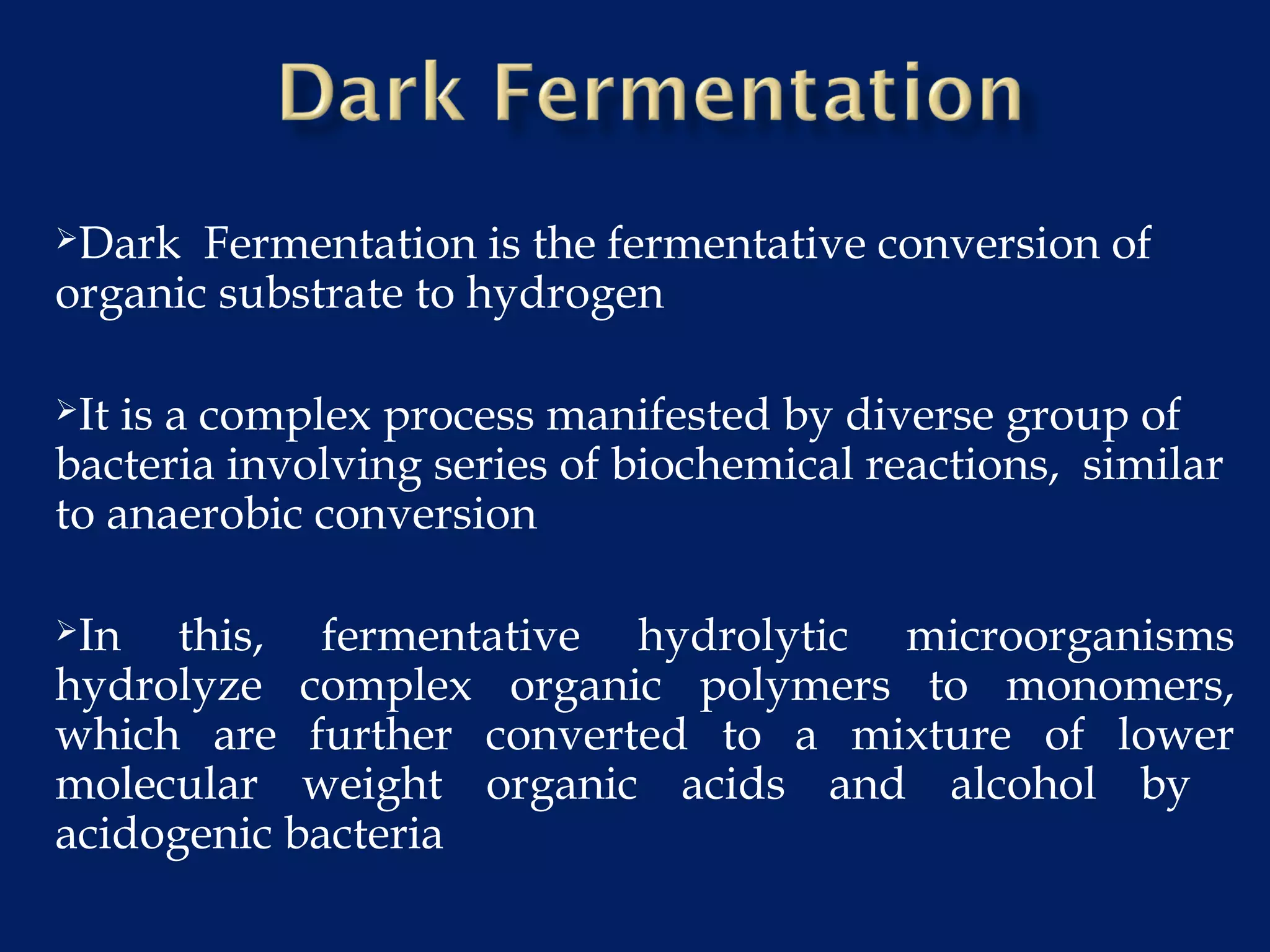
Dark Fermentation is the fermentative conversion of
organic substrate to hydrogen
It is a complex process manifested by diverse group of
bacteria involving series of biochemical reactions, similar
to anaerobic conversion
In this, fermentative hydrolytic microorganisms
hydrolyze complex organic polymers to monomers,
which are further converted to a mixture of lower
molecular weight organic acids and alcohol by
acidogenic bacteria
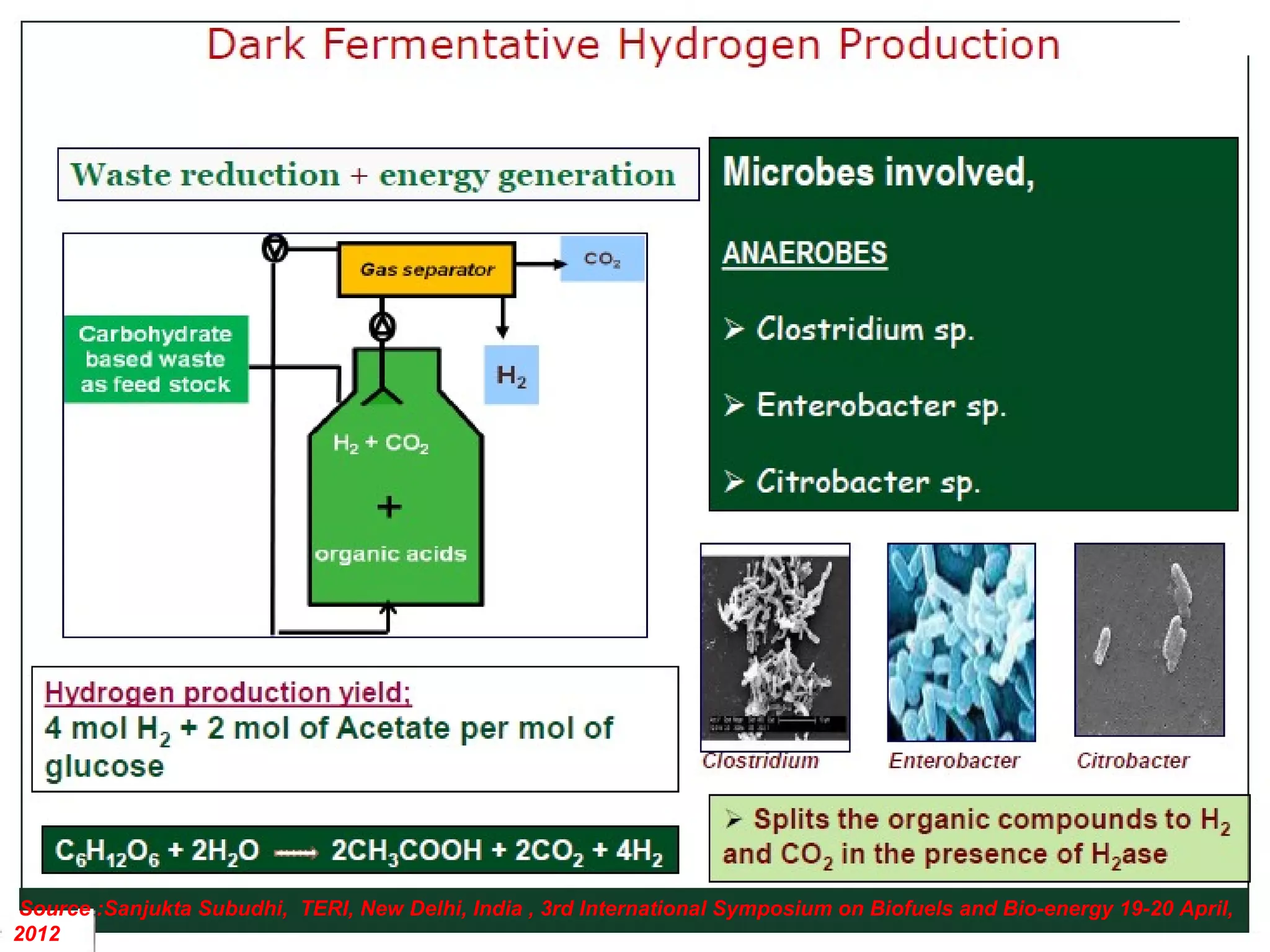
Source :Sanjukta Subudhi, TERI, New Delhi, India , 3rd International Symposium on Biofuels and Bio-energy 19-20 April,
2012
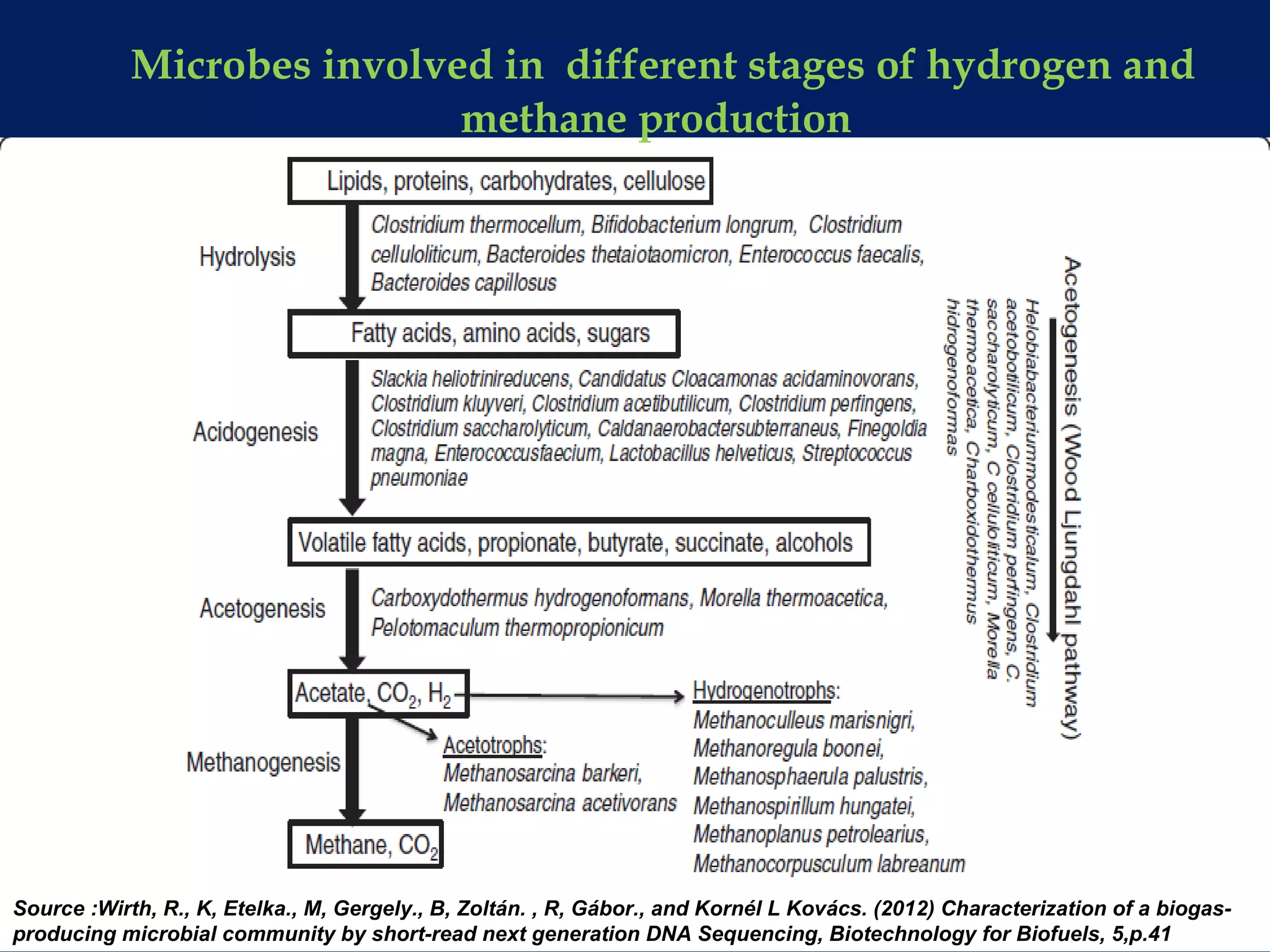
Hydrogen producing Bacteria – These includes class
Clostridia - e.g. C. thermocellum, C. acetobutylicum
Bacilli- e.g. B. thuringiensis, Enterobacter faecium
Bacteriode- e.g. Bacteriodes capillosus
Mollicutes- e.g. Acholeplasma laidlawi
Gammaproteobacteria - e.g. Escherichia coli
Actinobacteria - e.g. Slackla heliotrinireducens
Methane producing Bacteria- These mostly belong to
class Archaea such as
Methanosorcina barkeri, Methanosorcina activorans are some
methanotrophs and Methanoculleus marinsnigri ,
Methanoregula boonei are some hydrogenotrophs
Microbes involved in different stages of hydrogen and
methane production
Source :Wirth, R., K, Etelka., M, Gergely., B, Zoltán. , R, Gábor., and Kornél L Kovács. (2012) Characterization of a biogas-
producing microbial community by short-read next generation DNA Sequencing, Biotechnology for Biofuels, 5,p.41
Industrial Waste Agricultural waste Others
Dairy industry Corn straw Synthetic waste
water
Distillery
effluent
Wheat straw Sewage waste
water and sludge
Food processing
waste water
Rice bran Food Waste
Sugar industry
(Press mud
Bagasse &
molasses )
Grass silage Kitchen waste
Substrates used in Dark fermentation
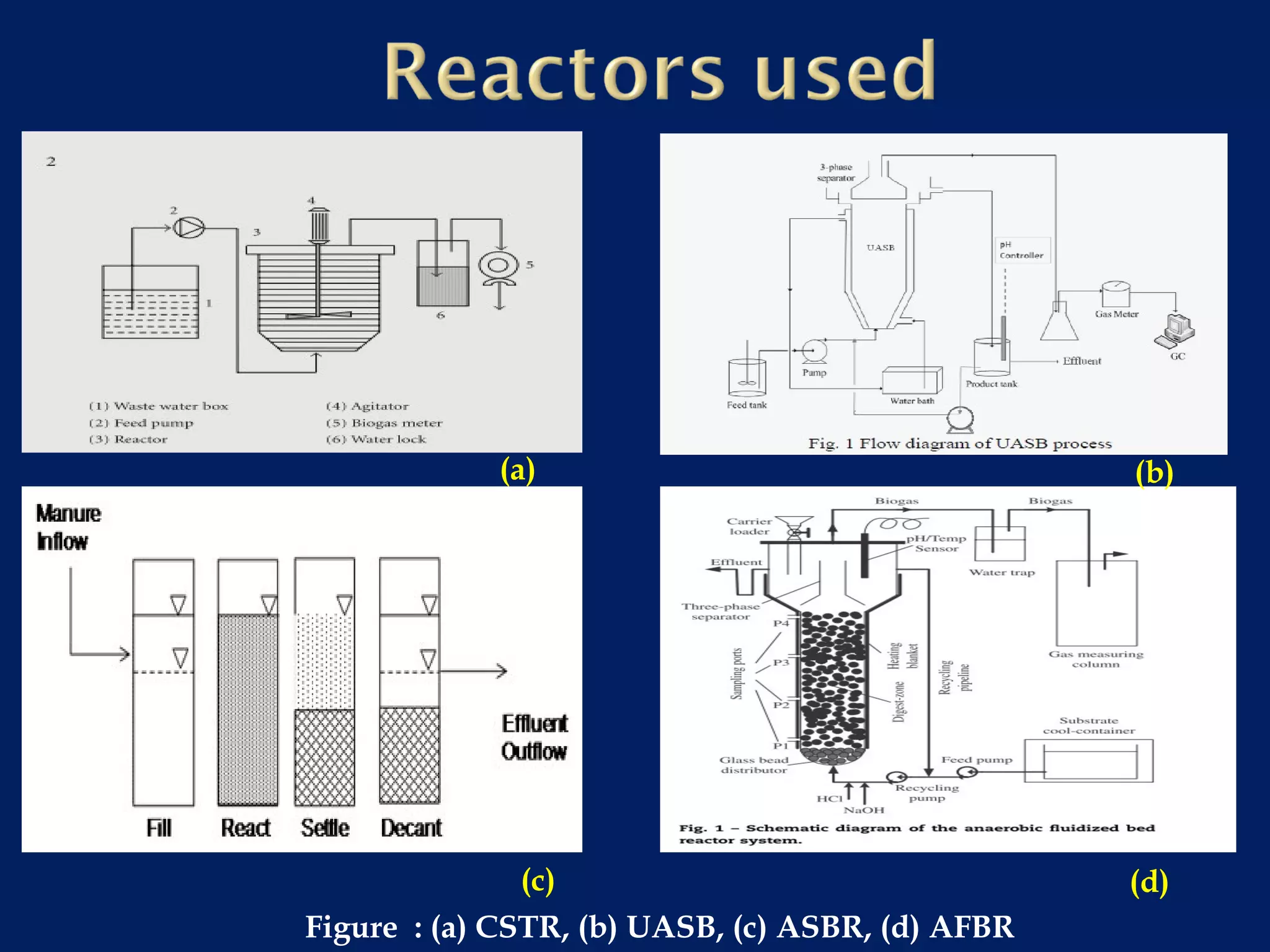
(a)
(c)
(b)
(d)
Figure : (a) CSTR, (b) UASB, (c) ASBR, (d) AFBR
Reactor Type Yield mol/mol References
UASB 1.62 Zhao et al. 2008
CSTR 1.84 Show et al. 2007
AFBR 0.4 -1.7 Zhnag et al. 2008
ASBR 0.01-1.0mmol/g
COD
V. Mohan et al 2007
Biohydrogen Yield from different reactors
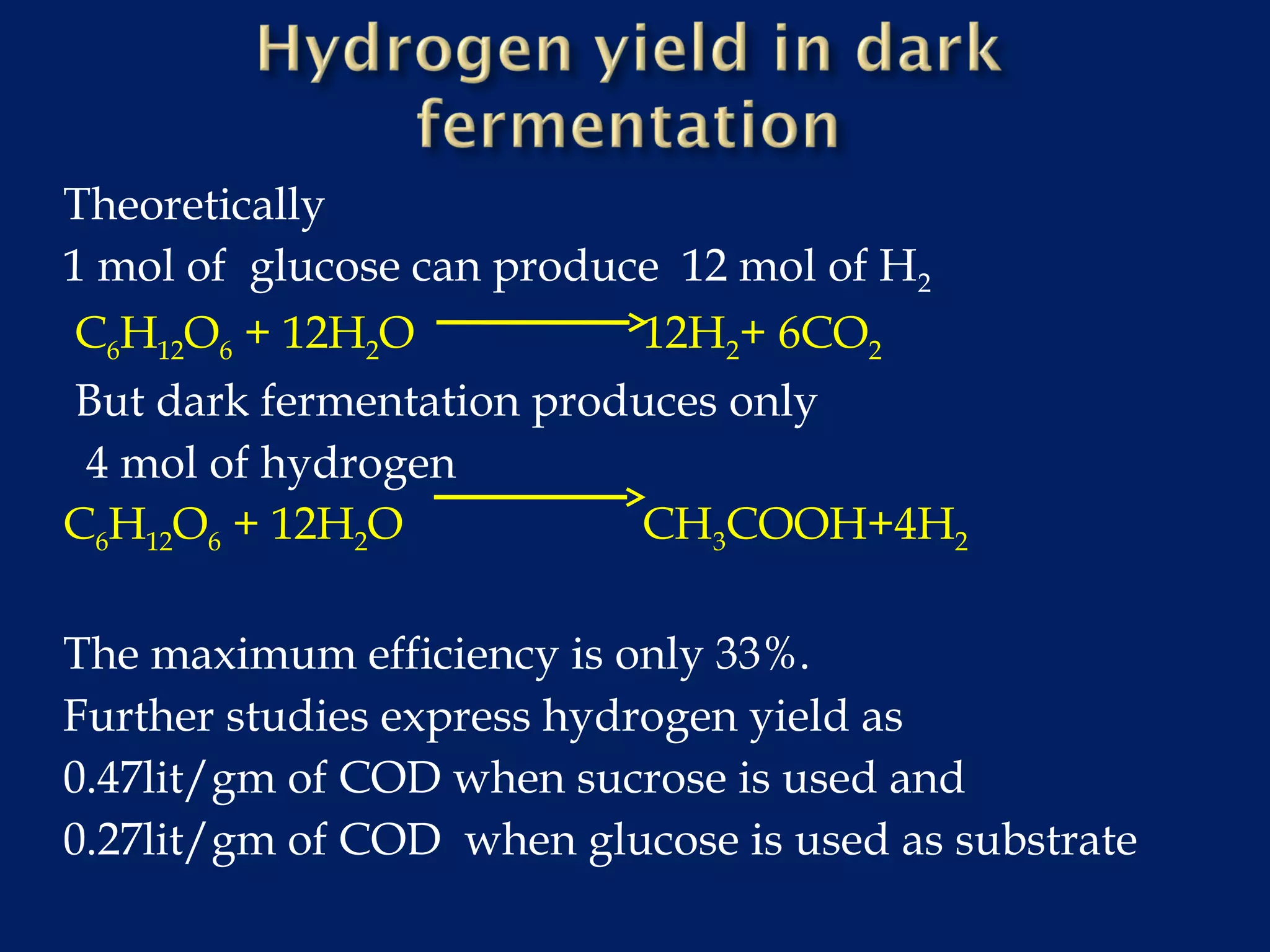
Theoretically
1 mol of glucose can produce 12 mol of H2
C6H12O6 + 12H2O 12H2+ 6CO2
But dark fermentation produces only
4 mol of hydrogen
C6H12O6 + 12H2O CH3COOH+4H2
The maximum efficiency is only 33%.
Further studies express hydrogen yield as
0.47lit/gm of COD when sucrose is used and
0.27lit/gm of COD when glucose is used as substrate
The solute of the dark fermentation contains 60-70%
organic acids such as acetate, butyrate, ethanol etc.
These substrate can be converted to methane
2CH3COOH 2CH4 + 2CO2
Integration of dark fermentation followed by methane production
Process Specific yield COD removal
efficiency
Acidogenic Process 16.23 mol H2/kg COD 21.43 kg COD/m3
Methanogenic Process 2.67 mol CH4/kg COD 50.18 kg COD/m3
Source: S. V. Mohan G. Mohankrishna, P. N Sharma (2008). Integration of acidogenic and methanogenic process for
simultaneous production of biohydrogen and methane from waste water, International Journal of Hydrogen Energy ,33pp .
2156-2166
 Reduction of waste is enhanced along with the
production of hydrogen and methane
 Inherently more stable
 Ecofriendly, Low-tech, Low capital cost and does not
require inputs of more energy
 Produces valuable metabolites like acetic, butyric and
lactic acid
 High rate of H2 evolution
 
 Aceves-Lara, C., Latrille, E., Bernet, N., Buffiere, P., and Steyer, J. (2008) A pseudo-stoichiometric dynamic
model of anaerobic hydrogen production from molasses. Water Research,42, (10), pp.2539-2550.
 Das, D., Veziroglu T.N. (2001) Hydrogen production by biological processes: a survey of literature, International
Journal of Hydrogen Energy, 26, pp.13–28.
 Fan, Y., Zhang, Y., Zhang, S., Hou, H., and Ren, B. (2006) Efficient conversion of wheat straw wastes into
biohydrogen gas by cow dung compost, Bioresource Technology,97 (3),pp.500-505.
 Ivanova, G., Rakhely, G., Kovacs, K.L. (2008) Thermophilic biohydrogen production from energy plants by
Caldicellulosiruptor saccharolyticus and comparison with related studies, International Journal Hydrogen Energy,34,
pp.3659-3670.
 Karlsson, A., Vallin, L., and Ejlertsson, J. (2008) Effects of temperature hydraulic retention time and hydrogen
extraction rate on hydrogen production from the fermentation of food industry residues and manure,
International Journal of Hydrogen Energy,33,(3), pp.953-962.
 Li, D., and Chen, H.(2007) Biological hydrogen production from steam exploded straw by simultaneous
saccharification and fermentation, International Journal of Hydrogen Energy,32,(12),pp.1742-1750.
 Mohan, S. V., Babu, L.V. and Sarma, P.N.(2007) Anaerobic biohydrogen production from dairy wastewater
treatment in sequencing batch reactor (AnSBR): effect of organic loading rate, Enzyme Microbial Technology, 41,
(4), pp. 506–15
 Show, K. Y., Zhang, Z. P., Tay, J. H., Liang, D. T., Lee, D. J. and Jiang, W. J. (2007) Production of hydrogen in a
granular sludge bed anaerobic continuous stirred tank reactor, International journal of Hydrogen Energy,
31,pp.1648-1657.
 Yu, H., Zhu, Z., Hu, W., and Zhang, H. (2002) Hydrogen production from rice slurry waste water in an upflow
anaerobic reactor by using mixed anaerobic cultures, International Journal of Hydrogen Energy,2,pp.359–65.
 Zhao, B. H., Yue, Z. B., Zhao, Q. B., Mu, Y., Yu, H. Q., Harada, H. and Li, Y. (2008) Optimization of hydrogen
production in a granule based UASB reactor, international journal of Hydrogen Energy, 33,pp.2454-2461.
 Zhnag, Z. P., Show, K. Y., Tay, J. H., Liang, D. T. and Lee, D. J.(2008) Biohydrogen production with anaerobic
fluidized bed reactors- A comparison of biofilm-based and granule based system, International journal of
Hydrogen Energy, 33, pp.1559-1564.
THANK YOU
FOR
ANTICIPATION!

Dark fermentation

  • 1.
  • 2.
    It can beproduced from renewable feed stocks using non-fossil energy sources  Water is the only byproduct and does not produce any green house gas  Electricity can be produced directly via fuel cells Good automotive fuel Since fossil fuels contribute massive carbon emission so we need to explore sustainable energy sources like hydrogen and methane
  • 3.
    Fuel type Energy/unit mass,MJ/Kg Energy /Vol MJ/l Carbon emission Kg C/Kg fuel Hydrogen gas 120 2 0 Hydrogen liquid 120 8.5 0 Coal(anthracite) 15-19 - 0.5 Natural gas 33-50 9 0.46 Diesel 42.8 35 0.9 Biodiesel 37 33 0.5 Ethanol 21 23 0.5 Bossel et al. 2003
  • 4.
    Hydrogen Production Processes Physicochemical Process Steam reforming of light HCs Partial oxidation/Gasification of heavier HCs/Coal Thermal Cracking of Natural gas Electrolysis of water Biological Process Bio photolysis of water (Direct/Indirect) Photo fermentation Dark fermentation Integration of dark fermentation with photo fermentation Most of the hydrogen is produced from hydrocarbon about 95%, followed by electrolysis of water 4%, and only 1% is produced from biomass through biological processes
  • 5.
    Metabolic Process Organism Advantages Hydrogen yield (mmolH2/l.h) Product Direct biophotolysis Greenalgae Can produce H2 directly from water 0.07 H2, O2 Indirect biophotolysis Cyanobacteria Can produce H2 directly from water 0.36 H2, O2 Photofermentati on Phototrophic bacteria A wide variety of spectral light energy can be used by bacteria 0.16 H2,CO2 Dark fermentation Fermentative bacteria A wide variety of carbon source can be used as substrate 65-75 H2,CO2, VFA Biological Processes of Hydrogen Production Source :Krupp, M. and Widmann, R. (2009) Biohydrogen production by dark fermentation: Experiences of continuous operation in large lab scale, International journal of hydrogen energy, 34, pp.4509-16
  • 6.
    Dark Fermentation isthe fermentative conversion of organic substrate to hydrogen It is a complex process manifested by diverse group of bacteria involving series of biochemical reactions, similar to anaerobic conversion In this, fermentative hydrolytic microorganisms hydrolyze complex organic polymers to monomers, which are further converted to a mixture of lower molecular weight organic acids and alcohol by acidogenic bacteria
  • 7.
    Source :Sanjukta Subudhi,TERI, New Delhi, India , 3rd International Symposium on Biofuels and Bio-energy 19-20 April, 2012
  • 8.
    Hydrogen producing Bacteria– These includes class Clostridia - e.g. C. thermocellum, C. acetobutylicum Bacilli- e.g. B. thuringiensis, Enterobacter faecium Bacteriode- e.g. Bacteriodes capillosus Mollicutes- e.g. Acholeplasma laidlawi Gammaproteobacteria - e.g. Escherichia coli Actinobacteria - e.g. Slackla heliotrinireducens Methane producing Bacteria- These mostly belong to class Archaea such as Methanosorcina barkeri, Methanosorcina activorans are some methanotrophs and Methanoculleus marinsnigri , Methanoregula boonei are some hydrogenotrophs
  • 9.
    Microbes involved indifferent stages of hydrogen and methane production Source :Wirth, R., K, Etelka., M, Gergely., B, Zoltán. , R, Gábor., and Kornél L Kovács. (2012) Characterization of a biogas- producing microbial community by short-read next generation DNA Sequencing, Biotechnology for Biofuels, 5,p.41
  • 10.
    Industrial Waste Agriculturalwaste Others Dairy industry Corn straw Synthetic waste water Distillery effluent Wheat straw Sewage waste water and sludge Food processing waste water Rice bran Food Waste Sugar industry (Press mud Bagasse & molasses ) Grass silage Kitchen waste Substrates used in Dark fermentation
  • 11.
    (a) (c) (b) (d) Figure : (a)CSTR, (b) UASB, (c) ASBR, (d) AFBR
  • 12.
    Reactor Type Yieldmol/mol References UASB 1.62 Zhao et al. 2008 CSTR 1.84 Show et al. 2007 AFBR 0.4 -1.7 Zhnag et al. 2008 ASBR 0.01-1.0mmol/g COD V. Mohan et al 2007 Biohydrogen Yield from different reactors
  • 13.
    Theoretically 1 mol ofglucose can produce 12 mol of H2 C6H12O6 + 12H2O 12H2+ 6CO2 But dark fermentation produces only 4 mol of hydrogen C6H12O6 + 12H2O CH3COOH+4H2 The maximum efficiency is only 33%. Further studies express hydrogen yield as 0.47lit/gm of COD when sucrose is used and 0.27lit/gm of COD when glucose is used as substrate
  • 14.
    The solute ofthe dark fermentation contains 60-70% organic acids such as acetate, butyrate, ethanol etc. These substrate can be converted to methane 2CH3COOH 2CH4 + 2CO2 Integration of dark fermentation followed by methane production Process Specific yield COD removal efficiency Acidogenic Process 16.23 mol H2/kg COD 21.43 kg COD/m3 Methanogenic Process 2.67 mol CH4/kg COD 50.18 kg COD/m3 Source: S. V. Mohan G. Mohankrishna, P. N Sharma (2008). Integration of acidogenic and methanogenic process for simultaneous production of biohydrogen and methane from waste water, International Journal of Hydrogen Energy ,33pp . 2156-2166
  • 15.
     Reduction ofwaste is enhanced along with the production of hydrogen and methane  Inherently more stable  Ecofriendly, Low-tech, Low capital cost and does not require inputs of more energy  Produces valuable metabolites like acetic, butyric and lactic acid  High rate of H2 evolution
  • 16.
       Aceves-Lara, C.,Latrille, E., Bernet, N., Buffiere, P., and Steyer, J. (2008) A pseudo-stoichiometric dynamic model of anaerobic hydrogen production from molasses. Water Research,42, (10), pp.2539-2550.  Das, D., Veziroglu T.N. (2001) Hydrogen production by biological processes: a survey of literature, International Journal of Hydrogen Energy, 26, pp.13–28.  Fan, Y., Zhang, Y., Zhang, S., Hou, H., and Ren, B. (2006) Efficient conversion of wheat straw wastes into biohydrogen gas by cow dung compost, Bioresource Technology,97 (3),pp.500-505.  Ivanova, G., Rakhely, G., Kovacs, K.L. (2008) Thermophilic biohydrogen production from energy plants by Caldicellulosiruptor saccharolyticus and comparison with related studies, International Journal Hydrogen Energy,34, pp.3659-3670.  Karlsson, A., Vallin, L., and Ejlertsson, J. (2008) Effects of temperature hydraulic retention time and hydrogen extraction rate on hydrogen production from the fermentation of food industry residues and manure, International Journal of Hydrogen Energy,33,(3), pp.953-962.  Li, D., and Chen, H.(2007) Biological hydrogen production from steam exploded straw by simultaneous saccharification and fermentation, International Journal of Hydrogen Energy,32,(12),pp.1742-1750.  Mohan, S. V., Babu, L.V. and Sarma, P.N.(2007) Anaerobic biohydrogen production from dairy wastewater treatment in sequencing batch reactor (AnSBR): effect of organic loading rate, Enzyme Microbial Technology, 41, (4), pp. 506–15  Show, K. Y., Zhang, Z. P., Tay, J. H., Liang, D. T., Lee, D. J. and Jiang, W. J. (2007) Production of hydrogen in a granular sludge bed anaerobic continuous stirred tank reactor, International journal of Hydrogen Energy, 31,pp.1648-1657.  Yu, H., Zhu, Z., Hu, W., and Zhang, H. (2002) Hydrogen production from rice slurry waste water in an upflow anaerobic reactor by using mixed anaerobic cultures, International Journal of Hydrogen Energy,2,pp.359–65.  Zhao, B. H., Yue, Z. B., Zhao, Q. B., Mu, Y., Yu, H. Q., Harada, H. and Li, Y. (2008) Optimization of hydrogen production in a granule based UASB reactor, international journal of Hydrogen Energy, 33,pp.2454-2461.  Zhnag, Z. P., Show, K. Y., Tay, J. H., Liang, D. T. and Lee, D. J.(2008) Biohydrogen production with anaerobic fluidized bed reactors- A comparison of biofilm-based and granule based system, International journal of Hydrogen Energy, 33, pp.1559-1564.
  • 17.