TOPIC : BIOHYDROGEN PRODUCTION
SUBMITTED BY– Dania Khan
Btech biotechnology
Semester-6
BIOFUELS
• Biofuel, any fuel that is derived from biomass—that is, plant or algae
material or animal waste. Since such feedstock material can be
replenished readily, biofuel is considered to be a source of renewable
energy, unlike fossil fuels such as petroleum, coal, and natural gas.
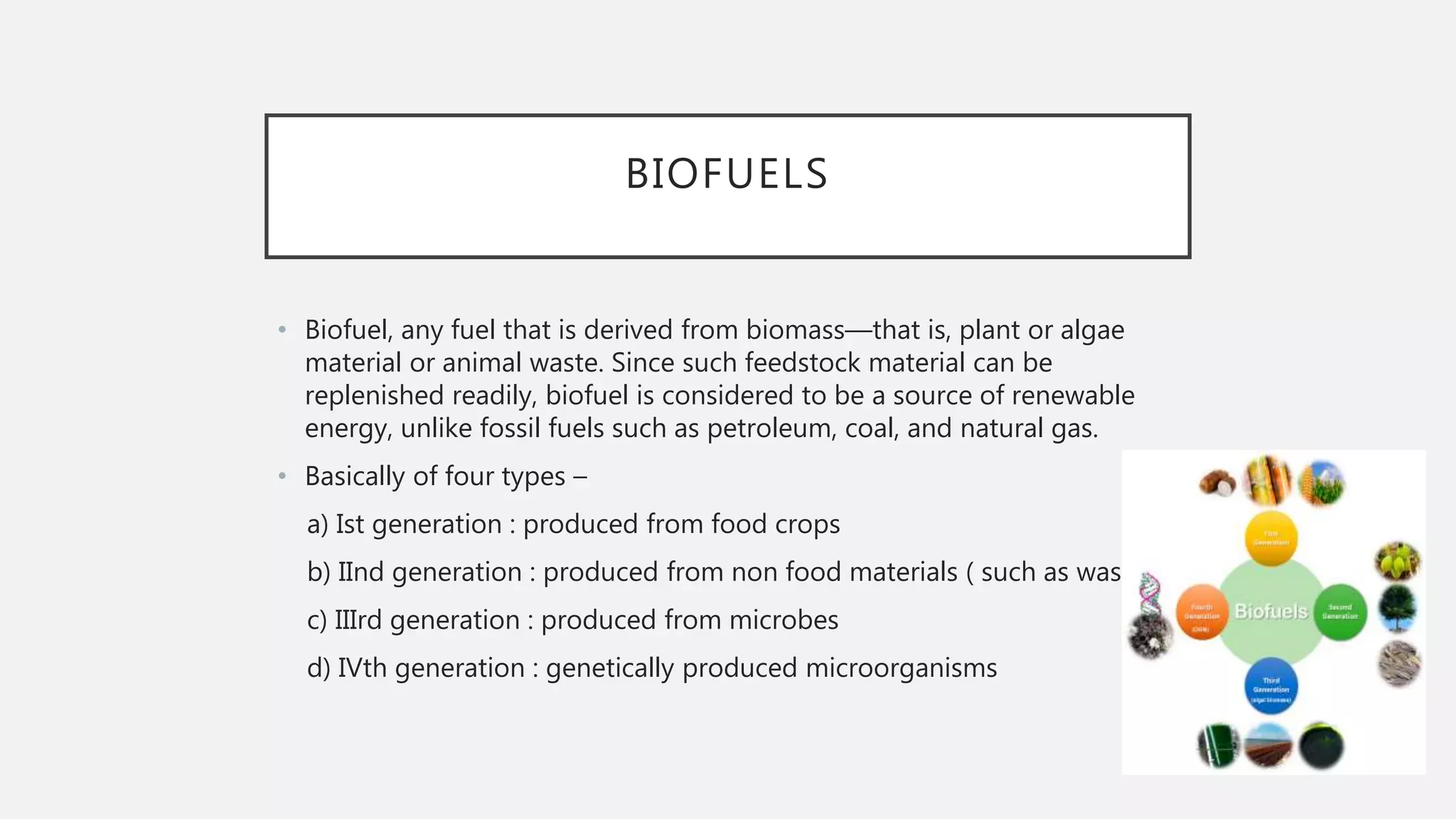
• Basically of four types –
a) Ist generation : produced from food crops
b) IInd generation : produced from non food materials ( such as waste )
c) IIIrd generation : produced from microbes
d) IVth generation : genetically produced microorganisms
INTRODUCTION
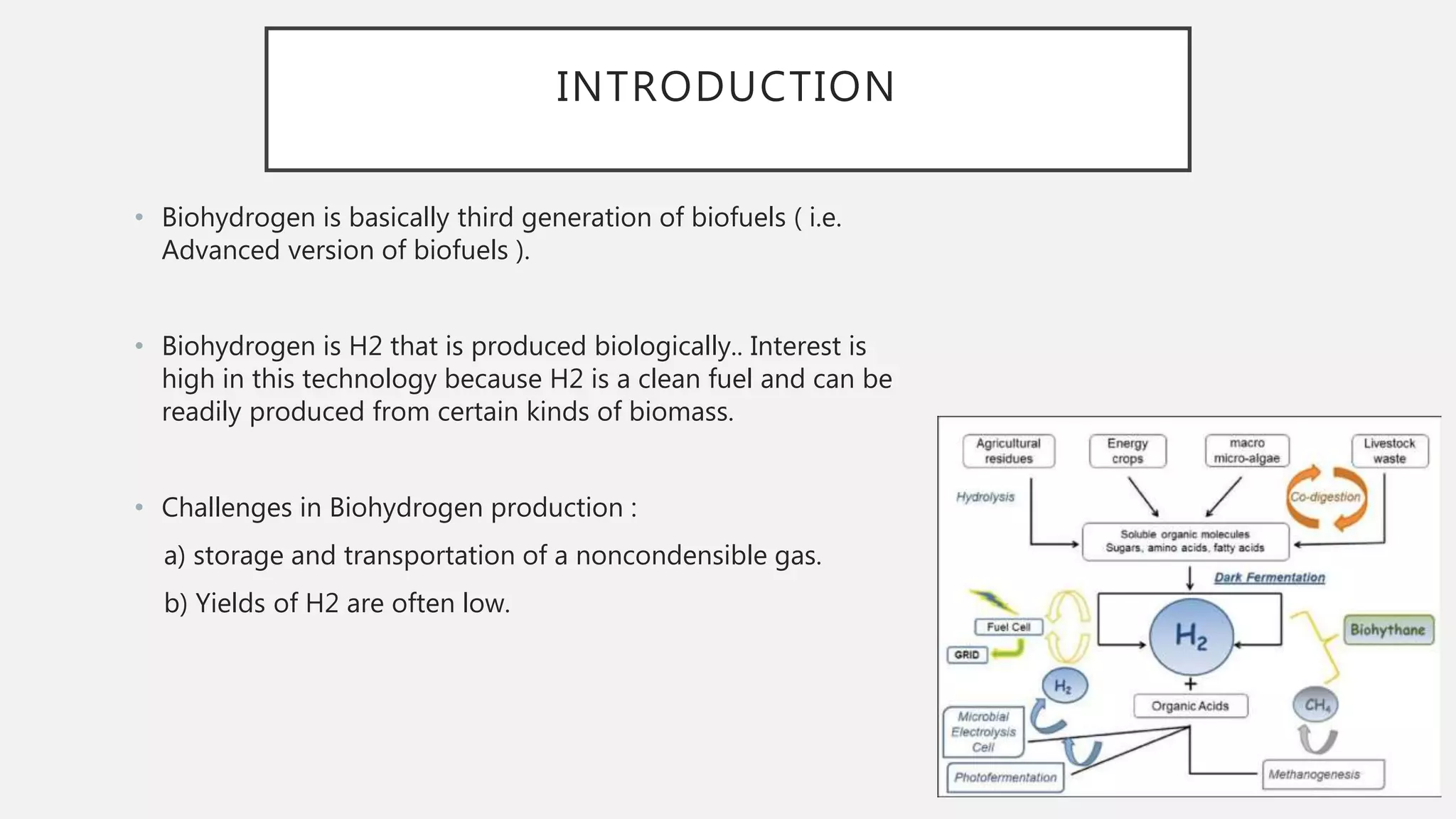
• Biohydrogen is basically third generation of biofuels ( i.e.
Advanced version of biofuels ).
• Biohydrogen is H2 that is produced biologically.. Interest is
high in this technology because H2 is a clean fuel and can be
readily produced from certain kinds of biomass.
• Challenges in Biohydrogen production :
a) storage and transportation of a noncondensible gas.
b) Yields of H2 are often low.
BIOCHEMICAL PRINCIPLE
H2 production is catalyzed by two hydrogenases. One is called [FeFe]-
hydrogenase; the other is called [NiFe]-hydrogenase. . Notable examples
are members of the genera Clostridium, Desulfovibrio, Ralstonia, and the
pathogen Helicobacter. E. Coli is the workhorse for genetic engineering of
hydrogenases.
Most of these species are microbes and their ability to use H2 as a
metabolite arises from the expression of H2 metalloenzymes (
Metalloenzymes all have one feature in common, namely that the metal
ion is bound to the protein with one labile coordination site) known as
hydrogenases.
PRODUCTION
PRODUCTION BY ALGAE
• The biological hydrogen production with algae is a method of photobiological
water splitting which is done in a closed photobioreactor. It is the most
common method of biohydrogen production.
• Algae produce hydrogen under certain conditions. In 2000 it was discovered
that if C. Reinhardtii algae are deprived of sulfur they will switch from the
production of oxygen, as in normal photosynthesis, to the production of
hydrogen.
• Photosynthesis in cyanobacteria and green algae splits water into hydrogen
ions and electrons. The electrons are transported over ferredoxins. Fe-Fe-
hydrogenases (enzymes) combine them into hydrogen gas.Fe-Fe-
hydrogenases need an anaerobic environment as they are inactivated by
oxygen.
INDUSTRIAL HYDROGEN
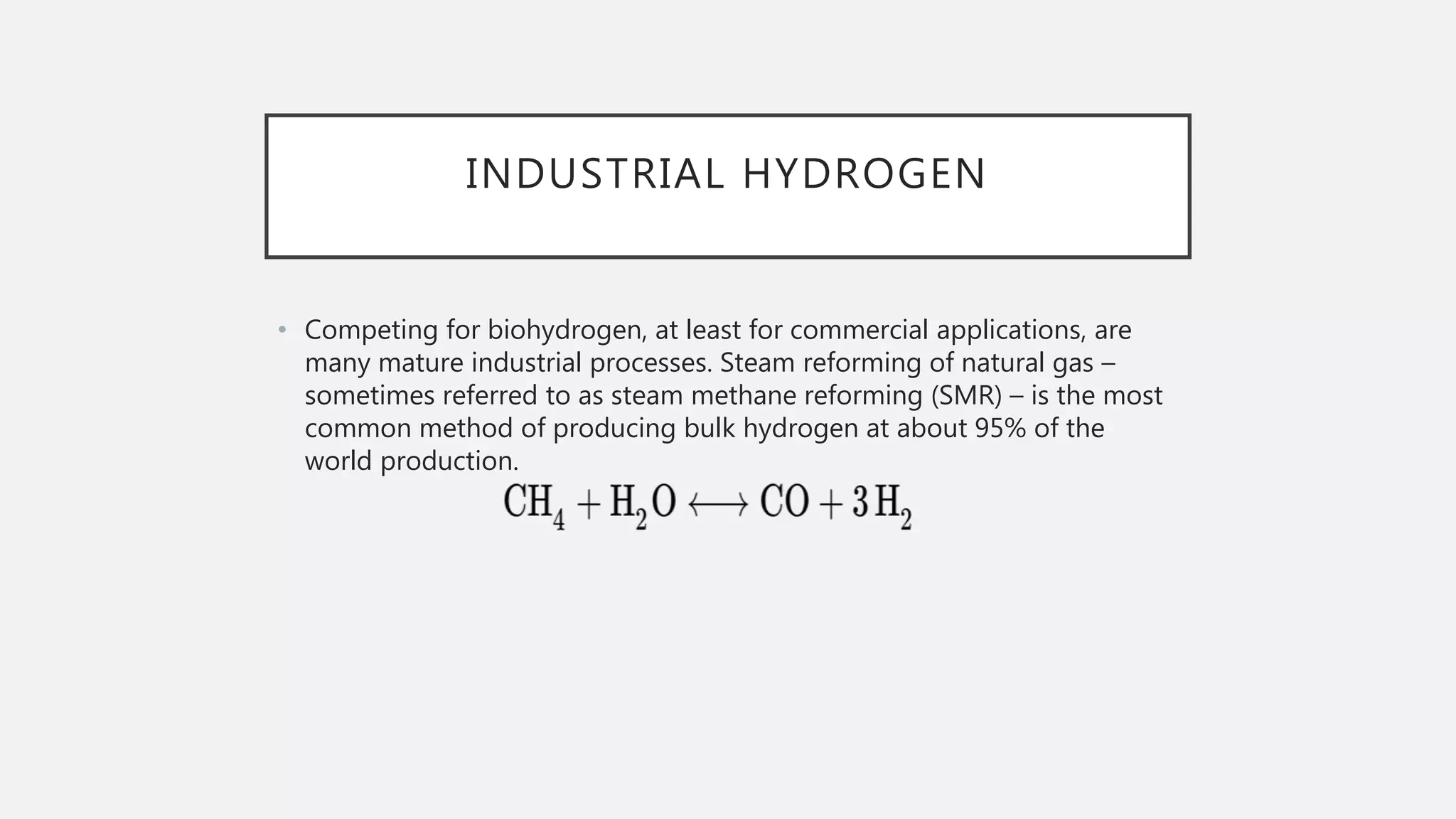
• Competing for biohydrogen, at least for commercial applications, are
many mature industrial processes. Steam reforming of natural gas –
sometimes referred to as steam methane reforming (SMR) – is the most
common method of producing bulk hydrogen at about 95% of the
world production.
FUTURE PERSPECTIVE
• The pre-treatment is a crucial step in biohydrogen research. Like physical
(high temperature, ultrasonication and microwave), mechanical (milling and
grinding), enzymatic, radiation and hydrothermal pre-treatment for the
improvement of H2 yield.
• Overall, electrolysis is a promising route where the efficiency of the
electrolyser ranges from 60 to 80%, while for other green hydrogen routes
such as dark fermentation, photofermentation, biophotolysis and microbial
electrolysis cells, their energy conversion efficiencies are low which are 4.3,
5.11, 4.0 and 11.3%, respectively .
• Economically, H2 production from natural gas is the cheapest method in
most of the countries around the world, such as in the Middle East which
costs (1$/kg H2). On the other hand, electrolysis cost is 10–40$/MWh along
with full load hours of 3000–6000
THANK YOU !!!

biohydrogen seminar.pptx

  • 1.
    TOPIC : BIOHYDROGENPRODUCTION SUBMITTED BY– Dania Khan Btech biotechnology Semester-6
  • 2.
    BIOFUELS • Biofuel, anyfuel that is derived from biomass—that is, plant or algae material or animal waste. Since such feedstock material can be replenished readily, biofuel is considered to be a source of renewable energy, unlike fossil fuels such as petroleum, coal, and natural gas. • Basically of four types – a) Ist generation : produced from food crops b) IInd generation : produced from non food materials ( such as waste ) c) IIIrd generation : produced from microbes d) IVth generation : genetically produced microorganisms
  • 3.
    INTRODUCTION • Biohydrogen isbasically third generation of biofuels ( i.e. Advanced version of biofuels ). • Biohydrogen is H2 that is produced biologically.. Interest is high in this technology because H2 is a clean fuel and can be readily produced from certain kinds of biomass. • Challenges in Biohydrogen production : a) storage and transportation of a noncondensible gas. b) Yields of H2 are often low.
  • 4.
    BIOCHEMICAL PRINCIPLE H2 productionis catalyzed by two hydrogenases. One is called [FeFe]- hydrogenase; the other is called [NiFe]-hydrogenase. . Notable examples are members of the genera Clostridium, Desulfovibrio, Ralstonia, and the pathogen Helicobacter. E. Coli is the workhorse for genetic engineering of hydrogenases. Most of these species are microbes and their ability to use H2 as a metabolite arises from the expression of H2 metalloenzymes ( Metalloenzymes all have one feature in common, namely that the metal ion is bound to the protein with one labile coordination site) known as hydrogenases.
  • 5.
  • 6.
    PRODUCTION BY ALGAE •The biological hydrogen production with algae is a method of photobiological water splitting which is done in a closed photobioreactor. It is the most common method of biohydrogen production. • Algae produce hydrogen under certain conditions. In 2000 it was discovered that if C. Reinhardtii algae are deprived of sulfur they will switch from the production of oxygen, as in normal photosynthesis, to the production of hydrogen. • Photosynthesis in cyanobacteria and green algae splits water into hydrogen ions and electrons. The electrons are transported over ferredoxins. Fe-Fe- hydrogenases (enzymes) combine them into hydrogen gas.Fe-Fe- hydrogenases need an anaerobic environment as they are inactivated by oxygen.
  • 7.
    INDUSTRIAL HYDROGEN • Competingfor biohydrogen, at least for commercial applications, are many mature industrial processes. Steam reforming of natural gas – sometimes referred to as steam methane reforming (SMR) – is the most common method of producing bulk hydrogen at about 95% of the world production.
  • 8.
    FUTURE PERSPECTIVE • Thepre-treatment is a crucial step in biohydrogen research. Like physical (high temperature, ultrasonication and microwave), mechanical (milling and grinding), enzymatic, radiation and hydrothermal pre-treatment for the improvement of H2 yield. • Overall, electrolysis is a promising route where the efficiency of the electrolyser ranges from 60 to 80%, while for other green hydrogen routes such as dark fermentation, photofermentation, biophotolysis and microbial electrolysis cells, their energy conversion efficiencies are low which are 4.3, 5.11, 4.0 and 11.3%, respectively . • Economically, H2 production from natural gas is the cheapest method in most of the countries around the world, such as in the Middle East which costs (1$/kg H2). On the other hand, electrolysis cost is 10–40$/MWh along with full load hours of 3000–6000
  • 9.