



Biofuel
BY
K. Deepak Raj
K. Gautham Reddy
Ankit Mittal
WHY RENEWABLE ENERGY?
 Increased the demand of energy in developing countries due to fast growing
population, rapid modernization and industrialization.
 The reserve will be depleted one day. In addition, the dependency on these
fossil fuels, which are largely been imported, has serious implications on
economy and environment.
 Scientist say that up to 2040,all the resources of fossil fuels will be finished.
So for this reason scientist are focus their view on the alternative renewable
energy resource such as solar energy, biogas, biodiesel, wind power, tidal
energy etc
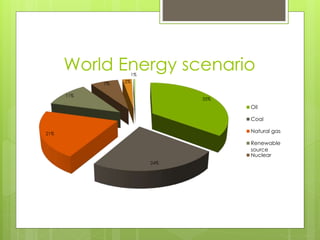
World Energy scenario
35%
24%
21%
11%
7% 2%
1%
Oil
Coal
Natural gas
Renewable
source
Nuclear
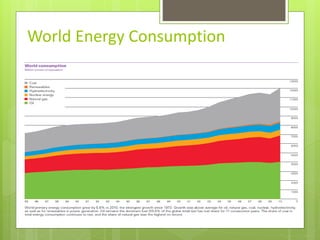
World Energy Consumption
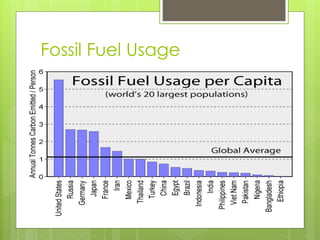
Fossil Fuel Usage
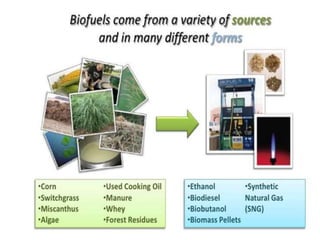
Biofuels
What is Biofuel?
 A biofuel is a type of fuel whose energy is
derived from biological carbon fixation.
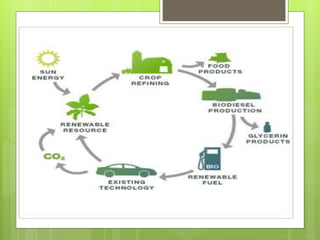
 Fuel which produced from renewable
biological resources such as plant
biomass and treated municipal and
industrial waste.
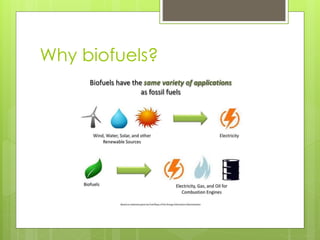
Why biofuels?
Why biofuels?
 To reduce our dependence on fossil fuels
 To reduce reliance on foreign oil
 To lower emissions of greenhouse gases
 To bring business to rural economics
Advantages of biofuels
 There is no emission of hazardous gases
 Locally available in every region of the
world.
 Friendly with the environment, so they do
not cause global warming
 The energy release per unit mass of biofuel
is greater than the energy released from
the unit mass of fossil fuels.
Two methods to form biofuel
1. Sugar crops and starch are grown and
through process of fermentation, ethanol
is produced.
2. Plants are grown naturally to produce oil
like algae. Oils are heated to reduce
viscosity, then directly used as a fuel for
diesel engines
Types of Biofuels
• Made from sugar, starch, and vegetable oil.
First generation Biofuel
• Made from non-edible plant materials.
Second generation Biofuel
• Made from algae and microbes.
Third generation Biofuel
Biodiesel
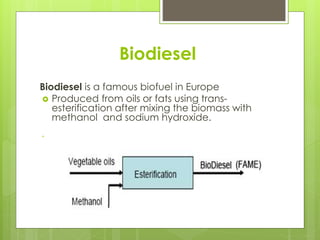
Biodiesel is a famous biofuel in Europe
 Produced from oils or fats using trans-
esterification after mixing the biomass with
methanol and sodium hydroxide.
 methanol and sodium hyrox
Used for car diesel engi
PrProduced after mixing the biomass with methanol and sodium hyroxide
♫ Used for car diesel engines
oduced after mixing the biomass with methanol and sodium hyroxide
♫ Used for car diesel engines
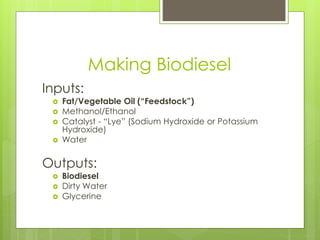
Making Biodiesel
Inputs:
 Fat/Vegetable Oil (“Feedstock”)
 Methanol/Ethanol
 Catalyst - “Lye” (Sodium Hydroxide or Potassium
Hydroxide)
 Water
Outputs:
 Biodiesel
 Dirty Water
 Glycerine
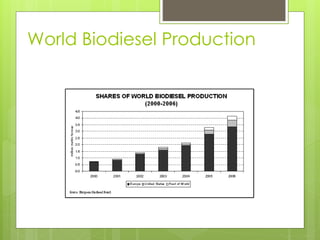
World Biodiesel Production
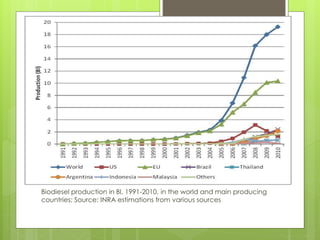
Biodiesel production in Bl, 1991-2010, in the world and main producing
countries; Source: INRA estimations from various sources
Application of Biodiesel
 car diesel engine
 effective solvent
 oxygenated fuel
Advantages of biodiesel
 Biodiesel can be termed clean fuel as it does not
contain carcinogens and its sulphur content is also
lesser than the mineral diesel.
 It possesses high biodegradability and lubricating
property
 Improves engine efficiency and operating life cycle.
 Domestic resource,
 Readily mixes with petroleum diesel fuel in any ratio
 Higher flash point makes it safer in transport and
storage;
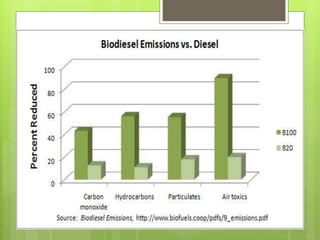
 Greatly reduces particulate matter and carbon
monoxide emissions.
Blends of biodiesel
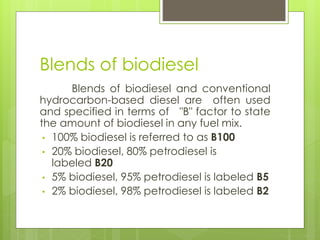
Blends of biodiesel and conventional
hydrocarbon-based diesel are often used
and specified in terms of "B" factor to state
the amount of biodiesel in any fuel mix.
• 100% biodiesel is referred to as B100
• 20% biodiesel, 80% petrodiesel is
labeled B20
• 5% biodiesel, 95% petrodiesel is labeled B5
• 2% biodiesel, 98% petrodiesel is labeled B2
Disadvantages of biodiesel
 Higher production cost.
 The resources like corn,soyabean etc are
extensively used for biodiesel leading to
increase in demand and inturn increasing
the prices of them.
 Poor low temperature properties.
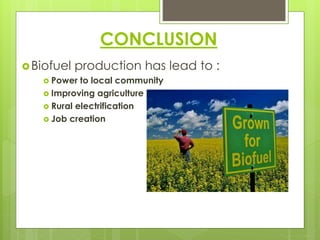
CONCLUSION
Biofuel production has lead to :
 Power to local community
 Improving agriculture
 Rural electrification
 Job creation
 Biofuels

Biofuels

  • 1.
    Biofuel BY K. Deepak Raj K.Gautham Reddy Ankit Mittal
  • 2.
    WHY RENEWABLE ENERGY? Increased the demand of energy in developing countries due to fast growing population, rapid modernization and industrialization.  The reserve will be depleted one day. In addition, the dependency on these fossil fuels, which are largely been imported, has serious implications on economy and environment.  Scientist say that up to 2040,all the resources of fossil fuels will be finished. So for this reason scientist are focus their view on the alternative renewable energy resource such as solar energy, biogas, biodiesel, wind power, tidal energy etc
  • 3.
    World Energy scenario 35% 24% 21% 11% 7%2% 1% Oil Coal Natural gas Renewable source Nuclear
  • 4.
  • 5.
  • 6.
  • 7.
    What is Biofuel? A biofuel is a type of fuel whose energy is derived from biological carbon fixation.  Fuel which produced from renewable biological resources such as plant biomass and treated municipal and industrial waste.
  • 8.
  • 9.
    Why biofuels?  Toreduce our dependence on fossil fuels  To reduce reliance on foreign oil  To lower emissions of greenhouse gases  To bring business to rural economics
  • 11.
    Advantages of biofuels There is no emission of hazardous gases  Locally available in every region of the world.  Friendly with the environment, so they do not cause global warming  The energy release per unit mass of biofuel is greater than the energy released from the unit mass of fossil fuels.
  • 13.
    Two methods toform biofuel 1. Sugar crops and starch are grown and through process of fermentation, ethanol is produced. 2. Plants are grown naturally to produce oil like algae. Oils are heated to reduce viscosity, then directly used as a fuel for diesel engines
  • 14.
    Types of Biofuels •Made from sugar, starch, and vegetable oil. First generation Biofuel • Made from non-edible plant materials. Second generation Biofuel • Made from algae and microbes. Third generation Biofuel
  • 15.
    Biodiesel Biodiesel is afamous biofuel in Europe  Produced from oils or fats using trans- esterification after mixing the biomass with methanol and sodium hydroxide.  methanol and sodium hyrox Used for car diesel engi PrProduced after mixing the biomass with methanol and sodium hyroxide ♫ Used for car diesel engines oduced after mixing the biomass with methanol and sodium hyroxide ♫ Used for car diesel engines
  • 16.
    Making Biodiesel Inputs:  Fat/VegetableOil (“Feedstock”)  Methanol/Ethanol  Catalyst - “Lye” (Sodium Hydroxide or Potassium Hydroxide)  Water Outputs:  Biodiesel  Dirty Water  Glycerine
  • 17.
  • 18.
    Biodiesel production inBl, 1991-2010, in the world and main producing countries; Source: INRA estimations from various sources
  • 19.
    Application of Biodiesel car diesel engine  effective solvent  oxygenated fuel
  • 20.
    Advantages of biodiesel Biodiesel can be termed clean fuel as it does not contain carcinogens and its sulphur content is also lesser than the mineral diesel.  It possesses high biodegradability and lubricating property  Improves engine efficiency and operating life cycle.  Domestic resource,  Readily mixes with petroleum diesel fuel in any ratio  Higher flash point makes it safer in transport and storage;  Greatly reduces particulate matter and carbon monoxide emissions.
  • 22.
    Blends of biodiesel Blendsof biodiesel and conventional hydrocarbon-based diesel are often used and specified in terms of "B" factor to state the amount of biodiesel in any fuel mix. • 100% biodiesel is referred to as B100 • 20% biodiesel, 80% petrodiesel is labeled B20 • 5% biodiesel, 95% petrodiesel is labeled B5 • 2% biodiesel, 98% petrodiesel is labeled B2
  • 24.
    Disadvantages of biodiesel Higher production cost.  The resources like corn,soyabean etc are extensively used for biodiesel leading to increase in demand and inturn increasing the prices of them.  Poor low temperature properties.
  • 26.
    CONCLUSION Biofuel production haslead to :  Power to local community  Improving agriculture  Rural electrification  Job creation

Editor's Notes

  • #20 contains a reduced amount of carbon and higher hydrogen and oxygen content than fossil diesel