Innovative continuous high-yield hydrogen-producing system: 
Coupling a microbial electrolysis cell fed with resultant dead-end 
metabolites of a saline dark fermentation reactor 
Alessandro A. Carmona-Martínez, Eric Trably and Nicolas Bernet 
Laboratory of Environmental Biotechnology, Narbonne-France 
(eric.trably@supagro.inra.fr) 
BioH2 2013, August 5th-7th, Montréal, Canada
Continuous high yield hydrogen gas production coupling system: 
Dark fermenter → Microbial electrolysis cell 
H2 H2 
Dark 
fermentation 
Microbial 
electrolysis 
Any substrate Organic acids 
(acetate,…) 
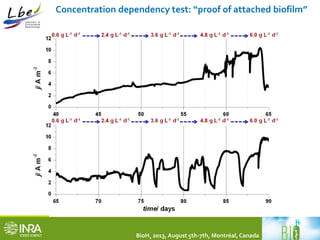
BioH2 2013, August 5th-7th, Montréal, Canada 
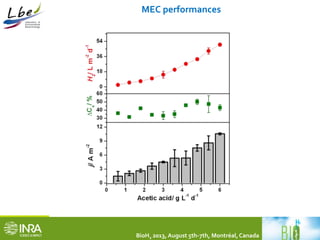
Outlet 
Saline media 
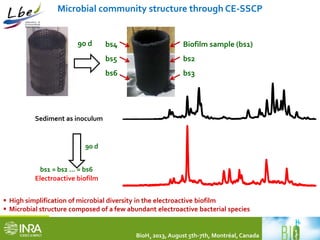
pH [7-8]
Introduction 
BioH2 2013, August 5th-7th, Montréal, Canada
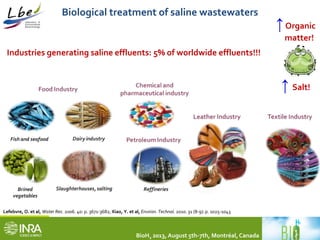
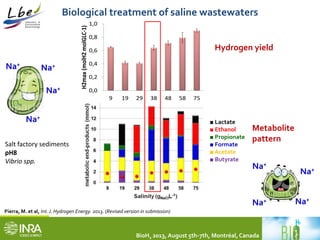
Biological treatment of saline wastewaters 
Industries generating saline effluents: 5% of worldwide effluents!!! 
BioH2 2013, August 5th-7th, Montréal, Canada 
↑ Organic 
matter! 
↑ Salt! 
Lefebvre, O. et al, Water Res. 2006. 40: p. 3671-3682; Xiao, Y. et al, Environ. Technol. 2010. 31 (8-9): p. 1025-1043
Biological treatment of saline wastewaters 
BioH2 2013, August 5th-7th, Montréal, Canada 
Na+ 
Na+ 
Na+ 
Na+ 
1,0 
0,8 
0,6 
0,4 
0,2 
Pierra, M. et al, Int. J. Hydrogen Energy. 2013. (Revised version in submission) 
Na+ 
Na+ 
Na+ Na+ 
0,0 
9 19 29 38 48 58 75 
H2max (molH2 molGLC-1) 
salinity (gNaClL-1) 
■ Lactate 
■ Ethanol 
■ Propionate 
■ Formate 
■ Acetate 
■ Butyrate 
Salt factory sediments 
pH8 
Vibrio spp. 
Hydrogen yield 
Metabolite 
pattern
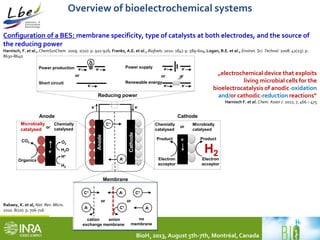
Overview of bioelectrochemical systems 
Configuration of a BES: membrane specificity, type of catalysts at both electrodes, and the source of 
the reducing power 
Harnisch, F. et al., ChemSusChem. 2009. 2(10): p. 921-926; Franks, A.E. et al., Biofuels. 2010. 184): p. 589-604; Logan, B.E. et al., Environ. Sci. Technol. 2008. 42(23): p. 
8630-8640 
Power supply 
or or 
Renewable energy 
Reducing power 
Anode Cathode 
Product 
Product 
BioH2 2013, August 5th-7th, Montréal, Canada 
Anode 
Cathode 
C+ 
A-e- 
e- 
C+ 
A-A-C+ 
C+ 
A-or 
or 
no 
membrane 
cation anion 
exchange membrane 
e- 
Microbially 
catalysed 
CO2 
Organics 
Chemially 
or catalysed 
O2 
H2O 
H+ 
H2 
e- 
Electron 
acceptor 
Microbially 
catalysed 
Chemially 
catalysed 
or 
Electron 
acceptor 
Power production 
Short circuit 
e- e-e-e- 
e-e- 
e- 
Membrane 
2 
Rabaey, K. et al, Nat. Rev. Micro. 
2010. 8(10): p. 706-716 
„electrochemical device that exploits 
living microbial cells for the 
bioelectrocatalysis of anodic-oxidation 
and/or cathodic-reduction reactions“ 
Harnisch F. et al. Chem. Asian J. 2012, 7, 466 – 475
Objective of the study: 
coupling a microbial electrolysis cell fed with 
dead-end metabolites of a saline dark 
fermentation reactor 
BioH2 2013, August 5th-7th, Montréal, Canada
Materials & Methods 
BioH2 2013, August 5th-7th, Montréal, Canada
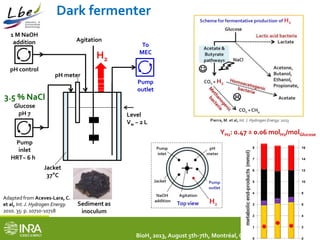
Dark fermenter 
10 
9 
8 
7 
6 
5 
4 
3 
2 
1 
10 
9 
8 
7 
6 
5 
4 
3 
2 
1 
10 
9 
8 
7 
6 
5 
4 
3 
2 
1 
10 
9 
8 
7 
6 
5 
4 
3 
2 
1 
BioH2 2013, August 5th-7th, Montréal, Canada 
Agitation 
H2 
1 M NaOH 
addition 
3.5 % NaCl 
Glucose 
pH 7 
Pump 
inlet 
pH meter 
Level 
Vw ~ 2 L 
pH control 
Jacket 
37°C 
Adapted from Aceves-Lara, C. 
et al, Int. J. Hydrogen Energy. 
2010. 35: p. 10710-10718 
Pump 
outlet 
HRT~ 6 h 
To 
MEC 
Sediment as 
inoculum 
0 
0 
20 
18 
16 
14 
12 
10 
8 
6 
4 
2 
0 
0 
20 
18 
16 
14 
12 
10 
8 
6 
4 
2 
0 
0 
YH2: 0.47 ± 0.06 molH2/molGlucose
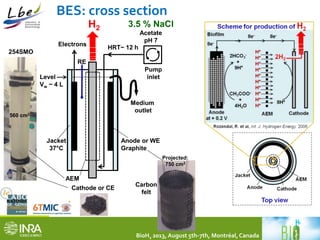
BES: cross section 
3.5 % NaCl 
Pump 
inlet 
BioH2 2013, August 5th-7th, Montréal, Canada 
AEM 
Cathode or CE 
Level 
Vw ~ 4 L 
Medium 
outlet 
Jacket 
37°C 
Anode or WE 
Graphite 
Electrons 
H2 
Carbon 
felt 
Projected: 
750 cm2 
254SMO 
560 cm2 
RE 
HRT~ 12 h 
Acetate 
pH 7
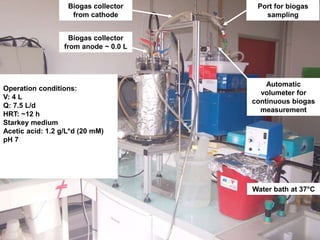
Biogas collector 
from cathode 
Biogas collector 
from anode ~ 0.0 L 
Operation conditions: 
V: 4 L 
Q: 7.5 L/d 
HRT: ~12 h 
Starkey medium 
Acetic acid: 1.2 g/L*d (20 mM) 
pH 7 
Port for biogas 
sampling 
Automatic 
volumeter for 
continuous biogas 
measurement 
Water bath at 37°C
Results & discussion 
BioH2 2013, August 5th-7th, Montréal, Canada
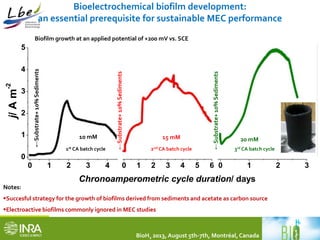
20 mM 
0 1 2 3 
15 mM 
BioH2 2013, August 5th-7th, Montréal, Canada 
10 mM 
0 1 2 3 4 
5 
4 
3 
2 
1 
0 
0 1 2 3 4 5 6 
Chronoamperometric cycle duration/ days 
j/ A m-2 
Bioelectrochemical biofilm development: 
an essential prerequisite for sustainable MEC performance 
Biofilmgrowth at an applied potential of +200 mV vs. SCE 
1st CA batch cycle 
2nd CA batch cycle 
3rd CA batch cycle 
←Substrate+ 10%Sediments 
Notes: 
Succesful strategy for the growth of biofilms derived fromsediments and acetate as carbon source 
Electroactive biofilms commonly ignored in MEC studies
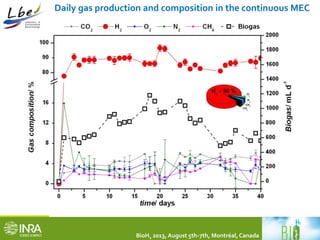
Daily gas production and composition in the continuous MEC 
BioH2 2013, August 5th-7th, Montréal, Canada
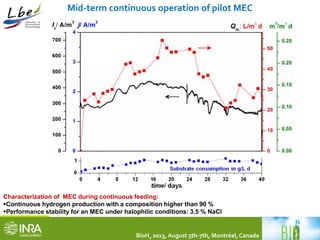
Mid-term continuous operation of pilot MEC 
Characterization of MEC during continuous feeding: 
Continuous hydrogen production with a composition higher than 90 % 
Performance stability for an MEC under halophilic conditions: 3.5 % NaCl 
BioH2 2013, August 5th-7th, Montréal, Canada
Concentration dependency test: “proof of attached biofilm” 
BioH2 2013, August 5th-7th, Montréal, Canada
MEC performances 
BioH2 2013, August 5th-7th, Montréal, Canada
MEC performances in comparison to other MEC studies 
BioH2 2013, August 5th-7th, Montréal, Canada 
Eapp./ 
V 
Anode 
material 
T/ 
C 
VMEC/ 
L 
IA/ 
A m-2 
Iv/ 
A m-3 
Q/ 
L d-1 
CE/ % YH2/ 
mol mol-1 
QH2 / 
m3 m-3 d-1 
H2/ 
% 
HRT/ 
h 
Ref. 
+0.2 Graphite 
felt 
37 4.00 2-3 400 7.5 22 2.28 0.15 ~90 12 This 
work 
-0.2 Graphite 
brush 
30 0.03 0.02 147 0.03 81 N.F. 3.6 68 24 [1] 
+0.9 Graphite 
brush 
30 2.50 1.18 74 2.5 ˃100 N.F. 0.53 70 24 [2] 
+0.8 Graphite 
felt 
28 0.20 2.91 40 N.F. 52 2.1 0.05 96.6 N.F. [3] 
+1.5 Graphite 
fiber 
32 0.13 N.F. 1630 0.46 ˃100 2.0 4.3 53 6.5 [4] 
+1.0 Graphite 
felt 
30 0.28 16.4 732 7.2 60 N.F. 5.6 N.F. 48 [5] 
+1.2 Graphite 
felt 
30 0.05 6.00 0.6 0.008 N.F. 3.36 5.4 N.F. 6 [6] 
[1] Nam et al. 2011, [2] Rader et al. 2010, [3] Chae et al. 2008, [4] Lee et al. 2010, [5] Sleutels et al., 2009, [6] Hrapovic et al., 2010 
Notes: 
•All values are well in line with previous literature data 
•However, just a very few studies have reported the coupling of dark fermentation and MEC technology 
•So far, theMEC using acetate as a model metabolite shows a stable performance 
•Not enough available information onMECs under saline conditions
Microbial community structure through CE-SSCP 
90 d Biofilm sample (bs1) 
Sediment as inoculum 
Electroactive biofilm 
 High simplification of microbial diversity in the electroactive biofilm 
 Microbial structure composed of a few abundant electroactive bacterial species 
*Thanks to Caroline Rivalland for SSCP analysis 
90 d 
bs2 
bs3 
bs4 
bs5 
bs6 
bs1 = bs2 … = bs6 
BioH2 2013, August 5th-7th, Montréal, Canada
Conclusions 
BioH2 2013, August 5th-7th, Montréal, Canada
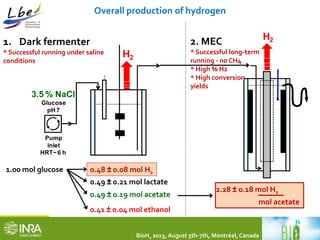
Overall production of hydrogen 
H2 
3.5 % NaCl 
Glucose 
pH 7 
1.00 mol glucose 0.48 ± 0.08 mol H2 
0.49 ± 0.21 mol lactate 
0.49 ± 0.19 mol acetate 
0.41 ± 0.04 mol ethanol 
0.11 ± 0.08 mol butyrate 
Pump 
inlet 
HRT~ 6 h 
2.28 ± 0.18 mol H2 
mol acetate 
1. Dark fermenter 
* Successful running under saline 
conditions 
2. MEC H2 
* Successful long-term 
running - no CH4 
* High % H2 
* High conversion 
yields 
+ H2? 
Rivalland, C. et al, In preparation. BioH2 2013, August 5th-7th, Montréal, Canada
Thank you for your kind attention…

BioH2Conference, Alessandro Carmona

  • 1.
    Innovative continuous high-yieldhydrogen-producing system: Coupling a microbial electrolysis cell fed with resultant dead-end metabolites of a saline dark fermentation reactor Alessandro A. Carmona-Martínez, Eric Trably and Nicolas Bernet Laboratory of Environmental Biotechnology, Narbonne-France (eric.trably@supagro.inra.fr) BioH2 2013, August 5th-7th, Montréal, Canada
  • 2.
    Continuous high yieldhydrogen gas production coupling system: Dark fermenter → Microbial electrolysis cell H2 H2 Dark fermentation Microbial electrolysis Any substrate Organic acids (acetate,…) BioH2 2013, August 5th-7th, Montréal, Canada Outlet Saline media pH [7-8]
  • 3.
    Introduction BioH2 2013,August 5th-7th, Montréal, Canada
  • 4.
    Biological treatment ofsaline wastewaters Industries generating saline effluents: 5% of worldwide effluents!!! BioH2 2013, August 5th-7th, Montréal, Canada ↑ Organic matter! ↑ Salt! Lefebvre, O. et al, Water Res. 2006. 40: p. 3671-3682; Xiao, Y. et al, Environ. Technol. 2010. 31 (8-9): p. 1025-1043
  • 5.
    Biological treatment ofsaline wastewaters BioH2 2013, August 5th-7th, Montréal, Canada Na+ Na+ Na+ Na+ 1,0 0,8 0,6 0,4 0,2 Pierra, M. et al, Int. J. Hydrogen Energy. 2013. (Revised version in submission) Na+ Na+ Na+ Na+ 0,0 9 19 29 38 48 58 75 H2max (molH2 molGLC-1) salinity (gNaClL-1) ■ Lactate ■ Ethanol ■ Propionate ■ Formate ■ Acetate ■ Butyrate Salt factory sediments pH8 Vibrio spp. Hydrogen yield Metabolite pattern
  • 6.
    Overview of bioelectrochemicalsystems Configuration of a BES: membrane specificity, type of catalysts at both electrodes, and the source of the reducing power Harnisch, F. et al., ChemSusChem. 2009. 2(10): p. 921-926; Franks, A.E. et al., Biofuels. 2010. 184): p. 589-604; Logan, B.E. et al., Environ. Sci. Technol. 2008. 42(23): p. 8630-8640 Power supply or or Renewable energy Reducing power Anode Cathode Product Product BioH2 2013, August 5th-7th, Montréal, Canada Anode Cathode C+ A-e- e- C+ A-A-C+ C+ A-or or no membrane cation anion exchange membrane e- Microbially catalysed CO2 Organics Chemially or catalysed O2 H2O H+ H2 e- Electron acceptor Microbially catalysed Chemially catalysed or Electron acceptor Power production Short circuit e- e-e-e- e-e- e- Membrane 2 Rabaey, K. et al, Nat. Rev. Micro. 2010. 8(10): p. 706-716 „electrochemical device that exploits living microbial cells for the bioelectrocatalysis of anodic-oxidation and/or cathodic-reduction reactions“ Harnisch F. et al. Chem. Asian J. 2012, 7, 466 – 475
  • 7.
    Objective of thestudy: coupling a microbial electrolysis cell fed with dead-end metabolites of a saline dark fermentation reactor BioH2 2013, August 5th-7th, Montréal, Canada
  • 8.
    Materials & Methods BioH2 2013, August 5th-7th, Montréal, Canada
  • 9.
    Dark fermenter 10 9 8 7 6 5 4 3 2 1 10 9 8 7 6 5 4 3 2 1 10 9 8 7 6 5 4 3 2 1 10 9 8 7 6 5 4 3 2 1 BioH2 2013, August 5th-7th, Montréal, Canada Agitation H2 1 M NaOH addition 3.5 % NaCl Glucose pH 7 Pump inlet pH meter Level Vw ~ 2 L pH control Jacket 37°C Adapted from Aceves-Lara, C. et al, Int. J. Hydrogen Energy. 2010. 35: p. 10710-10718 Pump outlet HRT~ 6 h To MEC Sediment as inoculum 0 0 20 18 16 14 12 10 8 6 4 2 0 0 20 18 16 14 12 10 8 6 4 2 0 0 YH2: 0.47 ± 0.06 molH2/molGlucose
  • 10.
    BES: cross section 3.5 % NaCl Pump inlet BioH2 2013, August 5th-7th, Montréal, Canada AEM Cathode or CE Level Vw ~ 4 L Medium outlet Jacket 37°C Anode or WE Graphite Electrons H2 Carbon felt Projected: 750 cm2 254SMO 560 cm2 RE HRT~ 12 h Acetate pH 7
  • 11.
    Biogas collector fromcathode Biogas collector from anode ~ 0.0 L Operation conditions: V: 4 L Q: 7.5 L/d HRT: ~12 h Starkey medium Acetic acid: 1.2 g/L*d (20 mM) pH 7 Port for biogas sampling Automatic volumeter for continuous biogas measurement Water bath at 37°C
  • 12.
    Results & discussion BioH2 2013, August 5th-7th, Montréal, Canada
  • 13.
    20 mM 01 2 3 15 mM BioH2 2013, August 5th-7th, Montréal, Canada 10 mM 0 1 2 3 4 5 4 3 2 1 0 0 1 2 3 4 5 6 Chronoamperometric cycle duration/ days j/ A m-2 Bioelectrochemical biofilm development: an essential prerequisite for sustainable MEC performance Biofilmgrowth at an applied potential of +200 mV vs. SCE 1st CA batch cycle 2nd CA batch cycle 3rd CA batch cycle ←Substrate+ 10%Sediments ←Substrate+ 10%Sediments ←Substrate+ 10%Sediments Notes: Succesful strategy for the growth of biofilms derived fromsediments and acetate as carbon source Electroactive biofilms commonly ignored in MEC studies
  • 14.
    Daily gas productionand composition in the continuous MEC BioH2 2013, August 5th-7th, Montréal, Canada
  • 15.
    Mid-term continuous operationof pilot MEC Characterization of MEC during continuous feeding: Continuous hydrogen production with a composition higher than 90 % Performance stability for an MEC under halophilic conditions: 3.5 % NaCl BioH2 2013, August 5th-7th, Montréal, Canada
  • 16.
    Concentration dependency test:“proof of attached biofilm” BioH2 2013, August 5th-7th, Montréal, Canada
  • 17.
    MEC performances BioH22013, August 5th-7th, Montréal, Canada
  • 18.
    MEC performances incomparison to other MEC studies BioH2 2013, August 5th-7th, Montréal, Canada Eapp./ V Anode material T/ C VMEC/ L IA/ A m-2 Iv/ A m-3 Q/ L d-1 CE/ % YH2/ mol mol-1 QH2 / m3 m-3 d-1 H2/ % HRT/ h Ref. +0.2 Graphite felt 37 4.00 2-3 400 7.5 22 2.28 0.15 ~90 12 This work -0.2 Graphite brush 30 0.03 0.02 147 0.03 81 N.F. 3.6 68 24 [1] +0.9 Graphite brush 30 2.50 1.18 74 2.5 ˃100 N.F. 0.53 70 24 [2] +0.8 Graphite felt 28 0.20 2.91 40 N.F. 52 2.1 0.05 96.6 N.F. [3] +1.5 Graphite fiber 32 0.13 N.F. 1630 0.46 ˃100 2.0 4.3 53 6.5 [4] +1.0 Graphite felt 30 0.28 16.4 732 7.2 60 N.F. 5.6 N.F. 48 [5] +1.2 Graphite felt 30 0.05 6.00 0.6 0.008 N.F. 3.36 5.4 N.F. 6 [6] [1] Nam et al. 2011, [2] Rader et al. 2010, [3] Chae et al. 2008, [4] Lee et al. 2010, [5] Sleutels et al., 2009, [6] Hrapovic et al., 2010 Notes: •All values are well in line with previous literature data •However, just a very few studies have reported the coupling of dark fermentation and MEC technology •So far, theMEC using acetate as a model metabolite shows a stable performance •Not enough available information onMECs under saline conditions
  • 19.
    Microbial community structurethrough CE-SSCP 90 d Biofilm sample (bs1) Sediment as inoculum Electroactive biofilm  High simplification of microbial diversity in the electroactive biofilm  Microbial structure composed of a few abundant electroactive bacterial species *Thanks to Caroline Rivalland for SSCP analysis 90 d bs2 bs3 bs4 bs5 bs6 bs1 = bs2 … = bs6 BioH2 2013, August 5th-7th, Montréal, Canada
  • 20.
    Conclusions BioH2 2013,August 5th-7th, Montréal, Canada
  • 21.
    Overall production ofhydrogen H2 3.5 % NaCl Glucose pH 7 1.00 mol glucose 0.48 ± 0.08 mol H2 0.49 ± 0.21 mol lactate 0.49 ± 0.19 mol acetate 0.41 ± 0.04 mol ethanol 0.11 ± 0.08 mol butyrate Pump inlet HRT~ 6 h 2.28 ± 0.18 mol H2 mol acetate 1. Dark fermenter * Successful running under saline conditions 2. MEC H2 * Successful long-term running - no CH4 * High % H2 * High conversion yields + H2? Rivalland, C. et al, In preparation. BioH2 2013, August 5th-7th, Montréal, Canada
  • 22.
    Thank you foryour kind attention…

Editor's Notes

  • #6 Sad bacteria: http://www.clipartof.com/gallery/clipart/germ.html
  • #7 In BESs, a plenitude of possible applications can be found (Fig. 1-6), from the original and promising production of electricity (Logan, et al., 2006), to hydrogen as a clean fuel (Logan, et al., 2008) and the production of useful chemicals (Rabaey and Rozendal, 2010) such as hydrogen peroxide, extraordinarily from wastewater (Fu, et al., 2010, You , et al., 2010). Nonetheless, the cited applications in this section would not be possible without the basic research on the microbe-electrode interactions which inexorably turn out to contribute to the betterment of the overall performance of this kind of systems by eliminating (or at least diminishing) electrochemical losses of BESs (Schröder and Harnisch, 2010). Therefore, the analysis of the microbe-electrode interactions would lead not only to a higher comprehension on improving the overall performance of BESs (see section 1.5) from the power production point of view but also on improving a more precise electron uptake by microorganisms for the production of useful and industrial demanded biochemicals (Nevin, et al., 2010, Ross, et al., 2011). As shown in Fig. 1-6, microbial-electrode interactions can take place in both electrode chambers depending on the application for which the BES has been designed. A simplified version of a BES system as shown in the insert of Fig. 1-6 is a potentiostatic controlled electrochemical half-cell in which an anode and a cathode are hosted within one vessel (LaBelle, et al., 2010). This experimental approach assures similar biological and environmental conditions for both electrodes and increases the reproducibility of the experiment by maintaining one of the electrodes at a constant potential permanently controlled against a reference electrode (e.g., vs. Ag/AgCl) (Bard, et al., 2008). This type of BES (with multiple modifications) is the one that has been extensively used in this Thesis.