NITRIC OXIDE
Dr.Rittu Chandel
Junior Resident in Biochemistry
Grant Government Medical College,Mumbai
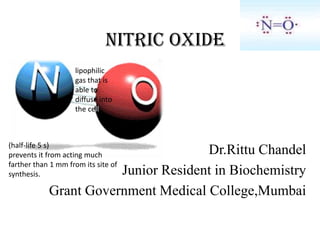
lipophilic
gas that is
able to
diffuse into
the cell
(half-life 5 s)
prevents it from acting much
farther than 1 mm from its site of
synthesis.
• NO is a gas with no known cellular storage
mechanism
• NO is the lowest molecular weight human cell
product
functions
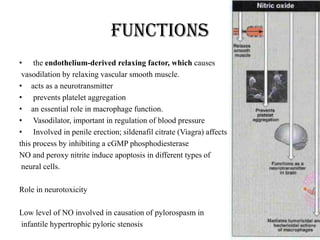
• the endothelium-derived relaxing factor, which causes
vasodilation by relaxing vascular smooth muscle.
• acts as a neurotransmitter
• prevents platelet aggregation
• an essential role in macrophage function.
• Vasodilator, important in regulation of blood pressure
• Involved in penile erection; sildenafil citrate (Viagra) affects
this process by inhibiting a cGMP phosphodiesterase
NO and peroxy nitrite induce apoptosis in different types of
neural cells.
Role in neurotoxicity
Low level of NO involved in causation of pylorospasm in
infantile hypertrophic pyloric stenosis
Synthesis of NO
• SUBSTRATES :Arginine, 02 , and NADPH
• ENZYME :cytosolic NO synthase
• COENZYMES: FMN, FAD, heme, and tetrahydrobiopterin
• PRODUCTS :NO and citrulline
NOS is a dioxygenase
A two step process
requiring five electron
oxidations
NOS is a homodimeric protein of 125-to 160-kD subunits
each subunit contains one FMN, one FAD, one tetrahydrobiopterin and one Fe(III)-heme.
These cofactors facilitate the five-electron oxidation of arginine to produce NO.
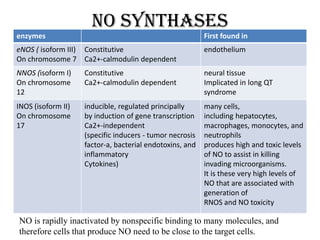
NO synthases
enzymes First found in
eNOS ( isoform III)
On chromosome 7
Constitutive
Ca2+-calmodulin dependent
endothelium
NNOS (isoform I)
On chromosome
12
Constitutive
Ca2+-calmodulin dependent
neural tissue
Implicated in long QT
syndrome
INOS (isoform II)
On chromosome
17
inducible, regulated principally
by induction of gene transcription
Ca2+-independent
(specific inducers - tumor necrosis
factor-a, bacterial endotoxins, and
inflammatory
Cytokines)
many cells,
including hepatocytes,
macrophages, monocytes, and
neutrophils
produces high and toxic levels
of NO to assist in killing
invading microorganisms.
It is these very high levels of
NO that are associated with
generation of
RNOS and NO toxicity
NO is rapidly inactivated by nonspecific binding to many molecules, and
therefore cells that produce NO need to be close to the target cells.
Review of Smooth Muscle
Contraction
Actions of NO on vascular
endothelium
NO is synthesized by eNOS in endothelial cells and diffuses
to vascular smooth muscle
it activates the cytosolic form of guanylate
cyclase.
The resultant rise in cGMP causes muscle relaxation through
activation of protein kinase G,which phosphorylates myosin
light-chain kinase and renders it inactive, thereby decreasing
smooth muscle contraction.
Role of NO in mediating macrophage
bactericidal activity
In macrophages, iNOS activity is normally low
synthesis of the enzyme is significantly
stimulated by bacterial lipopolysaccharide
and y-interferon release in response to infection
Activated macrophages form superoxide radicals that
combine with NO to form intermediates that decompose,
forming the highly bactericidal OH«" radical.
The Role of NO in Platelets
• NO inhibits platelet adhesion, aggregation, and recruitment
• Mechanism of Action
Inhibition of
NO Synthase
Inhibition of
NO Production
Platelet
Accumulation
in Vasculature
Shorten
Bleeding Time
Binding of NO
to sGC
Increase in
cGMP
Decrease in
Intracellular
Ca2+
Decrease
Platelet
Association
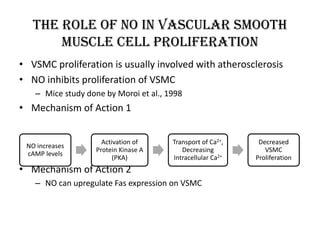
The Role of NO in Vascular Smooth
Muscle Cell Proliferation
• VSMC proliferation is usually involved with atherosclerosis
• NO inhibits proliferation of VSMC
– Mice study done by Moroi et al., 1998
• Mechanism of Action 1
• Mechanism of Action 2
– NO can upregulate Fas expression on VSMC
NO increases
cAMP levels
Activation of
Protein Kinase A
(PKA)
Transport of Ca2+,
Decreasing
Intracellular Ca2+
Decreased
VSMC
Proliferation
2. Nitric oxide (NO)
NO, a simple gas, is able to diffuse across the membrane, and alters the
activity of intracellular target enzymes. It’s extremely unstable, so its effects are
local. Ex. It signals the dilation of blood vessels.
Mechanism.
Acetylcholine is released from the terminus of nerve cell in the blood
vessel wall. The endothelial cells are stimulated to produce NO (from arginine),
which causes an increased synthesis of GMP, a second messenger responsible for
blood vessel dilation.
Ach
Nerve cell endothelial cell
NO GMP Vessel dilationAchR
NITRIC OXIDE AND REACTIVE NITROGEN-
OXYGEN
SPECIES (RNOS)
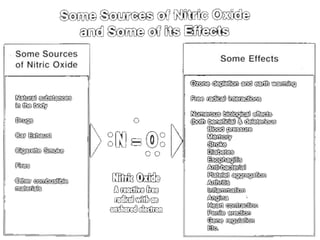
• an oxygen-containing free radical which, is both
essential to life and toxic
• at high concentrations, it combines with O2 or with
superoxide to form additional reactive and toxic
species containing both nitrogen and oxygen
(RNOS).
• RNOS are involved in neurodegenerative diseases,
such as Parkinson’s disease, and in chronic
inflammatory diseases, such as rheumatoid arthritis.
NO Toxicity
• DIRECT TOXIC EFFECTS OF NO RNOS TOXICITY
by combining with Fe-containing
compoundsthat also have single
electrons
Major destructive sites of attack
include Fe-
S centers (e.g., electron transport
chain complexes I-III, aconitase) and
Fe-heme
proteins (e.g., hemoglobin and
electron transport chain
cytochromes)
Aconitase
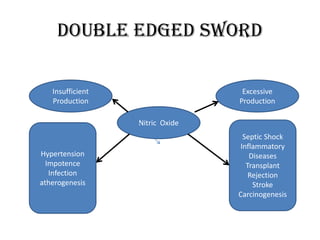
DOUBLE EDGED SWORD
Nitric Oxide
Insufficient
Production
Excessive
Production
Hypertension
Impotence
Infection
atherogenesis
Septic Shock
Inflammatory
Diseases
Transplant
Rejection
Stroke
Carcinogenesis
NO binding to Hemoglobin
• Binds at two sites –
• 1.involved in scavenging NO through its binding to ferrous
iron of heme
• Affinity of NO at Fe+2 heme site is about 8000 times greater
than oxygen affinity at same site
• 2.reversible process
• Occurs at B93 cysteine residues with formation of S-
nitrosothiol
• This is linked to binding of oxygen to hemoglobin in lungs and
release of NO and O2 in tissues
• Exact role of transport of NO by hemoglobin is not known
Signal transduction by CGMP
independent mechanisms
• ADP ribosylation of Glyceraldehyde -3 – phosphate
dehydrogenase
• Interactions with Heme containing and non- heme iron sulfur
containing proteins
• NO activates ADP ribosyltransferase which catalyses transfer
of ADP – ribose from NAD+ to GADPH.This cause
inactivation of GADPH causing inhibition of glycolysis and
decreased ATP production
• Antiaggregablity of platelets and neurotoxicity of NO are due
to inhibition of glycolysis
Endogenous inhibitor
Assymetric Dimethyl Arginine
An Arginine Analogue
Competitive inhibitor of NO synthase
Increases in Preeclampsia
Clinical Aspect
• Angina Pectoris
• Septic shock
• Pre Eclampsia
• iNO in preterm infants
• NO mediates normal lung growth
• Improves early pulmonary function
• Modifies lung growth and elastin depositio
• Surfactant dysfunction is improved by iNO
• Low dose iNO is an antioxidant
BIBLOGRAPHY
• Satyanaryan
• Ranna Shinde
• Harper
• Voet
• Marks
• Lippincott
THANK YOU

Nitric oxide

  • 1.
    NITRIC OXIDE Dr.Rittu Chandel JuniorResident in Biochemistry Grant Government Medical College,Mumbai lipophilic gas that is able to diffuse into the cell (half-life 5 s) prevents it from acting much farther than 1 mm from its site of synthesis.
  • 3.
    • NO isa gas with no known cellular storage mechanism • NO is the lowest molecular weight human cell product
  • 4.
    functions • the endothelium-derivedrelaxing factor, which causes vasodilation by relaxing vascular smooth muscle. • acts as a neurotransmitter • prevents platelet aggregation • an essential role in macrophage function. • Vasodilator, important in regulation of blood pressure • Involved in penile erection; sildenafil citrate (Viagra) affects this process by inhibiting a cGMP phosphodiesterase NO and peroxy nitrite induce apoptosis in different types of neural cells. Role in neurotoxicity Low level of NO involved in causation of pylorospasm in infantile hypertrophic pyloric stenosis
  • 5.
    Synthesis of NO •SUBSTRATES :Arginine, 02 , and NADPH • ENZYME :cytosolic NO synthase • COENZYMES: FMN, FAD, heme, and tetrahydrobiopterin • PRODUCTS :NO and citrulline NOS is a dioxygenase A two step process requiring five electron oxidations
  • 6.
    NOS is ahomodimeric protein of 125-to 160-kD subunits each subunit contains one FMN, one FAD, one tetrahydrobiopterin and one Fe(III)-heme. These cofactors facilitate the five-electron oxidation of arginine to produce NO.
  • 7.
    NO synthases enzymes Firstfound in eNOS ( isoform III) On chromosome 7 Constitutive Ca2+-calmodulin dependent endothelium NNOS (isoform I) On chromosome 12 Constitutive Ca2+-calmodulin dependent neural tissue Implicated in long QT syndrome INOS (isoform II) On chromosome 17 inducible, regulated principally by induction of gene transcription Ca2+-independent (specific inducers - tumor necrosis factor-a, bacterial endotoxins, and inflammatory Cytokines) many cells, including hepatocytes, macrophages, monocytes, and neutrophils produces high and toxic levels of NO to assist in killing invading microorganisms. It is these very high levels of NO that are associated with generation of RNOS and NO toxicity NO is rapidly inactivated by nonspecific binding to many molecules, and therefore cells that produce NO need to be close to the target cells.
  • 8.
    Review of SmoothMuscle Contraction
  • 9.
    Actions of NOon vascular endothelium NO is synthesized by eNOS in endothelial cells and diffuses to vascular smooth muscle it activates the cytosolic form of guanylate cyclase. The resultant rise in cGMP causes muscle relaxation through activation of protein kinase G,which phosphorylates myosin light-chain kinase and renders it inactive, thereby decreasing smooth muscle contraction.
  • 11.
    Role of NOin mediating macrophage bactericidal activity In macrophages, iNOS activity is normally low synthesis of the enzyme is significantly stimulated by bacterial lipopolysaccharide and y-interferon release in response to infection Activated macrophages form superoxide radicals that combine with NO to form intermediates that decompose, forming the highly bactericidal OH«" radical.
  • 12.
    The Role ofNO in Platelets • NO inhibits platelet adhesion, aggregation, and recruitment • Mechanism of Action Inhibition of NO Synthase Inhibition of NO Production Platelet Accumulation in Vasculature Shorten Bleeding Time Binding of NO to sGC Increase in cGMP Decrease in Intracellular Ca2+ Decrease Platelet Association
  • 13.
    The Role ofNO in Vascular Smooth Muscle Cell Proliferation • VSMC proliferation is usually involved with atherosclerosis • NO inhibits proliferation of VSMC – Mice study done by Moroi et al., 1998 • Mechanism of Action 1 • Mechanism of Action 2 – NO can upregulate Fas expression on VSMC NO increases cAMP levels Activation of Protein Kinase A (PKA) Transport of Ca2+, Decreasing Intracellular Ca2+ Decreased VSMC Proliferation
  • 14.
    2. Nitric oxide(NO) NO, a simple gas, is able to diffuse across the membrane, and alters the activity of intracellular target enzymes. It’s extremely unstable, so its effects are local. Ex. It signals the dilation of blood vessels. Mechanism. Acetylcholine is released from the terminus of nerve cell in the blood vessel wall. The endothelial cells are stimulated to produce NO (from arginine), which causes an increased synthesis of GMP, a second messenger responsible for blood vessel dilation. Ach Nerve cell endothelial cell NO GMP Vessel dilationAchR
  • 15.
    NITRIC OXIDE ANDREACTIVE NITROGEN- OXYGEN SPECIES (RNOS) • an oxygen-containing free radical which, is both essential to life and toxic • at high concentrations, it combines with O2 or with superoxide to form additional reactive and toxic species containing both nitrogen and oxygen (RNOS). • RNOS are involved in neurodegenerative diseases, such as Parkinson’s disease, and in chronic inflammatory diseases, such as rheumatoid arthritis.
  • 16.
    NO Toxicity • DIRECTTOXIC EFFECTS OF NO RNOS TOXICITY by combining with Fe-containing compoundsthat also have single electrons Major destructive sites of attack include Fe- S centers (e.g., electron transport chain complexes I-III, aconitase) and Fe-heme proteins (e.g., hemoglobin and electron transport chain cytochromes) Aconitase
  • 18.
    DOUBLE EDGED SWORD NitricOxide Insufficient Production Excessive Production Hypertension Impotence Infection atherogenesis Septic Shock Inflammatory Diseases Transplant Rejection Stroke Carcinogenesis
  • 19.
    NO binding toHemoglobin • Binds at two sites – • 1.involved in scavenging NO through its binding to ferrous iron of heme • Affinity of NO at Fe+2 heme site is about 8000 times greater than oxygen affinity at same site • 2.reversible process • Occurs at B93 cysteine residues with formation of S- nitrosothiol • This is linked to binding of oxygen to hemoglobin in lungs and release of NO and O2 in tissues • Exact role of transport of NO by hemoglobin is not known
  • 20.
    Signal transduction byCGMP independent mechanisms • ADP ribosylation of Glyceraldehyde -3 – phosphate dehydrogenase • Interactions with Heme containing and non- heme iron sulfur containing proteins • NO activates ADP ribosyltransferase which catalyses transfer of ADP – ribose from NAD+ to GADPH.This cause inactivation of GADPH causing inhibition of glycolysis and decreased ATP production • Antiaggregablity of platelets and neurotoxicity of NO are due to inhibition of glycolysis
  • 21.
    Endogenous inhibitor Assymetric DimethylArginine An Arginine Analogue Competitive inhibitor of NO synthase Increases in Preeclampsia
  • 22.
    Clinical Aspect • AnginaPectoris • Septic shock • Pre Eclampsia • iNO in preterm infants • NO mediates normal lung growth • Improves early pulmonary function • Modifies lung growth and elastin depositio • Surfactant dysfunction is improved by iNO • Low dose iNO is an antioxidant
  • 23.
    BIBLOGRAPHY • Satyanaryan • RannaShinde • Harper • Voet • Marks • Lippincott THANK YOU