welcome
1
Biogas
2
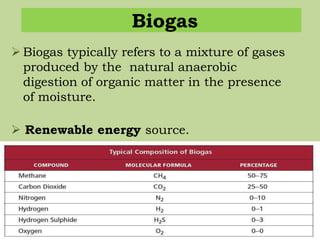
 Biogas typically refers to a mixture of gases
produced by the natural anaerobic
digestion of organic matter in the presence
of moisture.
 Renewable energy source.
Indian scenario
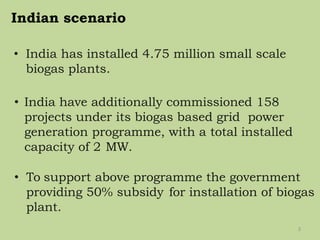
• India has installed 4.75 million small scale
biogas plants.
• India have additionally commissioned 158
projects under its biogas based grid power
generation programme, with a total installed
capacity of 2 MW.
• To support above programme the government
providing 50% subsidy for installation of biogas
plant.
3
4
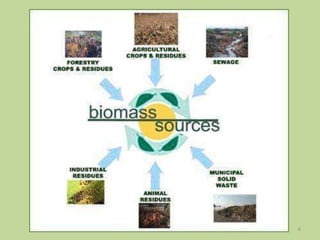
Raw materials
5
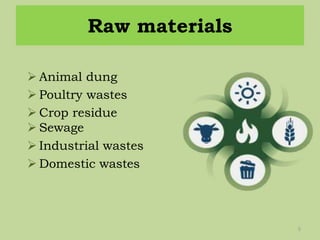
 Animal dung
 Poultry wastes
 Crop residue
 Sewage
 Industrial wastes
 Domestic wastes
6
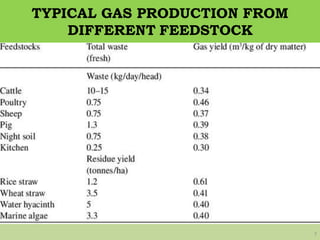
TYPICAL GAS PRODUCTION FROM
DIFFERENT FEEDSTOCK
7
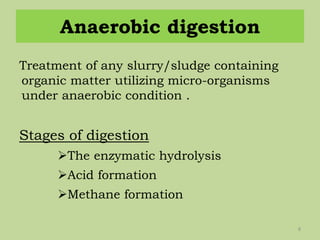
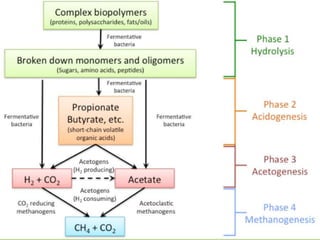
Anaerobic digestion
Treatment of any slurry/sludge containing
organic matter utilizing micro-organisms
under anaerobic condition .
Stages of digestion
The enzymatic hydrolysis
Acid formation
Methane formation
8
9
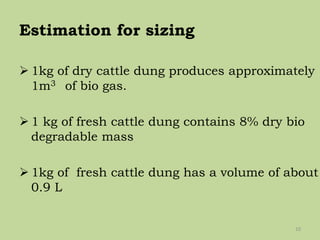
Estimation for sizing
 1kg of dry cattle dung produces approximately
1m3 of bio gas.
 1 kg of fresh cattle dung contains 8% dry bio
degradable mass
 1kg of fresh cattle dung has a volume of about
0.9 L
10
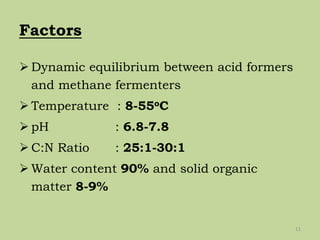
Factors
 Dynamic equilibrium between acid formers
and methane fermenters
 Temperature : 8-55oC
 pH : 6.8-7.8
 C:N Ratio : 25:1-30:1
 Water content 90% and solid organic
matter 8-9%
11
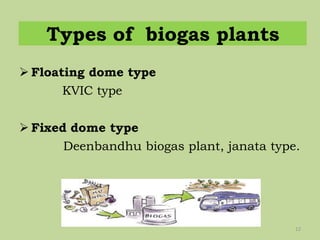
Types of biogas plants
12
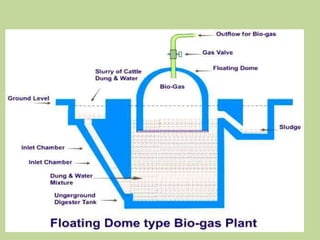
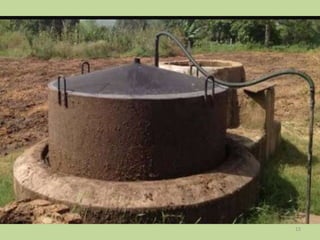
 Floating dome type
KVIC type
 Fixed dome type
Deenbandhu biogas plant, janata type.
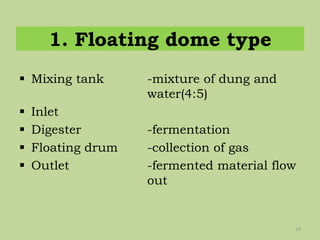
1. Floating dome type
 Mixing tank -mixture of dung and
water(4:5)
 Inlet
 Digester -fermentation
 Floating drum -collection of gas
 Outlet -fermented material flow
out
13
14
15
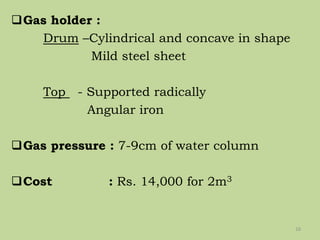
Gas holder :
Drum –Cylindrical and concave in shape
Mild steel sheet
Top - Supported radically
Angular iron
Gas pressure : 7-9cm of water column
Cost : Rs. 14,000 for 2m3
16
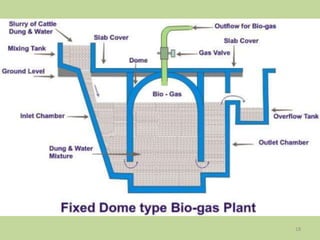
Fixed dome type
 Mixing tank
 Inlet
 Digester
 Outlet
17
18
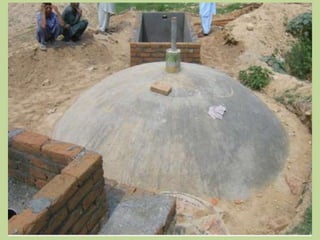
Gasholder :Hemispirically fixed dome
Reinforced concrete
Cost : Rs. 8,000 for 2m3
19
20
21
Advantages of biogas as a fuel
22
 High calorific value
 Clean fuel
 No residue produced
 No smoke produced
 Non polluting
 Economical
 Burns readily
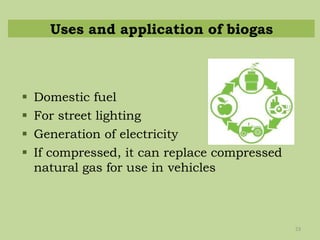
Uses and application of biogas
23
 Domestic fuel
 For street lighting
 Generation of electricity
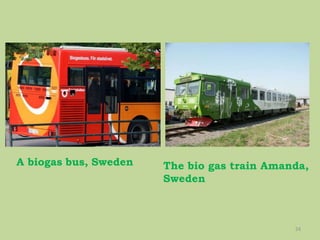
 If compressed, it can replace compressed
natural gas for use in vehicles
24
A biogas bus, Sweden The bio gas train Amanda,
Sweden
One cubic metre of bio gas can do the
following operations:
It can illuminate a mantle lamp (60 W) for a
period of 7 hours .
It can run 2 hp engine for one hour .
It can be used for cooking three meals for a
family of five .
It can run 100L capacity refrigerator for
9hours .
It can generate electricity of 1.25 KWH.
Family biogas plant - 2-3 m3.
25
Advantages :
26
Low initial investment
Suitable for rural areas .
Reduce the dependence of non renewable
resources.
The by products , nitrogen rich manure
can be used.
It improves sanitary condition and checks
environmental pollution .
Limitations :
27
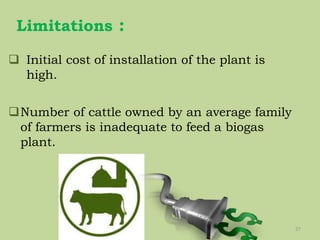
 Initial cost of installation of the plant is
high.
Number of cattle owned by an average family
of farmers is inadequate to feed a biogas
plant.
Conclusion
28
Biogas is a clean renewable source of energy.
The research organizations should focus on
newer efficient low cost designs.
 The government can play important role by
introducing different education schemes and
the availability of technology and providing
more subsidies.
Biogas technology – B T Nijaguna
ANGRAU Notes
Internet sources
29
30
Thank Yo

Biogas

  • 1.
  • 2.
    Biogas 2  Biogas typicallyrefers to a mixture of gases produced by the natural anaerobic digestion of organic matter in the presence of moisture.  Renewable energy source.
  • 3.
    Indian scenario • Indiahas installed 4.75 million small scale biogas plants. • India have additionally commissioned 158 projects under its biogas based grid power generation programme, with a total installed capacity of 2 MW. • To support above programme the government providing 50% subsidy for installation of biogas plant. 3
  • 4.
  • 5.
    Raw materials 5  Animaldung  Poultry wastes  Crop residue  Sewage  Industrial wastes  Domestic wastes
  • 6.
  • 7.
    TYPICAL GAS PRODUCTIONFROM DIFFERENT FEEDSTOCK 7
  • 8.
    Anaerobic digestion Treatment ofany slurry/sludge containing organic matter utilizing micro-organisms under anaerobic condition . Stages of digestion The enzymatic hydrolysis Acid formation Methane formation 8
  • 9.
  • 10.
    Estimation for sizing 1kg of dry cattle dung produces approximately 1m3 of bio gas.  1 kg of fresh cattle dung contains 8% dry bio degradable mass  1kg of fresh cattle dung has a volume of about 0.9 L 10
  • 11.
    Factors  Dynamic equilibriumbetween acid formers and methane fermenters  Temperature : 8-55oC  pH : 6.8-7.8  C:N Ratio : 25:1-30:1  Water content 90% and solid organic matter 8-9% 11
  • 12.
    Types of biogasplants 12  Floating dome type KVIC type  Fixed dome type Deenbandhu biogas plant, janata type.
  • 13.
    1. Floating dometype  Mixing tank -mixture of dung and water(4:5)  Inlet  Digester -fermentation  Floating drum -collection of gas  Outlet -fermented material flow out 13
  • 14.
  • 15.
  • 16.
    Gas holder : Drum–Cylindrical and concave in shape Mild steel sheet Top - Supported radically Angular iron Gas pressure : 7-9cm of water column Cost : Rs. 14,000 for 2m3 16
  • 17.
    Fixed dome type Mixing tank  Inlet  Digester  Outlet 17
  • 18.
  • 19.
    Gasholder :Hemispirically fixeddome Reinforced concrete Cost : Rs. 8,000 for 2m3 19
  • 20.
  • 21.
  • 22.
    Advantages of biogasas a fuel 22  High calorific value  Clean fuel  No residue produced  No smoke produced  Non polluting  Economical  Burns readily
  • 23.
    Uses and applicationof biogas 23  Domestic fuel  For street lighting  Generation of electricity  If compressed, it can replace compressed natural gas for use in vehicles
  • 24.
    24 A biogas bus,Sweden The bio gas train Amanda, Sweden
  • 25.
    One cubic metreof bio gas can do the following operations: It can illuminate a mantle lamp (60 W) for a period of 7 hours . It can run 2 hp engine for one hour . It can be used for cooking three meals for a family of five . It can run 100L capacity refrigerator for 9hours . It can generate electricity of 1.25 KWH. Family biogas plant - 2-3 m3. 25
  • 26.
    Advantages : 26 Low initialinvestment Suitable for rural areas . Reduce the dependence of non renewable resources. The by products , nitrogen rich manure can be used. It improves sanitary condition and checks environmental pollution .
  • 27.
    Limitations : 27  Initialcost of installation of the plant is high. Number of cattle owned by an average family of farmers is inadequate to feed a biogas plant.
  • 28.
    Conclusion 28 Biogas is aclean renewable source of energy. The research organizations should focus on newer efficient low cost designs.  The government can play important role by introducing different education schemes and the availability of technology and providing more subsidies.
  • 29.
    Biogas technology –B T Nijaguna ANGRAU Notes Internet sources 29
  • 30.