Sourav Bagchi
Power Engineering
Jadavpur University
Roll-001211501006
• Huge Sources:
There is no element in the universe as abundant as hydrogen.
• No Harmful Emission:
In fact, when used in NASA’s spaceships, the burned hydrogen gas leaves
behind clean drinking water for the astronauts.
• Environment Friendly
• Fuel Efficient:
Hydrogen energy is very efficient fuel source than traditional sources
of energy and produces more energy per pound of fuel.
• Renewable:
We can get Hydrogen by breaking water molecules.
Why Hydrogen is used as Fuel?
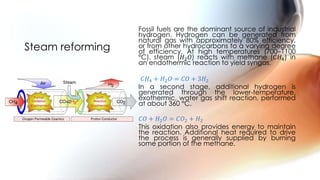
Fossil fuels are the dominant source of industrial
hydrogen. Hydrogen can be generated from
natural gas with approximately 80% efficiency,
or from other hydrocarbons to a varying degree
of efficiency. At high temperatures (700–1100
°C), steam (𝐻2 𝑂) reacts with methane (𝐶𝐻4) in
an endothermic reaction to yield syngas.
𝐶𝐻4 + 𝐻2 𝑂 = 𝐶𝑂 + 3𝐻2
In a second stage, additional hydrogen is
generated through the lower-temperature,
exothermic, water gas shift reaction, performed
at about 360 °C.
𝐶𝑂 + 𝐻2 𝑂 = 𝐶𝑂2 + 𝐻2
This oxidation also provides energy to maintain
the reaction. Additional heat required to drive
the process is generally supplied by burning
some portion of the methane.
Steam reforming
The partial oxidation reaction occurs when
a sub-stoichiometric fuel-air mixture is
partially combusted in a reformer, creating
a hydrogen-rich syngas. A distinction is
made between thermal partial oxidation
(TPOX) [ ≥ 1200°C] and catalytic partial
oxidation (CPOX) [800°C-900°C]. The
chemical reaction takes the general form:
𝐶 𝑛 𝐻 𝑚 +
𝑛
2
𝑂2 → 𝑛𝐶𝑂 +
𝑚
2
𝐻2
Idealized examples for heating oil and coal,
assuming compositions 𝐶12 𝐻24 and 𝐶12 𝐻12
respectively, are as follows:
𝐶12 𝐻24 + 6𝑂2 → 12𝐶𝑂 + 12𝐻2
𝐶24 𝐻12 + 12𝑂2 → 12𝐶𝑂 + 12𝐻2
Partial oxidation
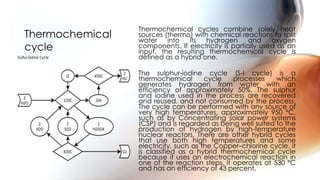
Thermochemical cycles combine solely heat
sources (thermo) with chemical reactions to split
water into its hydrogen and oxygen
components. If electricity is partially used as an
input, the resulting thermochemical cycle is
defined as a hybrid one.
The sulphur-iodine cycle (S-I cycle) is a
thermochemical cycle processes which
generates hydrogen from water with an
efficiency of approximately 50%. The sulphur
and iodine used in the process are recovered
and reused, and not consumed by the process.
The cycle can be performed with any source of
very high temperatures, approximately 950 °C,
such as by Concentrating solar power systems
(CSP) and is regarded as being well suited to the
production of hydrogen by high-temperature
nuclear reactors, There are other hybrid cycles
that use both high temperatures and some
electricity, such as the Copper–chlorine cycle, it
is classified as a hybrid thermochemical cycle
because it uses an electrochemical reaction in
one of the reaction steps, it operates at 530 °C
and has an efficiency of 43 percent.
Thermochemical
cycle
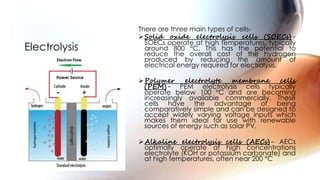
There are three main types of cells-
Solid oxide electrolysis cells (SOECs)-
SOECs operate at high temperatures, typically
around 800 °C. This has the potential to
reduce the overall cost of the hydrogen
produced by reducing the amount of
electrical energy required for electrolysis.
Polymer electrolyte membrane cells
(PEM)- PEM electrolysis cells typically
operate below 100 °C and are becoming
increasingly available commercially. These
cells have the advantage of being
comparatively simple and can be designed to
accept widely varying voltage inputs which
makes them ideal for use with renewable
sources of energy such as solar PV.
Alkaline electrolysis cells (AECs)- AECs
optimally operate at high concentrations
electrolyte (KOH or potassium carbonate) and
at high temperatures, often near 200 °C
Electrolysis
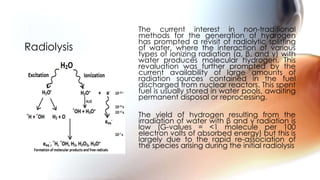
The current interest in non-traditional
methods for the generation of hydrogen
has prompted a revisit of radiolytic splitting
of water, where the interaction of various
types of ionizing radiation (α, β, and γ) with
water produces molecular hydrogen. This
revaluation was further prompted by the
current availability of large amounts of
radiation sources contained in the fuel
discharged from nuclear reactors. This spent
fuel is usually stored in water pools, awaiting
permanent disposal or reprocessing.
The yield of hydrogen resulting from the
irradiation of water with β and γ radiation is
low (G-values = <1 molecule per 100
electron volts of absorbed energy) but this is
largely due to the rapid re-association of
the species arising during the initial radiolysis
Radiolysis
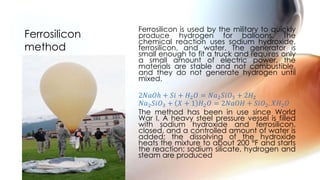
Ferrosilicon is used by the military to quickly
produce hydrogen for balloons. The
chemical reaction uses sodium hydroxide,
ferrosilicon, and water. The generator is
small enough to fit a truck and requires only
a small amount of electric power, the
materials are stable and not combustible,
and they do not generate hydrogen until
mixed.
2𝑁𝑎𝑂ℎ + 𝑆𝑖 + 𝐻2 𝑂 = 𝑁𝑎2 𝑆𝑖𝑂3 + 2𝐻2
𝑁𝑎2 𝑆𝑖𝑂3 + 𝑋 + 1 𝐻2 𝑂 = 2𝑁𝑎𝑂𝐻 + 𝑆𝑖𝑂2. 𝑋𝐻2 𝑂
The method has been in use since World
War I. A heavy steel pressure vessel is filled
with sodium hydroxide and ferrosilicon,
closed, and a controlled amount of water is
added; the dissolving of the hydroxide
heats the mixture to about 200 °F and starts
the reaction; sodium silicate, hydrogen and
steam are produced
Ferrosilicon
method
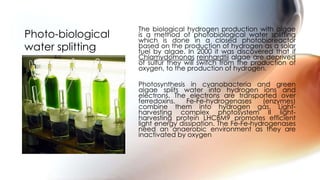
The biological hydrogen production with algae
is a method of photobiological water splitting
which is done in a closed photobioreactor
based on the production of hydrogen as a solar
fuel by algae. In 2000 it was discovered that if
Chlamydomonas reinhardtii algae are deprived
of sulfur they will switch from the production of
oxygen, to the production of hydrogen.
Photosynthesis in cyanobacteria and green
algae splits water into hydrogen ions and
electrons. The electrons are transported over
ferredoxins. Fe-Fe-hydrogenases (enzymes)
combine them into hydrogen gas. Light-
harvesting complex photosystem II light-
harvesting protein LHCBM9 promotes efficient
light energy dissipation. The Fe-Fe-hydrogenases
need an anaerobic environment as they are
inactivated by oxygen
Photo-biological
water splitting
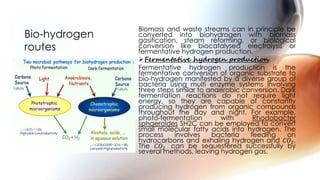
Biomass and waste streams can in principle be
converted into biohydrogen with biomass
gasification, steam reforming, or biological
conversion like biocatalysed electrolysis or
fermentative hydrogen production.
Fermentative hydrogen production
Fermentative hydrogen production is the
fermentative conversion of organic substrate to
bio-hydrogen manifested by a diverse group of
bacteria using multi enzyme systems involving
three steps similar to anaerobic conversion. Dark
fermentation reactions do not require light
energy, so they are capable of constantly
producing hydrogen from organic compounds
throughout the day and night. For example,
photo-fermentation with Rhodobacter
sphaeroides SH2C can be employed to convert
small molecular fatty acids into hydrogen. The
process involves bacteria feeding on
hydrocarbons and exhaling hydrogen and 𝐶𝑂2.
The 𝐶𝑂2 can be sequestered successfully by
several methods, leaving hydrogen gas.
Bio-hydrogen
routes
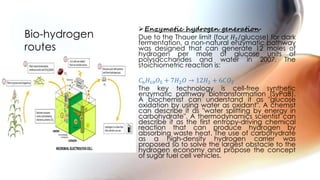
Enzymatic hydrogen generation-
Due to the Thauer limit (four 𝐻2/glucose) for dark
fermentation, a non-natural enzymatic pathway
was designed that can generate 12 moles of
hydrogen per mole of glucose units of
polysaccharides and water in 2007. The
stoichiometric reaction is:
𝐶6 𝐻10 𝑂5 + 7𝐻2 𝑂 → 12𝐻2 + 6𝐶𝑂2
The key technology is cell-free synthetic
enzymatic pathway biotransformation (SyPaB).
A biochemist can understand it as "glucose
oxidation by using water as oxidant". A chemist
can describe it as "water splitting by energy in
carbohydrate". A thermodynamics scientist can
describe it as the first entropy-driving chemical
reaction that can produce hydrogen by
absorbing waste heat. The use of carbohydrate
as a high-density hydrogen carrier was
proposed so to solve the largest obstacle to the
hydrogen economy and propose the concept
of sugar fuel cell vehicles.
Bio-hydrogen
routes
• Prof. Bireswar Majumdar for giving me such a good topic.
• Prof. Amitava Dutta for suggesting this topic.
• http://www.conserve-energy-
future.com/Advantages_Disadvantages_HydrogenEnergy
.php
• https://en.wikipedia.org/wiki/Hydrogen_production
Acknowledgement
Hydrogen generation

Hydrogen generation

  • 1.
    Sourav Bagchi Power Engineering JadavpurUniversity Roll-001211501006
  • 2.
    • Huge Sources: Thereis no element in the universe as abundant as hydrogen. • No Harmful Emission: In fact, when used in NASA’s spaceships, the burned hydrogen gas leaves behind clean drinking water for the astronauts. • Environment Friendly • Fuel Efficient: Hydrogen energy is very efficient fuel source than traditional sources of energy and produces more energy per pound of fuel. • Renewable: We can get Hydrogen by breaking water molecules. Why Hydrogen is used as Fuel?
  • 3.
    Fossil fuels arethe dominant source of industrial hydrogen. Hydrogen can be generated from natural gas with approximately 80% efficiency, or from other hydrocarbons to a varying degree of efficiency. At high temperatures (700–1100 °C), steam (𝐻2 𝑂) reacts with methane (𝐶𝐻4) in an endothermic reaction to yield syngas. 𝐶𝐻4 + 𝐻2 𝑂 = 𝐶𝑂 + 3𝐻2 In a second stage, additional hydrogen is generated through the lower-temperature, exothermic, water gas shift reaction, performed at about 360 °C. 𝐶𝑂 + 𝐻2 𝑂 = 𝐶𝑂2 + 𝐻2 This oxidation also provides energy to maintain the reaction. Additional heat required to drive the process is generally supplied by burning some portion of the methane. Steam reforming
  • 4.
    The partial oxidationreaction occurs when a sub-stoichiometric fuel-air mixture is partially combusted in a reformer, creating a hydrogen-rich syngas. A distinction is made between thermal partial oxidation (TPOX) [ ≥ 1200°C] and catalytic partial oxidation (CPOX) [800°C-900°C]. The chemical reaction takes the general form: 𝐶 𝑛 𝐻 𝑚 + 𝑛 2 𝑂2 → 𝑛𝐶𝑂 + 𝑚 2 𝐻2 Idealized examples for heating oil and coal, assuming compositions 𝐶12 𝐻24 and 𝐶12 𝐻12 respectively, are as follows: 𝐶12 𝐻24 + 6𝑂2 → 12𝐶𝑂 + 12𝐻2 𝐶24 𝐻12 + 12𝑂2 → 12𝐶𝑂 + 12𝐻2 Partial oxidation
  • 5.
    Thermochemical cycles combinesolely heat sources (thermo) with chemical reactions to split water into its hydrogen and oxygen components. If electricity is partially used as an input, the resulting thermochemical cycle is defined as a hybrid one. The sulphur-iodine cycle (S-I cycle) is a thermochemical cycle processes which generates hydrogen from water with an efficiency of approximately 50%. The sulphur and iodine used in the process are recovered and reused, and not consumed by the process. The cycle can be performed with any source of very high temperatures, approximately 950 °C, such as by Concentrating solar power systems (CSP) and is regarded as being well suited to the production of hydrogen by high-temperature nuclear reactors, There are other hybrid cycles that use both high temperatures and some electricity, such as the Copper–chlorine cycle, it is classified as a hybrid thermochemical cycle because it uses an electrochemical reaction in one of the reaction steps, it operates at 530 °C and has an efficiency of 43 percent. Thermochemical cycle
  • 6.
    There are threemain types of cells- Solid oxide electrolysis cells (SOECs)- SOECs operate at high temperatures, typically around 800 °C. This has the potential to reduce the overall cost of the hydrogen produced by reducing the amount of electrical energy required for electrolysis. Polymer electrolyte membrane cells (PEM)- PEM electrolysis cells typically operate below 100 °C and are becoming increasingly available commercially. These cells have the advantage of being comparatively simple and can be designed to accept widely varying voltage inputs which makes them ideal for use with renewable sources of energy such as solar PV. Alkaline electrolysis cells (AECs)- AECs optimally operate at high concentrations electrolyte (KOH or potassium carbonate) and at high temperatures, often near 200 °C Electrolysis
  • 7.
    The current interestin non-traditional methods for the generation of hydrogen has prompted a revisit of radiolytic splitting of water, where the interaction of various types of ionizing radiation (α, β, and γ) with water produces molecular hydrogen. This revaluation was further prompted by the current availability of large amounts of radiation sources contained in the fuel discharged from nuclear reactors. This spent fuel is usually stored in water pools, awaiting permanent disposal or reprocessing. The yield of hydrogen resulting from the irradiation of water with β and γ radiation is low (G-values = <1 molecule per 100 electron volts of absorbed energy) but this is largely due to the rapid re-association of the species arising during the initial radiolysis Radiolysis
  • 8.
    Ferrosilicon is usedby the military to quickly produce hydrogen for balloons. The chemical reaction uses sodium hydroxide, ferrosilicon, and water. The generator is small enough to fit a truck and requires only a small amount of electric power, the materials are stable and not combustible, and they do not generate hydrogen until mixed. 2𝑁𝑎𝑂ℎ + 𝑆𝑖 + 𝐻2 𝑂 = 𝑁𝑎2 𝑆𝑖𝑂3 + 2𝐻2 𝑁𝑎2 𝑆𝑖𝑂3 + 𝑋 + 1 𝐻2 𝑂 = 2𝑁𝑎𝑂𝐻 + 𝑆𝑖𝑂2. 𝑋𝐻2 𝑂 The method has been in use since World War I. A heavy steel pressure vessel is filled with sodium hydroxide and ferrosilicon, closed, and a controlled amount of water is added; the dissolving of the hydroxide heats the mixture to about 200 °F and starts the reaction; sodium silicate, hydrogen and steam are produced Ferrosilicon method
  • 9.
    The biological hydrogenproduction with algae is a method of photobiological water splitting which is done in a closed photobioreactor based on the production of hydrogen as a solar fuel by algae. In 2000 it was discovered that if Chlamydomonas reinhardtii algae are deprived of sulfur they will switch from the production of oxygen, to the production of hydrogen. Photosynthesis in cyanobacteria and green algae splits water into hydrogen ions and electrons. The electrons are transported over ferredoxins. Fe-Fe-hydrogenases (enzymes) combine them into hydrogen gas. Light- harvesting complex photosystem II light- harvesting protein LHCBM9 promotes efficient light energy dissipation. The Fe-Fe-hydrogenases need an anaerobic environment as they are inactivated by oxygen Photo-biological water splitting
  • 10.
    Biomass and wastestreams can in principle be converted into biohydrogen with biomass gasification, steam reforming, or biological conversion like biocatalysed electrolysis or fermentative hydrogen production. Fermentative hydrogen production Fermentative hydrogen production is the fermentative conversion of organic substrate to bio-hydrogen manifested by a diverse group of bacteria using multi enzyme systems involving three steps similar to anaerobic conversion. Dark fermentation reactions do not require light energy, so they are capable of constantly producing hydrogen from organic compounds throughout the day and night. For example, photo-fermentation with Rhodobacter sphaeroides SH2C can be employed to convert small molecular fatty acids into hydrogen. The process involves bacteria feeding on hydrocarbons and exhaling hydrogen and 𝐶𝑂2. The 𝐶𝑂2 can be sequestered successfully by several methods, leaving hydrogen gas. Bio-hydrogen routes
  • 11.
    Enzymatic hydrogen generation- Dueto the Thauer limit (four 𝐻2/glucose) for dark fermentation, a non-natural enzymatic pathway was designed that can generate 12 moles of hydrogen per mole of glucose units of polysaccharides and water in 2007. The stoichiometric reaction is: 𝐶6 𝐻10 𝑂5 + 7𝐻2 𝑂 → 12𝐻2 + 6𝐶𝑂2 The key technology is cell-free synthetic enzymatic pathway biotransformation (SyPaB). A biochemist can understand it as "glucose oxidation by using water as oxidant". A chemist can describe it as "water splitting by energy in carbohydrate". A thermodynamics scientist can describe it as the first entropy-driving chemical reaction that can produce hydrogen by absorbing waste heat. The use of carbohydrate as a high-density hydrogen carrier was proposed so to solve the largest obstacle to the hydrogen economy and propose the concept of sugar fuel cell vehicles. Bio-hydrogen routes
  • 12.
    • Prof. BireswarMajumdar for giving me such a good topic. • Prof. Amitava Dutta for suggesting this topic. • http://www.conserve-energy- future.com/Advantages_Disadvantages_HydrogenEnergy .php • https://en.wikipedia.org/wiki/Hydrogen_production Acknowledgement