Topic Assigned: Cytotaxonomy
Presented by: Ishtiyaq Mir
MSc Zoology (1st Semester)
Batch: 2021
Supervisor: Prof. Farooq Ahmad
CONTENTS
 INTRODUCTION
 DEFINITION
 HISTORY
 CHROMOSOME NUMBER
 CHROMOSOME SHAPE
 CHROMOSOME BANDS
 CHROMOSOME EVOLUTION IN PRIMATES
 BIBLIOGRAPHY
Introduction to Cytotaxonomy
 Cytotaxonomy is a branch of taxonomy that uses the
characteristics of cellular structures (especially
chromosomes) to classify organisms.The Term
Cytotaxonomy was proposed by Levan et al.
 In Cytotaxonomy, the chromosomal configuration is
widely used parameter to study relationships
between organisms.
 The number, structure and behaviour of
chromosomes is of great value in taxonomy.
Definition and History
 Cytotaxonomy is a branch of taxonomy dealing with the
classification of organisms using comparative study of
chromosomes during cell division in the elucidation of
taxonomical problems.
The species relationships is based on the assumption that
closely related species share similar chromosomal setup
(karyotype)
Cytology has contributed to track the evolutionary history of
many organisms especially primates.
Chromosome Number
All individuals within a species possess the same
chromosome number.
Variation in chromosome number is a taxonomic tool.
Its number is usually constant within a genus.
It helps in controversies in identifying the genus.
Example, Homo sapiens(23 pairs).
Pan troglodytes (24 pairs).
Chromosome Shape
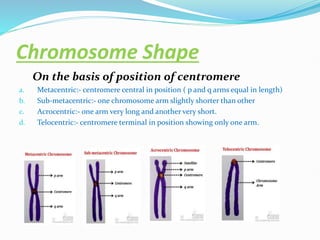
On the basis of position of centromere
a. Metacentric:- centromere central in position ( p and q arms equal in length)
b. Sub-metacentric:- one chromosome arm slightly shorter than other
c. Acrocentric:- one arm very long and another very short.
d. Telocentric:- centromere terminal in position showing only one arm.
BANDED CHROMOSOMES AND
PHYLOGENY
 Chromosome Banding refers to alternate dark and
light regions along the length of chromosome,
produced after staining with a dye(G-banding, R-
banding).
 Chromosome evolve by
a) Deletion of DNA segments
b) Duplication of DNA segments
c) Inversion of DNA segments
d) Translocation of DNA segments
Chromosome Evolution in Primates
Apes and Men
Chromosome banding techniques have now been
applied to non human organisms.
The karyotypes are more than 60 species of primates
have been studied and compared, with the use of
almost all banding techniques.
Relations among different breeding populations can
be estimated by comparing chromosomal
characteristics of different taxonomical groups.
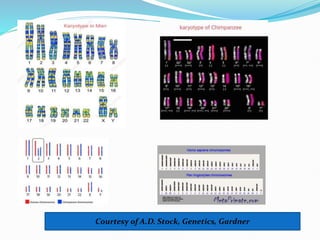
Man( Homo sapiens) and Chimpanzee(Pan troglodytes)
are placed in different genera Homo and Pan
respectively. But these species are much alike in almost
all features(DNA, Protein composition)
Comparisons of chromosomes show basic similarity with
a few super imposed structural re-arrangements.
The overall number of chromosomes is (46 for Homo,
48 for Pan)
Two acrocentrics in Pan(2A and 2B) have the same bands
as one sub-metacentric to make the equivalent of 46 in
both species.
Courtesy of A.D. Stock, Genetics, Gardner
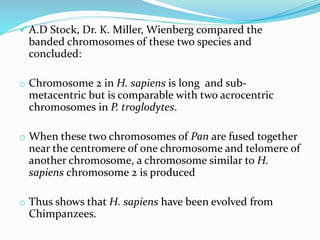
A.D Stock, Dr. K. Miller, Wienberg compared the
banded chromosomes of these two species and
concluded:
o Chromosome 2 in H. sapiens is long and sub-
metacentric but is comparable with two acrocentric
chromosomes in P. troglodytes.
o When these two chromosomes of Pan are fused together
near the centromere of one chromosome and telomere of
another chromosome, a chromosome similar to H.
sapiens chromosome 2 is produced
o Thus shows that H. sapiens have been evolved from
Chimpanzees.
References/Bibliography
 Principles of Genetics by Gardener et-al., John Wiley.
 Principles of Systematics by Ernst Mayr, Tata McGraw Company
 Organic Evolution by N Arumugam, Saras publication.
 https://www.slideshare.net/gkumarimahesh/cytotaxonomy
 https://www.scribd.com/presentation479985036/INTERDICIPLIN
ARY-APPROACH-IN-TAXONOMY-CYTOTAXONOMY
 https://Youtube.com
Cytotaxonomy(Its History,Background, Chromosome Evolution in Primates.pptx

Cytotaxonomy(Its History,Background, Chromosome Evolution in Primates.pptx

  • 1.
    Topic Assigned: Cytotaxonomy Presentedby: Ishtiyaq Mir MSc Zoology (1st Semester) Batch: 2021 Supervisor: Prof. Farooq Ahmad
  • 2.
    CONTENTS  INTRODUCTION  DEFINITION HISTORY  CHROMOSOME NUMBER  CHROMOSOME SHAPE  CHROMOSOME BANDS  CHROMOSOME EVOLUTION IN PRIMATES  BIBLIOGRAPHY
  • 3.
    Introduction to Cytotaxonomy Cytotaxonomy is a branch of taxonomy that uses the characteristics of cellular structures (especially chromosomes) to classify organisms.The Term Cytotaxonomy was proposed by Levan et al.  In Cytotaxonomy, the chromosomal configuration is widely used parameter to study relationships between organisms.  The number, structure and behaviour of chromosomes is of great value in taxonomy.
  • 4.
    Definition and History Cytotaxonomy is a branch of taxonomy dealing with the classification of organisms using comparative study of chromosomes during cell division in the elucidation of taxonomical problems. The species relationships is based on the assumption that closely related species share similar chromosomal setup (karyotype) Cytology has contributed to track the evolutionary history of many organisms especially primates.
  • 5.
    Chromosome Number All individualswithin a species possess the same chromosome number. Variation in chromosome number is a taxonomic tool. Its number is usually constant within a genus. It helps in controversies in identifying the genus. Example, Homo sapiens(23 pairs). Pan troglodytes (24 pairs).
  • 6.
    Chromosome Shape On thebasis of position of centromere a. Metacentric:- centromere central in position ( p and q arms equal in length) b. Sub-metacentric:- one chromosome arm slightly shorter than other c. Acrocentric:- one arm very long and another very short. d. Telocentric:- centromere terminal in position showing only one arm.
  • 7.
    BANDED CHROMOSOMES AND PHYLOGENY Chromosome Banding refers to alternate dark and light regions along the length of chromosome, produced after staining with a dye(G-banding, R- banding).  Chromosome evolve by a) Deletion of DNA segments b) Duplication of DNA segments c) Inversion of DNA segments d) Translocation of DNA segments
  • 8.
    Chromosome Evolution inPrimates Apes and Men Chromosome banding techniques have now been applied to non human organisms. The karyotypes are more than 60 species of primates have been studied and compared, with the use of almost all banding techniques. Relations among different breeding populations can be estimated by comparing chromosomal characteristics of different taxonomical groups.
  • 9.
    Man( Homo sapiens)and Chimpanzee(Pan troglodytes) are placed in different genera Homo and Pan respectively. But these species are much alike in almost all features(DNA, Protein composition) Comparisons of chromosomes show basic similarity with a few super imposed structural re-arrangements. The overall number of chromosomes is (46 for Homo, 48 for Pan) Two acrocentrics in Pan(2A and 2B) have the same bands as one sub-metacentric to make the equivalent of 46 in both species.
  • 10.
    Courtesy of A.D.Stock, Genetics, Gardner
  • 11.
    A.D Stock, Dr.K. Miller, Wienberg compared the banded chromosomes of these two species and concluded: o Chromosome 2 in H. sapiens is long and sub- metacentric but is comparable with two acrocentric chromosomes in P. troglodytes. o When these two chromosomes of Pan are fused together near the centromere of one chromosome and telomere of another chromosome, a chromosome similar to H. sapiens chromosome 2 is produced o Thus shows that H. sapiens have been evolved from Chimpanzees.
  • 12.
    References/Bibliography  Principles ofGenetics by Gardener et-al., John Wiley.  Principles of Systematics by Ernst Mayr, Tata McGraw Company  Organic Evolution by N Arumugam, Saras publication.  https://www.slideshare.net/gkumarimahesh/cytotaxonomy  https://www.scribd.com/presentation479985036/INTERDICIPLIN ARY-APPROACH-IN-TAXONOMY-CYTOTAXONOMY  https://Youtube.com