COLLEGE OF VETERINARY SCIENCE AND ANIMAL HUSBANDRY
ANDUAT, AYODHYA
SUBJECT-BasicConceptsin LaboratoryTechniques(PGS603)
ASSIGNMENT TOPIC :
Description of flowering plants in botanical terms in
relation to taxonomy
Suggested by – Dr. Chandra Shekhar (Professor)
Dept. of Public Health & Epidemiology
Presented by
SHARDENDU NARAYAN GIRI
Id. No. :V-10600/18/23 , Phd, 1st Year, 1st Semester
DEPARTMENT OF LIVESTOCK PRODUCTION MANAGEMENT
The Description of Flowers
 The flower is the reproductive unit in the
angiosperms.
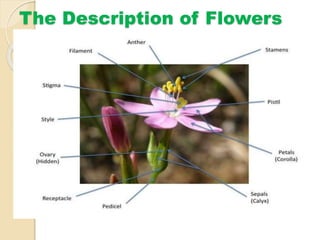
 A typical flower has four different kinds of whorls
 Calyx
 Corolla
 Androecium
 Gynoecium
 When a flower has both androecium and gynoecium, it
is bisexual.
 A flower having either only stamens or only carpels is
unisexual.
Calyx
 The calyx is the
outermost
whorl of the flower
and the members
are called sepals.
 Generally, sepals are green, leaf like and protect
the flower in the bud stage.
 The calyx may be gamosepalous (sepals united) or
polysepalous (sepals free).
Corolla
 Corolla is
Composed of petals.
 Petals are usually
brightly colored to
attract insects for pollination.
 Like calyx, corolla may also be gamopetalous
(petals united) or polypetalous (petals free).
 The shape and colour of corolla vary greatly in
plants.
 Corolla may be tubular, bell-shaped, funnel-shaped
or wheel-shaped
Androecium
 Androecium is
composed of stamens.
 Each stamen which
represents the male
reproductive organ
consists of a stalk or a filament and an anther.
 Each anther is usually bilobed and each lobe has
two chambers, the pollen-sacs.
 The pollen grains are produced in pollen-sacs.
 Stamens of flower may be
united with other members
such as petals or among themselves.
 When stamens are attached to
the petals, they are epipetalous
or epiphyllous.
 The stamens in a flower may
either remain free (polyandrous)
or may be united in varying degrees.
 The stamens may be united into one bunch or
one bundle (monoadelphous) or two bundles
(diadelphous) or into more than two bundles
(polyadelphous).
 There may be a variation in the length of
filaments within a flower.
Gynoecium
 Gynoecium is the
female reproductive part
of the flower and is made
up of one or more carpels.
 A carpel consists of three
parts namely stigma, style and ovary.
 Ovary is the enlarged basal part, on which lies
the elongated tube, the style.
 The style connects the ovary to the stigma.
 The stigma is usually at the tip of the style and is
the receptive surface for pollen grains.
 Each ovary bears one or more ovules attached to
a flattened, cushion-like placenta.
 When more than one carpel is present, they may
be free (as in lotus and rose) and are called
apocarpous.
 They are termed syncarpous when carpels are
fused, as in mustard and tomato.
 After fertilisation, the ovules develop into seeds
and the ovary matures into a fruit.
Taxonomy
What is Plant Taxonomy?
 The term “taxonomy” originates from two words, “taxis”
meaning arrangement and “nomos” meaning laws.
 The term taxonomy was coined by the Swiss botanist A. P. de
Candolle in his book “Théorie élémentaire de la botanique”.
 Plant taxonomy can be defined as the branch of botany which
deals with characterization, identification, classification and
nomenclature of plants based on their similarities and
differences.
 Characterization: To describe all the characteristics of
the newly identified species
 Identification: Identify the unknown species based on its
characteristics and by comparing with already existing species
 Classification: Placing and arranging the known species into
different groups or taxa according to similarities and
dissimilarities
 Nomenclature: Giving the scientific name according to the
convention.
 Organisms are categorized into different taxonomic
categories according to the similarities and specific
features.
 The different taxonomic categories in their
hierarchical order are:
Kingdom
Phylum
Class
Order
Family
Genus
Species
 The number of common characteristics decreases as
we move from species to the kingdom, where species
having fundamental similarities and organisms in the
same kingdom having least common features.
Systems of Plant Taxonomy
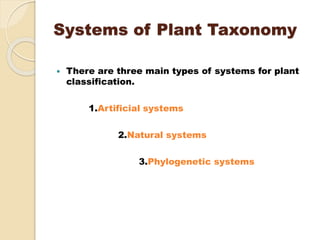
 There are three main types of systems for plant
classification.
1.Artificial systems
2.Natural systems
3.Phylogenetic systems
Artificial systems
 Artificial systems were the earliest systems, which
attempted to classify organisms based on a few
superficial characters.
 Aristotle classified plants more than 2000 years ago
on the basis of simple morphological characters into
herb, shrub and trees.
 Theophrastus in his book “Historia Plantarum or
Enquiry into plants” attempted to arrange plants in
various groups based on how plants reproduce and its
uses. He is called “Father of Botany”.
 Carl Linnaeus is known as the “Father of Modern
Taxonomy”.
 In his book “Systema Naturae” (1735), he gave the
hierarchical system of classification of the natural world
into the plant kingdom, the animal kingdom and mineral
kingdom.
 He understood the importance of floral characters and
classified plants based on the number of stamens
present in them. It is also known as the sexual system of
classification.
 In “Species Plantarum” (1753), he gave a brief
description of all the species known to him. He
described around 7,300 plant species in it.
 He gave the Binomial nomenclature system.
 In “Philosophia Botanica”, he had given rules for naming
every species. It is called binomial because each name
has two components, genus name and species name,
e.g. Solanum melongena (brinjal), Solanum tuberosum
(potato) having the same genus but different species
name.
Natural systems
 In this system of classification, more characters
were considered while classifying.
 It was based on the natural similarities of
vegetative and floral characters among the
organisms.
 It took into consideration various external and
internal features like the anatomy of a cell, types
of embryo and photochemistry.
 Bentham and Hooker proposed the most
important natural system of classification of
flowering plants.
 They classified plants into
Cryptogams (non-flowering plants)
Phanerogams (flowering plants)
Phylogenetic systems
 This system is based on evolutionary sequence and
genetic relationship.
 This system was developed after the publication of
Darwin’s theory of evolution.
 Apart from the morphological characteristics found
from fossil records, genetic constituents were also
considered.
 It has been widely accepted by biologists all over
the world.
 According to this system, all the organisms
belonging to the same taxa originated from the
common ancestor.
Importance of Plant Taxonomy
 It gives a detailed overview of various morphological and
anatomical structures of a plant species
 It organizes all the information of plants into an orderly
fashion
 It indicates the phylogenetic relationship between species
and its ancestry
 Plant taxonomy enables to identify any unknown species and
its place in the classification by comparing with known
species
 Analysis of genetic constituents can be done on the basis of
systematics
 It is used to scientifically name any species, which helps in
the uniformity of the name around the world and avoids
confusion
 It helps to understand the biodiversity present at a place
 It helps in recording all the living species known until now
 Taxonomy is widely used in agriculture, medicine and
forestry.
Modern/ Recent trends in
taxonomy of flowering plants
1. Gross Morphological
2. Anatomical
3. Pollen Morphology or Palynological
4. Chemotaxonomy
5. Serotaxonomy
6. Palaeontological
7. Ontogenetical
8. Embryologyand Taxonomy
9. Numerical Taxonomy.
1. Gross Morphological
• Turril says, the morphology, either of
plants Or animals, now days includes a
good deal more than the mere study of
shape.
 The term ‘morphology’ is very wide and
includes anatomy, and much of cytology,
ontogeny, embryology, paleontology and
genetics.
 He says, “even within morphology in a
very strict sense the taxonomist is
forced to consider matters which involve
physiology.”
 Turril says, that someone or other
morphological classification provides the
best basis for a general classification of
the widest possible use, because
morphological characters are, in general
easier to use than others.
2. Anatomical
 The study of morphology with a compound microscope is
known as anatomy (histology).
 According to some anatomists the anatomical features are
more conservative than those of-gross morphology and
are, therefore, of greater use in tracing phylogeny or
organogenesis.
 The following anatomical characters are of taxonomic
significance:
 Epidermal appendages, trichomes.
 Structure of stomata.
 The wood anatomy including the elements of the
secondary xylem
 The nodal anatomy of the axis, the leaf trace nature.
 Floral anatomy.
3. Pollen Morphology or Palynological
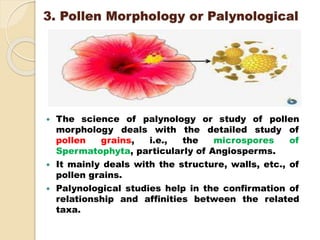
 The science of palynology or study of pollen
morphology deals with the detailed study of
pollen grains, i.e., the microspores of
Spermatophyta, particularly of Angiosperms.
 It mainly deals with the structure, walls, etc., of
pollen grains.
 Palynological studies help in the confirmation of
relationship and affinities between the related
taxa.
4. Chemotaxonomy
 It is based on the classification
of plants on the basis of their
chemical constituents which
are deeply concerned with the
molecular characteristics.
 The method of chemical
taxonomy is simple in principle
and is based on the
investigation of the distribution
of chemical compounds, or
groups of biosynthetically
related compounds in series of
related plants.
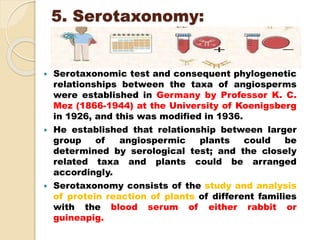
5. Serotaxonomy:
 Serotaxonomic test and consequent phylogenetic
relationships between the taxa of angiosperms
were established in Germany by Professor K. C.
Mez (1866-1944) at the University of Koenigsberg
in 1926, and this was modified in 1936.
 He established that relationship between larger
group of angiospermic plants could be
determined by serological test; and the closely
related taxa and plants could be arranged
accordingly.
 Serotaxonomy consists of the study and analysis
of protein reaction of plants of different families
with the blood serum of either rabbit or
guineapig.
6. Palaeontological
 Darrah has proposed the following palaeontological
evidences in support of the phylogenetic evolution
of the plants:
 1. The invasion of land by an undifferentiated
thalloid plant took place not later than Silurian.
 2. The simple upright undifferentiated and
protostelic axis formed in Silurian.
 3. Enlargement of the plant body with specialization
towards a division of labour-sterile and fertile, took
place apparently in late Silurian.
 4. Origin of the photosynthetic leaf took place in
Devonian.
7. Ontogenetical
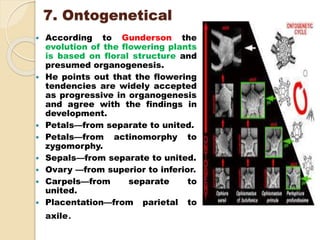
 According to Gunderson the
evolution of the flowering plants
is based on floral structure and
presumed organogenesis.
 He points out that the flowering
tendencies are widely accepted
as progressive in organogenesis
and agree with the findings in
development.
 Petals—from separate to united.
 Petals—from actinomorphy to
zygomorphy.
 Sepals—from separate to united.
 Ovary —from superior to inferior.
 Carpels—from separate to
united.
 Placentation—from parietal to
axile.
8. Embryology and Taxonomy
 The comparative or phylogenetic embryology
deals with the embryological data, which are
used as a tool for ascertaining inter-relationships
and taxonomic positions.
 In a symposium on comparative Embryology of
Angiosperms held at Delhi in 1967 the systematic
positions of various families were discussed in
the light of embryological data.
 This symposium enabled to bring together in a
comprehensive manner the scattered
embryological literature on various families.
9. Numerical Taxonomy
 It use mathematical principles for
classifying the plants.
 According to Sneath and Sokal (1973)
“numerical taxonomy aims to develop
methods that are objective, explicit and
repeatable, both in evaluation of taxonomic
relationships and in the erection of taxa.”
 This science is based on evidence of
similarities exhibited by observed and
recorded characters of taxa, not on
phylogenetic probabilities.
 It is not concerned with producing new
data but methods of handling them by
means of electronic computers so as to
reduce subjective element involved in
comparing sets of data.
Description of flowering plants in botanical terms in relation to taxonomyNew Microsoft PowerPoint Presentation.pptx