
Overview of
Plant Classification
Dr. Anil V. Dusane
Associate Professor,
Sir Parashurambhau College, Pune
anildusane@gmail.com
What is classification?
 It is an ancient activity of every culture.
 It is the grouping of organisms according to their characteristics.
 It is the hierarchical organization.
 Each level of hierarchy (grouping) is called taxa.
 Science of classifying organisms is known as taxonomy. (taxis-
arrangement, nomos-rule).
Taxonomy is a science of differentiating, grouping and
giving names (nomenclature) to living things.
Important Steps in Taxonomy
 Identification
 Description
 Nomenclature
 Phylogeny(evolution)
 Classification
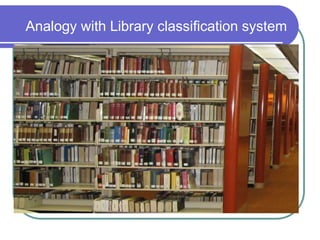
Analogy with Library classification system
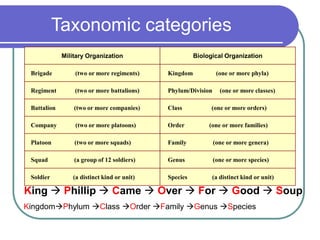
Taxonomic categories
King  Phillip  Came  Over  For  Good  Soup
KingdomPhylum Class Order Family Genus Species
Military Organization Biological Organization
Brigade (two or more regiments) Kingdom (one or more phyla)
Regiment (two or more battalions) Phylum/Division (one or more classes)
Battalion (two or more companies) Class (one or more orders)
Company (two or more platoons) Order (one or more families)
Platoon (two or more squads) Family (one or more genera)
Squad (a group of 12 soldiers) Genus (one or more species)
Soldier (a distinct kind or unit) Species (a distinct kind or unit)
Taxon
 Mainly there are seven levels of ranks of classification.
 Hierarchal arrangement
 Kingdom > Phylum/Division > Class > Order > Family > Genus > Species >Variety
 Kingdom
 Phylum/Division
 Class
 Order
 Family
 Genus
 Species (smallest unit)
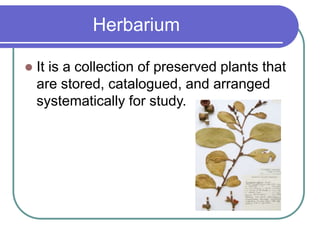
Herbarium
 It is a collection of preserved plants that
are stored, catalogued, and arranged
systematically for study.
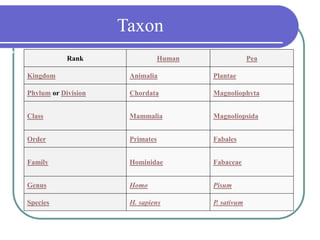
Taxon
… Rank Human Pea
Kingdom Animalia Plantae
Phylum or Division Chordata Magnoliophyta
Class Mammalia Magnoliopsida
Order Primates Fabales
Family Hominidae Fabaceae
Genus Homo Pisum
Species H. sapiens P. sativum
Importance of classification
 It is a primary way to organize and store the basic
information (typically of species).
 It would be impossible to deal with enormous plant diversity
(350,000 species of plants) without proper classification.
 It helps to keep the track of information for the purpose of
conservation management, inventories, commerce, etc.
 It provides information about relationships among various
groups.
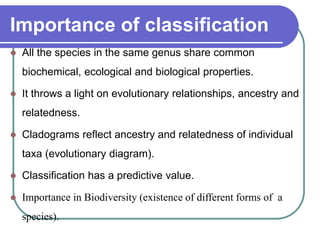
Importance of classification
 All the species in the same genus share common
biochemical, ecological and biological properties.
 It throws a light on evolutionary relationships, ancestry and
relatedness.
 Cladograms reflect ancestry and relatedness of individual
taxa (evolutionary diagram).
 Classification has a predictive value.
 Importance in Biodiversity (existence of different forms of a
species).
Problems in plant classification
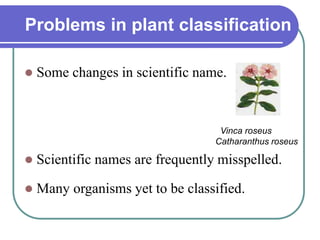
 Some changes in scientific name.
 Scientific names are frequently misspelled.
 Many organisms yet to be classified.
Vinca roseus
Catharanthus roseus
Landmarks of classification
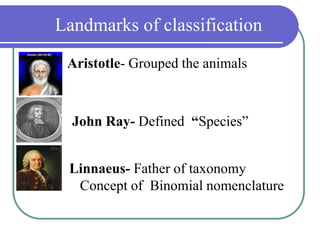
Aristotle- Grouped the animals

 John Ray- Defined “Species”
Linnaeus- Father of taxonomy
Concept of Binomial nomenclature
Nomenclature
 Binomial nomenclature has been developed by Linnaeus.
 It has Binomial nomenclature i.e. Genus and species.
 It is Latinized, unique and universal.
 Genus- It is Capitalized, Italicized.
 Species- Written in lower case, italicized.
 E.g. Binomial nomenclature of Mango is
Mangifera indica
Concept of species
It is a group of actually
or potentially
interbreeding natural
populations which are
reproductively isolated
from other groups.
Taxonomical aids
 Herbarium
 Botanical gardens
 Museums
 National Parks
 Institutes-Botanical Survey of India (BSI)
 Monographs
 Diagnostic Keys
 Scientific journals
Benefits of Herbarium
 It acts a source of information to determine, what the
plants look like, where it is found, what environmental
niche it occupy, what morphological and chemical variation
occurs and, when it flower or produce seed.
 Specimens can be used to provide samples of DNA to
study relationships and evolutionary processes.
 It acts as vouchers to validate scientific observations.
 It is used to identify species.
 It is important in discovery of new species.
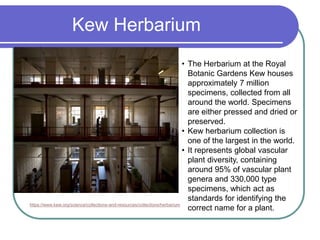
Kew Herbarium
https://www.kew.org/science/collections-and-resources/collections/herbarium
• The Herbarium at the Royal
Botanic Gardens Kew houses
approximately 7 million
specimens, collected from all
around the world. Specimens
are either pressed and dried or
preserved.
• Kew herbarium collection is
one of the largest in the world.
• It represents global vascular
plant diversity, containing
around 95% of vascular plant
genera and 330,000 type
specimens, which act as
standards for identifying the
correct name for a plant.
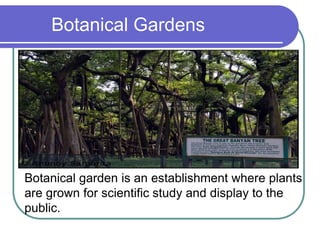
Botanical Gardens
Botanical garden is an establishment where plants
are grown for scientific study and display to the
public.
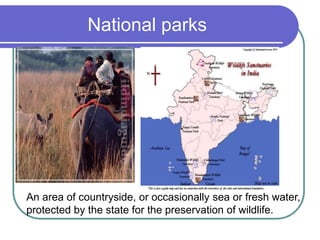
National parks
An area of countryside, or occasionally sea or fresh water,
protected by the state for the preservation of wildlife.
Monographs
 Term "monographia" is derived from the Greek mono
("single") and grapho ("to write"), meaning "writing on a
single subject.
 It is a comprehensive treatment of a taxon.
 Monographs typically review all known species within a
group, add any newly discovered species, and collect and
synthesize available information on the ecological
associations, geographic distributions, and morphological
variations within the group.
 The first-ever monograph of a plant taxon was Robert
Morison’s ‘Plantarum Umbelliferarum Distributio Nova’, a
treatment of the Apiaceae.
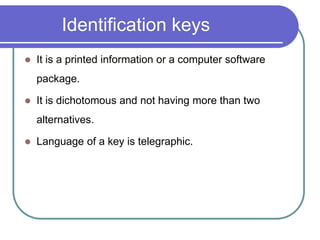
Identification keys
 It is a printed information or a computer software
package.
 It is dichotomous and not having more than two
alternatives.
 Language of a key is telegraphic.
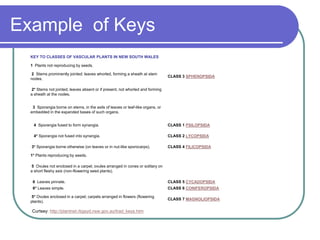
Example of Keys
KEY TO CLASSES OF VASCULAR PLANTS IN NEW SOUTH WALES
1 Plants not reproducing by seeds.
2 Stems prominently jointed: leaves whorled, forming a sheath at stem
nodes.
CLASS 3 SPHENOPSIDA
2* Stems not jointed; leaves absent or if present, not whorled and forming
a sheath at the nodes.
3 Sporangia borne on stems, in the axils of leaves or leaf-like organs, or
embedded in the expanded bases of such organs.
4 Sporangia fused to form synangia. CLASS 1 PSILOPSIDA
4* Sporangia not fused into synangia. CLASS 2 LYCOPSIDA
3* Sporangia borne otherwise (on leaves or in nut-like sporocarps). CLASS 4 FILICOPSIDA
1* Plants reproducing by seeds.
5 Ovules not enclosed in a carpel; ovules arranged in cones or solitary on
a short fleshy axis (non-flowering seed plants).
6 Leaves pinnate. CLASS 5 CYCADOPSIDA
6* Leaves simple. CLASS 6 CONIFEROPSIDA
5* Ovules enclosed in a carpel; carpels arranged in flowers (flowering
plants).
CLASS 7 MAGNOLIOPSIDA
Curtsey: http://plantnet.rbgsyd.nsw.gov.au/trad_keys.htm
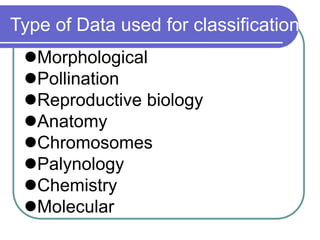
Type of Data used for classification
Morphological
Pollination
Reproductive biology
Anatomy
Chromosomes
Palynology
Chemistry
Molecular
Morphological Data
• Morphological data are the features of external form
or appearance.
• It provides nearly all the characters used for plant
identification.
• It is useful in phylogenetic studies and other
systematic studies.
• Morphological data has always and still is the
predominant type of data used in plant systematic
studies.
• It defines the limit of species.
• It provides a classification in agreement with evolutionary
relationships.
Morphological data sources
 Field samples
 Herbarium samples
 Qualitative characters
 Quantitative characters
 Data from vegetative and reproductive parts of the
plants.
Types of vegetative morphological
characters
 Duration and habit
 Root types/parts
 Stem types/parts
 Leaf types/parts
 Floral morphology
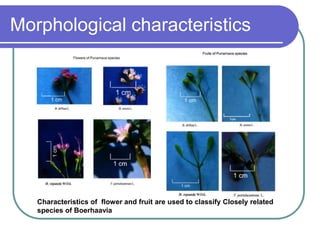
Morphological characteristics
Characteristics of flower and fruit are used to classify Closely related
species of Boerhaavia
Anatomical evidences
 Anatomy is related to the internal structure.
The evidences come from:
 (i) Wood cell type, size and shape,
 (ii) Wood cell wall sculpture, pattern,
 (iii) Stealer pattern,
 (iv) Vascular bundle type,
 (v) Xylem type, wood type and ray type,
 (vi) Ground tissue type,
 (vii) Epidermal type,
 (viii) Mesophyll type,
 (ix) Scleried type,
 (x) Stomatal type,
 (xi) Trichome type, crystal type,
 (xii) Nodal type,
 (xiii) Ventation type,
 (xiv) Petiole vasculation type,
 (xv) Periderm origin,
 (xvi) Pholem cell type, and
 (xvii) Specialized cell type.
Anatomical evidences
 Anatomical data is used to resolve phylogenetic problems.
 Nonporous wood is the characteristic feature of gymnosperms while
porous wood is found in angiosperms.
 A progressives evolution in angiosperms from small tracheids to long
narrow vessels with lignified thickening of various types is evident
through anatomical details.
 Wood anatomy reveals that Gnetales are not ancestral to angiosperms
and Amentiferae and Gnatales constitute a relatively advanced group.
 In Gnetales, the vessels arose from tracheids with circular pittings while
in angiosperms they evolve from tracheids with scalariform pitting.
 Vesselless angiosperms of Winteraeae, Trochodendraceae
Tetracentraceae are primitive angiosperms.
 Wood anatomy supports the separation of Austrobaileya and Paeonia to
separate family as Austrobaileyacae and Paeoniaceae respectively.
Anatomical evidences
 There are several closely related families which are
separated on the basis of stomatal type.
 Anomocytic stomata are characteristic of Ranunculaceae
while Diacytic stomata in Caryophyllaceae and Paracytic
in Rubiacace.
 Unicellular or multicellular non- glandular trichomes
(epidermal appendages) in Moraceae and Brassicaceae.
 Stellate hairs are present in Malvaceae, Peltate hairs in
Olea, branched dendroid hairs in Styrax and candelabrum
types in Verbascum.
 Occurrence of Kranz anatomy in leaf suggests presence
of C4 cycle of photosynthesis.
Evidences from Palynology
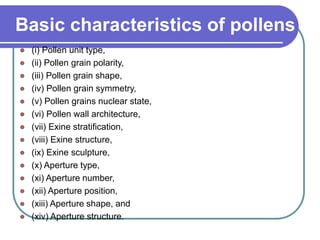
 Palynology is the science that deals with Pollen grains.
 Morphology of Pollen grains is used in classification.
 Pollen grains may be vesiculate (with air sacs); saccate or
non saccate, fenestrate or non-fenestrate, colpate (furrows or
colpi present) or porate (apertures present at the poles).
Basic characteristics of pollens
 (i) Pollen unit type,
 (ii) Pollen grain polarity,
 (iii) Pollen grain shape,
 (iv) Pollen grain symmetry,
 (v) Pollen grains nuclear state,
 (vi) Pollen wall architecture,
 (vii) Exine stratification,
 (viii) Exine structure,
 (ix) Exine sculpture,
 (x) Aperture type,
 (xi) Aperture number,
 (xii) Aperture position,
 (xiii) Aperture shape, and
 (xiv) Aperture structure.
Evidences from Palynology
 In Magnoliidae, pollens are binucleate while Caryophyllidae has
trinucleate pollens.
 In Asclepiadaceae pollens present in Pollinia.
 Linaceae and Plumbagineae shows greater similarity than that of
Plumbagineae and Staliceae based on palynology.
 Napenthaceae and Droseraceae (except Drosophyllum) have
spinuliferous pollen tetrads. Such type of pollen tetrads are not found in
any other plant.
 Close relationship between Polygalaceae and Ephedraceae has been
established based on similarity between their pollen grains.
 On the basis of Palynological characters Fumariaceae is separated
from Papaveraceae and Nelumbonaceae from Nymphaeaceae.
 Malvacae and Bombacaceae are separated on the basis of
palynological studies where Malvaceae shows spinose exine and
Bombacacee shows reticulate exine in Pollen grains.
Evidences from Embryology
 Embryology is the study of successive stages of sporogenesis,
gametogenesis and the development of embryo.
 Basic evidences are obtained using following characteristics:
 (i) Anther loculi number, arrangement,
 (ii) Anther wall formation and endothecium type,
 (iii) Archesporial cell number,
 (iv) Aril presence,
 (v) Embryo sac development type,
 (vi) Embryo and Embryogeny type,
 (vii) Endosperm type,
 (viii) Integument number and structural type,
 (ix) Ovule orientation type and position,
 (x) Tapetal type,
 (xi) Perisperm presence,
 (xii) Nucellus character, and
 (xiii) Haustorium formation type.
Evidences from Embryology
 Embryological evidences are important at higher category level e.g., in
conjunction with other types of evidences in confirming the systematic
position of taxa.
 In Asteridae the ovules are unitegmic and tenuinucellate, in
Caryophyllidae the ovules are bitegmic.
 In Cyperaceae only one microspore per microspore mother cell is formed.
 In Onagraceae the embryosac is 4 nucleate, oenothera type as compared
to normal 8 nucleated Polygonum type.
 Exocarpus was separated from Santalaceae to a new family
Exocarpaceae however after studying the embryology of the genus
Exocarpus is kept under family Santalaceae.
 Paeonia which earlier kept in Ranunculaceae is now separated to distinct
family Paeoniaceae on the basis of centrifugal stamens and floral
anatomy.
Cytological evidences
 Cytology is the study of the morphology and physiology of cells.
 Cytological evidences is used for distinguishing taxa; to determine
the origin of groups and to understand the evolutionary history of
related taxa.
 In cases of controversy, cytological studies are used for determining
the categories of genus and species.
 Chromosome homology studies are used in knowing the degree of
genetic relationship.
Some evidential characteristics are:
 (i) Chromosome number, structure, type,
 (ii) Chromosome meiotic behaviour,
 (iii) Ploidy level and type, and
 (iv) Chromosome aberration.
Cytological evidences
 On the basis of chromosome morphology, Pandanus and
Typha are kept under two different orders viz. Pandanales
and Typhales.
 Angiosperm, the chromosome number varies greatly e.g.,
n = 2 in Haplopappus gracilis (Asteraceae) and highest is
n = 132 in Poa litloroa (Poaceae).
 In Ranunculaceae, it is generally x = 8. Thallictrum and
Aquilegia have x = 7.
 In Poaceae the subfamily Poideae has x = 7 and
Bambusoideae has x =12.
 Ploidy level also plays a significant role in taxonomy e.g.,
Triticum contains diploid (2n = 14), Triploid (2n = 21) and
Hexaploid (2n = 42).
Cytological evidences
 Based on different nature of karyotype of Butomus from Limnocharis,
Hydrocharis, Tenagocharis, it is kept in Butomaceae while others are
retained in Alismataceae.
 Karyotype(structure of genome) study of members of Agavaceae confirms
the shifting of Agave from Amaryllidaceae (inferior ovary) and Yucca from
Liliaceae (superior ovary) into Agavaceae.
 Cyperaceae and Juncaceae were separated due to the distinct floral
structure however, based on the holocentric chromosomes these are
considered closely related.
 Meiotic behaviour of chromosomes is helpful in comparing the genomes
to detect degree of homology e.g., Triticum aestivum is haxaploid (A A B
B D D)where ‘A’ is derived from T. monococcum (diploid) and ‘B’ from
Aegilops speltoides and D is derived from Aegilops squarrosa (diploid).
Evidences from Chemo-taxonomy
The science of chemical taxonomy is based on classification of Plants on
the basis of their chemical constituents related with the molecular
characteristics. Following basic chemical characteristics are used
 (i) Flavonoids,
 (ii) Terpenoids,
 (iii) Carotenoids,
 (iv) Polysaccharides,
 (v) Alkaloids,
 (vi) Amino acids,
 (vii) Fatty acids,
 (viii) Aromatic compounds, and
 (ix) C3-C4 photosynthesis
Evidences from Chemo-taxonomy
 Morphologically similar plants possess similar chemicals.
 Micro molecules, macromolecules, primary metabolites and secondary
metabolites has important role in the classification of plants.
 Mentzar (1966) provided biogenetic classification on the basis of natural
relationships between various chemical constituents.
 Lathyrus martinus has a specific protein which is absent in other species
of Lathyrus.
 The members of Asteraceae lack unsaturated lipids while the members
of Acanthaceae, Annonaceae and Malvaceae are oleic and palmitic rich.
 In Pinus every species has different type of terpentine.
 In Lichens, chemical methods are largely used for the identification of
genera an species.
 Chemistry of Betacyanins led to recognition of 10 families containing
them (Centrospermae). They do not occur in plants containing
anthocyanins.
Evidences from Chemo-taxonomy
 Asteraceae is divided in two tribes Tubiflorae and Liguliflorae on the
presence of latex (chemical substances).
 Four species of Nyssa and eleven species of Cornus and one species
each of Dauidua, Camptotheca etc. are analysed and observed the
percentage of Palmitic, Stearic, Linolic acid etc. and found that Nyssa
biflora lies intermediate to N. sylvatica and N. aquatica.
 Terpenoid and glycosides are present in Apocynaceae and Moraceae.
 Sesquiterpene Lactones is a group of bitter tasting compounds. Out of
1400 in Asteraceae 1340 are present.
 Cronquist has shown evolution of Asteraceae on this basis i.e., Rubiales
→ Dipsacales → Asteraceae, rather than through Campanulales where
Lactones are altogether absent.
 The absence of ellagic acid in monocots and its presence in Nymphaeales
does not support the views of Cronquist and Takhtajan who were of the
opinion that Nymphaeales have given rise to monocots.
Numerical taxonomy (taximetrics)
 It is a classification system in biological systematics which
deals with the grouping by numerical methods of
taxonomic units based on their character states.
 The concept was first developed by Robert R. Sokal and
Peter H. A. Sneath in 1963.
 It aims to create a taxonomy using numeric algorithms
like cluster analysis rather than using subjective
evaluation of their properties.
 It has two major components i.e. Phenetics and cladistics.
In Phenetics, classifications is based on the patterns of
overall similarities and in cladistics, the classifications are
based on the branching patterns of the estimated
evolutionary history of the taxa.
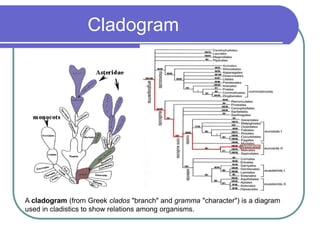
Cladogram
A cladogram (from Greek clados "branch" and gramma "character") is a diagram
used in cladistics to show relations among organisms.
Thank you
Dr. A.V. Dusane
anildusane@gmail.com