Ajay Babu.G 1st year M.D.S
Department of Conservative and Endodontics
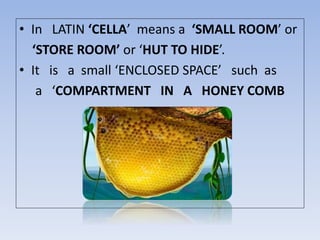
• In LATIN ‘CELLA’ means a ‘SMALL ROOM’ or
‘STORE ROOM’ or ‘HUT TO HIDE’.
• It is a small ‘ENCLOSED SPACE’ such as
a ‘COMPARTMENT IN A HONEY COMB
DEFINITION
It is defined as the structural and functional
unit of the living body because it has all the
characteristics of life.
Human body ,is quite complex and is made of,
70,000 billion cells which comprise different
tissues and organs.
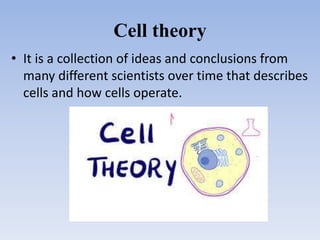
Cell theory
• It is a collection of ideas and conclusions from
many different scientists over time that describes
cells and how cells operate.
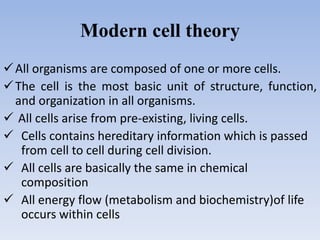
Modern cell theory
All organisms are composed of one or more cells.
The cell is the most basic unit of structure, function,
and organization in all organisms.
 All cells arise from pre-existing, living cells.
 Cells contains hereditary information which is passed
from cell to cell during cell division.
 All cells are basically the same in chemical
composition
 All energy flow (metabolism and biochemistry)of life
occurs within cells
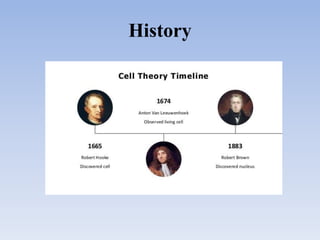
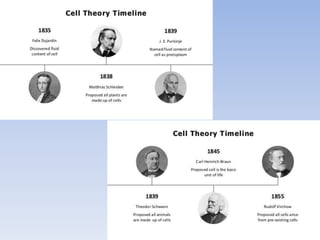
History
Cell organisation
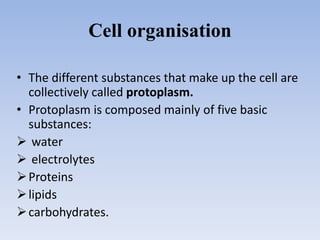
• The different substances that make up the cell are
collectively called protoplasm.
• Protoplasm is composed mainly of five basic
substances:
 water
 electrolytes
Proteins
lipids
carbohydrates.
• WATER: The principal fluid medium of the cell is water,
which is present in most cells, except for fat cells, in a
concentration of 70 to 85 per cent.
• IONS: The most important ions in the cell are potassium,
magnesium, phosphate,sulfate, bicarbonate, and
smaller quantities of sodium, chloride, and calcium.
The ions provide inorganic chemicals for cellular
reactions.
• PROTEINS: After water, the most abundant substances in
most cells are proteins, which normally constitute 10 to
20 per cent of the cell mass. These can be divided into
two types:
structural proteins
functional proteins
• Structural proteinsare present in the cell mainly in the
form of long filaments that themselves are
polymers of many individual protein molecules.
• Functional proteinsare an entirely different type of
protein, usually composed of combinations of a
few molecules in tubular-globular form.
• LIPIDS:
o Important lipids are phospholipids and cholesterol,
which together constitute only about 2 per cent of the
total cell mass. The significance of phospholipids and
cholesterol is that they are mainly insoluble in water
and, therefore, are used to form the cell membrane
and intracellular membrane barriers that separate the
different cell compartments.
o In addition to phospholipids and cholesterol, some cells
contain large quantities of triglycerides, also called
neutral fat.
o CARBOHYDRATES: Carbohydrates have little structural
function in the cell except as parts of glycoprotein
molecules, but they play a major role in nutrition of the
cell.
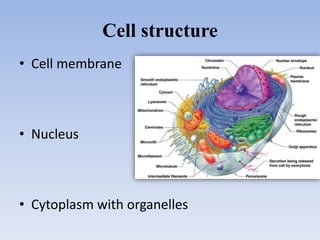
Cell structure
• Cell membrane
• Nucleus
• Cytoplasm with organelles
Cell membrane
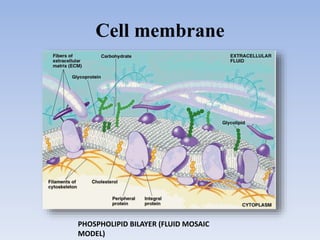
PHOSPHOLIPID BILAYER (FLUID MOSAIC
MODEL)
• Cell membrane is a unit membrane having the fluid
mosaic that is the membrane is a fluid with mosaic
of proteins, lipids and carbohydrates.
• Lipid layer
• Protein layer
• Carbohydrate layer
Lipid layer
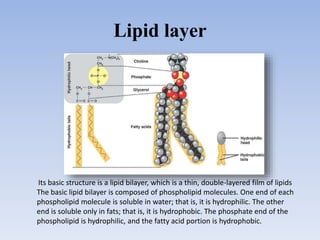
Its basic structure is a lipid bilayer, which is a thin, double-layered film of lipids
The basic lipid bilayer is composed of phospholipid molecules. One end of each
phospholipid molecule is soluble in water; that is, it is hydrophilic. The other
end is soluble only in fats; that is, it is hydrophobic. The phosphate end of the
phospholipid is hydrophilic, and the fatty acid portion is hydrophobic.
• Protein Layer-are electron dense layer
situated on either side of the central lipid layer.
Two categories
a. Integral proteins
b. Peripheral proteins
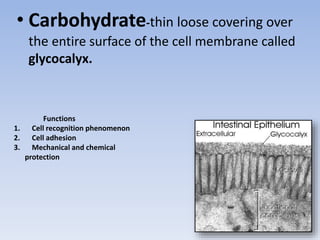
• Carbohydrate-thin loose covering over
the entire surface of the cell membrane called
glycocalyx.
Functions
1. Cell recognition phenomenon
2. Cell adhesion
3. Mechanical and chemical
protection
Cytoplasm
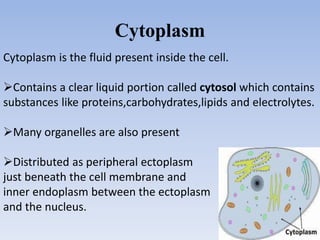
Cytoplasm is the fluid present inside the cell.
Contains a clear liquid portion called cytosol which contains
substances like proteins,carbohydrates,lipids and electrolytes.
Many organelles are also present
Distributed as peripheral ectoplasm
just beneath the cell membrane and
inner endoplasm between the ectoplasm
and the nucleus.
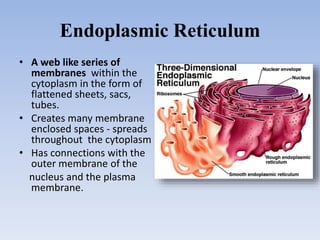
Endoplasmic Reticulum
• A web like series of
membranes within the
cytoplasm in the form of
flattened sheets, sacs,
tubes.
• Creates many membrane
enclosed spaces - spreads
throughout the cytoplasm
• Has connections with the
outer membrane of the
nucleus and the plasma
membrane.
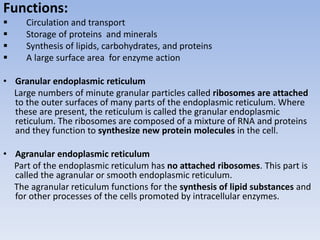
Functions:
 Circulation and transport
 Storage of proteins and minerals
 Synthesis of lipids, carbohydrates, and proteins
 A large surface area for enzyme action
• Granular endoplasmic reticulum
Large numbers of minute granular particles called ribosomes are attached
to the outer surfaces of many parts of the endoplasmic reticulum. Where
these are present, the reticulum is called the granular endoplasmic
reticulum. The ribosomes are composed of a mixture of RNA and proteins
and they function to synthesize new protein molecules in the cell.
• Agranular endoplasmic reticulum
Part of the endoplasmic reticulum has no attached ribosomes. This part is
called the agranular or smooth endoplasmic reticulum.
The agranular reticulum functions for the synthesis of lipid substances and
for other processes of the cells promoted by intracellular enzymes.
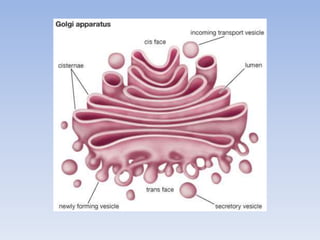
Golgi Apparatus
• Golgi apparatus is closely related to the endoplasmic
reticulum.
• It has membranes similar to those of the agranular
endoplasmic reticulum.
• It usually is composed of four or more stacked layers of
thin, flat, enclosed vesicles lying near one side of the
nucleus.
• This apparatus is prominent in secretary cells, where it
is located on the side of the cell.
Functions
1. Concerned with the processing and delivery of
substances like proteins and lipids to different parts
of the cell.
2.It packs the processed materials into the secretory
granules,secretory vesicles, and lysosomes and
dispatch them either out of the cell or to another
part of the cell.
3.Distribution to their proper destinations
Lysosomes
• Small globular structures filled with enzymes.
• Enzymes are synthesized in RER and transported
to Golgi apparatus.
• Processed and packed in the form of small
vesicles.
• These vesicles pinched off from Golgi apparatus
and become lysosomes.
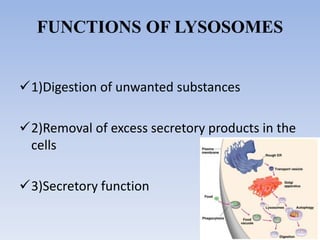
FUNCTIONS OF LYSOSOMES
1)Digestion of unwanted substances
2)Removal of excess secretory products in the
cells
3)Secretory function
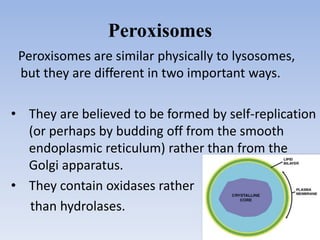
Peroxisomes
Peroxisomes are similar physically to lysosomes,
but they are different in two important ways.
• They are believed to be formed by self-replication
(or perhaps by budding off from the smooth
endoplasmic reticulum) rather than from the
Golgi apparatus.
• They contain oxidases rather
than hydrolases.
Mitochondria
• Mitochondria are called the “powerhouses” of
the cell.
• Mitochondria are present in all areas of each
cell’s cytoplasm, but the total number per cell
varies from less than a hundred up to several
thousand, depending on the amount of
energy required by the cell.
They are also variable in size and shape. Some are only a few hundred
nanometres in diameter and globular in shape, whereas others are
elongated—as large as 1 micrometer in diameter and 7 micrometers long
still others are branching and filamentous.
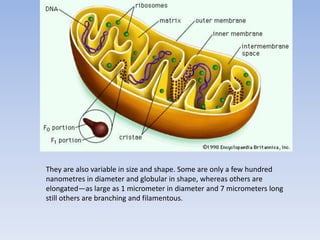
 The basic structure of the mitochondrion is composed
mainly of two lipid bilayer–protein membranes:
a) an outer membrane and
b) an inner membrane.
 Many infoldings of the inner membrane form shelves onto
which oxidative enzymes are attached.
 In addition, the inner cavity of the mitochondrion is filled
with a matrix that contains large quantities of dissolved
enzymes that are necessary for extracting energy from
nutrients.
Functions
1)Production of energy
2)Synthesis of ATP
3)Apoptosis
Secretory vesicles
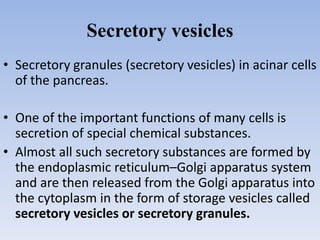
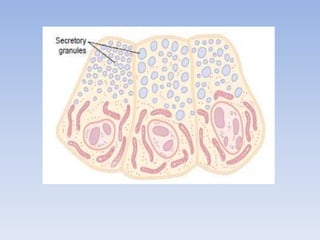
• Secretory granules (secretory vesicles) in acinar cells
of the pancreas.
• One of the important functions of many cells is
secretion of special chemical substances.
• Almost all such secretory substances are formed by
the endoplasmic reticulum–Golgi apparatus system
and are then released from the Golgi apparatus into
the cytoplasm in the form of storage vesicles called
secretory vesicles or secretory granules.
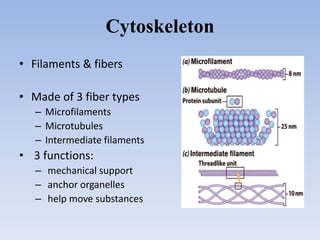
Cytoskeleton
• Filaments & fibers
• Made of 3 fiber types
– Microfilaments
– Microtubules
– Intermediate filaments
• 3 functions:
– mechanical support
– anchor organelles
– help move substances
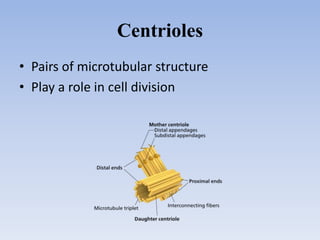
Centrioles
• Pairs of microtubular structure
• Play a role in cell division
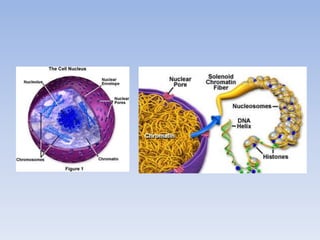
Nucleus
a)Nuclear membrane
also called the nuclear envelope , is actually two
separate bilayer membranes one inside the other.
• The outer membrane is continuous with the
endoplasmic reticulum of the cell cytoplasm, and
the space between the two nuclear membrane is
also continues with the space inside the
endoplasmic reticulum.
b)Nucleolus
• The nuclei of most cells contain one or more highly
staining structures called nucleoli.
• The nucleolus is simply an accumulation of large
amounts of RNA and proteins of the types found in
ribosomes.
• It does not have a limiting membrane.
• The nucleolus becomes considerably enlarged when
the cell is actively synthesizing proteins.
Cell functions
INGESTION (ENDOCYTOSIS)
Phagocytosis
Pinocytosis
DIGESTION –by lysosomes
SYNTHESIS & FORMATION OF CELLULAR STRUCTURES
–by endoplasmic reticulum & Golgi Apparatus
PRODUCTION OF ENERGY FROM NUTRIENTS – by
Mitochondria
Movement of cell
• 1.Passive Transport
• 2.Active Transport
• 3.Endocytosis : PHAGOCYTOSIS AND PINOCYTOSIS
• 4.Exocytosis
Passive transport
 No energy required
 Move due to gradient
 differences in concentration, pressure, charge.
 Move to equalize gradient
 High moves toward low
Types :
1. Diffusion
2. Osmosis
3. Facilitated diffusion
Diffusion
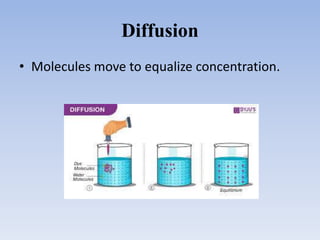
• Molecules move to equalize concentration.
Osmosis
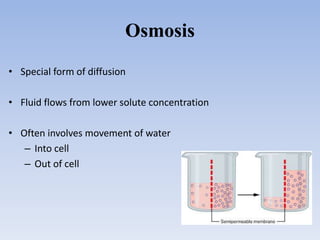
• Special form of diffusion
• Fluid flows from lower solute concentration
• Often involves movement of water
– Into cell
– Out of cell
Solution Differences And Cells
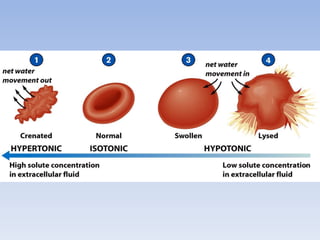
 Hypotonic
 Solutes in cell more than outside
 Outside solvent will flow into cell
 solvent + solute = solution
 Isotonic
 Solutes equal inside & out of cell
 Hypertonic
 Solutes greater outside cell
 Fluid will flow out of cell
Facilitated diffusion
• Differentially permeable membrane
• Channels (are specific) help molecule or ions
enter or leave the cell
• Channels usually are transport proteins
aquaporins facilitate the movement of water.
• No energy is used
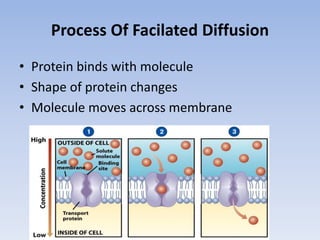
Process Of Facilated Diffusion
• Protein binds with molecule
• Shape of protein changes
• Molecule moves across membrane
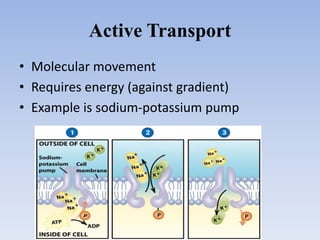
Active Transport
• Molecular movement
• Requires energy (against gradient)
• Example is sodium-potassium pump
Endocytosis
• Movement of large material
– Particles
– Organisms
– Large molecules
• Movement is into cells
• Types of endocytosis
– bulk-phase (nonspecific)
– receptor-mediated (specific)
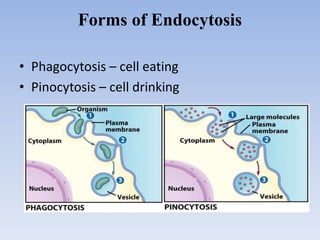
Forms of Endocytosis
• Phagocytosis – cell eating
• Pinocytosis – cell drinking
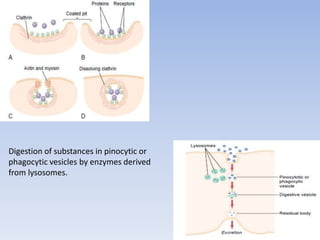
Digestion of substances in pinocytic or
phagocytic vesicles by enzymes derived
from lysosomes.
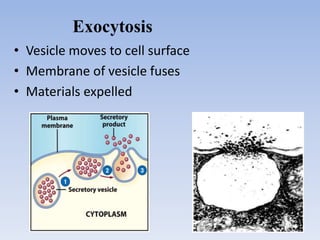
• Vesicle moves to cell surface
• Membrane of vesicle fuses
• Materials expelled
Exocytosis
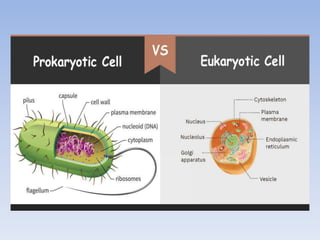
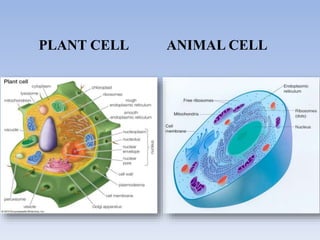
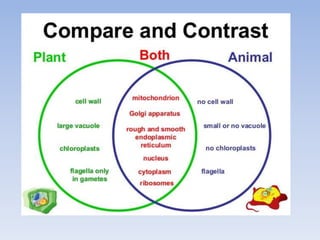
PLANT CELL ANIMAL CELL
Conclusion
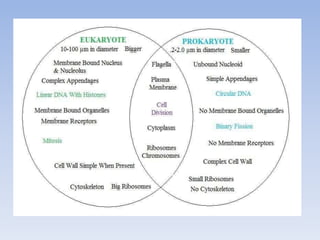
• Cells are a basic unit of life, sharing many
common mechanisms across different classes of
organisms (plants, animals, microorganisms).
Between these classes there are also key
differences in cell architecture.
• Each of the 100 trillion cells in a human being is a
living structure that can survive for months or
many years , provided its surrounding fluids
contain appropriate nutrients.
References
• Essentials of medical physiology -
k.Shembulingam
• Guyton textbook of medical physiology
Seminar on cell

Seminar on cell

  • 1.
    Ajay Babu.G 1styear M.D.S Department of Conservative and Endodontics
  • 3.
    • In LATIN‘CELLA’ means a ‘SMALL ROOM’ or ‘STORE ROOM’ or ‘HUT TO HIDE’. • It is a small ‘ENCLOSED SPACE’ such as a ‘COMPARTMENT IN A HONEY COMB
  • 4.
    DEFINITION It is definedas the structural and functional unit of the living body because it has all the characteristics of life. Human body ,is quite complex and is made of, 70,000 billion cells which comprise different tissues and organs.
  • 5.
    Cell theory • Itis a collection of ideas and conclusions from many different scientists over time that describes cells and how cells operate.
  • 6.
    Modern cell theory Allorganisms are composed of one or more cells. The cell is the most basic unit of structure, function, and organization in all organisms.  All cells arise from pre-existing, living cells.  Cells contains hereditary information which is passed from cell to cell during cell division.  All cells are basically the same in chemical composition  All energy flow (metabolism and biochemistry)of life occurs within cells
  • 7.
  • 11.
    Cell organisation • Thedifferent substances that make up the cell are collectively called protoplasm. • Protoplasm is composed mainly of five basic substances:  water  electrolytes Proteins lipids carbohydrates.
  • 12.
    • WATER: Theprincipal fluid medium of the cell is water, which is present in most cells, except for fat cells, in a concentration of 70 to 85 per cent. • IONS: The most important ions in the cell are potassium, magnesium, phosphate,sulfate, bicarbonate, and smaller quantities of sodium, chloride, and calcium. The ions provide inorganic chemicals for cellular reactions. • PROTEINS: After water, the most abundant substances in most cells are proteins, which normally constitute 10 to 20 per cent of the cell mass. These can be divided into two types: structural proteins functional proteins
  • 13.
    • Structural proteinsarepresent in the cell mainly in the form of long filaments that themselves are polymers of many individual protein molecules. • Functional proteinsare an entirely different type of protein, usually composed of combinations of a few molecules in tubular-globular form.
  • 14.
    • LIPIDS: o Importantlipids are phospholipids and cholesterol, which together constitute only about 2 per cent of the total cell mass. The significance of phospholipids and cholesterol is that they are mainly insoluble in water and, therefore, are used to form the cell membrane and intracellular membrane barriers that separate the different cell compartments. o In addition to phospholipids and cholesterol, some cells contain large quantities of triglycerides, also called neutral fat. o CARBOHYDRATES: Carbohydrates have little structural function in the cell except as parts of glycoprotein molecules, but they play a major role in nutrition of the cell.
  • 15.
    Cell structure • Cellmembrane • Nucleus • Cytoplasm with organelles
  • 16.
  • 17.
    • Cell membraneis a unit membrane having the fluid mosaic that is the membrane is a fluid with mosaic of proteins, lipids and carbohydrates. • Lipid layer • Protein layer • Carbohydrate layer
  • 18.
    Lipid layer Its basicstructure is a lipid bilayer, which is a thin, double-layered film of lipids The basic lipid bilayer is composed of phospholipid molecules. One end of each phospholipid molecule is soluble in water; that is, it is hydrophilic. The other end is soluble only in fats; that is, it is hydrophobic. The phosphate end of the phospholipid is hydrophilic, and the fatty acid portion is hydrophobic.
  • 19.
    • Protein Layer-areelectron dense layer situated on either side of the central lipid layer. Two categories a. Integral proteins b. Peripheral proteins
  • 20.
    • Carbohydrate-thin loosecovering over the entire surface of the cell membrane called glycocalyx. Functions 1. Cell recognition phenomenon 2. Cell adhesion 3. Mechanical and chemical protection
  • 21.
    Cytoplasm Cytoplasm is thefluid present inside the cell. Contains a clear liquid portion called cytosol which contains substances like proteins,carbohydrates,lipids and electrolytes. Many organelles are also present Distributed as peripheral ectoplasm just beneath the cell membrane and inner endoplasm between the ectoplasm and the nucleus.
  • 22.
    Endoplasmic Reticulum • Aweb like series of membranes within the cytoplasm in the form of flattened sheets, sacs, tubes. • Creates many membrane enclosed spaces - spreads throughout the cytoplasm • Has connections with the outer membrane of the nucleus and the plasma membrane.
  • 23.
    Functions:  Circulation andtransport  Storage of proteins and minerals  Synthesis of lipids, carbohydrates, and proteins  A large surface area for enzyme action • Granular endoplasmic reticulum Large numbers of minute granular particles called ribosomes are attached to the outer surfaces of many parts of the endoplasmic reticulum. Where these are present, the reticulum is called the granular endoplasmic reticulum. The ribosomes are composed of a mixture of RNA and proteins and they function to synthesize new protein molecules in the cell. • Agranular endoplasmic reticulum Part of the endoplasmic reticulum has no attached ribosomes. This part is called the agranular or smooth endoplasmic reticulum. The agranular reticulum functions for the synthesis of lipid substances and for other processes of the cells promoted by intracellular enzymes.
  • 24.
    Golgi Apparatus • Golgiapparatus is closely related to the endoplasmic reticulum. • It has membranes similar to those of the agranular endoplasmic reticulum. • It usually is composed of four or more stacked layers of thin, flat, enclosed vesicles lying near one side of the nucleus. • This apparatus is prominent in secretary cells, where it is located on the side of the cell.
  • 26.
    Functions 1. Concerned withthe processing and delivery of substances like proteins and lipids to different parts of the cell. 2.It packs the processed materials into the secretory granules,secretory vesicles, and lysosomes and dispatch them either out of the cell or to another part of the cell. 3.Distribution to their proper destinations
  • 27.
    Lysosomes • Small globularstructures filled with enzymes. • Enzymes are synthesized in RER and transported to Golgi apparatus. • Processed and packed in the form of small vesicles. • These vesicles pinched off from Golgi apparatus and become lysosomes.
  • 28.
    FUNCTIONS OF LYSOSOMES 1)Digestionof unwanted substances 2)Removal of excess secretory products in the cells 3)Secretory function
  • 29.
    Peroxisomes Peroxisomes are similarphysically to lysosomes, but they are different in two important ways. • They are believed to be formed by self-replication (or perhaps by budding off from the smooth endoplasmic reticulum) rather than from the Golgi apparatus. • They contain oxidases rather than hydrolases.
  • 30.
    Mitochondria • Mitochondria arecalled the “powerhouses” of the cell. • Mitochondria are present in all areas of each cell’s cytoplasm, but the total number per cell varies from less than a hundred up to several thousand, depending on the amount of energy required by the cell.
  • 31.
    They are alsovariable in size and shape. Some are only a few hundred nanometres in diameter and globular in shape, whereas others are elongated—as large as 1 micrometer in diameter and 7 micrometers long still others are branching and filamentous.
  • 32.
     The basicstructure of the mitochondrion is composed mainly of two lipid bilayer–protein membranes: a) an outer membrane and b) an inner membrane.  Many infoldings of the inner membrane form shelves onto which oxidative enzymes are attached.  In addition, the inner cavity of the mitochondrion is filled with a matrix that contains large quantities of dissolved enzymes that are necessary for extracting energy from nutrients.
  • 33.
  • 34.
    Secretory vesicles • Secretorygranules (secretory vesicles) in acinar cells of the pancreas. • One of the important functions of many cells is secretion of special chemical substances. • Almost all such secretory substances are formed by the endoplasmic reticulum–Golgi apparatus system and are then released from the Golgi apparatus into the cytoplasm in the form of storage vesicles called secretory vesicles or secretory granules.
  • 36.
    Cytoskeleton • Filaments &fibers • Made of 3 fiber types – Microfilaments – Microtubules – Intermediate filaments • 3 functions: – mechanical support – anchor organelles – help move substances
  • 37.
    Centrioles • Pairs ofmicrotubular structure • Play a role in cell division
  • 38.
    Nucleus a)Nuclear membrane also calledthe nuclear envelope , is actually two separate bilayer membranes one inside the other. • The outer membrane is continuous with the endoplasmic reticulum of the cell cytoplasm, and the space between the two nuclear membrane is also continues with the space inside the endoplasmic reticulum.
  • 39.
    b)Nucleolus • The nucleiof most cells contain one or more highly staining structures called nucleoli. • The nucleolus is simply an accumulation of large amounts of RNA and proteins of the types found in ribosomes. • It does not have a limiting membrane. • The nucleolus becomes considerably enlarged when the cell is actively synthesizing proteins.
  • 41.
    Cell functions INGESTION (ENDOCYTOSIS) Phagocytosis Pinocytosis DIGESTION–by lysosomes SYNTHESIS & FORMATION OF CELLULAR STRUCTURES –by endoplasmic reticulum & Golgi Apparatus PRODUCTION OF ENERGY FROM NUTRIENTS – by Mitochondria
  • 42.
    Movement of cell •1.Passive Transport • 2.Active Transport • 3.Endocytosis : PHAGOCYTOSIS AND PINOCYTOSIS • 4.Exocytosis
  • 43.
    Passive transport  Noenergy required  Move due to gradient  differences in concentration, pressure, charge.  Move to equalize gradient  High moves toward low Types : 1. Diffusion 2. Osmosis 3. Facilitated diffusion
  • 44.
    Diffusion • Molecules moveto equalize concentration.
  • 45.
    Osmosis • Special formof diffusion • Fluid flows from lower solute concentration • Often involves movement of water – Into cell – Out of cell
  • 46.
    Solution Differences AndCells  Hypotonic  Solutes in cell more than outside  Outside solvent will flow into cell  solvent + solute = solution  Isotonic  Solutes equal inside & out of cell  Hypertonic  Solutes greater outside cell  Fluid will flow out of cell
  • 48.
    Facilitated diffusion • Differentiallypermeable membrane • Channels (are specific) help molecule or ions enter or leave the cell • Channels usually are transport proteins aquaporins facilitate the movement of water. • No energy is used
  • 49.
    Process Of FacilatedDiffusion • Protein binds with molecule • Shape of protein changes • Molecule moves across membrane
  • 50.
    Active Transport • Molecularmovement • Requires energy (against gradient) • Example is sodium-potassium pump
  • 51.
    Endocytosis • Movement oflarge material – Particles – Organisms – Large molecules • Movement is into cells • Types of endocytosis – bulk-phase (nonspecific) – receptor-mediated (specific)
  • 52.
    Forms of Endocytosis •Phagocytosis – cell eating • Pinocytosis – cell drinking
  • 53.
    Digestion of substancesin pinocytic or phagocytic vesicles by enzymes derived from lysosomes.
  • 54.
    • Vesicle movesto cell surface • Membrane of vesicle fuses • Materials expelled Exocytosis
  • 55.
  • 57.
    Conclusion • Cells area basic unit of life, sharing many common mechanisms across different classes of organisms (plants, animals, microorganisms). Between these classes there are also key differences in cell architecture. • Each of the 100 trillion cells in a human being is a living structure that can survive for months or many years , provided its surrounding fluids contain appropriate nutrients.
  • 58.
    References • Essentials ofmedical physiology - k.Shembulingam • Guyton textbook of medical physiology