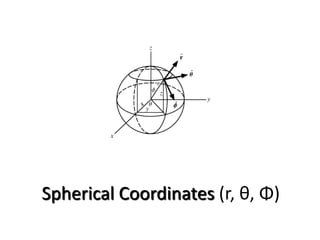
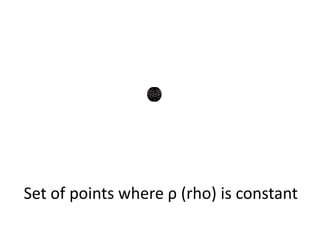
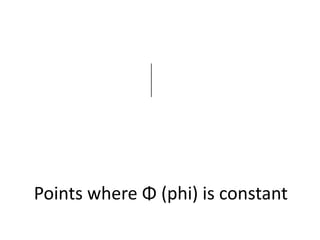
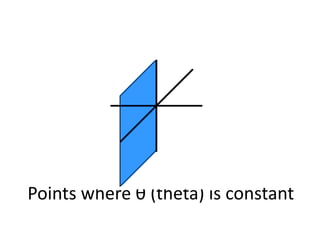
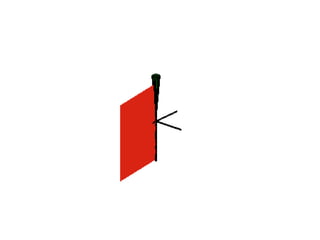
When ρ, θ, and Φ are all constant, the set of points described is a single point in 3D space. The spherical coordinates (ρ, θ, Φ) uniquely specify a location in 3D analogous to Cartesian coordinates (x, y, z).
Dimension
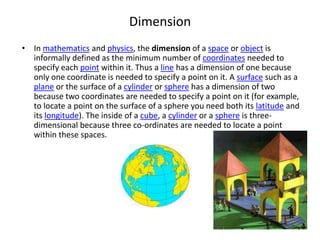
• In mathematicsand physics, the dimension of a space or object is
informally defined as the minimum number of coordinates needed to
specify each point within it. Thus a line has a dimension of one because
only one coordinate is needed to specify a point on it. A surface such as a
plane or the surface of a cylinder or sphere has a dimension of two
because two coordinates are needed to specify a point on it (for example,
to locate a point on the surface of a sphere you need both its latitude and
its longitude). The inside of a cube, a cylinder or a sphere is three-
dimensional because three co-ordinates are needed to locate a point
within these spaces.
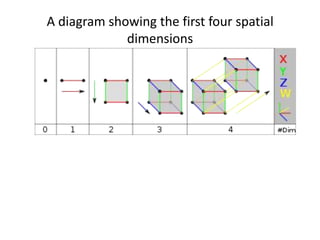
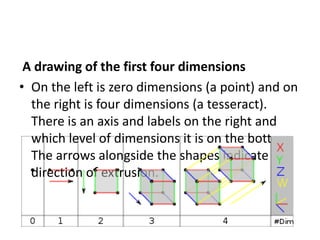
A drawing ofthe first four dimensions
• On the left is zero dimensions (a point) and on
the right is four dimensions (a tesseract).
There is an axis and labels on the right and
which level of dimensions it is on the bottom.
The arrows alongside the shapes indicate the
direction of extrusion.
5.
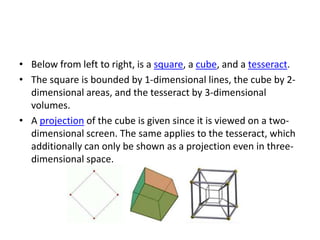
• Below fromleft to right, is a square, a cube, and a tesseract.
• The square is bounded by 1-dimensional lines, the cube by 2-
dimensional areas, and the tesseract by 3-dimensional
volumes.
• A projection of the cube is given since it is viewed on a two-
dimensional screen. The same applies to the tesseract, which
additionally can only be shown as a projection even in three-
dimensional space.
6.
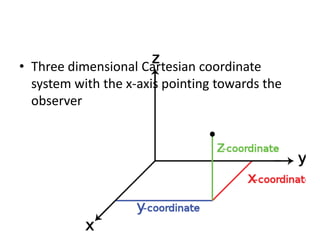
• Three dimensionalCartesian coordinate
system with the x-axis pointing towards the
observer
7.
Analytic geometry
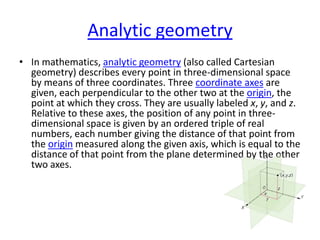
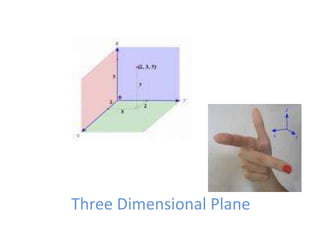
• Inmathematics, analytic geometry (also called Cartesian
geometry) describes every point in three-dimensional space
by means of three coordinates. Three coordinate axes are
given, each perpendicular to the other two at the origin, the
point at which they cross. They are usually labeled x, y, and z.
Relative to these axes, the position of any point in three-
dimensional space is given by an ordered triple of real
numbers, each number giving the distance of that point from
the origin measured along the given axis, which is equal to the
distance of that point from the plane determined by the other
two axes.
8.
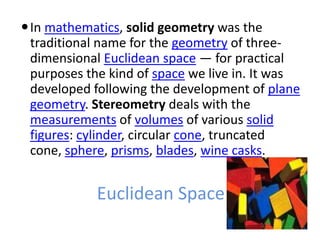
In mathematics, solidgeometry was the
traditional name for the geometry of three-
dimensional Euclidean space — for practical
purposes the kind of space we live in. It was
developed following the development of plane
geometry. Stereometry deals with the
measurements of volumes of various solid
figures: cylinder, circular cone, truncated
cone, sphere, prisms, blades, wine casks.
Euclidean Space
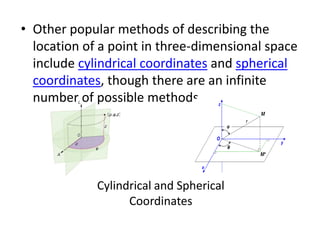
• Other popularmethods of describing the
location of a point in three-dimensional space
include cylindrical coordinates and spherical
coordinates, though there are an infinite
number of possible methods.
Cylindrical and Spherical
Coordinates
18.
• A cylindricalcoordinate system is a three-dimensional
coordinate system, where each point is specified by
the two polar coordinates of its perpendicular
projection onto some fixed plane, and by its (signed)
distance from that plane.
• Cylindrical coordinates are useful in connection with
objects and phenomena that have some rotational
symmetry about the longitudinal axis, such as water
flow in a straight pipe with round cross-section, heat
distribution in a metal cylinder, etc.
19.
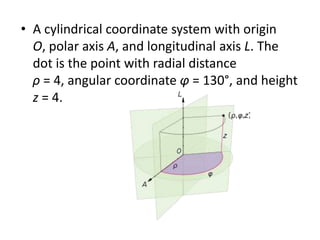
• A cylindricalcoordinate system with origin
O, polar axis A, and longitudinal axis L. The
dot is the point with radial distance
ρ = 4, angular coordinate φ = 130°, and height
z = 4.
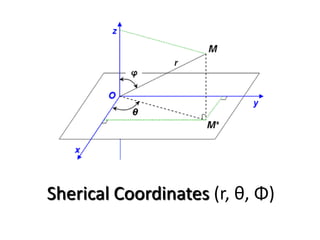
• Spherical coordinates,also called spherical polar
coordinates, are a system of curvilinear coordinates
that are natural for describing positions on a sphere or
spheroid. Define θ to be the azimuthal angle in the xy-
plane from the x-axis ,
Φ to be the polar angle (also known as the zenith angle
, and ρ to be distance (radius) from a point to the
origin. This is the convention commonly used in
mathematics.