CENTRIFUGATION
V.JAGAN MOHAN RAO M.S.Pharm., MED.CHEM
NIPER-KOLKATA
Asst.Professor, MIPER-KURNOOL
EMAIL- jaganvana6@gmail.com
CONTENTS
• Theory of centrifugation
• Vertically mounted centrifuges
• Horizontally mounted centrifuges
• Continuous centrifuges
• Ultra centrifuges
• References
Theory of centrifugation
• Protocols for centrifugation typically specify the
amount of acceleration to be applied to the sample,
rather than specifying a rotational speed such as
revolutions per minute.
• This distinction is important because two rotors with
different diameters running at the same rotational
speed will subject samples to different accelerations.
• During circular motion the acceleration is the product
of the radius and the square of the angular velocity,
and the acceleration relative to "g" is traditionally
named "relative centrifugal force" (RCF).
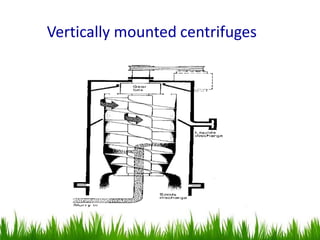
Vertically mounted centrifuges
• The suspension to be separated is filled into the
vertically mounted perforated basket at pre-selected
loading speed.
• Under the effect of the centrifugal force, the solid
particles settle on the filter fabric on the basket shell.
• The solids are retained by the filter fabric, suspension
fluid flows through the forming filter cake including
the filter fabric and leaves the perforated basket
through bore-holes in the basket sleeve.
Horizontally mounted centrifuges
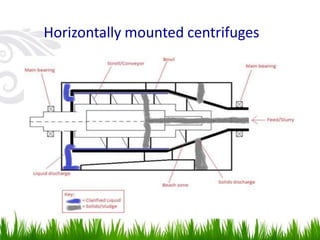
• The rotating assembly is mounted horizontally with
bearings on each end to a rigid frame, which provides
a good sealing surface for high-pressure applications.
• The horizontal machine is arranged in a way that
slurry can be introduced at the centre of a rotating
horizontal cylindrical bowl.
• The scroll discharge screw forces the solids to one
end of the bowl as it is collected on the walls.
• This orientation is the most common design
implemented in industry.
Horizontally mounted centrifuges
Continuous centrifuges
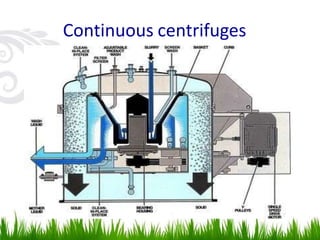
• The Centrifuge is designed for applications where a
continuous process or very high capacity is required.
• Continuous operations are best suited for applications
that require high capacity and large (greater than 300
micron) particle size.
• These centrifuges can provide excellent washing and
low final moisture.
Continuous centrifuges
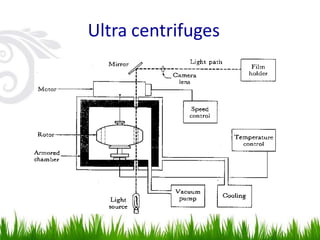
• The ultracentrifuge is a centrifuge optimized for
spinning a rotor at very high speeds, capable of
generating acceleration as high as.
• There are two kinds of ultracentrifuges, the
preparative and the analytical ultracentrifuge.
• Both classes of instruments find important uses in
molecular biology, biochemistry,
and polymer science.
Ultra centrifuges
Ultra centrifuges
centrifugation

centrifugation

  • 1.
    CENTRIFUGATION V.JAGAN MOHAN RAOM.S.Pharm., MED.CHEM NIPER-KOLKATA Asst.Professor, MIPER-KURNOOL EMAIL- jaganvana6@gmail.com
  • 2.
    CONTENTS • Theory ofcentrifugation • Vertically mounted centrifuges • Horizontally mounted centrifuges • Continuous centrifuges • Ultra centrifuges • References
  • 3.
    Theory of centrifugation •Protocols for centrifugation typically specify the amount of acceleration to be applied to the sample, rather than specifying a rotational speed such as revolutions per minute. • This distinction is important because two rotors with different diameters running at the same rotational speed will subject samples to different accelerations. • During circular motion the acceleration is the product of the radius and the square of the angular velocity, and the acceleration relative to "g" is traditionally named "relative centrifugal force" (RCF).
  • 4.
  • 5.
    Vertically mounted centrifuges •The suspension to be separated is filled into the vertically mounted perforated basket at pre-selected loading speed. • Under the effect of the centrifugal force, the solid particles settle on the filter fabric on the basket shell. • The solids are retained by the filter fabric, suspension fluid flows through the forming filter cake including the filter fabric and leaves the perforated basket through bore-holes in the basket sleeve.
  • 6.
  • 7.
    • The rotatingassembly is mounted horizontally with bearings on each end to a rigid frame, which provides a good sealing surface for high-pressure applications. • The horizontal machine is arranged in a way that slurry can be introduced at the centre of a rotating horizontal cylindrical bowl. • The scroll discharge screw forces the solids to one end of the bowl as it is collected on the walls. • This orientation is the most common design implemented in industry. Horizontally mounted centrifuges
  • 8.
  • 9.
    • The Centrifugeis designed for applications where a continuous process or very high capacity is required. • Continuous operations are best suited for applications that require high capacity and large (greater than 300 micron) particle size. • These centrifuges can provide excellent washing and low final moisture. Continuous centrifuges
  • 10.
    • The ultracentrifugeis a centrifuge optimized for spinning a rotor at very high speeds, capable of generating acceleration as high as. • There are two kinds of ultracentrifuges, the preparative and the analytical ultracentrifuge. • Both classes of instruments find important uses in molecular biology, biochemistry, and polymer science. Ultra centrifuges
  • 11.