KOTA COLLEGE
OF PHARMACY
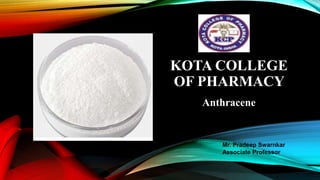
Anthracene
Mr. Pradeep Swarnkar
Associate Professor
Anthracene is present is coal-tar to the extent of 0.3 to 3.5 perecent hence its name
Greek anthrac meaning coal. on distillation of tar , it passes over in the high boiling
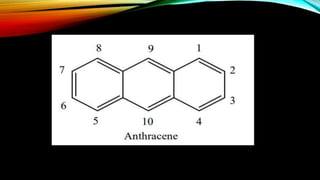
fractions anthracene oil. The molecule of anthracene is made of three benzene nuclei
fused in ortho positions . It is a colorless solid polycyclic aromatic hydrocarbon.
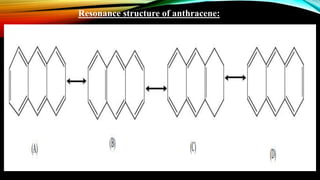
Resonance structure of anthracene:
x-ray diffraction studies show that,like naphthalene ,all carbon bonds in anthracene are not of
the same length . in particular, the C1-C2 bond is considerably shorter(1.37A°) than the (C2-
C3)bond (1.42A°). This difference in bond lengths can be understood if we examine the four
resonance forms given above .Notice that the C1-C2 bond is double in three structures(A,B
andC), and single in only one (D);whereas the C2-C3 bond is single in three structures(A,B
and C) and double in only one (D). we would, therefore , expect the C1-C2 bond to have
more double-bond character (shorter bond length), and the C2-C3 bond to have more single-
bond character(longer bond length).
The resonance energy of anthracene is 84 kcal/mole. This averages to 28 kcal/mole per
ring, which is substantially lower than that of benzene (36 kcal/mole). As a result,
anthracene is much less aromatic than benzene and behaves more like an unsaturated
aliphatic hydrocarbon.
Preparation of Anthracene:
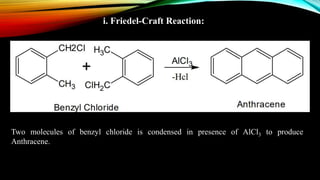
i. Friedel-Craft Reaction:
Two molecules of benzyl chloride is condensed in presence of AlCl3 to produce
Anthracene.
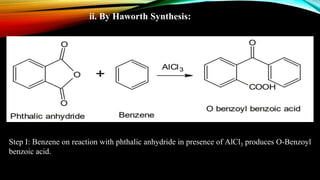
ii. By Haworth Synthesis:
Step I: Benzene on reaction with phthalic anhydride in presence of AlCl3 produces O-Benzoyl
benzoic acid.
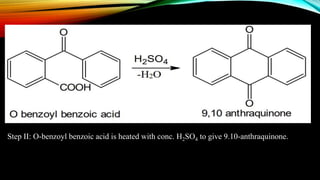
Step II: O-benzoyl benzoic acid is heated with conc. H2SO4 to give 9.10-anthraquinone.
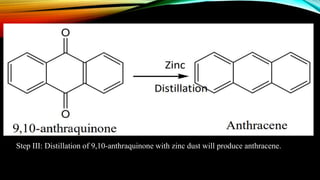
Step III: Distillation of 9,10-anthraquinone with zinc dust will produce anthracene.
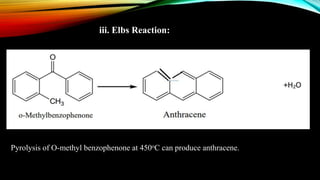
iii. Elbs Reaction:
450°C
Pyrolysis of O-methyl benzophenone at 450oC can produce anthracene.
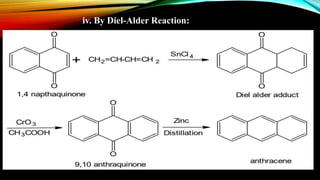
iv. By Diel-Alder Reaction:
This involves the reaction of 1, 4 napthaquinone with 1, 3 butadiene. The
product is oxidized with chromium trioxide in GAA to form 9, 10
anthraquinone, which on distillation (Zn) produce anthracene.
Properties of anthracene:
Anthracene is a colorless solid. It malts at 218°C and boils at 340°C. Anthracene is
insoluble in water, but dissolves in benzene. It shows a strong blue flurescence when
exposed to ultraviolet light. This fluorescent property of anthracene is used in criminal
detection work, since a small amount of finely powder anthracene on clothing , skin ,
money, etc., is not detected under ordinary light but easily noticed when exposed to
ultraviolet light.
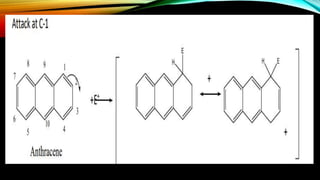
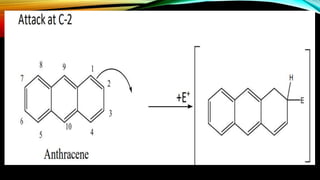
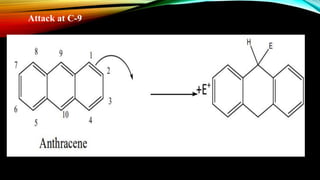
Chemical anthracene undergoes addition and electrophilic substitution reactions These
reactions preferentially occur at the C-9 and C-10 positions.This can be understood if we
examine the intermediate carbonium ions obtained from attack at C-1,C-2, and C-9(all
other positions are equivalent to either 1 or 2 or 9 by symmetry).E+ in the following
equations represents an electrophile
Attack at C-9
Attack at C-9 yields a carbonium ion intermediate in which two benzene rings are
retained; where as attack C-1 or C-2 yields an intermediate in which a naphthalene system
is retained. The former intermediate is more stable and its formation favoured because the
resonance energy of two benzene rings (2 * 36 =72 kcal) exceeds that of naphthalene
(61kcal).
Reactions of Anthracene:
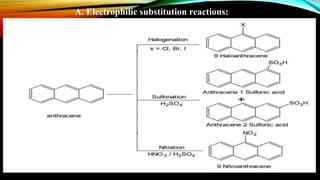
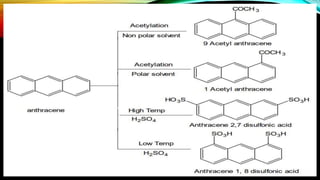
A. Electrophilic substitution reactions:
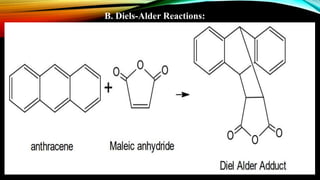
B. Diels-Alder Reactions:
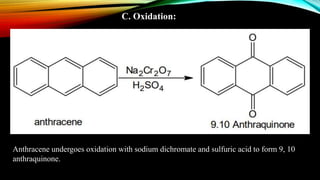
C. Oxidation:
Anthracene undergoes oxidation with sodium dichromate and sulfuric acid to form 9, 10
anthraquinone.
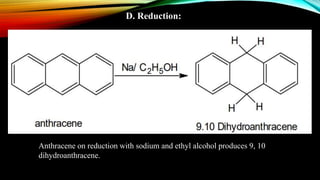
D. Reduction:
Anthracene on reduction with sodium and ethyl alcohol produces 9, 10
dihydroanthracene.
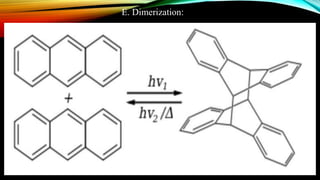
E. Dimerization:
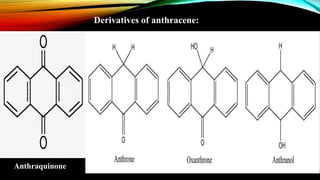
Derivatives of anthracene:
Anthraquinone
Medicinal uses of anthracene:
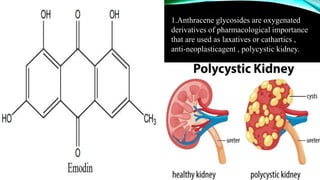
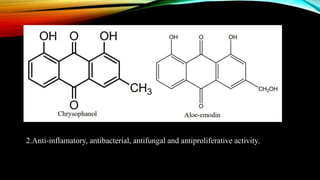
1.Anthracene glycosides are oxygenated
derivatives of pharmacological importance
that are used as laxatives or cathartics ,
anti-neoplasticagent , polycystic kidney.
2.Anti-inflamatory, antibacterial, antifungal and antiproliferative activity.
3.As natural dyes.
4.Hepatoprotective,nephroprotrctive,antioxidant
.
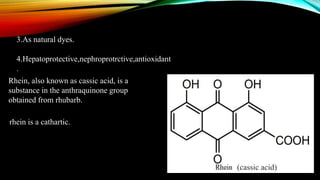
(cassic acid)
Rhein, also known as cassic acid, is a
substance in the anthraquinone group
obtained from rhubarb.
rhein is a cathartic.
Anthracene by pradeep swarnkar

Anthracene by pradeep swarnkar

  • 1.
    KOTA COLLEGE OF PHARMACY Anthracene Mr.Pradeep Swarnkar Associate Professor
  • 2.
    Anthracene is presentis coal-tar to the extent of 0.3 to 3.5 perecent hence its name Greek anthrac meaning coal. on distillation of tar , it passes over in the high boiling fractions anthracene oil. The molecule of anthracene is made of three benzene nuclei fused in ortho positions . It is a colorless solid polycyclic aromatic hydrocarbon.
  • 4.
  • 5.
    x-ray diffraction studiesshow that,like naphthalene ,all carbon bonds in anthracene are not of the same length . in particular, the C1-C2 bond is considerably shorter(1.37A°) than the (C2- C3)bond (1.42A°). This difference in bond lengths can be understood if we examine the four resonance forms given above .Notice that the C1-C2 bond is double in three structures(A,B andC), and single in only one (D);whereas the C2-C3 bond is single in three structures(A,B and C) and double in only one (D). we would, therefore , expect the C1-C2 bond to have more double-bond character (shorter bond length), and the C2-C3 bond to have more single- bond character(longer bond length).
  • 6.
    The resonance energyof anthracene is 84 kcal/mole. This averages to 28 kcal/mole per ring, which is substantially lower than that of benzene (36 kcal/mole). As a result, anthracene is much less aromatic than benzene and behaves more like an unsaturated aliphatic hydrocarbon.
  • 7.
  • 8.
    i. Friedel-Craft Reaction: Twomolecules of benzyl chloride is condensed in presence of AlCl3 to produce Anthracene.
  • 9.
    ii. By HaworthSynthesis: Step I: Benzene on reaction with phthalic anhydride in presence of AlCl3 produces O-Benzoyl benzoic acid.
  • 10.
    Step II: O-benzoylbenzoic acid is heated with conc. H2SO4 to give 9.10-anthraquinone.
  • 11.
    Step III: Distillationof 9,10-anthraquinone with zinc dust will produce anthracene.
  • 12.
    iii. Elbs Reaction: 450°C Pyrolysisof O-methyl benzophenone at 450oC can produce anthracene.
  • 13.
  • 14.
    This involves thereaction of 1, 4 napthaquinone with 1, 3 butadiene. The product is oxidized with chromium trioxide in GAA to form 9, 10 anthraquinone, which on distillation (Zn) produce anthracene.
  • 15.
  • 16.
    Anthracene is acolorless solid. It malts at 218°C and boils at 340°C. Anthracene is insoluble in water, but dissolves in benzene. It shows a strong blue flurescence when exposed to ultraviolet light. This fluorescent property of anthracene is used in criminal detection work, since a small amount of finely powder anthracene on clothing , skin , money, etc., is not detected under ordinary light but easily noticed when exposed to ultraviolet light.
  • 17.
    Chemical anthracene undergoesaddition and electrophilic substitution reactions These reactions preferentially occur at the C-9 and C-10 positions.This can be understood if we examine the intermediate carbonium ions obtained from attack at C-1,C-2, and C-9(all other positions are equivalent to either 1 or 2 or 9 by symmetry).E+ in the following equations represents an electrophile
  • 20.
  • 21.
    Attack at C-9yields a carbonium ion intermediate in which two benzene rings are retained; where as attack C-1 or C-2 yields an intermediate in which a naphthalene system is retained. The former intermediate is more stable and its formation favoured because the resonance energy of two benzene rings (2 * 36 =72 kcal) exceeds that of naphthalene (61kcal).
  • 22.
  • 23.
  • 25.
  • 26.
    C. Oxidation: Anthracene undergoesoxidation with sodium dichromate and sulfuric acid to form 9, 10 anthraquinone.
  • 27.
    D. Reduction: Anthracene onreduction with sodium and ethyl alcohol produces 9, 10 dihydroanthracene.
  • 28.
  • 29.
  • 30.
    Medicinal uses ofanthracene:
  • 31.
    1.Anthracene glycosides areoxygenated derivatives of pharmacological importance that are used as laxatives or cathartics , anti-neoplasticagent , polycystic kidney.
  • 32.
    2.Anti-inflamatory, antibacterial, antifungaland antiproliferative activity.
  • 33.
    3.As natural dyes. 4.Hepatoprotective,nephroprotrctive,antioxidant . (cassicacid) Rhein, also known as cassic acid, is a substance in the anthraquinone group obtained from rhubarb. rhein is a cathartic.