


1
HEAT TRANSFER
V.JAGAN MOHAN RAO M.S.Pharm., MED.CHEM
NIPER-KOLKATA
Asst.Professor, MIPER-KURNOOL
EMAIL- jaganvana6@gmail.com
Introduction
 A heat exchanger are the devices built for efficient heat
transfer from one medium to another. The media may be
separated by a solid wall, so that they never mix or they may
be in direct contact
 They are widely used in Petroleum refineries, Chemical
plants, Natural gas processing refrigeration, Power plants,
Air conditioning and space heating systems
 An equipment that permits efficient transfer of heat from a
hot fluid to a cold fluid without any contact or with direct
contact of fluids
 Such an equipment is called as “HeatExchangers”
In Technically term we can say……
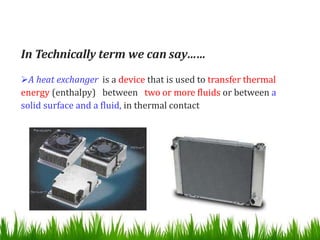
A heat exchanger is a device that is used to transfer thermal
energy (enthalpy) between two or more fluids or between a
solid surface and a fluid, in thermal contact
Applications
 Typical applications involve heating or cooling of a
flui
d stream of concern and evaporation or condensation of
single- or multi component fluid streams
 In otherapplications, the objective may be to recover or reject
heat, or sterilize, pasteurize, fractionate, distill, concentrate,
crystallize, orcontrol a process fluid
 Common examples of heat exchangers are shell-and tube
exchangers, automobile radiators, condensers, evaporators, air
preheaters, and coolingtowers
Classification of heat exchangers
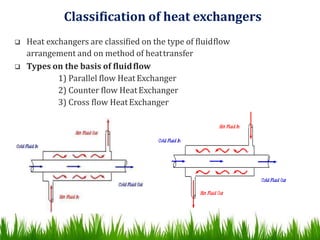
 Heat exchangers are classified on the type of fluidflow
arrangement and on method of heattransfer
 Types on the basis of fluidflow
1) Parallel flow Heat Exchanger
2) Counter flow HeatExchanger
3) Cross flow HeatExchanger
Parallel flow Heat Exchanger
1) Parallel flow
• In a parallel flow (also referred to as cocurrent or concurrent
parallel stream) exchanger, the fluid streams enter together at
one end, flow parallel to each other in the same direction, and
leave together at the other end.
• This arrangement has the lowest exchanger effectiveness
among single-pass exchangers for given overall thermal
conductance and fluid flow rates and fluid inlet
temperatures.
• In a parallel flow exchanger, a large temperature difference
between inlet temperatures of hot and cold fluids exists at the
inlet side, which may induce high thermal stresses in the
exchanger wall at the inlet.
Counter flow Heat Exchanger
2) Counter flow
• In a counter flow or counter current exchanger, the two fluids flow
parallel toeach other but in oppositedirections within the core
• The counter flow arrangement is thermodynamically superiorto
any other flow arrangement
• It is the most efficient flow arrangement, producing the highest
temperature change in each fluid compared to any other two-
fluid flow arrangements for a given overall thermal conductance
fluid flow rates and fluid inlettemperatures
• The maximum temperature difference across the exchanger
produces minimum thermal stresses in the wall for an equivalent
performance compared to any other flowarrangements
Cross flow Heat Exchanger
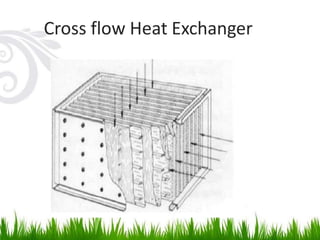
3) Cross flow
• In this type of exchanger, the two fluids flow in directions normalto
eachother
• Thermodynamically, the effectiveness for the cross flow
exchanger falls in between for the counter flow and parallelflow
arrangements
• The largest structural temperature difference exists at the
‘‘corner’’ of the entering hot and cold fluids
• This is one of the most common flow arrangements used for
extended surface heat exchangers, because it greatly simplifies
the header design at the entrance and exit of each fluid
Cross flow Heat Exchanger
Heat Exchangers
Tubular Heat Exchangers
Tubular heat exchangers consist of circular tubes, one fluid
flows inside the tube and the other on the outside
The heat transfer takes place across the wall of the tube
Types of tubular heat exchangers
1) Concentric tube or double pipe
2) shell and tube
Concentric tube or double pipe
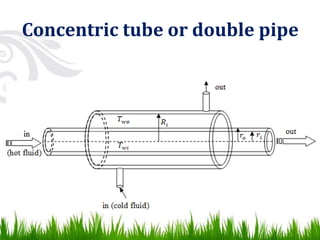
Two set of concentric pipes, two connecting tees, and a
return bend
A device whose purpose is the transfer of thermal energy
between two fluids
Common applications – Boilers, Coolers, Condensers,
Evaporators
Common design consist of two fluids separated by a
conducting medium
Concentric tube or double pipe
Shell & Tube Heat Exchangers
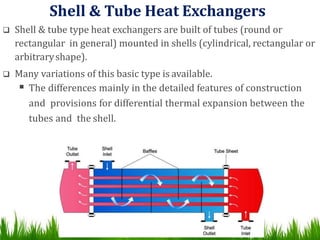
 Shell & tube type heat exchangers are built of tubes (round or
rectangular in general) mounted in shells (cylindrical, rectangular or
arbitraryshape).
 Many variations of this basic type is available.
 The differences mainly in the detailed features of construction
and provisions for differential thermal expansion between the
tubes and the shell.
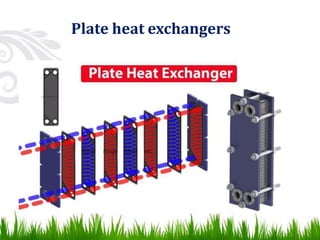
Plate heat exchangers
 Types
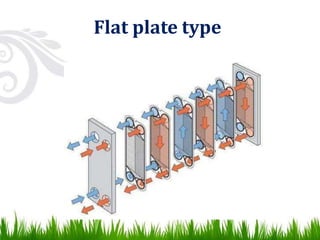
1) Flat plate type
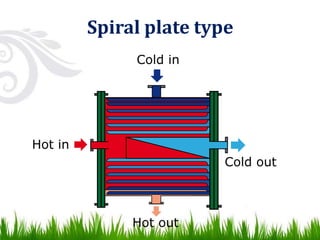
2) Spiral plate type
Plate heat exchangers
Flat plate type
Spiral plate type
heat transfer

heat transfer

  • 1.
    1 HEAT TRANSFER V.JAGAN MOHANRAO M.S.Pharm., MED.CHEM NIPER-KOLKATA Asst.Professor, MIPER-KURNOOL EMAIL- jaganvana6@gmail.com
  • 2.
    Introduction  A heatexchanger are the devices built for efficient heat transfer from one medium to another. The media may be separated by a solid wall, so that they never mix or they may be in direct contact  They are widely used in Petroleum refineries, Chemical plants, Natural gas processing refrigeration, Power plants, Air conditioning and space heating systems  An equipment that permits efficient transfer of heat from a hot fluid to a cold fluid without any contact or with direct contact of fluids  Such an equipment is called as “HeatExchangers”
  • 3.
    In Technically termwe can say…… A heat exchanger is a device that is used to transfer thermal energy (enthalpy) between two or more fluids or between a solid surface and a fluid, in thermal contact
  • 4.
    Applications  Typical applicationsinvolve heating or cooling of a flui d stream of concern and evaporation or condensation of single- or multi component fluid streams  In otherapplications, the objective may be to recover or reject heat, or sterilize, pasteurize, fractionate, distill, concentrate, crystallize, orcontrol a process fluid  Common examples of heat exchangers are shell-and tube exchangers, automobile radiators, condensers, evaporators, air preheaters, and coolingtowers
  • 5.
    Classification of heatexchangers  Heat exchangers are classified on the type of fluidflow arrangement and on method of heattransfer  Types on the basis of fluidflow 1) Parallel flow Heat Exchanger 2) Counter flow HeatExchanger 3) Cross flow HeatExchanger
  • 6.
    Parallel flow HeatExchanger 1) Parallel flow • In a parallel flow (also referred to as cocurrent or concurrent parallel stream) exchanger, the fluid streams enter together at one end, flow parallel to each other in the same direction, and leave together at the other end. • This arrangement has the lowest exchanger effectiveness among single-pass exchangers for given overall thermal conductance and fluid flow rates and fluid inlet temperatures. • In a parallel flow exchanger, a large temperature difference between inlet temperatures of hot and cold fluids exists at the inlet side, which may induce high thermal stresses in the exchanger wall at the inlet.
  • 7.
    Counter flow HeatExchanger 2) Counter flow • In a counter flow or counter current exchanger, the two fluids flow parallel toeach other but in oppositedirections within the core • The counter flow arrangement is thermodynamically superiorto any other flow arrangement • It is the most efficient flow arrangement, producing the highest temperature change in each fluid compared to any other two- fluid flow arrangements for a given overall thermal conductance fluid flow rates and fluid inlettemperatures • The maximum temperature difference across the exchanger produces minimum thermal stresses in the wall for an equivalent performance compared to any other flowarrangements
  • 8.
    Cross flow HeatExchanger 3) Cross flow • In this type of exchanger, the two fluids flow in directions normalto eachother • Thermodynamically, the effectiveness for the cross flow exchanger falls in between for the counter flow and parallelflow arrangements • The largest structural temperature difference exists at the ‘‘corner’’ of the entering hot and cold fluids • This is one of the most common flow arrangements used for extended surface heat exchangers, because it greatly simplifies the header design at the entrance and exit of each fluid
  • 9.
    Cross flow HeatExchanger
  • 10.
  • 11.
    Tubular Heat Exchangers Tubularheat exchangers consist of circular tubes, one fluid flows inside the tube and the other on the outside The heat transfer takes place across the wall of the tube Types of tubular heat exchangers 1) Concentric tube or double pipe 2) shell and tube
  • 12.
    Concentric tube ordouble pipe Two set of concentric pipes, two connecting tees, and a return bend A device whose purpose is the transfer of thermal energy between two fluids Common applications – Boilers, Coolers, Condensers, Evaporators Common design consist of two fluids separated by a conducting medium
  • 13.
    Concentric tube ordouble pipe
  • 14.
    Shell & TubeHeat Exchangers  Shell & tube type heat exchangers are built of tubes (round or rectangular in general) mounted in shells (cylindrical, rectangular or arbitraryshape).  Many variations of this basic type is available.  The differences mainly in the detailed features of construction and provisions for differential thermal expansion between the tubes and the shell.
  • 15.
    Plate heat exchangers Types 1) Flat plate type 2) Spiral plate type
  • 16.
  • 17.
  • 18.