AORTIC
STENOSIS
Normal Anatomy
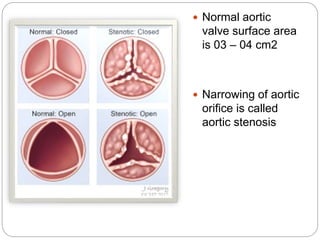
 Normal aortic
valve surface area
is 03 – 04 cm2
 Narrowing of aortic
orifice is called
aortic stenosis
Etiology
• Congenitally Abnormal Bicuspid Aortic
valve
• Senile Degenerated or calcified Aortic
valve
• Rheumatic heart Disease
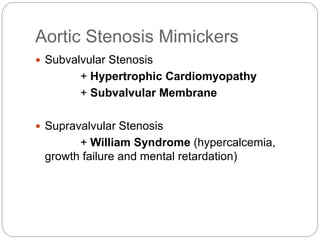
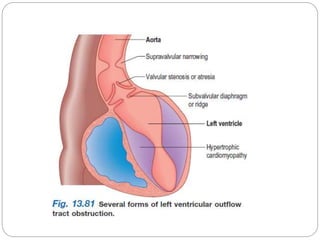
Aortic Stenosis Mimickers
 Subvalvular Stenosis
+ Hypertrophic Cardiomyopathy
+ Subvalvular Membrane
 Supravalvular Stenosis
+ William Syndrome (hypercalcemia,
growth failure and mental retardation)
History
Exertional Angina
Exertional Syncope
Dyspnoea (Heart
Failure)
Fatigue
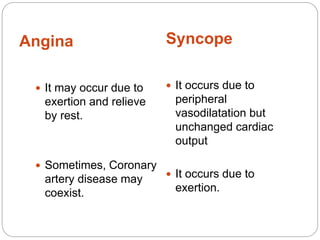
Angina Syncope
 It may occur due to
exertion and relieve
by rest.
 Sometimes, Coronary
artery disease may
coexist.
 It occurs due to
peripheral
vasodilatation but
unchanged cardiac
output
 It occurs due to
exertion.
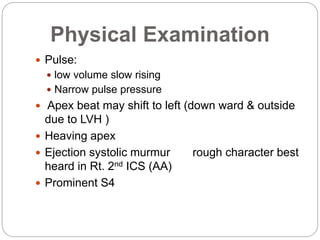
Physical Examination
 Pulse:
 low volume slow rising
 Narrow pulse pressure
 Apex beat may shift to left (down ward & outside
due to LVH )
 Heaving apex
 Ejection systolic murmur rough character best
heard in Rt. 2nd ICS (AA)
 Prominent S4
DIAGNOSTIC STUDIES
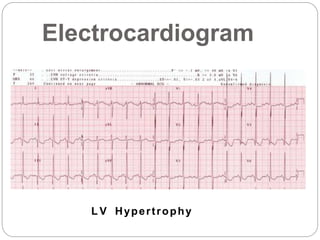
Electrocardiogram
L V Hypertrophy
Chest X Ray
 In Early stage,
CXR may be normal
 In late Stage,
Cardiac enlargement
Two-dimensional Echocargiography
• Diagnostic of AS
Treatment
 BP control
 It patient is symptomatic
 balloon valvotomy
 It valve is damaged or calcified AV
Replacement
Aortic
Regurgitation
Aortic Regurgitation: overview
 AR is a condition due to inadequate closure of
the aortic valve leaflets leading to abnormal
retrograde flow of blood through the aortic
valve during cardiac diastole.
 It can be induced either by damage to and
dysfunction of the aortic valve leaflets or by
distortion or dilatation of the aortic root and
ascending aorta
 In the developing world, the most common cause
of AR is rheumatic heart disease. However, in
developed countries, AR is most often due to
aortic root dilation or a congenital bicuspid
aortic valve .[1]
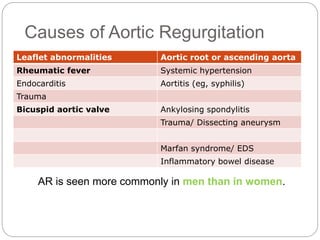
Causes of Aortic Regurgitation
Leaflet abnormalities Aortic root or ascending aorta
Rheumatic fever Systemic hypertension
Endocarditis Aortitis (eg, syphilis)
Trauma
Bicuspid aortic valve Ankylosing spondylitis
Trauma/ Dissecting aneurysm
Marfan syndrome/ EDS
Inflammatory bowel disease
AR is seen more commonly in men than in women.
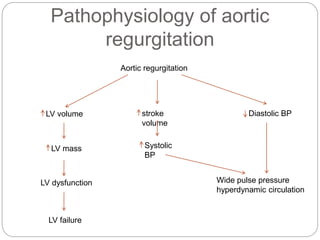
Pathophysiology of aortic
regurgitation
Aortic regurgitation
LV volume
LV mass
LV dysfunction
LV failure
stroke
volume
Systolic
BP
Diastolic BP
Wide pulse pressure
hyperdynamic circulation
 Palpitation
 Initial symptom due to vigrous contraction of volume
overload LV
 Angina
 Less common as C/F AS
 Dyspnoea
 Initially on exertion
 PND
Clinical history
Physical finding
 Pulse
 Very good volume & wide pulse pressure
 Rapid rise & collapse with markedly ed pulse
pressure (water hammer pulse / Corrigan pulse)
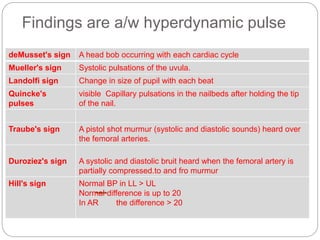
Findings are a/w hyperdynamic pulse
deMusset's sign A head bob occurring with each cardiac cycle
Mueller's sign Systolic pulsations of the uvula.
Landolfi sign Change in size of pupil with each beat
Quincke's
pulses
visible Capillary pulsations in the nailbeds after holding the tip
of the nail.
Traube's sign A pistol shot murmur (systolic and diastolic sounds) heard over
the femoral arteries.
Duroziez's sign A systolic and diastolic bruit heard when the femoral artery is
partially compressed.to and fro murmur
Hill's sign Normal BP in LL > UL
Normal difference is up to 20
In AR the difference > 20
Auscultation
 Early diastolic murmur
 Best heard LSB left 3rd /4th ICS with patient sitting &
leaning forward
Lab investigation
 CXR
 Cardiomegaly
 ECG
 LV hypertrophy
 Echo
 Confirm the diagnosis
Treatment
 Medical treatment (for heart failure)
- Diuretics, Digoxin, salt restriction
- Vasodilators
- Endocarditis prophylaxis
 Surgical treatment (in severe cases)
 AVR
.

Aortic stenosis

  • 1.
  • 2.
  • 3.
     Normal aortic valvesurface area is 03 – 04 cm2  Narrowing of aortic orifice is called aortic stenosis
  • 4.
    Etiology • Congenitally AbnormalBicuspid Aortic valve • Senile Degenerated or calcified Aortic valve • Rheumatic heart Disease
  • 5.
    Aortic Stenosis Mimickers Subvalvular Stenosis + Hypertrophic Cardiomyopathy + Subvalvular Membrane  Supravalvular Stenosis + William Syndrome (hypercalcemia, growth failure and mental retardation)
  • 8.
  • 9.
    Angina Syncope  Itmay occur due to exertion and relieve by rest.  Sometimes, Coronary artery disease may coexist.  It occurs due to peripheral vasodilatation but unchanged cardiac output  It occurs due to exertion.
  • 10.
    Physical Examination  Pulse: low volume slow rising  Narrow pulse pressure  Apex beat may shift to left (down ward & outside due to LVH )  Heaving apex  Ejection systolic murmur rough character best heard in Rt. 2nd ICS (AA)  Prominent S4
  • 11.
  • 12.
  • 13.
    Chest X Ray In Early stage, CXR may be normal  In late Stage, Cardiac enlargement Two-dimensional Echocargiography • Diagnostic of AS
  • 14.
    Treatment  BP control It patient is symptomatic  balloon valvotomy  It valve is damaged or calcified AV Replacement
  • 15.
  • 16.
    Aortic Regurgitation: overview AR is a condition due to inadequate closure of the aortic valve leaflets leading to abnormal retrograde flow of blood through the aortic valve during cardiac diastole.  It can be induced either by damage to and dysfunction of the aortic valve leaflets or by distortion or dilatation of the aortic root and ascending aorta  In the developing world, the most common cause of AR is rheumatic heart disease. However, in developed countries, AR is most often due to aortic root dilation or a congenital bicuspid aortic valve .[1]
  • 17.
    Causes of AorticRegurgitation Leaflet abnormalities Aortic root or ascending aorta Rheumatic fever Systemic hypertension Endocarditis Aortitis (eg, syphilis) Trauma Bicuspid aortic valve Ankylosing spondylitis Trauma/ Dissecting aneurysm Marfan syndrome/ EDS Inflammatory bowel disease AR is seen more commonly in men than in women.
  • 18.
    Pathophysiology of aortic regurgitation Aorticregurgitation LV volume LV mass LV dysfunction LV failure stroke volume Systolic BP Diastolic BP Wide pulse pressure hyperdynamic circulation
  • 19.
     Palpitation  Initialsymptom due to vigrous contraction of volume overload LV  Angina  Less common as C/F AS  Dyspnoea  Initially on exertion  PND Clinical history
  • 20.
    Physical finding  Pulse Very good volume & wide pulse pressure  Rapid rise & collapse with markedly ed pulse pressure (water hammer pulse / Corrigan pulse)
  • 21.
    Findings are a/whyperdynamic pulse deMusset's sign A head bob occurring with each cardiac cycle Mueller's sign Systolic pulsations of the uvula. Landolfi sign Change in size of pupil with each beat Quincke's pulses visible Capillary pulsations in the nailbeds after holding the tip of the nail. Traube's sign A pistol shot murmur (systolic and diastolic sounds) heard over the femoral arteries. Duroziez's sign A systolic and diastolic bruit heard when the femoral artery is partially compressed.to and fro murmur Hill's sign Normal BP in LL > UL Normal difference is up to 20 In AR the difference > 20
  • 22.
    Auscultation  Early diastolicmurmur  Best heard LSB left 3rd /4th ICS with patient sitting & leaning forward
  • 23.
    Lab investigation  CXR Cardiomegaly  ECG  LV hypertrophy  Echo  Confirm the diagnosis
  • 24.
    Treatment  Medical treatment(for heart failure) - Diuretics, Digoxin, salt restriction - Vasodilators - Endocarditis prophylaxis  Surgical treatment (in severe cases)  AVR .

Editor's Notes

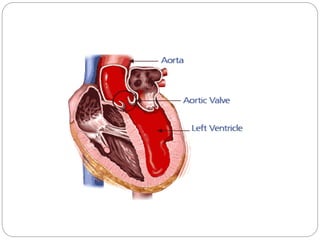
  • #3 The aortic valve is the valve located between the left ventricle of the heart and the aorta, the largest artery in the body, which carries the entire output of blood to the systemic circulation.
  • #9 Patient is asymptomatic for many years
  • #17 AR is a condition due to inadequate closure of the aortic valve leaflets leading to abnormal retrograde flow of blood through the aortic valve during cardiac diastole.
  • #18 AR may be caused by either valvular or aortic root pathology. Valvular abnormalities that may result in AR include bicuspid aortic valve (the most common congenital cause), rheumatic fever, infective endocarditis, collagen vascular diseases, and degenerative aortic valve disease. Abnormalities of the ascending aorta, in the absence of valve pathology, may also cause AR, such as may occur with longstanding uncontrolled hypertension, Marfan syndrome, idiopathic aortic dilation, syphilitic aortitis, giant cell arteritis, Takayasu arteritis, ankylosing spondylitis, Whipple disease, and other spondyloarthropathies. The absence of a wide pulse pressure and of the characteristic arterial auscultatory signs of chronic AR in patients with acute AR is thought to be due to the much higher LV end-diastolic pressure (LVEDP) in the acute form. The acute development of a severe aortic valvular leak causes a much higher LVEDP in the normal-sized LV of patients with acute AR. Patients with chronic AR commonly have a dilated LV with increased compliance capable of accommodating large blood volumes without a significant rise of LVEDP.
  • #22 Sherman sign ; prominently located and palpated dorsalis pedis pulse Landolfi sign: alternating constriction and dilatation of pupil Duroziez sign: systolic portion of murmur was caused by forward flow into the lower extremity and the diastolic segment was caused by aortic regurgitation towards the heart. Seagull murmur: it is murmur with musical qualities such as that heard occasionally in aortic insufficiency. A sea gull cry murmur is defined as a murmur imitating the cooing sound of a seagull.this type of murmur is typically characterised by a music timbre and a high frequency and may occur as a result of various valve disease.it is usually described as a sign of tight calcific aortic stenosis when the murmur high frequency components are transmitted to the lower left sternal border and the cardiac apex during most of the systole (gallavardin phenomenon).in this condition,the typical harsh timbre of the ejective murmur tends to assume a musical high pitched quality ,resembling that of mitral regurgitation which may be reminiscent of the cry of a seagull. A protodiastolic murmur with similar characteristics ,typically in decrescendo ,may occur in severe AR particularly when the flow presents high velocities. However, a seagulls cry murmur may also be the sign of MR or prolapse. Similarly the muscial and holosystolic sound reflects the presence of high frequency components due to high velocities of reflow.