CONGENITAL CYANOTIC HEART
DISEASE
DR.D.Rasikapriya
OBJECTIVES
• Introduction
• Clasification
• Common cyanotic heart disease
INDRODUCTION
• Most manifest during neonatal period and
requiring a correct diagnosis for appropriate
management.
• With increased pulmonary blood flow
• With decreased pulmonary blood flow
With increased pulmonary flow
• Persistent truncus arteriosus
• TGA
• TAPVD
• Univentricular heart
• Common atrium
• TOF with pulmonary atresia with increased
collateral blood flow
With decreased pulmonary flow
• Tricuspid atresia
• Pulmonary atresia with intact ventricular
septum
• Ebstein’s anomaly
• TOF
• Critical pulmonary stenosis
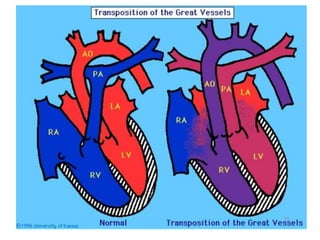
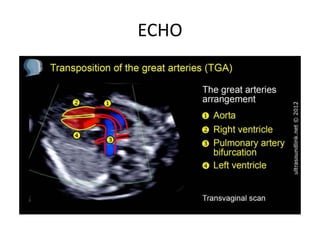
TRANSPOSITION OF GREAT ARTERIES
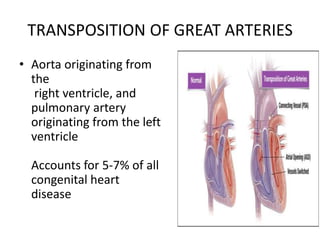
• Aorta originating from
the
right ventricle, and
pulmonary artery
originating from the left
ventricle
Accounts for 5-7% of all
congenital heart
disease
CONTD..
• In TGA aorta is anterior
• Survival is dependent on the presence of mixing
between the pulmonary and systemic circulation
ASD is essential for survival
50% of patients have a VSD
• More common in boys
• Presents with cyanosis and tachypnea within first
few hours or days of life
• Severity inversely proportional to presence of
shunts
TGA variants
TGA with intact Interventricular septum
• TGA with VSD
• TGA with VSD and LVOT obstruction
(Pulmonary stenosis)
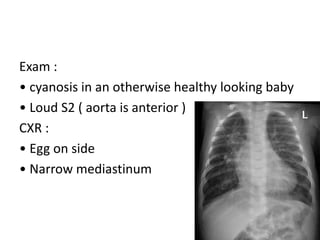
Exam :
• cyanosis in an otherwise healthy looking baby
• Loud S2 ( aorta is anterior )
CXR :
• Egg on side
• Narrow mediastinum
ECHO
TREATMENT
PGE1 (start with 0.05-0.1mcg/kg/min,once the
desired effect is achieved the dose is gradually
reduced to 0.01mics/kg/min)) to maintain PDA
• Rashkind balloon atrial septostomy in severely
hypoxic or acidotic infants
• Arterial switch procedure (Jatene) performed as
early as first 2 weeks of life
• Rastelli operation another alternative
• Previously, atrial switch operations were done by
creating atrial baffles
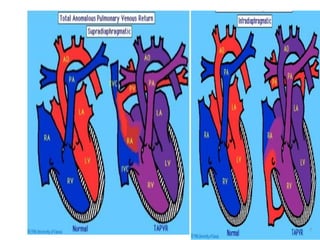
TOTAL ANOMALOUS PULMONARY VENOUS
CONNECTION
• 2-3% of CHD
• Male (4:1 ratio)
• PATHOLOGY:
NO direct communication exists between the
pulmonary veins/LA.
Drain into systemic venous tributaries/RA.
• 4 TYPES :
Depending on drainage site of pulmonary veins.
1.Supracardiac
2.Cardiac
3.Infracardiac
4. Mixed
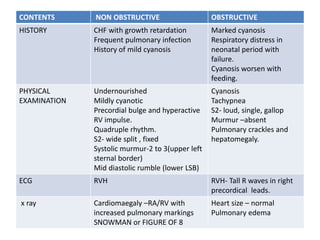
CONTENTS NON OBSTRUCTIVE OBSTRUCTIVE
HISTORY CHF with growth retardation
Frequent pulmonary infection
History of mild cyanosis
Marked cyanosis
Respiratory distress in
neonatal period with
failure.
Cyanosis worsen with
feeding.
PHYSICAL
EXAMINATION
Undernourished
Mildly cyanotic
Precordial bulge and hyperactive
RV impulse.
Quadruple rhythm.
S2- wide split , fixed
Systolic murmur-2 to 3(upper left
sternal border)
Mid diastolic rumble (lower LSB)
Cyanosis
Tachypnea
S2- loud, single, gallop
Murmur –absent
Pulmonary crackles and
hepatomegaly.
ECG RVH RVH- Tall R waves in right
precordical leads.
x ray Cardiomaegaly –RA/RV with
increased pulmonary markings
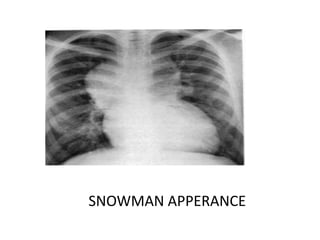
SNOWMAN or FIGURE OF 8
Heart size – normal
Pulmonary edema
SNOWMAN APPERANCE
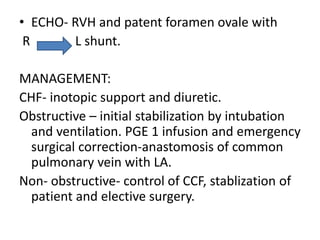
• ECHO- RVH and patent foramen ovale with
R L shunt.
MANAGEMENT:
CHF- inotopic support and diuretic.
Obstructive – initial stabilization by intubation
and ventilation. PGE 1 infusion and emergency
surgical correction-anastomosis of common
pulmonary vein with LA.
Non- obstructive- control of CCF, stablization of
patient and elective surgery.
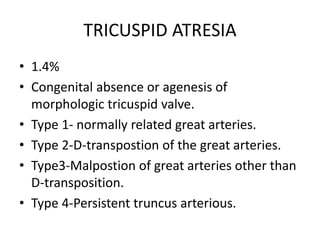
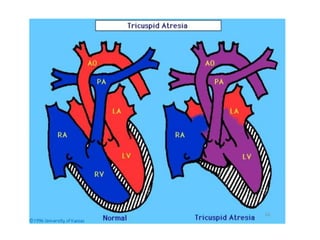
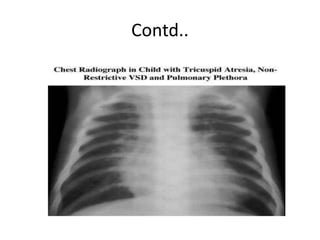
TRICUSPID ATRESIA
• 1.4%
• Congenital absence or agenesis of
morphologic tricuspid valve.
• Type 1- normally related great arteries.
• Type 2-D-transpostion of the great arteries.
• Type3-Malpostion of great arteries other than
D-transposition.
• Type 4-Persistent truncus arterious.
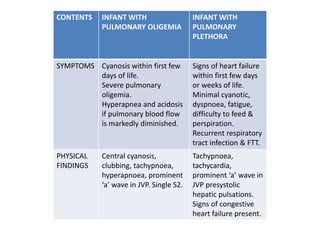
CONTENTS INFANT WITH
PULMONARY OLIGEMIA
INFANT WITH
PULMONARY
PLETHORA
SYMPTOMS Cyanosis within first few
days of life.
Severe pulmonary
oligemia.
Hyperapnea and acidosis
if pulmonary blood flow
is markedly diminished.
Signs of heart failure
within first few days
or weeks of life.
Minimal cyanotic,
dyspnoea, fatigue,
difficulty to feed &
perspiration.
Recurrent respiratory
tract infection & FTT.
PHYSICAL
FINDINGS
Central cyanosis,
clubbing, tachypnoea,
hyperapnoea, prominent
‘a’ wave in JVP. Single S2.
Tachypnoea,
tachycardia,
prominent ‘a’ wave in
JVP presystolic
hepatic pulsations.
Signs of congestive
heart failure present.
Contd..
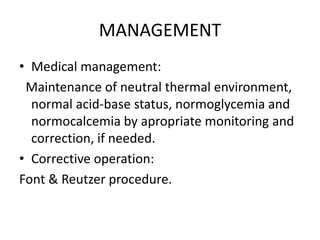
MANAGEMENT
• Medical management:
Maintenance of neutral thermal environment,
normal acid-base status, normoglycemia and
normocalcemia by apropriate monitoring and
correction, if needed.
• Corrective operation:
Font & Reutzer procedure.
Surgical
• Surgical Management Single ventricle
paliation
• First stage : to establish a reliable source of
PBF – Aorta to pulmonary artery shunt ( BT
shunt) – Pulmonary arterial banding in cases of
increased PBF
• Second stage: Glenn Anastomosis ( superior
vena cava to pulmonary artery )
• Third stage : Fontan anastomosis ( Inferior
vena cava to pulmonary artery)
TRUNCUS ARTERIOSUS
• The presence of a common trunk that supply
the systemic, pulmonary and coronary
circulation
• Almost always associated with VSD
• 1.2-2.5% of all congenital heart disease
Contd..
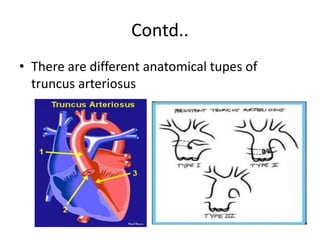
• There are different anatomical tupes of
truncus arteriosus
Contd..
• Presenting feature is congestive heart failure
(tachypneoa, hepatomegaly)
• Exam is significant for
Single and loud S2
– Ejection click of the abnormal truncal valve
– Systolic murmur of truncal valve stenosis if present
– Diastolic murmur of truncal valve insufficiency
– Gallop
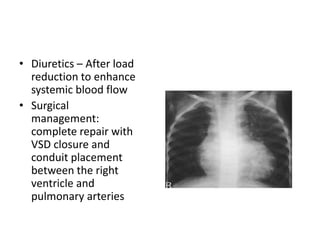
• CXR : Cardiomegaly , increased pulmonary circulation
• Diuretics – After load
reduction to enhance
systemic blood flow
• Surgical
management:
complete repair with
VSD closure and
conduit placement
between the right
ventricle and
pulmonary arteries
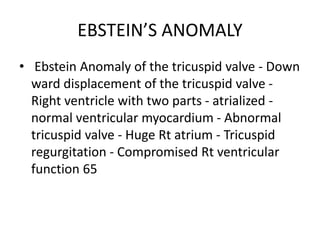
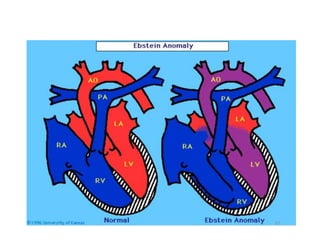
EBSTEIN’S ANOMALY
• Ebstein Anomaly of the tricuspid valve - Down
ward displacement of the tricuspid valve -
Right ventricle with two parts - atrialized -
normal ventricular myocardium - Abnormal
tricuspid valve - Huge Rt atrium - Tricuspid
regurgitation - Compromised Rt ventricular
function 65
• Clinical Manifestations –
• Easly fatiguability
- Cyanosis
- - Dysrhythmia
- - Rt to Lt shunt through formen ovale
- Holosystolic M at tricuspid area
- Heart failure
Diagnosis: -
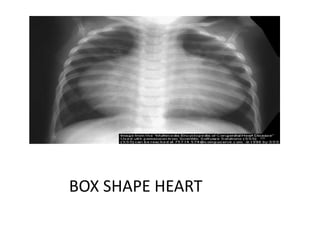
CXR - box shaped heart –
ECG - Right BBB - Superior axis deviation
Treatment :- PGE1 - Surgery
BOX SHAPE HEART
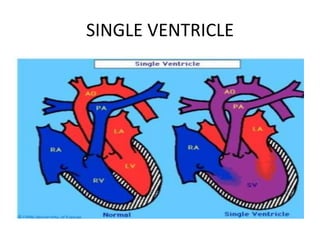
SINGLE VENTRICLE
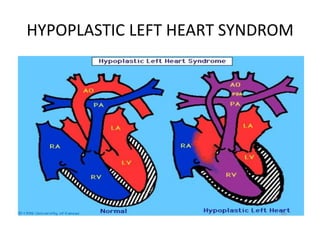
HYPOPLASTIC LEFT HEART SYNDROM
THANK YOU

Cchd

  • 1.
  • 2.
  • 3.
    INDRODUCTION • Most manifestduring neonatal period and requiring a correct diagnosis for appropriate management. • With increased pulmonary blood flow • With decreased pulmonary blood flow
  • 4.
    With increased pulmonaryflow • Persistent truncus arteriosus • TGA • TAPVD • Univentricular heart • Common atrium • TOF with pulmonary atresia with increased collateral blood flow
  • 5.
    With decreased pulmonaryflow • Tricuspid atresia • Pulmonary atresia with intact ventricular septum • Ebstein’s anomaly • TOF • Critical pulmonary stenosis
  • 6.
    TRANSPOSITION OF GREATARTERIES • Aorta originating from the right ventricle, and pulmonary artery originating from the left ventricle Accounts for 5-7% of all congenital heart disease
  • 8.
    CONTD.. • In TGAaorta is anterior • Survival is dependent on the presence of mixing between the pulmonary and systemic circulation ASD is essential for survival 50% of patients have a VSD • More common in boys • Presents with cyanosis and tachypnea within first few hours or days of life • Severity inversely proportional to presence of shunts
  • 9.
    TGA variants TGA withintact Interventricular septum • TGA with VSD • TGA with VSD and LVOT obstruction (Pulmonary stenosis)
  • 10.
    Exam : • cyanosisin an otherwise healthy looking baby • Loud S2 ( aorta is anterior ) CXR : • Egg on side • Narrow mediastinum
  • 11.
  • 12.
    TREATMENT PGE1 (start with0.05-0.1mcg/kg/min,once the desired effect is achieved the dose is gradually reduced to 0.01mics/kg/min)) to maintain PDA • Rashkind balloon atrial septostomy in severely hypoxic or acidotic infants • Arterial switch procedure (Jatene) performed as early as first 2 weeks of life • Rastelli operation another alternative • Previously, atrial switch operations were done by creating atrial baffles
  • 13.
    TOTAL ANOMALOUS PULMONARYVENOUS CONNECTION • 2-3% of CHD • Male (4:1 ratio) • PATHOLOGY: NO direct communication exists between the pulmonary veins/LA. Drain into systemic venous tributaries/RA. • 4 TYPES : Depending on drainage site of pulmonary veins. 1.Supracardiac 2.Cardiac 3.Infracardiac 4. Mixed
  • 15.
    CONTENTS NON OBSTRUCTIVEOBSTRUCTIVE HISTORY CHF with growth retardation Frequent pulmonary infection History of mild cyanosis Marked cyanosis Respiratory distress in neonatal period with failure. Cyanosis worsen with feeding. PHYSICAL EXAMINATION Undernourished Mildly cyanotic Precordial bulge and hyperactive RV impulse. Quadruple rhythm. S2- wide split , fixed Systolic murmur-2 to 3(upper left sternal border) Mid diastolic rumble (lower LSB) Cyanosis Tachypnea S2- loud, single, gallop Murmur –absent Pulmonary crackles and hepatomegaly. ECG RVH RVH- Tall R waves in right precordical leads. x ray Cardiomaegaly –RA/RV with increased pulmonary markings SNOWMAN or FIGURE OF 8 Heart size – normal Pulmonary edema
  • 16.
  • 17.
    • ECHO- RVHand patent foramen ovale with R L shunt. MANAGEMENT: CHF- inotopic support and diuretic. Obstructive – initial stabilization by intubation and ventilation. PGE 1 infusion and emergency surgical correction-anastomosis of common pulmonary vein with LA. Non- obstructive- control of CCF, stablization of patient and elective surgery.
  • 18.
    TRICUSPID ATRESIA • 1.4% •Congenital absence or agenesis of morphologic tricuspid valve. • Type 1- normally related great arteries. • Type 2-D-transpostion of the great arteries. • Type3-Malpostion of great arteries other than D-transposition. • Type 4-Persistent truncus arterious.
  • 20.
    CONTENTS INFANT WITH PULMONARYOLIGEMIA INFANT WITH PULMONARY PLETHORA SYMPTOMS Cyanosis within first few days of life. Severe pulmonary oligemia. Hyperapnea and acidosis if pulmonary blood flow is markedly diminished. Signs of heart failure within first few days or weeks of life. Minimal cyanotic, dyspnoea, fatigue, difficulty to feed & perspiration. Recurrent respiratory tract infection & FTT. PHYSICAL FINDINGS Central cyanosis, clubbing, tachypnoea, hyperapnoea, prominent ‘a’ wave in JVP. Single S2. Tachypnoea, tachycardia, prominent ‘a’ wave in JVP presystolic hepatic pulsations. Signs of congestive heart failure present.
  • 21.
  • 22.
    MANAGEMENT • Medical management: Maintenanceof neutral thermal environment, normal acid-base status, normoglycemia and normocalcemia by apropriate monitoring and correction, if needed. • Corrective operation: Font & Reutzer procedure.
  • 23.
    Surgical • Surgical ManagementSingle ventricle paliation • First stage : to establish a reliable source of PBF – Aorta to pulmonary artery shunt ( BT shunt) – Pulmonary arterial banding in cases of increased PBF • Second stage: Glenn Anastomosis ( superior vena cava to pulmonary artery ) • Third stage : Fontan anastomosis ( Inferior vena cava to pulmonary artery)
  • 24.
    TRUNCUS ARTERIOSUS • Thepresence of a common trunk that supply the systemic, pulmonary and coronary circulation • Almost always associated with VSD • 1.2-2.5% of all congenital heart disease
  • 25.
    Contd.. • There aredifferent anatomical tupes of truncus arteriosus
  • 26.
    Contd.. • Presenting featureis congestive heart failure (tachypneoa, hepatomegaly) • Exam is significant for Single and loud S2 – Ejection click of the abnormal truncal valve – Systolic murmur of truncal valve stenosis if present – Diastolic murmur of truncal valve insufficiency – Gallop • CXR : Cardiomegaly , increased pulmonary circulation
  • 27.
    • Diuretics –After load reduction to enhance systemic blood flow • Surgical management: complete repair with VSD closure and conduit placement between the right ventricle and pulmonary arteries
  • 28.
    EBSTEIN’S ANOMALY • EbsteinAnomaly of the tricuspid valve - Down ward displacement of the tricuspid valve - Right ventricle with two parts - atrialized - normal ventricular myocardium - Abnormal tricuspid valve - Huge Rt atrium - Tricuspid regurgitation - Compromised Rt ventricular function 65
  • 30.
    • Clinical Manifestations– • Easly fatiguability - Cyanosis - - Dysrhythmia - - Rt to Lt shunt through formen ovale - Holosystolic M at tricuspid area - Heart failure Diagnosis: - CXR - box shaped heart – ECG - Right BBB - Superior axis deviation Treatment :- PGE1 - Surgery
  • 31.
  • 32.
  • 33.
  • 34.