See discussions, stats, and author profiles for this publication at: https://www.researchgate.net/publication/309771431
PPT Fundamentals of Radar
Data · November 2016
CITATIONS
0
READS
1,024
1 author:
Some of the authors of this publication are also working on these related projects:
VLSI Testing View project
Opto Deportation View project
Naveenbalaji Gowthaman
University of KwaZulu-Natal
103 PUBLICATIONS   177 CITATIONS   
SEE PROFILE
All content following this page was uploaded by Naveenbalaji Gowthaman on 09 November 2016.
The user has requested enhancement of the downloaded file.
Fundamentals of Radar
SNS College of technology
(Autonomous)
Coimbatore
RADAR
• RADAR – RAdio Detection and RAnging
• First successfully demonstrated in 1936
• Electromagnetic Waves are used
• Wide range of applications
 Aircrafts
 Ship
 Satellite Communication
 Communication Systems
2
3
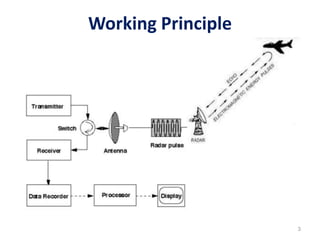
Working Principle
4
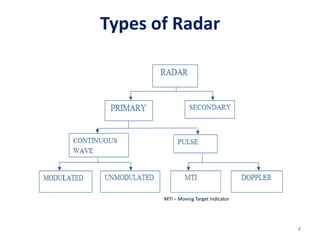
Types of Radar
MTI – Moving Target Indicator
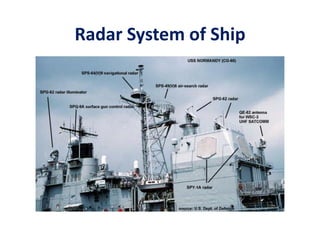
Radar System of Ship
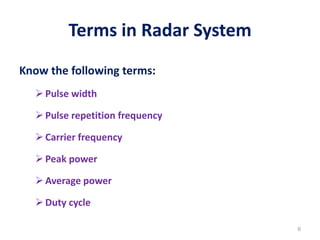
Terms in Radar System
Know the following terms:
Pulse width
Pulse repetition frequency
Carrier frequency
Peak power
Average power
Duty cycle
6
Basic Radar Types
• Pulse Transmission
• Continuous Wave
7
Pulse Transmission
• Pulse Width (PW)
– Length or duration of a given pulse
• Pulse Repetition Frequency (PRF)
– Frequency at which consecutive pulse are transmitted
• Pulse Repetition Time (PRT=1/PRF)
– Time from beginning of one pulse to the next
– Inverse of PRF
• PW determines radar’s
– Minimum detection range
– Maximum detection range
• PRF determines radar’s
– Maximum detection range
8
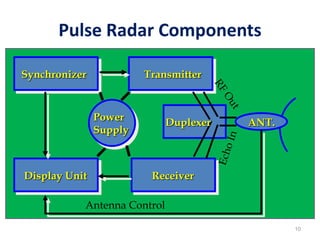
Pulse Radar Components
Synchronizer Transmitter
Display Unit Receiver
Power
Supply
ANT.
Duplexer
Antenna Control
10
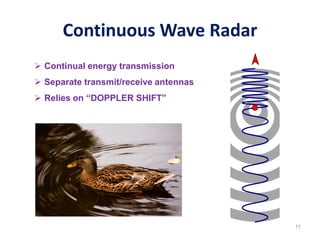
Continuous Wave Radar
11
 Continual energy transmission
 Separate transmit/receive antennas
 Relies on “DOPPLER SHIFT”
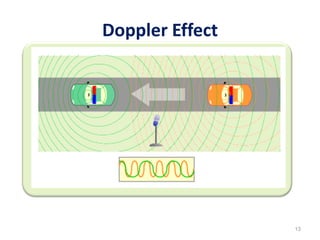
Doppler Frequency Shifts
Motion Away:
Echo Frequency Decreases
Motion Towards:
Echo Frequency Increases
RADAR
12
Doppler Effect
13
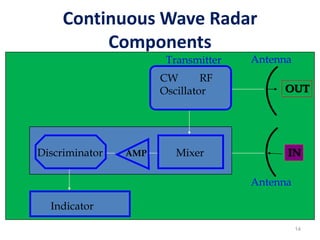
Continuous Wave Radar
Components
Discriminator AMP Mixer
CW RF
Oscillator
Indicator
OUT
IN
Transmitter Antenna
Antenna
14
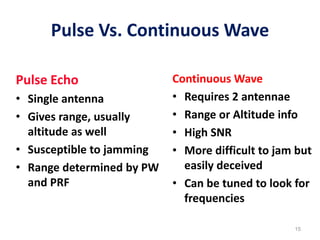
Pulse Vs. Continuous Wave
Pulse Echo
• Single antenna
• Gives range, usually
altitude as well
• Susceptible to jamming
• Range determined by PW
and PRF
Continuous Wave
• Requires 2 antennae
• Range or Altitude info
• High SNR
• More difficult to jam but
easily deceived
• Can be tuned to look for
frequencies
15
RADAR Wave Modulation
 Amplitude Modulation
– Vary the amplitude of the carrier sine wave
 Frequency Modulation
– Vary the frequency of the carrier sine wave
 Pulse-Amplitude Modulation
– Vary the amplitude of the pulses
 Pulse-Frequency Modulation
– Vary the Frequency at which the pulses occur
16
Antenna
• Two basic purposes:
– Radiates RF energy
– Provides beam forming and energy focusing
• Must be 1/2 the wave length for maximum wave
length employed
• Wide beam pattern for search
• Narrow beam pattern for tracking
17
Beam width Vs. Accuracy
B ea m w id th v s A ccu ra cy
S h ip A S h ip B
18
Determining Azimuth Angular
Measurement
A zim u th A n g u la r M ea su rem en t
R elativ e B earin g = A n g le fro m sh ip ’s h ead in g .
T ru e B earin g = S h ip ’s H ead in g + R elativ e B earin g
N
S h ip ’s H ead in g
A n g le
T a rg e t A n g le
19
Determining Altitude
D eterm in in g A ltitu d e
S lant R ange
A ltitu d e
A n g le o f E le v atio n
A ltitu d e = slan t ran g e x sin 0 elev atio n
20
21
Normal radar functions:
1. Range (from pulse delay)
2. Velocity (from Doppler frequency shift)
3. Angular direction (from antenna pointing)
Signature analysis and inverse scattering:
4. Target size (from magnitude of return)
5. Target shape and components (return as a function of direction)
6. Moving parts (modulation of the return)
7. Material composition
Applications
/ˈkwɪəri/
22
View publication stats

Ppt fundamentalsof radar (1)

  • 1.
    See discussions, stats,and author profiles for this publication at: https://www.researchgate.net/publication/309771431 PPT Fundamentals of Radar Data · November 2016 CITATIONS 0 READS 1,024 1 author: Some of the authors of this publication are also working on these related projects: VLSI Testing View project Opto Deportation View project Naveenbalaji Gowthaman University of KwaZulu-Natal 103 PUBLICATIONS   177 CITATIONS    SEE PROFILE All content following this page was uploaded by Naveenbalaji Gowthaman on 09 November 2016. The user has requested enhancement of the downloaded file.
  • 2.
    Fundamentals of Radar SNSCollege of technology (Autonomous) Coimbatore
  • 3.
    RADAR • RADAR –RAdio Detection and RAnging • First successfully demonstrated in 1936 • Electromagnetic Waves are used • Wide range of applications  Aircrafts  Ship  Satellite Communication  Communication Systems 2
  • 4.
  • 5.
    4 Types of Radar MTI– Moving Target Indicator
  • 6.
  • 7.
    Terms in RadarSystem Know the following terms: Pulse width Pulse repetition frequency Carrier frequency Peak power Average power Duty cycle 6
  • 8.
    Basic Radar Types •Pulse Transmission • Continuous Wave 7
  • 9.
    Pulse Transmission • PulseWidth (PW) – Length or duration of a given pulse • Pulse Repetition Frequency (PRF) – Frequency at which consecutive pulse are transmitted • Pulse Repetition Time (PRT=1/PRF) – Time from beginning of one pulse to the next – Inverse of PRF • PW determines radar’s – Minimum detection range – Maximum detection range • PRF determines radar’s – Maximum detection range 8
  • 10.
    Pulse Radar Components SynchronizerTransmitter Display Unit Receiver Power Supply ANT. Duplexer Antenna Control 10
  • 11.
    Continuous Wave Radar 11 Continual energy transmission  Separate transmit/receive antennas  Relies on “DOPPLER SHIFT”
  • 12.
    Doppler Frequency Shifts MotionAway: Echo Frequency Decreases Motion Towards: Echo Frequency Increases RADAR 12
  • 13.
  • 14.
    Continuous Wave Radar Components DiscriminatorAMP Mixer CW RF Oscillator Indicator OUT IN Transmitter Antenna Antenna 14
  • 15.
    Pulse Vs. ContinuousWave Pulse Echo • Single antenna • Gives range, usually altitude as well • Susceptible to jamming • Range determined by PW and PRF Continuous Wave • Requires 2 antennae • Range or Altitude info • High SNR • More difficult to jam but easily deceived • Can be tuned to look for frequencies 15
  • 16.
    RADAR Wave Modulation Amplitude Modulation – Vary the amplitude of the carrier sine wave  Frequency Modulation – Vary the frequency of the carrier sine wave  Pulse-Amplitude Modulation – Vary the amplitude of the pulses  Pulse-Frequency Modulation – Vary the Frequency at which the pulses occur 16
  • 17.
    Antenna • Two basicpurposes: – Radiates RF energy – Provides beam forming and energy focusing • Must be 1/2 the wave length for maximum wave length employed • Wide beam pattern for search • Narrow beam pattern for tracking 17
  • 18.
    Beam width Vs.Accuracy B ea m w id th v s A ccu ra cy S h ip A S h ip B 18
  • 19.
    Determining Azimuth Angular Measurement Azim u th A n g u la r M ea su rem en t R elativ e B earin g = A n g le fro m sh ip ’s h ead in g . T ru e B earin g = S h ip ’s H ead in g + R elativ e B earin g N S h ip ’s H ead in g A n g le T a rg e t A n g le 19
  • 20.
    Determining Altitude D etermin in g A ltitu d e S lant R ange A ltitu d e A n g le o f E le v atio n A ltitu d e = slan t ran g e x sin 0 elev atio n 20
  • 21.
    21 Normal radar functions: 1.Range (from pulse delay) 2. Velocity (from Doppler frequency shift) 3. Angular direction (from antenna pointing) Signature analysis and inverse scattering: 4. Target size (from magnitude of return) 5. Target shape and components (return as a function of direction) 6. Moving parts (modulation of the return) 7. Material composition Applications
  • 22.