Introduction to Modern
Radar for Machine
Perception
Robert Laganière
Professor, University of Ottawa
CEO, Sensor Cortek
1. Radar: fundamental principle
2. Radar history and modern radar development
3. Technology for radar: time of flight, continuous wave radar, frequency modulation
4. FMCW radar: the chirp signal, signal mixing
5. FMCW signal processing: range, Doppler, direction of arrival
6. The Range-Azimuth-Doppler signal
7. Detection from radar: constant false alarm rate algorithms
8. Pros and cons of radars
9. Conclusion
Content
2
© 2024 University of Ottawa / Sensor Cortek inc
• Radar is a relatively old technology
• Mature solid-state design, very reliable
• New applications emerged in recent years
• Occupancy detection
• Gesture recognition
• Automotive (ADAS and AV)
• Almost every aspect of radar performance has improved
• Cost, size, power, resolution, etc.
Radar development
3
© 2024 University of Ottawa / Sensor Cortek inc
• 1886-1889, German physicist Heinrich Hertz experimentally
prove the existence of radio waves
• Predicted by Maxwell’s theory of electromagnetism (1865)
• 1904, German engineer Christian Hülsmeyer invented
Telemobiloscope
• First patented device to use radio waves for detecting objects
• 18th May 1904 first public demonstration
• World War II stimulated the development and large-scale
deployment of Radar
Radar history
4
© 2024 University of Ottawa / Sensor Cortek inc
radarworld.org/huelsmeyer.html
1. Time of Flight (ToF)
2. Continuous Waves (CW)
3. Frequency Modulation (FM)
 FMCW Radar
Three technologies for radar
5
© 2024 University of Ottawa / Sensor Cortek inc
https://hforsten.com/third-version-of-homemade-6-ghz-fmcw-radar.html
• In its simplest form, an impulse signal is sent
• Measuring time to receive the echo yield to distance estimate according to:
1. Time of flight (ToF) for distance estimation
6
© 2024 University of Ottawa / Sensor Cortek inc
www.radartutorial.eu/01.basics/Distance-determination.en.html
monostatic
radar
• The power received Pr is a fraction of the power transmitted Pt
• σ is the radar cross section (expressed in m2) defines how detectable is the target; it
depends on:
• Target material
• Target shape
• Target size
• Incident angle
Radar cross section
7
© 2024 University of Ottawa / Sensor Cortek inc
www.radartutorial.eu/01.basics/Distance-determination.en.html
Pt
Pr
Pr= Pt x (gain) x (spread factor) x (losses) x σ x (spread factor) x (aperture) x (dwell time)
• A continuous signal is transmitted
• The Doppler effect provides target velocity information
• The Doppler frequency is the difference between the transmitted signal frequency
and the received signal frequency
2. Continuous wave (CW) and the Doppler effect
8
© 2024 University of Ottawa / Sensor Cortek inc
copradar.com/chapts/chapt3/ch3d1.html
• Technique for encoding of information
into a wave signal by varying its
instantaneous frequency
• For radar this is a way to add information
• To better estimate velocity and range via
Doppler shift
• To reduce interference by making the
signal more distinctive
3. Frequency modulation (FM) signal encoding
9
© 2024 University of Ottawa / Sensor Cortek inc
• FMCW radars transmit and receive a signal that combine FM and CW techniques
• The signal frequency changes periodically w.r.t time, one period is often referred to as
one “chirp”
FMCW signal
10
© 2024 University of Ottawa / Sensor Cortek inc
• Signal parameters:
• Chirp periodicity Tc;
• Frequency slope S;
• Frequency bandwidth of one chirp B.
• As we will see, the choice of the signal
parameters will affect the radar performance
• A radar frame is made of N chirps
• The transmitted (Tx) and received (Rx) signals are mixed by an onboard mixer
• The resulting signal is then digitized by an analog to digital converter (ADC)
FMCW signal mixing
11
© 2024 University of Ottawa / Sensor Cortek inc
www.radartutorial.eu/01.basics/Distance-determination.en.html
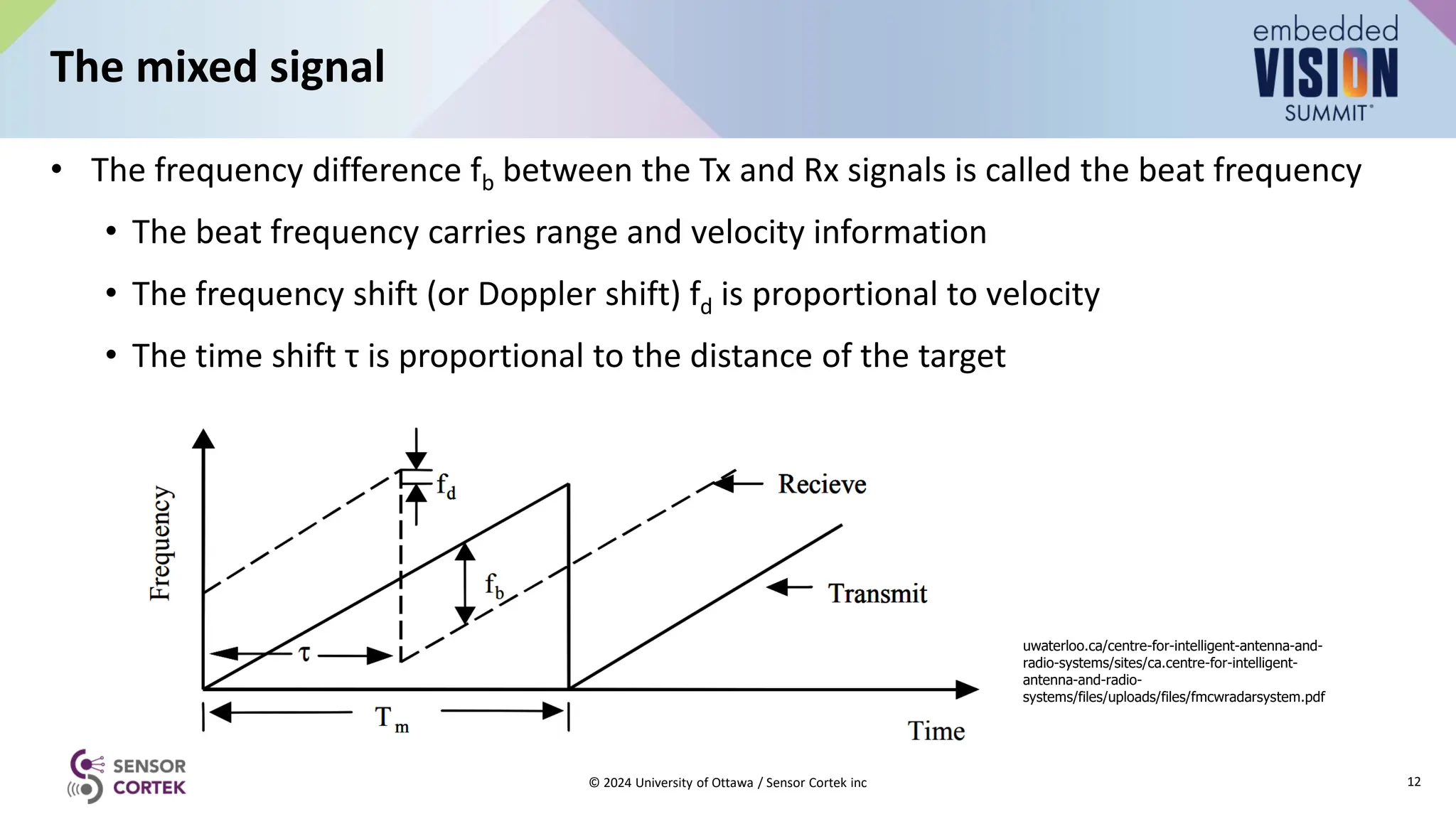
• The frequency difference fb between the Tx and Rx signals is called the beat frequency
• The beat frequency carries range and velocity information
• The frequency shift (or Doppler shift) fd is proportional to velocity
• The time shift τ is proportional to the distance of the target
The mixed signal
12
© 2024 University of Ottawa / Sensor Cortek inc
uwaterloo.ca/centre-for-intelligent-antenna-and-
radio-systems/sites/ca.centre-for-intelligent-
antenna-and-radio-
systems/files/uploads/files/fmcwradarsystem.pdf
• The input signal is a radar frame composed of N Chirps
• This is the ADC signal
• i.e., the signal from the Analog-to-Digital converter
• The Fast Fourier Transform (FFT) is the main tool for the analysis of FMCW radars
• Traditional FMCW DSP is normally divided into 3 steps:
• Range FFT
• Doppler FFT
• Direction of Arrival (DOA)
• The resulting signal is three-dimensional and is therefore designated as the:
• Radar Data Cube
FMCW digital signal processing
13
© 2024 University of Ottawa / Sensor Cortek inc
• The beat frequency fd (a.k.a. intermediate
frequency) is computed by FFT from ADC signals.
• The theoretical maximum range is limited by the
chirp periodicity (τ < Tm).
• In practice it is limited by the power of the signal
and the ADC sampling rate.
• To increase the range resolution, you must
increase the chirp frequency bandwidth B.
• This range FFT is conducted with the signals
collected in one chirp.
The range FFT
14
© 2024 University of Ottawa / Sensor Cortek inc
uwaterloo.ca/centre-for-intelligent-antenna-and-
radio-systems/sites/ca.centre-for-intelligent-
antenna-and-radio-
systems/files/uploads/files/fmcwradarsystem.pdf
• The velocity is extracted by
observing the change in
phase of the beat frequency
between consecutive chirps.
• This Doppler FFT is therefore
computed over the series of
chirps in a radar frame.
• To increase the range
resolution, you must increase
the number of chirps in the
radar frame.
Doppler FFT
15
© 2024 University of Ottawa / Sensor Cortek inc
Range and velocity estimation summary
16
© 2024 University of Ottawa / Sensor Cortek inc
Definition:
Resolution:
Maximum:
c, Speed of light
IFtone, Beat frequency
S, Chirp frequency slope
Tc, Chirp period
D, Chirp frequency bandwidth
Tf, Frame period
Fs, ADC sampling frequency
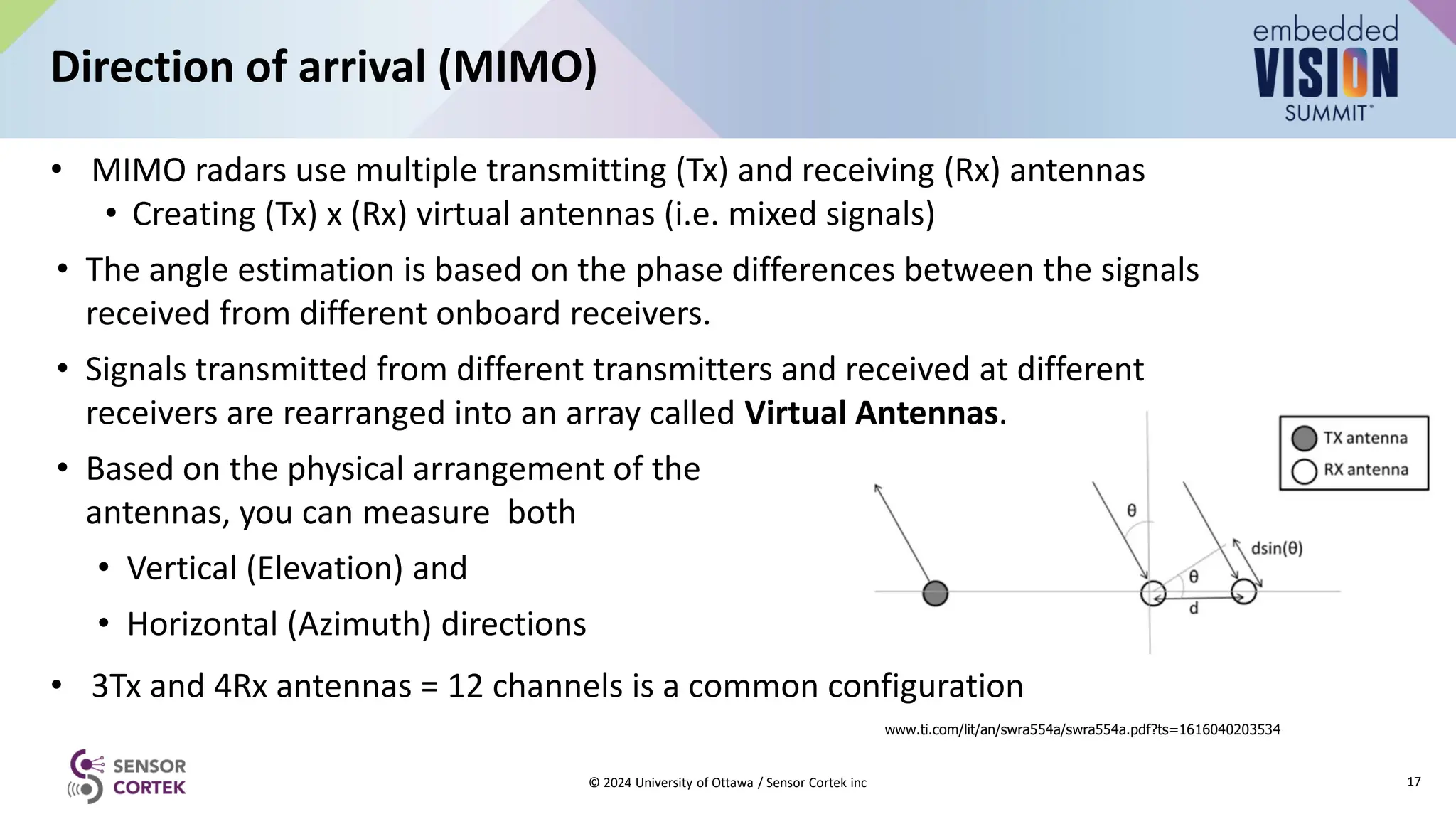
• MIMO radars use multiple transmitting (Tx) and receiving (Rx) antennas
• Creating (Tx) x (Rx) virtual antennas (i.e. mixed signals)
• The angle estimation is based on the phase differences between the signals
received from different onboard receivers.
• Signals transmitted from different transmitters and received at different
receivers are rearranged into an array called Virtual Antennas.
• Based on the physical arrangement of the
antennas, you can measure both
• Vertical (Elevation) and
• Horizontal (Azimuth) directions
• 3Tx and 4Rx antennas = 12 channels is a common configuration
Direction of arrival (MIMO)
17
© 2024 University of Ottawa / Sensor Cortek inc
www.ti.com/lit/an/swra554a/swra554a.pdf?ts=1616040203534
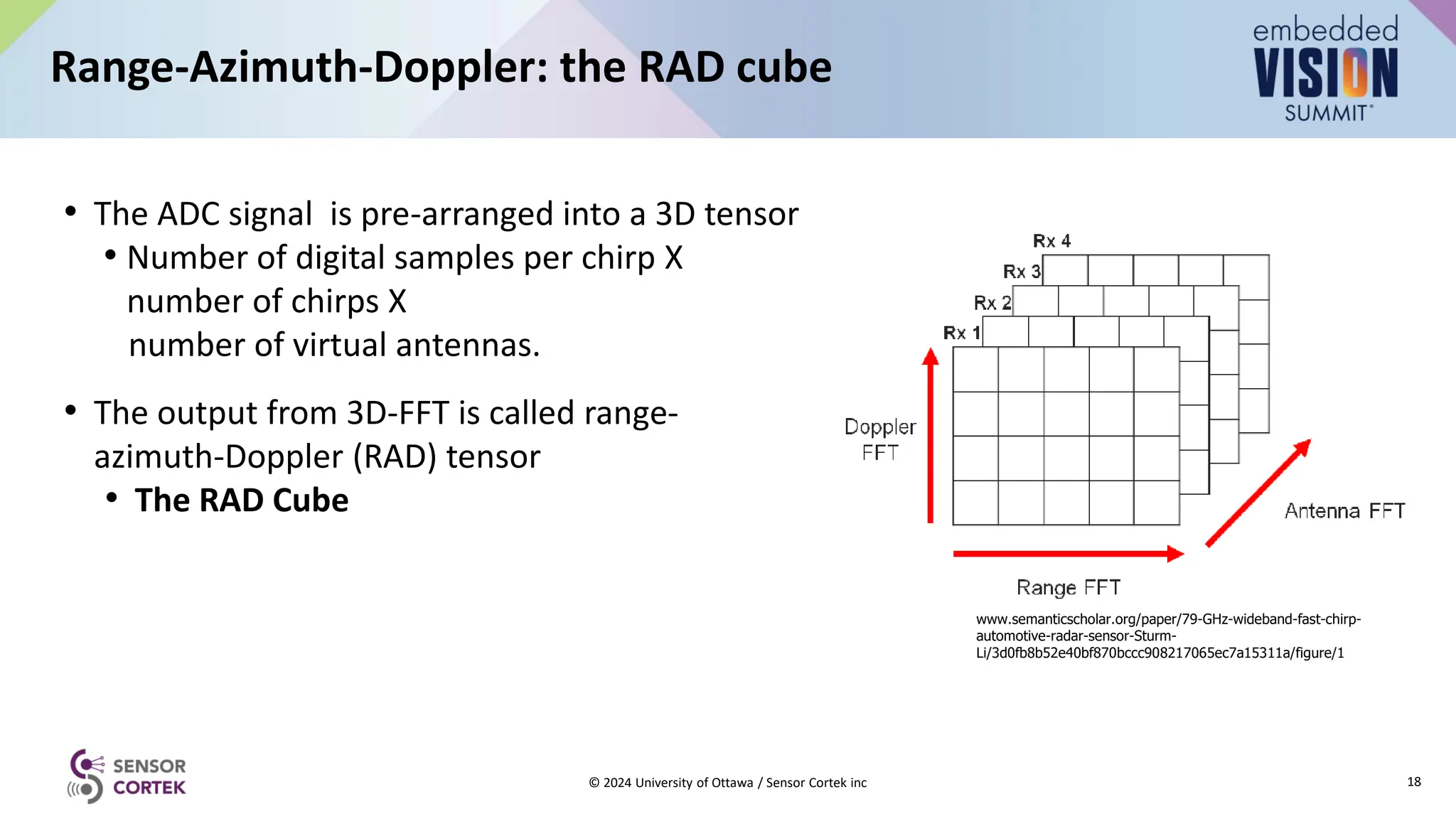
• The ADC signal is pre-arranged into a 3D tensor
• Number of digital samples per chirp X
number of chirps X
number of virtual antennas.
• The output from 3D-FFT is called range-
azimuth-Doppler (RAD) tensor
• The RAD Cube
Range-Azimuth-Doppler: the RAD cube
18
© 2024 University of Ottawa / Sensor Cortek inc
www.semanticscholar.org/paper/79-GHz-wideband-fast-chirp-
automotive-radar-sensor-Sturm-
Li/3d0fb8b52e40bf870bccc908217065ec7a15311a/figure/1
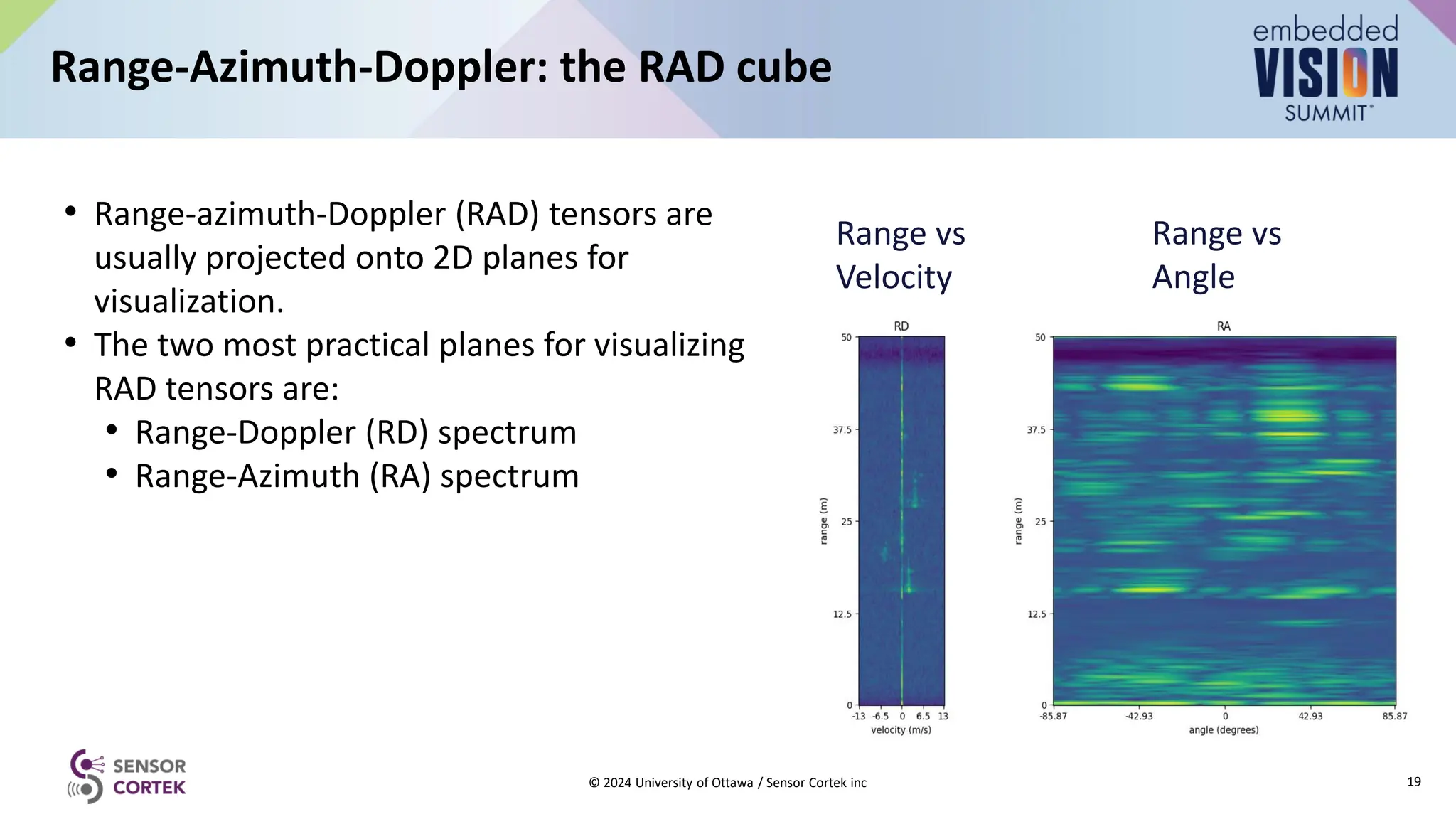
• Range-azimuth-Doppler (RAD) tensors are
usually projected onto 2D planes for
visualization.
• The two most practical planes for visualizing
RAD tensors are:
• Range-Doppler (RD) spectrum
• Range-Azimuth (RA) spectrum
Range-Azimuth-Doppler: the RAD cube
19
© 2024 University of Ottawa / Sensor Cortek inc
Range vs
Velocity
Range vs
Angle
• RA spectrum is presented with [range, angle] representations in polar coordinates.
• To increase the readability, RA data can also be transformed into top-view coordinates.
Polar to Cartesian
20
© 2024 University of Ottawa / Sensor Cortek inc
Range vs
Angle
Cartesian coordinates [X,Z]
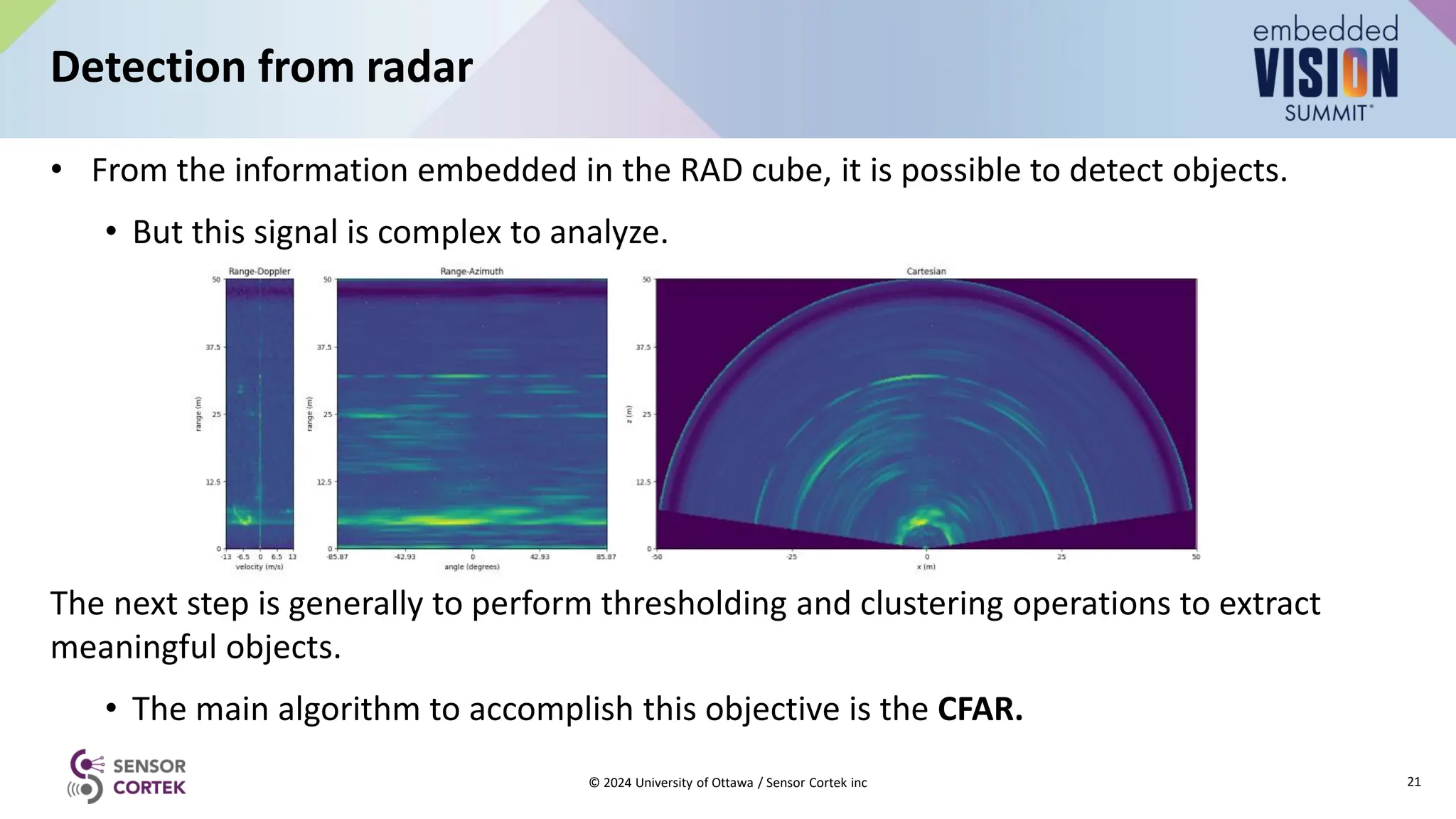
• From the information embedded in the RAD cube, it is possible to detect objects.
• But this signal is complex to analyze.
The next step is generally to perform thresholding and clustering operations to extract
meaningful objects.
• The main algorithm to accomplish this objective is the CFAR.
Detection from radar
21
© 2024 University of Ottawa / Sensor Cortek inc
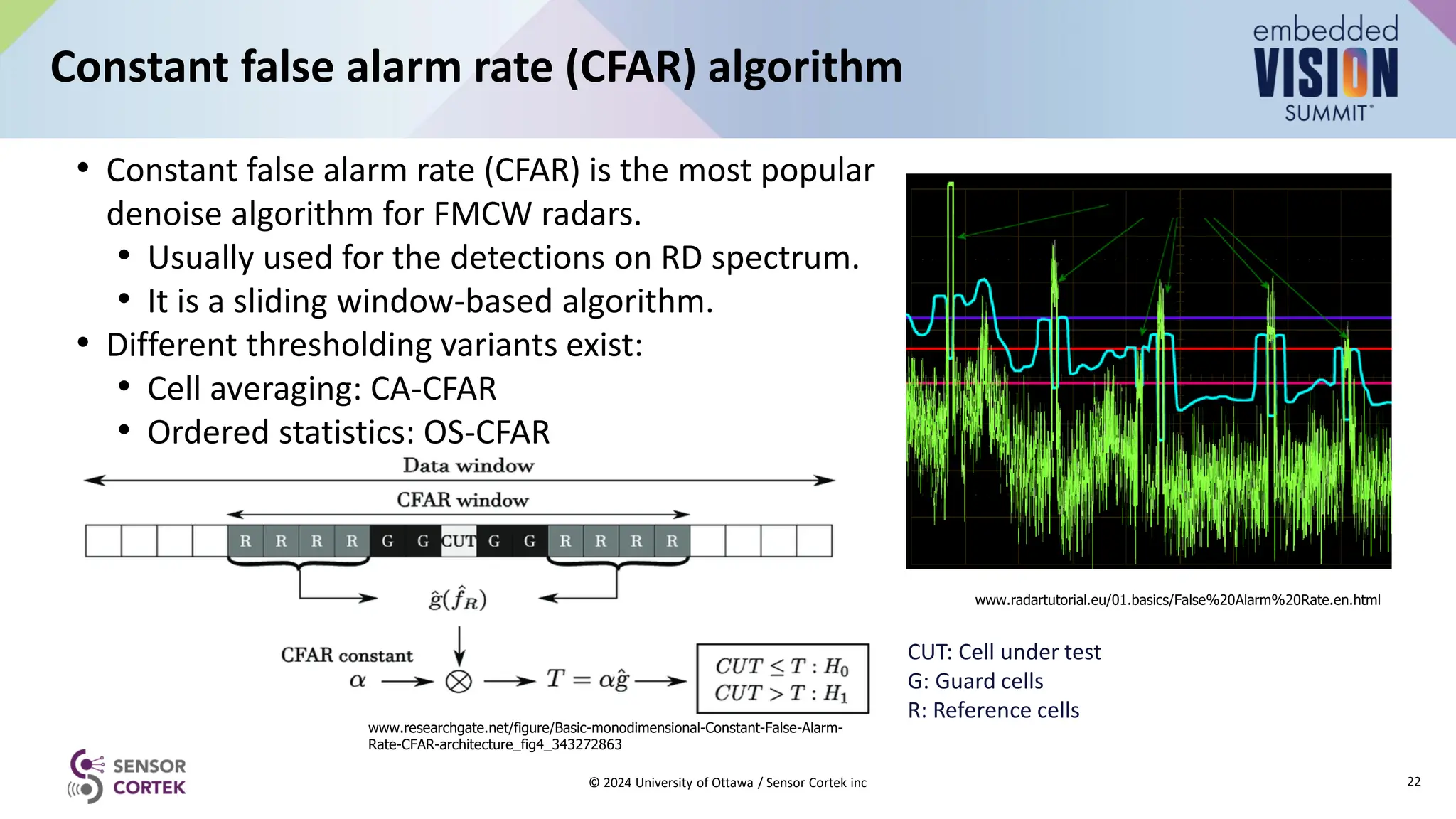
• Constant false alarm rate (CFAR) is the most popular
denoise algorithm for FMCW radars.
• Usually used for the detections on RD spectrum.
• It is a sliding window-based algorithm.
• Different thresholding variants exist:
• Cell averaging: CA-CFAR
• Ordered statistics: OS-CFAR
Constant false alarm rate (CFAR) algorithm
22
© 2024 University of Ottawa / Sensor Cortek inc
www.researchgate.net/figure/Basic-monodimensional-Constant-False-Alarm-
Rate-CFAR-architecture_fig4_343272863
www.radartutorial.eu/01.basics/False%20Alarm%20Rate.en.html
CUT: Cell under test
G: Guard cells
R: Reference cells
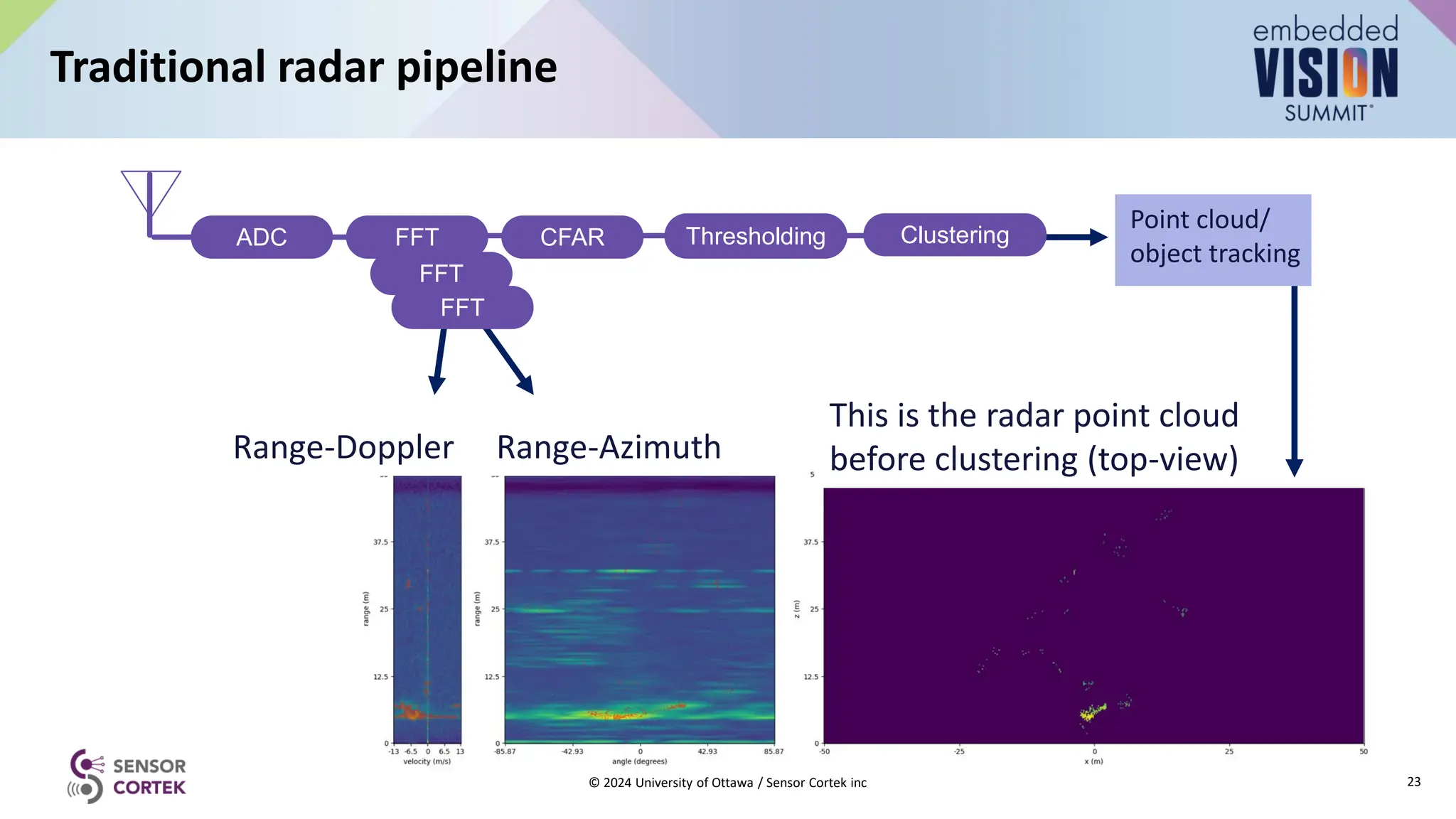
Traditional radar pipeline
23
© 2024 University of Ottawa / Sensor Cortek inc
ADC FFT CFAR Thresholding Clustering
FFT
FFT
Point cloud/
object tracking
This is the radar point cloud
before clustering (top-view)
Range-Doppler Range-Azimuth
• Weather-proof:
• FMCW radars can penetrate mediums such as clouds, fogs, mist and snow
• Illumination-proof:
• The signal frequency is specially designed and not affected by other visible light
sources
• Rich detection:
• FMCW radars can detect the positions and speeds of the targeted objects
simultaneously
• Large Field of View (FoV):
• The FoV of FMCW radars is approximately 180 degrees
• Economically friendly:
• FMCW radars are normally cheaper than other sensors in autonomous driving.
Pros of FMCW radars
24
© 2024 University of Ottawa / Sensor Cortek inc
• Noisy:
• The noisy signals lead to difficulties of distinguishing target objects from background
noise
• Unintuitive representations:
• The detection outputs are not visually intuitive to human observers
• Ignorance of some objects:
• Because FMCW radars can penetrate certain materials such as glasses, those objects
are sometimes not visible in radar frames
• No visual details:
• Radars cannot reveal the details of different objects, such as colors, surface
properties, etc.
• For example, it cannot read road signs
Cons of FMCW radars
25
© 2024 University of Ottawa / Sensor Cortek inc
• Radars are cheap, reliable, robust solid-state sensors
• Its claimed robustness to adverse weather condition is assumed but still must be fully
demonstrated
• Radars are becoming an essential component of complex perception systems
• e.g., autonomous vehicles
• Radars are improving in resolution and accuracy
• Deep neural networks (artificial intelligence) can be applied to radar
• Multi-sensor integration is the future of perception
• Radars will be part of it
Conclusion
26
© 2024 University of Ottawa / Sensor Cortek inc
References
27
© 2024 University of Ottawa / Sensor Cortek inc
Publications on radar:
• MIMO Radar, Application Report, Texas Instruments, May 2017.
• Automotive FMCW Radar Development and Verification Methods, Master’s thesis, Sanoal Machado Santiago
Manchego, University of Gothenburg, 2018.
• FMCW Radar System, Mostafa Alizadeh, University of Waterloo, 2019
• RADDet: Range-Azimuth-Doppler based Radar Object Detection for Dynamic Road Users, Ao Zhang, F. Nowruzi,
R. Laganière, CRV2021
• T-FFTRadNet: Object Detection with Swin Vision Transformers from Raw ADC Radar Signals, Giroux, Bouchard,
Laganiere, IEEE/CVF International Conference on Computer Vision Workshops, 2023

“Introduction to Modern Radar for Machine Perception,” a Presentation from Sensor Cortek

  • 1.
    Introduction to Modern Radarfor Machine Perception Robert Laganière Professor, University of Ottawa CEO, Sensor Cortek
  • 2.
    1. Radar: fundamentalprinciple 2. Radar history and modern radar development 3. Technology for radar: time of flight, continuous wave radar, frequency modulation 4. FMCW radar: the chirp signal, signal mixing 5. FMCW signal processing: range, Doppler, direction of arrival 6. The Range-Azimuth-Doppler signal 7. Detection from radar: constant false alarm rate algorithms 8. Pros and cons of radars 9. Conclusion Content 2 © 2024 University of Ottawa / Sensor Cortek inc
  • 3.
    • Radar isa relatively old technology • Mature solid-state design, very reliable • New applications emerged in recent years • Occupancy detection • Gesture recognition • Automotive (ADAS and AV) • Almost every aspect of radar performance has improved • Cost, size, power, resolution, etc. Radar development 3 © 2024 University of Ottawa / Sensor Cortek inc
  • 4.
    • 1886-1889, Germanphysicist Heinrich Hertz experimentally prove the existence of radio waves • Predicted by Maxwell’s theory of electromagnetism (1865) • 1904, German engineer Christian Hülsmeyer invented Telemobiloscope • First patented device to use radio waves for detecting objects • 18th May 1904 first public demonstration • World War II stimulated the development and large-scale deployment of Radar Radar history 4 © 2024 University of Ottawa / Sensor Cortek inc radarworld.org/huelsmeyer.html
  • 5.
    1. Time ofFlight (ToF) 2. Continuous Waves (CW) 3. Frequency Modulation (FM)  FMCW Radar Three technologies for radar 5 © 2024 University of Ottawa / Sensor Cortek inc https://hforsten.com/third-version-of-homemade-6-ghz-fmcw-radar.html
  • 6.
    • In itssimplest form, an impulse signal is sent • Measuring time to receive the echo yield to distance estimate according to: 1. Time of flight (ToF) for distance estimation 6 © 2024 University of Ottawa / Sensor Cortek inc www.radartutorial.eu/01.basics/Distance-determination.en.html monostatic radar
  • 7.
    • The powerreceived Pr is a fraction of the power transmitted Pt • σ is the radar cross section (expressed in m2) defines how detectable is the target; it depends on: • Target material • Target shape • Target size • Incident angle Radar cross section 7 © 2024 University of Ottawa / Sensor Cortek inc www.radartutorial.eu/01.basics/Distance-determination.en.html Pt Pr Pr= Pt x (gain) x (spread factor) x (losses) x σ x (spread factor) x (aperture) x (dwell time)
  • 8.
    • A continuoussignal is transmitted • The Doppler effect provides target velocity information • The Doppler frequency is the difference between the transmitted signal frequency and the received signal frequency 2. Continuous wave (CW) and the Doppler effect 8 © 2024 University of Ottawa / Sensor Cortek inc copradar.com/chapts/chapt3/ch3d1.html
  • 9.
    • Technique forencoding of information into a wave signal by varying its instantaneous frequency • For radar this is a way to add information • To better estimate velocity and range via Doppler shift • To reduce interference by making the signal more distinctive 3. Frequency modulation (FM) signal encoding 9 © 2024 University of Ottawa / Sensor Cortek inc
  • 10.
    • FMCW radarstransmit and receive a signal that combine FM and CW techniques • The signal frequency changes periodically w.r.t time, one period is often referred to as one “chirp” FMCW signal 10 © 2024 University of Ottawa / Sensor Cortek inc • Signal parameters: • Chirp periodicity Tc; • Frequency slope S; • Frequency bandwidth of one chirp B. • As we will see, the choice of the signal parameters will affect the radar performance • A radar frame is made of N chirps
  • 11.
    • The transmitted(Tx) and received (Rx) signals are mixed by an onboard mixer • The resulting signal is then digitized by an analog to digital converter (ADC) FMCW signal mixing 11 © 2024 University of Ottawa / Sensor Cortek inc www.radartutorial.eu/01.basics/Distance-determination.en.html
  • 12.
    • The frequencydifference fb between the Tx and Rx signals is called the beat frequency • The beat frequency carries range and velocity information • The frequency shift (or Doppler shift) fd is proportional to velocity • The time shift τ is proportional to the distance of the target The mixed signal 12 © 2024 University of Ottawa / Sensor Cortek inc uwaterloo.ca/centre-for-intelligent-antenna-and- radio-systems/sites/ca.centre-for-intelligent- antenna-and-radio- systems/files/uploads/files/fmcwradarsystem.pdf
  • 13.
    • The inputsignal is a radar frame composed of N Chirps • This is the ADC signal • i.e., the signal from the Analog-to-Digital converter • The Fast Fourier Transform (FFT) is the main tool for the analysis of FMCW radars • Traditional FMCW DSP is normally divided into 3 steps: • Range FFT • Doppler FFT • Direction of Arrival (DOA) • The resulting signal is three-dimensional and is therefore designated as the: • Radar Data Cube FMCW digital signal processing 13 © 2024 University of Ottawa / Sensor Cortek inc
  • 14.
    • The beatfrequency fd (a.k.a. intermediate frequency) is computed by FFT from ADC signals. • The theoretical maximum range is limited by the chirp periodicity (τ < Tm). • In practice it is limited by the power of the signal and the ADC sampling rate. • To increase the range resolution, you must increase the chirp frequency bandwidth B. • This range FFT is conducted with the signals collected in one chirp. The range FFT 14 © 2024 University of Ottawa / Sensor Cortek inc uwaterloo.ca/centre-for-intelligent-antenna-and- radio-systems/sites/ca.centre-for-intelligent- antenna-and-radio- systems/files/uploads/files/fmcwradarsystem.pdf
  • 15.
    • The velocityis extracted by observing the change in phase of the beat frequency between consecutive chirps. • This Doppler FFT is therefore computed over the series of chirps in a radar frame. • To increase the range resolution, you must increase the number of chirps in the radar frame. Doppler FFT 15 © 2024 University of Ottawa / Sensor Cortek inc
  • 16.
    Range and velocityestimation summary 16 © 2024 University of Ottawa / Sensor Cortek inc Definition: Resolution: Maximum: c, Speed of light IFtone, Beat frequency S, Chirp frequency slope Tc, Chirp period D, Chirp frequency bandwidth Tf, Frame period Fs, ADC sampling frequency
  • 17.
    • MIMO radarsuse multiple transmitting (Tx) and receiving (Rx) antennas • Creating (Tx) x (Rx) virtual antennas (i.e. mixed signals) • The angle estimation is based on the phase differences between the signals received from different onboard receivers. • Signals transmitted from different transmitters and received at different receivers are rearranged into an array called Virtual Antennas. • Based on the physical arrangement of the antennas, you can measure both • Vertical (Elevation) and • Horizontal (Azimuth) directions • 3Tx and 4Rx antennas = 12 channels is a common configuration Direction of arrival (MIMO) 17 © 2024 University of Ottawa / Sensor Cortek inc www.ti.com/lit/an/swra554a/swra554a.pdf?ts=1616040203534
  • 18.
    • The ADCsignal is pre-arranged into a 3D tensor • Number of digital samples per chirp X number of chirps X number of virtual antennas. • The output from 3D-FFT is called range- azimuth-Doppler (RAD) tensor • The RAD Cube Range-Azimuth-Doppler: the RAD cube 18 © 2024 University of Ottawa / Sensor Cortek inc www.semanticscholar.org/paper/79-GHz-wideband-fast-chirp- automotive-radar-sensor-Sturm- Li/3d0fb8b52e40bf870bccc908217065ec7a15311a/figure/1
  • 19.
    • Range-azimuth-Doppler (RAD)tensors are usually projected onto 2D planes for visualization. • The two most practical planes for visualizing RAD tensors are: • Range-Doppler (RD) spectrum • Range-Azimuth (RA) spectrum Range-Azimuth-Doppler: the RAD cube 19 © 2024 University of Ottawa / Sensor Cortek inc Range vs Velocity Range vs Angle
  • 20.
    • RA spectrumis presented with [range, angle] representations in polar coordinates. • To increase the readability, RA data can also be transformed into top-view coordinates. Polar to Cartesian 20 © 2024 University of Ottawa / Sensor Cortek inc Range vs Angle Cartesian coordinates [X,Z]
  • 21.
    • From theinformation embedded in the RAD cube, it is possible to detect objects. • But this signal is complex to analyze. The next step is generally to perform thresholding and clustering operations to extract meaningful objects. • The main algorithm to accomplish this objective is the CFAR. Detection from radar 21 © 2024 University of Ottawa / Sensor Cortek inc
  • 22.
    • Constant falsealarm rate (CFAR) is the most popular denoise algorithm for FMCW radars. • Usually used for the detections on RD spectrum. • It is a sliding window-based algorithm. • Different thresholding variants exist: • Cell averaging: CA-CFAR • Ordered statistics: OS-CFAR Constant false alarm rate (CFAR) algorithm 22 © 2024 University of Ottawa / Sensor Cortek inc www.researchgate.net/figure/Basic-monodimensional-Constant-False-Alarm- Rate-CFAR-architecture_fig4_343272863 www.radartutorial.eu/01.basics/False%20Alarm%20Rate.en.html CUT: Cell under test G: Guard cells R: Reference cells
  • 23.
    Traditional radar pipeline 23 ©2024 University of Ottawa / Sensor Cortek inc ADC FFT CFAR Thresholding Clustering FFT FFT Point cloud/ object tracking This is the radar point cloud before clustering (top-view) Range-Doppler Range-Azimuth
  • 24.
    • Weather-proof: • FMCWradars can penetrate mediums such as clouds, fogs, mist and snow • Illumination-proof: • The signal frequency is specially designed and not affected by other visible light sources • Rich detection: • FMCW radars can detect the positions and speeds of the targeted objects simultaneously • Large Field of View (FoV): • The FoV of FMCW radars is approximately 180 degrees • Economically friendly: • FMCW radars are normally cheaper than other sensors in autonomous driving. Pros of FMCW radars 24 © 2024 University of Ottawa / Sensor Cortek inc
  • 25.
    • Noisy: • Thenoisy signals lead to difficulties of distinguishing target objects from background noise • Unintuitive representations: • The detection outputs are not visually intuitive to human observers • Ignorance of some objects: • Because FMCW radars can penetrate certain materials such as glasses, those objects are sometimes not visible in radar frames • No visual details: • Radars cannot reveal the details of different objects, such as colors, surface properties, etc. • For example, it cannot read road signs Cons of FMCW radars 25 © 2024 University of Ottawa / Sensor Cortek inc
  • 26.
    • Radars arecheap, reliable, robust solid-state sensors • Its claimed robustness to adverse weather condition is assumed but still must be fully demonstrated • Radars are becoming an essential component of complex perception systems • e.g., autonomous vehicles • Radars are improving in resolution and accuracy • Deep neural networks (artificial intelligence) can be applied to radar • Multi-sensor integration is the future of perception • Radars will be part of it Conclusion 26 © 2024 University of Ottawa / Sensor Cortek inc
  • 27.
    References 27 © 2024 Universityof Ottawa / Sensor Cortek inc Publications on radar: • MIMO Radar, Application Report, Texas Instruments, May 2017. • Automotive FMCW Radar Development and Verification Methods, Master’s thesis, Sanoal Machado Santiago Manchego, University of Gothenburg, 2018. • FMCW Radar System, Mostafa Alizadeh, University of Waterloo, 2019 • RADDet: Range-Azimuth-Doppler based Radar Object Detection for Dynamic Road Users, Ao Zhang, F. Nowruzi, R. Laganière, CRV2021 • T-FFTRadNet: Object Detection with Swin Vision Transformers from Raw ADC Radar Signals, Giroux, Bouchard, Laganiere, IEEE/CVF International Conference on Computer Vision Workshops, 2023