AUTOMATIC TRANSMISSION
AND ITS TYPES
Submitted to :
Prof. Sukhinderpal
Singh
Submitted by :
Arshdeep Singh
Ashishpreet Singh
Avinash Shah
1. TORQUE CONVERTER
Unlike a manual gearbox, it does not use a clutch to change
gears. Instead, a hydraulic fluid coupling or a torque converter
does this job.
Planetary Gear can provide
following gear reductions:
a. Under Drive
(Low Speed , High Torque)
b. Direct Drive
(Same Speed and Torque as of Engine)
c. Neutral
(No power transmitted)
d. Over Drive
(High Speed , Low Torque)
e. Reverse
(Opposite motion of rotation )
2. PLANETARY GEAR SET
(principle of transmission system)
Planet Gear
UNDER DRIVE (First Gear)
Principle:- By fixing different gears of Planetary Set, different
speeds can be achieved at the output of transmission.
OVER DRIVE (Sixth Gear)
REVERSE DRIVE
HTTPS://WWW.YOUTUBE.COM/WA
TCH?V=U_Y1S8C0HMC&T=5S
WORKING OF AN AUTOMATIC
TRANSMISSION
https://www.youtube.com/watch?v=U
gao6jTyM7k
Terminologies of Gear system
• Clutch Packs (Locking of gears)
• Hydraulic System
-Pump, Governor, Shift Valves
How Transmission senses?
Vehicle
speed
Load Throttle Pedal
Position
**Governor, Engine Control Unit**
Pump, Shift Valves
Hydraulic System
(It routes fluid to all the
different components
in the transmission)
Shift Valve
The shift valve is
pressurized with fluid
from the governor on
one side, and the
throttle valve on the
other.
Types of Automatic Transmission
• Traditional Automatic Transmission
• Automated Manual Transmission
• Continuously Variable Transmission
• Dual Clutch Transmission
Automated-Manual Transmission
(AMT)
• Automates the current manual transmission.
• Regular Clutch Gear Setup (without a clutch pedal),
which does gear shifting via sensors, actuators and
processors.
• Shifting from automatic to manual(Sports mode)
possible.
• Increased fuel efficiency, economical
Disadvantages-
1. Not effective in hills
2. Jerky shifts if you drive aggressively
3. Not the finest smooth acceleration - which otherwise is
there in Automatic Cars.
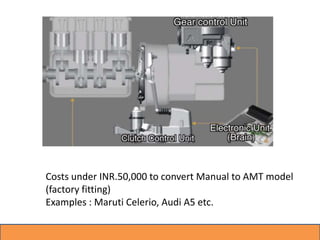
Costs under INR.50,000 to convert Manual to AMT model
(factory fitting)
Examples : Maruti Celerio, Audi A5 etc.
Continuously Variable Transmission
(CVT)
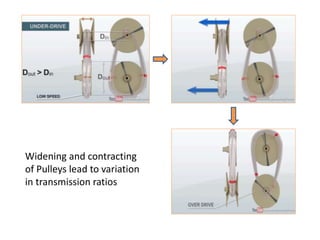
• Two variable-diameter pulleys, each shaped like a pair
of opposing cones, with a metal belt or chain running
between them. One pulley is connected to the engine
(input shaft) and the other to the drive wheels (output
shaft).
• Attains infinite transmission ratios
• The transmission shifts gears to provide the most
appropriate ratio for a given situation: Lowest gears for
starting out, middle gears for acceleration and passing,
and higher gears for fuel-efficient cruising.
• As the car accelerates, the pulleys vary their diameter
to lower the engine speed as car speed rises.
https://www.youtube.com/watch?v=PEq5_b4LWNY
PROS
• Step less transmission
• Smooth Drive
• Better
Fuel Consumption
• Good Adaptability
CONS
• Limited Amount of
Torque
• High Costs
• High Wear
Examples- Maruti Suzuki Baleno, Nissan Micra , Honda City/Amaze
Widening and contracting
of Pulleys lead to variation
in transmission ratios
Dual Clutch Transmission
(DCT)
• Formed to overcome the drawbacks of
manual transmission
• The DCT splits up odd and even gears on
two input shafts , that means two different
manual gear shafts with different clutches
Single Clutch
Transmission
https://www.youtube.com/watch?v=lF
Atc-zOKZs
Pros
• No lag in transfer of
power to the road
wheels while shifting
gears
• Switches gears faster
• Less fuel consumption
Cons
• High costs
Thank You

Automatic transmission

  • 1.
    AUTOMATIC TRANSMISSION AND ITSTYPES Submitted to : Prof. Sukhinderpal Singh Submitted by : Arshdeep Singh Ashishpreet Singh Avinash Shah
  • 5.
    1. TORQUE CONVERTER Unlikea manual gearbox, it does not use a clutch to change gears. Instead, a hydraulic fluid coupling or a torque converter does this job.
  • 7.
    Planetary Gear canprovide following gear reductions: a. Under Drive (Low Speed , High Torque) b. Direct Drive (Same Speed and Torque as of Engine) c. Neutral (No power transmitted) d. Over Drive (High Speed , Low Torque) e. Reverse (Opposite motion of rotation )
  • 8.
    2. PLANETARY GEARSET (principle of transmission system) Planet Gear
  • 9.
    UNDER DRIVE (FirstGear) Principle:- By fixing different gears of Planetary Set, different speeds can be achieved at the output of transmission.
  • 10.
  • 11.
  • 12.
  • 13.
  • 14.
    Terminologies of Gearsystem • Clutch Packs (Locking of gears)
  • 15.
    • Hydraulic System -Pump,Governor, Shift Valves How Transmission senses? Vehicle speed Load Throttle Pedal Position **Governor, Engine Control Unit** Pump, Shift Valves
  • 16.
    Hydraulic System (It routesfluid to all the different components in the transmission) Shift Valve The shift valve is pressurized with fluid from the governor on one side, and the throttle valve on the other.
  • 17.
    Types of AutomaticTransmission • Traditional Automatic Transmission • Automated Manual Transmission • Continuously Variable Transmission • Dual Clutch Transmission
  • 18.
    Automated-Manual Transmission (AMT) • Automatesthe current manual transmission. • Regular Clutch Gear Setup (without a clutch pedal), which does gear shifting via sensors, actuators and processors. • Shifting from automatic to manual(Sports mode) possible. • Increased fuel efficiency, economical Disadvantages- 1. Not effective in hills 2. Jerky shifts if you drive aggressively 3. Not the finest smooth acceleration - which otherwise is there in Automatic Cars.
  • 19.
    Costs under INR.50,000to convert Manual to AMT model (factory fitting) Examples : Maruti Celerio, Audi A5 etc.
  • 20.
    Continuously Variable Transmission (CVT) •Two variable-diameter pulleys, each shaped like a pair of opposing cones, with a metal belt or chain running between them. One pulley is connected to the engine (input shaft) and the other to the drive wheels (output shaft). • Attains infinite transmission ratios • The transmission shifts gears to provide the most appropriate ratio for a given situation: Lowest gears for starting out, middle gears for acceleration and passing, and higher gears for fuel-efficient cruising. • As the car accelerates, the pulleys vary their diameter to lower the engine speed as car speed rises.
  • 21.
    https://www.youtube.com/watch?v=PEq5_b4LWNY PROS • Step lesstransmission • Smooth Drive • Better Fuel Consumption • Good Adaptability CONS • Limited Amount of Torque • High Costs • High Wear Examples- Maruti Suzuki Baleno, Nissan Micra , Honda City/Amaze
  • 22.
    Widening and contracting ofPulleys lead to variation in transmission ratios
  • 23.
    Dual Clutch Transmission (DCT) •Formed to overcome the drawbacks of manual transmission • The DCT splits up odd and even gears on two input shafts , that means two different manual gear shafts with different clutches Single Clutch Transmission
  • 25.
  • 26.
    Pros • No lagin transfer of power to the road wheels while shifting gears • Switches gears faster • Less fuel consumption Cons • High costs
  • 27.