Learn the Library! Designed by POP Media
Learn the Library! Goals of the Library Media Center    Learn the arrangement of the media center Identify specific parts of a book  and  the  information included in each part
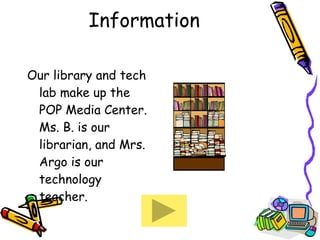
Information Our library and tech lab make up the POP Media Center. Ms. B. is our librarian, and Mrs. Argo is our technology teacher.
POP School Library The POP Library is arranged in sections: Easy (Picture Books) Fiction  -  Biography Easy Readers -  Reference Easy Non-fiction -  Professional Fiction  -  Series Non-fiction
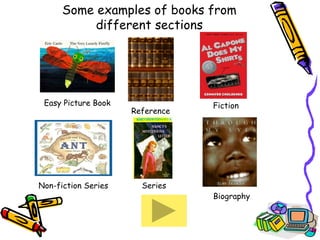
Easy Picture Book Fiction Non-fiction Series  Biography Some examples of books from different sections Reference Series
Parts of a book Each book in the library has many parts.  You will learn five parts:  spine  cover author illustrator  title
The spine of a book The spine of a book is the part that you see when the book is on the shelf, and other books are along side your book.  The spine of a book helps hold your book together and keep it strong just like the spine in your body does!
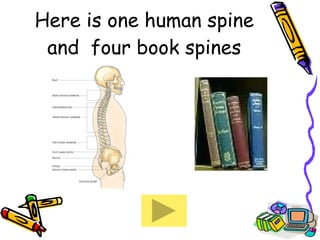
Here is one human spine and  four book spines
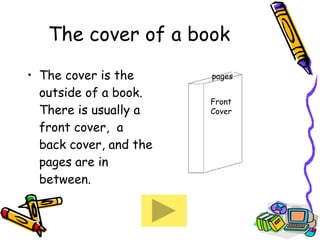
The cover of a book The cover is the outside of a book.  There is usually a front cover,  a back cover, and the pages are in between. Front  Cover spine pages
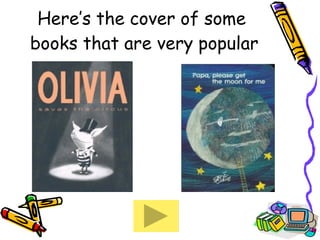
Here’s the cover of some  books that are very popular
What part is the cover? The cover is inside the book. The cover is the outside of the book. The cover is in the search station. The cover is in the computer lab.
Hurray!  That’s it!! You answered correctly.   Good job!
Who is the  author ?  The author is the person who writes the story. The   author  writes the words of a story.  Sometimes the  author  draws the pictures too – then you say the person is the  author  and illustrator.
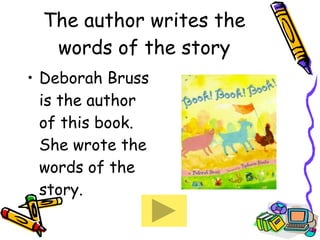
The author writes the words of the story Deborah Bruss is the author of this book.  She wrote the words of the story.
What does the author do? The author is the person who reads the story in    the library.   The author draws signs on billboards around town. The author writes the words of the story. The author is an animal in a story. Which is the correct answer?
AWESOME! You know the author writes the words of the story.  Good job! That's it!
The Illustrator draws the pictures in a book. The illustrator is the person that draws the pictures in a story book.  The pictures tell a big part of the story.
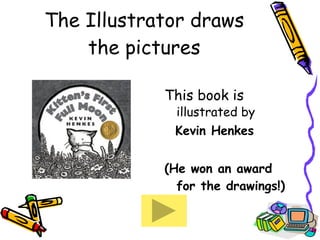
The Illustrator draws the pictures This book is  illustrated by  Kevin Henkes (He won an award for the drawings!)
What does the Illustrator do? The illustrator is the person who buys the book. The illustrator mails the book to people who order it. The illustrator writes the story. The illustrator draws the pictures in the story.
You answered correctly.  Now you may go on to the next slide. Hurray!
The title is the name of the story. The title is usually on the front cover of the book and on the spine. The title is on a page called  The Title Page  right before the beginning of the story. Authors usually choose the title for their book, since they write the words!
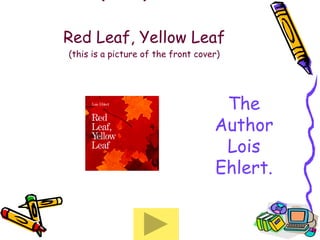
The title (name) of this book is  Red Leaf, Yellow Leaf (this is a picture of the front cover) The Author Lois Ehlert.
What is a title? The title is the name of the story The title is the name of the person who wrote the story The title doesn’t show up on the cover or the spine of the book The title is the wrapping at the store Which is the right answer?
That’s right!: The title is the name of the story. The title is on a page called  The Title Page  right before the beginning of the story. The title is usually on the front cover of the book and on the spine.
Other pages you know . . . The Table of Contents is at the beginning of a book. If there is an index, it is at the back of the book. A glossary is at the back of the book too, and tells you what some words in the book mean.
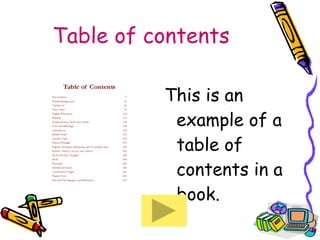
Table of contents  This is an example of a table of contents in a book.
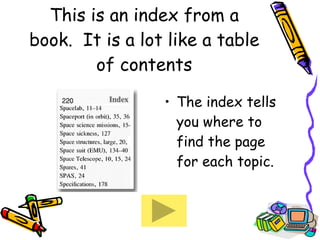
This is an index from a book.  It is a lot like a table of contents The index tells you where to find the page for each topic.
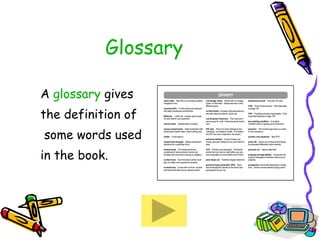
Glossary A  glossary  gives the definition of some words used  in the book.
You have learned five book parts and words about books! The spine The cover The author The illustrator  The title
Congratulations! This is the end of part one. Give yourself a pat on the back and a “round” of library applause! Take a break and tell your classmates and teacher what you learned today, then you    will be ready to start section two.
Now it’s time to talk about the parts of your library! The library in your school is arranged in  sections: Easy (Picture Books)   - Biography Easy Readers    - Reference Easy Non-Fiction   - Series Fiction (Chapter Books)   - Professional Non-fiction (Information Books)
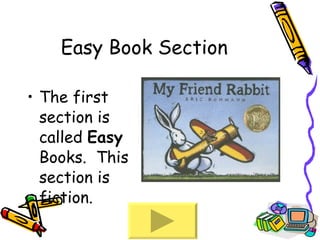
Easy Book Section The first section is called  Easy  Books.  This section is fiction.
Easy Books Many illustrations (pictures) are used to help tell the story. Illustrations are very, very important in picture books.  Sometimes they are even more important than the words! Picture books are ‘made-up’ stories from the authors’ imagination.
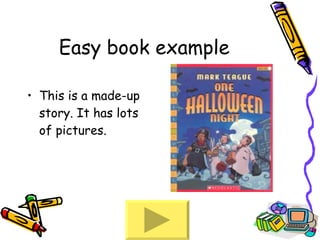
Easy book example This is a made-up story. It has lots of pictures.
Be sure to choose the BEST answer!     ~  What is an easy book? An easy book has illustrations in it . An easy book tells part of the story with pictures.  The illustrations are important in a story. All   of the answers are right. None  of the answers are right .  Which choice that is the BEST answer?
You know it! All three of the first answers are correct. Very, very good!
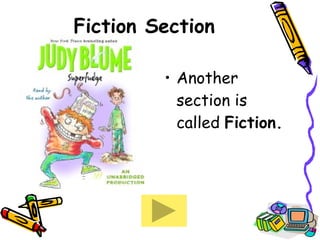
Fiction Section Another section is called  Fiction.
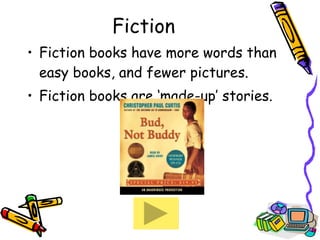
Fiction Fiction books have more words than easy books, and fewer pictures.  Fiction books are ‘made-up’ stories.
What is Fiction? Which is the best answer? Fiction books are  real  stories, not ‘made-up’ stories. Fiction books usually  don’t  have more words than picture books.  Fiction books have mostly words. Fiction books are never hardback
WOW! Bravo! Good job You are brilliant! Way to go!
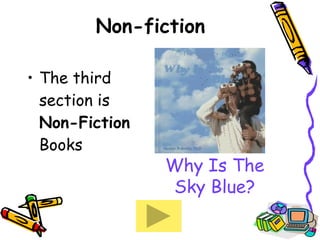
Non-fiction  The third section is  Non-Fiction  Books  Why Is The Sky Blue?
Non-Fiction Books Non-Fiction books are stories that tell about things that are real. Non-Fiction books have real places and real things in them. Non-Fiction can be about people, about places, about things – they can be history, or geography, crafts, sports, weather, science fair projects, even dinosaurs . . .
Read this to practice Non-Fiction books are stories that tell about things that are real. Non-Fiction can be about people, about places, about things – they can be history, or geography, crafts, sports, weather, science fair projects, even dinosaurs . . .
What is the best answer for non-fiction? Non-fiction is pretend, or made-up (make-believe) Real information is found in non-fiction Non-Fiction can be about people, about places, or about things
Awesome answer! You rock!
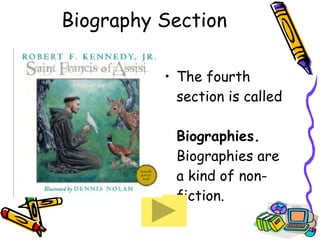
Biography Section The fourth section is called  Biographies.  Biographies are a kind of non-fiction.
Biographies Biographies are about real people. Biographies tell about the life of a person that lived in the past or even one that lives now. Biographies are true, and they are about real people, not made-up characters.
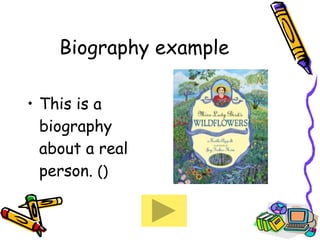
Biography example This is a biography about a real person.  ()
What is a Biography? A book about a real person’s life. Something made-up and imaginary. It tells definitions or words but doesn’t tell about people. Which is the best answer?
Hip! Hip! Hurray!   Excellent!
Reference Section We use these books for research and in depth study of a topic.
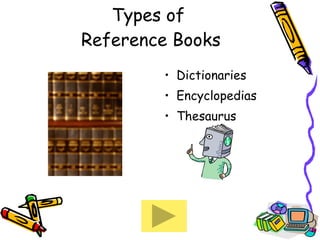
Types of  Reference Books Dictionaries Encyclopedias Thesaurus
Series Books Series books are a set of books written by one person. We have several sets of series books in our library. Can you name some of them?
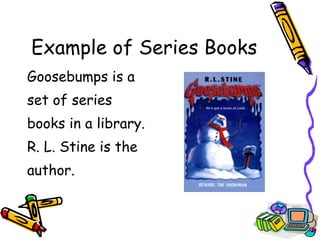
Example of Series Books Goosebumps is a set of series  books in a library.  R. L. Stine is the author.
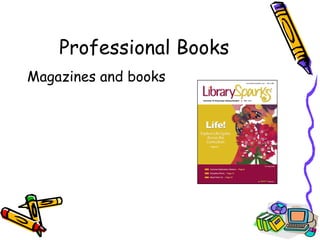
Professional Books Magazines and books
You have learned about: The arrangement of the library and the books in each section:  easy books (fiction), fiction, non-fiction, biographies, and the reference section Title, Spine, Cover,  and Author, and Illustrator
Keep up the good work! When you come to the library next time, you’ll know where to look for each type of book. You’ll be able to find the books you want too, by knowing where to look!
You have reached the end of this presentation I hope it helped you learn the library!       ©  popmedia

Learn The Library!

  • 1.
    Learn the Library!Designed by POP Media
  • 2.
    Learn the Library!Goals of the Library Media Center Learn the arrangement of the media center Identify specific parts of a book and the information included in each part
  • 3.
    Information Our libraryand tech lab make up the POP Media Center. Ms. B. is our librarian, and Mrs. Argo is our technology teacher.
  • 4.
    POP School LibraryThe POP Library is arranged in sections: Easy (Picture Books) Fiction - Biography Easy Readers - Reference Easy Non-fiction - Professional Fiction - Series Non-fiction
  • 5.
    Easy Picture BookFiction Non-fiction Series Biography Some examples of books from different sections Reference Series
  • 6.
    Parts of abook Each book in the library has many parts. You will learn five parts: spine cover author illustrator title
  • 7.
    The spine ofa book The spine of a book is the part that you see when the book is on the shelf, and other books are along side your book. The spine of a book helps hold your book together and keep it strong just like the spine in your body does!
  • 8.
    Here is onehuman spine and four book spines
  • 9.
    The cover ofa book The cover is the outside of a book. There is usually a front cover, a back cover, and the pages are in between. Front Cover spine pages
  • 10.
    Here’s the coverof some books that are very popular
  • 11.
    What part isthe cover? The cover is inside the book. The cover is the outside of the book. The cover is in the search station. The cover is in the computer lab.
  • 12.
    Hurray! That’sit!! You answered correctly. Good job!
  • 13.
    Who is the author ? The author is the person who writes the story. The author writes the words of a story. Sometimes the author draws the pictures too – then you say the person is the author and illustrator.
  • 14.
    The author writesthe words of the story Deborah Bruss is the author of this book. She wrote the words of the story.
  • 15.
    What does theauthor do? The author is the person who reads the story in the library. The author draws signs on billboards around town. The author writes the words of the story. The author is an animal in a story. Which is the correct answer?
  • 16.
    AWESOME! You knowthe author writes the words of the story. Good job! That's it!
  • 17.
    The Illustrator drawsthe pictures in a book. The illustrator is the person that draws the pictures in a story book. The pictures tell a big part of the story.
  • 18.
    The Illustrator drawsthe pictures This book is illustrated by Kevin Henkes (He won an award for the drawings!)
  • 19.
    What does theIllustrator do? The illustrator is the person who buys the book. The illustrator mails the book to people who order it. The illustrator writes the story. The illustrator draws the pictures in the story.
  • 20.
    You answered correctly. Now you may go on to the next slide. Hurray!
  • 21.
    The title isthe name of the story. The title is usually on the front cover of the book and on the spine. The title is on a page called The Title Page right before the beginning of the story. Authors usually choose the title for their book, since they write the words!
  • 22.
    The title (name)of this book is Red Leaf, Yellow Leaf (this is a picture of the front cover) The Author Lois Ehlert.
  • 23.
    What is atitle? The title is the name of the story The title is the name of the person who wrote the story The title doesn’t show up on the cover or the spine of the book The title is the wrapping at the store Which is the right answer?
  • 24.
    That’s right!: Thetitle is the name of the story. The title is on a page called The Title Page right before the beginning of the story. The title is usually on the front cover of the book and on the spine.
  • 25.
    Other pages youknow . . . The Table of Contents is at the beginning of a book. If there is an index, it is at the back of the book. A glossary is at the back of the book too, and tells you what some words in the book mean.
  • 26.
    Table of contents This is an example of a table of contents in a book.
  • 27.
    This is anindex from a book. It is a lot like a table of contents The index tells you where to find the page for each topic.
  • 28.
    Glossary A glossary gives the definition of some words used in the book.
  • 29.
    You have learnedfive book parts and words about books! The spine The cover The author The illustrator The title
  • 30.
    Congratulations! This isthe end of part one. Give yourself a pat on the back and a “round” of library applause! Take a break and tell your classmates and teacher what you learned today, then you will be ready to start section two.
  • 31.
    Now it’s timeto talk about the parts of your library! The library in your school is arranged in sections: Easy (Picture Books) - Biography Easy Readers - Reference Easy Non-Fiction - Series Fiction (Chapter Books) - Professional Non-fiction (Information Books)
  • 32.
    Easy Book SectionThe first section is called Easy Books. This section is fiction.
  • 33.
    Easy Books Manyillustrations (pictures) are used to help tell the story. Illustrations are very, very important in picture books. Sometimes they are even more important than the words! Picture books are ‘made-up’ stories from the authors’ imagination.
  • 34.
    Easy book exampleThis is a made-up story. It has lots of pictures.
  • 35.
    Be sure tochoose the BEST answer! ~ What is an easy book? An easy book has illustrations in it . An easy book tells part of the story with pictures. The illustrations are important in a story. All of the answers are right. None of the answers are right . Which choice that is the BEST answer?
  • 36.
    You know it!All three of the first answers are correct. Very, very good!
  • 37.
    Fiction Section Anothersection is called Fiction.
  • 38.
    Fiction Fiction bookshave more words than easy books, and fewer pictures. Fiction books are ‘made-up’ stories.
  • 39.
    What is Fiction?Which is the best answer? Fiction books are real stories, not ‘made-up’ stories. Fiction books usually don’t have more words than picture books. Fiction books have mostly words. Fiction books are never hardback
  • 40.
    WOW! Bravo! Goodjob You are brilliant! Way to go!
  • 41.
    Non-fiction Thethird section is Non-Fiction Books Why Is The Sky Blue?
  • 42.
    Non-Fiction Books Non-Fictionbooks are stories that tell about things that are real. Non-Fiction books have real places and real things in them. Non-Fiction can be about people, about places, about things – they can be history, or geography, crafts, sports, weather, science fair projects, even dinosaurs . . .
  • 43.
    Read this topractice Non-Fiction books are stories that tell about things that are real. Non-Fiction can be about people, about places, about things – they can be history, or geography, crafts, sports, weather, science fair projects, even dinosaurs . . .
  • 44.
    What is thebest answer for non-fiction? Non-fiction is pretend, or made-up (make-believe) Real information is found in non-fiction Non-Fiction can be about people, about places, or about things
  • 45.
  • 46.
    Biography Section Thefourth section is called Biographies. Biographies are a kind of non-fiction.
  • 47.
    Biographies Biographies areabout real people. Biographies tell about the life of a person that lived in the past or even one that lives now. Biographies are true, and they are about real people, not made-up characters.
  • 48.
    Biography example Thisis a biography about a real person. ()
  • 49.
    What is aBiography? A book about a real person’s life. Something made-up and imaginary. It tells definitions or words but doesn’t tell about people. Which is the best answer?
  • 50.
    Hip! Hip! Hurray! Excellent!
  • 51.
    Reference Section Weuse these books for research and in depth study of a topic.
  • 52.
    Types of Reference Books Dictionaries Encyclopedias Thesaurus
  • 53.
    Series Books Seriesbooks are a set of books written by one person. We have several sets of series books in our library. Can you name some of them?
  • 54.
    Example of SeriesBooks Goosebumps is a set of series books in a library. R. L. Stine is the author.
  • 55.
  • 56.
    You have learnedabout: The arrangement of the library and the books in each section: easy books (fiction), fiction, non-fiction, biographies, and the reference section Title, Spine, Cover, and Author, and Illustrator
  • 57.
    Keep up thegood work! When you come to the library next time, you’ll know where to look for each type of book. You’ll be able to find the books you want too, by knowing where to look!
  • 58.
    You have reachedthe end of this presentation I hope it helped you learn the library! © popmedia