Evolution / History / Development of
Digital Libraries
RupeshKumarA
a.rupeshkumar@gmail.com
Evolution
• Theideaof digital library is not new.
• It has been conceived by many people in differentways.
As WeMayThink
• In July 1945, Vannevar BushthethenDirector of the US
Office of ScientificResearch and Developmentpublished an
article.
• It was titled“As WeMay Think”.
• Publishedin the journalTheAtlanticMonthly
• The article proposed the potentialthattechnology offers the
scientiststo gather, store, find and retrieve information.
• He called this systemMemex
The Library ofthe Future
• In 1960s, J.C.R.Licklider studieddigital computingat
MassachusettsInstituteof Technology (MIT).
• In his book TheLibraryoftheFuture,he described the
research and development needed to builda truly digital
library.
ARPANET
• In late 1960s, the Departmentof DefenceAdvancedResearch
Project Agency (DARPA) initiateda computer network for
sharing confidentialdefenceinformation.
• This network was called theARPANET.
• Similar projects were being initiatedin the United Kingdom
and France.
TCP/IP
• In 1981, access to the ARPANET was expanded whenthe
NationalScience Foundation(NSF) fundedtheComputer
Science Network (CSNET).
• In 1982, theInternetprotocol suite(TCP/IP)was introduced
as the standard networking protocol on theARPANET.
• In late 1980s, Commercial Internetservice providers (ISPs)
began toemerge.
WWW
• In the1980s, research at CERN in Switzerland by British
computer scientist Tim Berners-Lee resulted in theWorld
Wide Web (WWW).
• In themid-1990s, communicationservices such as electronic
mail,instantmessaging,voice over InternetProtocol (VoIP)
telephone calls,two-way interactivevideo calls started.
NSF Grants for DLResearch
• In 1994, USgovernmentannouncedfunding of$24.4millionto
six universities forresearch in “digitallibraries”.
• The funding wasa joint initiativeof NationalScience Foundation
(NSF), DepartmentofDefenseAdvancedResearchProjects
Agency (DARPA),andNationalAeronauticsandSpace
Administration(NASA)
• This was called“DigitalLibrary Initiative-1”(DLIPhase 1)
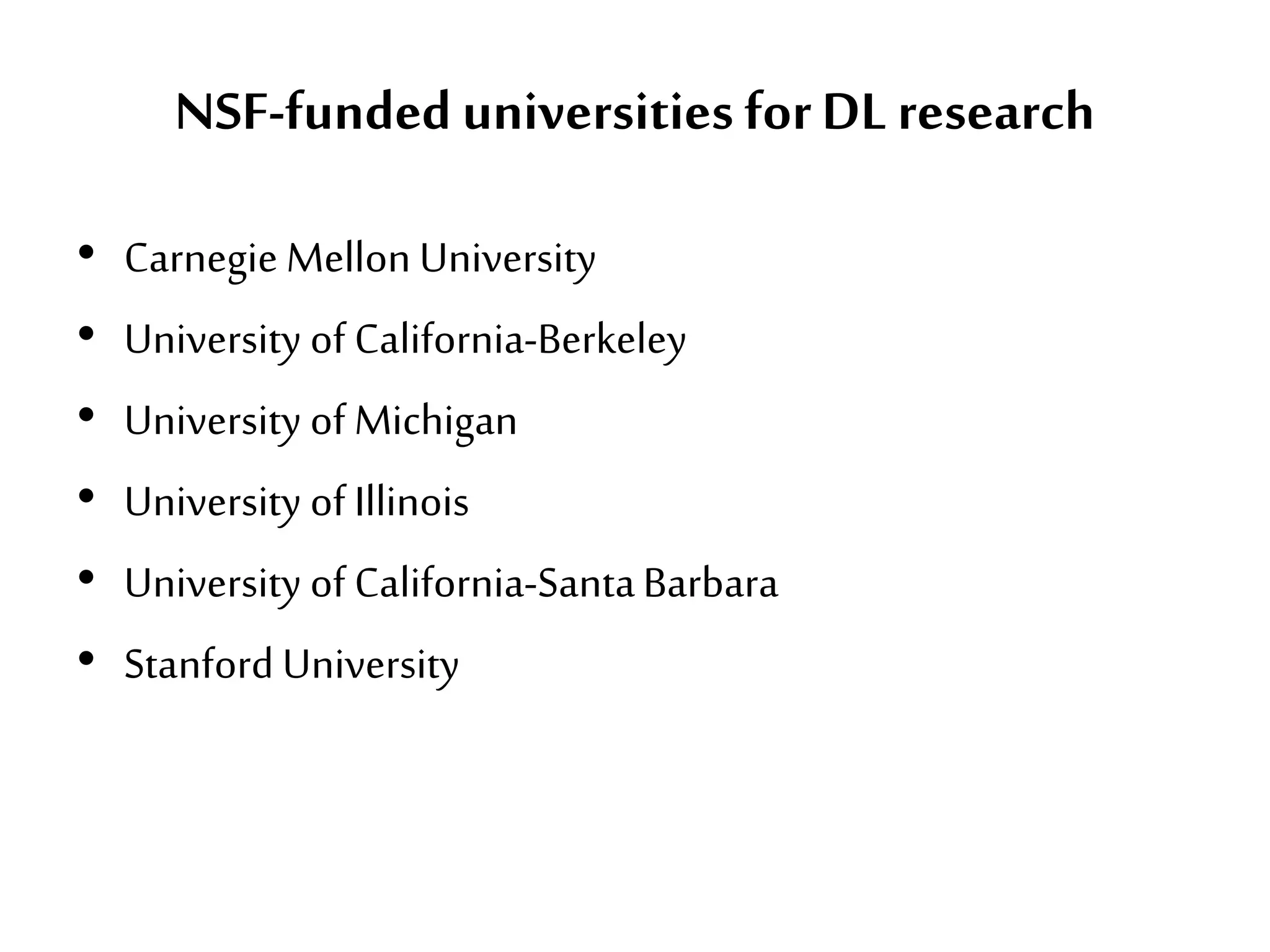
NSF-funded universities forDL research
• Carnegie Mellon University
• University of California-Berkeley
• University of Michigan
• University of Illinois
• University of California-SantaBarbara
• Stanford University
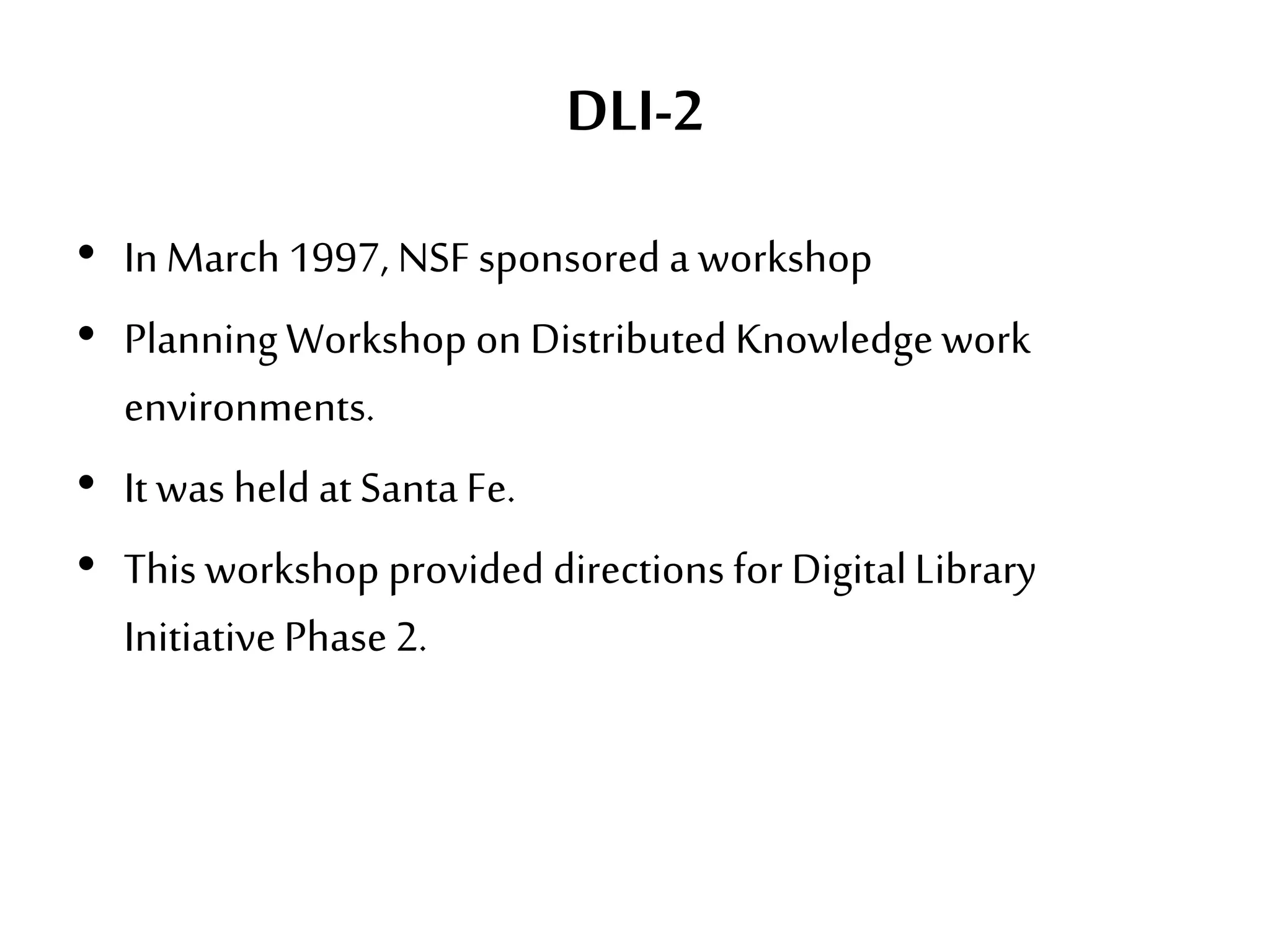
DLI-2
• In March 1997, NSF sponsored a workshop
• PlanningWorkshop on Distributed Knowledgework
environments.
• It was held at SantaFe.
• This workshop provided directions for DigitalLibrary
InitiativePhase2.
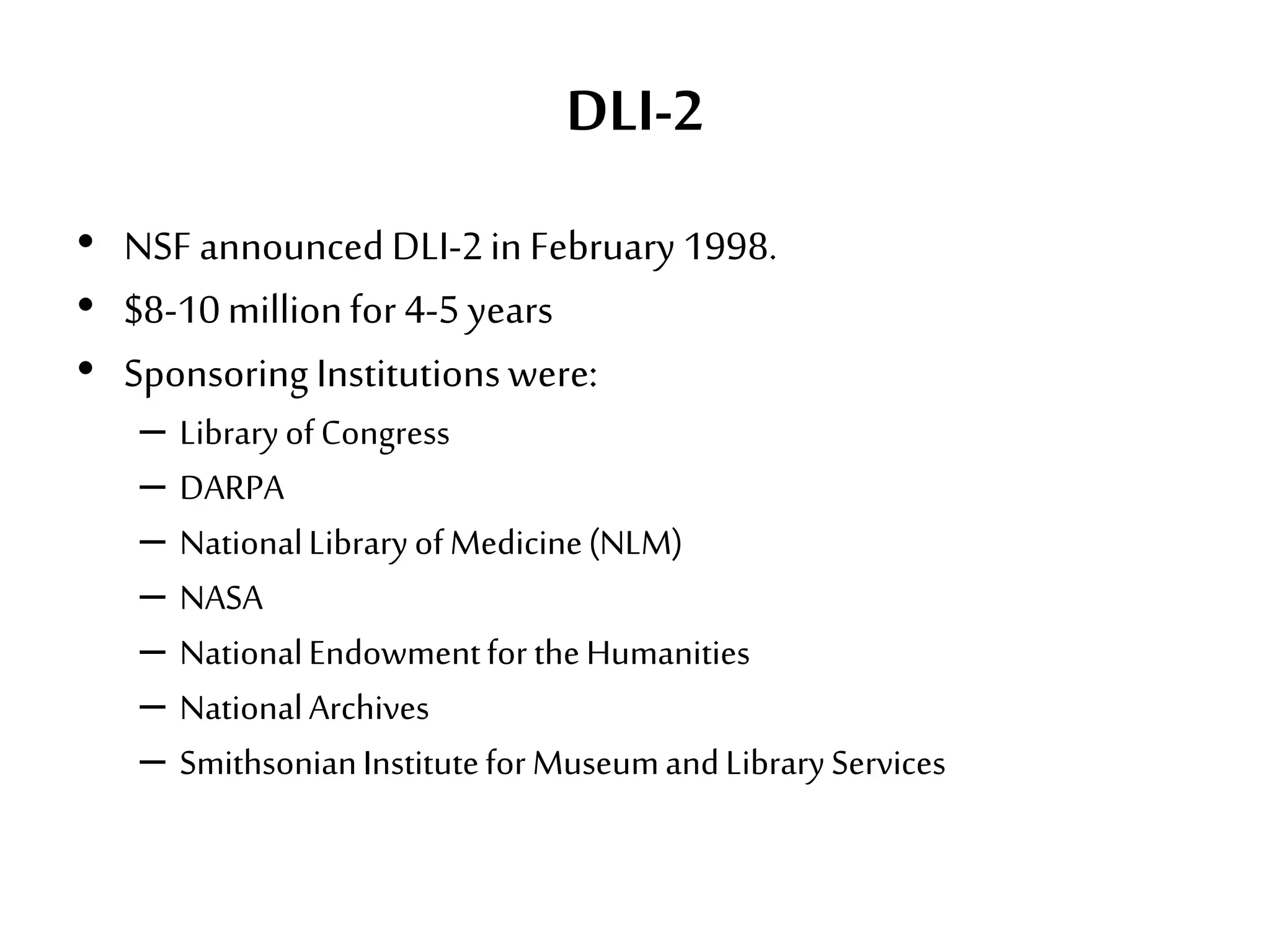
DLI-2
• NSF announced DLI-2in February 1998.
• $8-10millionfor4-5years
• Sponsoring Institutionswere:
– LibraryofCongress
– DARPA
– NationalLibraryofMedicine(NLM)
– NASA
– NationalEndowmentfortheHumanities
– NationalArchives
– SmithsonianInstituteforMuseumandLibraryServices
DLI-2 Program Goals
• NewDL research
• Technologiesand applications to advance the use of
distributed, networkedinformationof all types around the
nationand theworld.
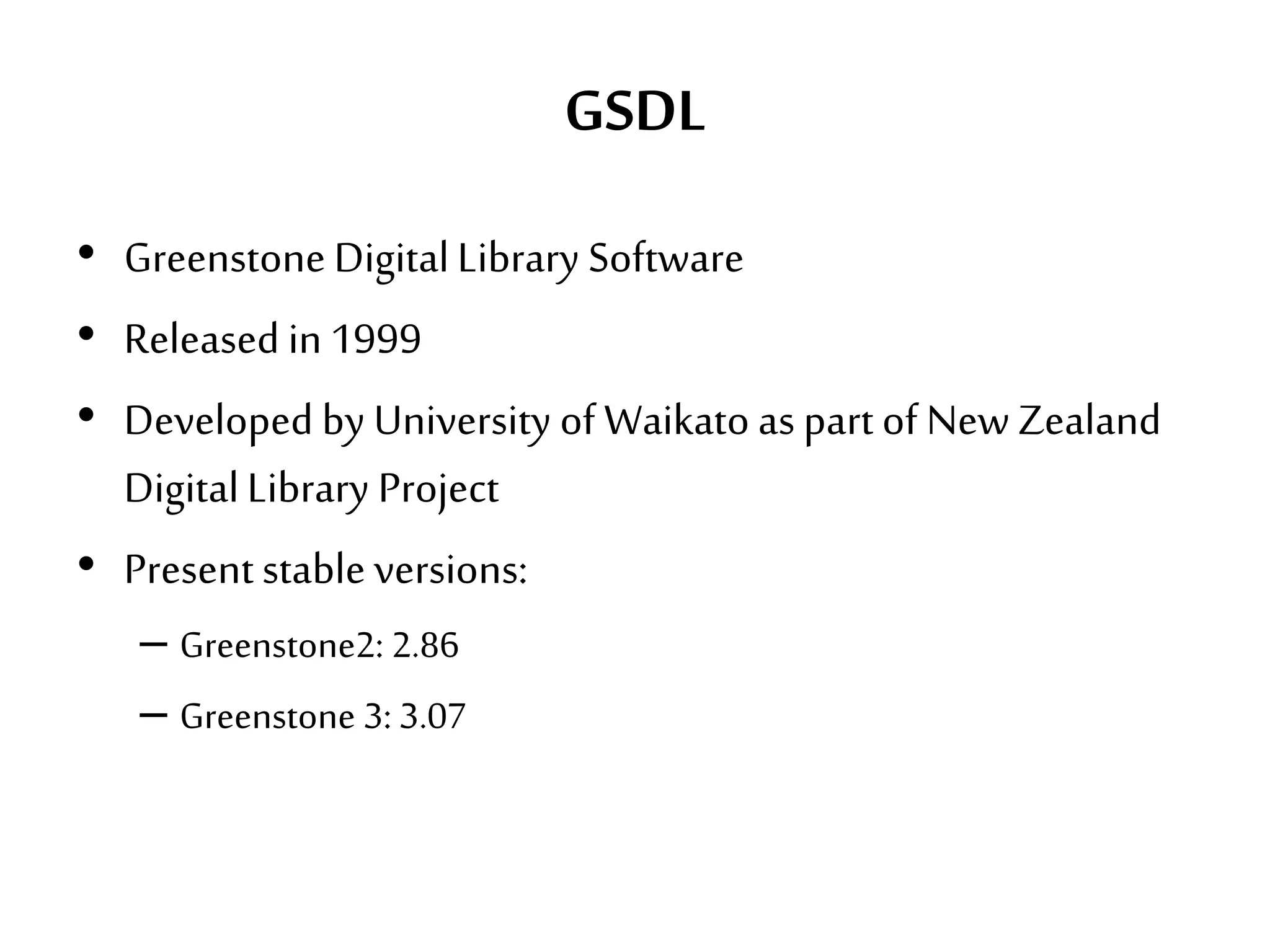
GSDL
• Greenstone DigitalLibrary Software
• Released in 1999
• Developed by University of Waikato as part of New Zealand
DigitalLibrary Project
• Presentstable versions:
– Greenstone2: 2.86
– Greenstone 3: 3.07
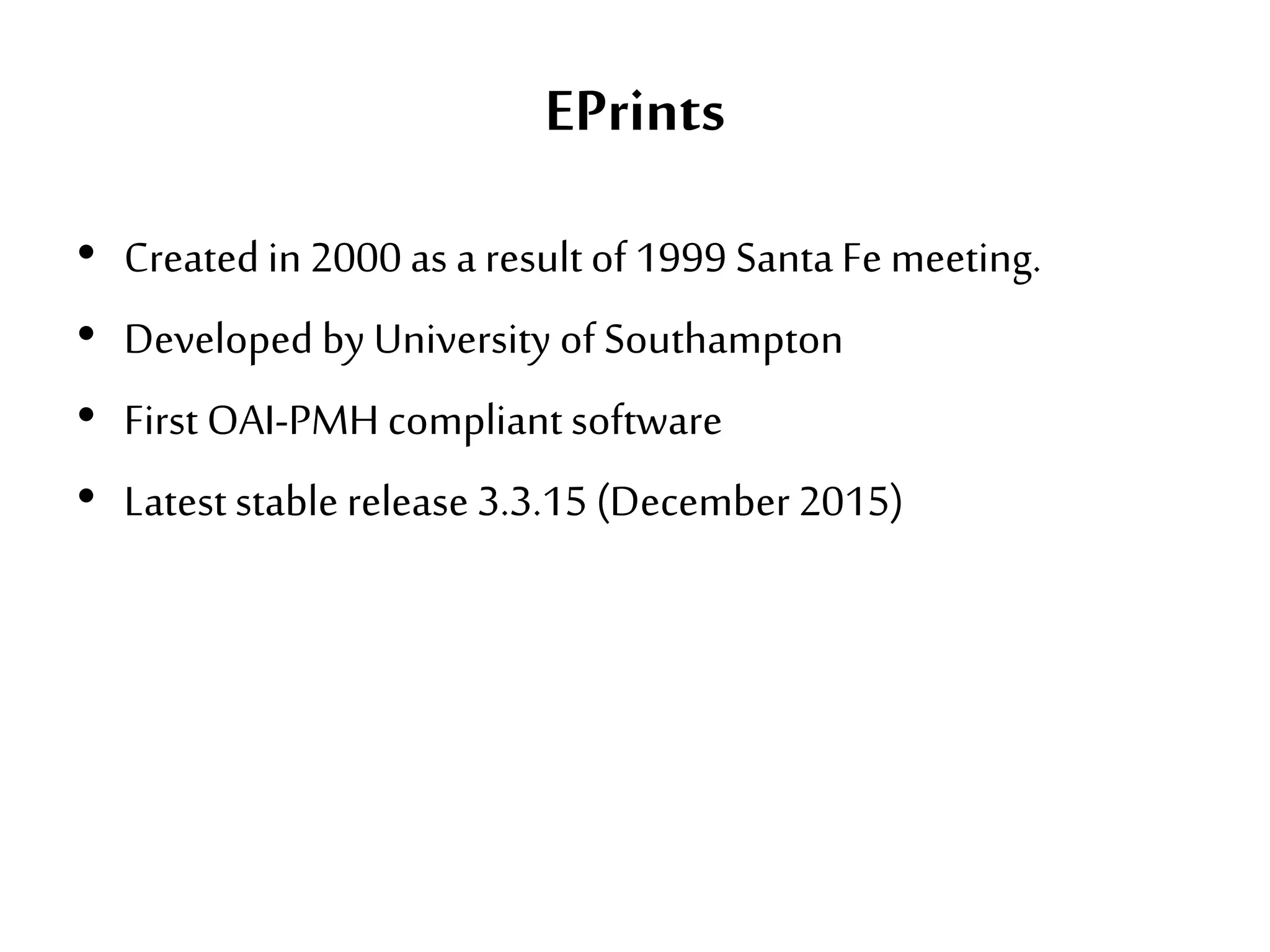
EPrints
• Created in 2000 as a result of 1999 SantaFe meeting.
• Developed by University of Southampton
• First OAI-PMH compliant software
• Latest stable release 3.3.15 (December 2015)
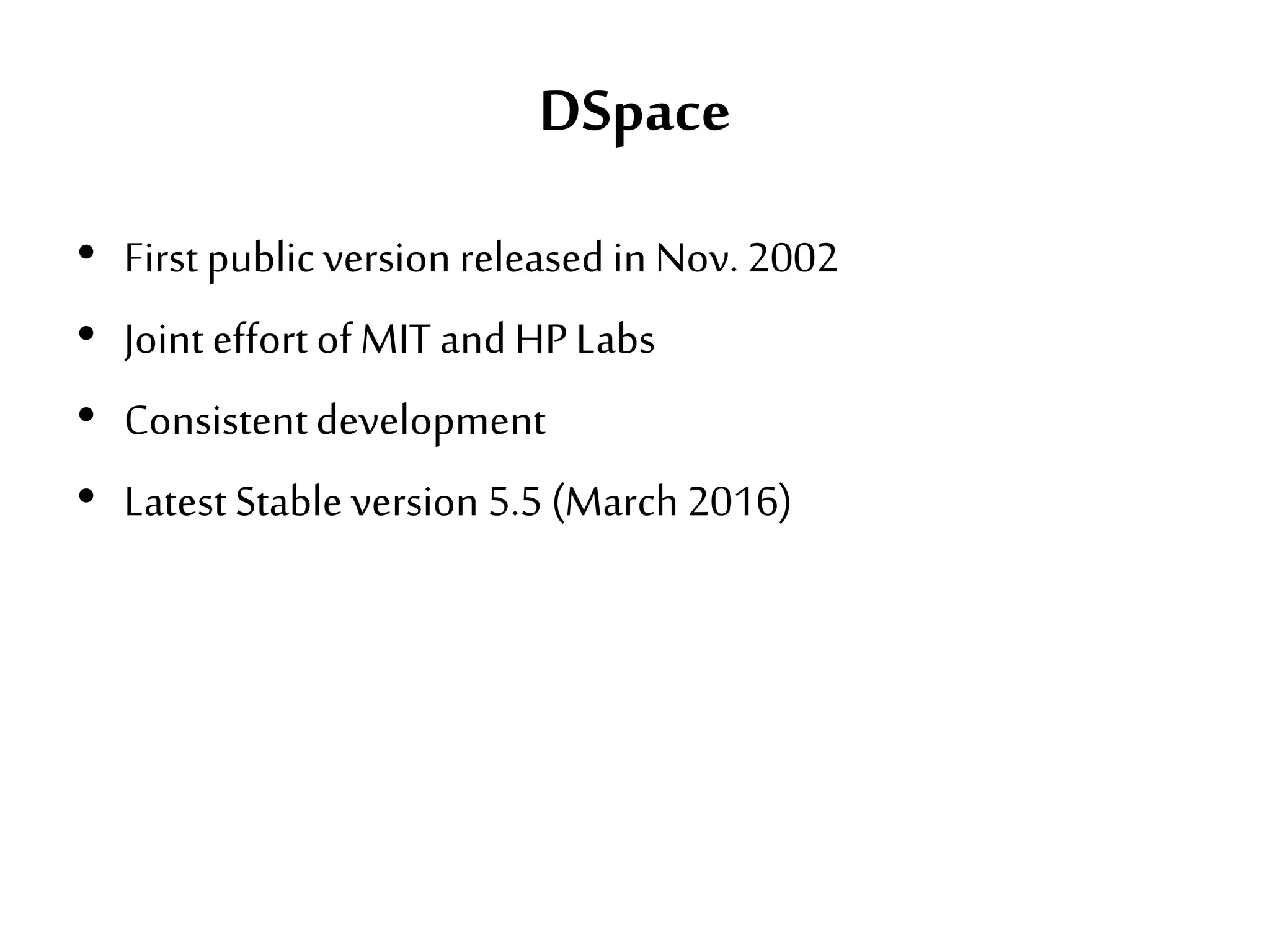
DSpace
• First public version released in Nov. 2002
• Joint effort of MIT and HPLabs
• Consistentdevelopment
• Latest Stable version 5.5 (March 2016)
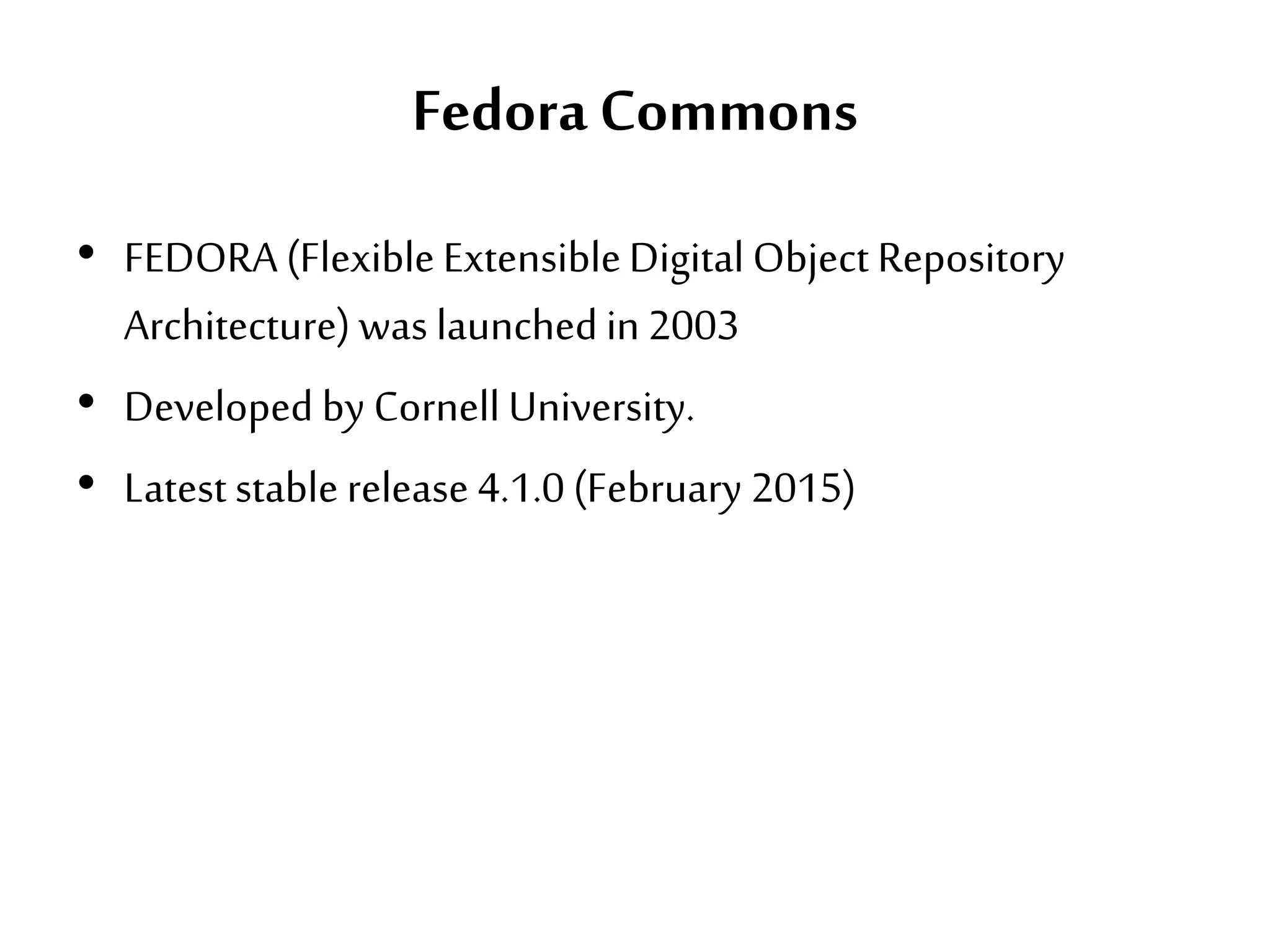
Fedora Commons
• FEDORA (Flexible ExtensibleDigital Object Repository
Architecture) was launched in 2003
• Developed by Cornell University.
• Latest stable release 4.1.0 (February 2015)
Invenio
• CERN DocumentServer Software
• Prior to 2006, it was calledCDSware
• Later renamed CDSInvenio
• Now, simply called “Invenio”

Evolution of Digital Libraries

  • 1.
    Evolution / History/ Development of Digital Libraries RupeshKumarA a.rupeshkumar@gmail.com
  • 2.
    Evolution • Theideaof digitallibrary is not new. • It has been conceived by many people in differentways.
  • 3.
    As WeMayThink • InJuly 1945, Vannevar BushthethenDirector of the US Office of ScientificResearch and Developmentpublished an article. • It was titled“As WeMay Think”. • Publishedin the journalTheAtlanticMonthly • The article proposed the potentialthattechnology offers the scientiststo gather, store, find and retrieve information. • He called this systemMemex
  • 4.
    The Library oftheFuture • In 1960s, J.C.R.Licklider studieddigital computingat MassachusettsInstituteof Technology (MIT). • In his book TheLibraryoftheFuture,he described the research and development needed to builda truly digital library.
  • 5.
    ARPANET • In late1960s, the Departmentof DefenceAdvancedResearch Project Agency (DARPA) initiateda computer network for sharing confidentialdefenceinformation. • This network was called theARPANET. • Similar projects were being initiatedin the United Kingdom and France.
  • 6.
    TCP/IP • In 1981,access to the ARPANET was expanded whenthe NationalScience Foundation(NSF) fundedtheComputer Science Network (CSNET). • In 1982, theInternetprotocol suite(TCP/IP)was introduced as the standard networking protocol on theARPANET. • In late 1980s, Commercial Internetservice providers (ISPs) began toemerge.
  • 7.
    WWW • In the1980s,research at CERN in Switzerland by British computer scientist Tim Berners-Lee resulted in theWorld Wide Web (WWW). • In themid-1990s, communicationservices such as electronic mail,instantmessaging,voice over InternetProtocol (VoIP) telephone calls,two-way interactivevideo calls started.
  • 8.
    NSF Grants forDLResearch • In 1994, USgovernmentannouncedfunding of$24.4millionto six universities forresearch in “digitallibraries”. • The funding wasa joint initiativeof NationalScience Foundation (NSF), DepartmentofDefenseAdvancedResearchProjects Agency (DARPA),andNationalAeronauticsandSpace Administration(NASA) • This was called“DigitalLibrary Initiative-1”(DLIPhase 1)
  • 9.
    NSF-funded universities forDLresearch • Carnegie Mellon University • University of California-Berkeley • University of Michigan • University of Illinois • University of California-SantaBarbara • Stanford University
  • 10.
    DLI-2 • In March1997, NSF sponsored a workshop • PlanningWorkshop on Distributed Knowledgework environments. • It was held at SantaFe. • This workshop provided directions for DigitalLibrary InitiativePhase2.
  • 11.
    DLI-2 • NSF announcedDLI-2in February 1998. • $8-10millionfor4-5years • Sponsoring Institutionswere: – LibraryofCongress – DARPA – NationalLibraryofMedicine(NLM) – NASA – NationalEndowmentfortheHumanities – NationalArchives – SmithsonianInstituteforMuseumandLibraryServices
  • 12.
    DLI-2 Program Goals •NewDL research • Technologiesand applications to advance the use of distributed, networkedinformationof all types around the nationand theworld.
  • 13.
    GSDL • Greenstone DigitalLibrarySoftware • Released in 1999 • Developed by University of Waikato as part of New Zealand DigitalLibrary Project • Presentstable versions: – Greenstone2: 2.86 – Greenstone 3: 3.07
  • 14.
    EPrints • Created in2000 as a result of 1999 SantaFe meeting. • Developed by University of Southampton • First OAI-PMH compliant software • Latest stable release 3.3.15 (December 2015)
  • 15.
    DSpace • First publicversion released in Nov. 2002 • Joint effort of MIT and HPLabs • Consistentdevelopment • Latest Stable version 5.5 (March 2016)
  • 16.
    Fedora Commons • FEDORA(Flexible ExtensibleDigital Object Repository Architecture) was launched in 2003 • Developed by Cornell University. • Latest stable release 4.1.0 (February 2015)
  • 17.
    Invenio • CERN DocumentServerSoftware • Prior to 2006, it was calledCDSware • Later renamed CDSInvenio • Now, simply called “Invenio”