Collection Evaluation and
Weeding
Georgia Southern University
FRIT 7732
Dr. S. A. Jones
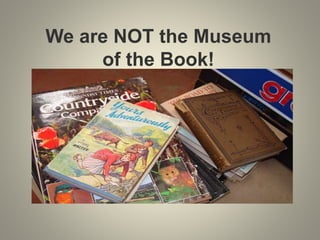
We are NOT the Museum
of the Book!
Double-click to enter text
Weeding definition
Removing items from the
collection based on specific
criteria.
Packed shelves
are NOT what our users want to see.
and dead links
Why Evaluate and Weed?
• Save time
• Save space
• Learn about your collection’s
strengths and weaknesses
• Ensure access to current,
accurate and relevant
information
Having something is NOT
always better than having
nothing!
Collection Evaluation
• Collection-centered measures
– Curriculum alignment with CCGPS
– Collection mapping
– Examining the collection directly
– Age analysis
• Use-centered measures
– Circulation /in library use
– User opinion surveys
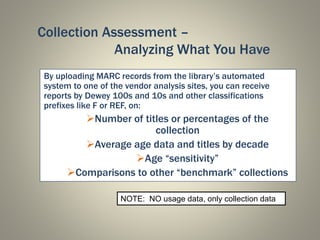
Collection Assessment –
Analyzing What You Have
By uploading MARC records from the library’s automated
system to one of the vendor analysis sites, you can receive
reports by Dewey 100s and 10s and other classifications
prefixes like F or REF, on:
Number of titles or percentages of the
collection
Average age data and titles by decade
Age “sensitivity”
Comparisons to other “benchmark” collections
NOTE: NO usage data, only collection data
Some Companies that offer FREE
Collection Analysis Services
Follett Library Resources
Mackin
Bound to Stay Bound
Capstone
or check with your book jobber
Understand that vendors provide this service
because they want your business.
Additionally, they provide a searchable
database of titles they sell.
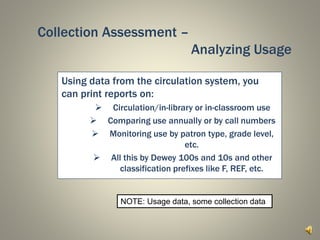
Collection Assessment –
Analyzing Usage
Using data from the circulation system, you
can print reports on:
 Circulation/in-library or in-classroom use
 Comparing use annually or by call numbers
 Monitoring use by patron type, grade level,
etc.
 All this by Dewey 100s and 10s and other
classification prefixes like F, REF, etc.
NOTE: Usage data, some collection data
MUSTY
Misleading (No more Bush as the
current president!)
Ugly (Visual inspection)
Superseded (No more 1999 Guinness
Book of World Records!)
Trivial (Biography of Mark McGwire
anybody?)
Your collection
The Fears
Too busy
Books are sacred
Might be needed by somebody, sometime
Numbers—current rules do NOT require this!
Admitting a selection mistake
Destruction of public property
What about...
 Classics
 Ok to keep but check for
newer, more appealing
editions
 School history--Keep
 Local history--Keep
 Textbooks--Discard
The really big issue
How and where do you discard the materials you weed?
Options
o Give to teachers for classroom use
(with caution)
o Donate items to others (schools or
organizations)
o Book sale
o Recycle
Before you do anything check your
school/district policy and check with
your administration!
http://cdn.homedit.com/wp-content/uploads/2013/02/LibraryDeskMadefromBooks2.jpg
A circulation desk made of books:
A way to weed your books and keep them too!

Collection Evaluation and Weeding

  • 1.
    Collection Evaluation and Weeding GeorgiaSouthern University FRIT 7732 Dr. S. A. Jones
  • 2.
    We are NOTthe Museum of the Book! Double-click to enter text
  • 3.
    Weeding definition Removing itemsfrom the collection based on specific criteria.
  • 4.
    Packed shelves are NOTwhat our users want to see. and dead links
  • 5.
    Why Evaluate andWeed? • Save time • Save space • Learn about your collection’s strengths and weaknesses • Ensure access to current, accurate and relevant information
  • 6.
    Having something isNOT always better than having nothing!
  • 7.
    Collection Evaluation • Collection-centeredmeasures – Curriculum alignment with CCGPS – Collection mapping – Examining the collection directly – Age analysis • Use-centered measures – Circulation /in library use – User opinion surveys
  • 8.
    Collection Assessment – AnalyzingWhat You Have By uploading MARC records from the library’s automated system to one of the vendor analysis sites, you can receive reports by Dewey 100s and 10s and other classifications prefixes like F or REF, on: Number of titles or percentages of the collection Average age data and titles by decade Age “sensitivity” Comparisons to other “benchmark” collections NOTE: NO usage data, only collection data
  • 9.
    Some Companies thatoffer FREE Collection Analysis Services Follett Library Resources Mackin Bound to Stay Bound Capstone or check with your book jobber Understand that vendors provide this service because they want your business. Additionally, they provide a searchable database of titles they sell.
  • 10.
    Collection Assessment – AnalyzingUsage Using data from the circulation system, you can print reports on:  Circulation/in-library or in-classroom use  Comparing use annually or by call numbers  Monitoring use by patron type, grade level, etc.  All this by Dewey 100s and 10s and other classification prefixes like F, REF, etc. NOTE: Usage data, some collection data
  • 11.
    MUSTY Misleading (No moreBush as the current president!) Ugly (Visual inspection) Superseded (No more 1999 Guinness Book of World Records!) Trivial (Biography of Mark McGwire anybody?) Your collection
  • 12.
    The Fears Too busy Booksare sacred Might be needed by somebody, sometime Numbers—current rules do NOT require this! Admitting a selection mistake Destruction of public property
  • 13.
    What about...  Classics Ok to keep but check for newer, more appealing editions  School history--Keep  Local history--Keep  Textbooks--Discard
  • 14.
    The really bigissue How and where do you discard the materials you weed?
  • 15.
    Options o Give toteachers for classroom use (with caution) o Donate items to others (schools or organizations) o Book sale o Recycle Before you do anything check your school/district policy and check with your administration!
  • 16.

Editor's Notes

  • #8 Now that we have discussed terminology and some collection misconceptions, let’s look at collection assessment or collection evaluation. There are basically two pieces to this puzzle—knowing what you have and knowing how it is used. The “what” is a description of basically how much is provided, how old the physical materials are, and how the collection compares to other similar collections or to recommendations. The “use” is a description of how the resources are used, including physical checkouts, in-school use (whether in classrooms or the library), and electronic counting of Internet accesses. Utilize others in helping you gather use data. For example, most IT staff in the school can help you put digital counters on web pages that are portals to various websites or databases.
  • #9 First Arrow - Number of titles is usually counted two ways—number of unique titles and also number of copies to account for duplicate titles. Second Arrow - Age is generally a mathematical average not a “median” which is the true middle of a range of dates. A median is actually a better indicator of how old a collection is but usually has to be manually calculated if you really are interested in that data. Average age usually is older and therefore, most commercial vendors prefer this date. Third Arrow - Age sensitivity refers to the number of titles that are outside an acceptable age range. Most collection analysis programs will use ages set by CREW Weeding Manual although most programs will allow you to select your own age limiters. (The Crew Manual is available online will be discussed later.) Fourth Arrow – “Benchmark collections” are collections of what is considered to be “ideal school library collections.” Use this comparison with caution. Sometimes this reflects only titles that are currently in print
  • #10 If you have never uploaded your MARC records and printed one of these reports, I would urge you to do so. The preformatted charts and graphs that are produced are good tools to use with administrators at budget time. A sample of a Follett TitleWise report in included at the WebJunction site if you would like to view a report. NOTE: Some of these you must either be a current customer or contact a sales rep in order to get an account.
  • #11 Use-centered measures such as Circulation /in library use and User opinion surveys are assessments that must be done locally. Note that vendors may not access or use your patron or circulation data to run analysis reports and they don’t. So, the only way you can get this data for analysis is to run the reports yourself from your circulation system. You need to work with your circ software vendor to learn how to do this if you don’t already know how. Sidebar: Often librarians ask how in-school usage can be counted and there are ways for example: Check out books placed on a cart for a class assignment to a “patron” named “in-library use”. (Various circ systems have ways of doing this.) Estimate the number of times you think books from a cart will be used whether in the library or in the classroom. Then multiple that times the number of class periods the cart of books is used (i.e. estimate each book is used twice in a class period and students are using the cart for 4 class period = 8 times per book). When you check the books back in, scan each 8 times. You can have students do this to save your time. Or, you may have a portable scanner that students may use to scan the barcode as they take the books.