Curriculum Development
Meaning of curriculum:
Curriculum is derived from Latin word “currere” which means
“run”.
It is runway for attaining the goals of education.
It is considered as blueprint of educational program.
It is the base of education on which the teaching-learning
process is planned and implemented.
Definition:
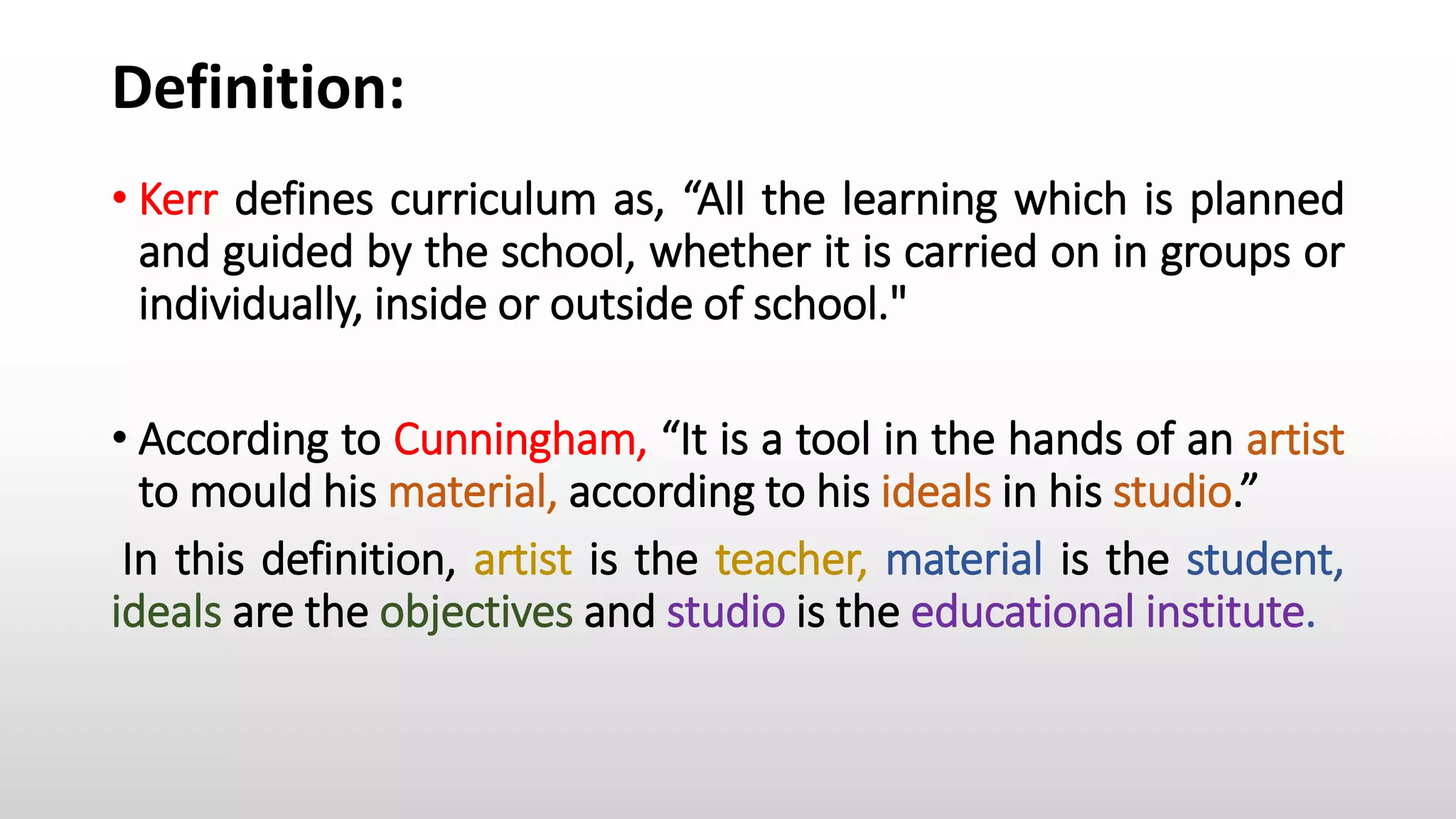
• Kerr defines curriculum as, “All the learning which is planned
and guided by the school, whether it is carried on in groups or
individually, inside or outside of school."
• According to Cunningham, “It is a tool in the hands of an artist
to mould his material, according to his ideals in his studio.”
In this definition, artist is the teacher, material is the student,
ideals are the objectives and studio is the educational institute.
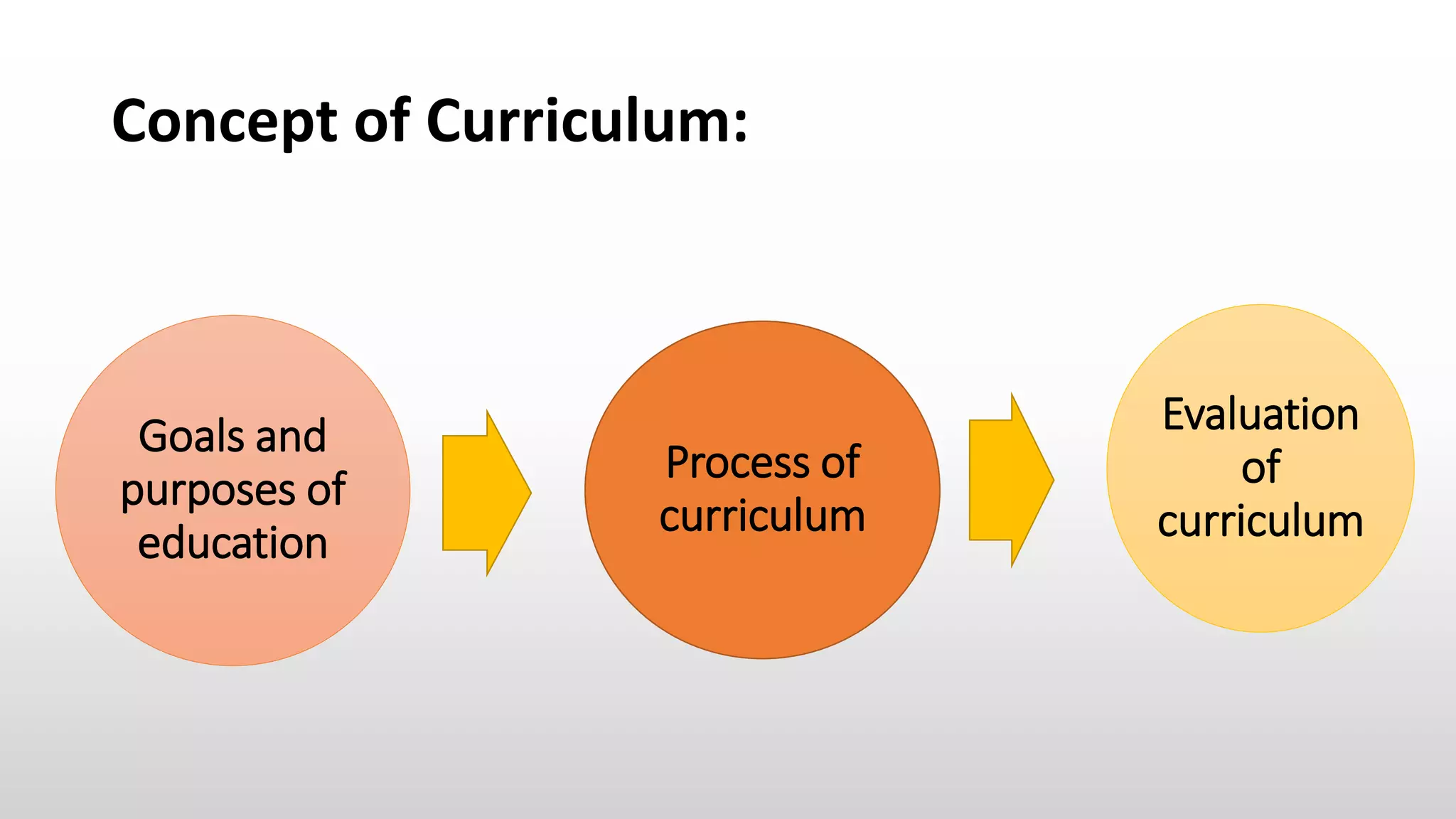
Concept of Curriculum:
Goals and
purposes of
education
Process of
curriculum
Evaluation
of
curriculum
Need of Curriculum:
Acts as educational planning tool
Setting agenda behind the time
Setting learning goals
Providing structure to educational goals
Lesson planning
Selection of teaching method
Quality assurance tool
Nature of Nursing Curriculum:
Curriculum is dynamic and flexible.
Health oriented
Having positive attitude towards learner’s need.
Influenced by development in other health care professions.
Influenced by trans-national trends in nursing education.
Influenced by policy decisions based on National Health Policy.
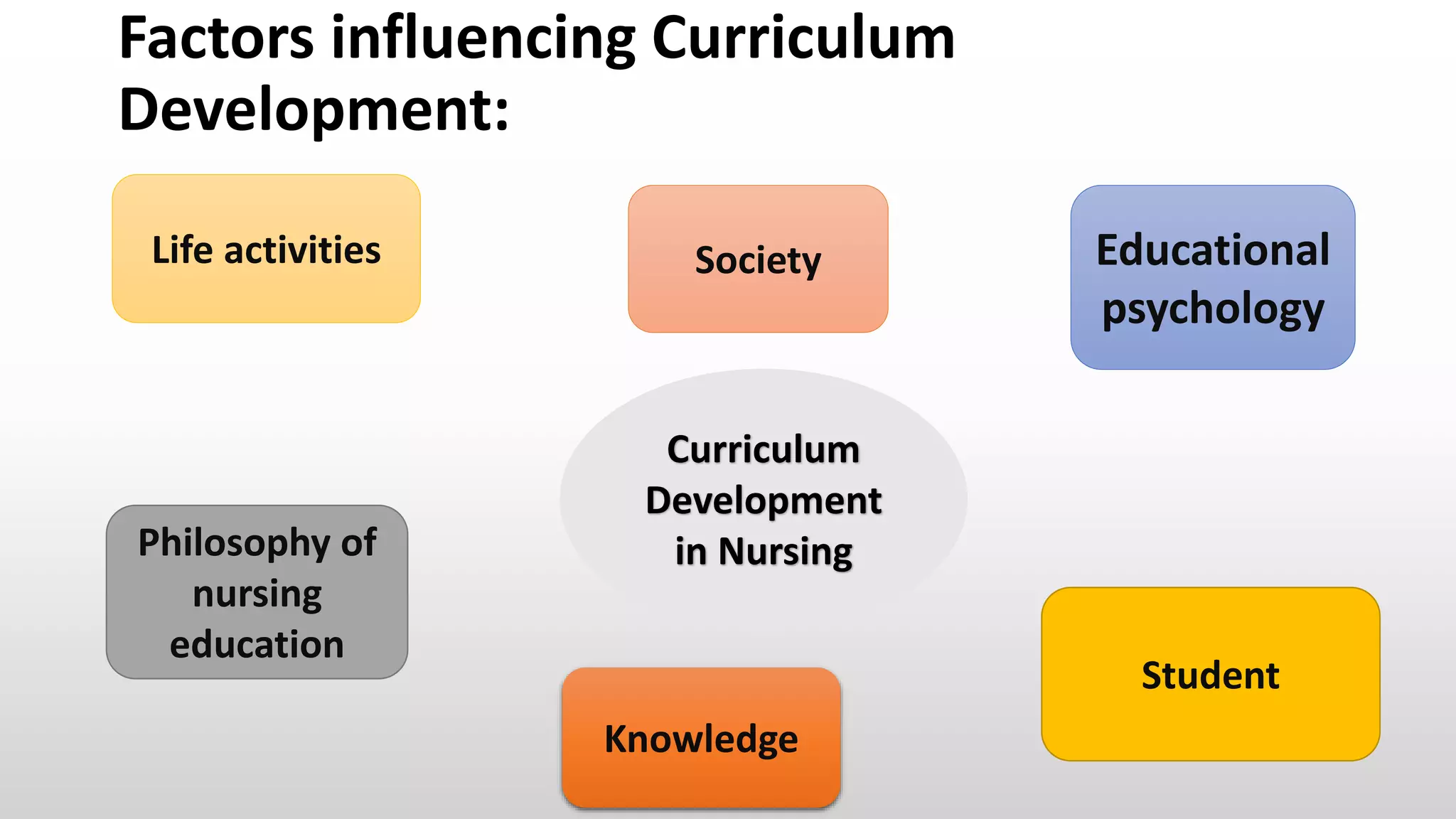
Factors influencing Curriculum
Development:
Curriculum
Development
in Nursing
Student
Educational
psychology
Life activities
Philosophy of
nursing
education
Society
Knowledge
Types of Curriculum:
Traditional/
subject-
centered
Activity
Experience
Undifferentiated
Basic
education
Life-centered/
balanced
Stages of Curriculum Development:
Directive stage
Formative
stage
Functional
stage
Evaluative
stage
Levels of Curriculum Planning:
Societal curriculum
Institutional curriculum
Instructional curriculum
Principles of Curriculum Development:
Conservative principle
Forward-looking principle
Creative principle
Activity principle
Contd….
Principle of preparation of life
Maturity principle
Principle of Loyalties
Principle of Individual
Differences
Contd..
Principle of flexibility
Principle of common subjects
Principle of character-building
Principle of leisure
Elements of Planning a Curriculum:
Lesson
Plan
Unit Plan
Course
Plan
Planning
curriculum
Steps of curriculum development
Curriculum
development
1. Formulation
of objectives
2. Selection
of teaching
learning
experience
3. Implementation of
teaching learning
experiences
4. Evaluation
of objectives
1. Formulation of objectives
Objectives must be stated in behavioral terms.
It must be clear and concise.
It must keep pace with ongoing changes in health
care.
Types of objectives
General objectives
Intermediate objectives
Specific objectives
2. Selection of teaching learning experiences
• Learning activities should be appropriate for cognitive,
affective and psychomotor development of students.
• Since knowledge is very vast and it is not possible to learn
everything the teacher must know what is essential for the
students to learn.
3. Organization of learning experiences
Organization should be done in a manner that
proceeds from:
Simple to complex
Concrete to abstract
Normal to abnormal
4. Evaluation of learning objectives/outcomes
It includes:
Purposes of test- formative & summative
Timings of various tests
Duration of tests
Frequency of tests
Criteria for pass and fail and grading of students
Determinants for revising curriculum
Advancement
in medical
sciences
Change in
socio-economic
status
Up-to date
knowledge
Student’s
interest
Need of
profession
Need of society
Sources to gather opinion on existing curriculum
Student’s
opinion
Self-
assessment
Outcome &
impact of
existing
curriculum
Professional
evaluation
What to be done for revising a curriculum
• Redefining curricular objectives
• Introduction of newer topics and skills
• Deletion of obsolete or irrelevant topics and skills
• Improving teaching learning experiences
• Modifying duration, timing and sequencing of subjects
• Modifying evaluation system
• Assessing the need and scope for introducing newer
courses
Curriculum models:
• It refers to an educational system that combines theory into
practice.
• These are targeted according to needs and characteristics of
particular groups of learner.
Basic Curriculum Model:
Aims and
objectives
Content
Methods of
teaching-
learning
Evaluation
of
outcomes
Tyler Behavioral Model(1950) :
1.
• Educational objectives/ purposes
2.
• Learning experiences to attain objectives
3.
• Method of teaching-learning
4.
• Evaluation of experiences
Stenhouse’s Process Model (1975) :
It emphasis on learning experience or the process of
education.
Teacher’s role is to appraise student’s work, self-appraisal
quality among students.
Improve learner’s performance and judgement
Lawton’s Cultural Analysis Model (1983) :
He proposed that curriculum is planned on the technique of
cultural analysis.
Culture is defined as the whole way of life of society and the
purpose of education is to make available to the next
generation what we regard.
Culture analysis is the process by which a selection is made
from the culture and in terms of curriculum planning.
Beattie’s Four-Fold Model (1987):
Beattie suggest that there are four fundamental approaches in
relation to the task of planning a nursing curriculum. They are:
1. Mapping of
key subjects.
2. Schedule of
basic skill
3. Portfolio of
meaningful
personal
experiences
4. Agenda of
cultural issues
Role of stakeholders in curriculum development
and implementation
Students Teachers
School
leaders
Parents Community
Students:
• Learners are at the core of the curriculum.
• The old view students are mere recipients of the curriculum, is
now changing. Learners have more dynamic participation from
the planning, designing, implementing and evaluating.
• However, the degree of their involvement is dependent on
their maturity. The older they are in high school or college, the
more mature they will be and the more effectively they help in
curriculum development and implementation.
Teachers:
• Teachers are stakeholders who plan, design and teachers,
implement and evaluate the Curriculum. No doubt, the most
important person in curriculum implementation is the teacher.
• Some of the roles that the teachers do in curriculum
implementation are:
1. Guiding, facilitating and directing the activities of the
learners
2. Choosing the activities and the methods to be utilized
Contd…..
3. Choosing the materials that are necessary for the activity;
4. Evaluating the whole implementation process and
5. Making a decision whether to continue, modify or terminate
the curriculum.
School leaders:
• School leaders are curriculum managers.
• Principals and school leaders too, have important roles in
curriculum implementation process in school. They should
understand fully the need for change and the implementation
process.
• They should be ready to assist the teachers and the students in
the implementation.
• Communication line should be open to all concerned should
the school leaders a lead in curriculum teamwork
Parents:
• Parents are significant school partners.
• Besides the students, teachers and school administrators, play
an important role in curriculum implementation.
• How do parents help shape the curriculum in schools?
Here are some observations
• The school composed of parents who are positively involved in
school activities have better achievement than schools with
uninvolved parents.
• Disciplinary problems are minimal, and students are highly
motivated. When parents take interest in their child’s learning
they become closer to the school.
• The home is the extended school environment. In lifelong
learning, the achieved learning in schools are transferred at
home. Thus, the home becomes the laboratory of learning.
Contd…
• Parents see to it that what children learn in school are
practiced at home. They follow up lessons, they make available
materials for learning and they give permission for the
participation of their children.
• In most schools, parents associations are organized. This is
being encourage in School Based Management. In some cases
the organization also include teachers to expand the school
learning community.
Community:
• It takes the whole village to educate the child” goes the
statement of the former First Lady Hillary Clinton.
• Yes it is true that the school is in the community, hence the
community is the extended school ground. A learning
environment. All the leaders, the elders, other citizens and
residents of the community have a stake in the curriculum
Conclusion:
Curriculum is the blue-print of an educational programme
and the main aim of education is to change behavior of
learners.
Curriculum is concerned with guiding the teachers and the
students in educative manner.
A lot of learning activities are learned by implementing
curriculum in various settings.
Curriculum nature, factors affecting curriculum

Curriculum nature, factors affecting curriculum

  • 1.
  • 2.
    Meaning of curriculum: Curriculumis derived from Latin word “currere” which means “run”. It is runway for attaining the goals of education. It is considered as blueprint of educational program. It is the base of education on which the teaching-learning process is planned and implemented.
  • 3.
    Definition: • Kerr definescurriculum as, “All the learning which is planned and guided by the school, whether it is carried on in groups or individually, inside or outside of school." • According to Cunningham, “It is a tool in the hands of an artist to mould his material, according to his ideals in his studio.” In this definition, artist is the teacher, material is the student, ideals are the objectives and studio is the educational institute.
  • 4.
    Concept of Curriculum: Goalsand purposes of education Process of curriculum Evaluation of curriculum
  • 5.
    Need of Curriculum: Actsas educational planning tool Setting agenda behind the time Setting learning goals Providing structure to educational goals Lesson planning Selection of teaching method Quality assurance tool
  • 6.
    Nature of NursingCurriculum: Curriculum is dynamic and flexible. Health oriented Having positive attitude towards learner’s need. Influenced by development in other health care professions. Influenced by trans-national trends in nursing education. Influenced by policy decisions based on National Health Policy.
  • 7.
    Factors influencing Curriculum Development: Curriculum Development inNursing Student Educational psychology Life activities Philosophy of nursing education Society Knowledge
  • 8.
  • 9.
    Stages of CurriculumDevelopment: Directive stage Formative stage Functional stage Evaluative stage
  • 10.
    Levels of CurriculumPlanning: Societal curriculum Institutional curriculum Instructional curriculum
  • 11.
    Principles of CurriculumDevelopment: Conservative principle Forward-looking principle Creative principle Activity principle
  • 12.
    Contd…. Principle of preparationof life Maturity principle Principle of Loyalties Principle of Individual Differences
  • 13.
    Contd.. Principle of flexibility Principleof common subjects Principle of character-building Principle of leisure
  • 14.
    Elements of Planninga Curriculum: Lesson Plan Unit Plan Course Plan Planning curriculum
  • 15.
    Steps of curriculumdevelopment Curriculum development 1. Formulation of objectives 2. Selection of teaching learning experience 3. Implementation of teaching learning experiences 4. Evaluation of objectives
  • 16.
    1. Formulation ofobjectives Objectives must be stated in behavioral terms. It must be clear and concise. It must keep pace with ongoing changes in health care.
  • 17.
    Types of objectives Generalobjectives Intermediate objectives Specific objectives
  • 18.
    2. Selection ofteaching learning experiences • Learning activities should be appropriate for cognitive, affective and psychomotor development of students. • Since knowledge is very vast and it is not possible to learn everything the teacher must know what is essential for the students to learn.
  • 19.
    3. Organization oflearning experiences Organization should be done in a manner that proceeds from: Simple to complex Concrete to abstract Normal to abnormal
  • 20.
    4. Evaluation oflearning objectives/outcomes It includes: Purposes of test- formative & summative Timings of various tests Duration of tests Frequency of tests Criteria for pass and fail and grading of students
  • 21.
    Determinants for revisingcurriculum Advancement in medical sciences Change in socio-economic status Up-to date knowledge Student’s interest Need of profession Need of society
  • 22.
    Sources to gatheropinion on existing curriculum Student’s opinion Self- assessment Outcome & impact of existing curriculum Professional evaluation
  • 23.
    What to bedone for revising a curriculum • Redefining curricular objectives • Introduction of newer topics and skills • Deletion of obsolete or irrelevant topics and skills • Improving teaching learning experiences • Modifying duration, timing and sequencing of subjects • Modifying evaluation system • Assessing the need and scope for introducing newer courses
  • 24.
    Curriculum models: • Itrefers to an educational system that combines theory into practice. • These are targeted according to needs and characteristics of particular groups of learner.
  • 25.
    Basic Curriculum Model: Aimsand objectives Content Methods of teaching- learning Evaluation of outcomes
  • 26.
    Tyler Behavioral Model(1950): 1. • Educational objectives/ purposes 2. • Learning experiences to attain objectives 3. • Method of teaching-learning 4. • Evaluation of experiences
  • 27.
    Stenhouse’s Process Model(1975) : It emphasis on learning experience or the process of education. Teacher’s role is to appraise student’s work, self-appraisal quality among students. Improve learner’s performance and judgement
  • 28.
    Lawton’s Cultural AnalysisModel (1983) : He proposed that curriculum is planned on the technique of cultural analysis. Culture is defined as the whole way of life of society and the purpose of education is to make available to the next generation what we regard. Culture analysis is the process by which a selection is made from the culture and in terms of curriculum planning.
  • 29.
    Beattie’s Four-Fold Model(1987): Beattie suggest that there are four fundamental approaches in relation to the task of planning a nursing curriculum. They are: 1. Mapping of key subjects. 2. Schedule of basic skill 3. Portfolio of meaningful personal experiences 4. Agenda of cultural issues
  • 30.
    Role of stakeholdersin curriculum development and implementation Students Teachers School leaders Parents Community
  • 31.
    Students: • Learners areat the core of the curriculum. • The old view students are mere recipients of the curriculum, is now changing. Learners have more dynamic participation from the planning, designing, implementing and evaluating. • However, the degree of their involvement is dependent on their maturity. The older they are in high school or college, the more mature they will be and the more effectively they help in curriculum development and implementation.
  • 32.
    Teachers: • Teachers arestakeholders who plan, design and teachers, implement and evaluate the Curriculum. No doubt, the most important person in curriculum implementation is the teacher. • Some of the roles that the teachers do in curriculum implementation are: 1. Guiding, facilitating and directing the activities of the learners 2. Choosing the activities and the methods to be utilized
  • 33.
    Contd….. 3. Choosing thematerials that are necessary for the activity; 4. Evaluating the whole implementation process and 5. Making a decision whether to continue, modify or terminate the curriculum.
  • 34.
    School leaders: • Schoolleaders are curriculum managers. • Principals and school leaders too, have important roles in curriculum implementation process in school. They should understand fully the need for change and the implementation process. • They should be ready to assist the teachers and the students in the implementation. • Communication line should be open to all concerned should the school leaders a lead in curriculum teamwork
  • 35.
    Parents: • Parents aresignificant school partners. • Besides the students, teachers and school administrators, play an important role in curriculum implementation. • How do parents help shape the curriculum in schools?
  • 36.
    Here are someobservations • The school composed of parents who are positively involved in school activities have better achievement than schools with uninvolved parents. • Disciplinary problems are minimal, and students are highly motivated. When parents take interest in their child’s learning they become closer to the school. • The home is the extended school environment. In lifelong learning, the achieved learning in schools are transferred at home. Thus, the home becomes the laboratory of learning.
  • 37.
    Contd… • Parents seeto it that what children learn in school are practiced at home. They follow up lessons, they make available materials for learning and they give permission for the participation of their children. • In most schools, parents associations are organized. This is being encourage in School Based Management. In some cases the organization also include teachers to expand the school learning community.
  • 38.
    Community: • It takesthe whole village to educate the child” goes the statement of the former First Lady Hillary Clinton. • Yes it is true that the school is in the community, hence the community is the extended school ground. A learning environment. All the leaders, the elders, other citizens and residents of the community have a stake in the curriculum
  • 39.
    Conclusion: Curriculum is theblue-print of an educational programme and the main aim of education is to change behavior of learners. Curriculum is concerned with guiding the teachers and the students in educative manner. A lot of learning activities are learned by implementing curriculum in various settings.