CURRICULUM
DEVELOPMENT
.
CURRICULUM
.
INTRODUCTION
•The term curriculum was first used in Scotland as
early as 1820.
•Word curriculum was derived from the Latin word
‘CURRERE’ meaning ‘TO RUN’
MEANING
It is a
• set of performance objectives
• Set of subjects
• Set of materials
• Sequence of courses
• Content
• A program of studies
• That which is taught in school
• Course of study
• That is planned by school personnel
DEFINITION
Curriculum is defined as a written document that
systematically describes goals planned, objectives,
content, learning activities, evaluation procedures and
so forth.
- PRATT
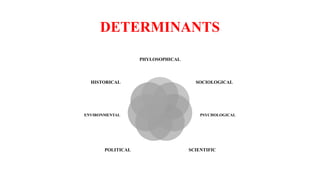
DETERMINANTS
PHYLOSOPHICAL
SOCIOLOGICAL
PSYCHOLOGICAL
SCIENTIFIC
POLITICAL
ENVIRONMENTAL
HISTORICAL
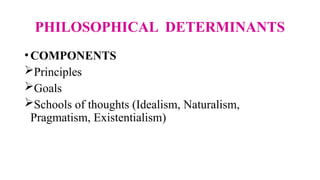
PHILOSOPHICAL DETERMINANTS
•COMPONENTS
Principles
Goals
Schools of thoughts (Idealism, Naturalism,
Pragmatism, Existentialism)
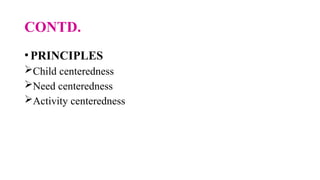
CONTD.
•PRINCIPLES
Child centeredness
Need centeredness
Activity centeredness
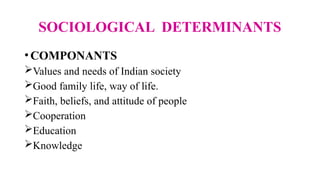
SOCIOLOGICAL DETERMINANTS
•COMPONANTS
Values and needs of Indian society
Good family life, way of life.
Faith, beliefs, and attitude of people
Cooperation
Education
Knowledge
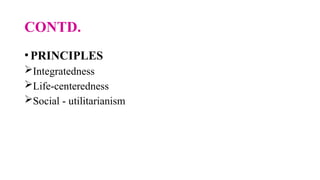
CONTD.
•PRINCIPLES
Integratedness
Life-centeredness
Social - utilitarianism
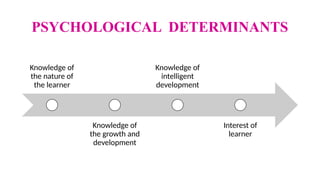
PSYCHOLOGICAL DETERMINANTS
Knowledge of
the nature of
the learner
Knowledge of
the growth and
development
Knowledge of
intelligent
development
Interest of
learner
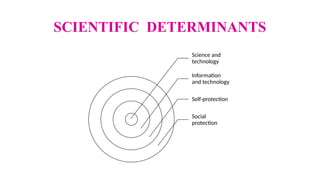
SCIENTIFIC DETERMINANTS
Science and
technology
Information
and technology
Self-protection
Social
protection
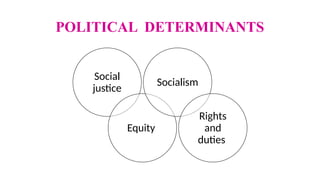
POLITICAL DETERMINANTS
Social
justice
Equity
Socialism
Rights
and
duties
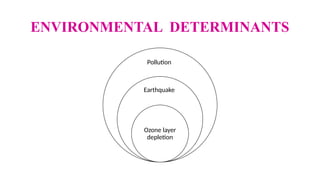
ENVIRONMENTAL DETERMINANTS
Pollution
Earthquake
Ozone layer
depletion
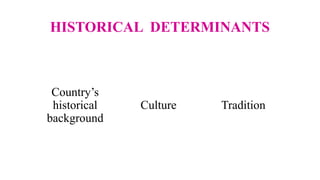
HISTORICAL DETERMINANTS
Country’s
historical
background
Culture Tradition
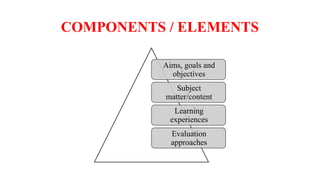
COMPONENTS / ELEMENTS
Aims, goals and
objectives
Subject
matter/content
Learning
experiences
Evaluation
approaches
PURPOSE
• Establishing clear educational aims and goals.
• Creating a framework for teaching and learning
• Promoting critical thinking and problem solving skills
• Preparing students for future
• Enhancing teaching effectiveness
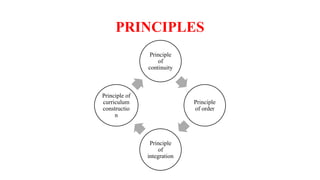
PRINCIPLES
Principle
of
continuity
Principle
of order
Principle
of
integration
Principle of
curriculum
constructio
n
PRINCIPLE OF CONTINUITY
• To ensure continuity, curriculum strand are used.
• Two types of curriculum strands are usually used:
1. Horizontal strands – these strands are introduced early in the program.
E.g. Nursing process, health care system, ethical principles.
2. Vertical strands- these strands focus on ensuring that learning
objectives and content are consistently developed at different levels.
E.g. Mathematics: concepts like fraction, decimals, algebra
Language: skills like reading, writing, Vocabulary
Science: concepts like solar system, Ecosystem, human body
PRINCIPLE OF ORDER
Order refers to sequencing of learning experiences and presentation of concepts.
• Simple to complex: teaching sociological concepts before sociological theories
• Whole to parts: presenting a total case and then looking at different aspects
• Parts to whole: explaining how cell work, then tissues, and then organs
• Chronological: teaching growth and development by starting with the
development from baby to elderly person.
• Taxonomies: using bloom’s taxonomy to differentiate between what 1st
yr and 2nd
yr students should be able to do
• Health to illness: teaching health state of individual before teaching about
disease condition.
PRINCIPLE OF INTEGRATION
• Integration refers to the horizontal relationships between
learning experiences (courses, content, clinical placements)
offered at the same time in particular level.
PRINCIPLE OF CURRICULUM
CONSTRUCTION
• Principle of utility
• Principle of training
• Principle of synthesis of play and work
• Principle of synthesis of all activities of life
• Principle of constant development
• Principle of creative training
• Principle of variety
• Principle of education
• Principle related to community life
CONTD.
• Principle of evolution of democratic values
• Principle of conservation
• Principle of selectivity
• Principle of forward looking
• Principle of activity and experience
• Principle of preparation of life
• Principle of linking with life
• Principle of child-centered curriculum
• Principle of maturity
CONTD.
• Principle of sensitivity
• Principle of flexibility
• Principle of individual difference
• Principle of comprehensiveness and balance
• Principle of core or common subjects
CURRICULUM
DEVELPOMENT
.
DEFINITION
Curriculum development is more comprehensive term,
which includes planning, aims and goals, design,
implementation and evaluation.
PURPOSE
•It establishes a clear philosophy.
•It outlines a basic framework for what to do, how to do it,
when to do it.
•It allows for flexibility and encourages, experimentation
and innovation.
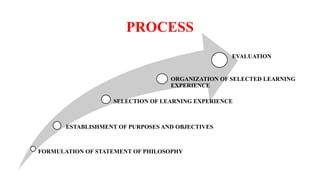
PROCESS
FORMULATION OF STATEMENT OF PHILOSOPHY
ESTABLISHMENT OF PURPOSES AND OBJECTIVES
SELECTION OF LEARNING EXPERIENCE
ORGANIZATION OF SELECTED LEARNING
EXPERIENCE
EVALUATION
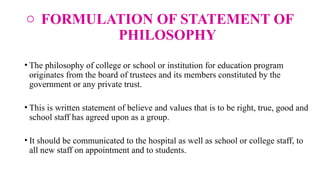
o FORMULATION OF STATEMENT OF
PHILOSOPHY
• The philosophy of college or school or institution for education program
originates from the board of trustees and its members constituted by the
government or any private trust.
• This is written statement of believe and values that is to be right, true, good and
school staff has agreed upon as a group.
• It should be communicated to the hospital as well as school or college staff, to
all new staff on appointment and to students.
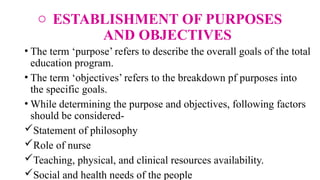
o ESTABLISHMENT OF PURPOSES
AND OBJECTIVES
• The term ‘purpose’ refers to describe the overall goals of the total
education program.
• The term ‘objectives’ refers to the breakdown pf purposes into
the specific goals.
• While determining the purpose and objectives, following factors
should be considered-
Statement of philosophy
Role of nurse
Teaching, physical, and clinical resources availability.
Social and health needs of the people
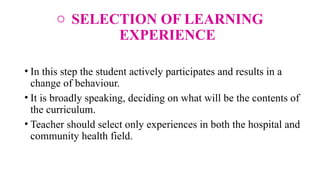
o SELECTION OF LEARNING
EXPERIENCE
• In this step the student actively participates and results in a
change of behaviour.
• It is broadly speaking, deciding on what will be the contents of
the curriculum.
• Teacher should select only experiences in both the hospital and
community health field.
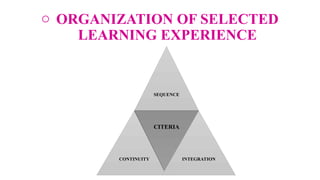
o ORGANIZATION OF SELECTED
LEARNING EXPERIENCE
SEQUENCE
CONTINUITY
CITERIA
INTEGRATION
CONTD.
• CONTINUITY: - it refers to the relationship existing between different
levels of the same subjects or skills.
• SEQUENCE: - it is also related to continuity, but going little beyond its
relationship.
• INTEGRATION: - It refers to the relationship among learning experiences
o EVALUATION
• This is the final steps of curriculum process .it includes-
Assess students learning
Evaluate the curriculum
Revise and improve.