Presentation on:
Monitoring and Supervising Curriculum
Curriculum Revision and Evaluation
List of Contents
 Introduction
 Definitions
 Types of Curriculum used in Schools
 Elements/components of the curriculum
 Curriculum Monitoring
 Importance of Curriculum Monitoring
 Curriculum Supervision
 Curriculum Revision
 Curriculum Revision ( HEC)
 What, Why and How to Evaluate a Curriculum
 Curriculum Evaluation
 Steps Curriculum Evaluation
 Models of Curriculum Evaluation
Monitoring and Supervising Curriculum
Introduction:
 Curriculum is as dynamic as the changes that occur in society.
 In its narrow sense
Curriculum is viewed merely as a listing of subject to be taught in school.
 In a broader sense
It refers to the total learning experiences of individuals not only in schools
but in society as well
Etymology and Definition of Curriculum
 The word curriculum comes from the Latin word currere, meaning "to run the
course".
 This is the same Latin word that career comes from. Curriculum is understood
as a course of study, allowing the student to follow it until he is finished with
the race.
Definitions
 The curriculum includes all the learners’ experience in or outside school that
are included in a program which has been devised to help him
developmentally, emotionally, socially, spiritually and morally”
“Crow and Crow”
Definition of Curriculum
 A brief answer is hard to give as curriculum can be both written and
unwritten.
 Essentially, curriculum is what the school is attempting to teach, which might
include social behaviors as well as content and thinking skills.
 A course of study that will enable the learner to acquire specific knowledge
and skills.
 A curriculum consists of the "roadmap" or "guideline" of any given discipline.
 A detailed plan for instruction set by policy-makers
Types of Curriculum used in Schools
Allan Glatthorn (2000) describes seven types of curriculum operating in the
schools.
1. Recommended curriculum
Proposed by scholars and professional organizations.
2. Written curriculum
Appears in school, district, division or country documents.
3. Taught curriculum
what teachers implement or deliver in the classrooms and schools
Types of Curriculum used in Schools
4. Supported curriculum
resources textbook computers, audio visual materials which support and
help in the implementation of the curriculum.
5. Assessed curriculum
Curriculum which is tested and evaluated.
6. Learned curriculum
what the students actually learn and what is measured and
7. Hidden curriculum
The unintended curriculum
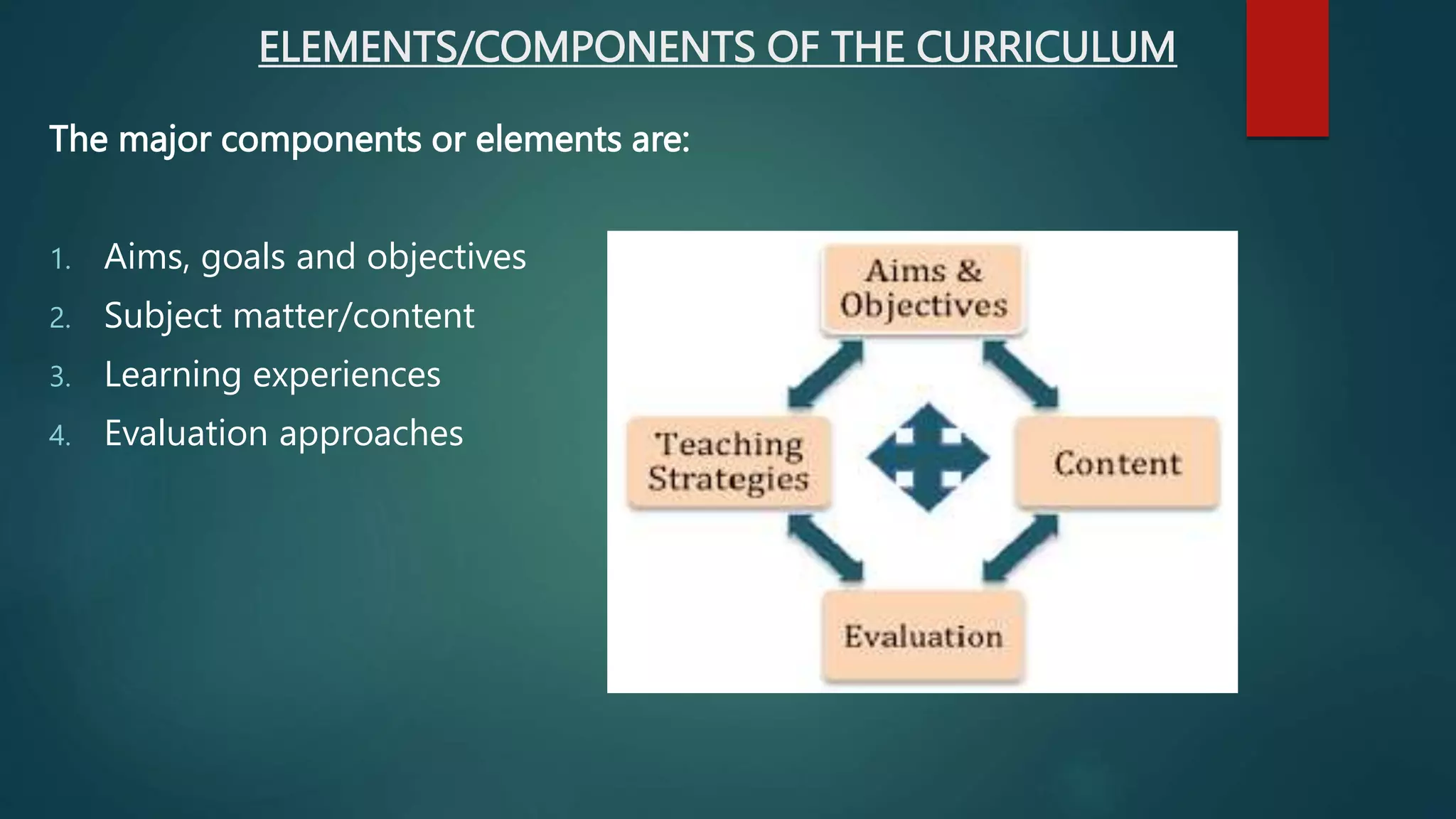
ELEMENTS/COMPONENTS OF THE CURRICULUM
The major components or elements are:
1. Aims, goals and objectives
2. Subject matter/content
3. Learning experiences
4. Evaluation approaches
ELEMENTS/COMPONENTS OF THE CURRICULUM
Goals
 Goals provide overall direction or guiding
images for curriculum development.
 A statement of goals should reflect a well-
developed position that is rooted in a particular
conception of philosophy, psychology, and
society.
 Example : To develop skill in interpersonal and
group relationships in students by helping them
recognizing the importance and need for
adopting moral standards of behavior.
ELEMENTS/COMPONENTS OF THE CURRICULUM
Instructional Objectives
Robert Mager (1962) has been one of the principal
proponents of writing behavioral objectives. He
suggests that behavioral objectives should contain
three components:
 Expected student behavior.
 The appropriate conditions under which the
behavior can be carried out.
 The degree of performance required
ELEMENTS/COMPONENTS OF THE CURRICULUM
Content
 The word content is used interchangeably with terms such as subject matter,
knowledge, concepts and ideas
 In selecting content, curriculum workers will emphasize various criteria. The
criteria for choosing content fall into the following categories:
 Psychological criteria
 Social/political criteria
 Ideological criteria
 Student interest criteria
 Student readiness criteria
 Philosophical criteria

ELEMENTS/COMPONENTS OF THE CURRICULUM
Teaching strategies/learning experiences
 In instruction, the teacher designs an immediate set of learning experiences to
achieve specific objectives.
Evaluation
 Evaluation is one of the dynamic process, which needs a continuous research and
evaluation for its betterment in order to cope and bring about desirable changes.
 Curriculum evaluation is not a student evaluation.
 It is a broader term being used to make judgment about the worth and
effectiveness of it.
 With the help of evaluation phase experts can modify the curriculum by bringing
about desirable changes.
Curriculum Monitoring
 Monitoring is the systematic process of collecting, analyzing and using
information to track a program's progress toward reaching its objectives and
to guide management decisions.
 A process of gathering information for evaluating the effectiveness of the
curriculum and ensuring that the intended, implemented and attained
curricula are aligned
This process typically focuses on such issues as
 Relevance,
 Consistency
 Practicality
 Effectiveness,
 Scaling-up and sustainability
Importance of Curriculum Monitering
 Determine if the curriculum is still relevant or effective.
 know if the curriculum is working or not.
 Provide decision on what aspects have to be retained improved or modified
 Provide decision that would even and or terminate the program.
:
Curriculum Monitoring asks the question:
 How are we doing? Is the curriculum accomplishing its intended purposes?
 Monitoring is also important to determine is the curriculum is still relevant
and effective.
 Monitoring is a periodic assessment and adjustment during the try –out
period. It is like formative evaluation.
 It determines how the curriculum is working, such that the monitoring report
becomes the basis of a decision on what aspects have to be retained,
improved or modified.
 Monitoring also provides decision that would even end or terminate the
program.
 Usually, monitoring is done by the module writers, curriculum experts or
outside agencies.
Curriculum Supervision
 According to Adams and Dickey,
“Supervision is a planned program for the improvement.” It exists in their
opinion for one reason only to improve teaching and learning.
The Review Council defined curriculum supervision as “The role of "persons
whose basic job description includes”
 Planning,
 Directing
 Supporting the development,
 Implementation,
 Evaluation of the curriculum.
Curriculum Supervision and Evaluation
 Curriculum revision means to give it a new position or direction .
 Alteration to its philosophy by way of its aims and objectives, reviewing the
content included, revising its methods and re-thinking its effectiveness
Eight Steps to Curricular Change
 Analyze current teaching practices and learning goals.
 Re-examine the links between goals and course design.
 Reconsider the role of assessment in the course
 Develop teaching strategies and approach.
 Explore Curricular Questions.
 Formulate, Deliberate, and Assess Possible Reform Models.
Need for revision in curriculum
 To restructure the curriculum according to the needs, interests or abilities of the le
arner.
 To eliminate unnecessary units, teaching methods and contents.
To introduce latest and update methods of teaching and content, new knowledge
and practices.
 To add or delete number of teaching hours of instruction.
 To correlate between the student’s theory courses and learning practices.
 To select learning experiences base on the objectives rather than on the service
needs of the society
 The students themselves receive little or no experience in assuming responsibilitie
s or in making choices, everything is decided for them by the teacher or the admi
nistrator.
Curriculum Revision (HEC)
​​​​​National Curriculum Revision Committee (NCRC) Process
 The curriculum revision work relates to Class XII at the bachelor's level and
onwards regarding all degrees, certificates and diplomas
 The HEC may at any time choose to advise the chancellor of an institution on
its statutes and regulations.
 To facilitate these changes, committees comprising senior academics
nominated by the universities are established at the national level.
Steps Involved in Curriculum Review/Revision Process
The curriculum review and revision process has been divided in two phases:
PHASE – I: Curricula under consideration
 Step – I: Constitution of NCRC in the subject
 Step –II: Assessment/Analysis of the existing curriculum
 Step – III: NCRC Meeting-I: Draft Preparation
PHASE – II: Circulation of the Draft Curriculum
 Step – I: Appraisal of the first draft
 Step – II: NCRC meeting-II - Finalization of draft
 Implementation
PHASE – I: Curricula under consideration
Step – I: Constitution of NCRC in the subject
 The Heads of Institutes requested to nominate their representatives, for
appointment as member of National Curriculum Review Committee (NCRC).
Step –II: Assessment/Analysis of the existing curriculum
Collective proposals for review and revision of existing curricula in relation to:
 Learning Outcomes
 Scheme of studies
 Course-content
 Weightage
 Reading materials
 Teaching strategies
 Methods of evaluation.
PHASE – I: Curricula under consideration
Step – III: NCRC Meeting-I: Draft Preparation
 The first meeting of the NCRC is organized at the HEC Headquarter
Islamabad or one of its Regional Centers at Peshawar, Lahore and Karachi.
 During this meeting maximum local input could be made available in the
exercise of revising a curriculum.
 Universities at different places may also be chosen to serve the purpose.
 The meeting which normally runs for three consecutive days comes up with a
draft of the revised curricula, after detailed discussion and deliberation on
the proposals prepared by the NCRC members.
PHASE – II: Circulation of the Draft Curriculum
Step – I: Appraisal of the first draft
 The first draft prepared is circulated amongst the local as well expatriate
Pakistani experts
Step – II: NCRC meeting-II - Finalization of draft
 The second meeting of the NCRC is held ​​to finalize the draft of the revised
curriculum in the light of comments/suggestions/
 The meeting would again take three days to finalize curriculum.
Implementation
 The curricula designed is printed and sent to universities/institutions for its
adoption/implementation after the approval of the Competent Authority.
Curriculum evaluation
According to Worthen and Sanders, (1987)
 All curricula to be effective must have the element of the evaluation.
 “Curriculum evaluation here may refer to the formal determination of the
quality, effectiveness or value of the program, process, and product of the
curriculum.”
 Curriculum Evaluation is defined as the process of delineating, obtaining, and
providing information useful for making decisions and judgments about a
program of learning.
 Translation those activities that translate a curriculum design into intended
instructional activity.
What, Why and How to Evaluate a Curriculum
What
 Ornstein, A. & Hunkins , F. (1998)
Curriculum evaluation is a process done in order to gather data that enables
one to decide whether to accept, change, eliminate the whole curriculum of a
textbook.
Why
 Any aspect of an activity or undertakings should be evaluated for purposes of
better performance in the future.
How
 Steps in Conducting a Curriculum Evaluation
Steps in Conducting a Curriculum Evaluation
 Identifying established standards and criteria
 Identifying Techniques
 Identifying Primary Audiences
 Identifying critical issues
 Identifying data source
 Preparing modes of display
 Preparing evaluation report Identifying techniques for collecting data
Curriculum Evaluation Models
 L.H . Bradley “Bradley effectiveness model”
 Ralph Tyler “Tyler’s objective centered model”
 Daniel Stuffle Beam “Daniel Stuffle beam model (cipp)”
 Robert stake “stake’s Countenace Model (1967)”
 Stake Responsive model(1976)”
 Stake’s Case study model(1978)”
 Scriven Consumer oriented Evaluation
BRADLEY EFFECTIVENESS MODEL
 -first , you have to identify what curriculum you will evaluate , then find out if
the curriculum you are evaluating answers yes or no.
 Answering yes to all questions means good curriculum as describe by
Bradley.
TYLER OBJECTIVE CENTERED MODEL
 Involves: establishing goals or objective; stating the objectives in behavioral
terms; measuring aspects of student performance at the completion of
teaching ; comparing test results with behavioral objectives
 it is a continuing process
DANIEL STUFFLEBEAM MODEL- CIPP
 The model made emphasis that the result of evaluation should provide data
for decision making.
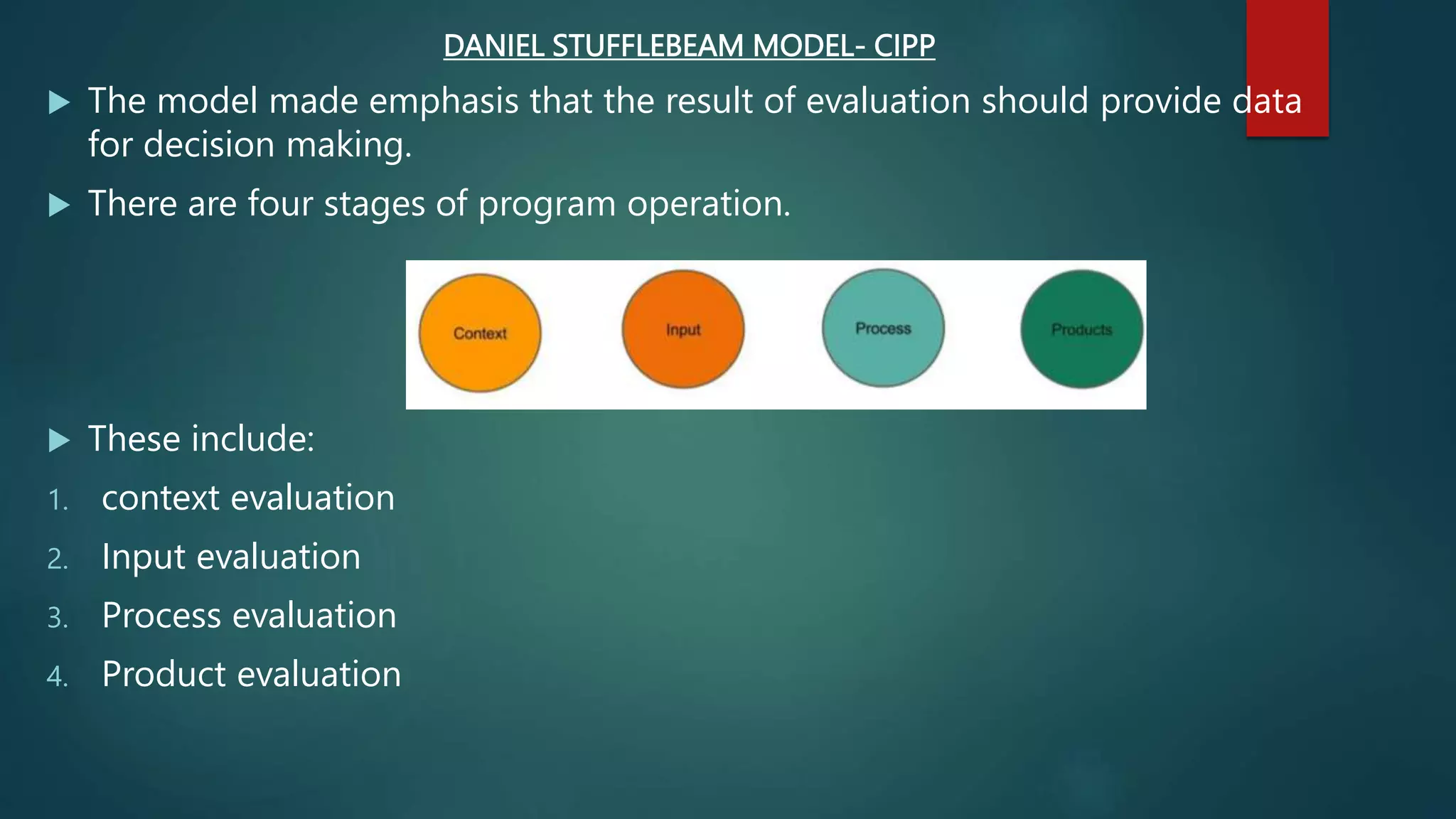
 There are four stages of program operation.
 These include:
1. context evaluation
2. Input evaluation
3. Process evaluation
4. Product evaluation
 STAKE’S COUNTENANCE MODEL
 Model emphasizes the importance of both description and observation in
evaluation.
 Distinguishes between the evaluators description and judgment at the
different stages of implementing a curriculum or program; antecedents’,
transactions’ and outcomes’.
 STAKE RESPONSIVE MODEL
 Oriented more directly to program activities than the program intents.
 Evaluation focuses more on the activities rather than intent or purposes
:
 STAKE’S CASE STUDY MODEL
The case study model is so called because of its emphasis on the specific
situation to be investigated.
 SCRIVEN CONSUMER ORIENTED EVALUATION
Uses criteria and checklist as a tool for either formative or summative
evaluation purposes. The use of criteria and checklist was proposed by
Screven for educational evaluators.
Steps on the Suggested Plan of Action for the Process of
Curriculum Evaluation
 Focus on one particular component of the curriculum.
 Collect or gather the information.
 Organize the information.
 This step will require coding, organizing, storing, and retrieving data for
interpretation.
 Analyze interpretation.
 Report the information.
 Recycle the information for continuous feedback, modification and
adjustments to be made

Monitoring and Supervising Curriculum & Curriculum Revision and Evaluation

  • 1.
    Presentation on: Monitoring andSupervising Curriculum Curriculum Revision and Evaluation
  • 2.
    List of Contents Introduction  Definitions  Types of Curriculum used in Schools  Elements/components of the curriculum  Curriculum Monitoring  Importance of Curriculum Monitoring  Curriculum Supervision  Curriculum Revision  Curriculum Revision ( HEC)  What, Why and How to Evaluate a Curriculum  Curriculum Evaluation  Steps Curriculum Evaluation  Models of Curriculum Evaluation
  • 3.
    Monitoring and SupervisingCurriculum Introduction:  Curriculum is as dynamic as the changes that occur in society.  In its narrow sense Curriculum is viewed merely as a listing of subject to be taught in school.  In a broader sense It refers to the total learning experiences of individuals not only in schools but in society as well
  • 4.
    Etymology and Definitionof Curriculum  The word curriculum comes from the Latin word currere, meaning "to run the course".  This is the same Latin word that career comes from. Curriculum is understood as a course of study, allowing the student to follow it until he is finished with the race. Definitions  The curriculum includes all the learners’ experience in or outside school that are included in a program which has been devised to help him developmentally, emotionally, socially, spiritually and morally” “Crow and Crow”
  • 5.
    Definition of Curriculum A brief answer is hard to give as curriculum can be both written and unwritten.  Essentially, curriculum is what the school is attempting to teach, which might include social behaviors as well as content and thinking skills.  A course of study that will enable the learner to acquire specific knowledge and skills.  A curriculum consists of the "roadmap" or "guideline" of any given discipline.  A detailed plan for instruction set by policy-makers
  • 6.
    Types of Curriculumused in Schools Allan Glatthorn (2000) describes seven types of curriculum operating in the schools. 1. Recommended curriculum Proposed by scholars and professional organizations. 2. Written curriculum Appears in school, district, division or country documents. 3. Taught curriculum what teachers implement or deliver in the classrooms and schools
  • 7.
    Types of Curriculumused in Schools 4. Supported curriculum resources textbook computers, audio visual materials which support and help in the implementation of the curriculum. 5. Assessed curriculum Curriculum which is tested and evaluated. 6. Learned curriculum what the students actually learn and what is measured and 7. Hidden curriculum The unintended curriculum
  • 8.
    ELEMENTS/COMPONENTS OF THECURRICULUM The major components or elements are: 1. Aims, goals and objectives 2. Subject matter/content 3. Learning experiences 4. Evaluation approaches
  • 9.
    ELEMENTS/COMPONENTS OF THECURRICULUM Goals  Goals provide overall direction or guiding images for curriculum development.  A statement of goals should reflect a well- developed position that is rooted in a particular conception of philosophy, psychology, and society.  Example : To develop skill in interpersonal and group relationships in students by helping them recognizing the importance and need for adopting moral standards of behavior.
  • 10.
    ELEMENTS/COMPONENTS OF THECURRICULUM Instructional Objectives Robert Mager (1962) has been one of the principal proponents of writing behavioral objectives. He suggests that behavioral objectives should contain three components:  Expected student behavior.  The appropriate conditions under which the behavior can be carried out.  The degree of performance required
  • 11.
    ELEMENTS/COMPONENTS OF THECURRICULUM Content  The word content is used interchangeably with terms such as subject matter, knowledge, concepts and ideas  In selecting content, curriculum workers will emphasize various criteria. The criteria for choosing content fall into the following categories:  Psychological criteria  Social/political criteria  Ideological criteria  Student interest criteria  Student readiness criteria  Philosophical criteria 
  • 12.
    ELEMENTS/COMPONENTS OF THECURRICULUM Teaching strategies/learning experiences  In instruction, the teacher designs an immediate set of learning experiences to achieve specific objectives. Evaluation  Evaluation is one of the dynamic process, which needs a continuous research and evaluation for its betterment in order to cope and bring about desirable changes.  Curriculum evaluation is not a student evaluation.  It is a broader term being used to make judgment about the worth and effectiveness of it.  With the help of evaluation phase experts can modify the curriculum by bringing about desirable changes.
  • 13.
    Curriculum Monitoring  Monitoringis the systematic process of collecting, analyzing and using information to track a program's progress toward reaching its objectives and to guide management decisions.  A process of gathering information for evaluating the effectiveness of the curriculum and ensuring that the intended, implemented and attained curricula are aligned This process typically focuses on such issues as  Relevance,  Consistency  Practicality  Effectiveness,  Scaling-up and sustainability
  • 14.
    Importance of CurriculumMonitering  Determine if the curriculum is still relevant or effective.  know if the curriculum is working or not.  Provide decision on what aspects have to be retained improved or modified  Provide decision that would even and or terminate the program.
  • 15.
    : Curriculum Monitoring asksthe question:  How are we doing? Is the curriculum accomplishing its intended purposes?  Monitoring is also important to determine is the curriculum is still relevant and effective.  Monitoring is a periodic assessment and adjustment during the try –out period. It is like formative evaluation.  It determines how the curriculum is working, such that the monitoring report becomes the basis of a decision on what aspects have to be retained, improved or modified.  Monitoring also provides decision that would even end or terminate the program.  Usually, monitoring is done by the module writers, curriculum experts or outside agencies.
  • 16.
    Curriculum Supervision  Accordingto Adams and Dickey, “Supervision is a planned program for the improvement.” It exists in their opinion for one reason only to improve teaching and learning. The Review Council defined curriculum supervision as “The role of "persons whose basic job description includes”  Planning,  Directing  Supporting the development,  Implementation,  Evaluation of the curriculum.
  • 17.
    Curriculum Supervision andEvaluation  Curriculum revision means to give it a new position or direction .  Alteration to its philosophy by way of its aims and objectives, reviewing the content included, revising its methods and re-thinking its effectiveness Eight Steps to Curricular Change  Analyze current teaching practices and learning goals.  Re-examine the links between goals and course design.  Reconsider the role of assessment in the course  Develop teaching strategies and approach.  Explore Curricular Questions.  Formulate, Deliberate, and Assess Possible Reform Models.
  • 18.
    Need for revisionin curriculum  To restructure the curriculum according to the needs, interests or abilities of the le arner.  To eliminate unnecessary units, teaching methods and contents. To introduce latest and update methods of teaching and content, new knowledge and practices.  To add or delete number of teaching hours of instruction.  To correlate between the student’s theory courses and learning practices.  To select learning experiences base on the objectives rather than on the service needs of the society  The students themselves receive little or no experience in assuming responsibilitie s or in making choices, everything is decided for them by the teacher or the admi nistrator.
  • 19.
    Curriculum Revision (HEC) ​​​​​NationalCurriculum Revision Committee (NCRC) Process  The curriculum revision work relates to Class XII at the bachelor's level and onwards regarding all degrees, certificates and diplomas  The HEC may at any time choose to advise the chancellor of an institution on its statutes and regulations.  To facilitate these changes, committees comprising senior academics nominated by the universities are established at the national level.
  • 20.
    Steps Involved inCurriculum Review/Revision Process The curriculum review and revision process has been divided in two phases: PHASE – I: Curricula under consideration  Step – I: Constitution of NCRC in the subject  Step –II: Assessment/Analysis of the existing curriculum  Step – III: NCRC Meeting-I: Draft Preparation PHASE – II: Circulation of the Draft Curriculum  Step – I: Appraisal of the first draft  Step – II: NCRC meeting-II - Finalization of draft  Implementation
  • 21.
    PHASE – I:Curricula under consideration Step – I: Constitution of NCRC in the subject  The Heads of Institutes requested to nominate their representatives, for appointment as member of National Curriculum Review Committee (NCRC). Step –II: Assessment/Analysis of the existing curriculum Collective proposals for review and revision of existing curricula in relation to:  Learning Outcomes  Scheme of studies  Course-content  Weightage  Reading materials  Teaching strategies  Methods of evaluation.
  • 22.
    PHASE – I:Curricula under consideration Step – III: NCRC Meeting-I: Draft Preparation  The first meeting of the NCRC is organized at the HEC Headquarter Islamabad or one of its Regional Centers at Peshawar, Lahore and Karachi.  During this meeting maximum local input could be made available in the exercise of revising a curriculum.  Universities at different places may also be chosen to serve the purpose.  The meeting which normally runs for three consecutive days comes up with a draft of the revised curricula, after detailed discussion and deliberation on the proposals prepared by the NCRC members.
  • 23.
    PHASE – II:Circulation of the Draft Curriculum Step – I: Appraisal of the first draft  The first draft prepared is circulated amongst the local as well expatriate Pakistani experts Step – II: NCRC meeting-II - Finalization of draft  The second meeting of the NCRC is held ​​to finalize the draft of the revised curriculum in the light of comments/suggestions/  The meeting would again take three days to finalize curriculum. Implementation  The curricula designed is printed and sent to universities/institutions for its adoption/implementation after the approval of the Competent Authority.
  • 24.
    Curriculum evaluation According toWorthen and Sanders, (1987)  All curricula to be effective must have the element of the evaluation.  “Curriculum evaluation here may refer to the formal determination of the quality, effectiveness or value of the program, process, and product of the curriculum.”  Curriculum Evaluation is defined as the process of delineating, obtaining, and providing information useful for making decisions and judgments about a program of learning.  Translation those activities that translate a curriculum design into intended instructional activity.
  • 25.
    What, Why andHow to Evaluate a Curriculum What  Ornstein, A. & Hunkins , F. (1998) Curriculum evaluation is a process done in order to gather data that enables one to decide whether to accept, change, eliminate the whole curriculum of a textbook. Why  Any aspect of an activity or undertakings should be evaluated for purposes of better performance in the future. How  Steps in Conducting a Curriculum Evaluation
  • 26.
    Steps in Conductinga Curriculum Evaluation  Identifying established standards and criteria  Identifying Techniques  Identifying Primary Audiences  Identifying critical issues  Identifying data source  Preparing modes of display  Preparing evaluation report Identifying techniques for collecting data
  • 27.
    Curriculum Evaluation Models L.H . Bradley “Bradley effectiveness model”  Ralph Tyler “Tyler’s objective centered model”  Daniel Stuffle Beam “Daniel Stuffle beam model (cipp)”  Robert stake “stake’s Countenace Model (1967)”  Stake Responsive model(1976)”  Stake’s Case study model(1978)”  Scriven Consumer oriented Evaluation
  • 28.
    BRADLEY EFFECTIVENESS MODEL -first , you have to identify what curriculum you will evaluate , then find out if the curriculum you are evaluating answers yes or no.  Answering yes to all questions means good curriculum as describe by Bradley. TYLER OBJECTIVE CENTERED MODEL  Involves: establishing goals or objective; stating the objectives in behavioral terms; measuring aspects of student performance at the completion of teaching ; comparing test results with behavioral objectives  it is a continuing process
  • 29.
    DANIEL STUFFLEBEAM MODEL-CIPP  The model made emphasis that the result of evaluation should provide data for decision making.  There are four stages of program operation.  These include: 1. context evaluation 2. Input evaluation 3. Process evaluation 4. Product evaluation
  • 30.
     STAKE’S COUNTENANCEMODEL  Model emphasizes the importance of both description and observation in evaluation.  Distinguishes between the evaluators description and judgment at the different stages of implementing a curriculum or program; antecedents’, transactions’ and outcomes’.  STAKE RESPONSIVE MODEL  Oriented more directly to program activities than the program intents.  Evaluation focuses more on the activities rather than intent or purposes
  • 31.
    :  STAKE’S CASESTUDY MODEL The case study model is so called because of its emphasis on the specific situation to be investigated.  SCRIVEN CONSUMER ORIENTED EVALUATION Uses criteria and checklist as a tool for either formative or summative evaluation purposes. The use of criteria and checklist was proposed by Screven for educational evaluators.
  • 32.
    Steps on theSuggested Plan of Action for the Process of Curriculum Evaluation  Focus on one particular component of the curriculum.  Collect or gather the information.  Organize the information.  This step will require coding, organizing, storing, and retrieving data for interpretation.  Analyze interpretation.  Report the information.  Recycle the information for continuous feedback, modification and adjustments to be made