BALLOON ASSISTED COILING IN
RUPTURED CEREBRAL ANEURYSMS
Vipul Gupta
Neurointerventional Surgery
Artemis Hospital, Gurgaon
Mechanical thrombectomy with stent retriever-
How do we do it
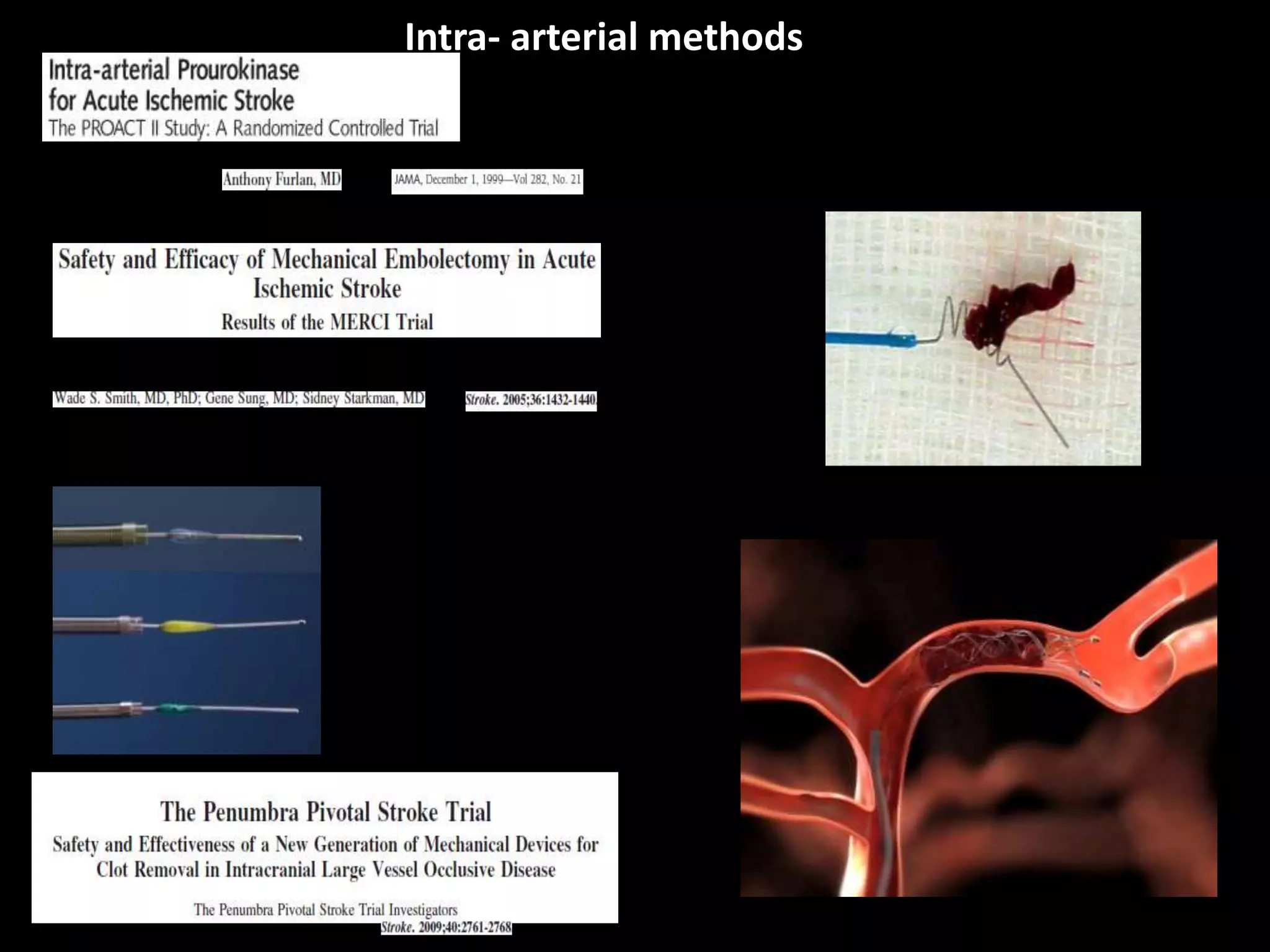
Intra- arterial methods
Randomised trials – General criterion
• Randomised (Intervention Vs Standard
medical therapy)
• Documented site of occlusion.
• Time based: 6 hrs (initiation of IA therapy)
• Small Core
• Predominantly stent retrievers.
MR CLEAN Trial
Netherlands, 2015
ESCAPE Trial
Canadian, 2015
EXTEND-IA Trial
Australian, 2015
SWIFT PRIME Trial
USA, 2015
REVASCAT Trial
Spanish, 2015
TICI 2B/3 – 59% - 88% - (previous trials 25%, 41%)
Recanalization – TICI 2B/3
Absolute Benefit (good outcome) : 13.5% to 31.4%
(Statistically significant)
mRS (90 d)
no significant difference
sICH
Device complication
Absolute mortality benefit : 8.6%
(Statistically significant in ESCAPE)
Mortality
AHA/ ASA guideline 2015:
Patients should receive endovascular therapy with a stent
retriever if they meet all the following criteria (Class I; Level of
Evidence A). (New recommendation):
 prestroke mRS score 0 to 1
 acute ischemic stroke receiving intravenous r-tPA within 4.5
hours of onset
 causative occlusion of the internal carotid artery or proximal
MCA (M1)
 age ≥18 years
 NIHSS score of ≥6
 ASPECTS of ≥ 6
 treatment can be initiated (groin puncture) within 6 hours of
symptom onset
AHA/ ASA guideline:
 Carefully selected patients with anterior circulation
occlusion who have contraindications to intravenous r-
tPA, endovascular therapy with stent retrievers
completed within 6 hours of stroke onset is reasonable
(Class IIa; Level of Evidence C).
 Carefully selected patients with acute ischemic stroke in
whom treatment can be initiated (groin puncture) within 6
hours of symptom onset and who have causative
occlusion of the M2 or M3 portion of the MCAs, anterior
cerebral arteries, vertebral arteries, basilar artery, or
posterior cerebral arteries (Class IIb; Level of Evidence
C)
AHA/ ASA guideline:
 Stent retrieval may be reasonable for patients
with acute is initiated (groin puncture) within 6
hours of ischemic stroke in whom treatment can
be of symptom onset and who have prestroke
mRS score of >1, ASPECTS >1, ASPECTS <6, or
NIHSS score <6 and causative occlusion of the
internal carotid artery or proximal MCA (M1)
 Observing patients after intravenous r-tPA to
assess for clinical response before pursuing
endovascular therapy is not required to achieve
beneficial outcomes and is not recommended.
(Class III; Level of Evidence B-R).
STRUCTURE of STROKE care systems:
Should be transported rapidly to the closest available
certified primary strokecenter or comprehensive stroke
center
Regional systems of stroke care: Initial emergency
care (IV tPA)→ Centers capable of performing
endovascular stroke treatment.
Experienced stroke center with rapid access to
cerebral angiography and qualified neuro-
interventionalists.
Beyond 6 hours – Should you consider MT?
ESCAPE: up to 12-hours – positive trial
6 hours
49 patients
rate ratio, 1.7; (95% CI, 0.7 to 4.0)
Not significant; however few numbers.
REVASCAT: upto 12 hours, positive trial
Data not provided.
Recent analysis – 7.3 hours…
Techniques
A. Stent retriever
B. Stent retriever with BCG
C. Stent retriever with DAC (ARTS), SOLUMBRA
D. ADAPT
E. Other
Various choices of stent retrievers or similar devices ..
Solitaire (ev3)- 2012, Trevo (Stryker), Revive™ SE (Codman),
Etc…. etc…..
Stentretrievers - Stent or stent-like system for
clot removal
STEPS
• Check clinical status
• Don’t wait for lines ,
complete draping
• Local anesthesia.- anesthetist
in lab – sedation
• If restless , consider GA
• But should be done without
delay , avoiding drop in BP
• If IV tPA – single wall
puncture, micropuncture set
(closure device)
• 8 F short sheath
• 3000-5000 U heparin (not if
tPA)
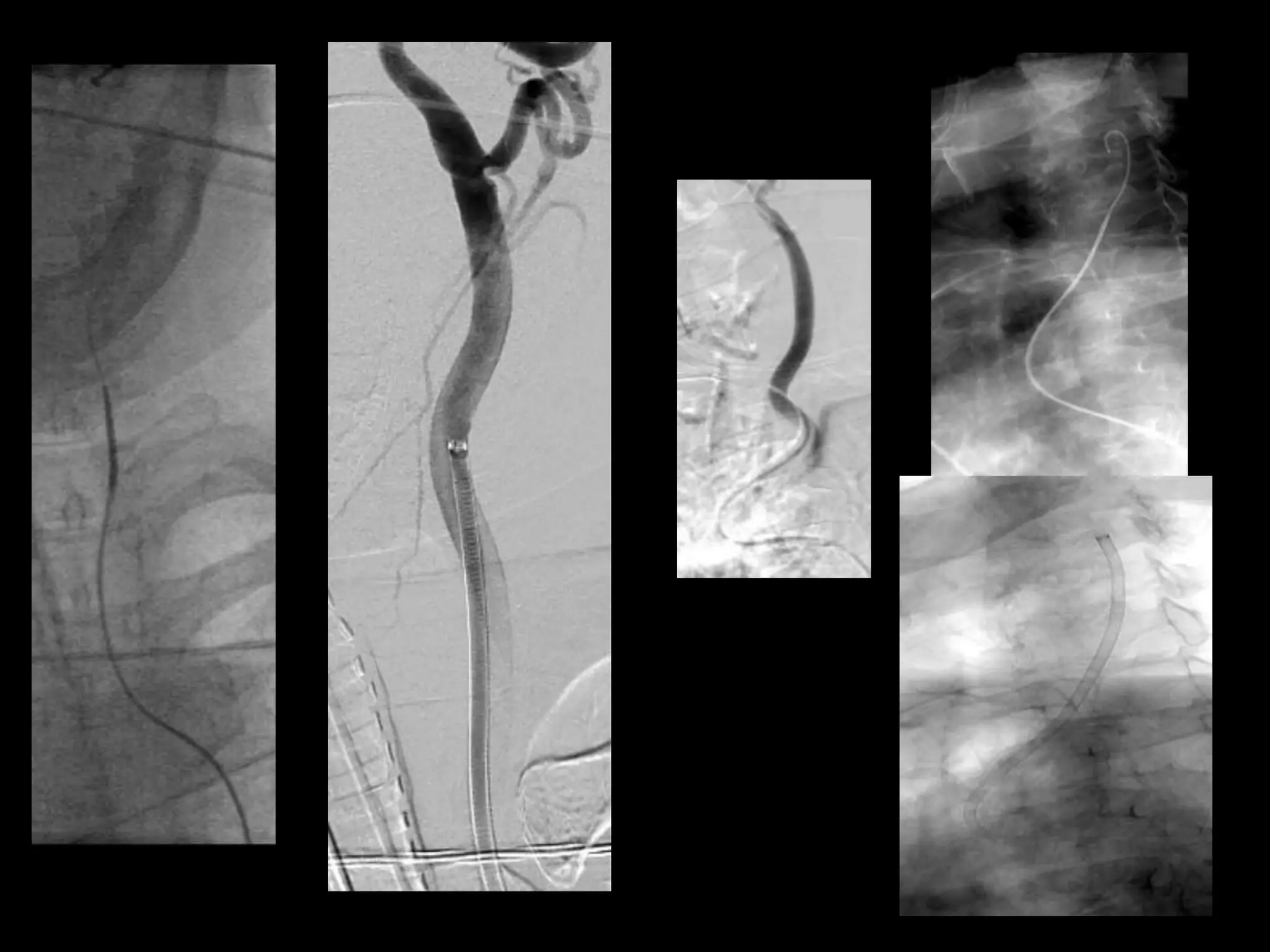
• Remember arch anatomy from CTA
• 8F BGC , co-axial 5F Vert
• If very tortuous – SIM 2 with Amplatz
exchange in ECA/CCA
• Coaxially over at proximal ICA
(straight segment)
• (Cello BCG – more navigable)
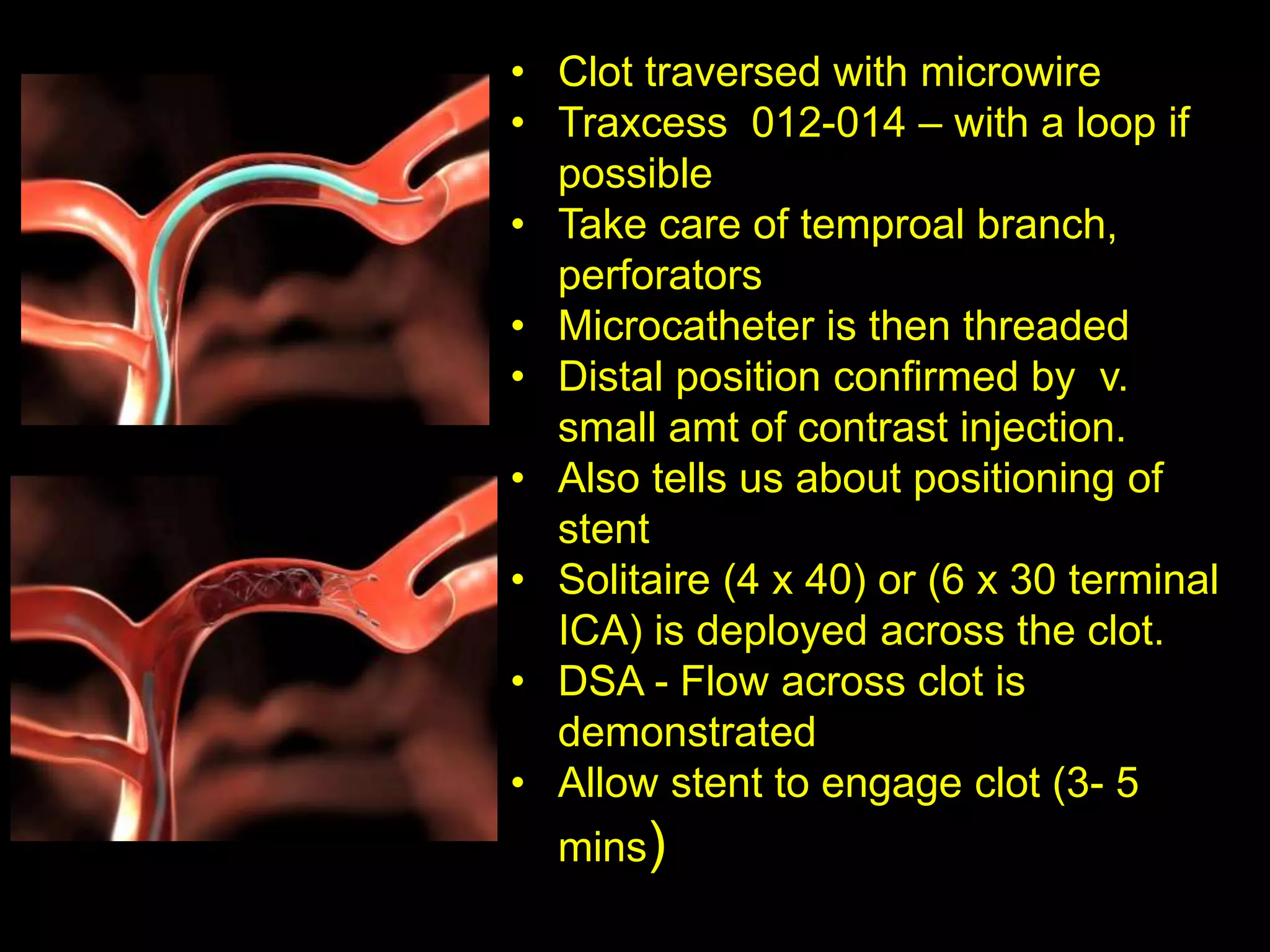
• Clot traversed with microwire
• Traxcess 012-014 – with a loop if
possible
• Take care of temproal branch,
perforators
• Microcatheter is then threaded
• Distal position confirmed by v.
small amt of contrast injection.
• Also tells us about positioning of
stent
• Solitaire (4 x 40) or (6 x 30 terminal
ICA) is deployed across the clot.
• DSA - Flow across clot is
demonstrated
• Allow stent to engage clot (3- 5
mins)
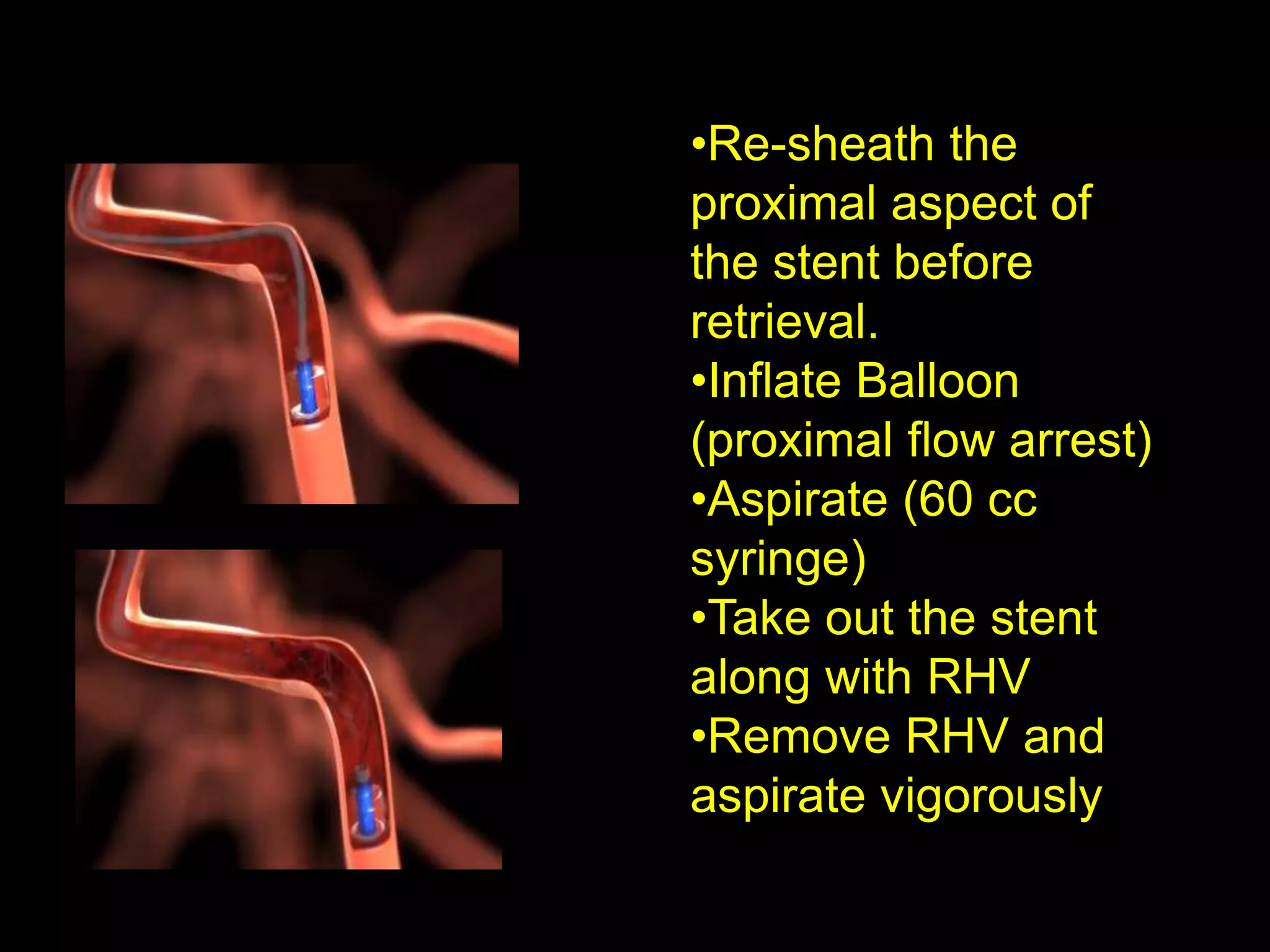
•Re-sheath the
proximal aspect of
the stent before
retrieval.
•Inflate Balloon
(proximal flow arrest)
•Aspirate (60 cc
syringe)
•Take out the stent
along with RHV
•Remove RHV and
aspirate vigorously
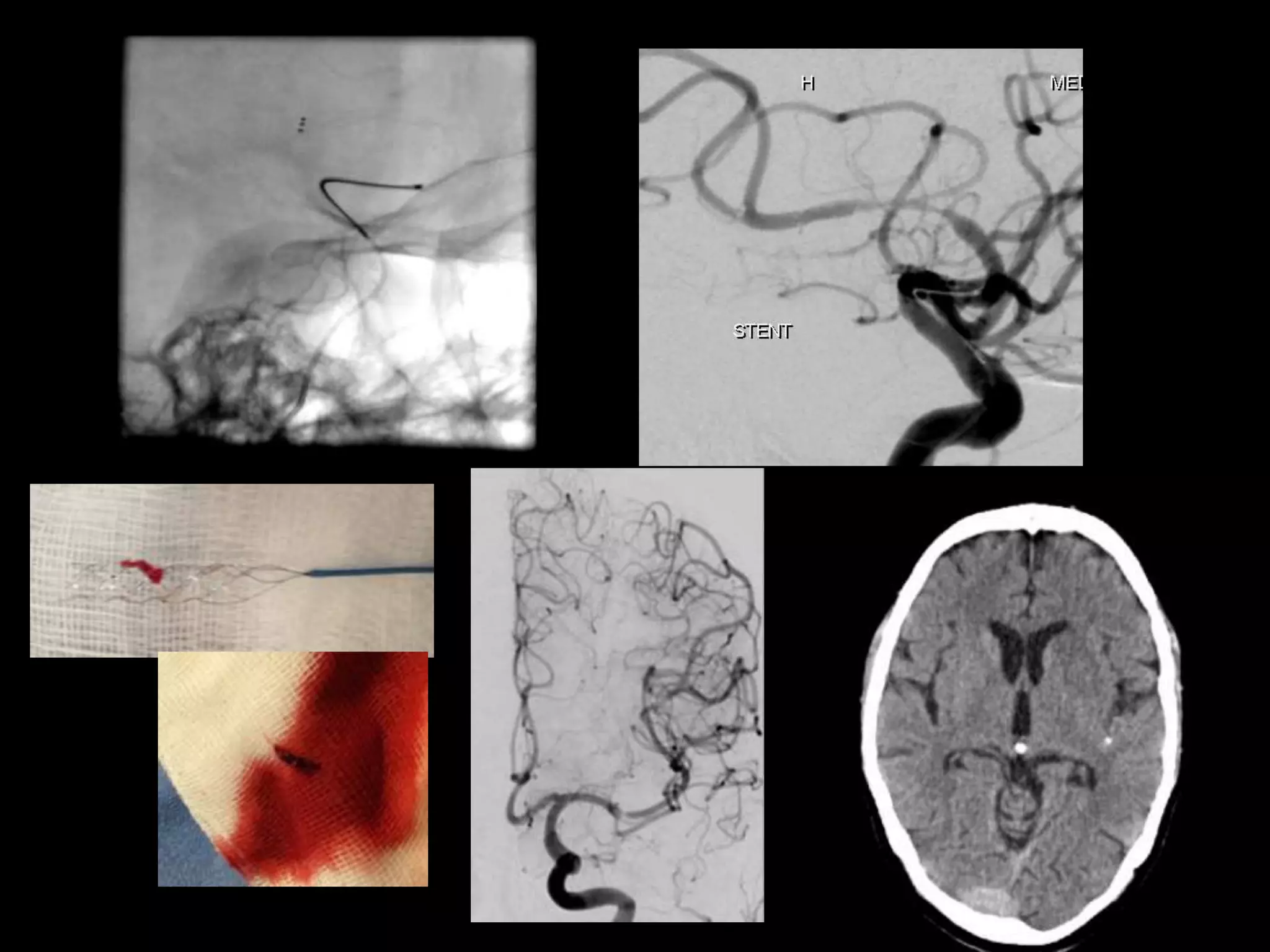
• DSA
• Cleaning an resheathing the stent, MC
preparation should go on simultaneously
• 3 passes
• End-point – TICI IIb/IIIa
• If not - stop, alternative methods, ?? PTA
• Closure device
• Stroke ICU
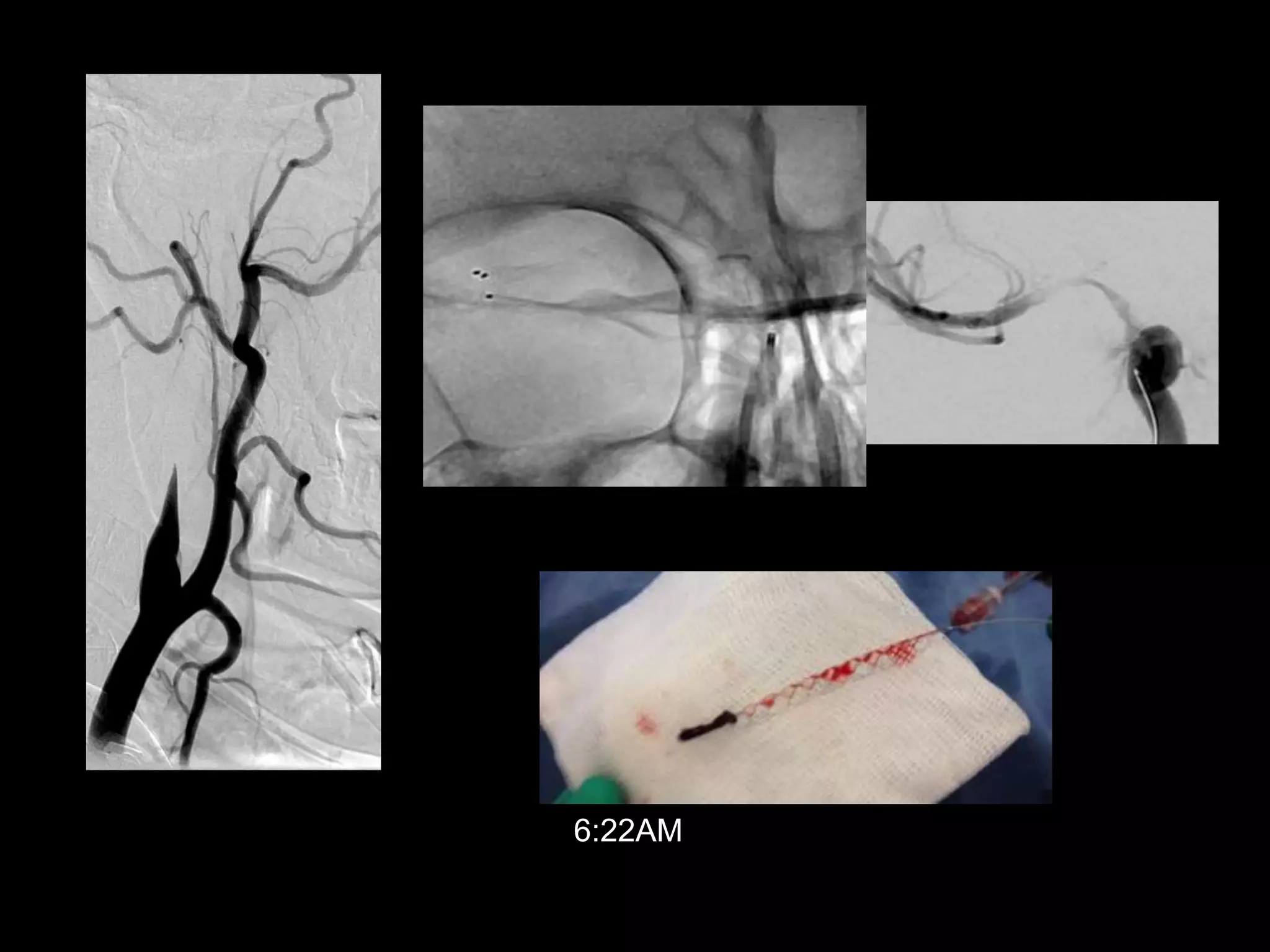
•68/M, DM, HTN, CAD, underwent PTCA to LAD
•Admitted for surgery of aortic stenosis.
•Double anti-platelets was stopped
•Patient developed acute onset right side weakness
with aphasia.
IV- tPA given, no improvement
• Left hemiplegia, left UL and LL 0/5
• 5:14AM
ICA occlusion
6:22AM
8:07 AM
Patient made gradual recovery
Left LL 4/5 and UL 3/5 - 30 day follow up
mRS at 90 days- 0
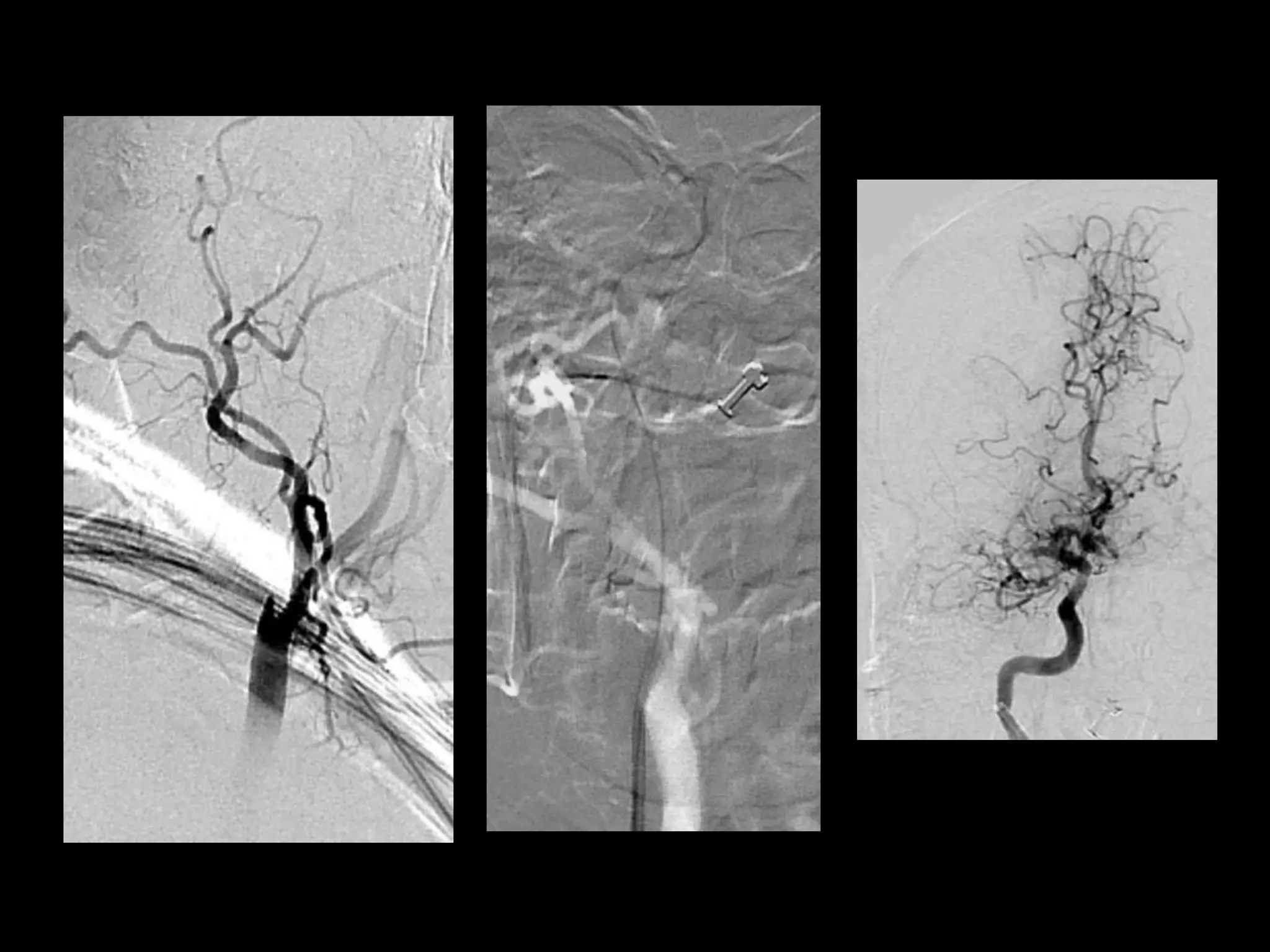
• 60 years old female.
• h/o hypertension and hypothyroidism
• Acute onset left hemiparesis and left facial weakness
• No history of LOC/seizures
• CT Brain , perfusion and angio done 6 1/2 hours after ictus.
2 months later
980 patients: GA in 44%
Poor neurological outcome:
OR 2.3 (with GA)
Higher mortality: OR 1.6 (with
GA)
1956 patients: GA in 41%
Good outcome: OR 0.5 (with GA)
Higher mortality: OR 2.5 (with GA)
Successful angiographic outcome:
OR 0.5 (with GA)
• Sedation vs Intubation for Endovascular Stroke TreAtment
Trial (SIESTA) is a prospective, randomised controlled,
monocentric, two-armed, comparative trial.
• ESOC - We did not see a difference in the primary outcome of
change in NIHSS [National Institutes of Health Stroke Severity]
score at 24 hours between patients receiving general
anesthesia and those given conscious sedation," he
concluded. "However, this data is preliminary and we don't
yet have the main secondary outcome of modified Rankin
scores at 3 months. These will be reported at the World
Stroke Congress in October
NASA BGC Registry (339)
USA, Multicenter, Retrospective
79/149 77/149 68/189 30/149
self reported
61/189 55/189
P < .001 P = .02 P = .02
34
Imrpoving the outcomes
• Technique
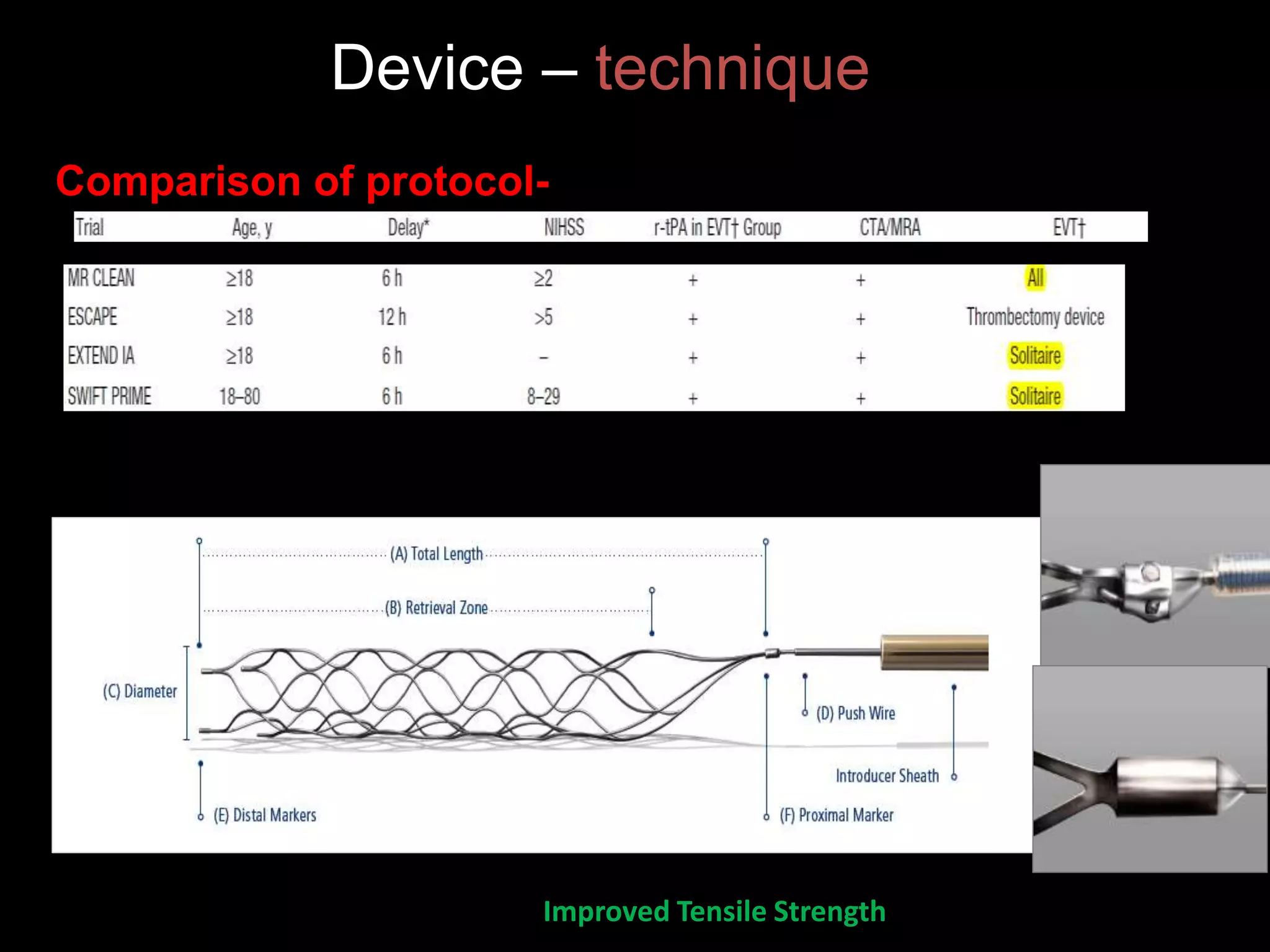
Device – technique
Comparison of protocol-
Improved Tensile Strength
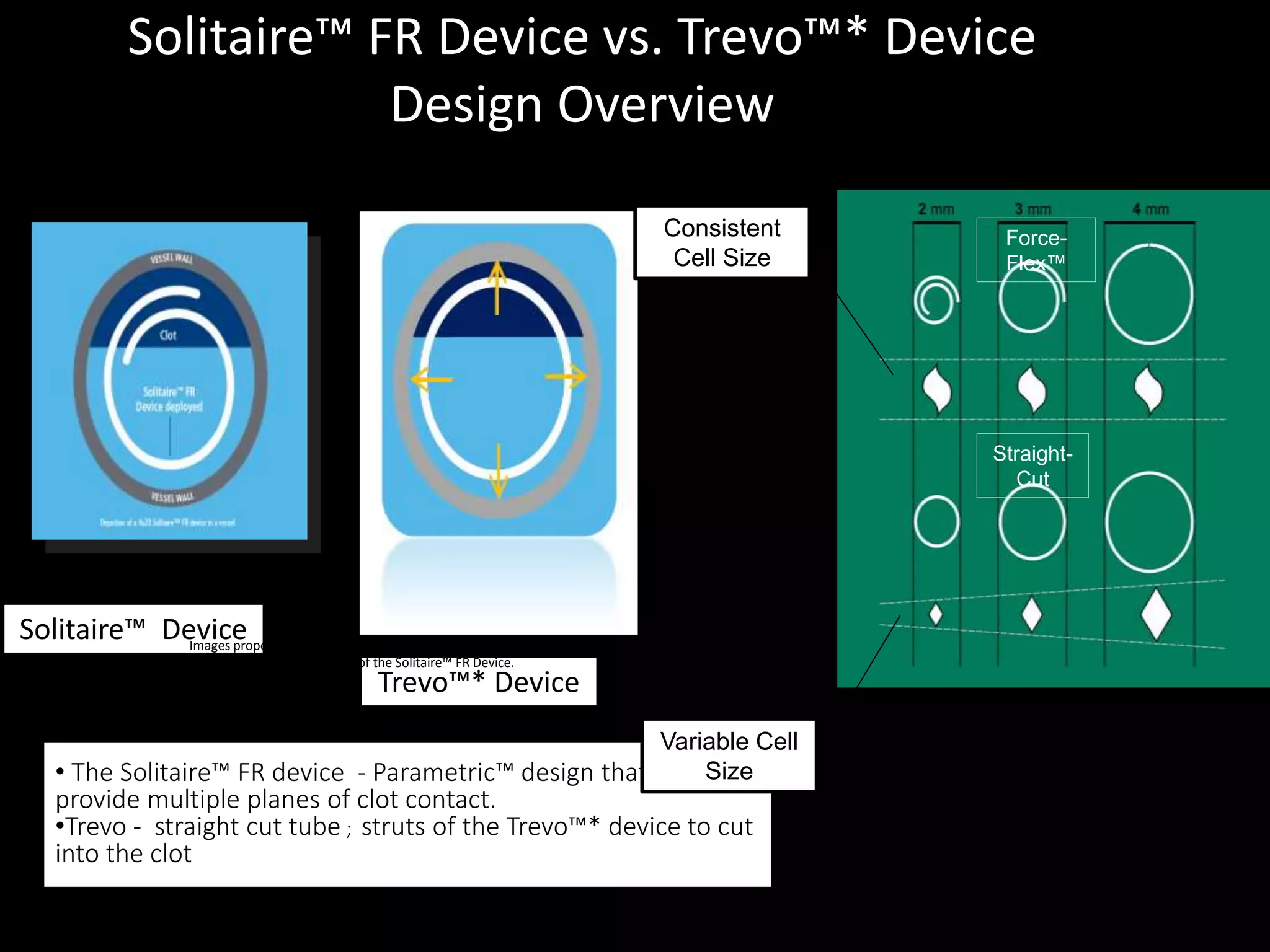
Solitaire™ FR Device vs. Trevo™* Device
Design Overview
**Competitive Testing Report FD2815.
***Covidien Testing Data: FD2601A
Trevo™* Device
Solitaire™ DeviceImages property of Covidien. Image is an artistic rendering
and not a n exact depiction of the Solitaire™ FR Device.
Image property of Covidien. Image is an artistic
rendering and not a n exact depiction of the Trevo™
Device.
• The Solitaire™ FR device - Parametric™ design that may
provide multiple planes of clot contact.
•Trevo - straight cut tube ; struts of the Trevo™* device to cut
into the clot
Consistent
Cell Size
Variable Cell
Size
Force-
Flex™
Straight-
Cut
Tips to getting the clot on first pass
• Long stent 4mm X 40 mm solitaire
First pass reperfusion:
54% vs 35%
9.24
am
PFT technique with
SOLITAIRE
9:45
10.13 am
(Puncture)
10.25 am
(Perfusion)
Single Pass
Imrpoving the
outcomes
Timing - “Is the
key “
Technique
• Stent retriever with BCG
• Simple – easy to learn
• Results getting better
• Each step as a protocol –
everybody in team in sync
• Avoid experimentation in
initial phase
• Other factors (selection,
time …) more important
For more information on:
STROKE & NEUROVASCULAR INTERVENTIONS:
URL:
www.sanif.co.in
Facebook:
https://www.facebook.com/strokeawarenessindia
https://www.facebook.com/vipul.gupta.35175
Twitter
https://twitter.com/drvipulgupta25
LinkedIN
https://in.linkedin.com/pub/dr-vipul-gupta/51/8a1/25a
YouTube
Channel: Stroke & Neurovascular Interventions
www.youtube.com/c/StrokeNeurovascularInterventionsfoundation
Dr Vipul Gupta
Thank you ….

Mechanical thrombectomy with stent retriever

  • 1.
    BALLOON ASSISTED COILINGIN RUPTURED CEREBRAL ANEURYSMS Vipul Gupta Neurointerventional Surgery Artemis Hospital, Gurgaon Mechanical thrombectomy with stent retriever- How do we do it
  • 2.
  • 3.
    Randomised trials –General criterion • Randomised (Intervention Vs Standard medical therapy) • Documented site of occlusion. • Time based: 6 hrs (initiation of IA therapy) • Small Core • Predominantly stent retrievers.
  • 4.
    MR CLEAN Trial Netherlands,2015 ESCAPE Trial Canadian, 2015 EXTEND-IA Trial Australian, 2015 SWIFT PRIME Trial USA, 2015 REVASCAT Trial Spanish, 2015
  • 5.
    TICI 2B/3 –59% - 88% - (previous trials 25%, 41%) Recanalization – TICI 2B/3
  • 6.
    Absolute Benefit (goodoutcome) : 13.5% to 31.4% (Statistically significant) mRS (90 d)
  • 7.
  • 8.
  • 9.
    Absolute mortality benefit: 8.6% (Statistically significant in ESCAPE) Mortality
  • 10.
    AHA/ ASA guideline2015: Patients should receive endovascular therapy with a stent retriever if they meet all the following criteria (Class I; Level of Evidence A). (New recommendation):  prestroke mRS score 0 to 1  acute ischemic stroke receiving intravenous r-tPA within 4.5 hours of onset  causative occlusion of the internal carotid artery or proximal MCA (M1)  age ≥18 years  NIHSS score of ≥6  ASPECTS of ≥ 6  treatment can be initiated (groin puncture) within 6 hours of symptom onset
  • 11.
    AHA/ ASA guideline: Carefully selected patients with anterior circulation occlusion who have contraindications to intravenous r- tPA, endovascular therapy with stent retrievers completed within 6 hours of stroke onset is reasonable (Class IIa; Level of Evidence C).  Carefully selected patients with acute ischemic stroke in whom treatment can be initiated (groin puncture) within 6 hours of symptom onset and who have causative occlusion of the M2 or M3 portion of the MCAs, anterior cerebral arteries, vertebral arteries, basilar artery, or posterior cerebral arteries (Class IIb; Level of Evidence C)
  • 12.
    AHA/ ASA guideline: Stent retrieval may be reasonable for patients with acute is initiated (groin puncture) within 6 hours of ischemic stroke in whom treatment can be of symptom onset and who have prestroke mRS score of >1, ASPECTS >1, ASPECTS <6, or NIHSS score <6 and causative occlusion of the internal carotid artery or proximal MCA (M1)  Observing patients after intravenous r-tPA to assess for clinical response before pursuing endovascular therapy is not required to achieve beneficial outcomes and is not recommended. (Class III; Level of Evidence B-R).
  • 13.
    STRUCTURE of STROKEcare systems: Should be transported rapidly to the closest available certified primary strokecenter or comprehensive stroke center Regional systems of stroke care: Initial emergency care (IV tPA)→ Centers capable of performing endovascular stroke treatment. Experienced stroke center with rapid access to cerebral angiography and qualified neuro- interventionalists.
  • 14.
    Beyond 6 hours– Should you consider MT? ESCAPE: up to 12-hours – positive trial 6 hours 49 patients rate ratio, 1.7; (95% CI, 0.7 to 4.0) Not significant; however few numbers. REVASCAT: upto 12 hours, positive trial Data not provided. Recent analysis – 7.3 hours…
  • 15.
    Techniques A. Stent retriever B.Stent retriever with BCG C. Stent retriever with DAC (ARTS), SOLUMBRA D. ADAPT E. Other Various choices of stent retrievers or similar devices ..
  • 16.
    Solitaire (ev3)- 2012,Trevo (Stryker), Revive™ SE (Codman), Etc…. etc….. Stentretrievers - Stent or stent-like system for clot removal
  • 17.
    STEPS • Check clinicalstatus • Don’t wait for lines , complete draping • Local anesthesia.- anesthetist in lab – sedation • If restless , consider GA • But should be done without delay , avoiding drop in BP • If IV tPA – single wall puncture, micropuncture set (closure device) • 8 F short sheath • 3000-5000 U heparin (not if tPA)
  • 18.
    • Remember archanatomy from CTA • 8F BGC , co-axial 5F Vert • If very tortuous – SIM 2 with Amplatz exchange in ECA/CCA • Coaxially over at proximal ICA (straight segment) • (Cello BCG – more navigable)
  • 20.
    • Clot traversedwith microwire • Traxcess 012-014 – with a loop if possible • Take care of temproal branch, perforators • Microcatheter is then threaded • Distal position confirmed by v. small amt of contrast injection. • Also tells us about positioning of stent • Solitaire (4 x 40) or (6 x 30 terminal ICA) is deployed across the clot. • DSA - Flow across clot is demonstrated • Allow stent to engage clot (3- 5 mins)
  • 22.
    •Re-sheath the proximal aspectof the stent before retrieval. •Inflate Balloon (proximal flow arrest) •Aspirate (60 cc syringe) •Take out the stent along with RHV •Remove RHV and aspirate vigorously
  • 23.
    • DSA • Cleaningan resheathing the stent, MC preparation should go on simultaneously • 3 passes • End-point – TICI IIb/IIIa • If not - stop, alternative methods, ?? PTA • Closure device • Stroke ICU
  • 24.
    •68/M, DM, HTN,CAD, underwent PTCA to LAD •Admitted for surgery of aortic stenosis. •Double anti-platelets was stopped •Patient developed acute onset right side weakness with aphasia. IV- tPA given, no improvement
  • 26.
    • Left hemiplegia,left UL and LL 0/5 • 5:14AM ICA occlusion
  • 27.
  • 28.
    8:07 AM Patient madegradual recovery Left LL 4/5 and UL 3/5 - 30 day follow up mRS at 90 days- 0
  • 29.
    • 60 yearsold female. • h/o hypertension and hypothyroidism • Acute onset left hemiparesis and left facial weakness • No history of LOC/seizures • CT Brain , perfusion and angio done 6 1/2 hours after ictus.
  • 32.
  • 33.
    980 patients: GAin 44% Poor neurological outcome: OR 2.3 (with GA) Higher mortality: OR 1.6 (with GA) 1956 patients: GA in 41% Good outcome: OR 0.5 (with GA) Higher mortality: OR 2.5 (with GA) Successful angiographic outcome: OR 0.5 (with GA) • Sedation vs Intubation for Endovascular Stroke TreAtment Trial (SIESTA) is a prospective, randomised controlled, monocentric, two-armed, comparative trial. • ESOC - We did not see a difference in the primary outcome of change in NIHSS [National Institutes of Health Stroke Severity] score at 24 hours between patients receiving general anesthesia and those given conscious sedation," he concluded. "However, this data is preliminary and we don't yet have the main secondary outcome of modified Rankin scores at 3 months. These will be reported at the World Stroke Congress in October
  • 34.
    NASA BGC Registry(339) USA, Multicenter, Retrospective 79/149 77/149 68/189 30/149 self reported 61/189 55/189 P < .001 P = .02 P = .02 34 Imrpoving the outcomes • Technique
  • 35.
    Device – technique Comparisonof protocol- Improved Tensile Strength
  • 36.
    Solitaire™ FR Devicevs. Trevo™* Device Design Overview **Competitive Testing Report FD2815. ***Covidien Testing Data: FD2601A Trevo™* Device Solitaire™ DeviceImages property of Covidien. Image is an artistic rendering and not a n exact depiction of the Solitaire™ FR Device. Image property of Covidien. Image is an artistic rendering and not a n exact depiction of the Trevo™ Device. • The Solitaire™ FR device - Parametric™ design that may provide multiple planes of clot contact. •Trevo - straight cut tube ; struts of the Trevo™* device to cut into the clot Consistent Cell Size Variable Cell Size Force- Flex™ Straight- Cut
  • 37.
    Tips to gettingthe clot on first pass • Long stent 4mm X 40 mm solitaire
  • 38.
  • 39.
  • 40.
  • 41.
  • 42.
    Technique • Stent retrieverwith BCG • Simple – easy to learn • Results getting better • Each step as a protocol – everybody in team in sync • Avoid experimentation in initial phase • Other factors (selection, time …) more important
  • 43.
    For more informationon: STROKE & NEUROVASCULAR INTERVENTIONS: URL: www.sanif.co.in Facebook: https://www.facebook.com/strokeawarenessindia https://www.facebook.com/vipul.gupta.35175 Twitter https://twitter.com/drvipulgupta25 LinkedIN https://in.linkedin.com/pub/dr-vipul-gupta/51/8a1/25a YouTube Channel: Stroke & Neurovascular Interventions www.youtube.com/c/StrokeNeurovascularInterventionsfoundation Dr Vipul Gupta
  • 44.