Reperfusion therapy for Acute ischemic stroke by Dr. Basil Tumaini
1.
1
Basil Tumaini, MD,MMed, MSc
Neurologist and Lecturer
Muhimbili University of Heath and Allied Sciences
Reperfusion therapies for acute
ischemic stroke
3
Introduction to ReperfusionTherapy
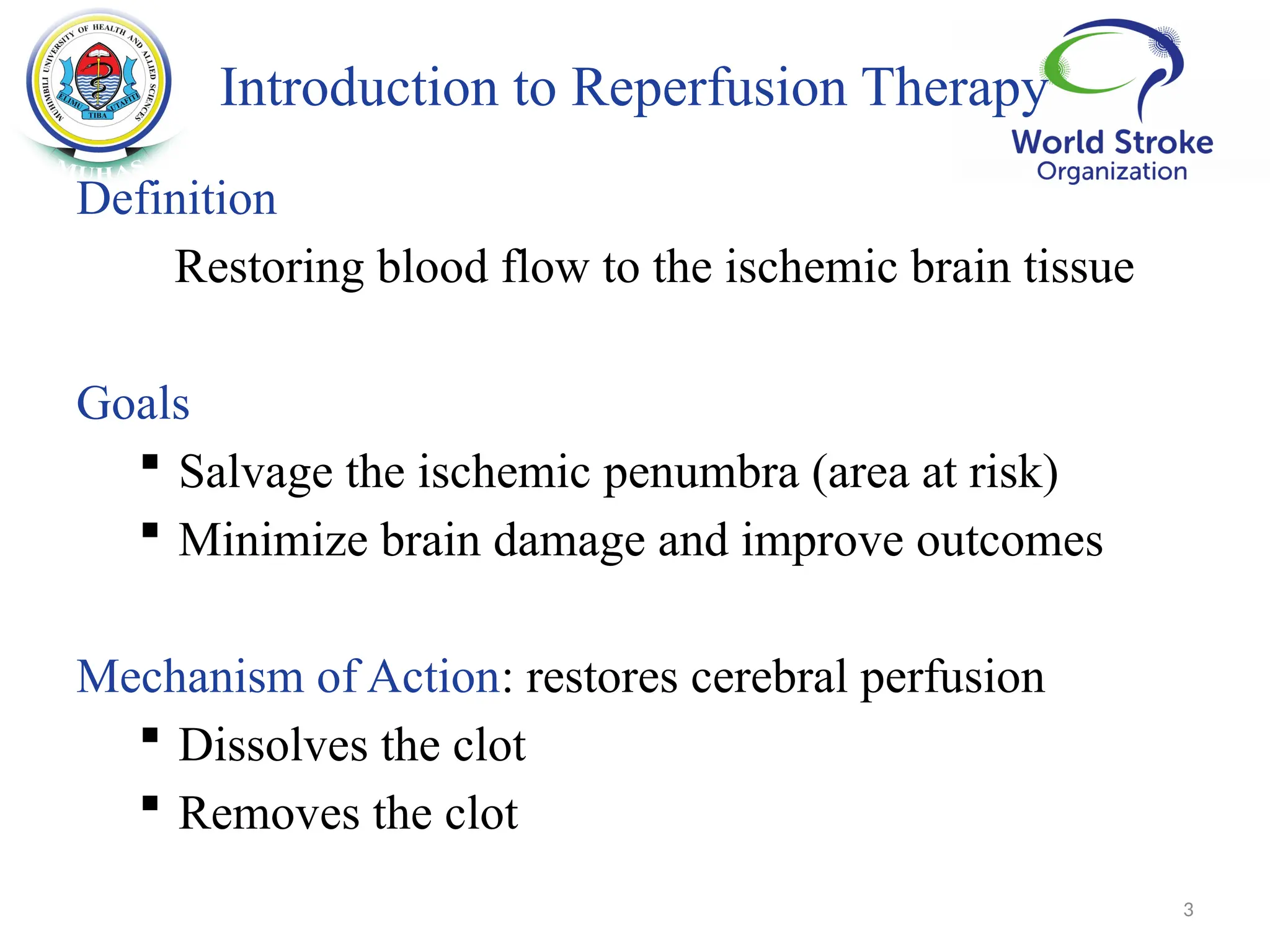
Definition
Restoring blood flow to the ischemic brain tissue
Goals
Salvage the ischemic penumbra (area at risk)
Minimize brain damage and improve outcomes
Mechanism of Action: restores cerebral perfusion
Dissolves the clot
Removes the clot
4.
4
Types of ReperfusionTherapy
1. Intravenous thrombolysis
Administration of thrombolytic drugs
2. Mechanical thrombectomy
Physical removal of the clot using endovascular
techniques
6
Mechanism of actionof alteplase/tenecteplase
Binding to fibrin
Conversion of plasminogen to plasmin
Clot dissolution
Reperfusion of ischemic tissue
Time sensitivity
Potential risks
7.
7
Landmark thrombolysis trials
Trial
Name
Journal,
Year
ResultsConclusion
NINDS
rtPA
NEJM,
1995
IV rtPA administered
within 3 hours of AIS
onset significantly
improved neurological
outcomes at 3 months,
with a 30% higher
likelihood of minimal or
no disability. There was
an increased risk of sICH
rtPA
administration
was associated
with 70%
increased odds
of functional
recovery at 90
days;
NNT=6
8.
8
Landmark thrombolysis trials
Trial
Name
Journal,
Year
ResultsConclusion
ECASS
3
NEJM,
2008
Extended the rtPA
therapeutic window to
4.5 hours after stroke
onset. Patients treated
within this period had
significantly better
outcomes compared to
placebo, with a safety
profile similar to earlier
trials
↑42% functional
independence;
NNT=9
10
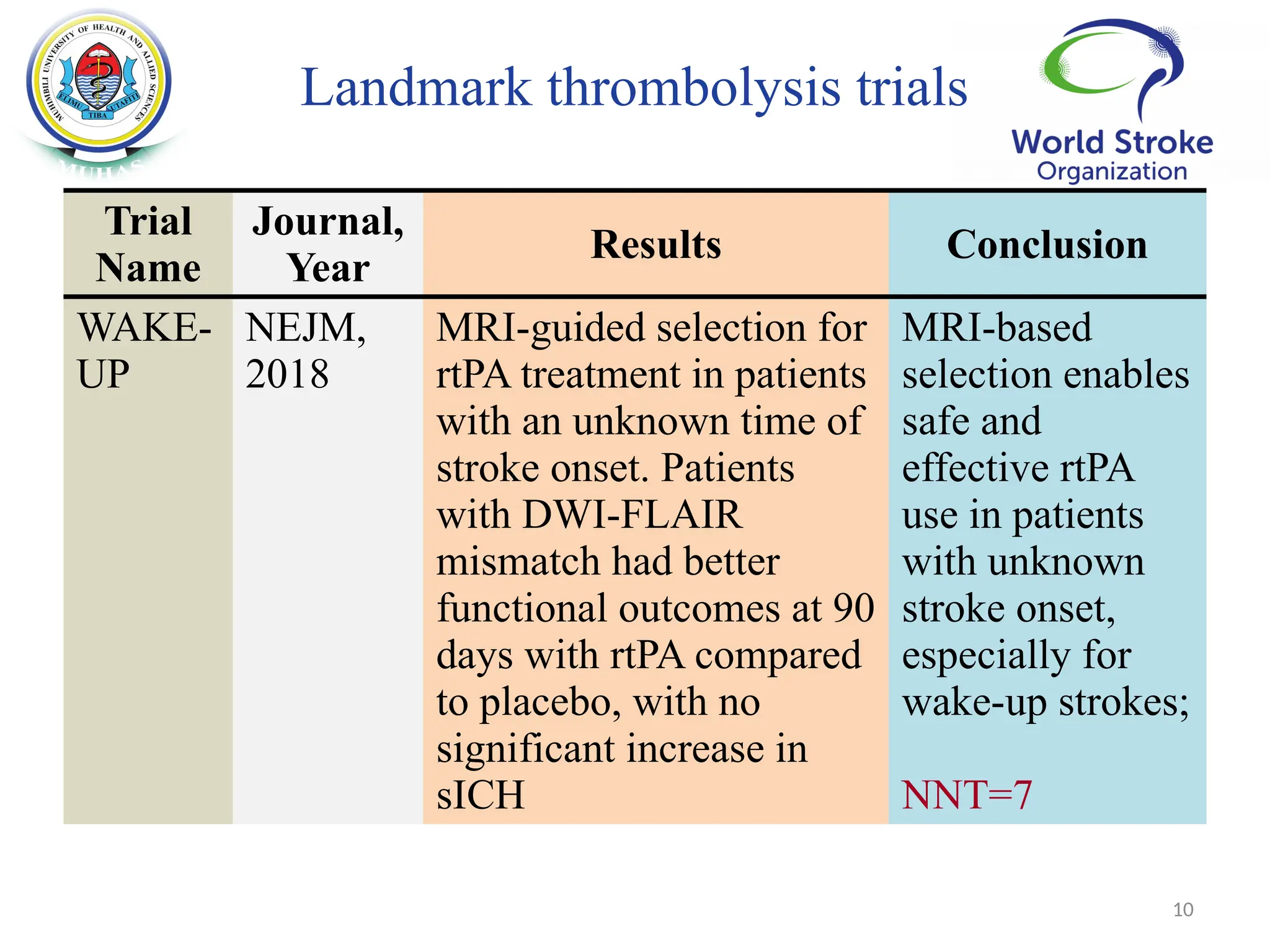
Landmark thrombolysis trials
Trial
Name
Journal,
Year
ResultsConclusion
WAKE-
UP
NEJM,
2018
MRI-guided selection for
rtPA treatment in patients
with an unknown time of
stroke onset. Patients
with DWI-FLAIR
mismatch had better
functional outcomes at 90
days with rtPA compared
to placebo, with no
significant increase in
sICH
MRI-based
selection enables
safe and
effective rtPA
use in patients
with unknown
stroke onset,
especially for
wake-up strokes;
NNT=7
11.
11
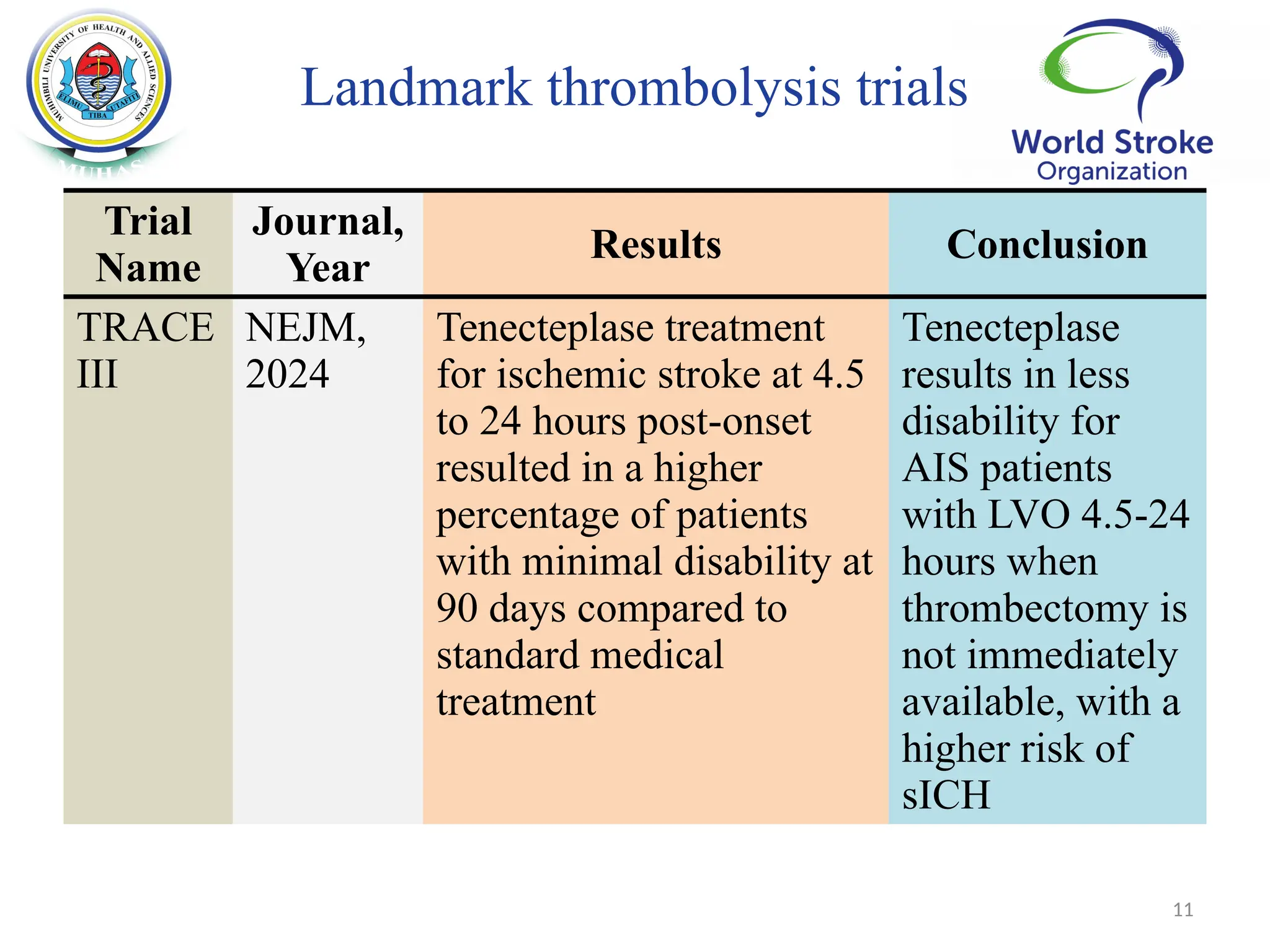
Landmark thrombolysis trials
Trial
Name
Journal,
Year
ResultsConclusion
TRACE
III
NEJM,
2024
Tenecteplase treatment
for ischemic stroke at 4.5
to 24 hours post-onset
resulted in a higher
percentage of patients
with minimal disability at
90 days compared to
standard medical
treatment
Tenecteplase
results in less
disability for
AIS patients
with LVO 4.5-24
hours when
thrombectomy is
not immediately
available, with a
higher risk of
sICH
16
Contraindications to rtPA
“SAMPLESTAGES” [absolute, relative]
• S Stroke (AIS) or head trauma - last 3 months,
SOL/intracranial neoplasm
• A Anticoagulation (on); INR>1.7, PT>15s,
aPTT>40s; DTL, DFXaI, GpIIb/IIIa I (last dose
within 48h); active internal bleeding, aortic
arch dissection, acute bleeding diathesis, arterial
puncture NCS in 7d
• M MI in prior 3months (recent)
17.
17
Contraindications to rtPA. .
P Prior ICH, evidence of hemorrhage on CTH;
pregnancy; intracranial vascular malformation; LMWH use
within 24hr for PE or DVT ℞
L Low platelet count <100,000/µL; large, untreated,
unruptured intracranial aneurysm
E Elevated BP: SBP ≥ 185, DBP ≥ 110 mm Hg
S Surgery, past 14 days; intracranial or spinal surgery,
past 3 months
T TIA, mild symptoms, rapid improvement
A Age < 18
18.
18
Contraindications to rtPA. . .
G GI/ urinary bleeding – past 14 days, malignancy,
infective endocarditis
E Elevated/ decreased blood glucose <50mg/dL
[2.7mmoL/L] or >400 mg/dL (22.2mmoL/L)
S Seizures at onset of stroke, SAH, extensive
regions of hypodensity on CTH consistent with
ischemic injury
19.
19
AcT trial
IV tenecteplasecompared with alteplase for AIS in Canada
(AcT): a pragmatic, multicentre, open-label, registry-
linked, randomised, controlled, non-inferiority trial
Tenecteplase is non-inferior to alteplase for achieving
functional independence at 90 days in patients with
AIS
The safety profiles were similar, with no significant
differences in sICH or mortality between the two
groups
Tenecteplase may offer a higher rate of early
recanalization compared to alteplase
21
Landmark thrombectomy trials;
NNT~3-4
Trial
Name
Journal,
Year
Results Conclusion
MR
CLEAN
NEJM,
2015
Showed that intra-arterial
treatment significantly
improved functional
outcomes in patients with
AIS caused by proximal
intracranial arterial
occlusion
Mechanical
thrombectomy
within 6 hours of
stroke onset
significantly
increases the
likelihood of
functional
independence
22.
22
Landmark thrombectomy trials
Trial
Name
Journa
l,Year
Results Conclusion
EXTEND
-IA
NEJM,
2015
Demonstrated a
significant reduction in
infarct size and
improvement in
functional outcomes with
endovascular
thrombectomy plus tPA
compared to tPA alone
Endovascular
thrombectomy is
highly effective
in reducing
disability when
used in
conjunction with
intravenous tPA
in patients with
ischemic stroke
23.
23
Landmark thrombectomy trials
Trial
Name
Journal,
Year
ResultsConclusion
SWIFT-
PRIME
NEJM,
2015
Showed that mechanical
thrombectomy using a
stent retriever
significantly improved
functional outcomes in
patients with ischemic
stroke who received
intravenous tPA
Combining
intravenous tPA
with mechanical
thrombectomy
results in better
functional
outcomes in
patients with
LVO
24.
24
Landmark thrombectomy trials
Trial
Name
Journal,
Year
ResultsConclusion
REVAS
CAT
NEJM,
2015
Demonstrated a
significant improvement
in functional outcomes
for patients treated with
thrombectomy within 8
hours of symptom onset
compared to medical
therapy alone
Thrombectomy
within 8 hours of
symptom onset
is beneficial for
patients with
acute ischemic
stroke due to
LVO
25.
25
Landmark thrombectomy trials
Trial
Name
Journal
,Year
Results Conclusion
ESCAPE NEJM,
2015
Showed that
endovascular therapy
within 12 hours of
symptom onset
significantly improved
functional outcomes and
reduced mortality in
patients with ischemic
stroke
Early and rapid
endovascular
therapy provides
substantial
benefits in terms
of functional
independence
and survival
26.
26
Landmark thrombectomy trials
Trial
Name
Journal,
Year
ResultsConclusion
DAWN NEJM,
2018
Demonstrated that
thrombectomy up to 24
hours after stroke onset
significantly improved
functional outcomes in
patients with a small
infarct core and large
clinical deficit
Mechanical
thrombectomy is
beneficial in
selected patients
with large vessel
occlusion stroke
even up to 24
hours after onset
27.
27
Landmark thrombectomy trials
Trial
Name
Journal
,Year
Results Conclusion
DEFUSE
3
NEJM,
2018
Showed that
thrombectomy 6 to 16
hours after stroke onset
significantly improved
functional outcomes in
patients with salvageable
brain tissue
Thrombectomy
is highly
effective when
performed 6 to
16 hours after
stroke onset in
patients with
mismatch
between clinical
deficit and
infarct size
28.
28
Landmark thrombectomy trials
Trial
Name
Journal
,Year
Results Conclusion
SELECT NEJM,
2018
Demonstrated that
thrombectomy in patients
with LVO and a
favorable imaging profile
improved outcomes
beyond the 6-hour
window
Favorable
outcomes can be
achieved with
thrombectomy
beyond the
traditional 6-
hour window in
patients selected
using advanced
imaging
29.
29
Landmark thrombectomy trials
Trial
Name
Journal
,Year
Results Conclusion
SELECT
2
NEJM,
2023
Showed that
thrombectomy in patients
with large infarcts
resulted in better
functional outcomes than
medical therapy alone
Thrombectomy
is beneficial
even in patients
with large
infarcts,
challenging
previous
exclusion
criteria based on
infarct size
30.
30
Landmark thrombectomy trials
Trial
Name
Journal,
Year
ResultsConclusion
ANGEL-
ASPECT
NEJM,
2023
Demonstrated that
thrombectomy
improved outcomes in
patients with large
ischemic strokes
(ASPECTS ≤5),
expanding the
indication for
mechanical
thrombectomy
Thrombectomy
should be
considered in
patients with
large ischemic
strokes,
expanding the
eligibility for
this intervention
31.
31
Comparison: thrombolysis vs.thrombectomy
Indications:
Thrombolysis: early treatment, smaller clots
Thrombectomy: large vessel occlusions, extended
time window
Combination Therapy:
Sometimes used together for optimal results
32.
32
Comparison: thrombolysis vs.thrombectomy
Success Rates:
Thrombectomy: ~60-70% recanalization
Thrombolysis: ~30% success in large vessels
Limitations:
Thrombolysis: time-sensitive, risk of bleeding
Thrombectomy: resource-intensive, not widely available
33.
33
Case Studies
Case 1:Successful Thrombolysis
65-year-old male
Onset of symptoms at 8 AM
Administered tPA at 9:30 AM
NIHSS score improved from 12 to 4 after treatment
34.
34
Case Studies .. .
Case 2: Mechanical Thrombectomy
72-year-old female
Found with stroke symptoms at 7 AM
CTA showed large vessel occlusion
Thrombectomy performed at 10 AM, NIHSS score
improved from 18 to 6
35.
35
Challenges and considerations
Delaysin Treatment:
Pre-hospital delays: recognition, transport
In-hospital delays: imaging, decision-making
Access to Therapy:
Limited availability of thrombectomy in low-resource
settings
Disparities in healthcare access
36.
36
Challenges and considerations. . .
Managing Complications:
Hemorrhage: intracerebral bleeding post-
thrombolysis
Reperfusion injury: paradoxical worsening due to
restored blood flow
37.
37
DOs
Always performyour own NIHSS
Always confirm medications twice (patient/family and
pharmacy/bottles)
Double check scans for hemorrhage before thrombolysis
Obtain BP and glucose
Go over all contraindications before giving tPA
Get wake up MRI only if no LVO on CTA
Faddi Saleh Velez
38.
38
DON’Ts
Give tPAunsafely in a rush
Get a wake up MRI when you already have an LVO
(LVO goes straight to angiography if wake up stroke)
Give tPA without BP control
Faddi Saleh Velez
39.
39
Conclusion
Summary
Reperfusion therapyis crucial in AIS management
Timely intervention can significantly improve
outcomes
Both thrombolysis and thrombectomy have their
place in treatment
40.
40
Conclusion . ..
Call to Action
Emphasize the need for rapid stroke
recognition and treatment access
41.
41
Basil Tumaini, MD,MMed, MSc
Neurologist and Lecturer
Muhimbili University of Heath and Allied Sciences
Email: basil.tumaini@muhas.ac.tz
RG: Basil Tumaini
Reperfusion therapies for acute
ischemic stroke
Editor's Notes
#6 Tenecteplase: 1. Enhanced resistance to inactivation 2. Single bolus administration
#7 NNT=number of patients who should be treated to achieve one additional favorable outcome
#21 NNT=number of patients who should be treated to achieve one additional favorable outcome
#22 NNT=number of patients who should be treated to achieve one additional favorable outcome
#23 NNT=number of patients who should be treated to achieve one additional favorable outcome
#24 NNT=number of patients who should be treated to achieve one additional favorable outcome
#25 NNT=number of patients who should be treated to achieve one additional favorable outcome
#26 NNT=number of patients who should be treated to achieve one additional favorable outcome
#27 NNT=number of patients who should be treated to achieve one additional favorable outcome
#28 NNT=number of patients who should be treated to achieve one additional favorable outcome
#29 NNT=number of patients who should be treated to achieve one additional favorable outcome
#30 NNT=number of patients who should be treated to achieve one additional favorable outcome





![16
Contraindications to rtPA
“SAMPLE STAGES” [absolute, relative]
• S Stroke (AIS) or head trauma - last 3 months,
SOL/intracranial neoplasm
• A Anticoagulation (on); INR>1.7, PT>15s,
aPTT>40s; DTL, DFXaI, GpIIb/IIIa I (last dose
within 48h); active internal bleeding, aortic
arch dissection, acute bleeding diathesis, arterial
puncture NCS in 7d
• M MI in prior 3months (recent)](https://image.slidesharecdn.com/reperfusiontherapyinas-250524223206-c707e4b5/75/Reperfusion-therapy-for-Acute-ischemic-stroke-by-Dr-Basil-Tumaini-16-2048.jpg)

![18
Contraindications to rtPA . . .
G GI/ urinary bleeding – past 14 days, malignancy,
infective endocarditis
E Elevated/ decreased blood glucose <50mg/dL
[2.7mmoL/L] or >400 mg/dL (22.2mmoL/L)
S Seizures at onset of stroke, SAH, extensive
regions of hypodensity on CTH consistent with
ischemic injury](https://image.slidesharecdn.com/reperfusiontherapyinas-250524223206-c707e4b5/75/Reperfusion-therapy-for-Acute-ischemic-stroke-by-Dr-Basil-Tumaini-18-2048.jpg)


![Mechanical thrombectomy in acute stroke [Autosaved].pptx](https://cdn.slidesharecdn.com/ss_thumbnails/mechanicalthrombectomyinacutestrokeautosaved-230102142009-fe15766f-thumbnail.jpg?width=640&height=640&fit=bounds)


