RING ENHANCING LESIONS
Dr.Abhijeet
• Most commonly encountered abnormalities
on neuroimaging.
• These lesions appear as hypodense or
isodense mass lesions on non-contrast
computed (plain) tomography studies.
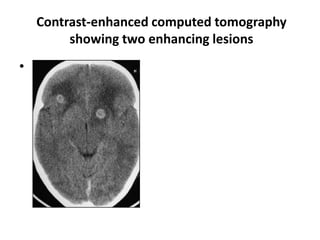
• After contrast administration, there is a ring-
or a homogeneous disk-like enhancement
within the region of hypodensity. The
enhancing lesions are often of variable size
and are usually surrounded by a varying
amount of perifocal vasogenic edema.
• Typically, the ring-enhancing lesions are
located at the junction of the gray and white
matter, but they could be located in the sub-
cortical area, deep in the brain parenchyma or
may even be superficial.
Contrast-enhanced computed tomography
showing two enhancing lesions
•
• Clinically, they manifest as recurrent
seizures, visual impairment, focal neurological
deficit and raised intracranial pressure (severe
headache, vomiting and papilledema).
• If cerebral edema is severe, patients may
develop loss of sensorium and posturing of
limbs because of transtentorial brain
herniation. Intractable headache, focal
neurological deficits and vision loss are long-
term sequelae in few of the surviving patients.
ETIOLOGY
• Causes of multiple ring-enhancing lesions of
the brain
DDs of Multiple Ring Enhancing
Lesions
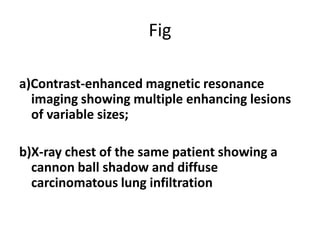
Fig
a)Contrast-enhanced magnetic resonance
imaging showing multiple enhancing lesions
of variable sizes;
b)X-ray chest of the same patient showing a
cannon ball shadow and diffuse
carcinomatous lung infiltration
• (
• Metastatic lesions are typically subcortical,
occurring in or near the gray matter-white matter
junction, and are usually associated with severe
perilesional edema.
• Primary brain tumors frequently cross the
midline. For example, glioblastoma multiforme
frequently crosses the midline by infiltrating the
white matter tracts of the corpus callosum.
Pyogenic Brain Abscesses
• Multiple brain abscesses are often caused by
hematogenous spread of bacteria from a
primary source and are frequently found in
the territory of the middle cerebral artery.
• The enhancing ring lesions caused by pyogenic
brain abscesses are commonly located at the
gray-white matter junction.
• The capsule of abscess is difficult to visualize
via conventional imaging techniques and
double-contrast computed tomography is
needed to clearly define the capsule of the
abscess.
• However, greater thickness, irregularity and
nodularity of the wall of the lesions are often
suggestive of tumor or a fungal infection.
• Tuberculoma
Tuberculomas are frequently encountered
brain lesions in tropical countries.
• Intracranial tuberculoma can occur with or
without tuberculous meningitis.
• Numerous small tuberculomas are common
in patients with miliary pulmonary
tuberculosis.
• A non-caseating tuberculoma usually appears
hyperintense on T2-weighted and slightly
hypointense on T1-weighted images.
• A caseating tuberculoma appears iso- to
hypointense on both T1-weighted and T2-
weighted images, with an iso- to hyperintense
rim on T2-weighted images.
• Tuberculomas on contrast administration
appear as nodular or ring-like enhancing
lesions.
• The diameter of these enhancing lesions
usually ranges from 1 mm to 5 cm.
• Tuberculomas frequently show varied types of
enhancement, including irregular shapes, ring-
like shapes, open rings and lobular patterns.
Target-like lesions are common.
Contrast-enhanced magnetic resonance imaging showing
multiple enhancing lesions and X-ray chest of the same patient
showing miliary pulmonary tuberculosis
• Cysticercus Granuloma
Neurocysticercosis - most common parasitic
disease of the CNS and is a major cause of
seizures worldwide.
• After reaching inside the brain parenchyma,
the cysticercus larva passes through several
stages of evolution
• . Initially, the cyst consists of a protoscolex
surrounded by a bladder wall. This stage of
viable cyst is known as vesicular cyst stage.
• At this stage, the scolex usually is identified as
an eccentric nodule within the cyst.
• colloid cyst stage- the cyst wall gets thickened
and hyaline degeneration and mineralization
of the cyst take place. The cyst fluid becomes
opaque . These degenerating cysts are called
colloid cyst stage
• In this stage, there is an intense inflammatory
reaction in the surrounding brain tissue.
• In this stage, neuroimaging reveals contrast
enhancing ring or disc lesions.
• Granular nodular stage- the cysticercus is no
longer viable & the bladder wall collapses to
form a small granuloma.
• Calcific stage. Months to years later, some of
these dead cysts get calcified into small
nodules. This stage is called calcific stage.
Modified diagnostic criteria for
neurocysticercosis
• Cysticercus granuloma shows a ring pattern of
enhancement after contrast medium
administration.
• Usually, the lesions are <20 mm in diameter.
• Calcified eccentric scolex is often seen in a
cysticercal lesion.
• The lesions are often multiple and most often
do not have extensive edema.
• Demyelinating Disorders
Demyelinating lesions, including both classic
multiple sclerosis and tumefactive
demyelination, may also create an open ring
or incomplete ring sign.
• Multiple Enhancing Lesions in HIV-infected
Patients
categories –
1 opportunistic infections,
2 neoplasms and
3 cerebrovascular diseases.
The common causes include toxoplasmosis,
tuberculoma and primary CNS lymphoma and,
rarely, brain abscess and fungal granuloma.
• The lesions of primary CNS lymphoma on
computed tomography are hyperintense or
isointense with homogeneous contrast
enhancement and variable surrounding
edema.
• They are often multifocal and periventricular
in location. Leptomeningeal involvement may
be seen.
• Lymphomatous lesions are frequently
periventricular and have indistinct borders.
• The lymphomas rarely invade the basal
ganglia and have a tendency to occur in the
white matter adjacent to an ependymal
surface.
• Methods used for establishing the
diagnosis in patients with multiple
enhancing lesions of the brain
• Differential diagnosis of multiple ring-
enhancing lesions of the brain
THANK YOU
Ring enhancing lesions

Ring enhancing lesions

  • 1.
  • 2.
    • Most commonlyencountered abnormalities on neuroimaging. • These lesions appear as hypodense or isodense mass lesions on non-contrast computed (plain) tomography studies.
  • 3.
    • After contrastadministration, there is a ring- or a homogeneous disk-like enhancement within the region of hypodensity. The enhancing lesions are often of variable size and are usually surrounded by a varying amount of perifocal vasogenic edema.
  • 4.
    • Typically, thering-enhancing lesions are located at the junction of the gray and white matter, but they could be located in the sub- cortical area, deep in the brain parenchyma or may even be superficial.
  • 5.
  • 6.
    • Clinically, theymanifest as recurrent seizures, visual impairment, focal neurological deficit and raised intracranial pressure (severe headache, vomiting and papilledema).
  • 7.
    • If cerebraledema is severe, patients may develop loss of sensorium and posturing of limbs because of transtentorial brain herniation. Intractable headache, focal neurological deficits and vision loss are long- term sequelae in few of the surviving patients.
  • 8.
    ETIOLOGY • Causes ofmultiple ring-enhancing lesions of the brain
  • 11.
    DDs of MultipleRing Enhancing Lesions
  • 13.
    Fig a)Contrast-enhanced magnetic resonance imagingshowing multiple enhancing lesions of variable sizes; b)X-ray chest of the same patient showing a cannon ball shadow and diffuse carcinomatous lung infiltration
  • 14.
  • 15.
    • Metastatic lesionsare typically subcortical, occurring in or near the gray matter-white matter junction, and are usually associated with severe perilesional edema. • Primary brain tumors frequently cross the midline. For example, glioblastoma multiforme frequently crosses the midline by infiltrating the white matter tracts of the corpus callosum.
  • 16.
    Pyogenic Brain Abscesses •Multiple brain abscesses are often caused by hematogenous spread of bacteria from a primary source and are frequently found in the territory of the middle cerebral artery.
  • 17.
    • The enhancingring lesions caused by pyogenic brain abscesses are commonly located at the gray-white matter junction. • The capsule of abscess is difficult to visualize via conventional imaging techniques and double-contrast computed tomography is needed to clearly define the capsule of the abscess.
  • 18.
    • However, greaterthickness, irregularity and nodularity of the wall of the lesions are often suggestive of tumor or a fungal infection.
  • 19.
    • Tuberculoma Tuberculomas arefrequently encountered brain lesions in tropical countries. • Intracranial tuberculoma can occur with or without tuberculous meningitis. • Numerous small tuberculomas are common in patients with miliary pulmonary tuberculosis.
  • 20.
    • A non-caseatingtuberculoma usually appears hyperintense on T2-weighted and slightly hypointense on T1-weighted images. • A caseating tuberculoma appears iso- to hypointense on both T1-weighted and T2- weighted images, with an iso- to hyperintense rim on T2-weighted images.
  • 21.
    • Tuberculomas oncontrast administration appear as nodular or ring-like enhancing lesions. • The diameter of these enhancing lesions usually ranges from 1 mm to 5 cm. • Tuberculomas frequently show varied types of enhancement, including irregular shapes, ring- like shapes, open rings and lobular patterns. Target-like lesions are common.
  • 22.
    Contrast-enhanced magnetic resonanceimaging showing multiple enhancing lesions and X-ray chest of the same patient showing miliary pulmonary tuberculosis
  • 23.
    • Cysticercus Granuloma Neurocysticercosis- most common parasitic disease of the CNS and is a major cause of seizures worldwide. • After reaching inside the brain parenchyma, the cysticercus larva passes through several stages of evolution
  • 24.
    • . Initially,the cyst consists of a protoscolex surrounded by a bladder wall. This stage of viable cyst is known as vesicular cyst stage. • At this stage, the scolex usually is identified as an eccentric nodule within the cyst.
  • 25.
    • colloid cyststage- the cyst wall gets thickened and hyaline degeneration and mineralization of the cyst take place. The cyst fluid becomes opaque . These degenerating cysts are called colloid cyst stage • In this stage, there is an intense inflammatory reaction in the surrounding brain tissue.
  • 26.
    • In thisstage, neuroimaging reveals contrast enhancing ring or disc lesions. • Granular nodular stage- the cysticercus is no longer viable & the bladder wall collapses to form a small granuloma. • Calcific stage. Months to years later, some of these dead cysts get calcified into small nodules. This stage is called calcific stage.
  • 27.
    Modified diagnostic criteriafor neurocysticercosis
  • 29.
    • Cysticercus granulomashows a ring pattern of enhancement after contrast medium administration. • Usually, the lesions are <20 mm in diameter. • Calcified eccentric scolex is often seen in a cysticercal lesion. • The lesions are often multiple and most often do not have extensive edema.
  • 30.
    • Demyelinating Disorders Demyelinatinglesions, including both classic multiple sclerosis and tumefactive demyelination, may also create an open ring or incomplete ring sign.
  • 31.
    • Multiple EnhancingLesions in HIV-infected Patients categories – 1 opportunistic infections, 2 neoplasms and 3 cerebrovascular diseases. The common causes include toxoplasmosis, tuberculoma and primary CNS lymphoma and, rarely, brain abscess and fungal granuloma.
  • 32.
    • The lesionsof primary CNS lymphoma on computed tomography are hyperintense or isointense with homogeneous contrast enhancement and variable surrounding edema. • They are often multifocal and periventricular in location. Leptomeningeal involvement may be seen.
  • 33.
    • Lymphomatous lesionsare frequently periventricular and have indistinct borders. • The lymphomas rarely invade the basal ganglia and have a tendency to occur in the white matter adjacent to an ependymal surface.
  • 34.
    • Methods usedfor establishing the diagnosis in patients with multiple enhancing lesions of the brain
  • 36.
    • Differential diagnosisof multiple ring- enhancing lesions of the brain
  • 39.