Vipul Gupta
Head, Neurointerventional Surgery
Interventional Neuroradiology
NEUROVASCULAR & STROKE CENTRE
Interventions in stroke:Interventions in stroke:
A new eraA new era
Neurovascular diseases…
Stroke…. Third most common cause of death
 Most common reason for disability
 Appx. 1 in 4 people die within 1 year
 30%–50% do not regain functional
independence
 Annual incidence rate of stroke in India
currently is 145 per 100,000 population
 10 - 15% occur in < 40 years
WHO estimates suggest that by 2050, 80% stroke
cases in the world would occur in low and middle
income countries mainly India and China
Endovascular
neurointerventions !!! Disease states different
 End- organ different- every area
important
 Reactive organ- reperfusion-
bleed
 Arteries different
 Access difficult- tortuosity
Neurointervention Cath Lab- Biplane
flat panel, 3D imaging, Road map,
Dyna CT
NEUROINTERVENTION EVOLUTION…….
Neurointerventions…
 SAH- aneurysms, vasospasm
 Intracerebral hemorrhage- AVMs
 TIA- major vessel stenosis E/C & I/C
 Stroke- revascularization
 Diagnosis- Imaging
 Interventional hardware
 Integrated approach
ANEURYSMS- basic facts
• Subarachnoid hemorrhage (SAH).
• One in every 20 strokes , at the
prime of ones life (commonly
between 40-50yrs).
• Up to 40-50% patients do not
survive even for a month mostly
because of the rerupture of the
aneurysm
• With proper treatment up to 90%
of patient who reach hospital
before any major damage has
happened will lead an independent
and productive life
Initial CT Scan
Rebleeding after 1 day
Clipping vs coiling…
Initially
 Surgically inappropriate
Tremendous changes in last 15-yrs
Cerebral Aneurysms-
• Image-guidance (3-D , Dyna-CT)
• Coil, catheter, balloons, stents
• Drugs- aspirin, clopidogrel, abciximab
• Appx. 90% by endovascular
• Intra-arterial vasospasm mgt.
• HELP and Cerecyte studies – mRS 0-2 in
87% (80% in ISAT)
ISAT
 Randomized,
prospective,
international trial
 Clipping vs coiling
 ISAT follow-up, Lancet 2014- at 9
yrs, outcome better
 Guidelines for the Management of Aneurysmal SAH: Special Writing
Group of the Stroke Council, ASA/AHA Stroke 2009
 Amenable to both endovascular coiling and neurosurgical
clipping, endovascular coiling can be beneficial (Class I, Level
of Evidence B).
Metanalysis- Stroke 2013, AJNR 2013
• Ruptured aneurysms- better outcomes
after endovascular management
3 D
Balloon assisted coiling
Very small aneurysms
Stent assisted coiling
Flow diverters
(stents)- no coils
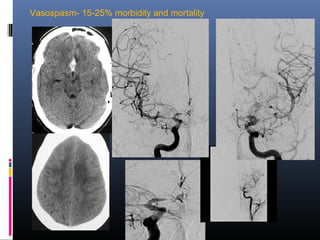
Vasospasm- 15-25% morbidity and mortality
Our protocol
 Interventionist part of neurosurgery
team
 DSA & if possible embolization
 Neuro lab with 3D, CT
 NS ICU monitoring (TCD/CTP).
 Vasospasm- IAVD
 N- 706 (Sept 2014)
 Data of consecutive patients
Our protocol
Embolization
Surgery
91%
9%
Good outcome
FND
Mortality
Mgt. outcome in good grade patients- 90 % mRS 0-2
CAROTID ARTERY STENOSIS-
20-25% STROKES BY MAJOR VESSEL
STENOSIS
Symptomatic StenosisSymptomatic Stenosis
• Non-invasive >70%Non-invasive >70%
• Catheter angiography >50%Catheter angiography >50%
• Peri-procedural risk <6%Peri-procedural risk <6%
Asymptomatic StenosisAsymptomatic Stenosis
• >70% Stenosis>70% Stenosis
• Periprocedural complication risk is lowPeriprocedural complication risk is low
• Life expectancy >5 yrLife expectancy >5 yr
• >80% stenosis- tend to be treated>80% stenosis- tend to be treated
Revascularization indications-Revascularization indications-
ASA/AHA guidelines 2011ASA/AHA guidelines 2011
Patient with TIAs…..stenting done the next day
Should be done as soon as possible…
maximum stroke risk in first few weeks
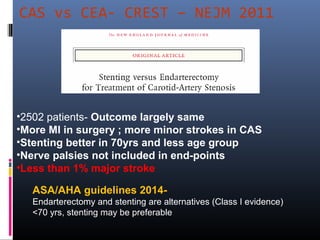
CAS vs CEA- CREST – NEJM 2011
•2502 patients- Outcome largely same
•More MI in surgery ; more minor strokes in CAS
•Stenting better in 70yrs and less age group
•Nerve palsies not included in end-points
•Less than 1% major stroke
ASA/AHA guidelines 2014-
Endarterectomy and stenting are alternatives (Class I evidence)
<70 yrs, stenting may be preferable
Intracranial atherosclerosis
 Intracranial arterial stenosis is responsible for 6% to
10% of ischemic strokes in whites and 22% to 26% of
ischemic strokes in Asians
SAMPRIS Trial- stenting not to be
done as routine in acute stroke
•Recurrent symptom
•Subocclusive stenosis
ISCHAEMIC stroke- brain attack
Penumbra
• At 60 min, about 90%
• At 2 h about 80 %
• At 3 h about 60% and
• At 4.5 h about 40% of
patients
 Thereafter ?
• Maybe 30% at 9 h
• And less than 20%
beyond 12 h
Issues with IV tPA
 Time factor
 Large vessel disease
 Time to recanalize
 C.I. – anti-coagulants, recent surgery, wake-up
strokes….
 < 5 % qualify
CT, CTA, CTP….
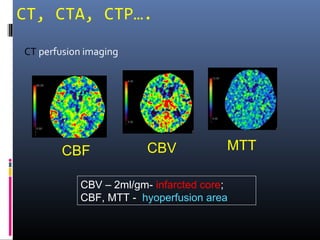
CT perfusion imaging
MTTCBF CBV
CBV – 2ml/gm- infarcted core;
CBF, MTT - hyoperfusion area
Concept of Penumbra
CBF/MTT CBV
Matched
No penumbra
CBF/MTT
CBV
penumbra
CTA & CTP vs MR DWI & PWI
PENUMBRA, 2007MERCI, 2004
STENTREIVERS- SOLITAIRE (2012), TREVO…..
Clinical … Left hemiplegia, left UL and LL 0/5
 5:14AM
6:22AM
8:07 AM
Patient made gradual recovery
Left LL 4/5 and UL 3/5 - 30 day
follow up mRS at 90 days- 0
 63 /M, AVR, Coumadin
 INR of 2.5
 RT hemiparesis - 2/5 in leg
and 0/5 in arm
 Global aphasia
CBF CBV
Solitaire stent was deployed
Evidence – 2014-2015
 IMS-III, MR RESCUE & Synthes – failed- no
appropriate imaging and old devices
 Recent trials – imaging for MVO & stent-
retreviers
 MR CLEAN – strongly positive
 ESCAPE – stopped bcs of efficacy
 EXTEND –IA – positive
DRAMATIC CHANGE IN MGT OF STROKE
Clinical-
 Bleeding
 Seizures
 Neurological deficit
 Headaches
 Incidental
Cerebral ArteriovenousCerebral Arteriovenous
malformationsmalformations
AVM- treatment options
 Embolization
 Radiosurgery (Gamma Knife, LINAC,
Cyberknife)
 Surgery
Embolization
Glue (NBCA) vs Onyx embolization
Conclusion
 Advances in Neuroimaging and
neurointervention
 Critical role in mgt of SAH-
aneurysm, Acute stroke, TIA-
carotid stenosis, ICH-AVMs
 Latest trials have proven the
role in acute stroke
 Neurointerventionist,
neurologist, neurosurgeon and
radiologist as a team
STROKE AND NEUROVASCULAR
INTERVENTION FOUNDATION
 Newsletter
 Stroke training courses
 Website
 Social media – Facebook,
Youtube , whatsApp
 App
 Patient awarenss campaign
 RG Singh, Sachin Bhawsar
Thank you
Intervention in Stroke-A New Era

Intervention in Stroke-A New Era

  • 1.
    Vipul Gupta Head, NeurointerventionalSurgery Interventional Neuroradiology NEUROVASCULAR & STROKE CENTRE Interventions in stroke:Interventions in stroke: A new eraA new era
  • 2.
    Neurovascular diseases… Stroke…. Thirdmost common cause of death  Most common reason for disability  Appx. 1 in 4 people die within 1 year  30%–50% do not regain functional independence  Annual incidence rate of stroke in India currently is 145 per 100,000 population  10 - 15% occur in < 40 years WHO estimates suggest that by 2050, 80% stroke cases in the world would occur in low and middle income countries mainly India and China
  • 3.
    Endovascular neurointerventions !!! Diseasestates different  End- organ different- every area important  Reactive organ- reperfusion- bleed  Arteries different  Access difficult- tortuosity
  • 4.
    Neurointervention Cath Lab-Biplane flat panel, 3D imaging, Road map, Dyna CT NEUROINTERVENTION EVOLUTION…….
  • 5.
    Neurointerventions…  SAH- aneurysms,vasospasm  Intracerebral hemorrhage- AVMs  TIA- major vessel stenosis E/C & I/C  Stroke- revascularization  Diagnosis- Imaging  Interventional hardware  Integrated approach
  • 6.
    ANEURYSMS- basic facts •Subarachnoid hemorrhage (SAH). • One in every 20 strokes , at the prime of ones life (commonly between 40-50yrs). • Up to 40-50% patients do not survive even for a month mostly because of the rerupture of the aneurysm • With proper treatment up to 90% of patient who reach hospital before any major damage has happened will lead an independent and productive life Initial CT Scan Rebleeding after 1 day
  • 7.
    Clipping vs coiling… Initially Surgically inappropriate Tremendous changes in last 15-yrs Cerebral Aneurysms- • Image-guidance (3-D , Dyna-CT) • Coil, catheter, balloons, stents • Drugs- aspirin, clopidogrel, abciximab • Appx. 90% by endovascular • Intra-arterial vasospasm mgt. • HELP and Cerecyte studies – mRS 0-2 in 87% (80% in ISAT)
  • 8.
    ISAT  Randomized, prospective, international trial Clipping vs coiling  ISAT follow-up, Lancet 2014- at 9 yrs, outcome better  Guidelines for the Management of Aneurysmal SAH: Special Writing Group of the Stroke Council, ASA/AHA Stroke 2009  Amenable to both endovascular coiling and neurosurgical clipping, endovascular coiling can be beneficial (Class I, Level of Evidence B). Metanalysis- Stroke 2013, AJNR 2013 • Ruptured aneurysms- better outcomes after endovascular management
  • 10.
  • 11.
  • 12.
  • 13.
  • 14.
  • 15.
  • 17.
    Our protocol  Interventionistpart of neurosurgery team  DSA & if possible embolization  Neuro lab with 3D, CT  NS ICU monitoring (TCD/CTP).  Vasospasm- IAVD  N- 706 (Sept 2014)  Data of consecutive patients
  • 18.
  • 19.
    CAROTID ARTERY STENOSIS- 20-25%STROKES BY MAJOR VESSEL STENOSIS
  • 20.
    Symptomatic StenosisSymptomatic Stenosis •Non-invasive >70%Non-invasive >70% • Catheter angiography >50%Catheter angiography >50% • Peri-procedural risk <6%Peri-procedural risk <6% Asymptomatic StenosisAsymptomatic Stenosis • >70% Stenosis>70% Stenosis • Periprocedural complication risk is lowPeriprocedural complication risk is low • Life expectancy >5 yrLife expectancy >5 yr • >80% stenosis- tend to be treated>80% stenosis- tend to be treated Revascularization indications-Revascularization indications- ASA/AHA guidelines 2011ASA/AHA guidelines 2011
  • 22.
    Patient with TIAs…..stentingdone the next day Should be done as soon as possible… maximum stroke risk in first few weeks
  • 23.
    CAS vs CEA-CREST – NEJM 2011 •2502 patients- Outcome largely same •More MI in surgery ; more minor strokes in CAS •Stenting better in 70yrs and less age group •Nerve palsies not included in end-points •Less than 1% major stroke ASA/AHA guidelines 2014- Endarterectomy and stenting are alternatives (Class I evidence) <70 yrs, stenting may be preferable
  • 24.
    Intracranial atherosclerosis  Intracranialarterial stenosis is responsible for 6% to 10% of ischemic strokes in whites and 22% to 26% of ischemic strokes in Asians SAMPRIS Trial- stenting not to be done as routine in acute stroke •Recurrent symptom •Subocclusive stenosis
  • 26.
    ISCHAEMIC stroke- brainattack Penumbra • At 60 min, about 90% • At 2 h about 80 % • At 3 h about 60% and • At 4.5 h about 40% of patients  Thereafter ? • Maybe 30% at 9 h • And less than 20% beyond 12 h
  • 27.
    Issues with IVtPA  Time factor  Large vessel disease  Time to recanalize  C.I. – anti-coagulants, recent surgery, wake-up strokes….  < 5 % qualify
  • 28.
    CT, CTA, CTP…. CTperfusion imaging MTTCBF CBV CBV – 2ml/gm- infarcted core; CBF, MTT - hyoperfusion area
  • 29.
    Concept of Penumbra CBF/MTTCBV Matched No penumbra CBF/MTT CBV penumbra CTA & CTP vs MR DWI & PWI
  • 30.
    PENUMBRA, 2007MERCI, 2004 STENTREIVERS-SOLITAIRE (2012), TREVO…..
  • 32.
    Clinical … Lefthemiplegia, left UL and LL 0/5  5:14AM
  • 33.
  • 34.
    8:07 AM Patient madegradual recovery Left LL 4/5 and UL 3/5 - 30 day follow up mRS at 90 days- 0
  • 35.
     63 /M,AVR, Coumadin  INR of 2.5  RT hemiparesis - 2/5 in leg and 0/5 in arm  Global aphasia CBF CBV Solitaire stent was deployed
  • 36.
    Evidence – 2014-2015 IMS-III, MR RESCUE & Synthes – failed- no appropriate imaging and old devices  Recent trials – imaging for MVO & stent- retreviers  MR CLEAN – strongly positive  ESCAPE – stopped bcs of efficacy  EXTEND –IA – positive DRAMATIC CHANGE IN MGT OF STROKE
  • 37.
    Clinical-  Bleeding  Seizures Neurological deficit  Headaches  Incidental Cerebral ArteriovenousCerebral Arteriovenous malformationsmalformations
  • 38.
    AVM- treatment options Embolization  Radiosurgery (Gamma Knife, LINAC, Cyberknife)  Surgery Embolization Glue (NBCA) vs Onyx embolization
  • 44.
    Conclusion  Advances inNeuroimaging and neurointervention  Critical role in mgt of SAH- aneurysm, Acute stroke, TIA- carotid stenosis, ICH-AVMs  Latest trials have proven the role in acute stroke  Neurointerventionist, neurologist, neurosurgeon and radiologist as a team
  • 45.
    STROKE AND NEUROVASCULAR INTERVENTIONFOUNDATION  Newsletter  Stroke training courses  Website  Social media – Facebook, Youtube , whatsApp  App  Patient awarenss campaign  RG Singh, Sachin Bhawsar
  • 46.

Editor's Notes

  • #26 Humanitarian Device: The WingspanTM Stent System with GatewayTM PTA Balloon Catheter is authorized by Federal Law for use in improving cerebral artery lumen diameter in patients with intracranial atherosclerotic disease, refractory to medical therapy, in intracranial vessels with ≥50% stenosis that are accessible to the system. The effectiveness of this device for this use has not been demonstrated. The Gateway PTA Balloon Catheter is indicated for balloon dilation of the stenotic portion of intracranial arteries prior to stenting for the purpose of improving intracranial perfusion.