
Current Sensor Source: Honeywell
Introduction Purpose To introduce an Brief classification of different Current Sensor Outline Introduction to Honeywell Current Sensors Digital/Inductive Current Sensor  Closed Loop current sensor and its Sub-categories Open Loop current sensor and its Sub-categories Content 14 pages
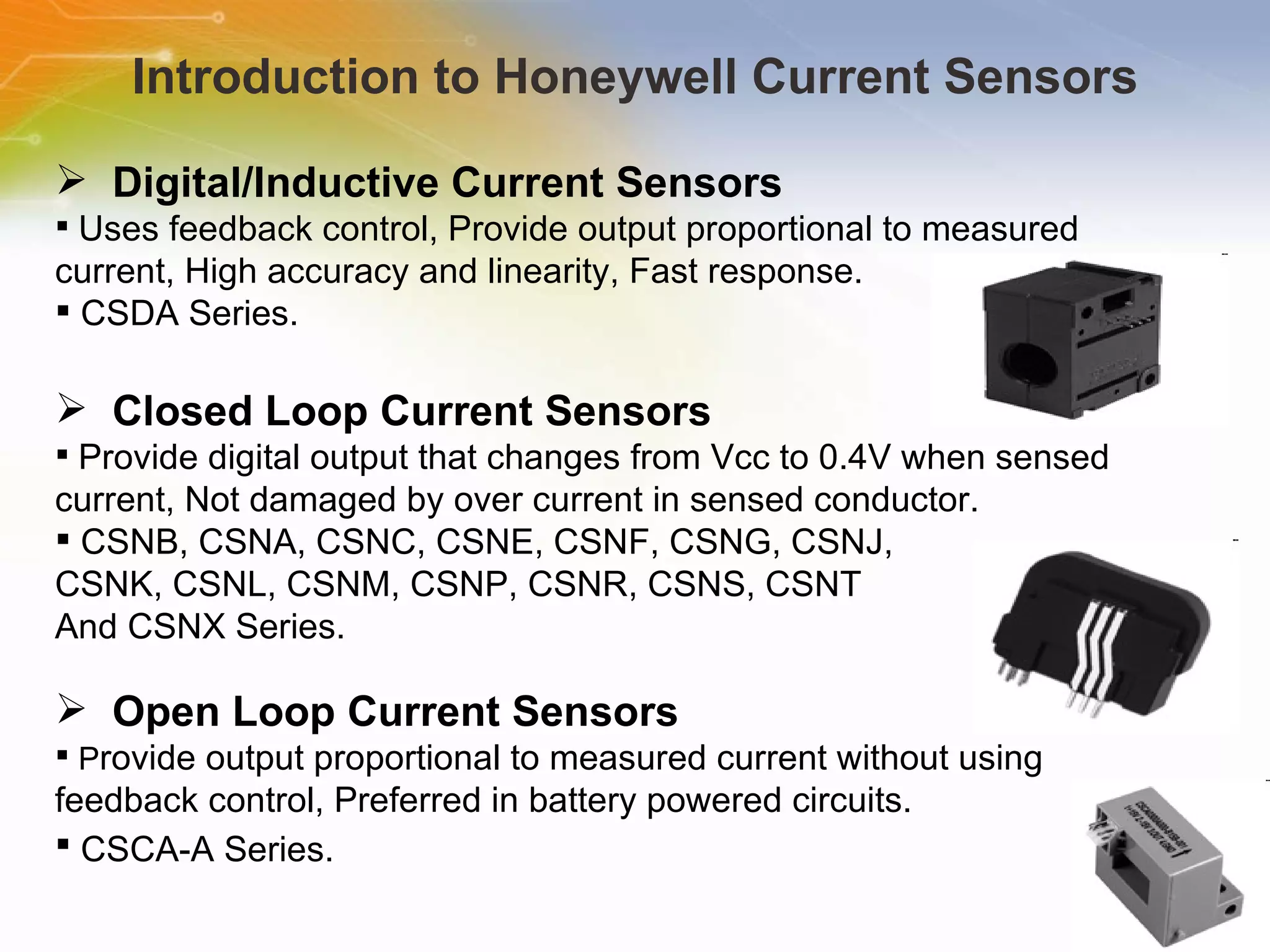
Introduction to Honeywell Current Sensors Digital/Inductive Current Sensors Uses feedback control, Provide output proportional to measured current, High accuracy and linearity, Fast response. CSDA Series. Closed Loop Current Sensors Provide digital output that changes from Vcc to 0.4V when sensed current, Not damaged by over current in sensed conductor. CSNB, CSNA, CSNC, CSNE, CSNF, CSNG, CSNJ, CSNK, CSNL, CSNM, CSNP, CSNR, CSNS, CSNT And CSNX Series. Open Loop Current Sensors P rovide output proportional to measured current without using feedback control, Preferred in battery powered circuits. CSCA-A Series.
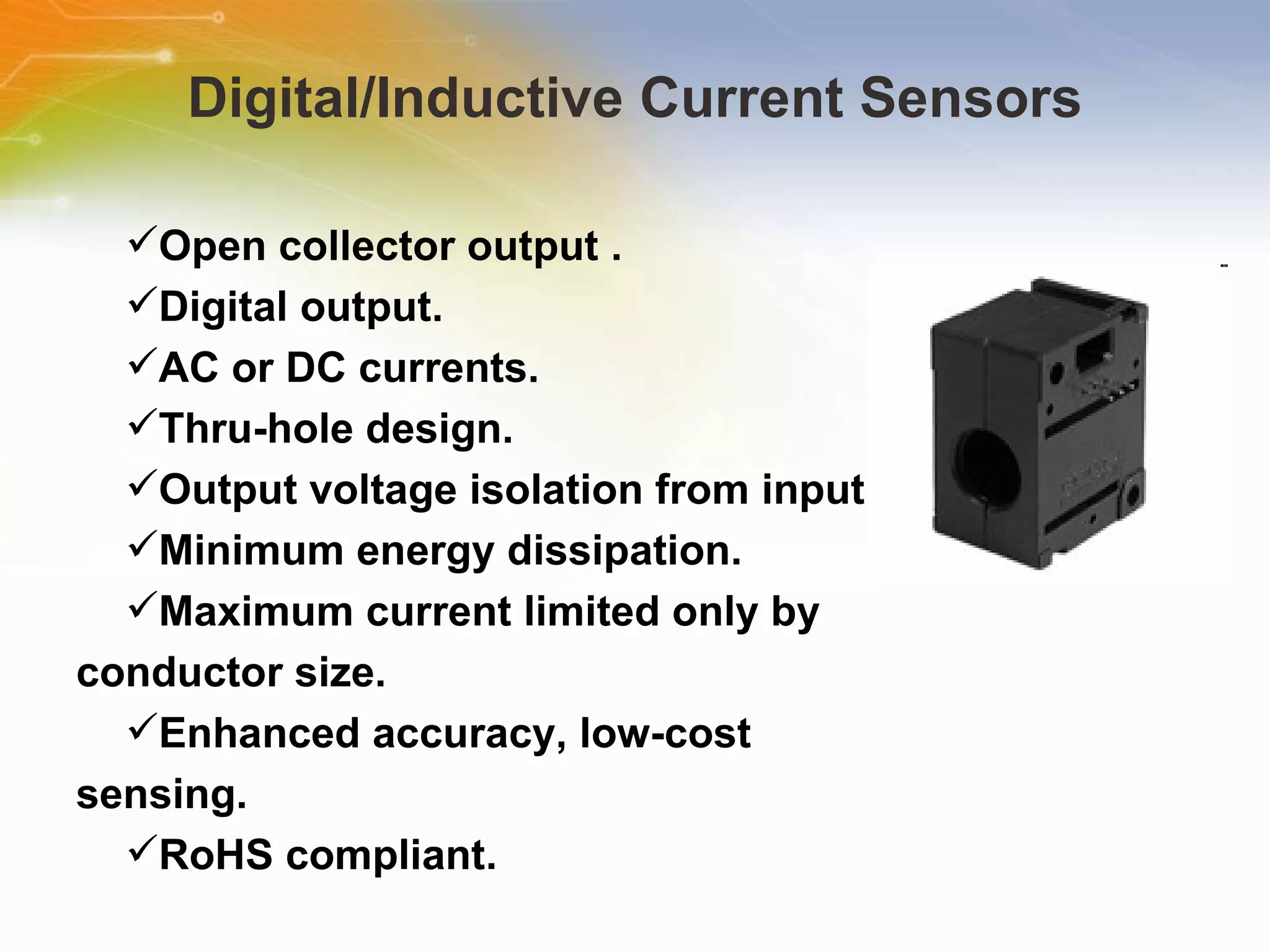
Digital/Inductive Current Sensors Open collector output . Digital output. AC or DC currents. Thru-hole design. Output voltage isolation from input. Minimum energy dissipation. Maximum current limited only by  conductor size.  Enhanced accuracy, low-cost sensing. RoHS compliant.
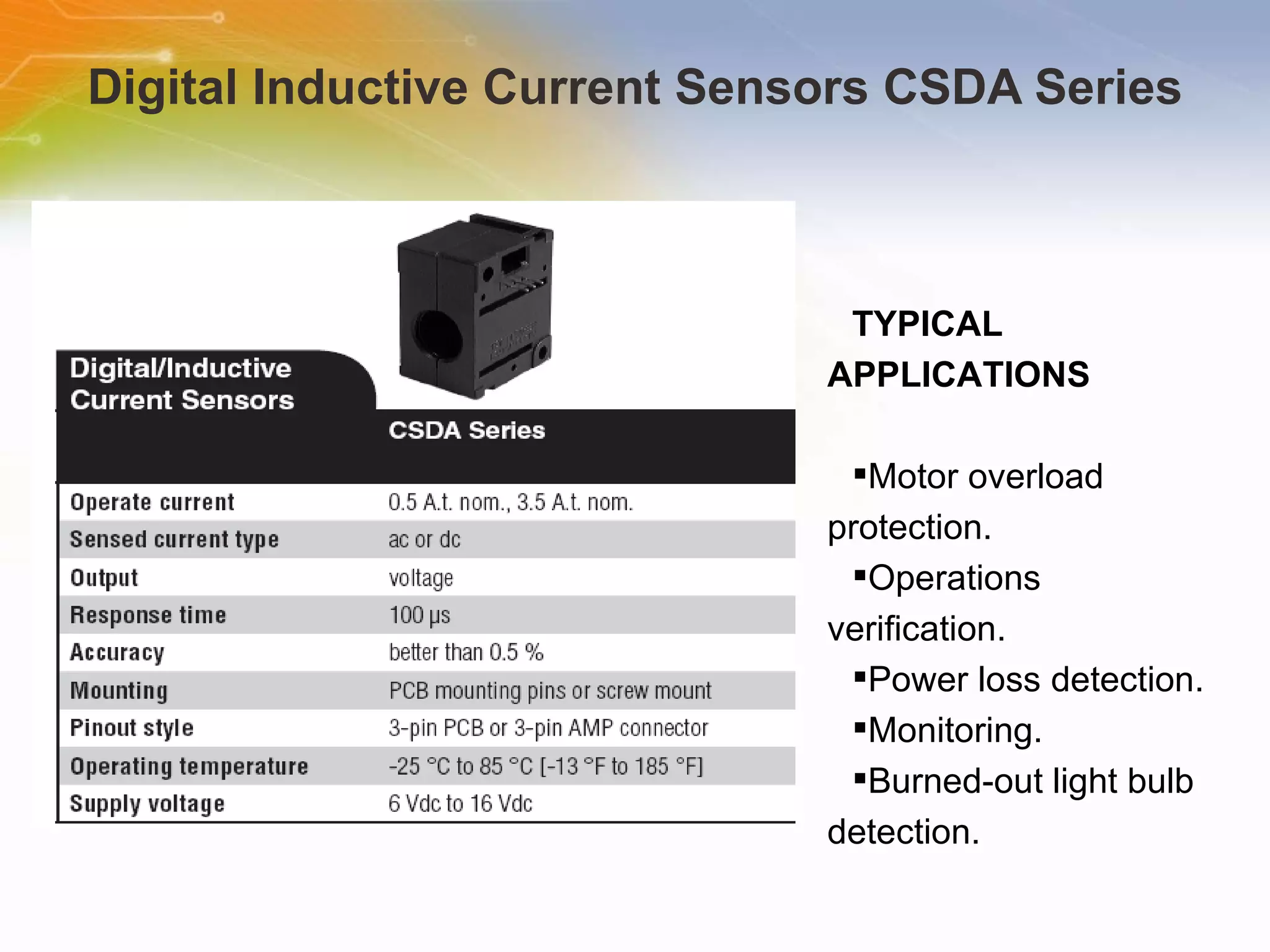
Digital Inductive Current Sensors CSDA Series TYPICAL APPLICATIONS Motor overload protection. Operations verification. Power loss detection. Monitoring. Burned-out light bulb detection.
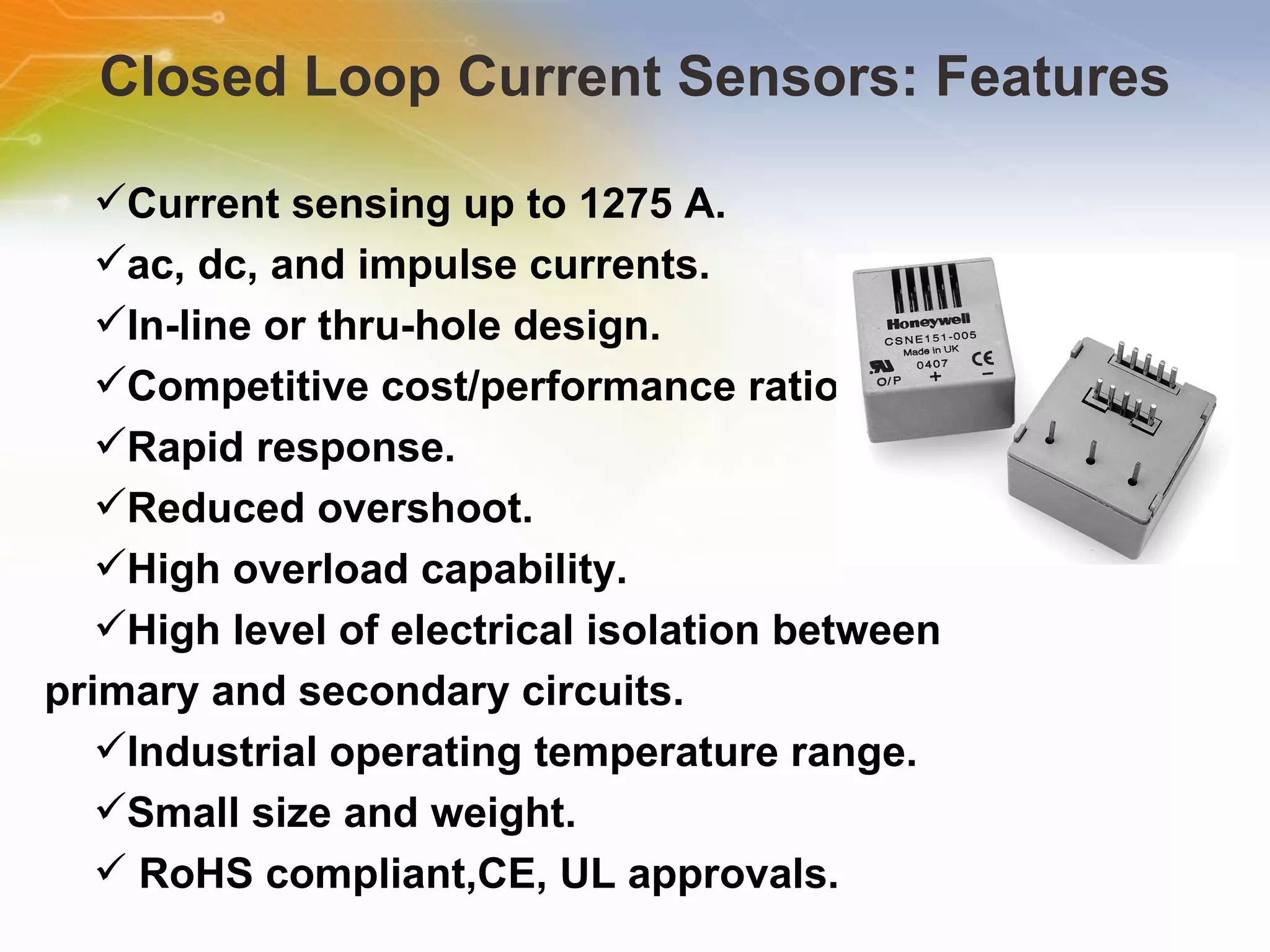
Closed Loop Current Sensors: Features Current sensing up to 1275 A.  ac, dc, and impulse currents.  In-line or thru-hole design.  Competitive cost/performance ratio. Rapid response.  Reduced overshoot.  High overload capability.  High level of electrical isolation between primary and secondary circuits.  Industrial operating temperature range.  Small size and weight. RoHS compliant,CE, UL approvals.
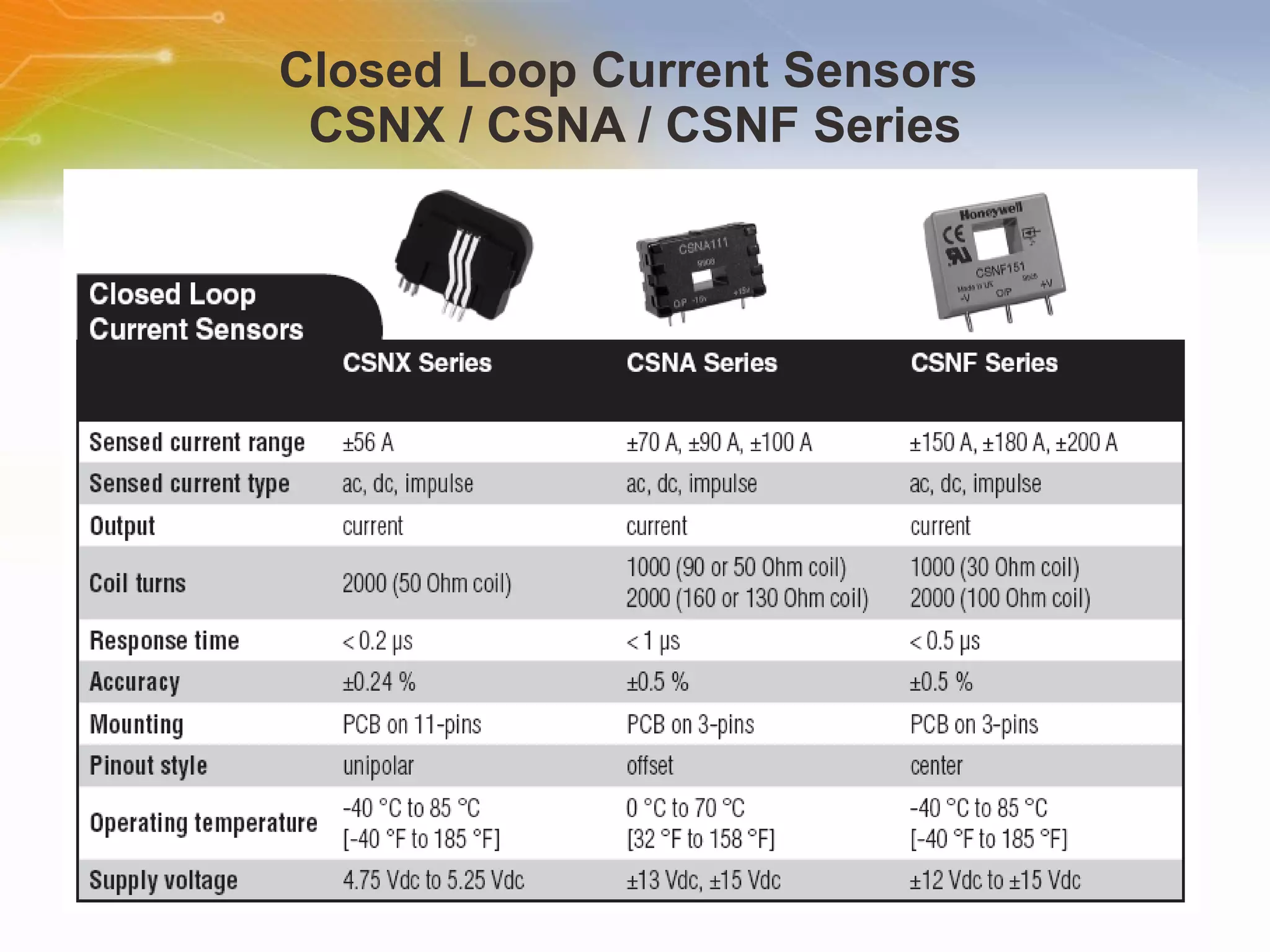
Closed Loop Current Sensors  CSNX / CSNA / CSNF Series
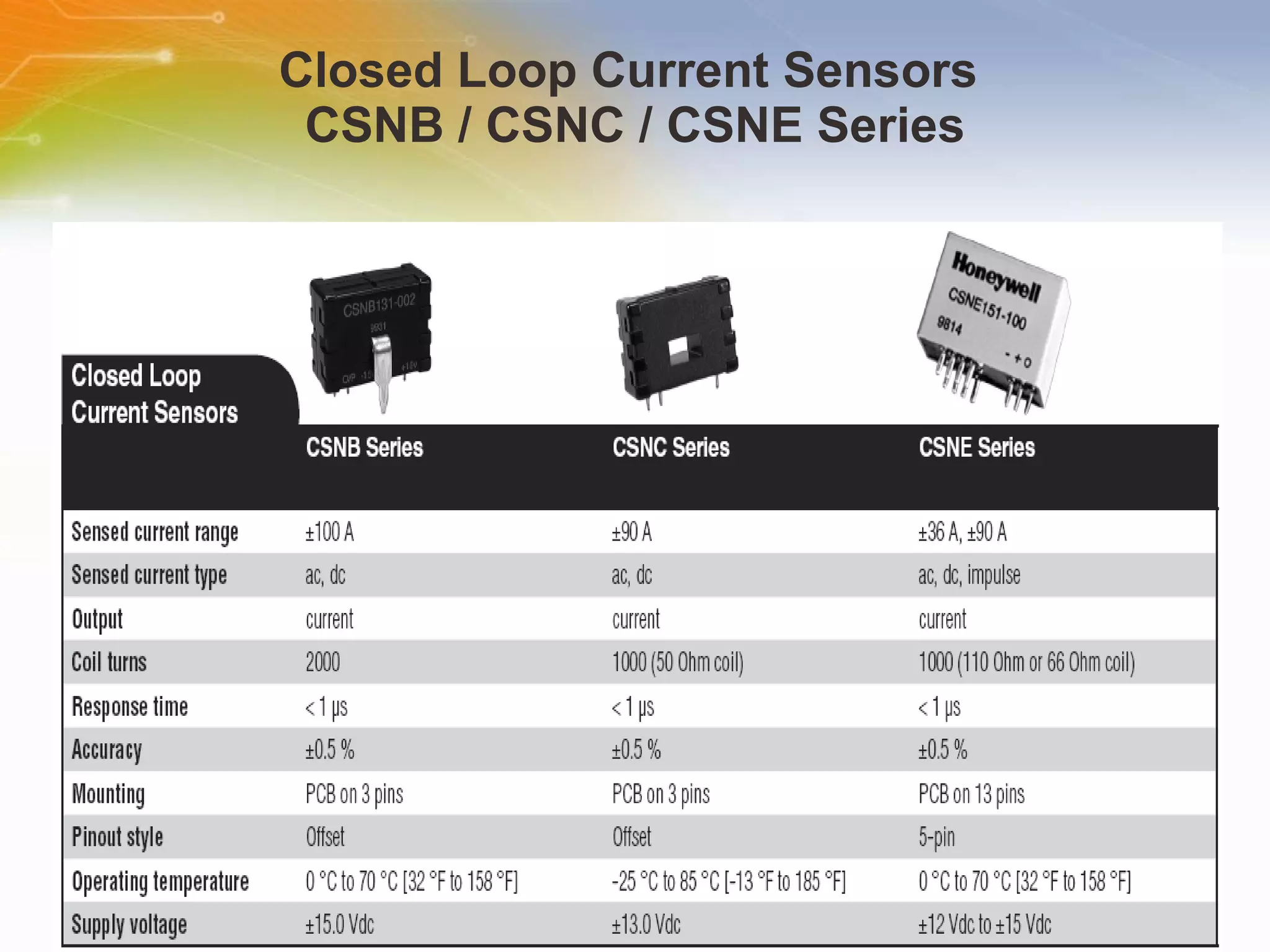
Closed Loop Current Sensors  CSNB / CSNC / CSNE Series
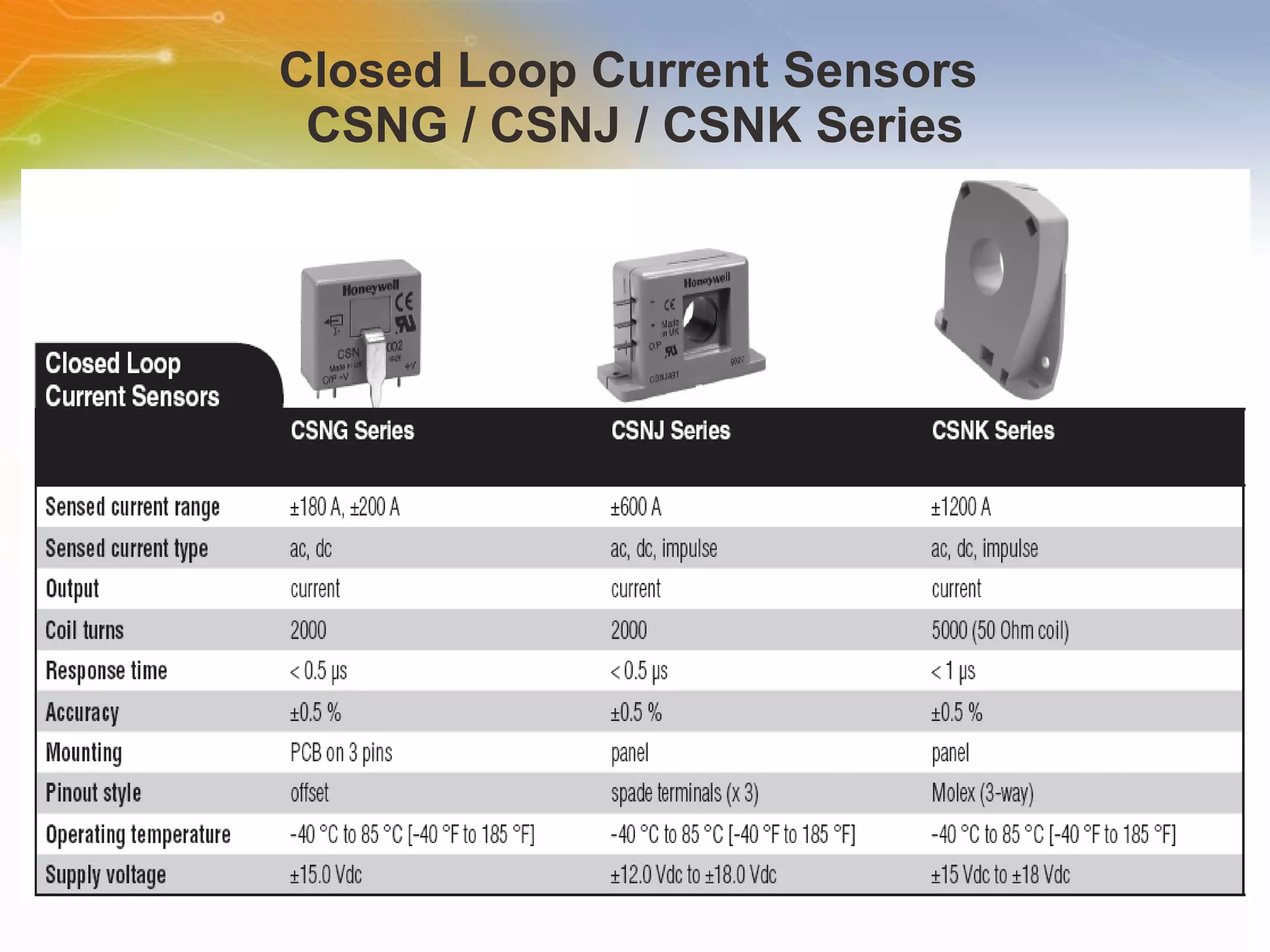
Closed Loop Current Sensors  CSNG / CSNJ / CSNK Series
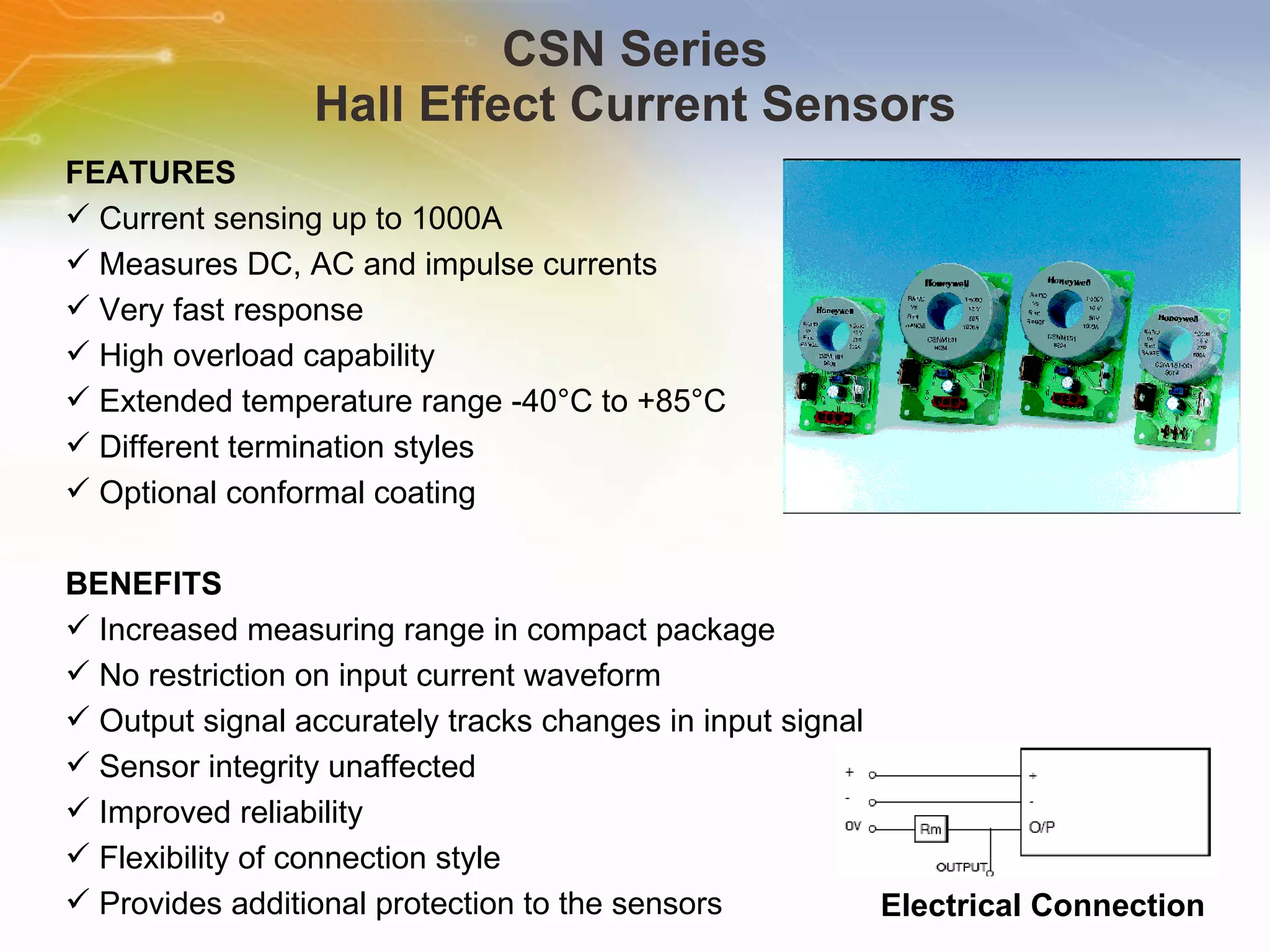
CSN Series Hall Effect Current Sensors FEATURES Current sensing up to 1000A Measures DC, AC and impulse currents Very fast response High overload capability Extended temperature range -40°C to +85°C Different termination styles Optional conformal coating BENEFITS Increased measuring range in compact package No restriction on input current waveform Output signal accurately tracks changes in input signal Sensor integrity unaffected Improved reliability Flexibility of connection style Provides additional protection to the sensors Electrical Connection
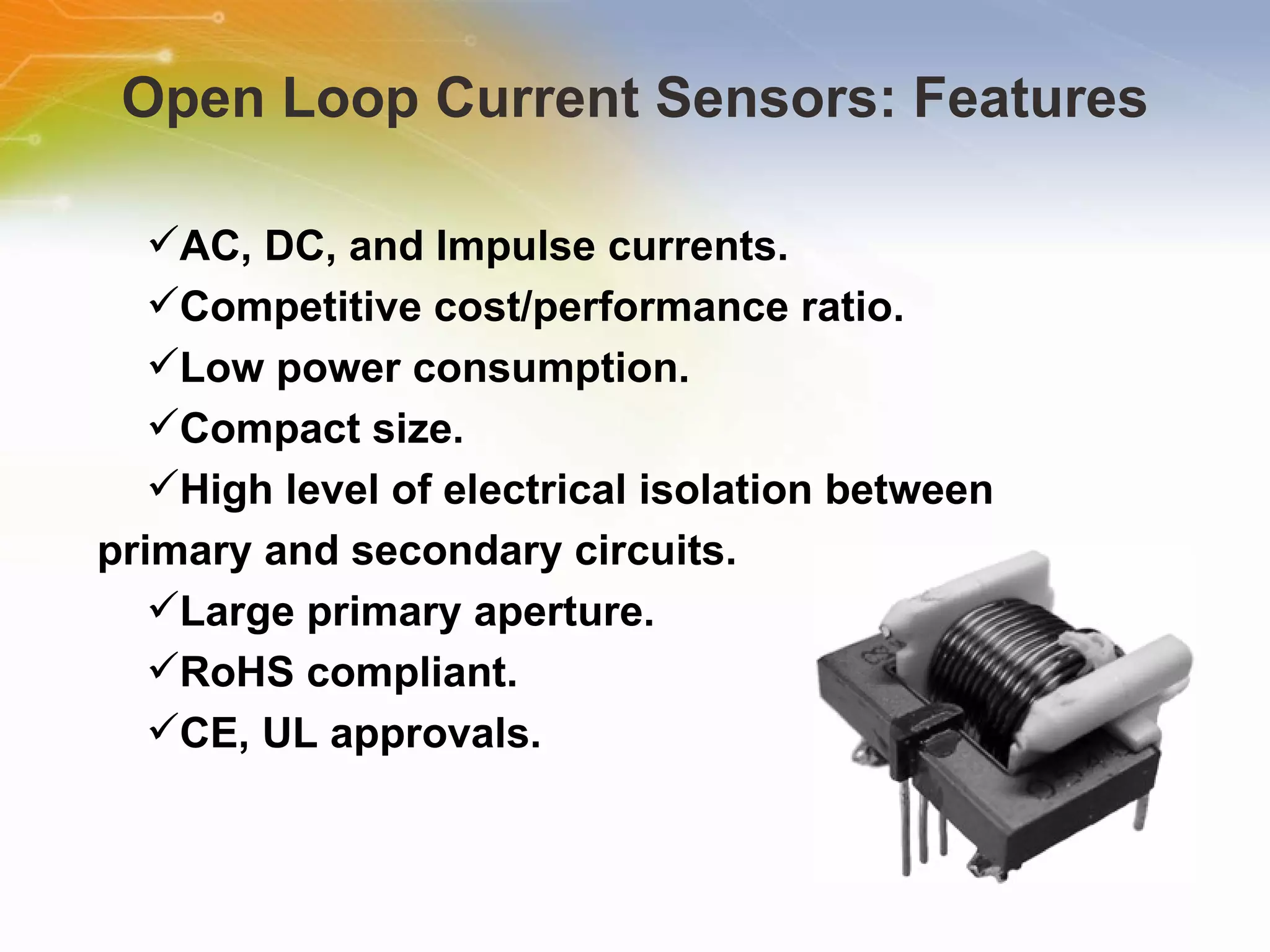
Open Loop Current Sensors: Features AC, DC, and Impulse currents.  Competitive cost/performance ratio.  Low power consumption.  Compact size.  High level of electrical isolation between primary and secondary circuits.  Large primary aperture.  RoHS compliant.  CE, UL approvals.
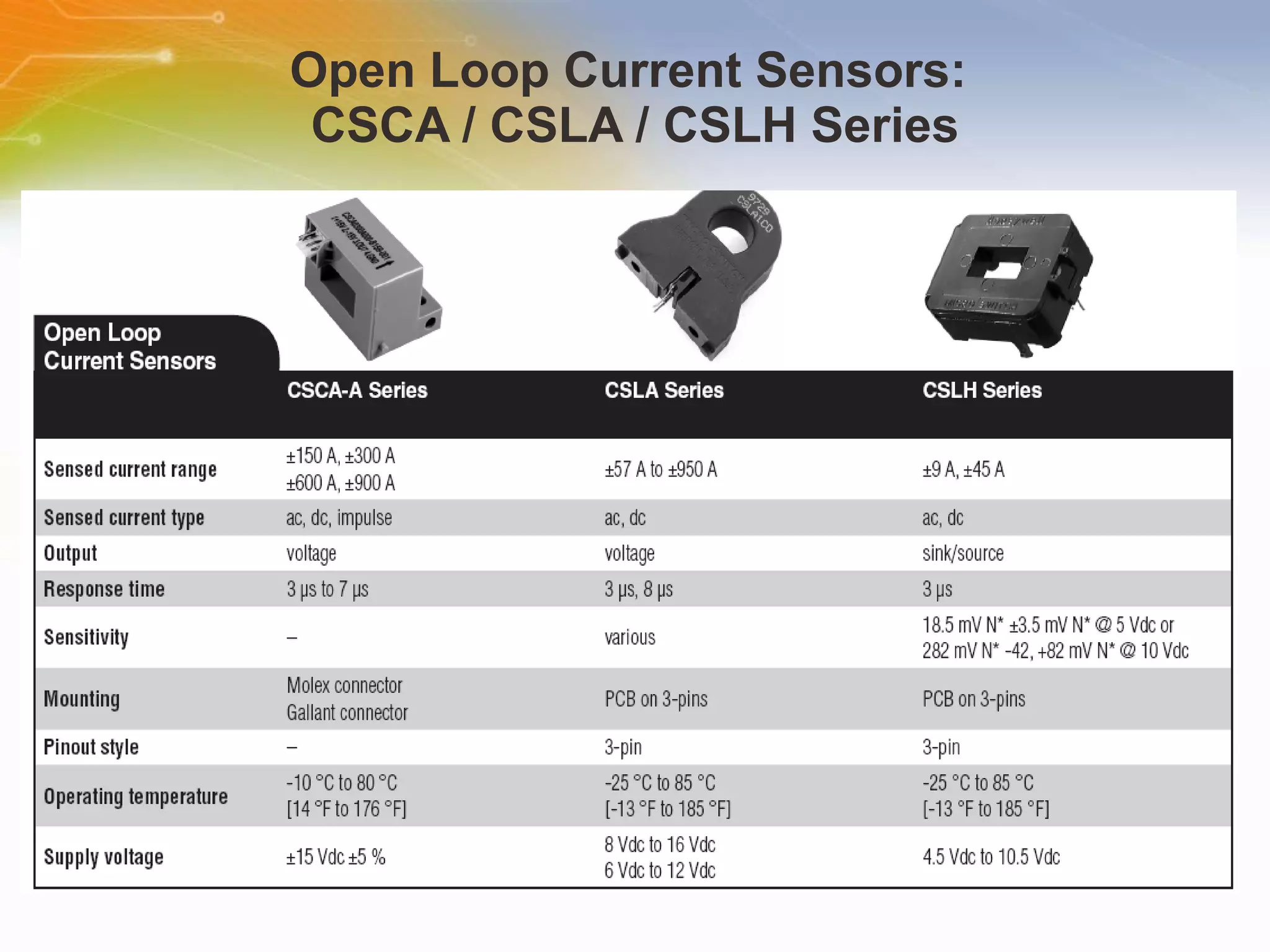
Open Loop Current Sensors:  CSCA / CSLA / CSLH Series
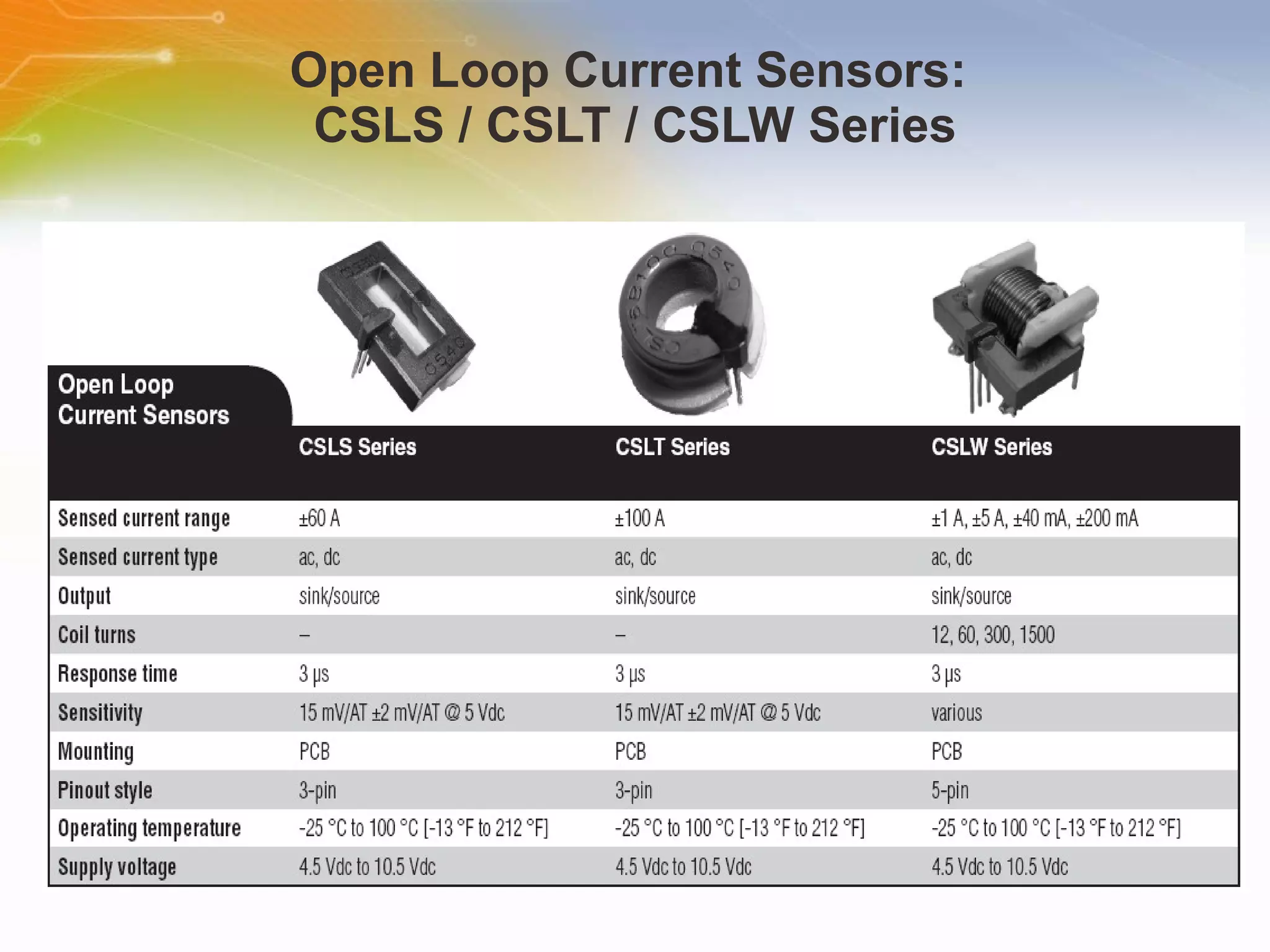
Open Loop Current Sensors:  CSLS / CSLT / CSLW Series
Additional Resource For ordering Honeywell Current Sensor, please click the part list or Call our sales hotline For more product information go to http://sensing.honeywell.com/index.cfm?Ne=2308&ci_id=154317&N=3027&la_id=1 Visit Element 14 to post your question   www.element-14.com For additional inquires contact our technical service hotline or even use our “Live Technical Chat” online facility Newark Farnell

Current Sensor

  • 1.
  • 2.
    Introduction Purpose Tointroduce an Brief classification of different Current Sensor Outline Introduction to Honeywell Current Sensors Digital/Inductive Current Sensor Closed Loop current sensor and its Sub-categories Open Loop current sensor and its Sub-categories Content 14 pages
  • 3.
    Introduction to HoneywellCurrent Sensors Digital/Inductive Current Sensors Uses feedback control, Provide output proportional to measured current, High accuracy and linearity, Fast response. CSDA Series. Closed Loop Current Sensors Provide digital output that changes from Vcc to 0.4V when sensed current, Not damaged by over current in sensed conductor. CSNB, CSNA, CSNC, CSNE, CSNF, CSNG, CSNJ, CSNK, CSNL, CSNM, CSNP, CSNR, CSNS, CSNT And CSNX Series. Open Loop Current Sensors P rovide output proportional to measured current without using feedback control, Preferred in battery powered circuits. CSCA-A Series.
  • 4.
    Digital/Inductive Current SensorsOpen collector output . Digital output. AC or DC currents. Thru-hole design. Output voltage isolation from input. Minimum energy dissipation. Maximum current limited only by conductor size. Enhanced accuracy, low-cost sensing. RoHS compliant.
  • 5.
    Digital Inductive CurrentSensors CSDA Series TYPICAL APPLICATIONS Motor overload protection. Operations verification. Power loss detection. Monitoring. Burned-out light bulb detection.
  • 6.
    Closed Loop CurrentSensors: Features Current sensing up to 1275 A. ac, dc, and impulse currents. In-line or thru-hole design. Competitive cost/performance ratio. Rapid response. Reduced overshoot. High overload capability. High level of electrical isolation between primary and secondary circuits. Industrial operating temperature range. Small size and weight. RoHS compliant,CE, UL approvals.
  • 7.
    Closed Loop CurrentSensors CSNX / CSNA / CSNF Series
  • 8.
    Closed Loop CurrentSensors CSNB / CSNC / CSNE Series
  • 9.
    Closed Loop CurrentSensors CSNG / CSNJ / CSNK Series
  • 10.
    CSN Series HallEffect Current Sensors FEATURES Current sensing up to 1000A Measures DC, AC and impulse currents Very fast response High overload capability Extended temperature range -40°C to +85°C Different termination styles Optional conformal coating BENEFITS Increased measuring range in compact package No restriction on input current waveform Output signal accurately tracks changes in input signal Sensor integrity unaffected Improved reliability Flexibility of connection style Provides additional protection to the sensors Electrical Connection
  • 11.
    Open Loop CurrentSensors: Features AC, DC, and Impulse currents. Competitive cost/performance ratio. Low power consumption. Compact size. High level of electrical isolation between primary and secondary circuits. Large primary aperture. RoHS compliant. CE, UL approvals.
  • 12.
    Open Loop CurrentSensors: CSCA / CSLA / CSLH Series
  • 13.
    Open Loop CurrentSensors: CSLS / CSLT / CSLW Series
  • 14.
    Additional Resource Forordering Honeywell Current Sensor, please click the part list or Call our sales hotline For more product information go to http://sensing.honeywell.com/index.cfm?Ne=2308&ci_id=154317&N=3027&la_id=1 Visit Element 14 to post your question www.element-14.com For additional inquires contact our technical service hotline or even use our “Live Technical Chat” online facility Newark Farnell

Editor's Notes

  • #2 This is a training module on the Honeywell Current sensor
  • #3 Welcome to the training module on the Honeywell Current sensor. This training module introduces different types and features of a current sensor and its application.
  • #4 Honeywell offers a wide variety of current sensors to monitor alternating (ac) or direct (dc) current. From digital output detectors sensing a few hundred milliamps to linear sensors monitoring over one thousand amps, Honeywell line provides superior performance at a reduced cost. It has been categorised in three types of current sensors: Digital/Inductive Current Sensors, Closed Loop Current Sensors, Open Loop Current Sensors. When any of these sensors detect predetermined signals, the system then performs the designated task. For instance, the digital signal’s logic level output may sound an alarm, start a motor, or open a valve.
  • #5 This Page gives you information about a Digital / inductive current sensor. It Uses feedback control and Provides output proportional to measured current and it also has High accuracy and linearity, Fast response, Low temperature drift and its Output is relatively immune to electrical noise.
  • #6 This page explains about the CSDA Series Digital / Inductive current sensors, these current sensors produce a digital logic level output. When the current being sensed reaches a predetermined level, the output changes state. Its Output voltage is isolated from the input, it has a 40mA current sinking output. Its major application areas includes motor overload protection, monitoring system, power loss detection. CSDA Series digital current sensor specifies a 0.25 A to 1.0 A operating current, through-hole design, logic level sinking output, operates on AC or DC current, pin-out style 1 PCB pins.
  • #7 This Page gives you information about a Closed Loop current sensor. It has around fifteen series of sub-category products which is presented in further slides. It can sense current up to 1275A, it is available in in-line or thru-hole design, it has reduced overshoot and has high overload capability. This closed loop current is the output from the device and presents an image of the primary current reduced by the number of secondary turns.
  • #8 Closed loop current sensors measure AC, DC and impulse currents over 0-25, 0-50, 0-100, 0-600 and 0-1200 Amp ranges. The CSN Series is based on the principles of the Hall effect and the null balance or zero magnetic flux method (feedback system). Here we show features of CSNX / CSNA / CSNF Series closed loop current sensors. CSN Series closed loop current sensor, measures ac, dc or impulse current, 50 A nominal, ±70 amp range, 1000 turn The CSN series MR current sensor builds on patented Honeywell technology to offer superior performance and accuracy in current measuring application.
  • #9 This page shows the features of CSNB / CSNC / CSNE Series closed loop current sensors. The features includes Sensed current range, supported current type (AC/DC) output form, No of coil turns, the response time, its accuracy, mounting type and supply voltage. This current sensor utilizes an ASIC and a magnetic sensor to provide extremely low offset drift with temperature resulting in stable, repeatable and accurate measurement.
  • #10 Here we have shown features of CSNG / CSNJ / CSNK Series Closed Loop Current Sensors. CSN Series closed loop current sensor, measures ac, dc or impulse current, 50A nominal, ±70 amp range, 1000 turn . The sensor operates from +5V unipolar supply and has an accessible internal 2.5V voltage reference.
  • #11 These new industrial current sensors extend Honeywell’s closed loop current sensing capability. They offer increased current measuring capability up to 1000A over an extended temperature range of -40°C to +85°C and are available with different terminal options. The sensors are closed loop devices based on the principle of the hall effect and null balance method. The output from the current sensor is the balancing current which is a perfect image of the primary current reduced by the number of secondary turns at any time. This current can be expressed as a voltage by passing it through a resistor.
  • #12 Here we have shown the general features of open loop current sensor like these type of sensors can operate ion AC or DC and impulse current, it consumes low power, it has high level of electrical isolation between primary and secondary circuits.
  • #13 Here we show features of Open Loop Current Sensors CSCA / CSLA / CSLH Series, CSCA-A Series Hall-effect based, open-loop current sensor, Molex-type connector, 50 A rms nominal, ±150 A range. It has Linear output, operates at ac or dc currents, Thru-hole design, Enhanced response time, Output voltage isolation from input, Minimum energy dissipation, Maximum current limited only by conductor size. Also, it has Adjustable performance and built-in temperature compensation and assures reliable operation.
  • #14 This page gives you information about open loop current sensor CSLS / CSLT / CSLW Series. CSL Series miniature open-loop current sensor, 60A sensed current, sink or source output, through-hole, operates on ac or dc current, bottom mount. Its sensing type can be ac or dc currents, it gives Linear ratio metric output, it has Current sinking or sourcing output for interfacing flexibility, No insertion loss, it has Enhanced response time, Compact size for applications with limited space, it has Enhanced accuracy, low-cost sensing, Minimum energy dissipation and Maximum current limited only by conductor size.
  • #15 Thank you for taking the time to view this presentation on “ Honeywell current sensor ” . If you would like to learn more or go on to purchase some of these devices, you may either click on the part list link, or simply call our sales hotline. For more technical information you may either visit the Honeywell site, or if you would prefer to speak to someone live, please call our hotline number, or even use our ‘live chat’ online facility. You may visit Element 14 e-community to post your questions.