Embed presentation
Downloaded 1,180 times


The HY-WIRE concept car uses hydrogen fuel cells instead of an engine or hydraulic systems. It has a fuel cell stack that powers an electric motor and uses drive-by-wire technology instead of mechanical linkages. The car has a central computer that controls acceleration via hand controls on either side of the driver interface, which uses LCD screens instead of mirrors. The hydrogen fuel is stored in composite cylinders and the fuel cells produce electricity through a chemical reaction with oxygen to power the vehicle without pollution.




Presentation introduced by III E.C.E. about the HY-WIRE vehicle.
HY-WIRE uses hydrogen fuel cells instead of hydraulic links, featuring drive by wire technology.
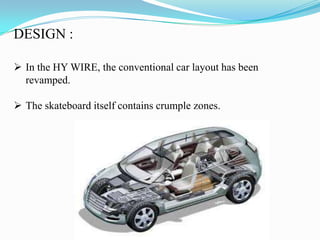
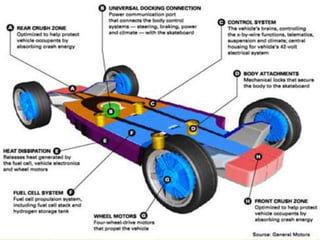
The design of HY-WIRE features a re-imagined layout with integrated crumple zones.
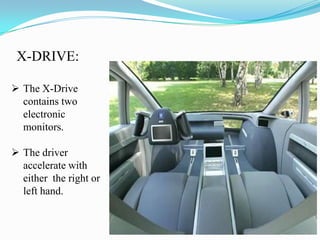
Features two electronic monitors; drivers can accelerate using either hand.
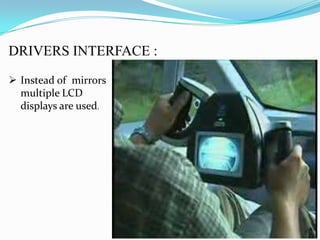
Utilizes multiple LCD displays instead of traditional mirrors for improved visibility.
HY-WIRE is powered by a fuel cell stack and employs drive by wire systems.
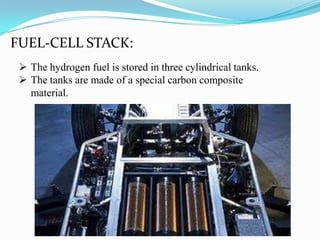
Hydrogen fuel stored in three carbon composite cylindrical tanks.
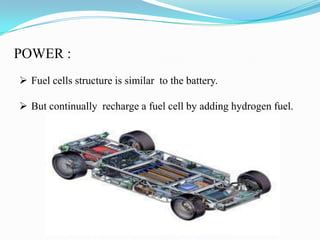
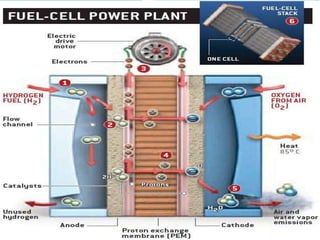
Fuel cells function like batteries, recharged continuously by hydrogen.
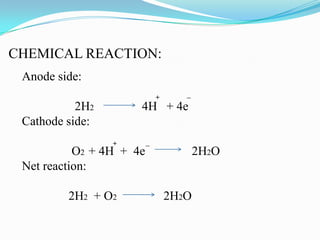
Describes the chemical reactions involved in the fuel cell operation.
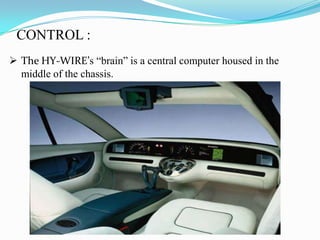
Features a central computer as the 'brain' of the vehicle located in the chassis.
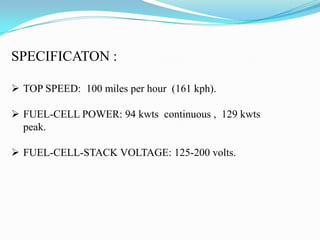
Top speed: 100 mph, Fuel-cell power: 94 kW continuous, 129 kW peak, Voltage: 125-200 V.
Minimizes fuel consumption and pollution; offers flexibility, stability, and spaciousness.
Fuel cells represent a promising alternative, facing challenges in hydrogen storage.
HY-WIRE has significantly impacted the auto industry; expected public launch by 2020.
The presentation concludes with an invitation for queries from the audience.