FETAL MONITORING
GOALS
1. To have standardized terminology and approach in
interpretation of CTG
2. To identify abnormal CTG and appropriate
intervention
3. Risk management and documentation
MODALITIES IN SGH…
 Intermittent auscultation (Pinard stetoscope)
 Electronic FHR monitoring (Daptone)
 Cardiotocograph (CTG)- external or internal
 Fetal scalp blood sampling (pH testing)
1. FETAL STETHOSCOPE…
• 17th century - 1818 Francis-Isaac
• Professor John Ferguson described fetal heart sound in 1827
Hohl fetal stethoscope Depaul fetal stethoscope
Procedure Rationale
1 Perform Leopold’s manoeuver by palpating
the maternal abdomen
To identify fetal presentation and
position
2 Place the listening device over the area of
maximum intensity, which is usually over the
back of the fetus, and clarity of the fetal heart
sound
To obtain the clearest and loudest
sound, this is easier to count.
3 Count the maternal radial pulse To differentiate it from the fetal
rate
4 Palpate the abdomen for the absence of
uterine activity
To be able to count FHR between
contraction
5 Count the FHR for 30 to 60 seconds between
contractions
To identify the basal heart rate
(BHR) which can only be assessed
during the absence of uterine
activity
6 Auscultate the FHR during contraction, if
possible, and for 30 seconds after the end of
the contraction
To identify the FHR during the
contraction and as a response to
the contraction
7 When there are distinct discrepancies in FHR
during or between listening periods,
auscultate for a longer period during, after
and between contraction
To identify changes from the
baseline that indicate the need for
another mode of FHR monitoring
FREQUENCY OF AUSCULTATION
Stageoflabour Lowrisk Highrisk
Latentphase Every30-60minutes Every30minutes
Activephase Every30minutes Every15minutes
Secondstage Every15minutes Every5minutes
2.DAPTONE..
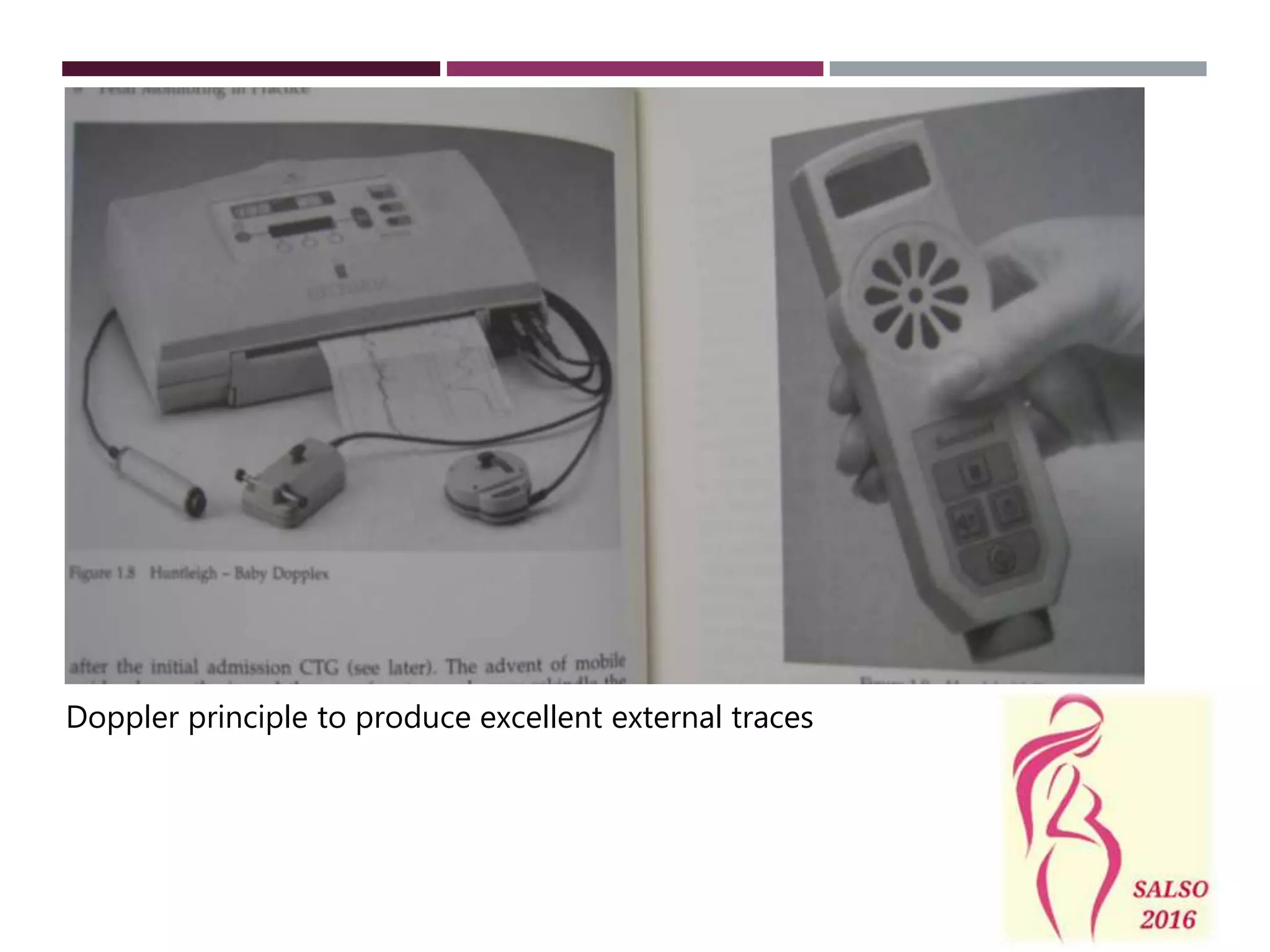
Doppler principle to produce excellent external traces
FREQUENCY OF AUSCULTATION
Stageoflabour Lowrisk Highrisk
Latentphase Every30-60minutes Every30minutes
Activephase Every30minutes Every15minutes
Secondstage Every15minutes Every5minutes
3. CTG…
DEFINITION
 (CTG) is a technical means of recording (-graphy) the
fetal heartbeat (cardio-) and the uterine contractions (-
toco-) during pregnancy
 The machine used to perform the monitoring is called a
cardiotocograph (CTG), more commonly known as an
electronic fetal monitor (EFM)
Ultrasound Doppler technology has produce excellent quality external traces
Corometric 170 series
Avalon FM 20
Oxford-Sonicaid Meridian fetal
monitor
ADVANTAGES
 FHR & contraction can be
monitored & recorded at
the same time
 Reduce rates of seizure in
newborn
DISADVANTAGES
 Prevent mother from moving
 Unable to change position
 Increase interventions
(instrumental deliveris or C-sec)
TYPES
EXTERNAL CTG
 An ultrasound transducer
over the abdomen that will
pick up the baby's
heartbeat. The heartbeat
will be recorded
continuously on a paper
strip.
 Tocogram- a pressure
gauge that measures the
frequency of your
contractions.
INTERNAL CTG
 This method can only be
used if membranes (fore-
waters) and your cervix
have ruptured either
spontaneously or
artificially.
 An electrode is placed on
the baby’s scalp to directly
monitor the fetal heart
rate. An electrode is called
a fetal scalp electrode (FSE)
 The length of the CTG strip depends on the paper speed. In
the UK it is usually 1cm/min.
 Each vertical division on the paper is 1cm and therefore 1
min.
SALSO 2015
ELECTRICAL FETAL MONITORING: TERMINOLOGY
A=Fetal heart rate
B=Movement by mother
C=Fetal movement
D=Contraction
Twin 1
Twin 2
Tocogra
m
DR DEFINE RISK
C CONTRACTION
BR BASELINE HEART
RATE
A ACCELARATION
VA VARIABILITY
D DECELARATION
O OVERALL
INTERPRETATION OF CTG: DR C BR A VA DO
 The process of birth is the most dangerous journey any
individual undertakes
 Assess from the history and examination either low
risk or high risk pregnancy
 Admission CTG performed, then intermittent ascultation vs
continuous monitoring
1. DR = DEFINE RISK
*ALL ANTENATAL PATIENT CAME TO LABOUR ROOM WILL
HAVE AN ADMISSION CTG AT LEAST 20 MINS TRACING
RISK CTG MONITORING
LOW - Intermittent tracing 2-4hly
- Continous CTG is unnecessary
MODERATE - Intermittent CTG trace to be decide by registra or
specialist
- Frequency & length of CTG tracing depends on
individual case & previous trace
HIGH - Intermittent CTG trace to be decide by registrar or
specialist
- Continous CTG may be needed
 Assess contraction pain from the tocogram- quantifying the number
of contractions present in a 10-minute window
 There are several factors used in assessing uterine activity.
 Frequency
 Duration
 Normal- less than or equal to 5 contractions in 10 minutes, averaged
over a 30-minute window
 Tachysystole- more than 5 contractions in 10 minutes, averaged over
a 30-minute window
2. C = CONTRACTION
SALSO 2015
CONTRACTIONS
 Level of the fetal heart rate when this stable with
accelerations and decelerations excluded. Determined
over a period of 5 or 10 min and expressed in bpm.
 Normal range is 100-160bpm.
3. BR = BASELINE FETAL HEART RATE
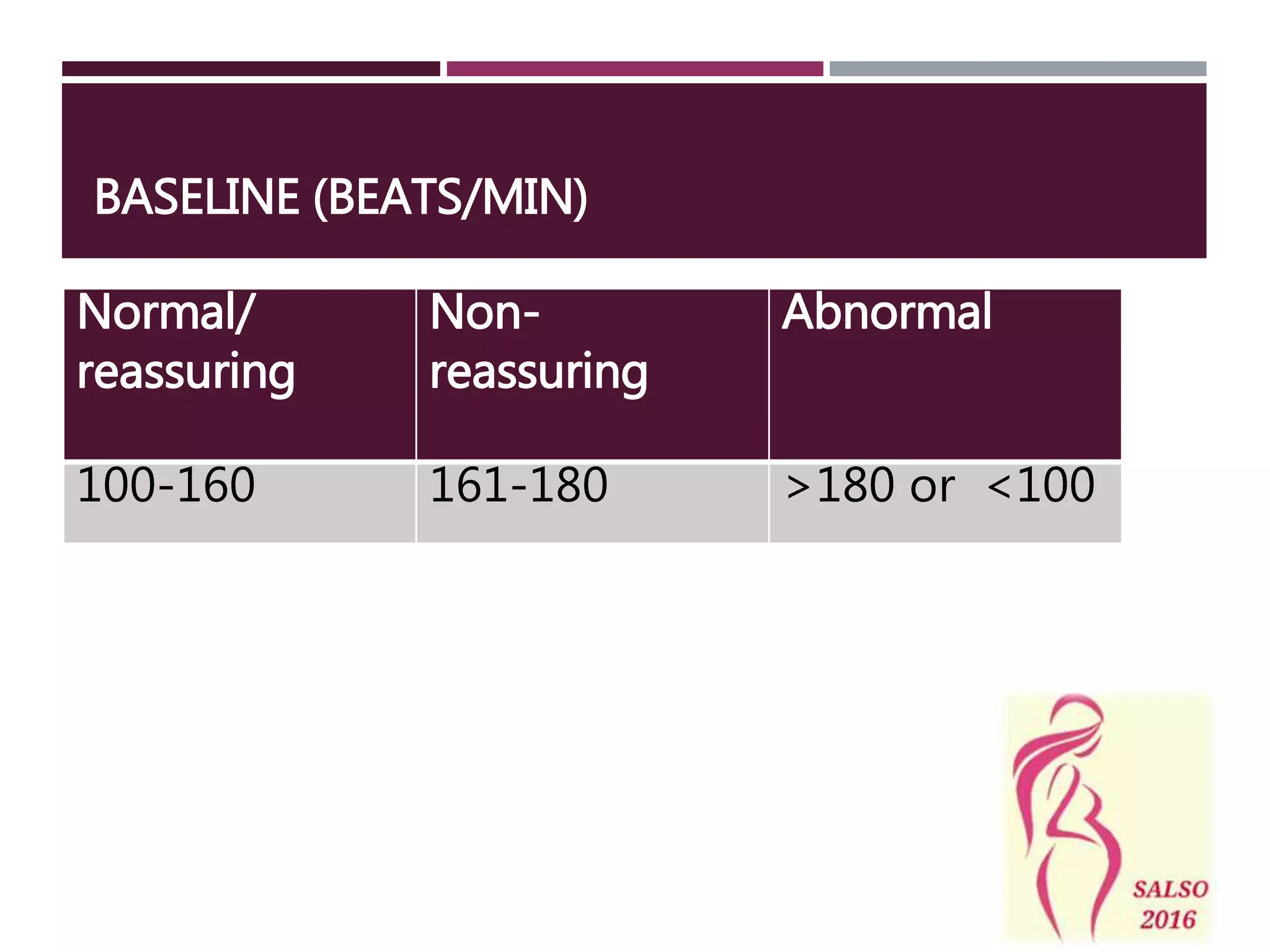
BASELINE (BEATS/MIN)
Normal/
reassuring
Non-
reassuring
Abnormal
100-160 161-180 >180 or <100
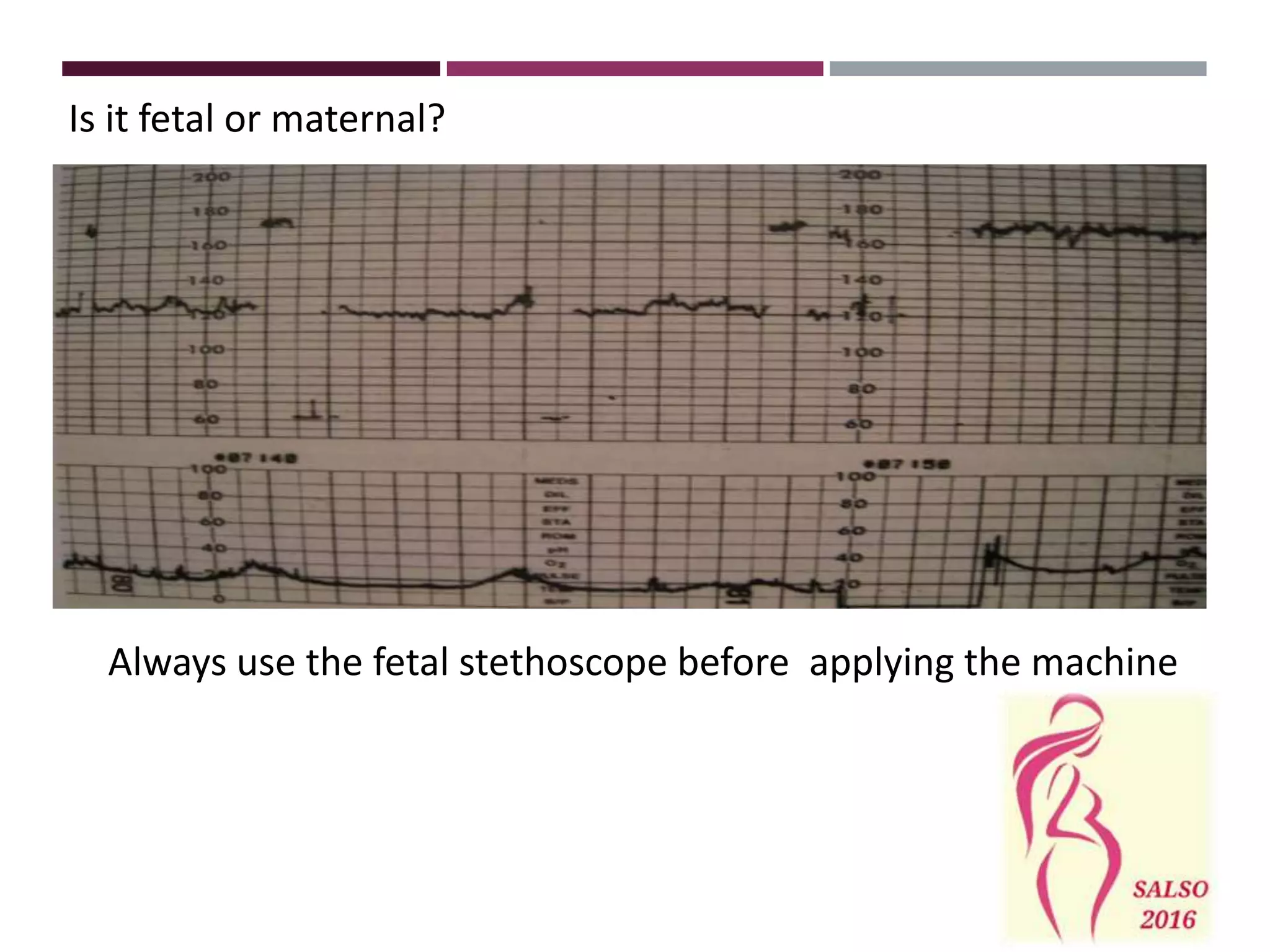
Is it fetal or maternal?
Always use the fetal stethoscope before applying the machine
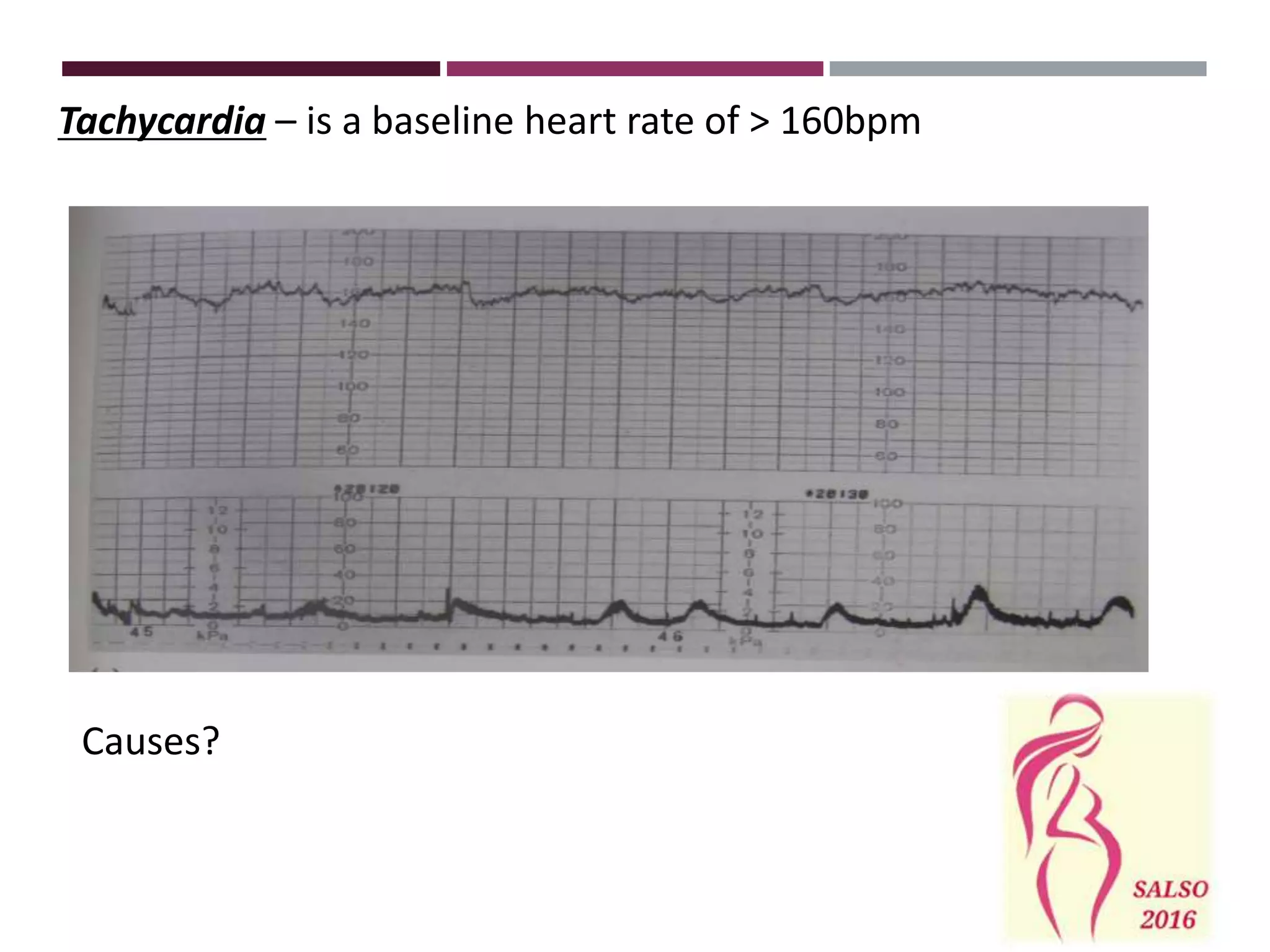
Tachycardia – is a baseline heart rate of > 160bpm
Causes?
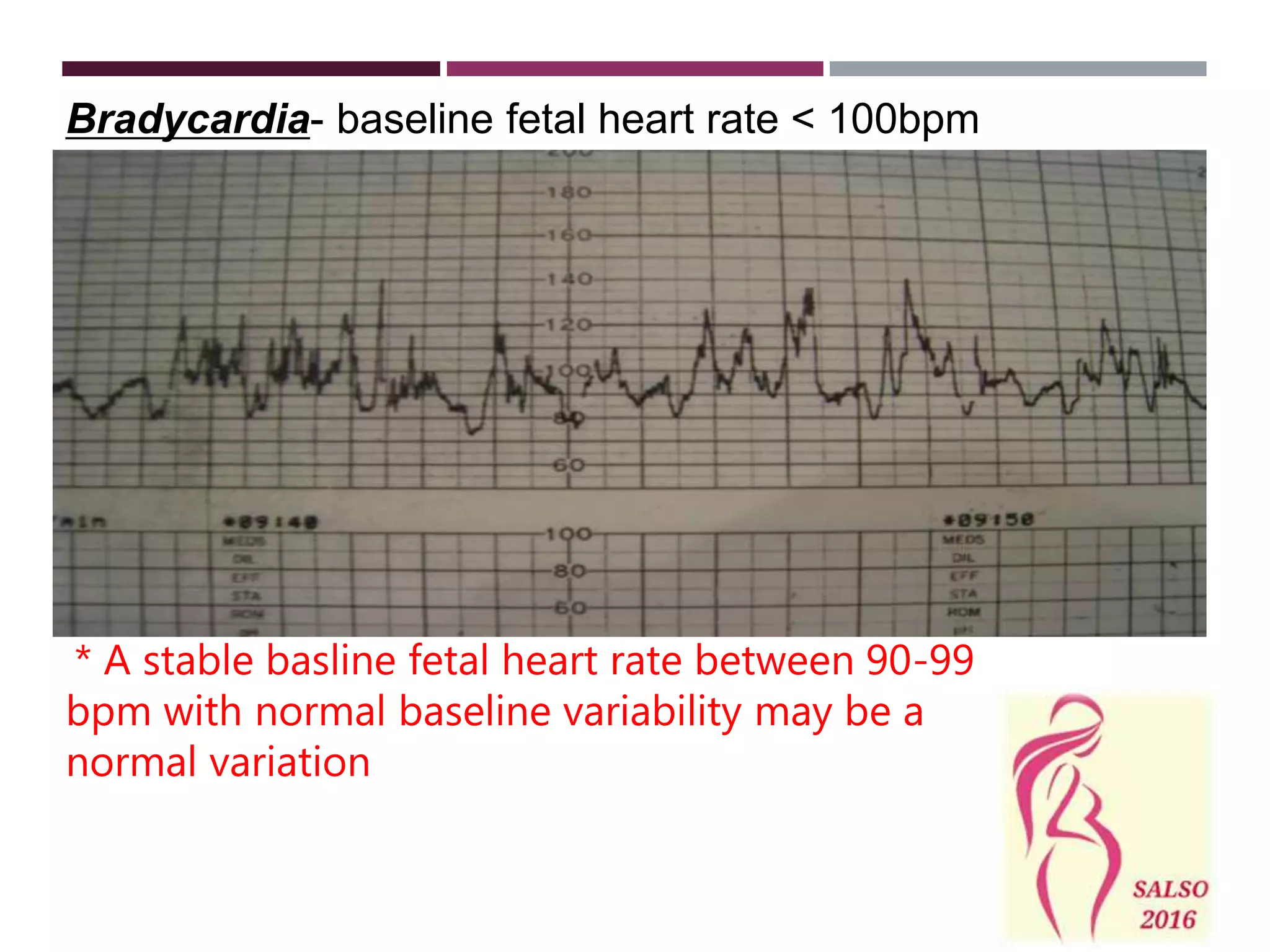
Bradycardia- baseline fetal heart rate < 100bpm
* A stable basline fetal heart rate between 90-99
bpm with normal baseline variability may be a
normal variation
 Transient increase in heart rate of 15bpm or more and
lasting 15s or more.
 The recording of at least 2 accelerations in a 20 min
period is considered a reactive trace
Accelerations are the hallmark of fetal health.
4. A = ACCELERATION
NICE GUIDELINES 2014
 Acceleration is not a feature to categorise CTG
 Fetal heart rate accelerations is generally a sign that
unborn baby is healthy
 Abscence of accelerations in an otherwise normal CTG
does not indicate acidosis
 If FBS is indicated and sample cannot be obtained,but
scalp stimulation results in fetal heart rate
acceleration,decide whether to continue labour or
expedite the birth in light of the clinical circumstances and
in discussion with the woman
Baseline varies within a particular band width excluding
accelerations and decelerations. It indicates the integrity of the
autonomic nervous system
Silent , 0-5bpm
Reduced, 5-
10bpm
Normal, 10-25bpm
Saltatory, >25bpm
5. VA = VARIABILITY
BASELINE VARIABILITY
Normal/
reassuring
Non-
reassuring
Abnormal
5 or more <5 for 30-90min <5 for > 90min
*Intermittent period of reduced baseline variability
are normal, especially during periods of “sleep”
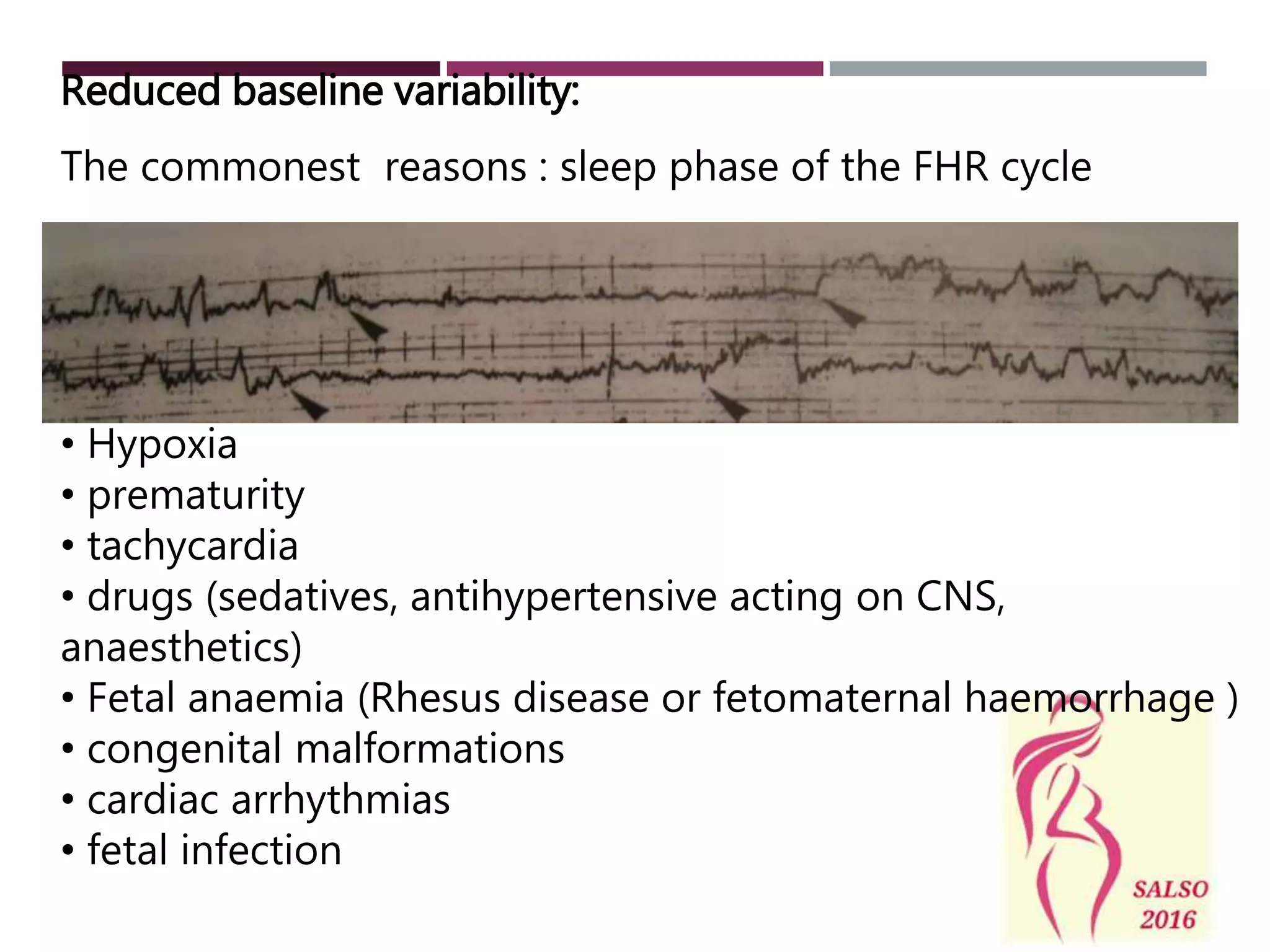
Reduced baseline variability:
The commonest reasons : sleep phase of the FHR cycle
• Hypoxia
• prematurity
• tachycardia
• drugs (sedatives, antihypertensive acting on CNS,
anaesthetics)
• Fetal anaemia (Rhesus disease or fetomaternal haemorrhage )
• congenital malformations
• cardiac arrhythmias
• fetal infection
 Transient episode of slowing of the heart rate below the
baseline level of > 15bpm and lasting 15s or more
6. D = DECELERATION
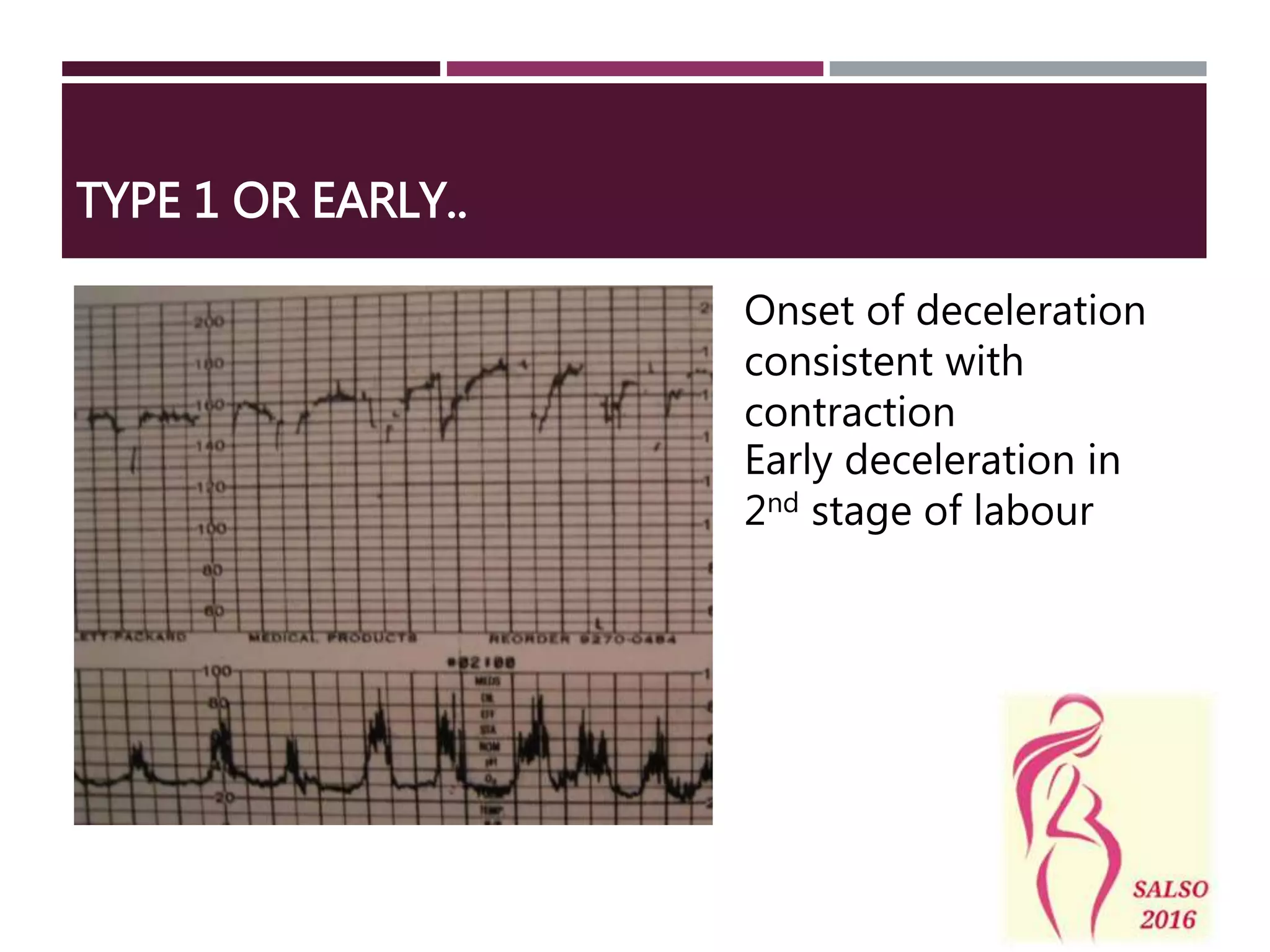
Early deceleration in
2nd stage of labour
TYPE 1 OR EARLY..
Onset of deceleration
consistent with
contraction
The onset of
deceleration after the
contraction.
Late deceleration in 2nd
stage of labour
TYPE 2 OR LATE….
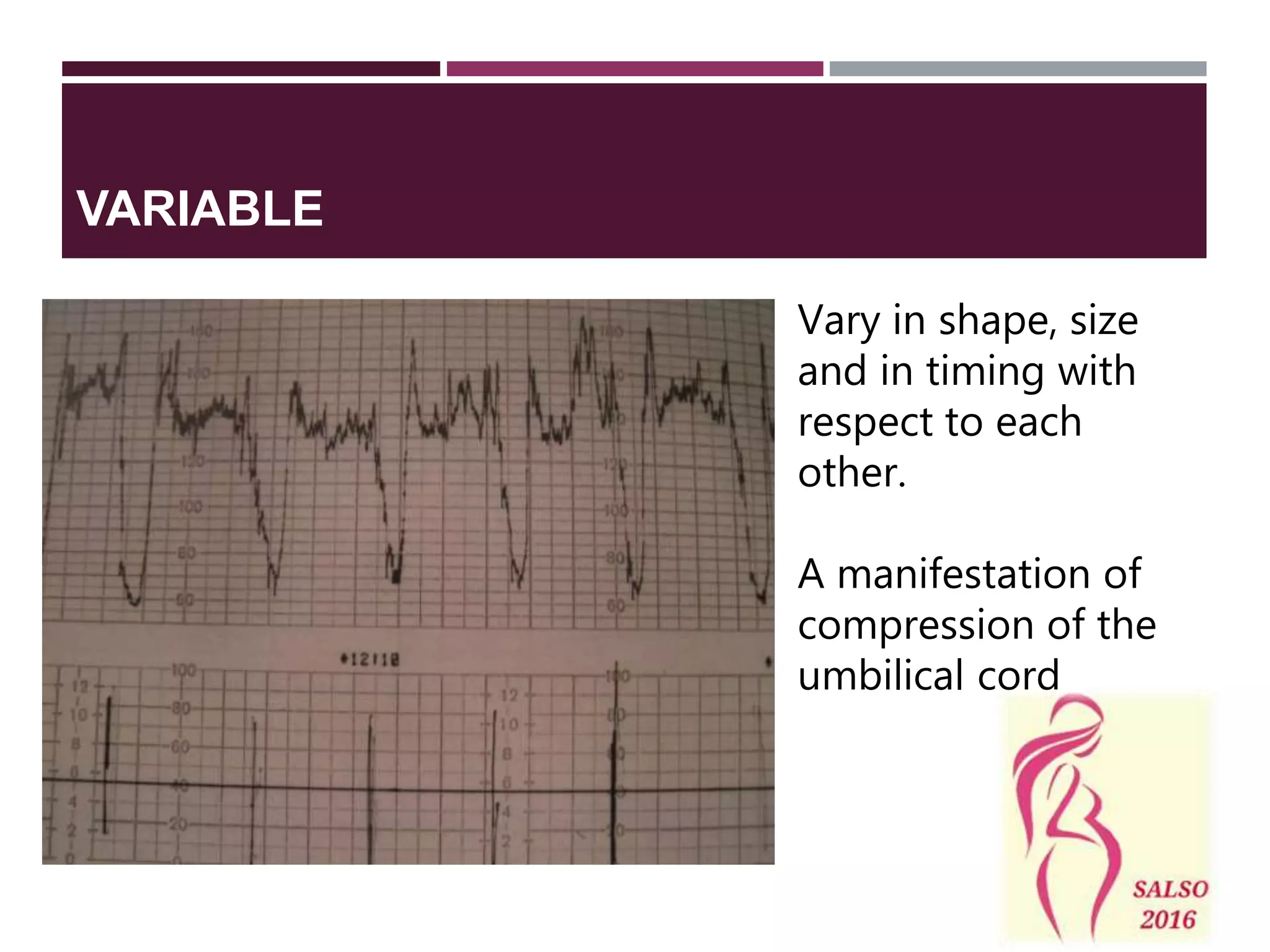
Vary in shape, size
and in timing with
respect to each
other.
A manifestation of
compression of the
umbilical cord
VARIABLE
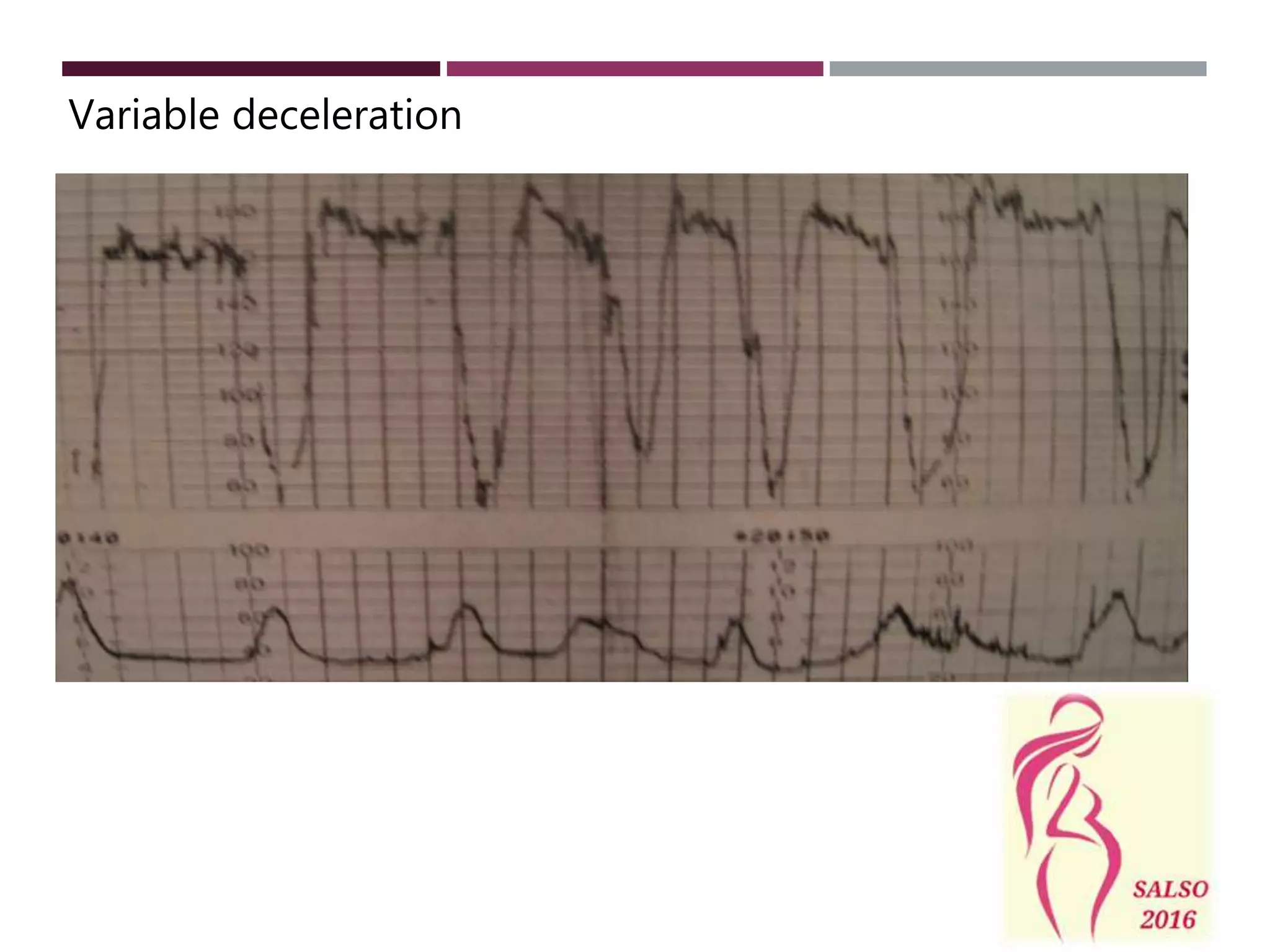
Variable deceleration
Normal/
reassuring
Non-
reassuring
Abnormal
None or early Variable deceleration dropping from
baseline less than 60 beats
AND
taking less than 60 sec to recover
Present over 90min
Occuring over 50% of contraction
Non-reassuring variable
deceleration
Still observed 30min after starting
conservative measures
Variable deceleration dropping from
baseline >60 bpm
OR
taking > 60sec to recover
Present for up to 30min
Occuring over 50% of contractions
Bradycardia or single prolonged
deceleration lasting 3min or more
Late deceleration present for
up to 30min
Occuring over 50% of contractions
Late deceleration present for
>30 min
Occuring over 50% of contraction
Do not improve with conservative
measures
Decelerations (variable or late) accompanied by
fetal tachycardia or reduced baseline variability
Take action sooner than 30min
 Normal/Reassuring
 Non-reassuring
 Abnormal
7. O=OVERALL CATEGORISATION OF FHR TRACE
4 FEATURES OF CTG
1) Acceleration – no longer include
2) Baseline fetal heart rate
3) Baseline variability
4) Deceleration
Used to
categorise CTG
CTG catogories
Normal /reassuring All 3 features are normal
Non-reassuring 1 non-reasuring feature
AND 2 normal/reassuring
features
• Conservative measures
Abnormal
(need for conservative
measures AND further
testing)
1 abnormal feature
OR
2 non-reasuring features
• Conservative measures
• Offer FBS
or
Expedite birth if FBS
cannot be obtained and no
accelerations are seen as a
result of scalp stimulation
Abnormal
(need for urgent intervention)
Bradycardia or single
prolonged deceleration with
baseline below 100bpm
persisting 3min or more
• Start Conservative measure
• Prepare for urgent birth
• Expedite birth if persist for
9min
• If heart rate recovers before
9 min, reassess decision to
expedite birth in discussion
with the woman
OVERALL CARE
 Do not make any decision about woman’s care in labour on the basis of
CTG findings alone
 Make a documented systematic assessment of the condition of woman
and the unborn baby hourly or more frequently if there is concern
HOW TO MANAGE??
 DEPENDS ON VARIOUS FACTORS
 1.Severity of abnormal trace
 2.Antenatal risk
 3.Patient’s age & parity
 4.How advance she is in labour
 5.Progress of labour
 6.Colour of liquour
 7.Patient’s opinion
CTG GOALS DO DON’T
Recurrent Type 2
decelerations
Improve placenta
perfusion
-Left lateral
position
-Reducing
frequency of
uterine
contractions
-Administer O2
-IV Fluid bolus
Prolonged
deceleration or
bradycardia
Improve placenta
perfusion
-Tocolytic agents
Minimal or absent
variability
Improve placenta
perfusion
-Lateral position
-Fetal stimulation
Hyperstimulation Reduce uterine
contractility
-Stop oxytocin
-Tocolytic agents
Recurrent variable
deceleration
Reduce cord
compression
-Maternal position Amnioinfussion
** In an emergency setting-
acceptable time for decision to the
delivery of the baby is 30 minutes
SECOND STAGE CTG
 Most of the time CTG is abnormal
 Early deceleration or variable deceleration is
acceptable
 Which CTG changes require interventions?
 Prolonged bradycardia
 Reduced variability
4. FETAL SCALP BLOOD SAMPLING
 Fetal scalp PH testing is essentially an invasive vaginal
procedure performed when a woman is in active labour
to determine if the baby is getting enough oxygen
 If possible should be performed before a decission of C-
Sec is made where the CTG changes are not conclusive or
suspicious
RESULT…
pH RESULT ACTION
NORMAL 7.25-7.35 REPEAT IF
ABNORMALITY
PERSIST
BORDERLINE 7.20-7.25 REPEAT TEST EVERY 30
MINS TILL DELIVERY IF
VAGINAL DELIVERY IS
EXPECTED SOON
ABNORMAL < 7.20 EXPEDITE DELIVERY
 RISKS
 Bleeding from puncture site
 Infection
 Bruising on fetal’s scalp
 CONTRAINDICATIONS
 Infections- hep C or HIV
 Thrombocytopenia
 Non cephalic presentation
 Prematurity <34 weeks
RISK MANAGEMENT
 Proper documentation in case notes- date,
time, signature
 Document paired cord blood gases & accurate
Apgar Score
 Photocopy the CTG and store properly
 Frequent training of staff
Ctg 2016

Ctg 2016

  • 1.
  • 2.
    GOALS 1. To havestandardized terminology and approach in interpretation of CTG 2. To identify abnormal CTG and appropriate intervention 3. Risk management and documentation
  • 3.
    MODALITIES IN SGH… Intermittent auscultation (Pinard stetoscope)  Electronic FHR monitoring (Daptone)  Cardiotocograph (CTG)- external or internal  Fetal scalp blood sampling (pH testing)
  • 4.
  • 5.
    • 17th century- 1818 Francis-Isaac • Professor John Ferguson described fetal heart sound in 1827 Hohl fetal stethoscope Depaul fetal stethoscope
  • 6.
    Procedure Rationale 1 PerformLeopold’s manoeuver by palpating the maternal abdomen To identify fetal presentation and position 2 Place the listening device over the area of maximum intensity, which is usually over the back of the fetus, and clarity of the fetal heart sound To obtain the clearest and loudest sound, this is easier to count. 3 Count the maternal radial pulse To differentiate it from the fetal rate 4 Palpate the abdomen for the absence of uterine activity To be able to count FHR between contraction 5 Count the FHR for 30 to 60 seconds between contractions To identify the basal heart rate (BHR) which can only be assessed during the absence of uterine activity 6 Auscultate the FHR during contraction, if possible, and for 30 seconds after the end of the contraction To identify the FHR during the contraction and as a response to the contraction 7 When there are distinct discrepancies in FHR during or between listening periods, auscultate for a longer period during, after and between contraction To identify changes from the baseline that indicate the need for another mode of FHR monitoring
  • 7.
    FREQUENCY OF AUSCULTATION StageoflabourLowrisk Highrisk Latentphase Every30-60minutes Every30minutes Activephase Every30minutes Every15minutes Secondstage Every15minutes Every5minutes
  • 8.
  • 9.
    Doppler principle toproduce excellent external traces
  • 10.
    FREQUENCY OF AUSCULTATION StageoflabourLowrisk Highrisk Latentphase Every30-60minutes Every30minutes Activephase Every30minutes Every15minutes Secondstage Every15minutes Every5minutes
  • 11.
  • 12.
    DEFINITION  (CTG) isa technical means of recording (-graphy) the fetal heartbeat (cardio-) and the uterine contractions (- toco-) during pregnancy  The machine used to perform the monitoring is called a cardiotocograph (CTG), more commonly known as an electronic fetal monitor (EFM)
  • 13.
    Ultrasound Doppler technologyhas produce excellent quality external traces Corometric 170 series Avalon FM 20
  • 14.
  • 15.
    ADVANTAGES  FHR &contraction can be monitored & recorded at the same time  Reduce rates of seizure in newborn DISADVANTAGES  Prevent mother from moving  Unable to change position  Increase interventions (instrumental deliveris or C-sec)
  • 16.
    TYPES EXTERNAL CTG  Anultrasound transducer over the abdomen that will pick up the baby's heartbeat. The heartbeat will be recorded continuously on a paper strip.  Tocogram- a pressure gauge that measures the frequency of your contractions. INTERNAL CTG  This method can only be used if membranes (fore- waters) and your cervix have ruptured either spontaneously or artificially.  An electrode is placed on the baby’s scalp to directly monitor the fetal heart rate. An electrode is called a fetal scalp electrode (FSE)
  • 18.
     The lengthof the CTG strip depends on the paper speed. In the UK it is usually 1cm/min.  Each vertical division on the paper is 1cm and therefore 1 min. SALSO 2015 ELECTRICAL FETAL MONITORING: TERMINOLOGY
  • 19.
    A=Fetal heart rate B=Movementby mother C=Fetal movement D=Contraction
  • 20.
  • 21.
    DR DEFINE RISK CCONTRACTION BR BASELINE HEART RATE A ACCELARATION VA VARIABILITY D DECELARATION O OVERALL INTERPRETATION OF CTG: DR C BR A VA DO
  • 22.
     The processof birth is the most dangerous journey any individual undertakes  Assess from the history and examination either low risk or high risk pregnancy  Admission CTG performed, then intermittent ascultation vs continuous monitoring 1. DR = DEFINE RISK
  • 23.
    *ALL ANTENATAL PATIENTCAME TO LABOUR ROOM WILL HAVE AN ADMISSION CTG AT LEAST 20 MINS TRACING RISK CTG MONITORING LOW - Intermittent tracing 2-4hly - Continous CTG is unnecessary MODERATE - Intermittent CTG trace to be decide by registra or specialist - Frequency & length of CTG tracing depends on individual case & previous trace HIGH - Intermittent CTG trace to be decide by registrar or specialist - Continous CTG may be needed
  • 24.
     Assess contractionpain from the tocogram- quantifying the number of contractions present in a 10-minute window  There are several factors used in assessing uterine activity.  Frequency  Duration  Normal- less than or equal to 5 contractions in 10 minutes, averaged over a 30-minute window  Tachysystole- more than 5 contractions in 10 minutes, averaged over a 30-minute window 2. C = CONTRACTION
  • 25.
  • 26.
  • 27.
     Level ofthe fetal heart rate when this stable with accelerations and decelerations excluded. Determined over a period of 5 or 10 min and expressed in bpm.  Normal range is 100-160bpm. 3. BR = BASELINE FETAL HEART RATE
  • 28.
  • 29.
    Is it fetalor maternal? Always use the fetal stethoscope before applying the machine
  • 30.
    Tachycardia – isa baseline heart rate of > 160bpm Causes?
  • 31.
    Bradycardia- baseline fetalheart rate < 100bpm * A stable basline fetal heart rate between 90-99 bpm with normal baseline variability may be a normal variation
  • 32.
     Transient increasein heart rate of 15bpm or more and lasting 15s or more.  The recording of at least 2 accelerations in a 20 min period is considered a reactive trace Accelerations are the hallmark of fetal health. 4. A = ACCELERATION
  • 33.
    NICE GUIDELINES 2014 Acceleration is not a feature to categorise CTG  Fetal heart rate accelerations is generally a sign that unborn baby is healthy  Abscence of accelerations in an otherwise normal CTG does not indicate acidosis  If FBS is indicated and sample cannot be obtained,but scalp stimulation results in fetal heart rate acceleration,decide whether to continue labour or expedite the birth in light of the clinical circumstances and in discussion with the woman
  • 34.
    Baseline varies withina particular band width excluding accelerations and decelerations. It indicates the integrity of the autonomic nervous system Silent , 0-5bpm Reduced, 5- 10bpm Normal, 10-25bpm Saltatory, >25bpm 5. VA = VARIABILITY
  • 36.
    BASELINE VARIABILITY Normal/ reassuring Non- reassuring Abnormal 5 ormore <5 for 30-90min <5 for > 90min *Intermittent period of reduced baseline variability are normal, especially during periods of “sleep”
  • 37.
    Reduced baseline variability: Thecommonest reasons : sleep phase of the FHR cycle • Hypoxia • prematurity • tachycardia • drugs (sedatives, antihypertensive acting on CNS, anaesthetics) • Fetal anaemia (Rhesus disease or fetomaternal haemorrhage ) • congenital malformations • cardiac arrhythmias • fetal infection
  • 38.
     Transient episodeof slowing of the heart rate below the baseline level of > 15bpm and lasting 15s or more 6. D = DECELERATION
  • 39.
    Early deceleration in 2ndstage of labour TYPE 1 OR EARLY.. Onset of deceleration consistent with contraction
  • 40.
    The onset of decelerationafter the contraction. Late deceleration in 2nd stage of labour TYPE 2 OR LATE….
  • 41.
    Vary in shape,size and in timing with respect to each other. A manifestation of compression of the umbilical cord VARIABLE
  • 42.
  • 43.
    Normal/ reassuring Non- reassuring Abnormal None or earlyVariable deceleration dropping from baseline less than 60 beats AND taking less than 60 sec to recover Present over 90min Occuring over 50% of contraction Non-reassuring variable deceleration Still observed 30min after starting conservative measures Variable deceleration dropping from baseline >60 bpm OR taking > 60sec to recover Present for up to 30min Occuring over 50% of contractions Bradycardia or single prolonged deceleration lasting 3min or more Late deceleration present for up to 30min Occuring over 50% of contractions Late deceleration present for >30 min Occuring over 50% of contraction Do not improve with conservative measures
  • 44.
    Decelerations (variable orlate) accompanied by fetal tachycardia or reduced baseline variability Take action sooner than 30min
  • 45.
     Normal/Reassuring  Non-reassuring Abnormal 7. O=OVERALL CATEGORISATION OF FHR TRACE
  • 46.
    4 FEATURES OFCTG 1) Acceleration – no longer include 2) Baseline fetal heart rate 3) Baseline variability 4) Deceleration Used to categorise CTG
  • 47.
    CTG catogories Normal /reassuringAll 3 features are normal Non-reassuring 1 non-reasuring feature AND 2 normal/reassuring features • Conservative measures Abnormal (need for conservative measures AND further testing) 1 abnormal feature OR 2 non-reasuring features • Conservative measures • Offer FBS or Expedite birth if FBS cannot be obtained and no accelerations are seen as a result of scalp stimulation Abnormal (need for urgent intervention) Bradycardia or single prolonged deceleration with baseline below 100bpm persisting 3min or more • Start Conservative measure • Prepare for urgent birth • Expedite birth if persist for 9min • If heart rate recovers before 9 min, reassess decision to expedite birth in discussion with the woman
  • 48.
    OVERALL CARE  Donot make any decision about woman’s care in labour on the basis of CTG findings alone  Make a documented systematic assessment of the condition of woman and the unborn baby hourly or more frequently if there is concern
  • 49.
    HOW TO MANAGE?? DEPENDS ON VARIOUS FACTORS  1.Severity of abnormal trace  2.Antenatal risk  3.Patient’s age & parity  4.How advance she is in labour  5.Progress of labour  6.Colour of liquour  7.Patient’s opinion
  • 50.
    CTG GOALS DODON’T Recurrent Type 2 decelerations Improve placenta perfusion -Left lateral position -Reducing frequency of uterine contractions -Administer O2 -IV Fluid bolus Prolonged deceleration or bradycardia Improve placenta perfusion -Tocolytic agents Minimal or absent variability Improve placenta perfusion -Lateral position -Fetal stimulation Hyperstimulation Reduce uterine contractility -Stop oxytocin -Tocolytic agents Recurrent variable deceleration Reduce cord compression -Maternal position Amnioinfussion
  • 51.
    ** In anemergency setting- acceptable time for decision to the delivery of the baby is 30 minutes
  • 52.
    SECOND STAGE CTG Most of the time CTG is abnormal  Early deceleration or variable deceleration is acceptable  Which CTG changes require interventions?  Prolonged bradycardia  Reduced variability
  • 53.
    4. FETAL SCALPBLOOD SAMPLING
  • 54.
     Fetal scalpPH testing is essentially an invasive vaginal procedure performed when a woman is in active labour to determine if the baby is getting enough oxygen  If possible should be performed before a decission of C- Sec is made where the CTG changes are not conclusive or suspicious
  • 55.
    RESULT… pH RESULT ACTION NORMAL7.25-7.35 REPEAT IF ABNORMALITY PERSIST BORDERLINE 7.20-7.25 REPEAT TEST EVERY 30 MINS TILL DELIVERY IF VAGINAL DELIVERY IS EXPECTED SOON ABNORMAL < 7.20 EXPEDITE DELIVERY
  • 56.
     RISKS  Bleedingfrom puncture site  Infection  Bruising on fetal’s scalp  CONTRAINDICATIONS  Infections- hep C or HIV  Thrombocytopenia  Non cephalic presentation  Prematurity <34 weeks
  • 57.
    RISK MANAGEMENT  Properdocumentation in case notes- date, time, signature  Document paired cord blood gases & accurate Apgar Score  Photocopy the CTG and store properly  Frequent training of staff