CARDIOTOCOGRAPHY
Dr Shipra Kunwar
MD,FMAS,FICOG,MRCOG
Prof and head
Era’s lucknow medical college
lucknow
Assessment of fetal
well being
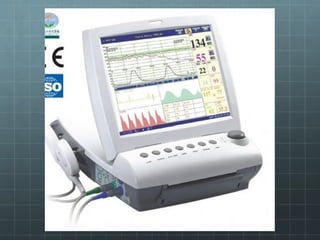
IA
EFM
INDICATIONS
CHORIOANIONITIS
MECONIUM
HYPERTENSION
OXYTOCIN
CONFIRMED DELAY IN LABOUR
PROLONGED RUPTURE OF MEMBRANES
FRESH VAGINAL BLEEDING IN LABOUR
NAME /AGE
TIME
DURATION
PAPER SPEED 1cm/min or 3 cm/min
PRESENCE OF FETAL BLOOD SAMPLING
Dr- define risk
C –contraction
B- Baseline
Ra-Rate
V-Variability
A-Accelerations
D-decelerations
O- overall impression
Define risk
contractions
Baseline rate
acelerationsvariabilty
declerations
Overall
DEFINE RISK
PREECLAMPSIA
GDM
FGR
PREVIOUS CAESAREAN
POSTDATES
PROM
BASELINE
110-160 beats/min
100- 109 nonreassuring
<100 abnormal
160-179 nonreassuring
> 180 abnormal
Bradycardia
Head compression
Congenital heart block
Maternal hypothermia
Severe pyelonephritis
Tachycardia
Materal hyperthermia
Chorioamnionitis
Maternal hypotension
Fetal compromise
Cardiac arrhythmias
Maternal administration of
parasympathetic blockers(
atropine) or
sympathomimetic drugs
(terbutaline)
ACCELERATIONS
INCREASE IN FETAL HEART RATE OF MORE THAN 15
BEATS PER MIN LASTING FOR MORE THAN 15
SECONDS
DENOTES A HEALTHY FETUS.
Variabilty
5-25 beats
Decreased variability is –parasympathetic stimulation
Seen in sleep , hypoxia, administration of many drugs
Increased variability is a sign of sympathetic
stimulation
NICE CLASSIFICATION
If variability reduced < 5 beats for < 50 min it is
referred to as non-reassuring feature.
If variability < 5 beats > 50 min then it is abnormal
feature
If variability > 25 for < 25 min then non-reassuring
If variabilty > 25 for >25 min then its an abnormal
feature
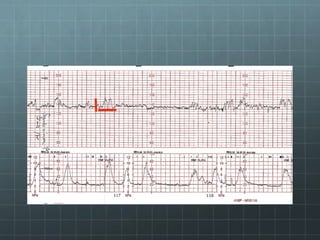
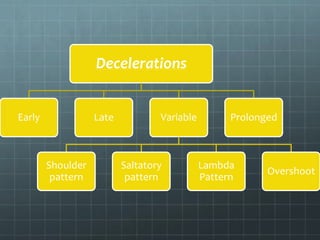
Decelerations
Decelerations are an abrupt decrease in
the baseline fetal heart rate of greater than 15 bpm fo
r greater than 15seconds.
There are a number of different types of
decelerations, each with varying significance.
Decelerations
Early Late Variable
Shoulder
pattern
Saltatory
pattern
Lambda
Pattern
Overshoot
Prolonged
Not to be used
Typical:
shoulders
Atypical :
Overshoot
Saltatory
Lambda
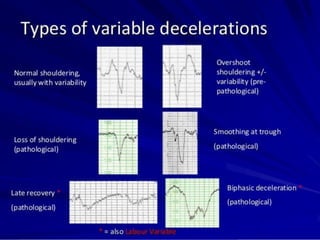
Slow return to baseline (late component)
Baseline returns to a lower level(after deceleration)
Biphasic(W shape)loss of variability during
deceleration
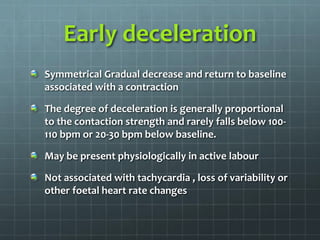
Early deceleration
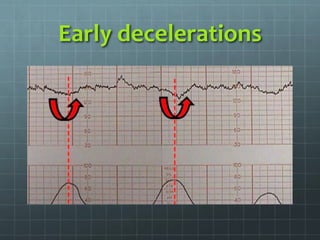
Symmetrical Gradual decrease and return to baseline
associated with a contraction
The degree of deceleration is generally proportional
to the contaction strength and rarely falls below 100-
110 bpm or 20-30 bpm below baseline.
May be present physiologically in active labour
Not associated with tachycardia , loss of variability or
other foetal heart rate changes
Early decelerations
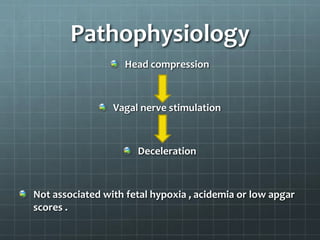
Pathophysiology
Head compression
Vagal nerve stimulation
Deceleration
Not associated with fetal hypoxia , acidemia or low apgar
scores .
Late deceleration
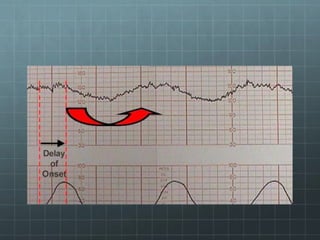
It is a smooth , gradual* and symmetrical decrease in
foetal heart rate , beginning at or after the contraction
peak and returning to baseline only after the contraction
has ended .
Not accompanied by accelerations .
Causes –
Maternal hypotension
Excessive uterine activity
Placental dysfunction
( Gradual - ≥ 30 sec from onset to nadir )
NICE CLASSIFICATION
Late decelerations for < 30 min is a non-reassuring
feature
however, if > 30 min it is an abnormal feature
Variable deceleration
Abrupt decrease in the foetal heart rate 15 bpm not
related to contractions.
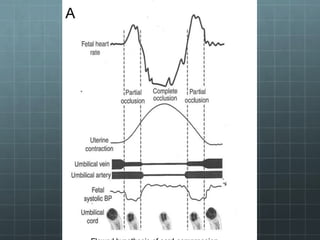
Variable decelerations are usually caused by umbilical cord
compression:
The umbilical vein is often occluded first causing an acceleration in
response.
Then the umbilical artery is occluded causing a subsequent rapid
deceleration.
When pressure on the cord is reduced another acceleration occurs
and then the baseline rate returns.
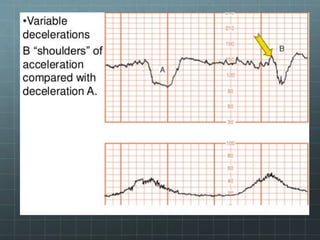
Accelerations before and after a variable deceleration are known as
the “shoulders of deceleration”.
Their presence indicates the fetus is not yet hypoxic and is adapting
to the reduced blood flow.
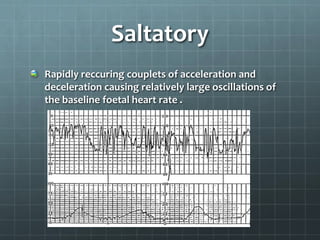
Saltatory
Rapidly reccuring couplets of acceleration and
deceleration causing relatively large oscillations of
the baseline foetal heart rate .
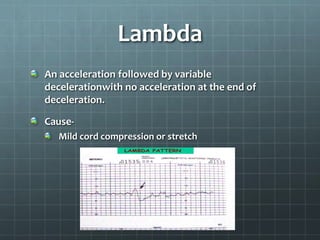
Lambda
An acceleration followed by variable
decelerationwith no acceleration at the end of
deceleration.
Cause-
Mild cord compression or stretch
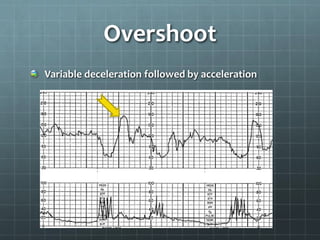
Overshoot
Variable deceleration followed by acceleration
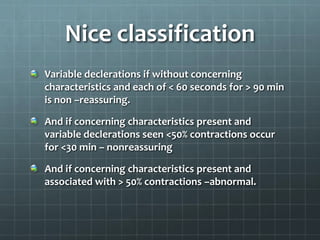
Nice classification
Variable declerations if without concerning
characteristics and each of < 60 seconds for > 90 min
is non –reassuring.
And if concerning characteristics present and
variable declerations seen <50% contractions occur
for <30 min – nonreassuring
And if concerning characteristics present and
associated with > 50% contractions –abnormal.
Reading A CTG
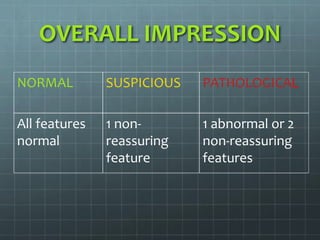
OVERALL IMPRESSION
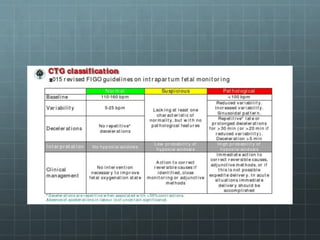
NORMAL SUSPICIOUS PATHOLOGICAL
All features
normal
1 non-
reassuring
feature
1 abnormal or 2
non-reassuring
features
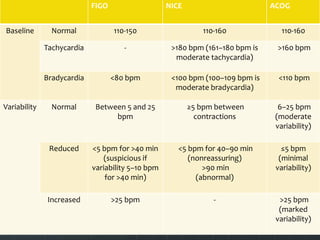
FIGO NICE ACOG
Baseline Normal 110-150 110-160 110-160
Tachycardia - >180 bpm (161–180 bpm is
moderate tachycardia)
>160 bpm
Bradycardia <80 bpm <100 bpm (100–109 bpm is
moderate bradycardia)
<110 bpm
Variability Normal Between 5 and 25
bpm
≥5 bpm between
contractions
6–25 bpm
(moderate
variability)
Reduced <5 bpm for >40 min
(suspicious if
variability 5–10 bpm
for >40 min)
<5 bpm for 40–90 min
(nonreassuring)
>90 min
(abnormal)
≤5 bpm
(minimal
variability)
Increased >25 bpm - >25 bpm
(marked
variability)
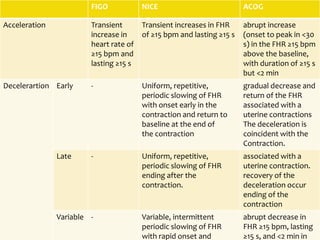
FIGO NICE ACOG
Acceleration Transient
increase in
heart rate of
≥15 bpm and
lasting ≥15 s
Transient increases in FHR
of ≥15 bpm and lasting ≥15 s
abrupt increase
(onset to peak in <30
s) in the FHR ≥15 bpm
above the baseline,
with duration of ≥15 s
but <2 min
Decelerartion Early - Uniform, repetitive,
periodic slowing of FHR
with onset early in the
contraction and return to
baseline at the end of
the contraction
gradual decrease and
return of the FHR
associated with a
uterine contractions
The deceleration is
coincident with the
Contraction.
Late - Uniform, repetitive,
periodic slowing of FHR
ending after the
contraction.
associated with a
uterine contraction.
recovery of the
deceleration occur
ending of the
contraction
Variable - Variable, intermittent
periodic slowing of FHR
with rapid onset and
abrupt decrease in
FHR ≥15 bpm, lasting
≥15 s, and <2 min in
Management
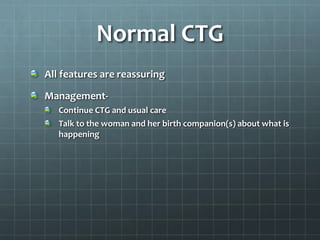
Normal CTG
All features are reassuring
Management-
Continue CTG and usual care
Talk to the woman and her birth companion(s) about what is
happening
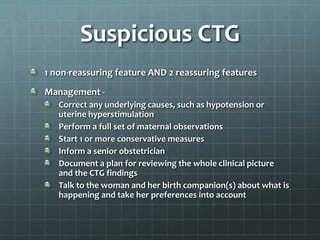
Suspicious CTG
1 non-reassuring feature AND 2 reassuring features
Management -
Correct any underlying causes, such as hypotension or
uterine hyperstimulation
Perform a full set of maternal observations
Start 1 or more conservative measures
Inform a senior obstetrician
Document a plan for reviewing the whole clinical picture
and the CTG findings
Talk to the woman and her birth companion(s) about what is
happening and take her preferences into account
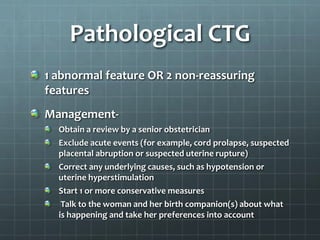
Pathological CTG
1 abnormal feature OR 2 non-reassuring
features
Management-
Obtain a review by a senior obstetrician
Exclude acute events (for example, cord prolapse, suspected
placental abruption or suspected uterine rupture)
Correct any underlying causes, such as hypotension or
uterine hyperstimulation
Start 1 or more conservative measures
Talk to the woman and her birth companion(s) about what
is happening and take her preferences into account
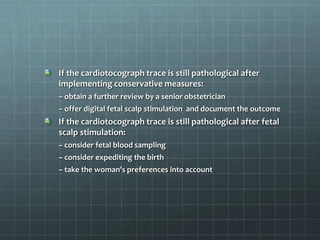
If the cardiotocograph trace is still pathological after
implementing conservative measures:
– obtain a further review by a senior obstetrician
– offer digital fetal scalp stimulation and document the outcome
If the cardiotocograph trace is still pathological after fetal
scalp stimulation:
– consider fetal blood sampling
– consider expediting the birth
– take the woman's preferences into account
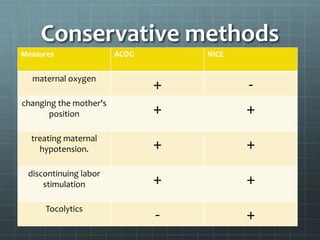
Conservative methods
NICE
mg).
Measures ACOG NICE
maternal oxygen
+ -
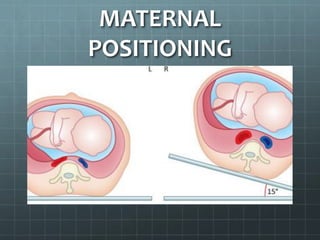
changing the mother's
position + +
treating maternal
hypotension. + +
discontinuing labor
stimulation + +
Tocolytics
- +
MATERNAL
POSITIONING
IV FLUIDS
MATERNAL HYDRATION IS IMPORTANT .
OVERLOAD SHOULD BE AVOIDED
DEXTROSE (5% AND 10%) ARE POTENTIALY
DANGEROUS AND SHOULD BE AVOIDED.
INTRAUTERINE
RESUSCITATION
S-STOP OXYTOCIN
P-POSITION
O-OXYGEN
I-IV FLUIDS
L-LOW BP – VASOPRESSORS
T-TOCOLYSIS
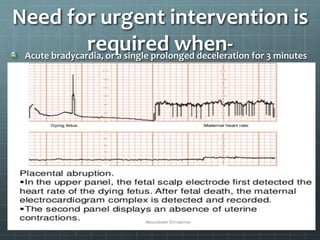
Need for urgent intervention is
required when-Acute bradycardia, or a single prolonged deceleration for 3 minutes
or more
Management –
Urgently seek obstetric help
If there has been an acute event (for example, cord prolapse,
suspected placental abruption or suspected uterine rupture), expedite
the birth
Correct any underlying causes, such as hypotension or uterine
hyperstimulation
Start 1 or more conservative measures*
Make preparations for an urgent birth
Talk to the woman and her birth companion(s) about what is
happening and take her preferences into account
Expedite the birth if the acute bradycardia persists for 9 minutes
If the fetal heart rate recovers at any time up to 9 minutes, reassess
any decision to expedite the birth, in discussion with the woman
Remember the 'Rule of 3' for fetal bradycardia:
3 minutes – call for help
6 minutes – move to theatre
9 minutes – prepare for assisted delivery
12 minutes – aim to deliver the baby.
The pH of the fetus has been shown to drop at the
rate of 0.01 every 2–3 minutes.
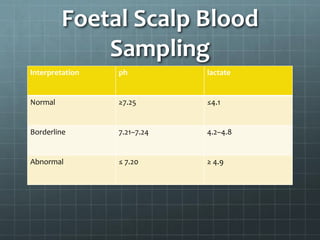
Foetal Scalp Blood
Sampling
Interpretation ph lactate
Normal ≥7.25 ≤4.1
Borderline 7.21–7.24 4.2–4.8
Abnormal ≤ 7.20 ≥ 4.9
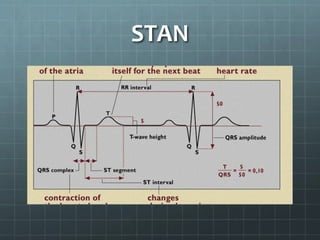
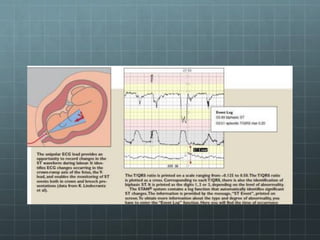
STAN
Rise in ST segment reperesents a compensated
myocardial stress and a switch to anaerobic
metabolism
A progressive rise in T/QRS RATIO represents
continued anaerobic metabolism by adrenaline surge
due to stress caused by hypoxia
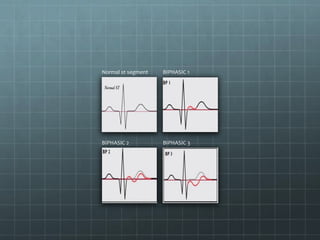
Biphasic and negative T wave indicate initial phases
of myocardial ischemia or hypoxia.
There may be conductance problems
STAN should not be used fetuses less than 36 weeks
Normal st segment BIPHASIC 1
BIPHASIC 2 BIPHASIC 3
Key messages
Being methodical and reporting all important aspects
in CTG is essential
-hourly reporting as trace changes
Remember the dr and spoilt the patient
Cardiotocography

Cardiotocography

  • 1.
    CARDIOTOCOGRAPHY Dr Shipra Kunwar MD,FMAS,FICOG,MRCOG Profand head Era’s lucknow medical college lucknow
  • 2.
  • 5.
    INDICATIONS CHORIOANIONITIS MECONIUM HYPERTENSION OXYTOCIN CONFIRMED DELAY INLABOUR PROLONGED RUPTURE OF MEMBRANES FRESH VAGINAL BLEEDING IN LABOUR
  • 6.
    NAME /AGE TIME DURATION PAPER SPEED1cm/min or 3 cm/min PRESENCE OF FETAL BLOOD SAMPLING
  • 7.
    Dr- define risk C–contraction B- Baseline Ra-Rate V-Variability A-Accelerations D-decelerations O- overall impression
  • 8.
  • 9.
  • 10.
    BASELINE 110-160 beats/min 100- 109nonreassuring <100 abnormal 160-179 nonreassuring > 180 abnormal
  • 12.
    Bradycardia Head compression Congenital heartblock Maternal hypothermia Severe pyelonephritis Tachycardia Materal hyperthermia Chorioamnionitis Maternal hypotension Fetal compromise Cardiac arrhythmias Maternal administration of parasympathetic blockers( atropine) or sympathomimetic drugs (terbutaline)
  • 13.
    ACCELERATIONS INCREASE IN FETALHEART RATE OF MORE THAN 15 BEATS PER MIN LASTING FOR MORE THAN 15 SECONDS DENOTES A HEALTHY FETUS.
  • 15.
    Variabilty 5-25 beats Decreased variabilityis –parasympathetic stimulation Seen in sleep , hypoxia, administration of many drugs Increased variability is a sign of sympathetic stimulation
  • 16.
    NICE CLASSIFICATION If variabilityreduced < 5 beats for < 50 min it is referred to as non-reassuring feature. If variability < 5 beats > 50 min then it is abnormal feature If variability > 25 for < 25 min then non-reassuring If variabilty > 25 for >25 min then its an abnormal feature
  • 17.
    Decelerations Decelerations are anabrupt decrease in the baseline fetal heart rate of greater than 15 bpm fo r greater than 15seconds. There are a number of different types of decelerations, each with varying significance.
  • 18.
  • 19.
    Not to beused Typical: shoulders Atypical : Overshoot Saltatory Lambda Slow return to baseline (late component) Baseline returns to a lower level(after deceleration) Biphasic(W shape)loss of variability during deceleration
  • 20.
    Early deceleration Symmetrical Gradualdecrease and return to baseline associated with a contraction The degree of deceleration is generally proportional to the contaction strength and rarely falls below 100- 110 bpm or 20-30 bpm below baseline. May be present physiologically in active labour Not associated with tachycardia , loss of variability or other foetal heart rate changes
  • 21.
  • 22.
    Pathophysiology Head compression Vagal nervestimulation Deceleration Not associated with fetal hypoxia , acidemia or low apgar scores .
  • 23.
    Late deceleration It isa smooth , gradual* and symmetrical decrease in foetal heart rate , beginning at or after the contraction peak and returning to baseline only after the contraction has ended . Not accompanied by accelerations . Causes – Maternal hypotension Excessive uterine activity Placental dysfunction ( Gradual - ≥ 30 sec from onset to nadir )
  • 25.
    NICE CLASSIFICATION Late decelerationsfor < 30 min is a non-reassuring feature however, if > 30 min it is an abnormal feature
  • 26.
    Variable deceleration Abrupt decreasein the foetal heart rate 15 bpm not related to contractions.
  • 27.
    Variable decelerations areusually caused by umbilical cord compression: The umbilical vein is often occluded first causing an acceleration in response. Then the umbilical artery is occluded causing a subsequent rapid deceleration. When pressure on the cord is reduced another acceleration occurs and then the baseline rate returns. Accelerations before and after a variable deceleration are known as the “shoulders of deceleration”. Their presence indicates the fetus is not yet hypoxic and is adapting to the reduced blood flow.
  • 31.
    Saltatory Rapidly reccuring coupletsof acceleration and deceleration causing relatively large oscillations of the baseline foetal heart rate .
  • 32.
    Lambda An acceleration followedby variable decelerationwith no acceleration at the end of deceleration. Cause- Mild cord compression or stretch
  • 33.
  • 34.
    Nice classification Variable declerationsif without concerning characteristics and each of < 60 seconds for > 90 min is non –reassuring. And if concerning characteristics present and variable declerations seen <50% contractions occur for <30 min – nonreassuring And if concerning characteristics present and associated with > 50% contractions –abnormal.
  • 35.
  • 36.
    OVERALL IMPRESSION NORMAL SUSPICIOUSPATHOLOGICAL All features normal 1 non- reassuring feature 1 abnormal or 2 non-reassuring features
  • 38.
    FIGO NICE ACOG BaselineNormal 110-150 110-160 110-160 Tachycardia - >180 bpm (161–180 bpm is moderate tachycardia) >160 bpm Bradycardia <80 bpm <100 bpm (100–109 bpm is moderate bradycardia) <110 bpm Variability Normal Between 5 and 25 bpm ≥5 bpm between contractions 6–25 bpm (moderate variability) Reduced <5 bpm for >40 min (suspicious if variability 5–10 bpm for >40 min) <5 bpm for 40–90 min (nonreassuring) >90 min (abnormal) ≤5 bpm (minimal variability) Increased >25 bpm - >25 bpm (marked variability)
  • 39.
    FIGO NICE ACOG AccelerationTransient increase in heart rate of ≥15 bpm and lasting ≥15 s Transient increases in FHR of ≥15 bpm and lasting ≥15 s abrupt increase (onset to peak in <30 s) in the FHR ≥15 bpm above the baseline, with duration of ≥15 s but <2 min Decelerartion Early - Uniform, repetitive, periodic slowing of FHR with onset early in the contraction and return to baseline at the end of the contraction gradual decrease and return of the FHR associated with a uterine contractions The deceleration is coincident with the Contraction. Late - Uniform, repetitive, periodic slowing of FHR ending after the contraction. associated with a uterine contraction. recovery of the deceleration occur ending of the contraction Variable - Variable, intermittent periodic slowing of FHR with rapid onset and abrupt decrease in FHR ≥15 bpm, lasting ≥15 s, and <2 min in
  • 40.
  • 41.
    Normal CTG All featuresare reassuring Management- Continue CTG and usual care Talk to the woman and her birth companion(s) about what is happening
  • 42.
    Suspicious CTG 1 non-reassuringfeature AND 2 reassuring features Management - Correct any underlying causes, such as hypotension or uterine hyperstimulation Perform a full set of maternal observations Start 1 or more conservative measures Inform a senior obstetrician Document a plan for reviewing the whole clinical picture and the CTG findings Talk to the woman and her birth companion(s) about what is happening and take her preferences into account
  • 43.
    Pathological CTG 1 abnormalfeature OR 2 non-reassuring features Management- Obtain a review by a senior obstetrician Exclude acute events (for example, cord prolapse, suspected placental abruption or suspected uterine rupture) Correct any underlying causes, such as hypotension or uterine hyperstimulation Start 1 or more conservative measures Talk to the woman and her birth companion(s) about what is happening and take her preferences into account
  • 44.
    If the cardiotocographtrace is still pathological after implementing conservative measures: – obtain a further review by a senior obstetrician – offer digital fetal scalp stimulation and document the outcome If the cardiotocograph trace is still pathological after fetal scalp stimulation: – consider fetal blood sampling – consider expediting the birth – take the woman's preferences into account
  • 45.
    Conservative methods NICE mg). Measures ACOGNICE maternal oxygen + - changing the mother's position + + treating maternal hypotension. + + discontinuing labor stimulation + + Tocolytics - +
  • 46.
  • 47.
    IV FLUIDS MATERNAL HYDRATIONIS IMPORTANT . OVERLOAD SHOULD BE AVOIDED DEXTROSE (5% AND 10%) ARE POTENTIALY DANGEROUS AND SHOULD BE AVOIDED.
  • 48.
  • 49.
    Need for urgentintervention is required when-Acute bradycardia, or a single prolonged deceleration for 3 minutes or more Management – Urgently seek obstetric help If there has been an acute event (for example, cord prolapse, suspected placental abruption or suspected uterine rupture), expedite the birth Correct any underlying causes, such as hypotension or uterine hyperstimulation Start 1 or more conservative measures* Make preparations for an urgent birth Talk to the woman and her birth companion(s) about what is happening and take her preferences into account Expedite the birth if the acute bradycardia persists for 9 minutes If the fetal heart rate recovers at any time up to 9 minutes, reassess any decision to expedite the birth, in discussion with the woman
  • 50.
    Remember the 'Ruleof 3' for fetal bradycardia: 3 minutes – call for help 6 minutes – move to theatre 9 minutes – prepare for assisted delivery 12 minutes – aim to deliver the baby. The pH of the fetus has been shown to drop at the rate of 0.01 every 2–3 minutes.
  • 51.
    Foetal Scalp Blood Sampling Interpretationph lactate Normal ≥7.25 ≤4.1 Borderline 7.21–7.24 4.2–4.8 Abnormal ≤ 7.20 ≥ 4.9
  • 52.
  • 53.
    Rise in STsegment reperesents a compensated myocardial stress and a switch to anaerobic metabolism A progressive rise in T/QRS RATIO represents continued anaerobic metabolism by adrenaline surge due to stress caused by hypoxia Biphasic and negative T wave indicate initial phases of myocardial ischemia or hypoxia. There may be conductance problems STAN should not be used fetuses less than 36 weeks
  • 55.
    Normal st segmentBIPHASIC 1 BIPHASIC 2 BIPHASIC 3
  • 56.
    Key messages Being methodicaland reporting all important aspects in CTG is essential -hourly reporting as trace changes Remember the dr and spoilt the patient