CTG
INTERPRETATION
Wafaa Benjamin Basta
ConsultantOb/ Gyn MatariaTeaching Hospital
MRCOG –ERC Member
Egyptian Board of Ob/Gyn Meeting - March 2019
Foetal Physiology
• Fetus designed to cope with labour
•Every fetus will have his/hers own unique
physiological reserve all modified by his /hers
antenatal and intra-partum risk factors.
• Fetal physiology in labour will make all efforts
to protect the myocardium
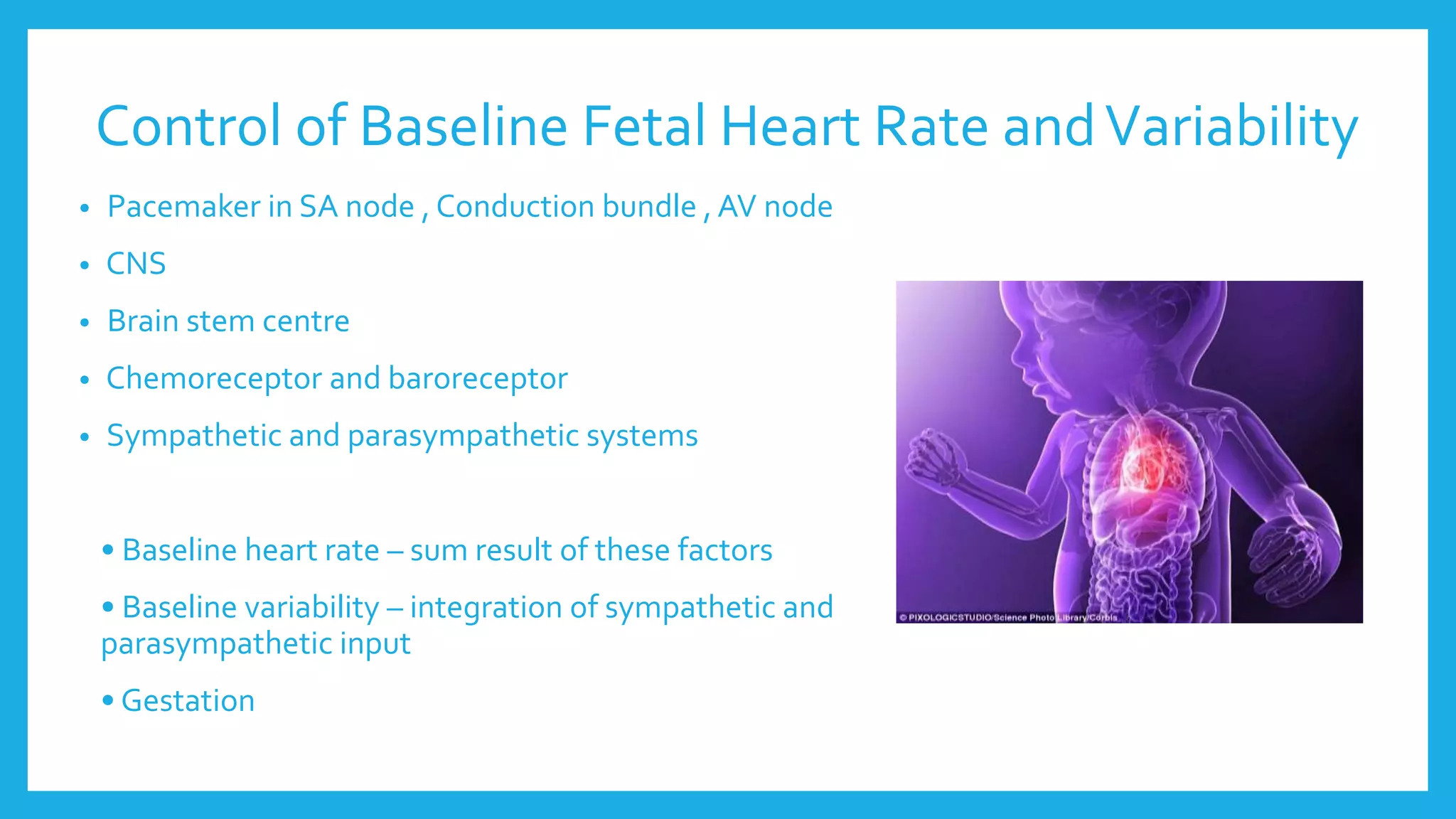
Control of Baseline Fetal Heart Rate andVariability
• Pacemaker in SA node , Conduction bundle , AV node
• CNS
• Brain stem centre
• Chemoreceptor and baroreceptor
• Sympathetic and parasympathetic systems
• Baseline heart rate – sum result of these factors
• Baseline variability – integration of sympathetic and
parasympathetic input
• Gestation
Control of Baseline Fetal Heart Rate andVariability
• CNS activity - increase activity leads to increased variability of heart rate
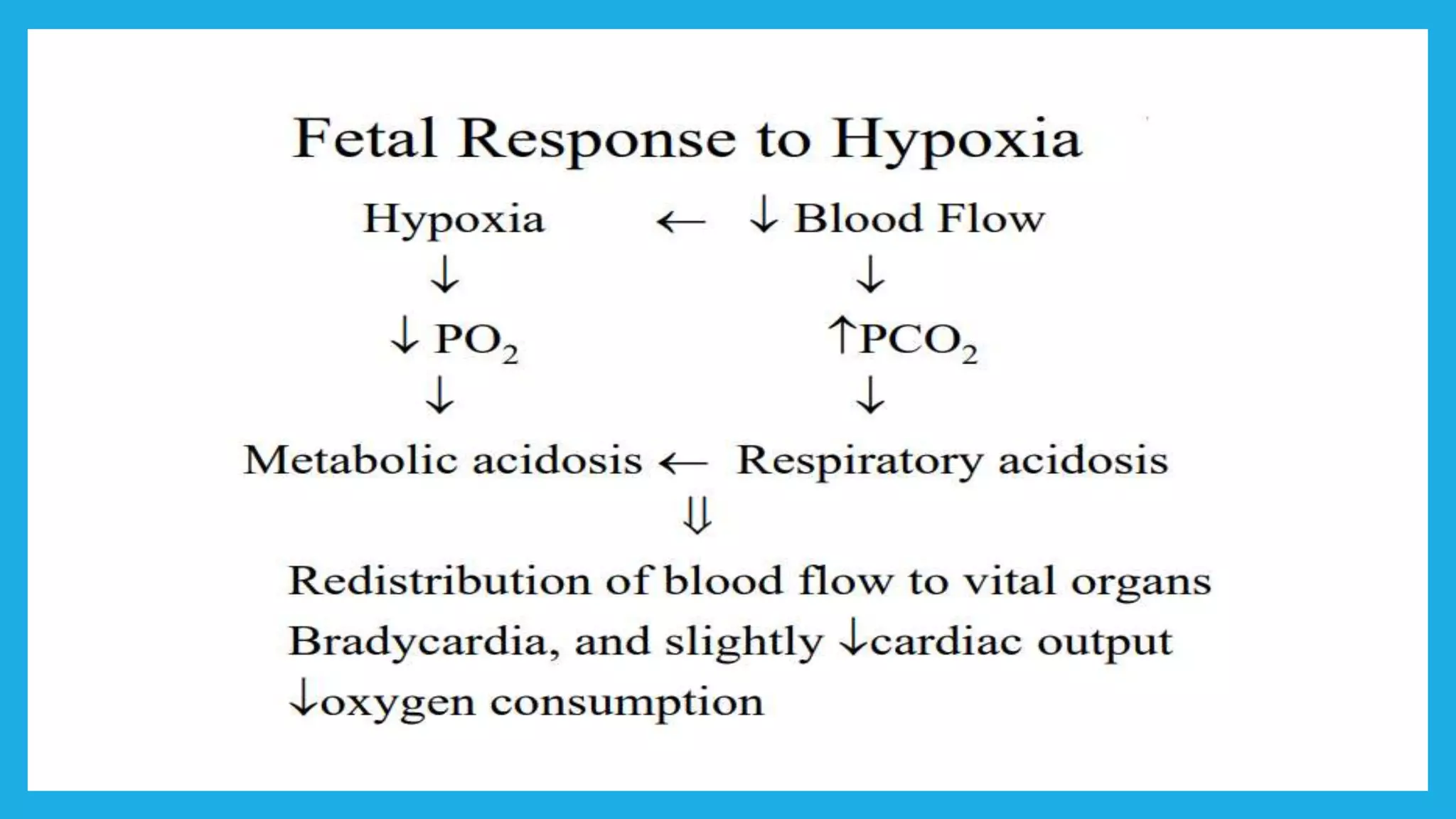
• Chemoreceptors – hypoxia / hypercapnia → bradycardia
• Baroreceptors - ↑ arterial pressure → bradycardia
• Sympathetic system – adrenal medulla → epinephrine and nor-epinephrine
• Parasympathetic system – vagal effect on SA node and AV node → decreased
FHR
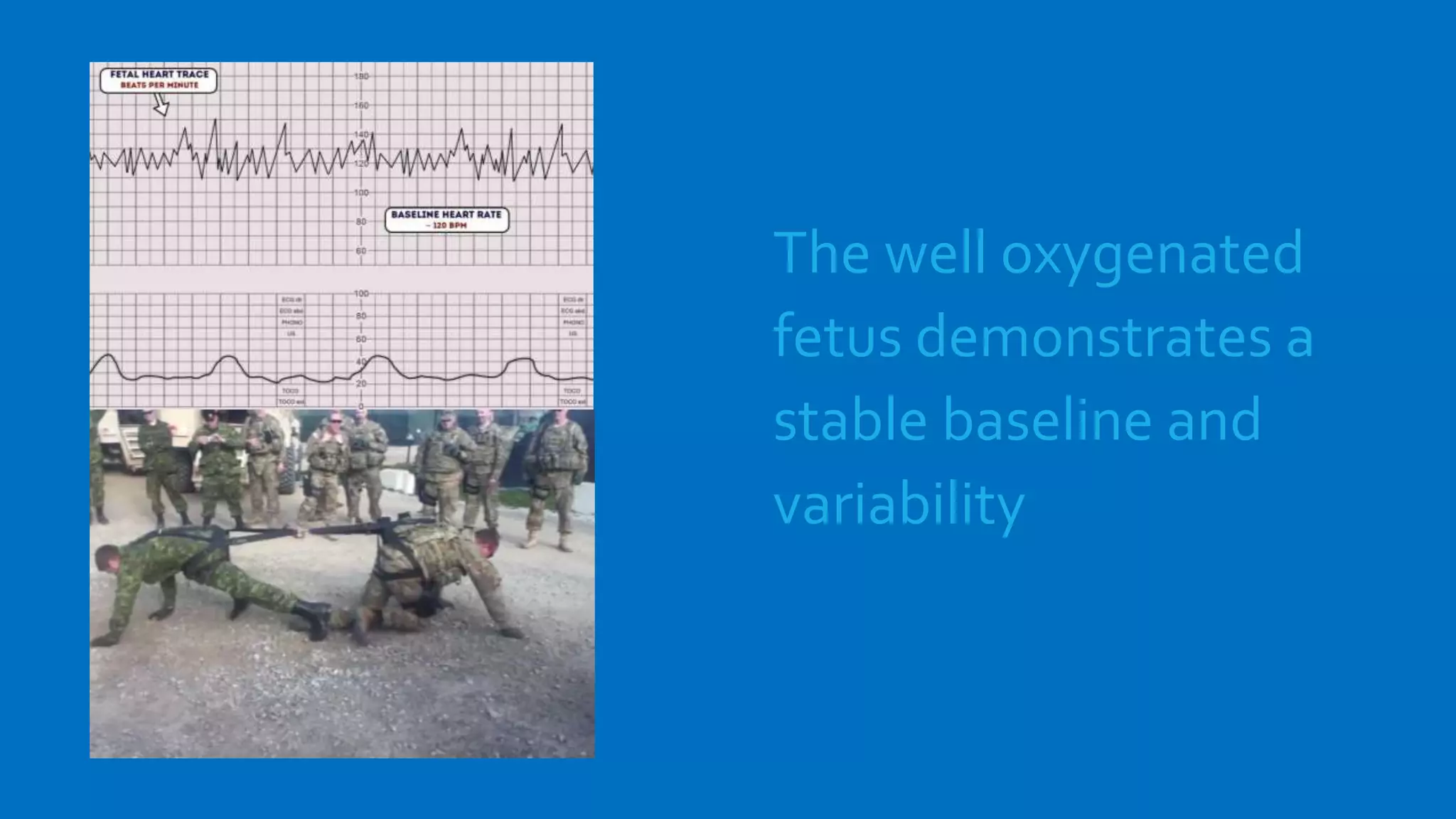
The well oxygenated
fetus demonstrates a
stable baseline and
variability
Chemical (Chemo-receptors)
• Responsive to ↑ in H+ CO2 ↓ Po2
• Stimulate parasympathetic nervous system to
decrease FH
• Gradual fall from baseline and delayed recovery.Take
longer to recovery to baseline
Mechanical Baro-receptors
• Compression of umbilical artery
• Increase in fetal systemic BP
• Stimulates Baro-receptor to send impulse to cardiac
inhibitory centre
• FH slows Sharp drop
• Usually 30 -60 seconds
• Recovery to baseline
• Not of concern if Baseline andVariability are reassuring.
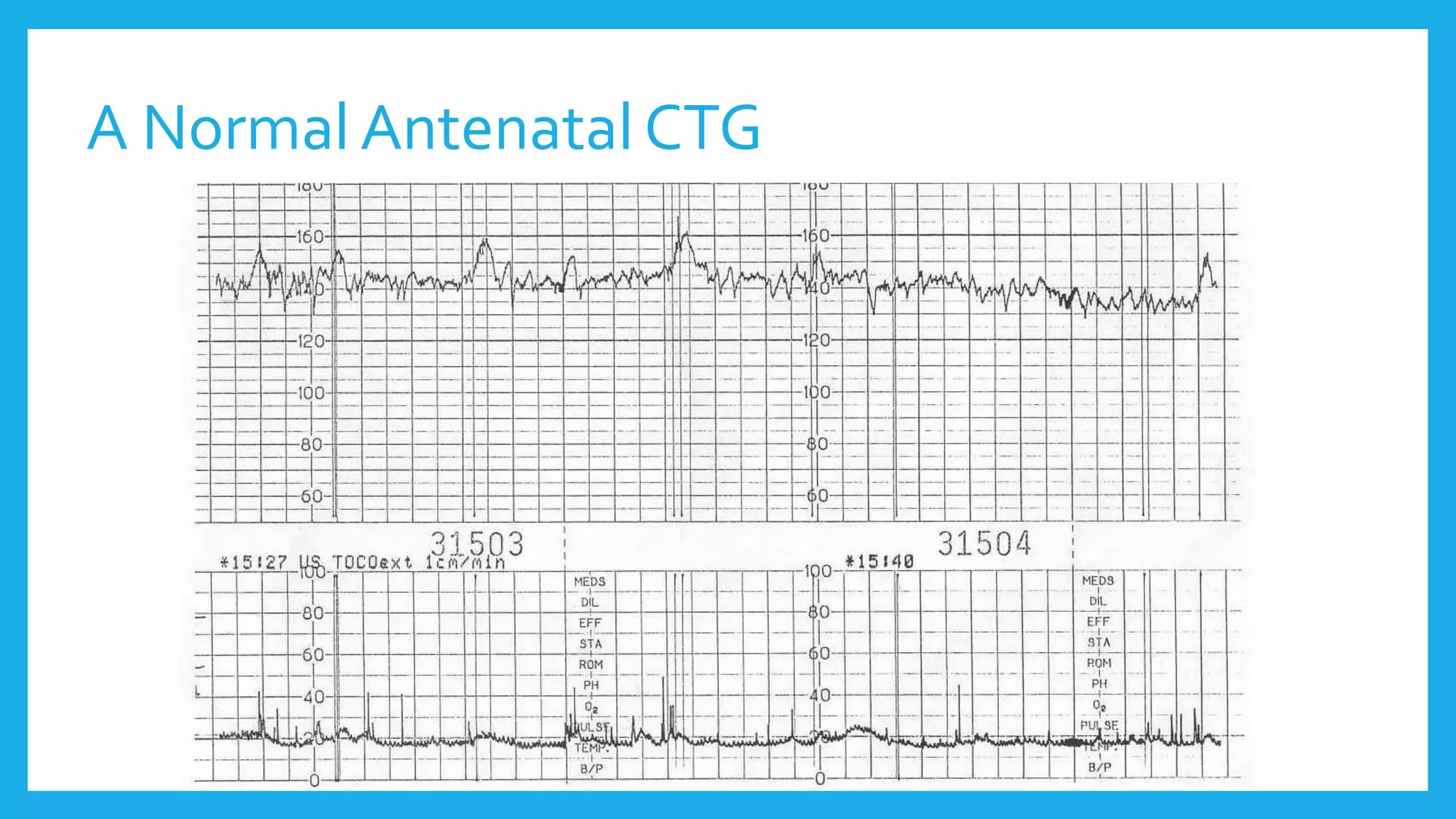
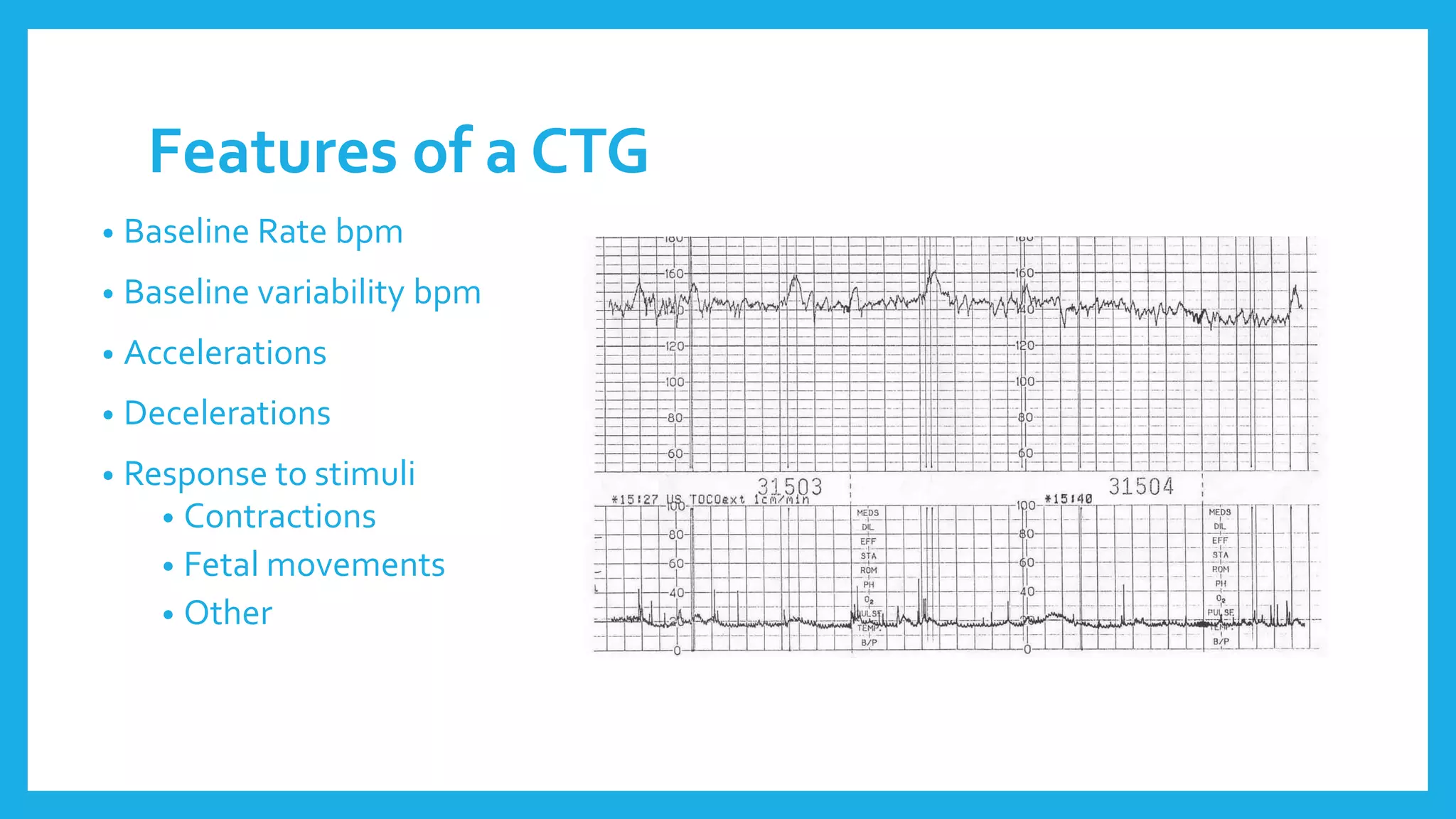
A Normal Antenatal CTG
Features of a CTG
• Baseline Rate bpm
• Baseline variability bpm
• Accelerations
• Decelerations
• Response to stimuli
• Contractions
• Fetal movements
• Other
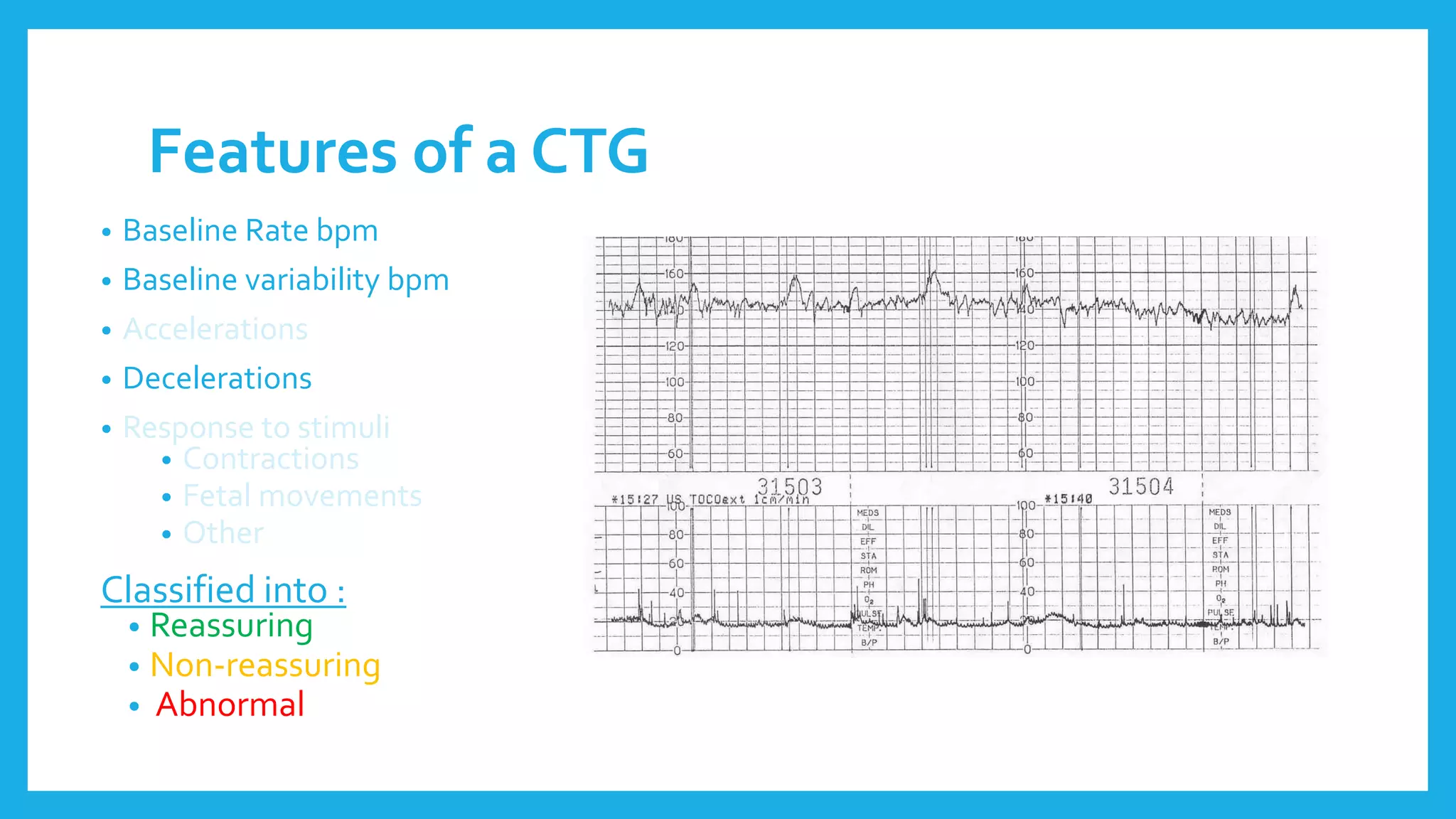
Features of a CTG
• Baseline Rate bpm
• Baseline variability bpm
• Accelerations
• Decelerations
• Response to stimuli
• Contractions
• Fetal movements
• Other
Classified into :
• Reassuring
• Non-reassuring
• Abnormal
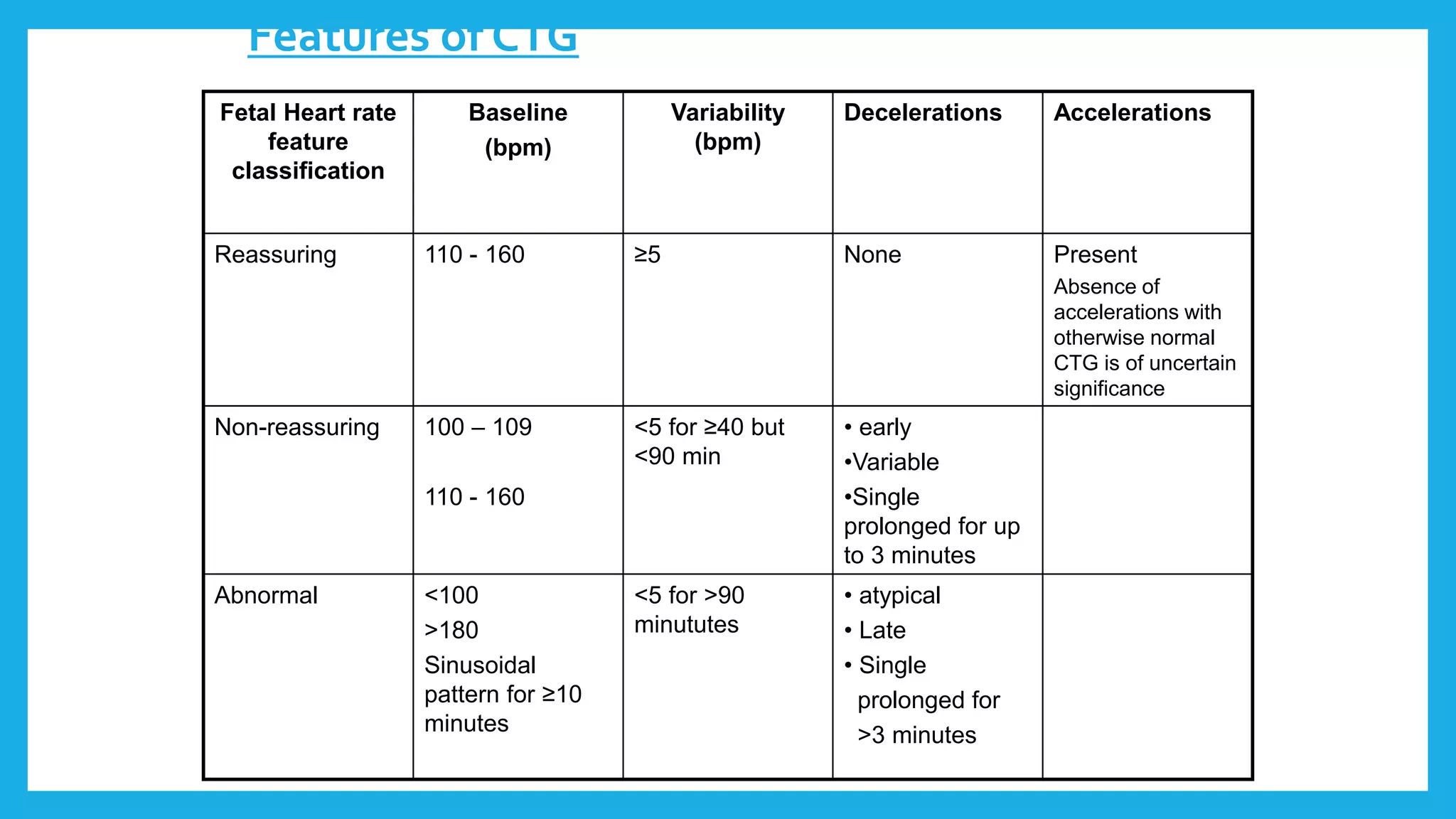
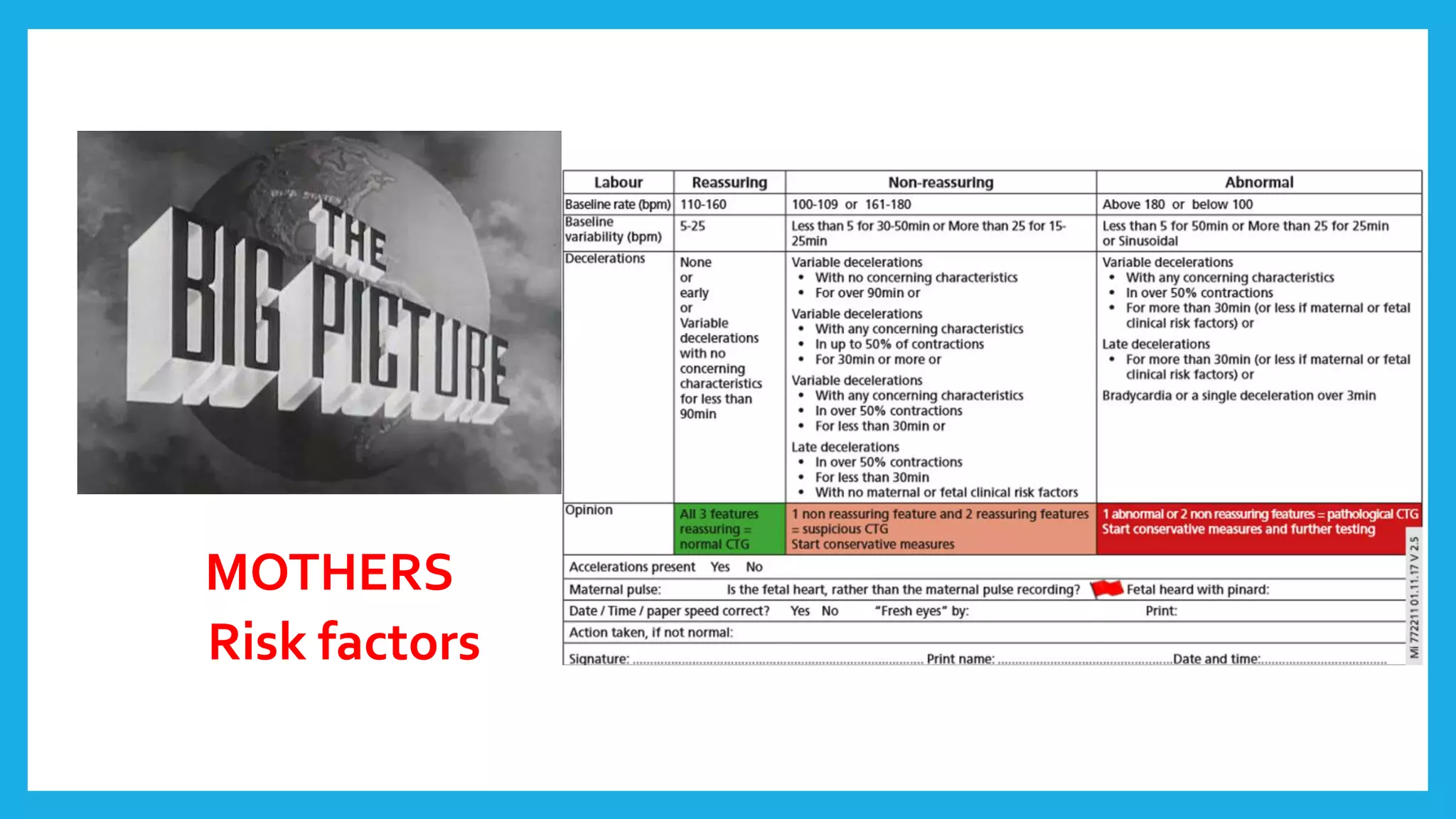
RCOG Classification of CTGs
• Normal CTG = all Three features are reassuring
• Suspicious CTG = One non reassuring feature and two reassuring
• Pathological CTG = One abnormal or Two non reassuring features
Features of CTG
Fetal Heart rate
feature
classification
Baseline
(bpm)
Variability
(bpm)
Decelerations Accelerations
Reassuring 110 - 160 ≥5 None Present
Absence of
accelerations with
otherwise normal
CTG is of uncertain
significance
Non-reassuring 100 – 109
110 - 160
<5 for ≥40 but
<90 min
• early
•Variable
•Single
prolonged for up
to 3 minutes
Abnormal <100
>180
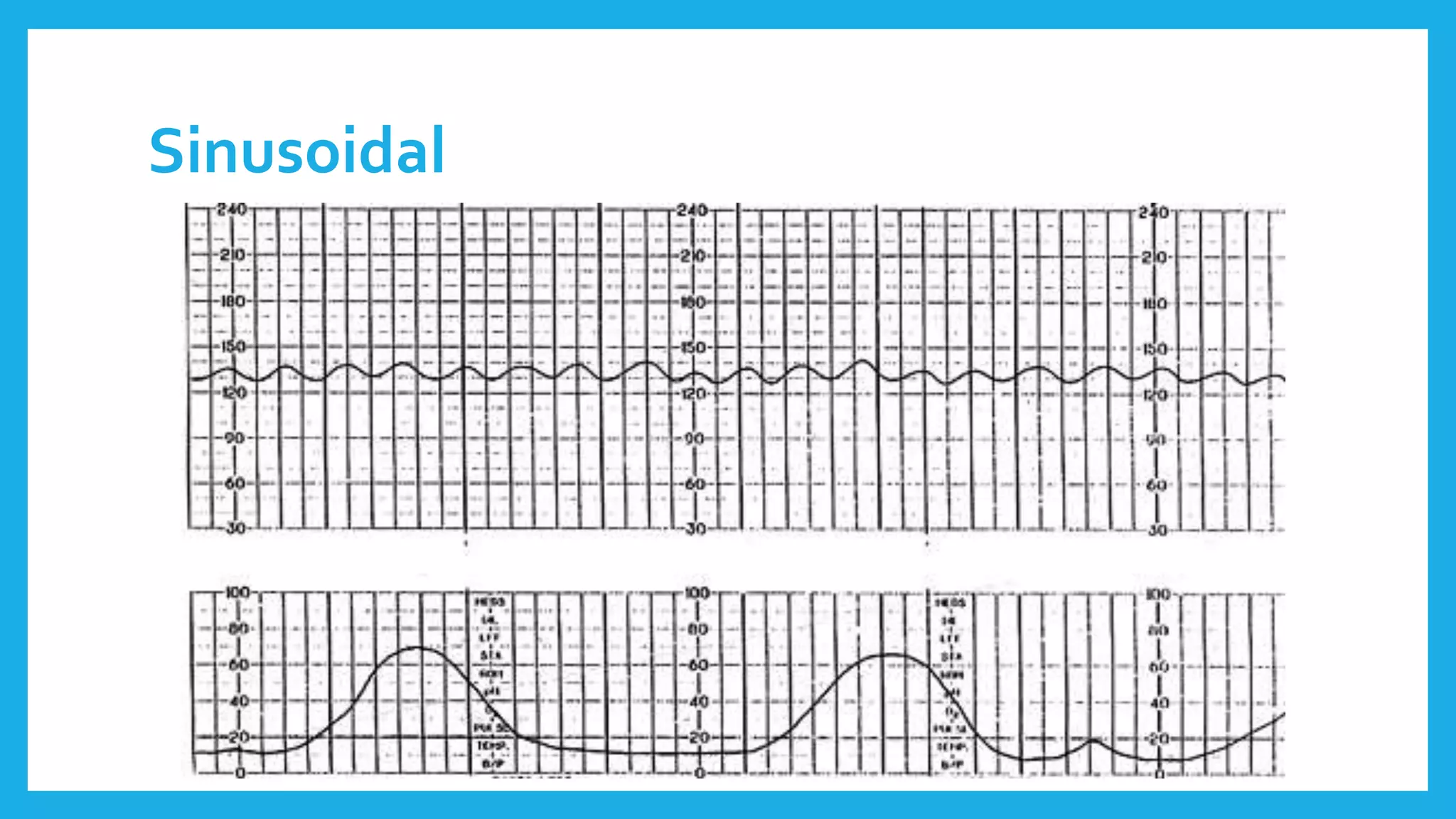
Sinusoidal
pattern for ≥10
minutes
<5 for >90
minututes
• atypical
• Late
• Single
prolonged for
>3 minutes
Baseline Fetal Heart Rate {FHR}
Mean level of FHR when this is stable, excluding Accelerations and Decelerations
-Tachycardia
-Bradycardia
• Reassuring : 110 to 160 bpm at term
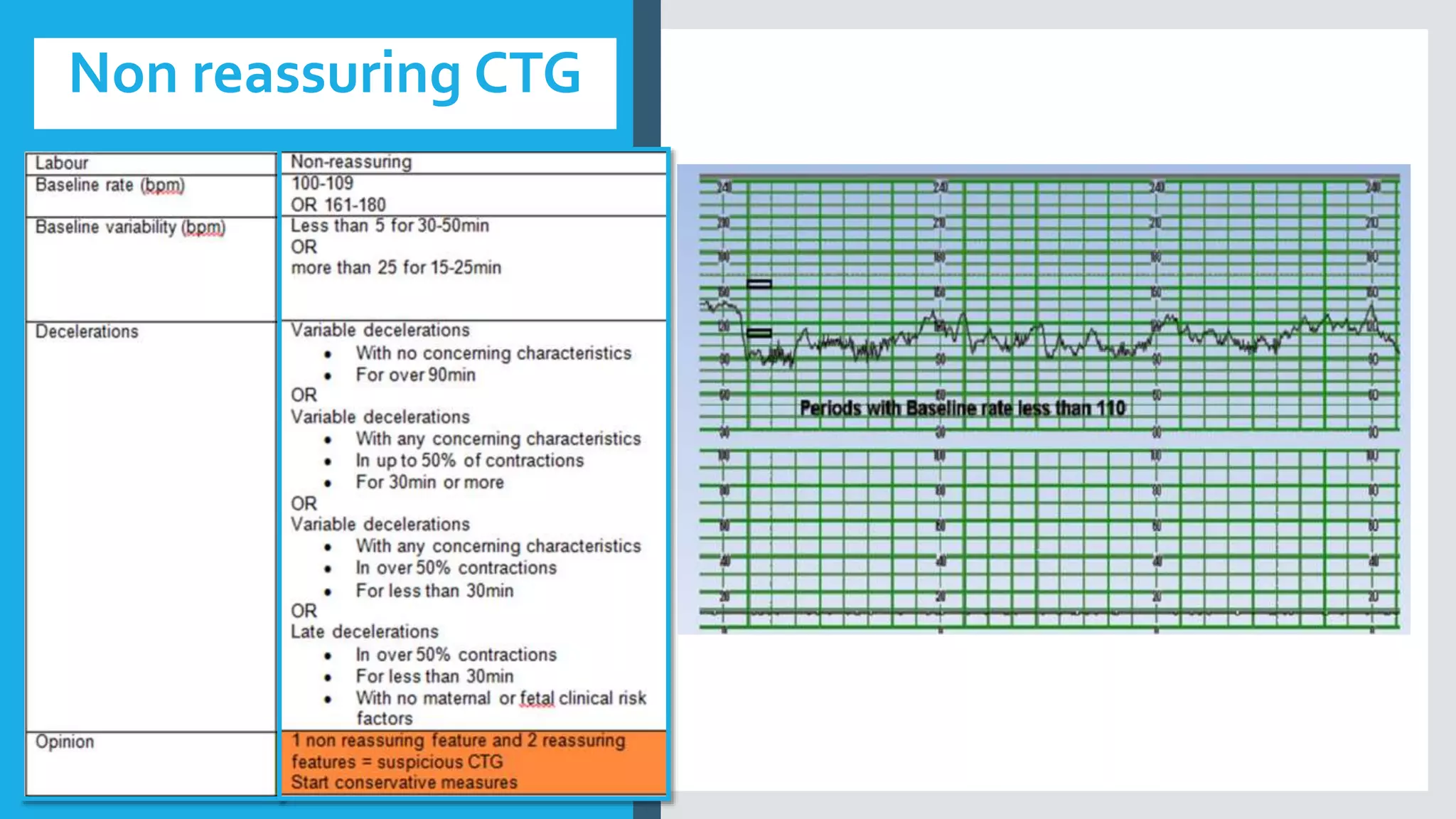
• Non-reassuring : 100-109 bpm / 161-180 bpm
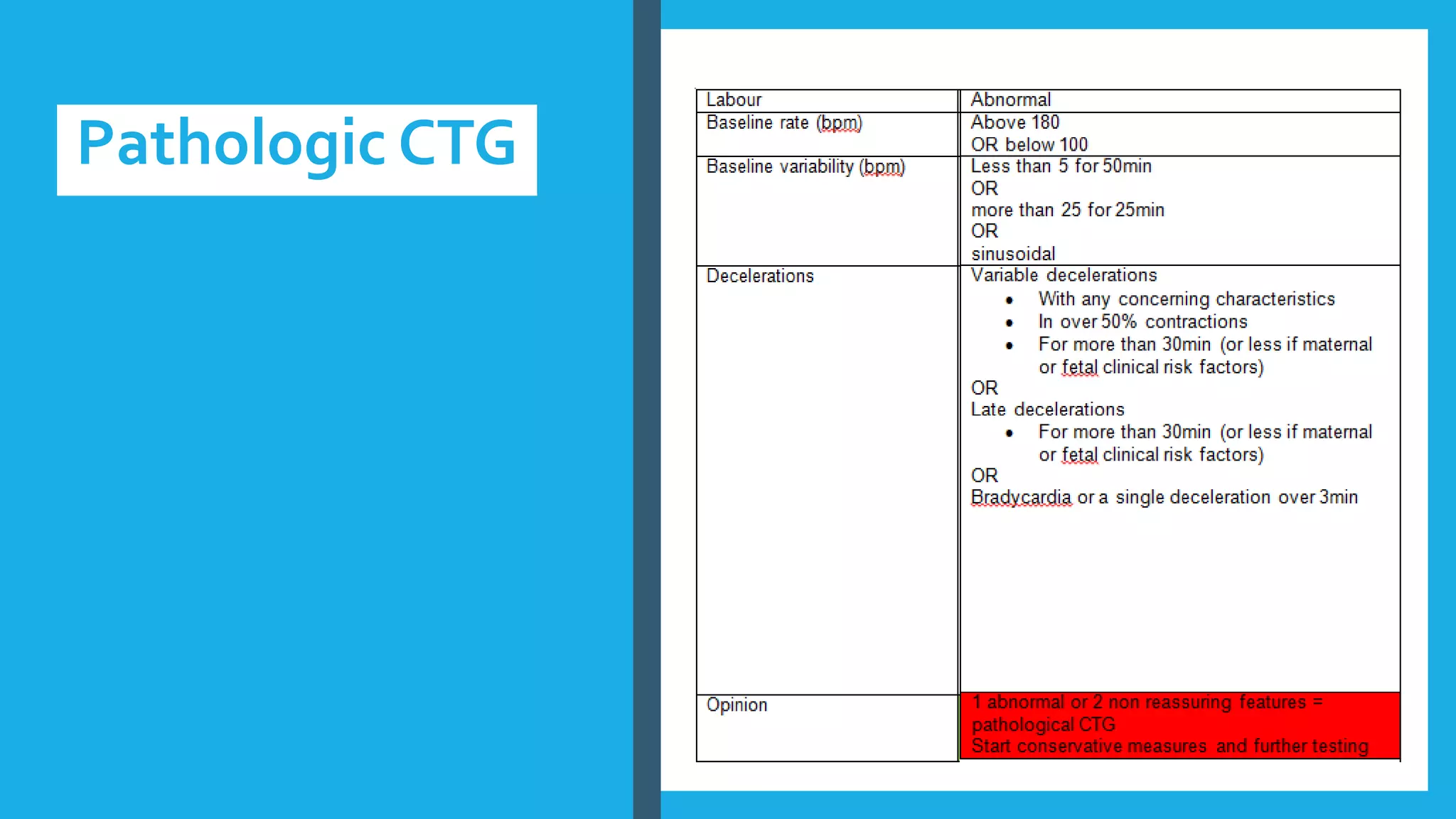
• Abnormal: less than 100/ more than 180 bpm
• Tachycardia with reduced STV = early hypoxia
BaselineTachycardia
• Hypoxia
• Chorio-
amnionitis
• Sepsis
• Maternal fever
• Maternal Anxiety
• Maternal
thyrotoxicosis
• B-Mimetic drugs
• Fetal anaemia
• Heart failure
• Arrhythmias
• Prematurity
Baseline Bradycardia
• Postdates
• Drugs
• Idiopathic
• Arrhythmia's
• Hypothermia.
• Cord compression
• Acute Hypoxia
• Congenital heart
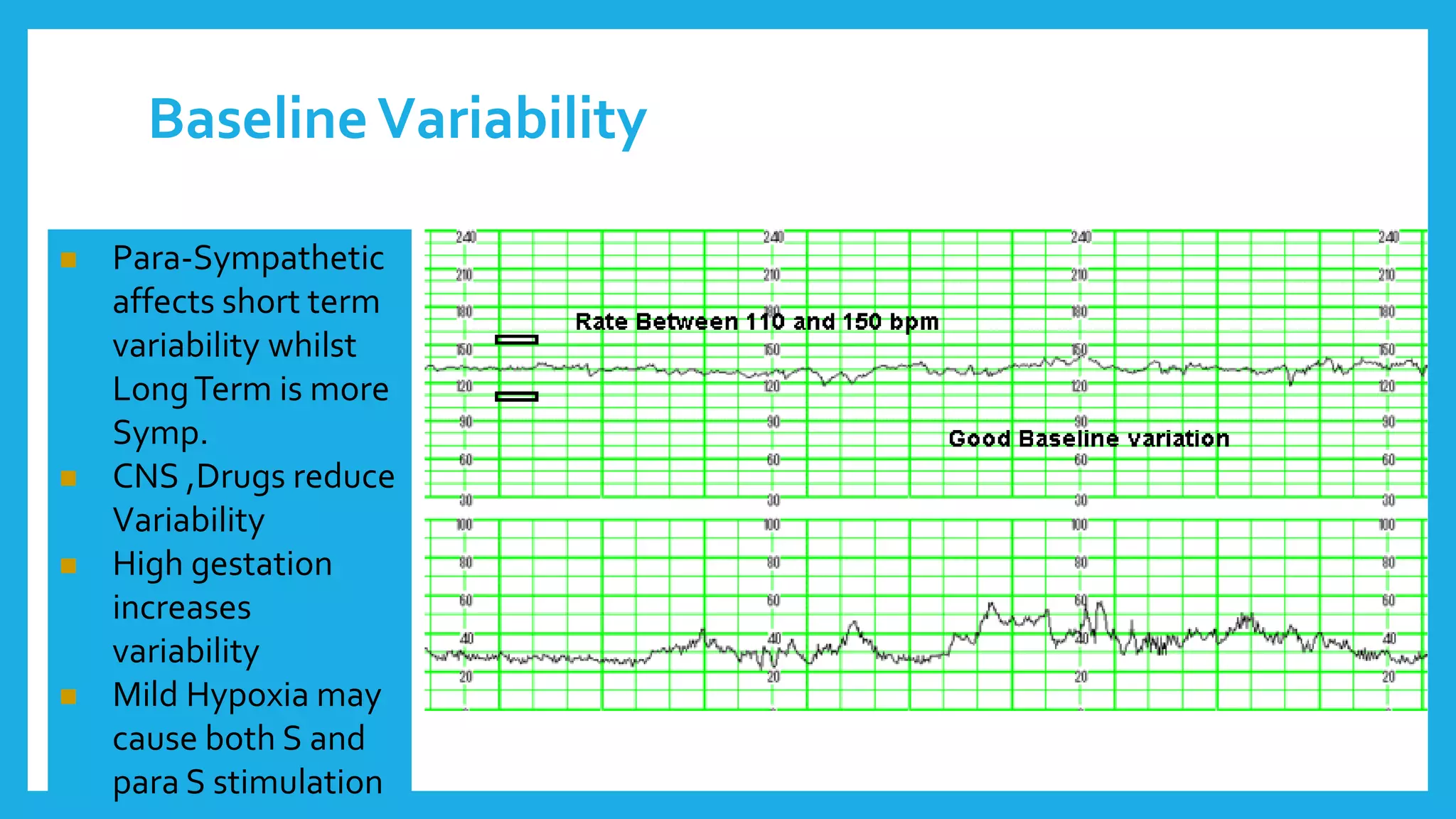
Baseline variability
• The minor fluctuations on baseline FHR at 3-5 cycles bpm produces Baseline
variability.
• Examine imin segment and estimate highest peak and lowest trough.
• Reassuring: 5-25 bpm – this indicates Normal-CNS.
• Non-reassuring: > 5 bpm for 30-50 minutes
• < 25 bpm for 15-25minutes
• Abnormal: > 5 bpm for <50 minutes
• <25 bpm for <25 minutes
BaselineVariability
 Para-Sympathetic
affects short term
variability whilst
LongTerm is more
Symp.
 CNS ,Drugs reduce
Variability
 High gestation
increases
variability
 Mild Hypoxia may
cause both S and
para S stimulation
ReducedVariability
• Hypoxia
• Drugs
• Extreme
prematurity
• Sleep
• CNS abnormality.
Variability less than 5 bpm for 30-50 minutes
Accelerations
• Must be >15 bpm and >15 sec above baseline
• Should be >2 per 15 min period
• Always reassuring when present
• May not occur when fetus is “sleeping”
• Should occur in response to fetal movements or fetal stimulation
• Non reactive periods usually do not exceed 45 min
• (>90 min and no accelerations is worrying)
Acceleration
Decelerations
Transient slowing of
FHR below the
baseline level of
more than 15 bpm
and lasting for 15 sec.
Or more.
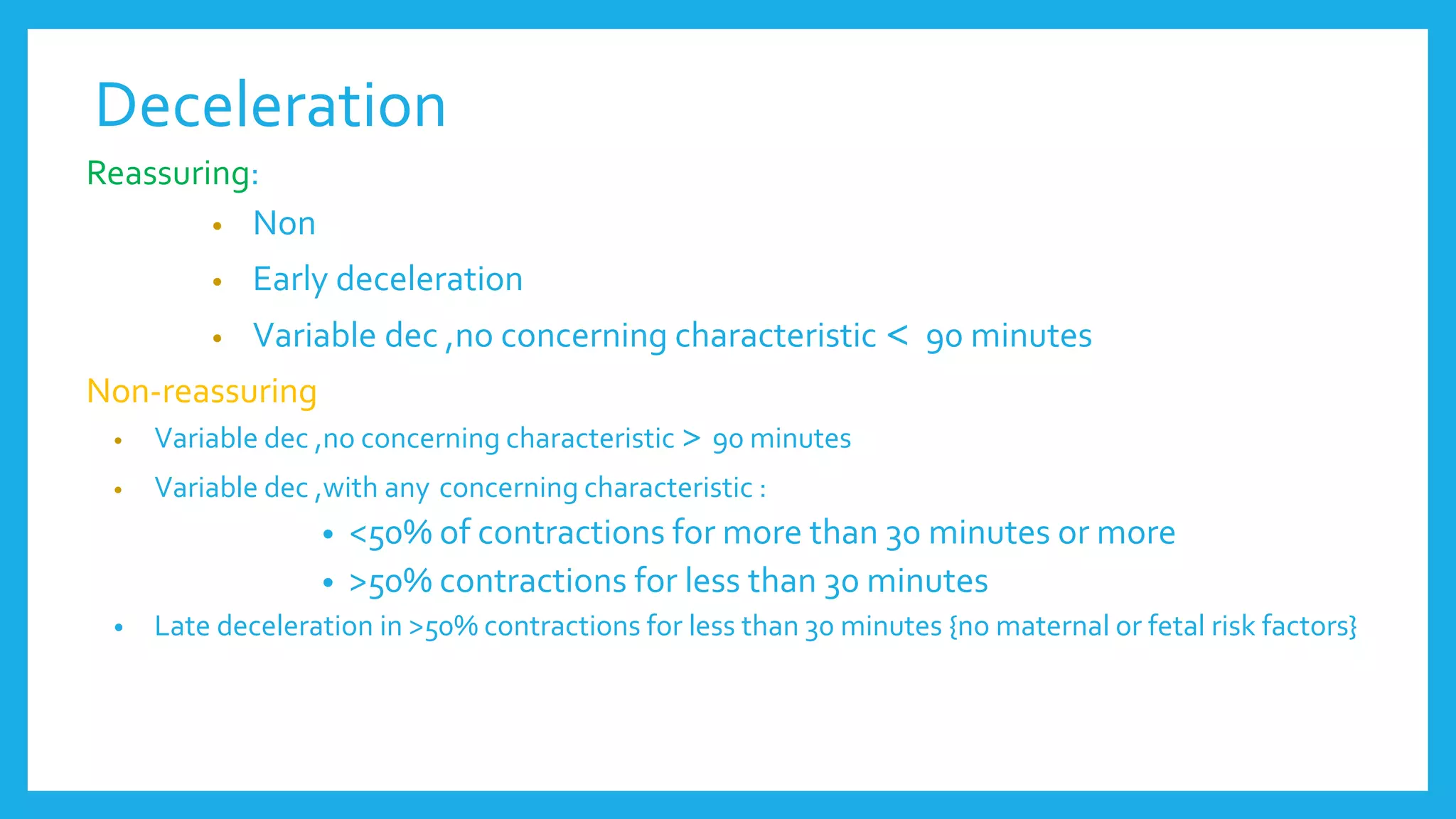
Deceleration
Reassuring:
• Non
• Early deceleration
• Variable dec ,no concerning characteristic > 90 minutes
Non-reassuring
• Variable dec ,no concerning characteristic < 90 minutes
• Variable dec ,with any concerning characteristic :
• <50% of contractions for more than 30 minutes or more
• >50% contractions for less than 30 minutes
• Late deceleration in >50% contractions for less than 30 minutes {no maternal or fetal risk factors}
Deceleration
Abnormal:
• Variable dec ,with any concerning characteristic >50% contractions for more than 30 minutes
{or less if fetal or maternal risk factors}
• Late deceleration for more than 30 minutes {or less if maternal or fetal risk factors}
• Bradycardia or a single deceleration over 3 minutes
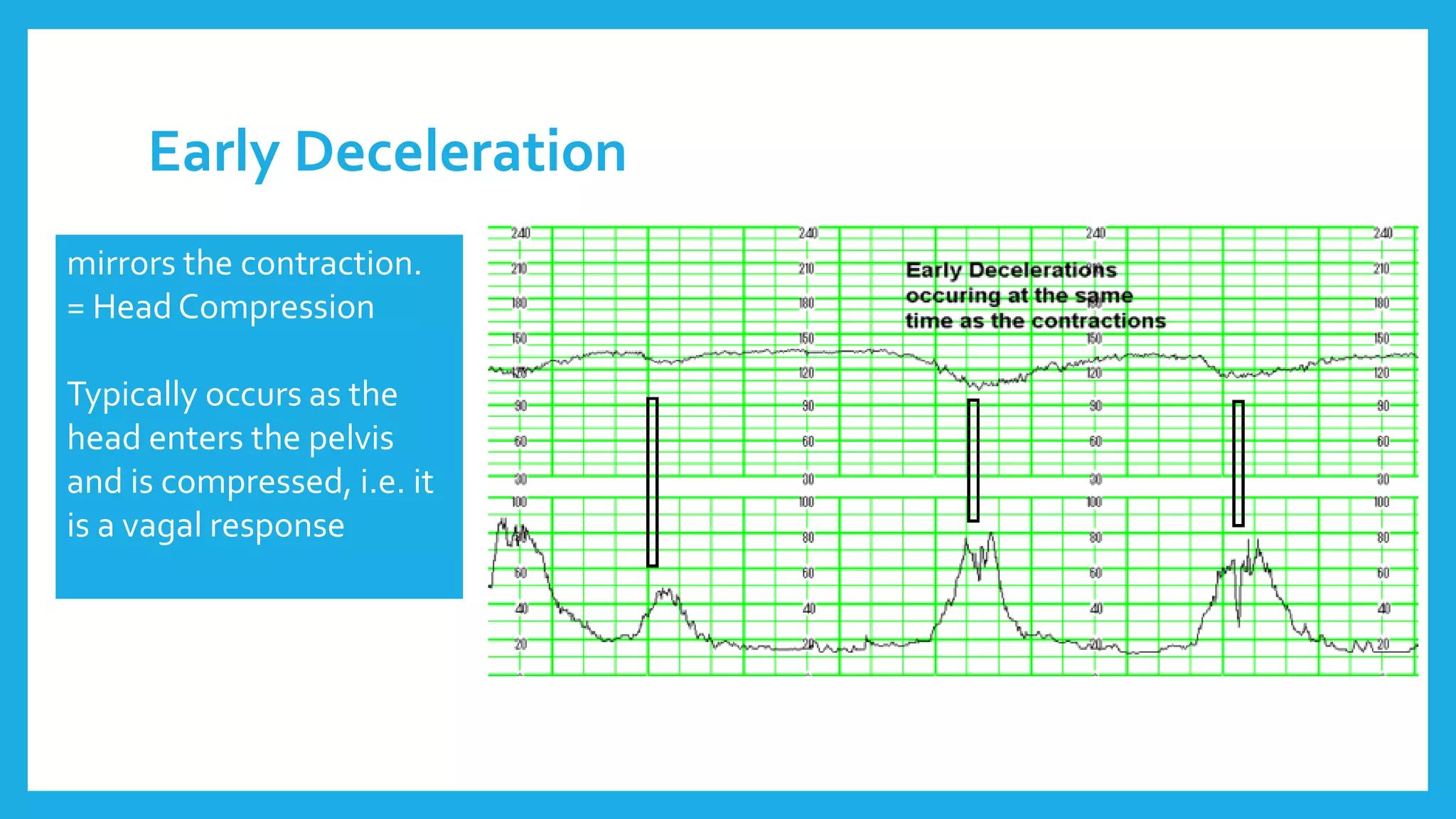
Early Deceleration
mirrors the contraction.
= Head Compression
Typically occurs as the
head enters the pelvis
and is compressed, i.e. it
is a vagal response
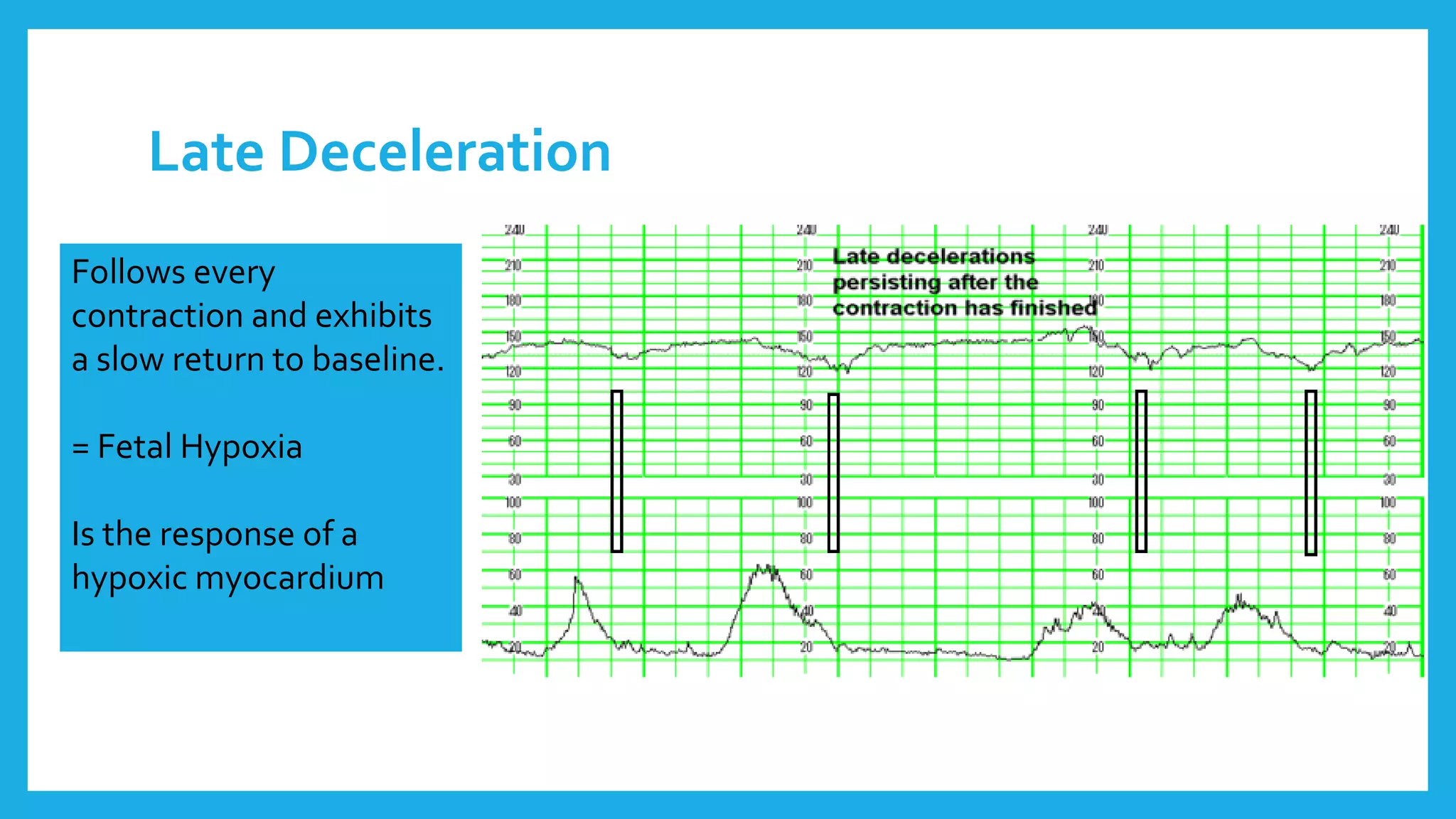
Late Deceleration
Follows every
contraction and exhibits
a slow return to baseline.
= Fetal Hypoxia
Is the response of a
hypoxic myocardium
Variable Deceleration
Show no relationship
to contractions.
= Cord Compression
If frequent lead to
hypoxia
Without concerning
features
With concerning features
Non-reassuring – variable decelerations
Concerning features
• Biphasic or W shaped
• Lasting >60 seconds
• Failure to return to baseline
• No shouldering
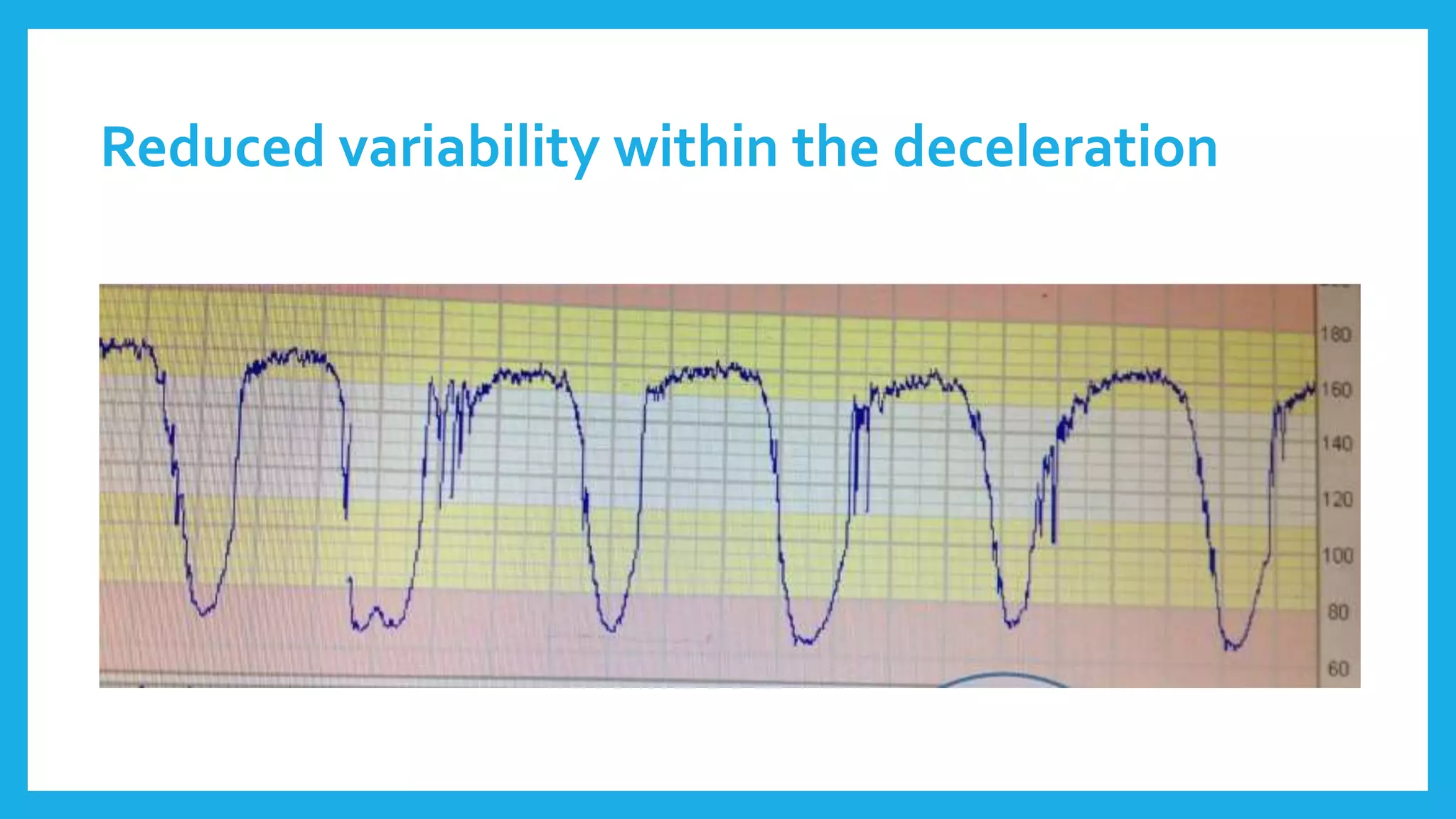
• Reduced variability within the
deceleration
Variable decels with concerning
features:
• <50% of contractions for more
than 30 minutes
• >50% contractions for less than
30 minutes
Biphasic orW shaped
Lasting > 60 seconds
Reduced variability within the deceleration
Failure to return to the baseline
No shouldering
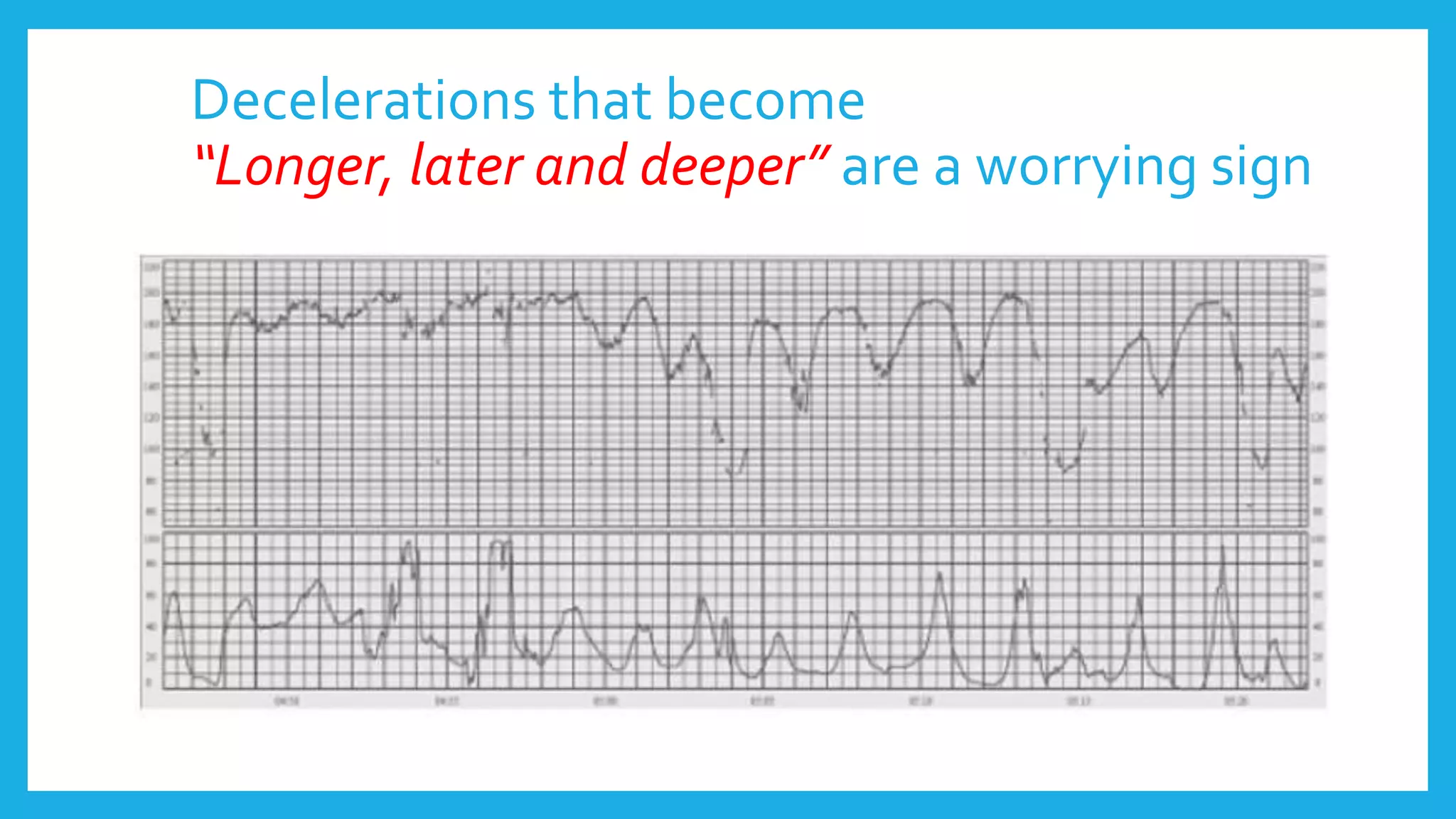
Decelerations that become
“Longer, later and deeper” are a worrying sign
Sinusoidal
Saltatory Pattern
Normal CTG
• Variable decelerations with no concerning features are very
common
• They can be normal if there are no other non-reassuring
features
• They become non-reassuring if they persist for more than 90
minutes
Non reassuring CTG
Pathologic CTG
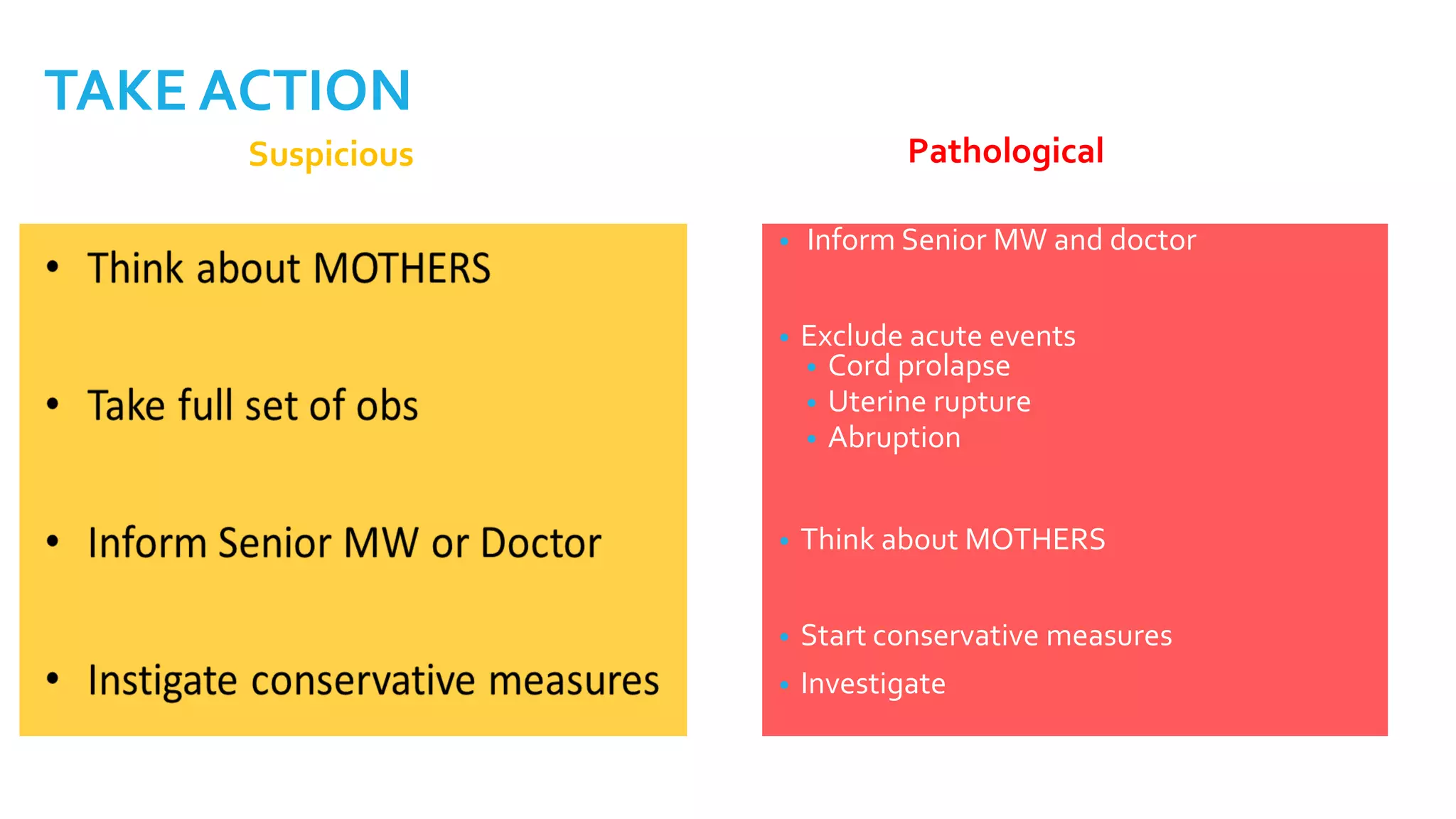
TAKE ACTION
Suspicious Pathological
• Inform Senior MW and doctor
• Exclude acute events
• Cord prolapse
• Uterine rupture
• Abruption
• Think about MOTHERS
• Start conservative measures
• Investigate
Pathological CTG
• If CTG remains pathological:
Perform scalp stimulation
If this leads to an acceleration,
regard this as a sign the baby is
healthy
Only continue with FBS if the
CTG remains pathological
If there is no acceleration,
consider
FBS
Or
Expediting birth
Conservative measures
• Left lateral / mobilise
• Consider iv fluids
• Reduce contractions:
o Reduce/stop synto
o Terbutaline
• Paracetamol if temp/pulse raised
Remember….
MOTHERS
Risk factors
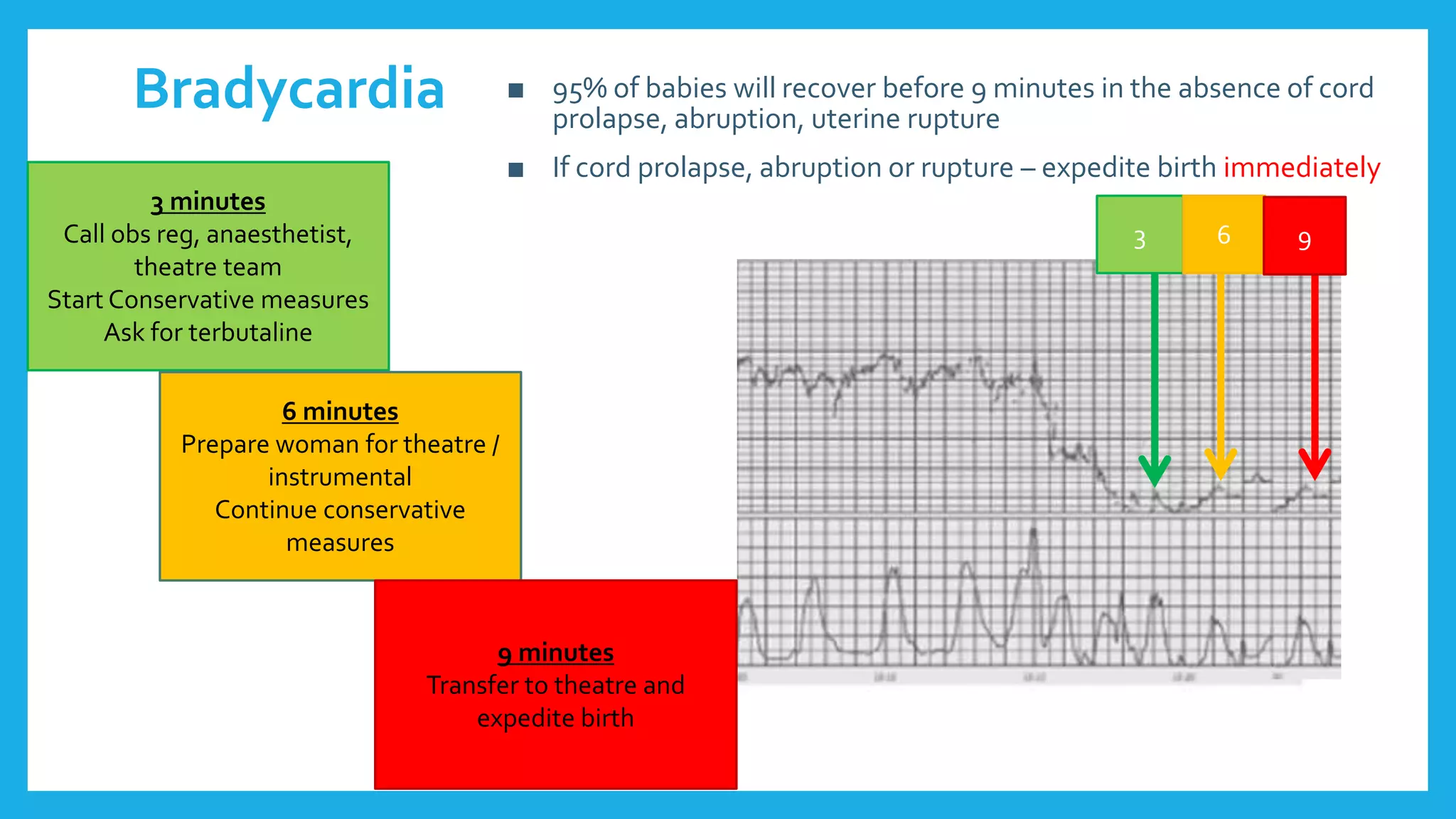
Bradycardia
3 6 9
3 minutes
Call obs reg, anaesthetist,
theatre team
Start Conservative measures
Ask for terbutaline
6 minutes
Prepare woman for theatre /
instrumental
Continue conservative
measures
9 minutes
Transfer to theatre and
expedite birth
■ 95% of babies will recover before 9 minutes in the absence of cord
prolapse, abruption, uterine rupture
■ If cord prolapse, abruption or rupture – expedite birth immediately
Prolonged deceleration
Decompensation of the CNS
Thank you
Any questions ?!

CTG Interpretation .pptx

  • 1.
    CTG INTERPRETATION Wafaa Benjamin Basta ConsultantOb/Gyn MatariaTeaching Hospital MRCOG –ERC Member Egyptian Board of Ob/Gyn Meeting - March 2019
  • 2.
    Foetal Physiology • Fetusdesigned to cope with labour •Every fetus will have his/hers own unique physiological reserve all modified by his /hers antenatal and intra-partum risk factors. • Fetal physiology in labour will make all efforts to protect the myocardium
  • 3.
    Control of BaselineFetal Heart Rate andVariability • Pacemaker in SA node , Conduction bundle , AV node • CNS • Brain stem centre • Chemoreceptor and baroreceptor • Sympathetic and parasympathetic systems • Baseline heart rate – sum result of these factors • Baseline variability – integration of sympathetic and parasympathetic input • Gestation
  • 4.
    Control of BaselineFetal Heart Rate andVariability • CNS activity - increase activity leads to increased variability of heart rate • Chemoreceptors – hypoxia / hypercapnia → bradycardia • Baroreceptors - ↑ arterial pressure → bradycardia • Sympathetic system – adrenal medulla → epinephrine and nor-epinephrine • Parasympathetic system – vagal effect on SA node and AV node → decreased FHR
  • 5.
    The well oxygenated fetusdemonstrates a stable baseline and variability
  • 8.
    Chemical (Chemo-receptors) • Responsiveto ↑ in H+ CO2 ↓ Po2 • Stimulate parasympathetic nervous system to decrease FH • Gradual fall from baseline and delayed recovery.Take longer to recovery to baseline Mechanical Baro-receptors • Compression of umbilical artery • Increase in fetal systemic BP • Stimulates Baro-receptor to send impulse to cardiac inhibitory centre • FH slows Sharp drop • Usually 30 -60 seconds • Recovery to baseline • Not of concern if Baseline andVariability are reassuring.
  • 9.
  • 10.
    Features of aCTG • Baseline Rate bpm • Baseline variability bpm • Accelerations • Decelerations • Response to stimuli • Contractions • Fetal movements • Other
  • 11.
    Features of aCTG • Baseline Rate bpm • Baseline variability bpm • Accelerations • Decelerations • Response to stimuli • Contractions • Fetal movements • Other Classified into : • Reassuring • Non-reassuring • Abnormal
  • 13.
    RCOG Classification ofCTGs • Normal CTG = all Three features are reassuring • Suspicious CTG = One non reassuring feature and two reassuring • Pathological CTG = One abnormal or Two non reassuring features
  • 14.
    Features of CTG FetalHeart rate feature classification Baseline (bpm) Variability (bpm) Decelerations Accelerations Reassuring 110 - 160 ≥5 None Present Absence of accelerations with otherwise normal CTG is of uncertain significance Non-reassuring 100 – 109 110 - 160 <5 for ≥40 but <90 min • early •Variable •Single prolonged for up to 3 minutes Abnormal <100 >180 Sinusoidal pattern for ≥10 minutes <5 for >90 minututes • atypical • Late • Single prolonged for >3 minutes
  • 15.
    Baseline Fetal HeartRate {FHR} Mean level of FHR when this is stable, excluding Accelerations and Decelerations -Tachycardia -Bradycardia • Reassuring : 110 to 160 bpm at term • Non-reassuring : 100-109 bpm / 161-180 bpm • Abnormal: less than 100/ more than 180 bpm • Tachycardia with reduced STV = early hypoxia
  • 17.
    BaselineTachycardia • Hypoxia • Chorio- amnionitis •Sepsis • Maternal fever • Maternal Anxiety • Maternal thyrotoxicosis • B-Mimetic drugs • Fetal anaemia • Heart failure • Arrhythmias • Prematurity
  • 18.
    Baseline Bradycardia • Postdates •Drugs • Idiopathic • Arrhythmia's • Hypothermia. • Cord compression • Acute Hypoxia • Congenital heart
  • 19.
    Baseline variability • Theminor fluctuations on baseline FHR at 3-5 cycles bpm produces Baseline variability. • Examine imin segment and estimate highest peak and lowest trough. • Reassuring: 5-25 bpm – this indicates Normal-CNS. • Non-reassuring: > 5 bpm for 30-50 minutes • < 25 bpm for 15-25minutes • Abnormal: > 5 bpm for <50 minutes • <25 bpm for <25 minutes
  • 20.
    BaselineVariability  Para-Sympathetic affects shortterm variability whilst LongTerm is more Symp.  CNS ,Drugs reduce Variability  High gestation increases variability  Mild Hypoxia may cause both S and para S stimulation
  • 21.
    ReducedVariability • Hypoxia • Drugs •Extreme prematurity • Sleep • CNS abnormality.
  • 23.
    Variability less than5 bpm for 30-50 minutes
  • 24.
    Accelerations • Must be>15 bpm and >15 sec above baseline • Should be >2 per 15 min period • Always reassuring when present • May not occur when fetus is “sleeping” • Should occur in response to fetal movements or fetal stimulation • Non reactive periods usually do not exceed 45 min • (>90 min and no accelerations is worrying)
  • 25.
  • 26.
    Decelerations Transient slowing of FHRbelow the baseline level of more than 15 bpm and lasting for 15 sec. Or more.
  • 27.
    Deceleration Reassuring: • Non • Earlydeceleration • Variable dec ,no concerning characteristic > 90 minutes Non-reassuring • Variable dec ,no concerning characteristic < 90 minutes • Variable dec ,with any concerning characteristic : • <50% of contractions for more than 30 minutes or more • >50% contractions for less than 30 minutes • Late deceleration in >50% contractions for less than 30 minutes {no maternal or fetal risk factors}
  • 28.
    Deceleration Abnormal: • Variable dec,with any concerning characteristic >50% contractions for more than 30 minutes {or less if fetal or maternal risk factors} • Late deceleration for more than 30 minutes {or less if maternal or fetal risk factors} • Bradycardia or a single deceleration over 3 minutes
  • 29.
    Early Deceleration mirrors thecontraction. = Head Compression Typically occurs as the head enters the pelvis and is compressed, i.e. it is a vagal response
  • 30.
    Late Deceleration Follows every contractionand exhibits a slow return to baseline. = Fetal Hypoxia Is the response of a hypoxic myocardium
  • 31.
    Variable Deceleration Show norelationship to contractions. = Cord Compression If frequent lead to hypoxia Without concerning features With concerning features
  • 32.
    Non-reassuring – variabledecelerations Concerning features • Biphasic or W shaped • Lasting >60 seconds • Failure to return to baseline • No shouldering • Reduced variability within the deceleration Variable decels with concerning features: • <50% of contractions for more than 30 minutes • >50% contractions for less than 30 minutes
  • 33.
  • 34.
    Lasting > 60seconds
  • 35.
  • 36.
    Failure to returnto the baseline
  • 37.
  • 38.
    Decelerations that become “Longer,later and deeper” are a worrying sign
  • 39.
  • 40.
  • 42.
    Normal CTG • Variabledecelerations with no concerning features are very common • They can be normal if there are no other non-reassuring features • They become non-reassuring if they persist for more than 90 minutes
  • 43.
  • 44.
  • 45.
    TAKE ACTION Suspicious Pathological •Inform Senior MW and doctor • Exclude acute events • Cord prolapse • Uterine rupture • Abruption • Think about MOTHERS • Start conservative measures • Investigate
  • 46.
    Pathological CTG • IfCTG remains pathological: Perform scalp stimulation If this leads to an acceleration, regard this as a sign the baby is healthy Only continue with FBS if the CTG remains pathological If there is no acceleration, consider FBS Or Expediting birth
  • 47.
    Conservative measures • Leftlateral / mobilise • Consider iv fluids • Reduce contractions: o Reduce/stop synto o Terbutaline • Paracetamol if temp/pulse raised
  • 48.
  • 49.
  • 50.
    Bradycardia 3 6 9 3minutes Call obs reg, anaesthetist, theatre team Start Conservative measures Ask for terbutaline 6 minutes Prepare woman for theatre / instrumental Continue conservative measures 9 minutes Transfer to theatre and expedite birth ■ 95% of babies will recover before 9 minutes in the absence of cord prolapse, abruption, uterine rupture ■ If cord prolapse, abruption or rupture – expedite birth immediately
  • 51.
  • 52.
  • 53.

Editor's Notes

  • #3 Imagine a coach arrives and takes this group of midwives to the (Airspace ) trampoline park here in Wolverhampton and we HAVE to complete a days training. Once we enter the trampoline park we have to complete the compulsory moves, theres a whole series of jumps, tilts, twists, tucks, swivel hips, seat drops, full arm swings, half twists with backward rotation, full twists with forward rotation, etc etc. you have to make your way through all the trampolines to get to the exit. You cant exit until all the compulsory sets are completed. How would we do ?? Some will do it and come out of the exit smiling and waving, others may not look like that at the exit…some may need a helping hand and some of us ……may not make it !! Some of us may have breathing, cardiac, muscular, neurological problems…… we all have an individual physiological reserve……so does the fetus. Fetal ability: already used to relatively hypoxic environment arterial O2 sats of around 70%..can be as low as 30% in labour Fetal haemoglobin is higher tha adult 18-22g/dl. Greater affinity for oxygen Fetal circulation designed to supply major organs readily with oxygenated blood. Think of yourselves on a trampoline or another time when you are physically exerting yourselves… and the heart muscle is working harder and harder …what do you do ) … what happens to your breathing.? You breathe faster and deeper…more o2 to the heart muscle…you make slow down… less workload on the myocardium…
  • #6 Similar to the adult…. the central nervous system is made of autonomic and somatic nervous systems. This is not just a photo showing stupidity of some men … it helps to represent the constant state of push & pull of the sympathetic and parasympathetic nervous systems . The constant state of interaction between the sympathetic NS increasing the FH and the parasympathetic NS decreasing it. The baseline is the agreement reached between the 2 systems. … look at the tie between the 2 men. They may have been moving backward and forward all day (lol) but the constant push pull results in the line forming between them….baseline. Agreement between the 2 systems. Constant fluctuation is the variability. A stable baseline and variability are the strongest indicator s that is a well oxygenated fetus.
  • #13 NICE 2017 Guidance CTG interpretation lets look at stickers Coloured RAG Flag Main change to normal, non reassuring and pathological The terminology regarding variables decelerations… now described as variables with without concerning characteristics Think about the bigger picture Scalp stimulation
  • #43 Remember the physiology… baroreceptor response to compression, mechanical causes, quick to fall, quick to recover, return to baseline. If there is atable baseline 110-160, normal variability and no risk factors then unlikely to be acidotic . Continue care …90 minutes!! s
  • #44 Remember the physiology… baroreceptor response to compression, mechanical causes, quick to fall, quick to recover, return to baseline. If there is atable baseline 110-160, normal variability and no risk factors then unlikely to be acidotic . Continue care …90 minutes!! s
  • #45 Remember the physiology… baroreceptor response to compression, mechanical causes, quick to fall, quick to recover, return to baseline. If there is atable baseline 110-160, normal variability and no risk factors then unlikely to be acidotic . Continue care …90 minutes!! s
  • #49 Remember the physiology… baroreceptor response to compression, mechanical causes, quick to fall, quick to recover, return to baseline. If there is atable baseline 110-160, normal variability and no risk factors then unlikely to be acidotic . Continue care …90 minutes!! s